
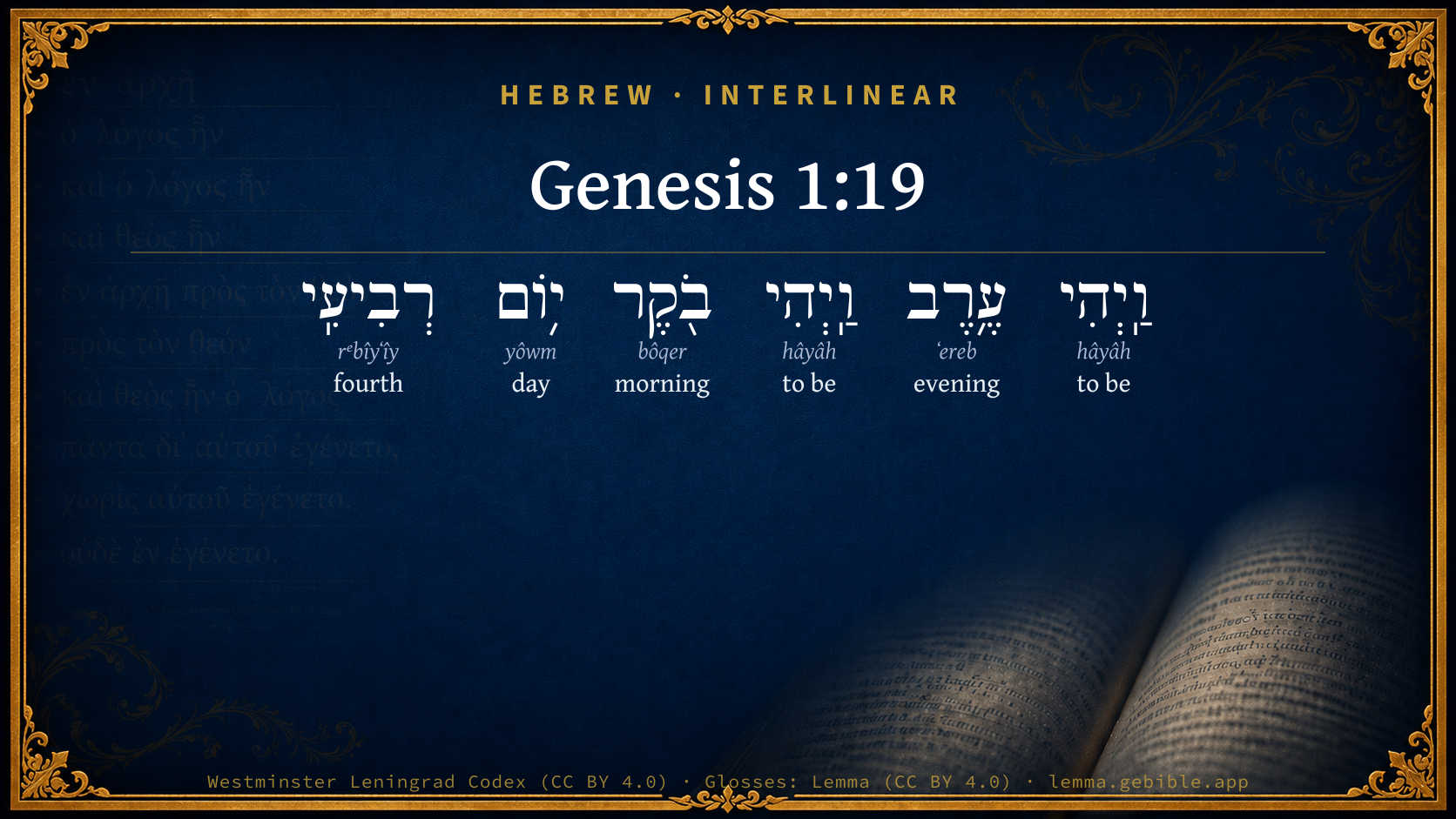
Genesis 1:19

Hebrew (Westminster Leningrad Codex) Genesis 1:19 appears in the Hebrew Old Testament. The text above is from the Westminster Leningrad Codex. Each word links to its Strong’s number, a concise gloss, and parsing drawn from the Open Scriptures Hebrew Bible morphology. Click any word for its full Brown-Driver-Briggs (BDB) entry.
Download image
Cite this verse

Genesis 1:19 (World English Bible). Public Domain. Lemma interlinear Bible study tool, https://lemma.gebible.app/v/genesis/1/19.

Show BibTeX & RIS
BibTeX
RIS
English Translation
There was evening and there was morning, a fourth day.
World English Bible · Public Domain
Highlights
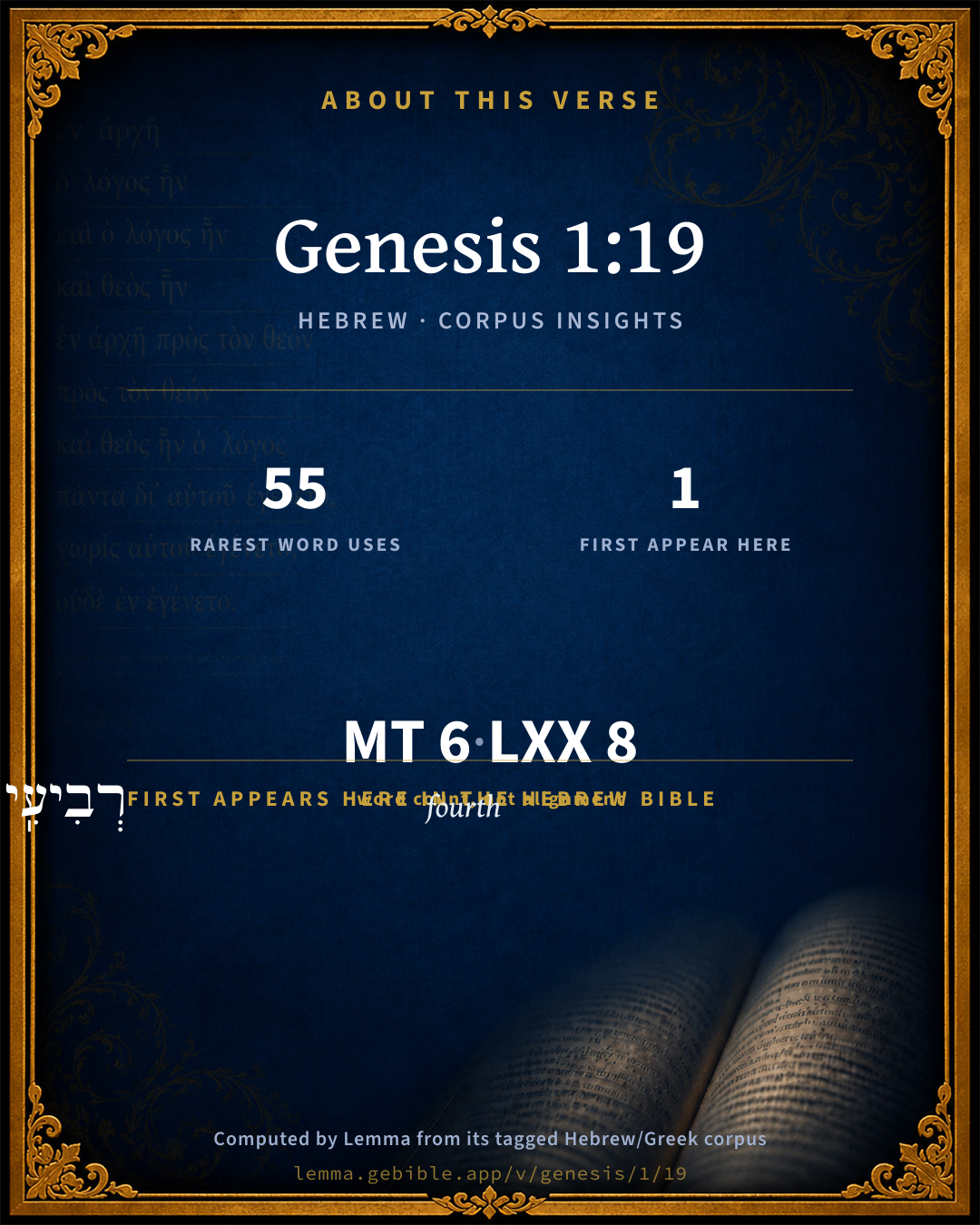
  • 1 first appearance in the Hebrew Bible
Full analysis ↓
Download a study sheet

One document with this verse’s original text, its word-by-word gloss line, the meaning frame, cross-references with their text, attributed commentary, and full source and license credits — printable, and it pastes into notes with its structure intact.

This verse Autodidact and up

Study sheet (.html) Plain text (.txt)

A passage Seminary Student

Up to 50 verses in one chapter. A passage sheet keeps up to 6 commentary sources and 12 cross-references per verse, in the order this page ranks them, and says so on the sheet whenever that leaves anything out. Ask for a single verse and you get the Autodidact verse sheet above.

Everything on this page stays free to read, with no account — the sheet is a download of what is already on screen, not access to it.

Want to remove ads? Support Godless Engineer
Compare translations 3

The same verse in 3 English versions, stacked beneath the original-language interlinear above. Click any original word for its lexicon entry.

Each is an independent rendering of the whole verse — the interlinear is not word-aligned to these translations.

Highlighted words mark where these versions differ — a whole-verse word diff, not a word-by-word alignment.

  • World English Bible Public Domain
    There was evening and there was morning, a fourth day.
  • King James Version Public Domain
    And the evening and the morning were the fourth day.
  • unfoldingWord Literal Text CC BY-SA 4.0
    Then there was evening, and there was morning, the fourth day.

unfoldingWord Literal Text — © unfoldingWord, licensed CC BY-SA 4.0. Word-aligned USFM3 via Door43 (git.door43.org/unfoldingWord/en_ult).

Versions to compare (up to 4)

3 of 4 selected

Show all 18 translations

Every available English version of this verse, each an independent rendering of the whole verse.

  • World English Bible Public Domain
    There was evening and there was morning, a fourth day.
  • Berean Standard Bible Public Domain
    And there was evening, and there was morning—the fourth day.
  • Majority Standard Bible Public Domain
    And there was evening, and there was morning—the fourth day.
  • King James Version Public Domain
    And the evening and the morning were the fourth day.
  • American Standard Version (1901) Public Domain
    And there was evening and there was morning, a fourth day.
  • Revised Version (1885) Public Domain
    And there was evening and there was morning, a fourth day.
  • Geneva Bible (1599) Public Domain
    So the euening and the morning were the fourth day.
  • Douay-Rheims (1899) Public Domain
    And the evening and morning were the fourth day.
  • Young's Literal Translation Public Domain
    and there is an evening, and there is a morning -- day fourth.
  • Literal Standard Version CC BY-SA 4.0
    and there is an evening, and there is a morning—[the] fourth day.
  • Unlocked Literal Bible CC BY-SA 4.0
    This was evening and morning, the fourth day.
  • unfoldingWord Literal Text CC BY-SA 4.0
    Then there was evening, and there was morning, the fourth day.
  • Darby Bible Public Domain
    And there was evening, and there was morning -- a fourth day.
  • World Messianic Bible Public Domain
    There was evening and there was morning, a fourth day.
  • Webster's Bible Public Domain
    And the evening and the morning were the fourth day.
  • Free Bible Version CC BY-SA 4.0
    So there was evening, and then the morning, making day four.
  • Bible in Basic English Public Domain
    And there was evening and there was morning, the fourth day.
  • JPS Tanakh (1917) Public Domain
    And there was evening and there was morning, a fourth day.

Literal Standard Version (2020), Covenant Press — licensed CC BY-SA 4.0. Text via the HelloAO Bible API (eBible.org). Unlocked Literal Bible (unfoldingWord) — licensed CC BY-SA 4.0. Text via the HelloAO Bible API (eBible.org). unfoldingWord Literal Text — © unfoldingWord, licensed CC BY-SA 4.0. Word-aligned USFM3 via Door43 (git.door43.org/unfoldingWord/en_ult). Free Bible Version, Dr. Jonathan Gallagher — licensed CC BY-SA 4.0. Text via the HelloAO Bible API (eBible.org).

Word by word

More ways to search: Search by grammar → Find every occurrence → Compare this word →

Practice this passage: Drill this verse → Learn its vocabulary →

About this verse

These counts appear in no published source. They are computed here, from the morphology-tagged text and Lemma’s own curated glosses. What Lemma adds →

6
words
5
distinct lemmas
Pentateuch
section

First appearance in Scripture

This word makes its first canonical appearance in the Hebrew Bible here:

  • רְבִיעִֽי fourth H7243

Shared distinctive vocabulary

רְבִיעִֽי fourth H7243 occurs in 53 verses of the Hebrew Bible. Also found in:

Grammatical profile

  • 2 verbs
  • 3 nouns
  • 1 adjective

Verb forms

  • וַֽיְהִי Qal · Sequential Imperfect
  • וַֽיְהִי Qal · Sequential Imperfect

Repetition

A word recurs within this verse — often emphatic in Hebrew:

  • וַֽיְהִי to be H1961 ×2

Hebrew & Septuagint length

In English translation the verse runs 10 words from the Hebrew and 11 from the Septuagint (LXX English) — closely comparable.

A rough comparison of the two English renderings, which tokenize alike — not a word-level alignment.

Word counts can differ between the Hebrew and the Greek without any difference in meaning — e.g. the Hebrew direct-object marker אֵת has no separate Greek word, and Greek often adds the article ὁ.

In the original languages it is 6 Hebrew tokens and 8 Greek tokens — but the two are counted differently (Hebrew bundles its prefixes and suffixes into one token; the Greek is in lemma form), so that isn’t a like-for-like length.

Hebrew and Greek witnesses Masoretic Hebrew ↔ Greek Septuagint

The same verse in the two great witnesses to the Old Testament, shown verse-for-verse.

These are two independent witnesses, not word-aligned to each other, and the Septuagint is shown in lemma (dictionary) form.

Hebrew Genesis 1:19 Masoretic · Westminster Leningrad Codex

וַֽיְהִי עֶ֥רֶב וַֽיְהִי בֹ֖קֶר י֥וֹם רְבִיעִֽי

There was evening and there was morning, a fourth day.

World English Bible · Public Domain

Greek LXX Genesis 1:19 Septuagint · lemma form

καί γίγνομαι ἑσπέρα καί γίγνομαι πρωΐ ἡμέρα τέταρτος

And there was evening and there was morning, the fourth day.

LXX2012 (modern English Septuagint) · Public Domain

Hebrew: Westminster Leningrad Codex (CC BY 4.0). Greek: Septuagint (public domain); English from LXX2012 (modern English Septuagint) (Public Domain). How the Septuagint differs from the Hebrew →

Targum (Aramaic paraphrase)

2

The Targum is the ancient Jewish Aramaic paraphrase of the Hebrew Scriptures — an interpretive translation, not the Hebrew text itself. Onkelos (literal) and Pseudo-Jonathan (expansive) render the Torah, and Jonathan the Prophets. Coverage is partial: where no permissively-licensed English translation exists for a verse, only the Aramaic is shown. This is verse-level text, not a word-by-word alignment to the Hebrew.

  1. Targum Onkelos Torah (Genesis–Deuteronomy)
    וַהֲוָה רְמַשׁ וַהֲוָה צְפַר יוֹם רְבִיעָאִי

    (no public-domain English translation for this verse)

    Targum Onkelos — Aramaic: “Onkelos Genesis” (public domain); “Onkelos Exodus” (public domain); “Onkelos Leviticus” (public domain); “Onkelos Numbers” (public domain); “Onkelos Deuteronomy” (public domain). English: “Sefaria Community Translation” (CC0 1.0 (public-domain dedication)); “J.W. Etheridge. The Targums of Onkelos and Jonathan Ben Uzziel on the Pentateuch. London: Longmans, Green, 1862” (public domain). Text via Sefaria.

  2. Targum Pseudo-Jonathan Torah (Genesis–Deuteronomy)
    וַהֲוָה רְמַשׁ וַהֲוָה צְפַר יוֹם רְבִיעָאֵי

    And it was evening, and it was morning, Day the Fourth.

    Targum Pseudo-Jonathan — Aramaic: “Targum Jonathan on Genesis” (public domain); “Targum Jonathan on Exodus” (public domain); “Targum Jonathan on Leviticus” (public domain); “Targum Jonathan on Numbers” (public domain); “Targum Jonathan on Deuteronomy” (public domain). English: “The Targum of Jonathan ben Uzziel, trans. J. W. Etheridge, London, 1862” (public domain). Text via Sefaria.

Commentary

Notes on Genesis 1:19 from classic Christian and Jewish commentators (each source and its license shown beneath its notes). The classic Christian expositions comment on the surrounding passage and are grouped to its opening verse, so a note may address several verses; the Jewish commentaries on the Tanakh (Rashi and others) are per-verse, so they appear only where the commentator wrote on this verse.

Lemma curates 59 commentaries, every one of them public domain or Creative Commons licensed, each selected and text-cleaned for this edition rather than reprinted as found. About our sources →

John Gill's Exposition

And the evening and the morning were the fourth day. Made by the rotation of the earth on its own axis, in the space of twenty four hours: this according to Capellus was the twenty first of April, and according to Bishop Usher the twenty sixth of October; or, as others, the fourth of September: and thus, as on the fourth day of the creation the sun was made, or appeared, so in the fourth millennium the sun of righteousness arose on our earth.

And the evening and the morning were the fourth day. Made by the rotation of the earth on its own axis, in the space of twenty four hours: this according to Capellus was the twenty first of April, and according to Bishop Usher the twenty sixth of October; or, as others, the fourth of September: and thus, as on the fourth day of the creation the sun was made, or appeared, so in the fourth millennium the sun of righteousness arose on our earth.

Genesis 1:20

gen 1:20

gen 1:20

gen 1:20And God said, let the waters bring forth abundantly,.... The waters gathered together in one place, the waters of the ocean, and those in rivers, pools and lakes, and which, before their collection into those places, had been sat on, moved, and impregnated by the Spirit of God; so that they could, as they did, by the divine order accompanied with his power, bring forth abundance of creatures, next mentioned:

the moving creature that hath life: an animal life, of which sort of creatures as yet there had been none made; vegetables, or such as have a vegetative life, were made on the third day; but those that have a sensitive and animal life not till this day, the fifth; and the less perfect, or lower sort of these, were first produced, even such as move or "creep" (n), as the word used signifies; which is applied to fishes as well as creeping things, because in swimming their bellies touch the water, and are close to it, as reptiles on the earth: and of these creeping things in the seas there are innumerable, as the Psalmist says, Psa 104:25. Pliny (o) reckons up an hundred and seventy six kinds of fishes, which he puts in an alphabetical order:

and fowl that may fly above the earth in the open firmament of heaven; which according to our version were to be produced out of the waters also; not out of mere water, but out of earth and water mixed together, or out of the earth or clay (p) that lay at the bottom of the waters: and it may be observed of some fowls, that they live on the waters, and others partly on land and partly on water; and as the elements of fowl and fish, the air and water, bear a resemblance to each other, so do these creatures, some fowls both fly and swim; and what wings are to the one, fins are to the other; and both steer their course by their tails, and are both oviparous: though it should seem, according to Gen 2:19, that the fowls were produced from the earth, and the words may be rendered here, "let the fowl fly above the earth", &c. as they are in the Samaritan and Syriac versions, and in others (q).

(n) "reptile", V. L. Pagninus, Montanus; "reptilia", Junius & Tremellius, Piscator. (o) Nat. Hist. l. 32. c. 11. (p) Vid. T. Bab. Cholin. fol. 27. 2. (q) "et volatile volet", Pagninus, Montanus, Vatablus, Amama, "et volatile volitet", Tigurine version; "et volucres volent", Junius & Tremellius, Piscator; "et aves volent", Drusius; "et volucris volet", Cartwrightus; "et avis volitet", Schmidt.

John Gill's Exposition of the Whole Bible (1746–1763) — public domain (CC PDM 1.0). Text via the HelloAO Bible API.

The Pulpit Commentary

And the evening and the morning were the fourth day. The Scripture references to this day"s work are both numerous and instructive (cf. Job_9:9 Job_37:3 Psa_8:1-9 Psa_104:17) The Hebrew writers supply no information as to the astronomical theories which were prevalent in their time; yet "from other sources we have facts leading to the belief that even in the time of Moses there was not a little practical astronomy in the East, and some good theory. The Chaldeans at a very early period had ascertained the principal circles of the sphere, the position of the poles, and the nature of the apparent motions of the heavens as the results of revolution on an inclined axis. The Egyptian astronomers, whom we know through Thales, 640 B.C., taught the true nature of the moon"s light, the sphericity of the earth, and the position of its five zones. Pythagoras, 580 B.C., knew, in addition, the obliquity of the ecliptic, the identity of the evening and morning star, and the earth"s revolution round the sun" (Dawson, "O.W.," p. 207). Modern astronomy, though possessed of highly probable theories as to the formation of the universe, is still unable to speak with absolute precision with regard to this fourth day"s work. Yet them are not wanting indirect corroborations of the truth of the Mosaic narrative from both it and geology. According to the sacred writer, the presently existing atmosphere, the distribution of land and water, the succession of day and night, and the regular alternation of the seasons, were established prior to the introduction of animal life upon the earth; and Sir Charles Lyell has demonstrated nothing more successfully than the dominion of existing causes" from the Eozoic era downwards, and the sufficiency of these causes to account for all the changes which have taken place in the earth"s crust. Again, geology attests the prevalence on our globe in prehistoric times of a much more uniform and high temperature than it now possesses, so late as the Miocene era a genial tropical climate having extended up beyond the Arctic circle, and in the earliest eras of the history of the globe, in all probability, the entire sphere bring so favored with excessive heat. Different causes have been suggested for this phenomenon; as, e.g., the greater heat of the cooling globe (the earliest geologists), a different distribution of land and water (Lyell), variations in the eccentricity of the earth"s orbit (Herschell and. Croll), changes in the earth"s axis (Evans, Drayson, Bell), and the greater intensity of the sun"s heat; Sir W Thomson, "Trans. Geolog. Soc.," Glasgow, 1877). The Biblical narrative, by distinctly teaching that the sun was perfected on the fourth day, renders it intelligible that his influence on the surface of the earth was then at its greatest, causing tropical climates to prevail and tropical vegetation to abound, both of which have gradually disappeared from the polar regions in consequence of the sun"s diminished heat. It remains only to note that the Chaldean Genesis preserves a striking reminiscence of this day"s work; the obverse of the fifth creation tablet reading

1. It was delightful, all that was fixed by the great gods,

2. Stars, their appearance (in figures) of animals he arranged.

3. To fix the year through the observation.of their constellations.

4. Twelve months (or signs) of stars in three rows he arranged.

5. From the day when the year commences unto the close.

6. He marked the positions of the wandering stars (planets) to shine in their courses.

1. The god Uru (the moon) he caused to rise out, the night he overshadowed,

2. To fix it also for the light of the night, until the shining of the day.

3. When the god Shamas (the sun) in the horizon of heaven in the east.

4. formed beautifully and..

5. to the orbit Shamas was perfected. It appears that the Chaldean record con talus the review and expression of satisfaction at the head of each tablet, while the Hebrew has it at the close of each act" ("Chaldean Genesis," pp. 69-73).

The Pulpit Commentary (1880–1919), ed. H.D.M. Spence-Jones & Joseph S. Exell — public domain. Text from a community e-Sword module.

Lesson kit

Teaching starters — assembled from the data on this page, not authored interpretation. Every prompt links to the verse data it draws on. Edit before teaching.

Genesis, in the Pentateuch, opens this verse with 6 words (5 distinct Hebrew lemmas). Its most distinctive word is rᵉbîyʻîy (“fourth”). A historical commentator’s framing appears above. Read the whole chapter for the surrounding context.

Discussion questions

  1. What does “fourth” (rᵉbîyʻîy) contribute to the verse as a whole?
  2. This is the first place “fourth” appears in Scripture (first appears here). What does its debut here establish?
  3. How does Genesis 2:14, which shares the word «fourth», read alongside this verse?
  4. What does the repetition of “to be” (2× in this one verse) do in this verse?
  5. These translations render this verse differently; the difference is in the English rendering, not the original. What questions does that raise?
  6. «וַֽיְהִי» is a Qal Sequential Imperfect verb. How does that grammatical form shape the action described?
  7. Compare how John Gill's Exposition and The Pulpit Commentary read this verse. Where do they agree or differ?

Things to notice

Reading settings

Reading text

Shown beneath each verse's original-language words.

Old Testament
Old Testament edition

Read the OT as the Masoretic Hebrew (MT) or the Greek Septuagint (LXX).

English shown for the Greek Septuagint (in the Hebrew ↔ Greek comparison).

Comparing translations? Open the Compare panel on any verse page to stack up to four side by side.