Matthew 25:2

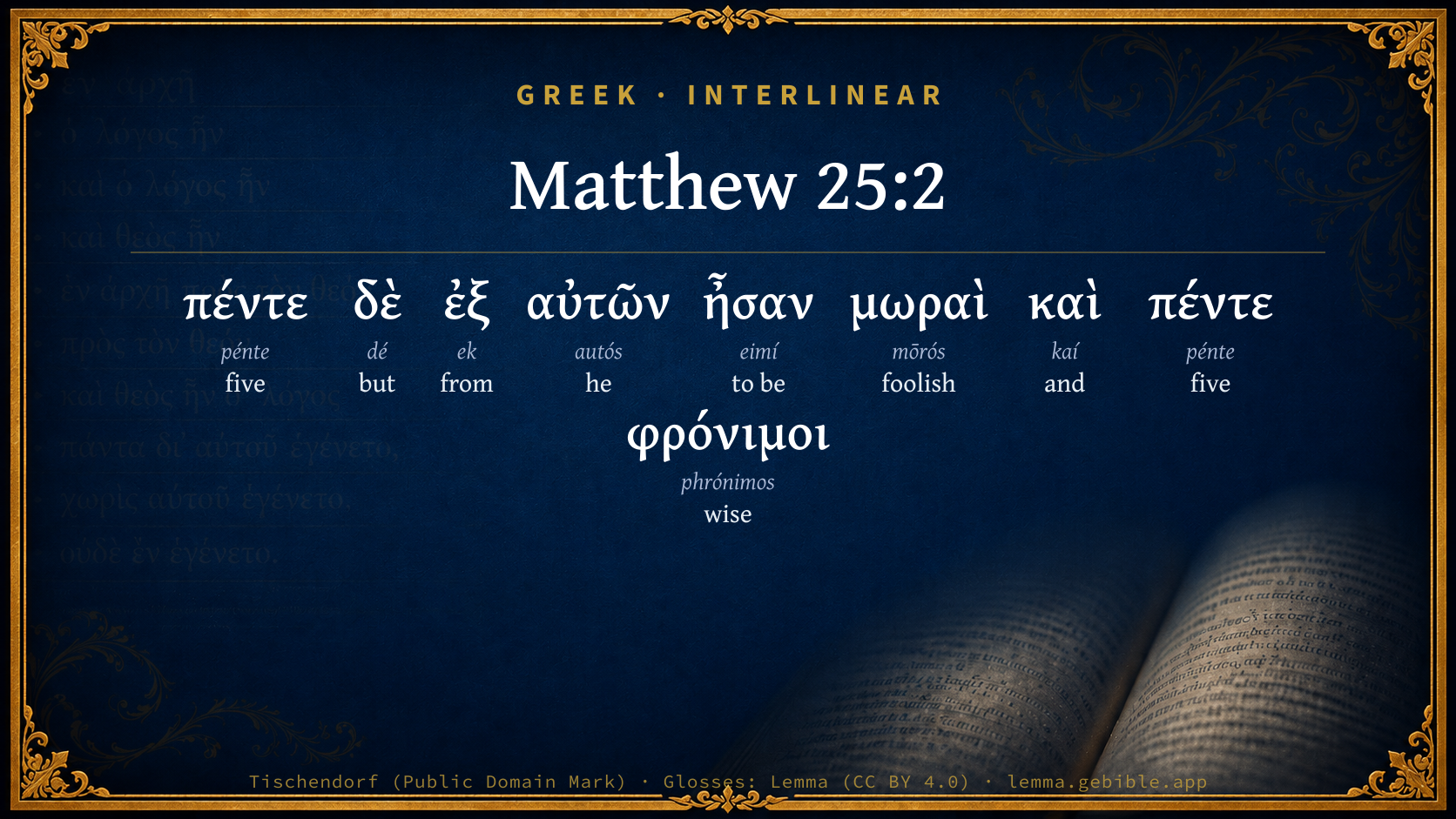
Greek (Tischendorf 8th ed.) Matthew 25:2 appears in the Greek New Testament. The text above is from the Tischendorf 8th edition. Each word links to its Strong’s number and a concise gloss. Click any word for its full Thayer’s Greek Lexicon entry.
Download image
Cite this verse

Matthew 25:2 (World English Bible). Public Domain. Lemma interlinear Bible study tool, https://lemma.gebible.app/v/matthew/25/2.

Show BibTeX & RIS
BibTeX
RIS
English Translation
Five of them were foolish, and five were wise.
World English Bible · Public Domain
Download a study sheet

One document with this verse’s original text, its word-by-word gloss line, the meaning frame, cross-references with their text, attributed commentary, and full source and license credits — printable, and it pastes into notes with its structure intact.

This verse Autodidact and up

Study sheet (.html) Plain text (.txt)

A passage Seminary Student

Up to 50 verses in one chapter. A passage sheet keeps up to 6 commentary sources and 12 cross-references per verse, in the order this page ranks them, and says so on the sheet whenever that leaves anything out. Ask for a single verse and you get the Autodidact verse sheet above.

Everything on this page stays free to read, with no account — the sheet is a download of what is already on screen, not access to it.

Want to remove ads? Support Godless Engineer
Compare translations 3

The same verse in 3 English versions, stacked beneath the original-language interlinear above. Click any original word for its lexicon entry.

Each is an independent rendering of the whole verse — the interlinear is not word-aligned to these translations.

Highlighted words mark where these versions differ — a whole-verse word diff, not a word-by-word alignment.

  • World English Bible Public Domain
    Five of them were foolish, and five were wise.
  • King James Version Public Domain
    And five of them were wise, and five were foolish.
  • unfoldingWord Literal Text CC BY-SA 4.0
    Now five of them were foolish and five wise.

unfoldingWord Literal Text — © unfoldingWord, licensed CC BY-SA 4.0. Word-aligned USFM3 via Door43 (git.door43.org/unfoldingWord/en_ult).

Versions to compare (up to 4)

3 of 4 selected

Show all 19 translations

Every available English version of this verse, each an independent rendering of the whole verse.

  • World English Bible Public Domain
    Five of them were foolish, and five were wise.
  • Berean Standard Bible Public Domain
    Five of them were foolish, and five were wise.
  • Majority Standard Bible Public Domain
    Five of them were wise, and five were foolish.
  • King James Version Public Domain
    And five of them were wise, and five were foolish.
  • American Standard Version (1901) Public Domain
    And five of them were foolish, and five were wise.
  • Revised Version (1885) Public Domain
    And five of them were foolish, and five were wise.
  • Geneva Bible (1599) Public Domain
    And fiue of them were wise, and fiue foolish.
  • Douay-Rheims (1899) Public Domain
    And five of them were foolish, and five wise.
  • Young's Literal Translation Public Domain
    and five of them were prudent, and five foolish;
  • Literal Standard Version CC BY-SA 4.0
    and five of them were prudent, and five foolish;
  • Unlocked Literal Bible CC BY-SA 4.0
    Five of them were foolish and five were wise.
  • unfoldingWord Literal Text CC BY-SA 4.0
    Now five of them were foolish and five wise.
  • Darby Bible Public Domain
    And five of them were prudent and five foolish.
  • World Messianic Bible Public Domain
    Five of them were foolish, and five were wise.
  • Webster's Bible Public Domain
    And five of them were wise, and five were foolish.
  • Free Bible Version CC BY-SA 4.0
    Five were foolish, and five were wise.
  • Bible in Basic English Public Domain
    And five of them were foolish, and five were wise.
  • Text-Critical English NT CC BY 4.0
    Five of them were wise, and five were foolish.
  • Tyndale New Testament (1534) Public Domain
    fyve of them were folysshe and fyve were wyse.

Literal Standard Version (2020), Covenant Press — licensed CC BY-SA 4.0. Text via the HelloAO Bible API (eBible.org). Unlocked Literal Bible (unfoldingWord) — licensed CC BY-SA 4.0. Text via the HelloAO Bible API (eBible.org). unfoldingWord Literal Text — © unfoldingWord, licensed CC BY-SA 4.0. Word-aligned USFM3 via Door43 (git.door43.org/unfoldingWord/en_ult). Free Bible Version, Dr. Jonathan Gallagher — licensed CC BY-SA 4.0. Text via the HelloAO Bible API (eBible.org).

Word by word

More ways to search: Search by grammar → Find every occurrence → Compare this word →

Practice this passage: Drill this verse → Learn its vocabulary →

About this verse

These counts appear in no published source. They are computed here, from the morphology-tagged text and Lemma’s own curated glosses. What Lemma adds →

9
words
8
distinct lemmas
Gospels
section

Notable vocabulary

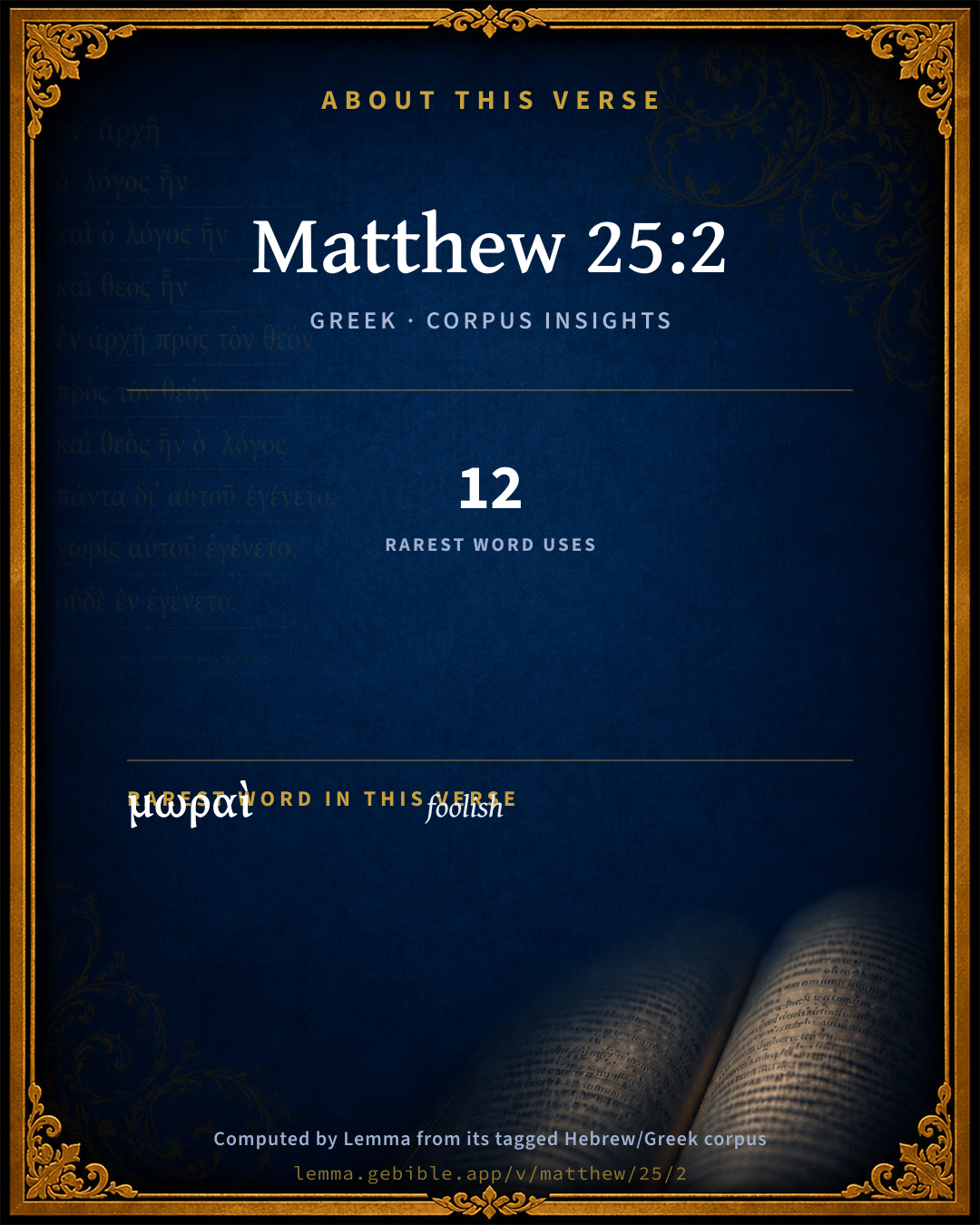
The rarest word here is μωραὶ foolish G3474 — appearing just 12 times in the whole Greek New Testament.

Shared distinctive vocabulary

μωραὶ foolish G3474 occurs in 12 verses of the Greek New Testament. Also found in:

Repetition

A word recurs within this verse:

  • πέντε five G4002 ×2

Cross-references

10

Topical passages linked to Matthew 25:2 in the Treasury of Scripture Knowledge — connected by theme and wording, ordered by reader-vote popularity; previews shown in the World English Bible.

  • Jeremiah 24:2 One basket had very good figs, like the figs that are first-ripe; and the other basket had very bad figs, which could not be eaten, they were so bad.
  • 1 Corinthians 10:1–5 Now I would not have you ignorant, brothers, that our fathers were all under the cloud, and all passed through the sea;
  • Matthew 13:19–23 When anyone hears the word of the Kingdom, and doesn't understand it, the evil one comes, and snatches away that which has been sown in his heart. This is what was sown by the roadside.
  • Matthew 13:47–48 "Again, the Kingdom of Heaven is like a dragnet, that was cast into the sea, and gathered some fish of every kind,
  • 1 John 2:19 They went out from us, but they didn't belong to us; for if they had belonged to us, they would have continued with us. But they left, that they might be revealed that none of them belong to us.
  • Jude 1:5 Now I desire to remind you, though you already know this, that the Lord, having saved a people out of the land of Egypt, afterward destroyed those who didn't believe.
  • Matthew 13:38–43 the field is the world; and the good seed, these are the children of the Kingdom; and the darnel are the children of the evil one.
  • Matthew 24:45 "Who then is the faithful and wise servant, whom his lord has set over his household, to give them their food in due season?
  • Matthew 22:10–11 Those servants went out into the highways, and gathered together as many as they found, both bad and good. The wedding was filled with guests.
  • Matthew 7:24–27 "Everyone therefore who hears these words of mine, and does them, I will liken him to a wise man, who built his house on a rock.

Cross-references courtesy of OpenBible.info (CC BY 4.0).

Commentary

Notes on Matthew 25:2 from classic Christian and Jewish commentators (each source and its license shown beneath its notes). The classic Christian expositions comment on the surrounding passage and are grouped to its opening verse, so a note may address several verses; the Jewish commentaries on the Tanakh (Rashi and others) are per-verse, so they appear only where the commentator wrote on this verse.

Lemma curates 59 commentaries, every one of them public domain or Creative Commons licensed, each selected and text-cleaned for this edition rather than reprinted as found. About our sources →

Joseph Benson's Commentary

Mat 25:2-4. And five of them were wise — Prudent and provident; and five foolish — Inconsiderate and careless. These latter took their lamps — Took up a profession of the true religion; but took no oil with them — No more than kept them burning just for the present. None to supply their future want, to recruit their lamps’ decay. They did not receive or maintain the saving grace of God, did not get or keep faith working by love, an interest in and union with Christ the good olive, or the life of God in their souls. But the wise took oil in their vessels, &c. — Together with the lamp of an external profession, they secured and maintained vital godliness, through the indwelling of the Spirit of God, and living in the Spirit, they walked in the Spirit, seeking daily, a fresh supply of spiritual strength, till their faith was made perfect.

Joseph Benson's Commentary on the Old and New Testaments (1811–1818) — public domain. Text from a community e-Sword module.

Bengel's Gnomon

Johann Albrecht Bengel

Mat 25:2. Φρόνιμοι—μωραὶ, prudent—foolish) See ch. Mat 7:24; Mat 7:26.—καὶ αἱ πέντε μωραί, and the five other foolish) Their condition becomes better understood from the description given of the prudent.[1079]

[1079] Both characters are clearly described in 2Pe 1:5-11.—B. G. V. They aimed at what was right, but not consistently and steadily.—V. g.

Bengel's Gnomon of the New Testament — English translation (T&T Clark, Edinburgh, 1860) — public domain. Text from a community e-Sword module.

Expositor's Greek Testament

ed. W. Robertson Nicoll

Mat 25:2 . πέντε μωραὶ , πέντε φρόνιμοι : equal numbers of both, not intended to represent the proportion in the spiritual sphere; foolish, wise, not bad and good, but imprudent and prudent, thoughtless and thoughtful. Even the “foolish” might be very attractive, lovable girls; perhaps might have been the favourites at the feast: for wisdom is apt to be cold; foolish first named in best MSS., and properly, for they play the chief rôle in the story, and are first characterised in the sequel.

The Expositor's Greek Testament, edited by W. Robertson Nicoll (1897–1910) — public domain. Text from a community e-Sword module.

Adam Clarke's Commentary

Verse 2. Five of them were wise] Or, provident, φρονιμοι - they took care to make a proper provision beforehand, and left nothing to be done in the last moment.

Five were foolish] μωροι, which might be translated careless, is generally rendered foolish; but this does not agree so well with φρονιμοι, provident, or prudent, in the first clause, which is the proper meaning of the word. μωρος in the Etymologicon, is thus defined, μη ὁρᾶ το δεον, he who sees not what is proper or necessary. These did not see that it was necessary to have oil in their vessels, (the salvation of God in their souls,) as well as a burning lamp of religious profession, Matt 25:3; Matt 25:4.

Adam Clarke's Commentary on the Bible (1810–1826) — public domain. Text from a community e-Sword/MySword module.

Ellicott's Commentary for English Readers

(2) Five of them were wise.—The word is the same as in Mat_24:45, where see Note.

A Bible Commentary for English Readers, edited by Charles John Ellicott (1878–1897) — public domain. Text from a community e-Sword module.

The Cambridge Bible for Schools and Colleges

gen. ed. J. J. S. Perowne

2. wise] The word is used of prudence or practical intelligence, a characteristic of the steward, ch. Mat_24:45, and Luk_16:8.

The Cambridge Bible for Schools and Colleges (gen. ed. J. J. S. Perowne; Cambridge University Press, 1878–1918) — public domain. Text from a community e-Sword module.

John Gill's Exposition

And five of them were wise,.... The order of these words is inverted in some versions, as in the Vulgate Latin, Arabic, and Ethiopic, and in Munster's Hebrew Gospel, which read, "and five of them were foolish, and five of them were wise"; but this is of no great consequence. There is a parable of R. Jochanan ben Zaccai (m), who lived before, and after the destruction of the second temple, which bears some likeness to this part of the parable, and others in it, and is this;

"a certain king invited his servants, but did not fix any time for them; those of them that were "wise", adorned themselves, and sat at the gate of the king's house, and said, is there any want at the king's house? but those of them that were "fools", went and did their work, and said, is there any feast without trouble? on a sudden, the king inquired after his servants: the wise went in before him, as they were, adorned; but the fools went in before him, as they were, filthy: the king rejoiced at meeting the wise, and was angry at meeting the foolish; and ordered, that those who had adorned themselves for the feast should sit and eat, and those that had not adorned themselves for the feast should stand.''

The wise virgins are such, who are wise, not in their own conceits, which is the case of natural men, and empty professors; nor in the things of nature, or in the things of the world, of which the saints are oftentimes less knowing than others; nor in notional and speculative knowledge, much less in things that are evil: but they are such who are wise unto salvation; who not only know the scheme of it, but are sensible of their need of it; apply to Christ for it; venture their souls on him, and commit them to him: they trust in his righteousness for justification; in his blood for pardon; in his sacrifice for atonement; in his fulness for daily supplies; in his grace and strength to perform every duty; and expect eternal life in, and from him: they know him, prize him, and value him as their Saviour; rejoice in him, and give him all the glory; and they are such who are also wise in the business of a profession, as well as in the affair of salvation; they are such who take up a profession of religion aright, upon principles of grace, and after mature thought and deliberation; and when they have so done, hold it fast without wavering, walk becoming it in their lives and conversations; and yet do not depend on it, or trust to it:

and five were foolish; not in their own apprehension, in which they might be wise enough; nor in the judgment of others; nor in natural knowledge; or with respect to the things of the world; nor in speculative notions of the Gospel; nor merely so called, because unconverted; every unconverted man being a foolish man: but they were so in the business of salvation; as all are who build their hopes of it on birth privileges; on a carnal descent from good men; on a religious education; on their own righteousness; or on the absolute mercy of God; and not on Christ, the one only, and sure foundation: they are such who know not themselves; the impurity of their hearts, and nature; their impotency to that which is spiritually good; and the imperfection and insufficiency of their own righteousness: they know not Christ, and his salvation, neither the worth, nor want of him, or that; and are altogether strangers to the power of godliness, and spiritual experience: and are also as foolish in the affair of a profession, which they take up without a work of the Spirit of God upon their souls, and without considering the cost and charge of it; and either in a little time wholly drop it, or, if they hold it, they foolishly depend upon it, or lead lives unsuitable to it. The number of wise and foolish virgins being equal, does not imply that there will be just the same number of nominal, as of real believers in the churches, in the latter day, a little before the coming of Christ; only that there will be a large number of such among them.

(m) T. Bab. Sabbat, fol. 153. 1. Vid. R. David Kimchi in Isa. lxv. 13.

John Gill's Exposition of the Whole Bible (1746–1763) — public domain (CC PDM 1.0). Text via the HelloAO Bible API.

Trapp's Complete Commentary

John Trapp

2 And five of them were wise, and five were foolish.

Ver. 2. Five were foolish] That is, some were wise, and some others foolish, and these last usually the most imprudent, improvident, after witted, oculos habentes in occipitio, having eyes in the back of their head, that foresee not a following mischief, but come in with their fools’ Had I known, with their Si praescivissem, as the lion in the fable (μωραι quasi μη ορωσαι). The Spaniards say of the Portuguese that they are pocos y focos, few and foolish. But of foolish virgins, that is, of profligate professors, that have no more than an outside, there are not a few, but more than a good many in all places, Son 6:8-9.

John Trapp, A Commentary or Exposition upon All the Books of the Old and New Testament (1647–1656) — public domain. Text from a community e-Sword module.

Albert Barnes' Notes on the Bible

And five of them were wise - . The words “wise and foolish,” here, refer only to their conduct; in regard to the oil. The one part was “wise” in taking oil, the other “foolish” in neglecting it. The conduct of those who were “wise” refers to those who are “prepared” for the coming of Christ - prepared by possessing real piety, and not being merely his professed followers. The conduct of those “without” oil expresses the conduct of those who profess to love him, but are destitute of true grace, and are therefore unprepared to meet him. Nothing can be argued from the number here in regard to the proportion of sincere Christians among professors. circumstances in parables are not to be pressed literally. They are necessary to keep up the story, and we must look chiefly or entirely to the scope or design of the parable to understand its meaning. In this parable the scope is to teach us to “watch” or be ready, Mat 25:13. It is not to teach us the relative “number” of those who shall be saved and who shall not. In teaching us to “watch and to be ready,” our Lord gives great additional interest by the circumstances of this narrative; but there is no authority for saying that he meant to teach that just half of professing Christians would be deceived. The moral certainty is that “nothing like” that number will be found to have been hypocrites.

Oil in their vessels - The five foolish virgins probably expected that the bridegroom would come immediately; they therefore made no provision for any delay. The wise virgins knew that the time of his coming was uncertain, and they therefore furnished themselves with oil. This was carried in “vessels,” so that it could be poured on the torches when it was necessary.

Vessels - Cups, cans, or anything to hold oil.

Albert Barnes' Notes on the Bible (1834–1885) — public domain. Text from a community e-Sword/MySword module.

Whedon's Commentary on the Bible

Daniel D. Whedon

2. Five… wise… five… foolish — As their conduct demonstrated. This is not to be taken as an indication of the comparative number of the saved and the lost.

Daniel D. Whedon (gen. ed.), Commentary on the Old and New Testaments (1874–1909) — public domain. Text from a community e-Sword module.

The Pulpit Commentary

Five of them were wise, (fronimoi , Mat_24:45) and five were foolish. The best uncials (a, B, C, D, L) invert the clauses, in agreement with the order in vers. 3, 4. So the Vulgate. In this case the idea would be that the foolish were a more prominent and noticeable class than the others. All the virgins were outwardly the same, were provided with the same lamps, prepared to perform the same office; the difference in their characters is proved by the result. Their folly is seen in the fact that at the time of action they were unable to do the part which a little care and forethought would have enabled them to perform successfully.

HOMILIES BY R. TUCK Ver. 2. Signs of wisdom and of folly in the Christian life.

"And five of them were wise, and five were foolish." We should not confuse the word "foolish" with the word "wicked." Some were thoughtless, heedless of possibilities; they lived in the present, and could not anticipate. Life is full of emergencies, and he is wise who prepares for all that he can imagine may come. Our Lord frequently impressed the importance of forethought in the Christian life. He had immediately before been counselling his disciples to be "always ready." It is that point he now further illustrates in these three parables of the chapter, showing that the true readiness includes

(1) maintenance of the personal religious life;

(2) full response to all Christian obligations; and

(3) kindly relations with all around us.

In the parable of the "virgins," we are taught that the wise Christian provides for the maintenance of the soul"s life, but the foolish Christian is content to live on the experiences of today.

I WISE CHRISTIAN LIVING. Strain of some kind is sure to come in every Christian life. It may take forms of affliction, persecution, temptation; but our Lord intimates that nothing will ever really test and try us so much as "mere continuance." This is his point in the teachings of the last time. Everybody was anticipating speedy consummations. He says, "the end is not yet." The bridegroom is certainly coming, but there may be long waiting times before he comes. Wise disciples provide for the strain of "patient continuing in well doing." And the provision they make is soul nourishment. They keep the oil stores replenished; they keep the soul"s light brightly shining, and then they are ready for all circumstances, prepared for all delay and for all strain. That is the secret of Christian wisdom, "Keep thy soul with all diligence; for out of it are the issues of life." What are the soul stores from which the soul"s light may be kept replenished, should be felly illustrated.

II FOOLISH CHRISTIAN LIVING. There is both a wrong and a right concern for the "morrow." It is wrong to worry over it; it is right to anticipate and prepare for it. It is foolish merely to enjoy the present. Dods says, "The foolish virgins are a warning to all who are tempted to make conversion everything, edification nothing; who cultivate religion for a season, and then think they have done enough; who were religious once, can remember the time when they had very serious thoughts and very solemn resolutions, but who have made no earnest effort, and are making none, to maintain within themselves the life they once began." Christian folly is neglecting personal soul culture. R.T.

The Pulpit Commentary (1880–1919), ed. H.D.M. Spence-Jones & Joseph S. Exell — public domain. Text from a community e-Sword module.

The People's New Testament

B. W. Johnson

2. And five of them were wise, and five were foolish. The quality that made the difference between them was prudent forethought on the part of the wise. Compare Matt. 7:21–27.

B. W. Johnson's The People's New Testament with Notes (1889–1891) — public domain. Electronic text from the Christian Classics Ethereal Library (CCEL) ThML edition.

Cambridge Greek Testament for Schools and Colleges

2. The order μωραὶ … φρόνιμοι on decisive evidence. The striking and unexpected fact was that there were foolish virgins in the group.

2. φρόνιμοι. Used of prudence or practical intelligence, a characteristic of the steward, ch. Mat 24:45, and Luk 16:8.

Cambridge Greek Testament for Schools and Colleges (Cambridge University Press, 1896; 21 vols, various authors incl. Carr, Maclear, Plummer, Farrar, Lumby, Moule, M. R. James, Simcox) — public domain. Text from a community e-Sword module.

International Critical Commentary

2. And five of them were foolish, and five wise.]

“Like a king of flesh and blood, who distributed kingly garments to his servants. The wise amongst them folded them up and put them in a chest; the foolish of them went and used them for ordinary work,” Shabbath 152b. “Like a king who invited his servants to a feast, and gave them no fixed time. The wise amongst them adorned themselves, and sat at the king’s door, saying, Lacks the king’s house anything? The foolish amongst them went to their work, saying, Is there ever a feast without preparation?” Shabbath 153a.

(L)

International Critical Commentary — older volumes (1896–1929), various authors — public domain. Text from a community e-Sword module.

Lesson kit

Teaching starters — assembled from the data on this page, not authored interpretation. Every prompt links to the verse data it draws on. Edit before teaching.

Matthew, in the Gospels, opens this verse with 9 words (8 distinct Greek lemmas). Its most distinctive word is mōrós (“foolish”). A historical commentator’s framing appears above. Read the whole chapter for the surrounding context.

Discussion questions

  1. What does “foolish” (mōrós) contribute to the verse as a whole?
  2. How does Matthew 5:22, which shares the word «foolish», read alongside this verse?
  3. What does the repetition of “five” (2× in this one verse) do in this verse?
  4. The translations on this page render this verse differently — a whole-verse word diff, not a word-by-word alignment. What might account for the different wordings?
  5. Compare how Joseph Benson's Commentary and Bengel's Gnomon read this verse. Where do they agree or differ?

Things to notice

  • These translations choose different wording for 1 word in this verse.
  • “five” occurs 2× in this single verse.
  • 8 distinct Greek lemmas span 9 words in this verse.

Reading settings

Reading text

Shown beneath each verse's original-language words.

Old Testament
Old Testament edition

Read the OT as the Masoretic Hebrew (MT) or the Greek Septuagint (LXX).

English shown for the Greek Septuagint (in the Hebrew ↔ Greek comparison).

Comparing translations? Open the Compare panel on any verse page to stack up to four side by side.