

Matthew 21:35
Greek (Tischendorf 8th ed.) Matthew 21:35 appears in the Greek New Testament. The text above is from the Tischendorf 8th edition. Each word links to its Strong’s number and a concise gloss. Click any word for its full Thayer’s Greek Lexicon entry.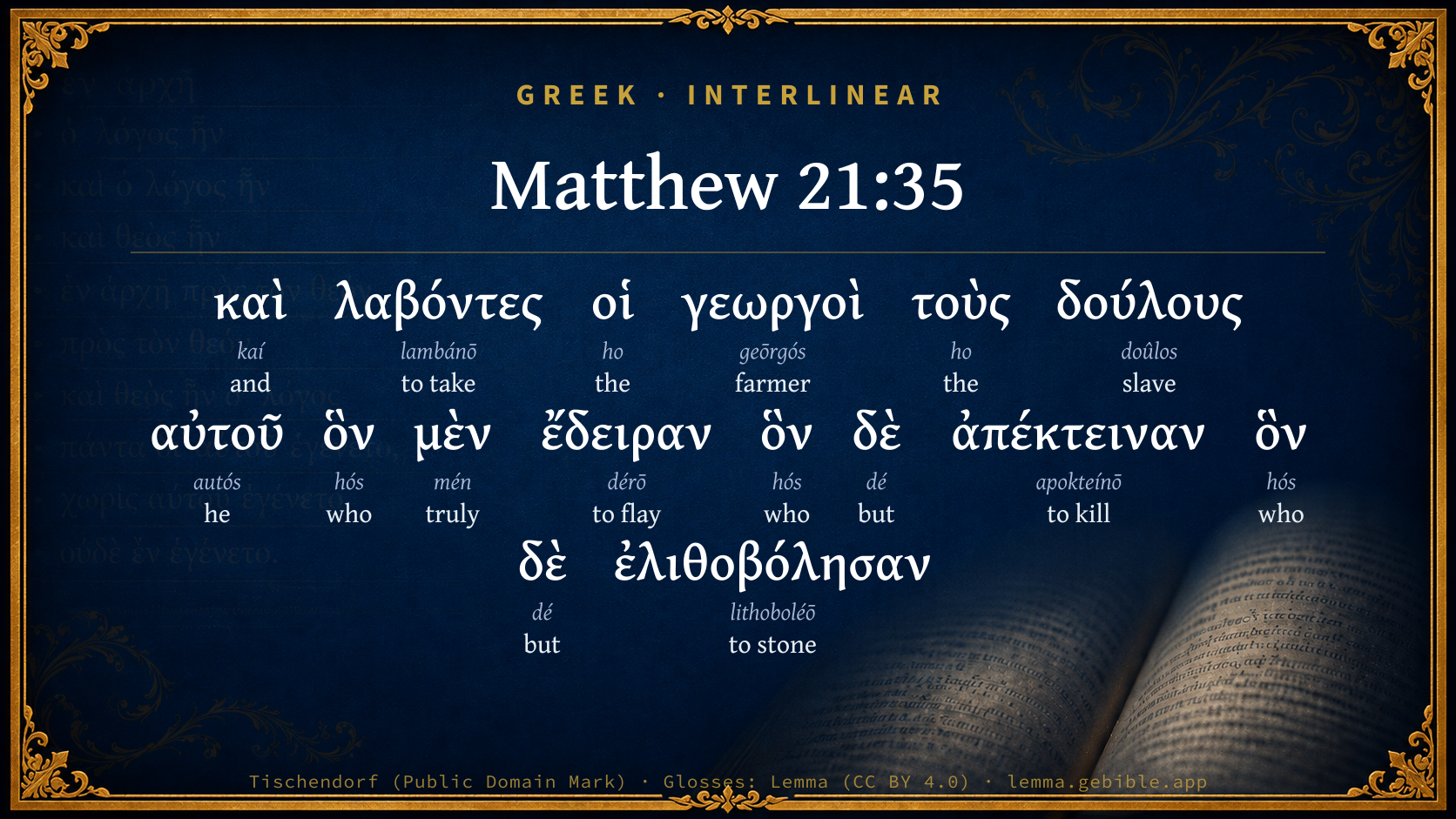
The farmers took his servants, beat one, killed another, and stoned another.
Download a study sheet
One document with this verse’s original text, its word-by-word gloss line, the meaning frame, cross-references with their text, attributed commentary, and full source and license credits — printable, and it pastes into notes with its structure intact.
This verse Autodidact and up
A passage Seminary Student
Up to 50 verses in one chapter. A passage sheet keeps up to 6 commentary sources and 12 cross-references per verse, in the order this page ranks them, and says so on the sheet whenever that leaves anything out. Ask for a single verse and you get the Autodidact verse sheet above.
Everything on this page stays free to read, with no account — the sheet is a download of what is already on screen, not access to it.
Compare translations 3
The same verse in 3 English versions, stacked beneath the original-language interlinear above. Click any original word for its lexicon entry.
Each is an independent rendering of the whole verse — the interlinear is not word-aligned to these translations.
Highlighted words mark where these versions differ — a whole-verse word diff, not a word-by-word alignment.
-
World English Bible Public Domain
The farmers took his servants, beat one, killed another, and stoned another.
-
King James Version Public Domain
And the husbandmen took his servants, and beat one, and killed another, and stoned another.
-
unfoldingWord Literal Text CC BY-SA 4.0
But the farmers, having seized his servants, beat one, and killed another, and stoned another.
unfoldingWord Literal Text — © unfoldingWord, licensed CC BY-SA 4.0. Word-aligned USFM3 via Door43 (git.door43.org/unfoldingWord/en_ult).
Show all 19 translations
Every available English version of this verse, each an independent rendering of the whole verse.
-
World English Bible Public Domain
The farmers took his servants, beat one, killed another, and stoned another.
-
Berean Standard Bible Public Domain
But the tenants seized his servants. They beat one, killed another, and stoned a third.
-
Majority Standard Bible Public Domain
But the tenants seized his servants. They beat one, killed another, and stoned a third.
-
King James Version Public Domain
And the husbandmen took his servants, and beat one, and killed another, and stoned another.
-
American Standard Version (1901) Public Domain
And the husbandmen took his servants, and beat one, and killed another, and stoned another.
-
Revised Version (1885) Public Domain
And the husbandmen took his servants, and beat one, and killed another, and stoned another.
-
Geneva Bible (1599) Public Domain
And ye husbandmen tooke his seruants and beat one, and killed another, and stoned another.
-
Douay-Rheims (1899) Public Domain
And the husbandmen laying hands on his servants, beat one, and killed another, and stoned another.
-
Young's Literal Translation Public Domain
and the husbandmen having taken his servants, one they scourged, and one they killed, and one they stoned.
-
Literal Standard Version CC BY-SA 4.0
and the farmers having taken his servants, one they scourged, and one they killed, and one they stoned.
-
Unlocked Literal Bible CC BY-SA 4.0
But the vine growers took his servants, beat one, killed another, and stoned still another.
-
unfoldingWord Literal Text CC BY-SA 4.0
But the farmers, having seized his servants, beat one, and killed another, and stoned another.
-
Darby Bible Public Domain
And the husbandmen took his bondmen, and beat one, killed another, and stoned another.
-
World Messianic Bible Public Domain
The farmers took his servants, beat one, killed another, and stoned another.
-
Webster's Bible Public Domain
And the husbandmen took his servants, and beat one, and killed another, and stoned another.
-
Free Bible Version CC BY-SA 4.0
But the farmers attacked his servants. They beat one, killed another, and stoned another.
-
Bible in Basic English Public Domain
And the workmen made an attack on his servants, giving blows to one, putting another to death, and stoning another.
-
Text-Critical English NT CC BY 4.0
But the farmers seized his servants; they beat one, killed another, and stoned yet another.
-
Tyndale New Testament (1534) Public Domain
And the husbandme caught his servauntes and bet one kylled another and stoned another.
Literal Standard Version (2020), Covenant Press — licensed CC BY-SA 4.0. Text via the HelloAO Bible API (eBible.org). Unlocked Literal Bible (unfoldingWord) — licensed CC BY-SA 4.0. Text via the HelloAO Bible API (eBible.org). unfoldingWord Literal Text — © unfoldingWord, licensed CC BY-SA 4.0. Word-aligned USFM3 via Door43 (git.door43.org/unfoldingWord/en_ult). Free Bible Version, Dr. Jonathan Gallagher — licensed CC BY-SA 4.0. Text via the HelloAO Bible API (eBible.org).
Word by word
More ways to search: Search by grammar → Find every occurrence → Compare this word →
Practice this passage: Drill this verse → Learn its vocabulary →
- Appears 8× in the Greek New Testament
- First appears here
- Part of Speech
- Verb
- Tense
- Aorist
- Voice
- Active
- Mood
- Indicative
- Person
- 3rd person
- Number
- Plural
Full Thayer's Definition
- καὶ kaí G2532 “and” Conjunction
- λαβόντες lambánō G2983 “to take” Verb, Aorist, Active, Participle, Nominative, Plural, Masculine
- οἱ ho G3588 “the” Article, Nominative, Plural, Masculine
- γεωργοὶ geōrgós G1092 “farmer” Noun, Nominative, Plural, Masculine
- τοὺς ho G3588 “the” Article, Accusative, Plural, Masculine
- δούλους doûlos G1401 “slave” Noun, Accusative, Plural, Masculine
- αὐτοῦ autós G846 “he” Personal pronoun, Genitive, Singular, Masculine
- ὃν hós G3739 “who” Relative pronoun, Accusative, Singular, Masculine
- μὲν mén G3303 “truly” Particle
- ἔδειραν dérō G1194 “to flay” Verb, Aorist, Active, Indicative, 3rd person, Plural
- ὃν hós G3739 “who” Relative pronoun, Accusative, Singular, Masculine
- δὲ dé G1161 “but” Conjunction
- ἀπέκτειναν apokteínō G615 “to kill” Verb, Aorist, Active, Indicative, 3rd person, Plural
- ὃν hós G3739 “who” Relative pronoun, Accusative, Singular, Masculine
- δὲ dé G1161 “but” Conjunction
- ἐλιθοβόλησαν lithoboléō G3036 “to stone” Verb, Aorist, Active, Indicative, 3rd person, Plural
About this verse
These counts appear in no published source. They are computed here, from the morphology-tagged text and Lemma’s own curated glosses. What Lemma adds →
- 16
- words
- 12
- distinct lemmas
- Gospels
- section
Notable vocabulary
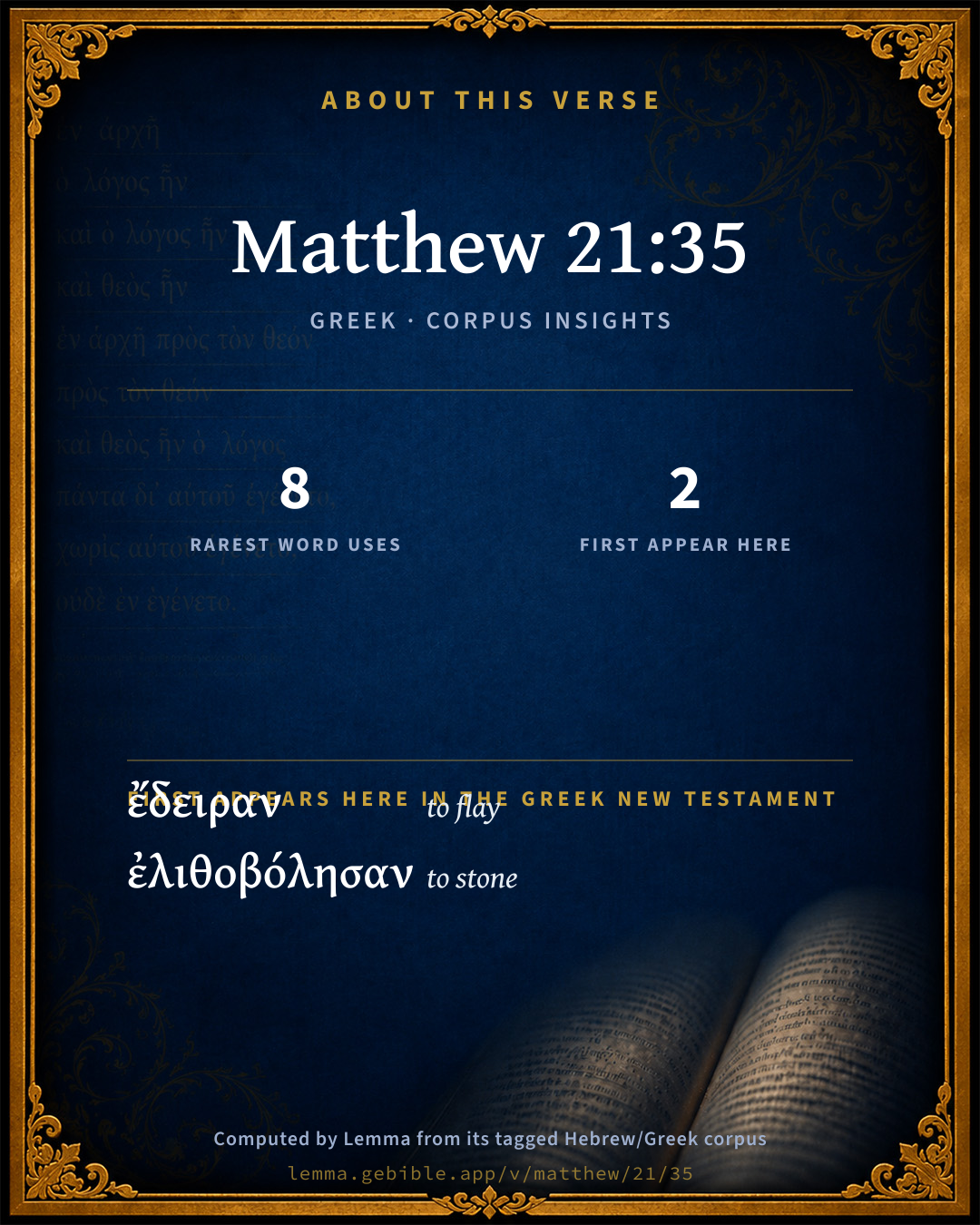
The rarest word here is ἐλιθοβόλησαν to stone G3036 — appearing just 8 times in the whole Greek New Testament.
First appearance in Scripture
These words make their first canonical appearance in the Greek New Testament here:
Shared distinctive vocabulary
ἐλιθοβόλησαν to stone G3036 occurs in 8 verses of the Greek New Testament. Also found in:
Cross-references
19Topical passages linked to Matthew 21:35 in the Treasury of Scripture Knowledge — connected by theme and wording, ordered by reader-vote popularity; previews shown in the World English Bible.
- 2 Chronicles 36:15–16 Yahweh, the God of their fathers, sent to them by his messengers, rising up early and sending, because he had compassion on his people, and on his dwelling-place:
- Hebrews 11:36–37 Others were tried by mocking and scourging, yes, moreover by bonds and imprisonment.
- Nehemiah 9:26 Nevertheless they were disobedient, and rebelled against you, and cast your law behind their back, and killed your prophets that testified against them to turn them again to you, and they committed awful blasphemies.
- Matthew 5:12 Rejoice, and be exceedingly glad, for great is your reward in heaven. For that is how they persecuted the prophets who were before you.
- Acts 7:52 Which of the prophets didn't your fathers persecute? They killed those who foretold the coming of the Righteous One, of whom you have now become betrayers and murderers.
- Matthew 23:31–37 Therefore you testify to yourselves that you are children of those who killed the prophets.
- Luke 13:33–34 Nevertheless I must go on my way today and tomorrow and the next day, for it can't be that a prophet perish outside of Jerusalem.'
- Revelation 6:9 When he opened the fifth seal, I saw underneath the altar the souls of those who had been killed for the Word of God, and for the testimony of the Lamb which they had.
- 1 Kings 18:4 for it was so, when Jezebel cut off the prophets of Yahweh, that Obadiah took one hundred prophets, and hid them by fifty in a cave, and fed them with bread and water.)
- 1 Kings 18:13 Wasn't it told my lord what I did when Jezebel killed the prophets of Yahweh, how I hid one hundred men of Yahweh's prophets by fifty in a cave, and fed them with bread and water?
- 1 Kings 19:2 Then Jezebel send a messenger to Elijah, saying, So let the gods do to me, and more also, if I don't make your life as the life of one of them by tomorrow about this time.
- 1 Kings 19:10 He said, I have been very jealous for Yahweh, the God of hosts; for the children of Israel have forsaken your covenant, thrown down your altars, and slain your prophets with the sword: and I, even I only, am left; and they seek my life, to take it away.
- 1 Kings 22:24 Then Zedekiah the son of Chenaanah came near, and struck Micaiah on the cheek, and said, Which way went the Spirit of Yahweh from me to speak to you?
- 2 Chronicles 16:10 Then Asa was angry with the seer, and put him in the prison-house; for he was in a rage with him because of this thing. Asa oppressed some of the people at the same time.
- 2 Chronicles 24:21–22 They conspired against him, and stoned him with stones at the commandment of the king in the court of the house of Yahweh.
- Jeremiah 2:30 In vain have I struck your children; they received no correction: your own sword has devoured your prophets, like a destroying lion.
- Jeremiah 25:3–7 From the thirteenth year of Josiah the son of Amon, king of Judah, even to this day, these twenty-three years, the word of Yahweh has come to me, and I have spoken to you, rising up early and speaking; but you have not listened.
- Jeremiah 26:21–24 and when Jehoiakim the king, with all his mighty-men, and all the princes, heard his words, the king sought to put him to death; but when Uriah heard it, he was afraid, and fled, and went into Egypt:
- 1 Thessalonians 2:15–16 who killed both the Lord Jesus and their own prophets, and drove us out, and didn't please God, and are contrary to all men;
Cross-references courtesy of OpenBible.info (CC BY 4.0).
Lesson kit
Teaching starters — assembled from the data on this page, not authored interpretation. Every prompt links to the verse data it draws on. Edit before teaching.
Matthew, in the Gospels, opens this verse with 16 words (12 distinct Greek lemmas). Its most distinctive word is lithoboléō (“to stone”). A historical commentator’s framing appears above. Read the whole chapter for the surrounding context.
Discussion questions
- What does “to stone” (lithoboléō) contribute to the verse as a whole?
- 2 words make their first appearance in Scripture here. What does this debut establish?
- How does Matthew 23:37, which shares the word «to stone», read alongside this verse?
- What does the repetition of “who” (3× in this one verse) do in this verse?
- These translations render this verse differently; the difference is in the English rendering, not the original. What questions does that raise?
- Compare how Bengel's Gnomon and Expositor's Greek Testament read this verse. Where do they agree or differ?
Things to notice
- 2 words make their first canonical appearance in Scripture here.
- These translations choose different wording for 5 words in this verse.
- “who” occurs 3× in this single verse.
- 12 distinct Greek lemmas span 16 words in this verse.
Commentary
Notes on Matthew 21:35 from classic Christian and Jewish commentators (each source and its license shown beneath its notes). The classic Christian expositions comment on the surrounding passage and are grouped to its opening verse, so a note may address several verses; the Jewish commentaries on the Tanakh (Rashi and others) are per-verse, so they appear only where the commentator wrote on this verse.
Lemma curates 59 commentaries, every one of them public domain or Creative Commons licensed, each selected and text-cleaned for this edition rather than reprinted as found. About our sources →
Bengel's Gnomon
Johann Albrecht Bengel
Bengel's Gnomon of the New Testament — English translation (T&T Clark, Edinburgh, 1860) — public domain. Text from a community e-Sword module.
Expositor's Greek Testament
ed. W. Robertson Nicoll
The Expositor's Greek Testament, edited by W. Robertson Nicoll (1897–1910) — public domain. Text from a community e-Sword module.
Jamieson, Fausset & Brown
Robert Jamieson, A. R. Fausset & David Brown
Jamieson, Fausset & Brown — Commentary Critical and Explanatory on the Whole Bible (1871) — public domain (CC PDM 1.0). Text via the HelloAO Bible API.
Adam Clarke's Commentary
Adam Clarke's Commentary on the Bible (1810–1826) — public domain. Text from a community e-Sword/MySword module.
Ellicott's Commentary for English Readers
A Bible Commentary for English Readers, edited by Charles John Ellicott (1878–1897) — public domain. Text from a community e-Sword module.
The Cambridge Bible for Schools and Colleges
gen. ed. J. J. S. Perowne
The Cambridge Bible for Schools and Colleges (gen. ed. J. J. S. Perowne; Cambridge University Press, 1878–1918) — public domain. Text from a community e-Sword module.
John Gill's Exposition
John Gill's Exposition of the Whole Bible (1746–1763) — public domain (CC PDM 1.0). Text via the HelloAO Bible API.
Trapp's Complete Commentary
John Trapp
John Trapp, A Commentary or Exposition upon All the Books of the Old and New Testament (1647–1656) — public domain. Text from a community e-Sword module.
Whedon's Commentary on the Bible
Daniel D. Whedon
Daniel D. Whedon (gen. ed.), Commentary on the Old and New Testaments (1874–1909) — public domain. Text from a community e-Sword module.
The Pulpit Commentary
The Pulpit Commentary (1880–1919), ed. H.D.M. Spence-Jones & Joseph S. Exell — public domain. Text from a community e-Sword module.
The People's New Testament
B. W. Johnson
B. W. Johnson's The People's New Testament with Notes (1889–1891) — public domain. Electronic text from the Christian Classics Ethereal Library (CCEL) ThML edition.
unfoldingWord translationNotes
Door43 World Missions Community
unfoldingWord translationNotes — © Distant Shores Media and the Door43 World Missions Community, licensed CC BY-SA 4.0. Source: git.door43.org/Door43/en_tn.
Cambridge Greek Testament for Schools and Colleges
Cambridge Greek Testament for Schools and Colleges (Cambridge University Press, 1896; 21 vols, various authors incl. Carr, Maclear, Plummer, Farrar, Lumby, Moule, M. R. James, Simcox) — public domain. Text from a community e-Sword module.
International Critical Commentary
International Critical Commentary — older volumes (1896–1929), various authors — public domain. Text from a community e-Sword module.