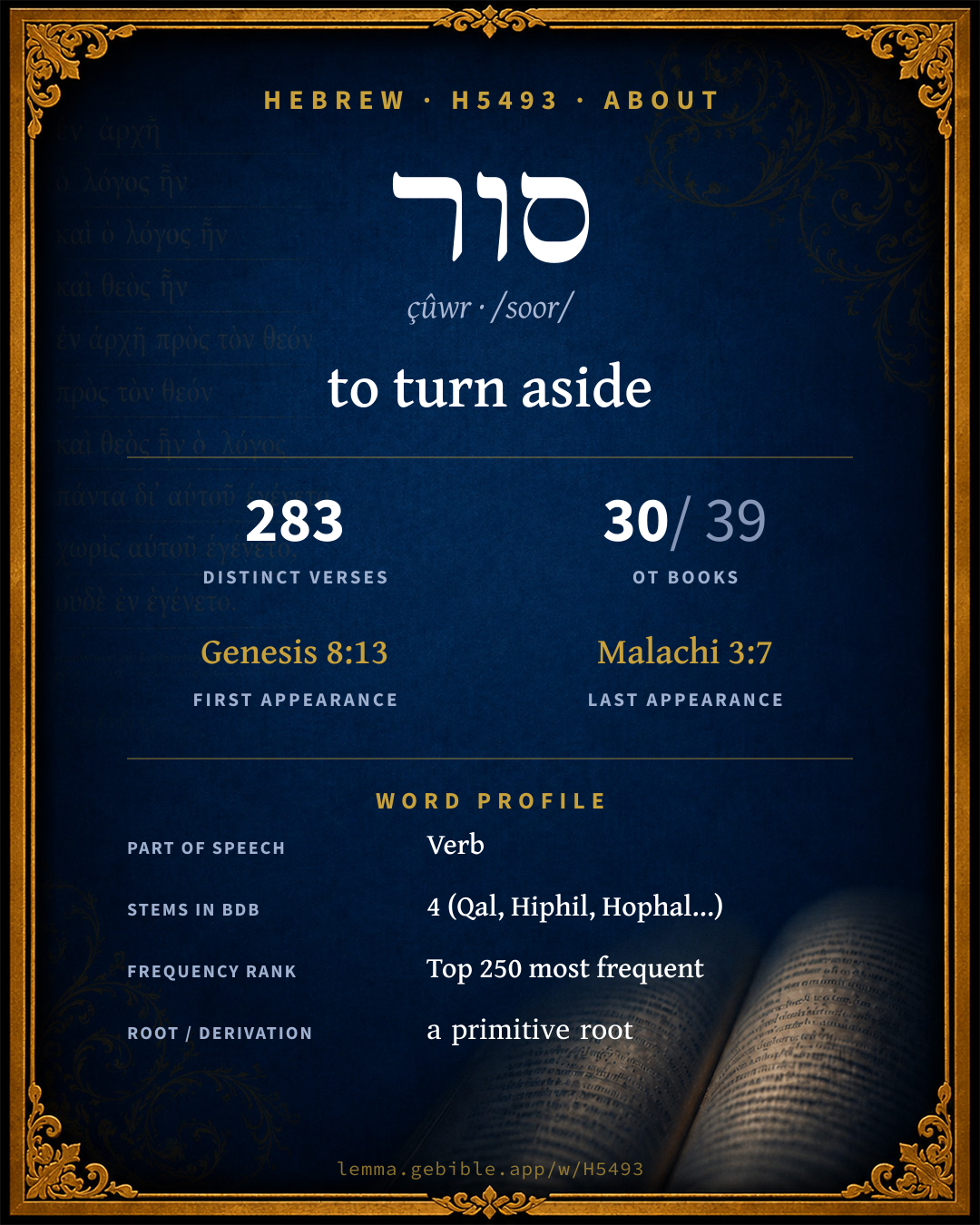
סוּר
to turn aside
‘to turn aside’ is one of 3 main senses fuller range ↓
Full lexicon entry — Brown-Driver-Briggs (BDB)
From Brown-Driver-Briggs (BDB)
Where this word appears
See every Qal verb in the Hebrew Bible →
Grammar key — what these labels mean
Part of speech
- Verb
- An action or state-of-being word.
Stem
- Qal
- The basic, simple active stem — the plain form of the verb (“he wrote”). Here: ‘turn aside’
- Hiphil
- The causative active stem (“he caused / brought about”). Here: ‘cause to’
- Hophal
- The passive counterpart of the Hiphil (“he was caused to…”).
- Polel
- A stem of hollow/geminate roots functioning like the Piel — intensive active.
Form
- Perfect
- A completed action or state — Hebrew marks aspect (completeness) more than strict tense (“he wrote”).
- Sequential Imperfect
- An imperfect with prefixed waw — the standard past-narrative form (waw-consecutive imperfect).
- Imperfect
- An incomplete, ongoing, or future action (“he will / would write”).
- Imperative
- A direct command (“write!”).
- Infinitive Construct
- A bound verbal noun, frequently with prepositions (“to write / in writing”).
- Sequential Perfect
- A perfect with prefixed waw continuing a preceding imperfect or command (waw-consecutive perfect).
- Participle Active
- A verbal adjective expressing ongoing or characteristic action (“writing / one who writes”).
- Jussive
- A third- or second-person volitional form expressing wish or command (“let him write”).
- Infinitive Absolute
- An unbound verbal noun, often intensifying or standing in for a finite verb.
- Cohortative
- A first-person volitional form expressing wish or resolve (“let me / let us write”).
- Participle Passive
- A verbal adjective expressing action received (“written”).
State
- Absolute
- The independent form of a noun, not bound to a following word.
- Construct
- A noun bound to a following noun in a possessive / “of” relationship (the construct chain).
Person
- 3rd Person
- The one spoken about (“he / she / it / they”).
- 2nd Person
- The one addressed (“you”).
- 1st Person
- The speaker (“I / we”).
Gender
- Masculine
- Grammatically masculine.
- Common
- Either gender — not distinguished for this form.
- Feminine
- Grammatically feminine.
Number
- Singular
- One.
- Plural
- More than one (in Hebrew, generally three or more).
Grammatical forms 62 distinct
- Verb, Qal, Perfect, 3rd Person, Masculine, Singular 31 times (10%)
- Verb, Hiphil, Sequential Imperfect, 3rd Person, Masculine, Singular 20 times (7%)
- Verb, Qal, Perfect, 3rd Person, Common, Plural 19 times (6%)
- Verb, Hiphil, Perfect, 3rd Person, Masculine, Singular 18 times (6%)
- Verb, Qal, Infinitive Construct 15 times (5%)
- Verb, Qal, Imperfect, 3rd Person, Masculine, Singular 14 times (5%)
- Verb, Hiphil, Imperfect, 3rd Person, Masculine, Singular 14 times (5%)
- Verb, Qal, Imperative, 2nd Person, Masculine, Plural 12 times (4%)
+54 more forms (158 occurrences)
Parsed forms decoded from the imported morphology (morphhb / Westminster Leningrad Codex — WLC text public domain, morphhb tagging CC BY 4.0), counted across 301 parsed occurrences — not distinct verses.
Page 1 of 2 — showing verses 1–200 of 283 distinct verses where H5493 appears, across 30 books. Click any verse to open its interlinear word-by-word view. Verse text shown in the World English Bible for context — . Each verse’s Hebrew form is shown with its reference; the English is not keyword-highlighted, since the data carries no word-level English alignment. Use “Compare translations” on any verse to read it across multiple English versions. This concordance covers the Hebrew Bible; Septuagint (Greek Old Testament) occurrences are not indexed here.
Genesis 11 verses
- Genesis 8:13 וַ/יָּ֤סַר conj + Hiphil wimpf 3ms It happened in the six hundred first year, in the first month, the first day of the month, the waters were dried up from off the earth. Noah removed the covering of the ark, and looked. He saw that the surface of the ground was dried.
- Genesis 19:2 ס֣וּרוּ Qal impv 2mp and he said, "See now, my lords, please turn aside into your servant's house, stay all night, wash your feet, and you will rise up early, and go on your way." They said, "No, but we will stay in the street all night."
- Genesis 19:3 וַ/יָּסֻ֣רוּ conj + Qal wimpf 3mp He urged them greatly, and they came in with him, and entered into his house. He made them a feast, and baked unleavened bread, and they ate.
- Genesis 30:32 הָסֵ֨ר Hiphil inf.abs I will pass through all your flock today, removing from there every speckled and spotted one, and every black one among the sheep, and the spotted and speckled among the goats. This will be my hire.
- Genesis 30:35 וַ/יָּ֣סַר conj + Hiphil wimpf 3ms That day, he removed the male goats that were streaked and spotted, and all the female goats that were speckled and spotted, every one that had white in it, and all the black ones among the sheep, and gave them into the hand of his sons.
- Genesis 35:2 הָסִ֜רוּ Hiphil impv 2mp Then Jacob said to his household, and to all who were with him, "Put away the foreign gods that are among you, purify yourselves, change your garments.
- Genesis 38:14 וַ/תָּסַר֩ conj + Hiphil wimpf 3fs She took off of her the garments of her widowhood, and covered herself with her veil, and wrapped herself, and sat in the gate of Enaim, which is by the way to Timnah; for she saw that Shelah was grown up, and she wasn't given to him as a wife.
- Genesis 38:19 וַ/תָּ֥סַר conj + Hiphil wimpf 3fs She arose, and went away, and put off her veil from her, and put on the garments of her widowhood.
- Genesis 41:42 וַ/יָּ֨סַר conj + Hiphil wimpf 3ms Pharaoh took off his signet ring from his hand, and put it on Joseph's hand, and arrayed him in robes of fine linen, and put a gold chain about his neck,
- Genesis 48:17 לְ/הָסִ֥יר prep + Hiphil inf.cs When Joseph saw that his father laid his right hand on the head of Ephraim, it displeased him. He held up his father's hand, to remove it from Ephraim's head to Manasseh's head.
- Genesis 49:10 יָס֥וּר Qal impf 3ms The scepter will not depart from Judah, Nor the ruler's staff from between his feet, Until he comes to whom it belongs. To him will the obedience of the peoples be.
Exodus 13 verses
- Exodus 3:3 אָסֻֽרָה Qal coh 1cs Moses said, I will turn aside now, and see this great sight, why the bush is not burnt.
- Exodus 3:4 סָ֣ר Qal pf 3ms When Yahweh saw that he turned aside to see, God called to him out of the midst of the bush, and said, "Moses! Moses!" He said, "Here I am."
- Exodus 8:8 וְ/יָסֵר֙ conj + Hiphil juss 3ms Then Pharaoh called for Moses and Aaron, and said, "Entreat Yahweh, that he take away the frogs from me, and from my people; and I will let the people go, that they may sacrifice to Yahweh."
- Exodus 8:11 וְ/סָר֣וּ conj + Qal wpf 3cp The frogs shall depart from you, and from your houses, and from your servants, and from your people. They shall remain in the river only."
- Exodus 8:29 וְ/סָ֣ר conj + Qal wpf 3ms Moses said, "Behold, I go out from you, and I will pray to Yahweh that the swarms of flies may depart from Pharaoh, from his servants, and from his people, tomorrow; only don't let Pharaoh deal deceitfully any more in not letting the people go to sacrifice to Yahweh."
- Exodus 8:31 וַ/יָּ֨סַר֙ conj + Qal wimpf 3ms Yahweh did according to the word of Moses, and he removed the swarms of flies from Pharaoh, from his servants, and from his people. There remained not one.
- Exodus 10:17 וְ/יָסֵר֙ conj + Hiphil juss 3ms Now therefore please forgive my sin again, and pray to Yahweh your God, that he may also take away from me this death."
- Exodus 14:25 וַ/יָּ֗סַר conj + Hiphil wimpf 3ms He took off their chariot wheels, and they drove them heavily; so that the Egyptians said, "Let's flee from the face of Israel, for Yahweh fights for them against the Egyptians!"
- Exodus 23:25 וַ/הֲסִרֹתִ֥י conj + Hiphil wpf 1cs You shall serve Yahweh your God, and he will bless your bread and your water, and I will take sickness away from your midst.
- Exodus 25:15 יָסֻ֖רוּ Qal impf 3mp The poles shall be in the rings of the ark. They shall not be taken from it.
- Exodus 32:8 סָ֣רוּ Qal pf 3cp They have turned aside quickly out of the way which I commanded them. They have made themselves a molten calf, and have worshiped it, and have sacrificed to it, and said, 'These are your gods, Israel, which brought you up out of the land of Egypt.'"
- Exodus 33:23 וַ/הֲסִרֹתִי֙ conj + Hiphil wpf 1cs then I will take away my hand, and you will see my back; but my face shall not be seen."
- Exodus 34:34 יָסִ֥יר Hiphil impf 3ms But when Moses went in before Yahweh to speak with him, he took the veil off, until he came out; and he came out, and spoke to the children of Israel that which he was commanded.
Leviticus 10 verses
- Leviticus 1:16 וְ/הֵסִ֥יר conj + Hiphil wpf 3ms and he shall take away its crop with its filth, and cast it beside the altar on the east part, in the place of the ashes.
- Leviticus 3:4 יְסִירֶֽ/נָּה Hiphil impf 3ms + sfx pers 3fs and the two kidneys, and the fat that is on them, which is by the loins, and the cover on the liver, with the kidneys, he shall take away.
- Leviticus 3:9 יְסִירֶ֑/נָּה Hiphil impf 3ms + sfx pers 3fs He shall offer from the sacrifice of peace offerings an offering made by fire to Yahweh; its fat, the entire tail fat, he shall take away close to the backbone; and the fat that covers the inwards, and all the fat that is on the inwards,
- Leviticus 3:10 יְסִירֶֽ/נָּה Hiphil impf 3ms + sfx pers 3fs and the two kidneys, and the fat that is on them, which is by the loins, and the cover on the liver, with the kidneys, he shall take away.
- Leviticus 3:15 יְסִירֶֽ/נָּה Hiphil impf 3ms + sfx pers 3fs and the two kidneys, and the fat that is on them, which is by the loins, and the cover on the liver, with the kidneys, he shall take away.
- Leviticus 4:9 יְסִירֶֽ/נָּה Hiphil impf 3ms + sfx pers 3fs and the two kidneys, and the fat that is on them, which is by the loins, and the cover on the liver, with the kidneys, he shall take away,
- Leviticus 4:31 יָסִ֗יר הוּסַ֣ר Hiphil impf 3ms Hophal pf 3ms All its fat he shall take away, like the fat is taken away from off of the sacrifice of peace offerings; and the priest shall burn it on the altar for a sweet savor to Yahweh; and the priest shall make atonement for him, and he will be forgiven.
- Leviticus 4:35 יָסִ֗יר יוּסַ֥ר Hiphil impf 3ms Hophal impf 3ms All its fat he shall take away, like the fat of the lamb is taken away from the sacrifice of peace offerings; and the priest shall burn them on the altar, on the offerings of Yahweh made by fire; and the priest shall make atonement for him concerning his sin that he has sinned, and he will be forgiven.
- Leviticus 7:4 יְסִירֶֽ/נָּה Hiphil impf 3ms + sfx pers 3fs and the two kidneys, and the fat that is on them, which is by the loins, and the cover on the liver, with the kidneys, shall he take away;
- Leviticus 13:58 וְ/סָ֥ר conj + Qal wpf 3ms The garment, either the warp, or the woof, or whatever thing of skin it is, which you shall wash, if the plague has departed from them, then it shall be washed the second time, and it will be clean."
Numbers 4 verses
- Numbers 12:10 סָ֚ר Qal pf 3ms The cloud removed from over the Tent; and, behold, Miriam was leprous, as [white as] snow: and Aaron looked at Miriam, and, behold, she was leprous.
- Numbers 14:9 סָ֣ר Qal pf 3ms Only don't rebel against Yahweh, neither fear the people of the land; for they are bread for us: their defense is removed from over them, and Yahweh is with us: don't fear them.
- Numbers 16:26 ס֣וּרוּ Qal impv 2mp He spoke to the congregation, saying, Depart, I pray you, from the tents of these wicked men, and touch nothing of theirs, lest you be consumed in all their sins.
- Numbers 21:7 וְ/יָסֵ֥ר conj + Hiphil juss 3ms The people came to Moses, and said, We have sinned, because we have spoken against Yahweh, and against you; pray to Yahweh, that he take away the serpents from us. Moses prayed for the people.
Deuteronomy 15 verses
- Deuteronomy 2:27 אָס֖וּר Qal impf 1cs Let me pass through your land: I will go along by the highway, I will turn neither to the right hand nor to the left.
- Deuteronomy 4:9 יָס֨וּרוּ֙ Qal impf 3mp Only take heed to yourself, and keep your soul diligently, lest you forget the things which your eyes saw, and lest they depart from your heart all the days of your life; but make them known to your children and your children's children;
- Deuteronomy 5:32 תָסֻ֖רוּ Qal impf 2mp You shall observe to do therefore as Yahweh your God has commanded you: you shall not turn aside to the right hand or to the left.
- Deuteronomy 7:4 יָסִ֤יר Hiphil impf 3ms For he will turn away your son from following me, that they may serve other gods: so will the anger of Yahweh be kindled against you, and he will destroy you quickly.
- Deuteronomy 7:15 וְ/הֵסִ֧יר conj + Hiphil wpf 3ms Yahweh will take away from you all sickness; and none of the evil diseases of Egypt, which you know, will he put on you, but will lay them on all those who hate you.
- Deuteronomy 9:12 סָ֣רוּ Qal pf 3cp Yahweh said to me, Arise, get you down quickly from hence; for your people whom you have brought forth out of Egypt have corrupted themselves; they have quickly turned aside out of the way which I commanded them; they have made them a molten image.
- Deuteronomy 9:16 סַרְתֶּ֣ם Qal pf 2mp I looked, and, behold, you had sinned against Yahweh your God; you had made you a molten calf: you had turned aside quickly out of the way which Yahweh had commanded you.
- Deuteronomy 11:16 וְ/סַרְתֶּ֗ם conj + Qal wpf 2mp Take heed to yourselves, lest your heart be deceived, and you turn aside, and serve other gods, and worship them;
- Deuteronomy 11:28 וְ/סַרְתֶּ֣ם conj + Qal wpf 2mp and the curse, if you shall not listen to the commandments of Yahweh your God, but turn aside out of the way which I command you this day, to go after other gods, which you have not known.
- Deuteronomy 17:11 תָס֗וּר Qal impf 2ms according to the tenor of the law which they shall teach you, and according to the judgment which they shall tell you, you shall do; you shall not turn aside from the sentence which they shall show you, to the right hand, nor to the left.
- Deuteronomy 17:17 יָס֖וּר Qal impf 3ms Neither shall he multiply wives to himself, that his heart not turn away: neither shall he greatly multiply to himself silver and gold.
- Deuteronomy 17:20 ס֥וּר Qal inf.cs that his heart not be lifted up above his brothers, and that he not turn aside from the commandment, to the right hand, or to the left: to the end that he may prolong his days in his kingdom, he and his children, in the midst of Israel.
- Deuteronomy 21:13 וְ/הֵסִ֩ירָה֩ conj + Hiphil wpf 3fs and she shall put the clothing of her captivity from off her, and shall remain in your house, and bewail her father and her mother a full month: and after that you shall go in to her, and be her husband, and she shall be your wife.
- Deuteronomy 28:14 תָס֗וּר Qal impf 2ms and shall not turn aside from any of the words which I command you this day, to the right hand, or to the left, to go after other gods to serve them.
- Deuteronomy 31:29 וְ/סַרְתֶּ֣ם conj + Qal wpf 2mp For I know that after my death you will utterly corrupt yourselves, and turn aside from the way which I have commanded you; and evil will happen to you in the latter days; because you will do that which is evil in the sight of Yahweh, to provoke him to anger through the work of your hands.
Joshua 6 verses
- Joshua 1:7 תָּס֥וּר Qal juss 2ms Only be strong and very courageous, to observe to do according to all the law, which Moses my servant commanded you: don't turn from it to the right hand or to the left, that you may have good success wherever you go.
- Joshua 7:13 הֲסִירְ/כֶ֥ם Hiphil inf.cs + sfx pers 2mp Up, sanctify the people, and say, Sanctify yourselves against tomorrow: for thus says Yahweh, the God of Israel, There is a devoted thing in the midst of you, Israel; you can not stand before your enemies, until you take away the devoted thing from among you.
- Joshua 11:15 הֵסִ֣יר Hiphil pf 3ms As Yahweh commanded Moses his servant, so did Moses command Joshua: and so did Joshua; he left nothing undone of all that Yahweh commanded Moses.
- Joshua 23:6 סוּר Qal inf.cs Therefore be you very courageous to keep and to do all that is written in the book of the law of Moses, that you not turn aside from it to the right hand or to the left;
- Joshua 24:14 וְ/הָסִ֣ירוּ conj + Hiphil impv 2mp Now therefore fear Yahweh, and serve him in sincerity and in truth; and put away the gods which your fathers served beyond the River, and in Egypt; and serve you Yahweh.
- Joshua 24:23 הָסִ֛ירוּ Hiphil impv 2mp Now therefore put away, [said he], the foreign gods which are among you, and incline your heart to Yahweh, the God of Israel.
Judges 14 verses
- Judges 2:17 סָ֣רוּ Qal pf 3cp Yet they didn't listen to their judges; for they played the prostitute after other gods, and bowed themselves down to them: they turned aside quickly out of the way in which their fathers walked, obeying the commandments of Yahweh; [but] they didn't do so.
- Judges 4:18 סוּרָ֧/ה סוּרָ֥/ה וַ/יָּ֤סַר Qal impv 2ms + sfx h Qal impv 2ms + sfx h conj + Qal wimpf 3ms Jael went out to meet Sisera, and said to him, Turn in, my lord, turn in to me; don't be afraid. He came in to her into the tent, and she covered him with a rug.
- Judges 9:29 וְ/אָסִ֖ירָה conj + Hiphil impf 1cs Would that this people were under my hand! then would I remove Abimelech. He said to Abimelech, Increase your army, and come out.
- Judges 10:16 וַ/יָּסִ֜ירוּ conj + Hiphil wimpf 3mp They put away the foreign gods from among them, and served Yahweh; and his soul was grieved for the misery of Israel.
- Judges 14:8 וַ/יָּ֣סַר conj + Qal wimpf 3ms After a while he returned to take her; and he turned aside to see the carcass of the lion: and, behold, there was a swarm of bees in the body of the lion, and honey.
- Judges 16:17 וְ/סָ֣ר conj + Qal pf 3ms He told her all his heart, and said to her, "No razor has ever come on my head; for I have been a Nazirite to God from my mother's womb. If I am shaved, then my strength will go from me, and I will become weak, and be like any other man."
- Judges 16:19 וַ/יָּ֥סַר conj + Qal wimpf 3ms She made him sleep on her knees; and she called for a man, and shaved off the seven locks of his head; and she began to afflict him, and his strength went from him.
- Judges 16:20 סָ֥ר Qal pf 3ms She said, The Philistines are on you, Samson. He awoke out of his sleep, and said, I will go out as at other times, and shake myself free. But he didn't know that Yahweh had departed from him.
- Judges 18:3 וַ/יָּס֣וּרוּ conj + Qal wimpf 3mp When they were by the house of Micah, they knew the voice of the young man the Levite; and they turned aside there, and said to him, Who brought you here? and what do you in this place? and what have you here?
- Judges 18:15 וַ/יָּס֣וּרוּ conj + Qal wimpf 3mp They turned aside there, and came to the house of the young man the Levite, even to the house of Micah, and asked him of his welfare.
- Judges 19:11 וְ/נָס֛וּרָה conj + Qal coh 1cp When they were by Jebus, the day was far spent; and the servant said to his master, Please come and let us turn aside into this city of the Jebusites, and lodge in it.
- Judges 19:12 נָסוּר֙ Qal impf 1cp His master said to him, We won't turn aside into the city of a foreigner, that is not of the children of Israel; but we will pass over to Gibeah.
- Judges 19:15 וַ/יָּסֻ֣רוּ conj + Qal wimpf 3mp They turned aside there, to go in to lodge in Gibeah: and he went in, and sat him down in the street of the city; for there was no man who took them into his house to lodge.
- Judges 20:8 נָס֖וּר Qal impf 1cp All the people arose as one man, saying, We will not any of us go to his tent, neither will we any of us turn to his house.
Ruth 1 verse
1 Samuel 21 verses
- 1 Samuel 1:14 הָסִ֥ירִי Hiphil impv 2fs Eli said to her, How long will you be drunken? put away your wine from you.
- 1 Samuel 6:3 תָס֥וּר Qal impf 3fs They said, "If you send away the ark of the God of Israel, don't send it empty; but by all means return him a trespass-offering: then you shall be healed, and it shall be known to you why his hand is not removed from you."
- 1 Samuel 6:12 סָ֖רוּ Qal pf 3cp The cattle took the straight way by the way to Beth-shemesh; they went along the highway, lowing as they went, and didn't turn aside to the right hand or to the left; and the lords of the Philistines went after them to the border of Beth-shemesh.
- 1 Samuel 7:3 הָסִ֜ירוּ Hiphil impv 2mp Samuel spoke to all the house of Israel, saying, If you do return to Yahweh with all your heart, then put away the foreign gods and the Ashtaroth from among you, and direct your hearts to Yahweh, and serve him only; and he will deliver you out of the hand of the Philistines.
- 1 Samuel 7:4 וַ/יָּסִ֨ירוּ֙ conj + Hiphil wimpf 3mp Then the children of Israel did put away the Baals and the Ashtaroth, and served Yahweh only.
- 1 Samuel 12:20 תָּס֨וּרוּ֙ Qal juss 2mp Samuel said to the people, "Don't be afraid; you have indeed done all this evil; yet don't turn aside from following Yahweh, but serve Yahweh with all your heart:
- 1 Samuel 12:21 תָּס֑וּרוּ Qal impf 2mp and don't turn aside; for [then would you go] after vain things which can't profit nor deliver, for they are vain.
- 1 Samuel 15:6 סֻּ֨רוּ וַ/יָּ֥סַר Qal impv 2mp conj + Qal wimpf 3ms Saul said to the Kenites, Go, depart, get you down from among the Amalekites, lest I destroy you with them; for you shown kindness to all the children of Israel, when they came up out of Egypt. So the Kenites departed from among the Amalekites.
- 1 Samuel 15:32 סָ֥ר Qal pf 3ms Then said Samuel, Bring you here to me Agag the king of the Amalekites. Agag came to him cheerfully. Agag said, Surely the bitterness of death is past.
- 1 Samuel 16:14 סָ֖רָה Qal pf 3fs Now the Spirit of Yahweh departed from Saul, and an evil spirit from Yahweh troubled him.
- 1 Samuel 16:23 וְ/סָ֥רָה conj + Qal wpf 3fs It happened, when the [evil] spirit from God was on Saul, that David took the harp, and played with his hand: so Saul was refreshed, and was well, and the evil spirit departed from him.
- 1 Samuel 17:26 וְ/הֵסִ֥יר conj + Hiphil wpf 3ms David spoke to the men who stood by him, saying, What shall be done to the man who kills this Philistine, and takes away the reproach from Israel? for who is this uncircumcised Philistine, that he should defy the armies of the living God?
- 1 Samuel 17:39 וַ/יְסִרֵ֥/ם conj + Hiphil wimpf 3ms + sfx pers 3mp David girded his sword on his clothing, and he tried to go; for he had not proved it. David said to Saul, I can't go with these; for I have not proved them. David put them off him.
- 1 Samuel 17:46 וַ/הֲסִרֹתִ֤י conj + Hiphil wpf 1cs This day will Yahweh deliver you into my hand; and I will strike you, and take your head from off you; and I will give the dead bodies of the host of the Philistines this day to the birds of the sky, and to the wild animals of the earth; that all the earth may know that there is a God in Israel,
- 1 Samuel 18:12 סָֽר Qal pf 3ms Saul was afraid of David, because Yahweh was with him, and was departed from Saul.
- 1 Samuel 18:13 וַ/יְסִרֵ֤/הוּ conj + Hiphil wimpf 3ms + sfx pers 3ms Therefore Saul removed him from him, and made him his captain over a thousand; and he went out and came in before the people.
- 1 Samuel 21:6 הַ/מּֽוּסָרִים֙ ptcl def.art + Hophal ptcp.pass mp So the priest gave him holy [bread]; for there was no bread there but the show bread, that was taken from before Yahweh, to put hot bread in the day when it was taken away.
- 1 Samuel 22:14 וְ/סָ֥ר conj + Qal ptcp.act ms Then Ahimelech answered the king, and said, Who among all your servants is so faithful as David, who is the king's son-in-law, and is taken into your council, and is honorable in your house?
- 1 Samuel 28:3 הֵסִ֛יר Hiphil pf 3ms Now Samuel was dead, and all Israel had lamented him, and buried him in Ramah, even in his own city. Saul had put away those who had familiar spirits, and the wizards, out of the land.
- 1 Samuel 28:15 סָ֤ר Qal pf 3ms Samuel said to Saul, Why have you disquieted me, to bring me up? Saul answered, I am sore distressed; for the Philistines make war against me, and God is departed from me, and answers me no more, neither by prophets, nor by dreams: therefore I have called you, that you may make known to me what I shall do.
- 1 Samuel 28:16 סָ֥ר Qal pf 3ms Samuel said, Why then do you ask of me, seeing Yahweh is departed from you, and is become your adversary?
2 Samuel 10 verses
- 2 Samuel 2:21 לָ/ס֖וּר prep + Qal inf.cs Abner said to him, Turn you aside to your right hand or to your left, and lay you hold on one of the young men, and take you his armor. But Asahel would not turn aside from following him.
- 2 Samuel 2:22 ס֥וּר Qal impv 2ms Abner said again to Asahel, Turn you aside from following me: why should I strike you to the ground? how then should I hold up my face to Joab your brother?
- 2 Samuel 2:23 לָ/ס֗וּר prep + Qal inf.cs However he refused to turn aside: therefore Abner with the hinder end of the spear struck him in the body, so that the spear came out behind him; and he fell down there, and died in the same place: and it happened, that as many as came to the place where Asahel fell down and died stood still.
- 2 Samuel 4:7 וַ/יָּסִ֖ירוּ conj + Hiphil wimpf 3mp Now when they came into the house, as he lay on his bed in his bedchamber, they struck him, and killed him, and beheaded him, and took his head, and went by the way of the Arabah all night.
- 2 Samuel 5:6 הֱסִֽירְ/ךָ֗ Hiphil pf 3ms + sfx pers 2ms The king and his men went to Jerusalem against the Jebusites, the inhabitants of the land, who spoke to David, saying, Except you take away the blind and the lame, you shall not come in here; thinking, David can't come in here.
- 2 Samuel 6:10 לְ/הָסִ֥יר prep + Hiphil inf.cs So David would not remove the ark of Yahweh to him into the city of David; but David carried it aside into the house of Obed-edom the Gittite.
- 2 Samuel 7:15 יָס֣וּר הֲסִרֹ֨תִי֙ הֲסִרֹ֖תִי Qal impf 3ms Hiphil pf 1cs Hiphil pf 1cs but my loving kindness shall not depart from him, as I took it from Saul, whom I put away before you.
- 2 Samuel 12:10 תָס֥וּר Qal impf 3fs Now therefore the sword will never depart from your house, because you have despised me, and have taken the wife of Uriah the Hittite to be your wife.'
- 2 Samuel 16:9 וְ/אָסִ֥ירָה conj + Hiphil coh 1cs Then said Abishai the son of Zeruiah to the king, "Why should this dead dog curse my lord the king? Please let me go over and take off his head."
- 2 Samuel 22:23 אָס֥וּר Qal impf 1cs For all his ordinances were before me; As for his statutes, I did not depart from them.
1 Kings 10 verses
- 1 Kings 2:31 וַ/הֲסִירֹ֣תָ conj + Hiphil wpf 2ms The king said to him, Do as he has said, and fall on him, and bury him; that you may take away the blood, which Joab shed without cause, from me and from my father's house.
- 1 Kings 15:5 סָ֞ר Qal pf 3ms because David did that which was right in the eyes of Yahweh, and didn't turn aside from anything that he commanded him all the days of his life, except only in the matter of Uriah the Hittite.
- 1 Kings 15:12 וַ/יָּ֨סַר֙ conj + Hiphil wimpf 3ms He put away the sodomites out of the land, and removed all the idols that his fathers had made.
- 1 Kings 15:13 וַ/יְסִרֶ֨/הָ֙ conj + Hiphil wimpf 3ms + sfx pers 3fs Also Maacah his mother he removed from being queen, because she had made an abominable image for an Asherah; and Asa cut down her image, and burnt it at the brook Kidron.
- 1 Kings 15:14 סָ֑רוּ Qal pf 3cp But the high places were not taken away: nevertheless the heart of Asa was perfect with Yahweh all his days.
- 1 Kings 20:24 הָסֵ֤ר Hiphil impv 2ms Do this thing: take the kings away, every man out of his place, and put captains in their room;
- 1 Kings 20:39 סָ֜ר Qal pf 3ms As the king passed by, he cried to the king; and he said, Your servant went out into the midst of the battle; and, behold, a man turned aside, and brought a man to me, and said, Keep this man: if by any means he be missing, then shall your life be for his life, or else you shall pay a talent of silver.
- 1 Kings 20:41 וַ/יָּ֨סַר֙ conj + Hiphil wimpf 3ms He hurried, and took the headband away from his eyes; and the king of Israel discerned him that he was of the prophets.
- 1 Kings 22:32 וַ/יָּסֻ֥רוּ conj + Qal wimpf 3mp It happened, when the captains of the chariots saw Jehoshaphat, that they said, Surely it is the king of Israel; and they turned aside to fight against him: and Jehoshaphat cried out.
- 1 Kings 22:43 סָ֣ר סָ֑רוּ Qal pf 3ms Qal pf 3cp He walked in all the way of Asa his father; He didn't turn aside from it, doing that which was right in the eyes of Yahweh: however the high places were not taken away; the people still sacrificed and burnt incense in the high places.
2 Kings 31 verses
- 2 Kings 3:2 וַ/יָּ֨סַר֙ conj + Hiphil wimpf 3ms He did that which was evil in the sight of Yahweh, but not like his father, and like his mother; for he put away the pillar of Baal that his father had made.
- 2 Kings 3:3 סָ֖ר Qal pf 3ms Nevertheless he cleaved to the sins of Jeroboam the son of Nebat, with which he made Israel to sin; he didn't depart from it.
- 2 Kings 4:8 יָסֻ֥ר Qal impf 3ms It fell on a day, that Elisha passed to Shunem, where was a great woman; and she constrained him to eat bread. So it was, that as often as he passed by, he turned in there to eat bread.
- 2 Kings 4:10 יָס֥וּר Qal impf 3ms Let us make, Please, a little chamber on the wall; and let us set for him there a bed, and a table, and a seat, and a lamp stand: and it shall be, when he comes to us, that he shall turn in there.
- 2 Kings 4:11 וַ/יָּ֥סַר conj + Qal wimpf 3ms It fell on a day, that he came there, and he turned into the chamber and lay there.
- 2 Kings 6:32 לְ/הָסִ֣יר prep + Hiphil inf.cs But Elisha was sitting in his house, and the elders were sitting with him; and [the king] sent a man from before him: but before the messenger came to him, he said to the elders, See you how this son of a murderer has sent to take away my head? behold, when the messenger comes, shut the door, and hold the door fast against him: isn't the sound of his master's feet behind him?
- 2 Kings 10:29 סָ֥ר Qal pf 3ms However from the sins of Jeroboam the son of Nebat, with which he made Israel to sin, Jehu didn't depart from after them, [to wit], the golden calves that were in Bethel, and that were in Dan.
- 2 Kings 10:31 סָ֗ר Qal pf 3ms But Jehu took no heed to walk in the law of Yahweh, the God of Israel, with all his heart: he didn't depart from the sins of Jeroboam, with which he made Israel to sin.
- 2 Kings 12:3 סָ֑רוּ Qal pf 3cp However the high places were not taken away; the people still sacrificed and burnt incense in the high places.
- 2 Kings 13:2 סָ֥ר Qal pf 3ms He did that which was evil in the sight of Yahweh, and followed the sins of Jeroboam the son of Nebat, with which he made Israel to sin; he didn't depart from it.
- 2 Kings 13:6 סָ֜רוּ Qal pf 3cp Nevertheless they didn't depart from the sins of the house of Jeroboam, with which he made Israel to sin, but walked therein: and there remained the Asherah also in Samaria.)
- 2 Kings 13:11 סָ֗ר Qal pf 3ms He did that which was evil in the sight of Yahweh; he didn't depart from all the sins of Jeroboam the son of Nebat, with which he made Israel to sin; but he walked therein.
- 2 Kings 14:4 סָ֑רוּ Qal pf 3cp However the high places were not taken away: the people still sacrificed and burnt incense in the high places.
- 2 Kings 14:24 סָ֗ר Qal pf 3ms He did that which was evil in the sight of Yahweh: he didn't depart from all the sins of Jeroboam the son of Nebat, with which he made Israel to sin.
- 2 Kings 15:4 סָ֑רוּ Qal pf 3cp However the high places were not taken away: the people still sacrificed and burnt incense in the high places.
- 2 Kings 15:9 סָ֗ר Qal pf 3ms He did that which was evil in the sight of Yahweh, as his fathers had done: he didn't depart from the sins of Jeroboam the son of Nebat, with which he made Israel to sin.
- 2 Kings 15:18 סָ֠ר Qal pf 3ms He did that which was evil in the sight of Yahweh: he didn't depart all his days from the sins of Jeroboam the son of Nebat, with which he made Israel to sin.
- 2 Kings 15:24 סָ֗ר Qal pf 3ms He did that which was evil in the sight of Yahweh: he didn't depart from the sins of Jeroboam the son of Nebat, with which he made Israel to sin.
- 2 Kings 15:28 סָ֗ר Qal pf 3ms He did that which was evil in the sight of Yahweh: he didn't depart from the sins of Jeroboam the son of Nebat, with which he made Israel to sin.
- 2 Kings 15:35 סָ֔רוּ Qal pf 3cp However the high places were not taken away: the people still sacrificed and burned incense in the high places. He built the upper gate of the house of Yahweh.
- 2 Kings 16:17 וַ/יָּ֤סַר conj + Hiphil wimpf 3ms King Ahaz cut off the panels of the bases, and removed the basin from off them, and took down the sea from off the brazen oxen that were under it, and put it on a pavement of stone.
- 2 Kings 17:18 וַ/יְסִרֵ֖/ם conj + Hiphil wimpf 3ms + sfx pers 3mp Therefore Yahweh was very angry with Israel, and removed them out of his sight: there was none left but the tribe of Judah only.
- 2 Kings 17:22 סָ֖רוּ Qal pf 3cp The children of Israel walked in all the sins of Jeroboam which he did; they didn't depart from them;
- 2 Kings 17:23 הֵסִ֨יר Hiphil pf 3ms until Yahweh removed Israel out of his sight, as he spoke by all his servants the prophets. So Israel was carried away out of their own land to Assyria to this day.
- 2 Kings 18:4 הֵסִ֣יר Hiphil pf 3ms He removed the high places, and broke the pillars, and cut down the Asherah: and he broke in pieces the brazen serpent that Moses had made; for to those days the children of Israel did burn incense to it; and he called it Nehushtan.
- 2 Kings 18:6 סָ֖ר Qal pf 3ms For he joined with Yahweh; he didn't depart from following him, but kept his commandments, which Yahweh commanded Moses.
- 2 Kings 18:22 הֵסִ֤יר Hiphil pf 3ms But if you tell me, We trust in Yahweh our God; isn't that he whose high places and whose altars Hezekiah has taken away, and has said to Judah and to Jerusalem, You shall worship before this altar in Jerusalem?
- 2 Kings 22:2 סָ֖ר Qal pf 3ms He did that which was right in the eyes of Yahweh, and walked in all the way of David his father, and didn't turn aside to the right hand or to the left.
- 2 Kings 23:19 הֵסִ֖יר Hiphil pf 3ms All the houses also of the high places that were in the cities of Samaria, which the kings of Israel had made to provoke [Yahweh] to anger, Josiah took away, and did to them according to all the acts that he had done in Bethel.
- 2 Kings 23:27 אָסִיר֙ הֲסִרֹ֖תִי Hiphil impf 1cs Hiphil pf 1cs Yahweh said, I will remove Judah also out of my sight, as I have removed Israel, and I will cast off this city which I have chosen, even Jerusalem, and the house of which I said, My name shall be there.
- 2 Kings 24:3 לְ/הָסִ֖יר prep + Hiphil inf.cs Surely at the commandment of Yahweh came this on Judah, to remove them out of his sight, for the sins of Manasseh, according to all that he did,
1 Chronicles 2 verses
- 1 Chronicles 13:13 הֵסִ֨יר Hiphil pf 3ms So David didn't move the ark to him into the city of David, but carried it aside into the house of Obed-edom the Gittite.
- 1 Chronicles 17:13 אָסִ֣יר הֲסִיר֔וֹתִי Hiphil impf 1cs Hiphil pf 1cs I will be his father, and he shall be my son: and I will not take my loving kindness away from him, as I took it from him that was before you;
2 Chronicles 20 verses
- 2 Chronicles 8:15 סָרוּ֩ Qal pf 3cp They didn't depart from the commandment of the king to the priests and Levites concerning any matter, or concerning the treasures.
- 2 Chronicles 14:3 וַ/יָּ֛סַר conj + Hiphil wimpf 3ms for he took away the foreign altars, and the high places, and broke down the pillars, and hewed down the Asherim,
- 2 Chronicles 14:5 וַ/יָּ֨סַר֙ conj + Hiphil wimpf 3ms Also he took away out of all the cities of Judah the high places and the sun-images: and the kingdom was quiet before him.
- 2 Chronicles 15:16 הֱסִירָ/הּ֙ Hiphil pf 3ms + sfx pers 3fs Also Maacah, the mother of Asa the king, he removed from being queen, because she had made an abominable image for an Asherah; and Asa cut down her image, and made dust of it, and burnt it at the brook Kidron.
- 2 Chronicles 15:17 סָ֖רוּ Qal pf 3cp But the high places were not taken away out of Israel: nevertheless the heart of Asa was perfect all his days.
- 2 Chronicles 17:6 הֵסִ֛יר Hiphil pf 3ms His heart was lifted up in the ways of Yahweh: and furthermore he took away the high places and the Asherim out of Judah.
- 2 Chronicles 20:10 סָ֥רוּ Qal pf 3cp Now, behold, the children of Ammon and Moab and Mount Seir, whom you would not let Israel invade, when they came out of the land of Egypt, but they turned aside from them, and didn't destroy them;
- 2 Chronicles 20:32 סָ֣ר Qal pf 3ms He walked in the way of Asa his father, and didn't turn aside from it, doing that which was right in the eyes of Yahweh.
- 2 Chronicles 20:33 סָ֑רוּ Qal pf 3cp However the high places were not taken away; neither as yet had the people set their hearts to the God of their fathers.
- 2 Chronicles 25:27 סָ֤ר Qal pf 3ms Now from the time that Amaziah did turn away from following Yahweh they made a conspiracy against him in Jerusalem; and he fled to Lachish: but they sent after him to Lachish, and killed him there.
- 2 Chronicles 30:9 יָסִ֤יר Hiphil impf 3ms For if you turn again to Yahweh, your brothers and your children shall find compassion before those who led them captive, and shall come again into this land: for Yahweh your God is gracious and merciful, and will not turn away his face from you, if you return to him.
- 2 Chronicles 30:14 וַ/יָּסִ֨ירוּ֙ הֵסִ֔ירוּ conj + Hiphil wimpf 3mp Hiphil pf 3cp They arose and took away the altars that were in Jerusalem, and all the altars for incense took they away, and cast them into the brook Kidron.
- 2 Chronicles 32:12 הֵסִ֥יר Hiphil pf 3ms Has not the same Hezekiah taken away his high places and his altars, and commanded Judah and Jerusalem, saying, You shall worship before one altar, and on it shall you burn incense?
- 2 Chronicles 33:8 לְ/הָסִיר֙ prep + Hiphil inf.cs neither will I any more remove the foot of Israel from off the land which I have appointed for your fathers, if only they will observe to do all that I have commanded them, even all the law and the statutes and the ordinances [given] by Moses.
- 2 Chronicles 33:15 וַ֠/יָּסַר conj + Hiphil wimpf 3ms He took away the foreign gods, and the idol out of the house of Yahweh, and all the altars that he had built in the mountain of the house of Yahweh, and in Jerusalem, and cast them out of the city.
- 2 Chronicles 34:2 סָ֖ר Qal pf 3ms He did that which was right in the eyes of Yahweh, and walked in the ways of David his father, and didn't turn aside to the right hand or to the left.
- 2 Chronicles 34:33 וַ/יָּ֨סַר סָ֔רוּ conj + Hiphil wimpf 3ms Qal pf 3cp Josiah took away all the abominations out of all the countries that pertained to the children of Israel, and made all who were found in Israel to serve, even to serve Yahweh their God. All his days they didn't depart from following Yahweh, the God of their fathers.
- 2 Chronicles 35:12 וַ/יָּסִ֨ירוּ conj + Hiphil wimpf 3mp They removed the burnt offerings, that they might give them according to the divisions of the fathers' houses of the children of the people, to offer to Yahweh, as it is written in the book of Moses. So did they with the oxen.
- 2 Chronicles 35:15 לָ/סוּר֙ prep + Qal inf.cs The singers the sons of Asaph were in their place, according to the commandment of David, and Asaph, and Heman, and Jeduthun the king's seer; and the porters were at every gate: they didn't need to depart from their service; for their brothers the Levites prepared for them.
- 2 Chronicles 36:3 וַ/יְסִירֵ֥/הוּ conj + Hiphil wimpf 3ms + sfx pers 3ms The king of Egypt deposed him at Jerusalem, and fined the land one hundred talents of silver and a talent of gold.
Nehemiah 1 verse
Esther 3 verses
- Esther 3:10 וַ/יָּ֧סַר conj + Hiphil wimpf 3ms The king took his ring from his hand, and gave it to Haman the son of Hammedatha the Agagite, the Jews' enemy.
- Esther 4:4 וּ/לְ/הָסִ֥יר conj + prep + Hiphil inf.cs Esther's maidens and her chamberlains came and told it her; and the queen was exceedingly grieved: and she sent clothing to clothe Mordecai, and to take his sackcloth from off him; but he didn't receive it.
- Esther 8:2 וַ/יָּ֨סַר conj + Hiphil wimpf 3ms The king took off his ring, which he had taken from Haman, and gave it to Mordecai. Esther set Mordecai over the house of Haman.
Job 17 verses
- Job 1:1 וְ/סָ֥ר conj + Qal ptcp.act ms There was a man in the land of Uz, whose name was Job. That man was blameless and upright, and one who feared God, and turned away from evil.
- Job 1:8 וְ/סָ֥ר conj + Qal ptcp.act ms Yahweh said to Satan, "Have you considered my servant, Job? For there is none like him in the earth, a blameless and an upright man, one who fears God, and turns away from evil."
- Job 2:3 וְ/סָ֣ר conj + Qal ptcp.act ms Yahweh said to Satan, "Have you considered my servant Job? For there is none like him in the earth, a blameless and an upright man, one who fears God, and turns away from evil. He still maintains his integrity, although you incited me against him, to ruin him without cause."
- Job 9:34 יָסֵ֣ר Hiphil impf 3ms Let him take his rod away from me, Let his terror not make me afraid:
- Job 12:20 מֵסִ֣יר Hiphil ptcp.act ms He removes the speech of those who are trusted, And takes away the understanding of the elders.
- Job 12:24 מֵסִ֗יר Hiphil ptcp.act ms He takes away understanding from the chiefs of the people of the earth, And causes them to wander in a wilderness where there is no way.
- Job 15:30 יָס֨וּר וְ֝/יָס֗וּר Qal impf 3ms conj + Qal impf 3ms He shall not depart out of darkness; The flame shall dry up his branches, By the breath of God's mouth shall he go away.
- Job 19:9 וַ֝/יָּ֗סַר conj + Hiphil wimpf 3ms He has stripped me of my glory, And taken the crown from my head.
- Job 21:14 ס֣וּר Qal impv 2ms They tell God, 'Depart from us, For we don't want to know about your ways.
- Job 22:17 ס֣וּר Qal impv 2ms Who said to God, 'Depart from us;' And, 'What can the Almighty do for us?'
- Job 27:2 הֵסִ֣יר Hiphil pf 3ms "As God lives, who has taken away my right, The Almighty, who has made my soul bitter.
- Job 27:5 אָסִ֖יר Hiphil impf 1cs Far be it from me that I should justify you. Until I die I will not put away my integrity from me.
- Job 28:28 וְ/ס֖וּר conj + Qal inf.cs To man he said, 'Behold, the fear of the Lord, that is wisdom. To depart from evil is understanding.'"
- Job 33:17 לְ֭/הָסִיר prep + Hiphil inf.cs That he may withdraw man from his purpose, And hide pride from man.
- Job 34:5 הֵסִ֥יר Hiphil pf 3ms For Job has said, 'I am righteous, God has taken away my right:
- Job 34:20 וְ/יָסִ֥ירוּ conj + Hiphil impf 3mp In a moment they die, even at midnight; The people are shaken and pass away, The mighty are taken away without hand.
- Job 34:27 סָ֣רוּ Qal pf 3cp Because they turned aside from following him, And wouldn't have regard in any of his ways:
Psalms 13 verses
- Psalms 6:8 ס֣וּרוּ Qal impv 2mp Depart from me, all you workers of iniquity, For Yahweh has heard the voice of my weeping.
- Psalms 14:3 סָר֮ Qal pf 3ms They have all gone aside. They have together become corrupt. There is none who does good, no, not one.
- Psalms 18:22 אָסִ֥יר Hiphil impf 1cs For all his ordinances were before me. I didn't put away his statutes from me.
- Psalms 34:14 ס֣וּר Qal impv 2ms Depart from evil, and do good. Seek peace, and pursue it.
- Psalms 37:27 ס֣וּר Qal impv 2ms Depart from evil, and do good; Live securely forever.
- Psalms 39:10 הָסֵ֣ר Hiphil impv 2ms Remove your scourge away from me. I am overcome by the blow of your hand.
- Psalms 66:20 הֵסִ֘יר Hiphil pf 3ms Blessed be God, who has not turned away my prayer, Nor his loving kindness from me.
- Psalms 81:6 הֲסִיר֣וֹתִי Hiphil pf 1cs "I removed his shoulder from the burden. His hands were freed from the basket.
- Psalms 101:4 יָס֣וּר Qal impf 3ms A perverse heart will be far from me. I will have nothing to do with evil.
- Psalms 119:29 הָסֵ֣ר Hiphil impv 2ms Keep me from the way of deceit. Grant me your law graciously!
- Psalms 119:102 סָ֑רְתִּי Qal pf 1cs I have not turned aside from your ordinances, For you have taught me.
About this entry
At a glance — auto-summarized from this page’s data, not written by a person. Every figure links to its source below. This summary describes the numbers; it doesn’t interpret them.
The Hebrew verb סור centers on the idea of “to turn aside.” Where the King James Version says “depart,” newer translations reach for “turn away” (Berean Standard Bible) and “turn aside” (unfoldingWord Literal Text); the renderings breakdown has the detail. It appears 283 verses across 30 books of the Hebrew Bible, among its common vocabulary. Debuting at Genesis 8:13, it then recurs through the corpus. Read the stem: it spans 4 stems, including Qal and Hiphil. For the data behind this summary, explore the sense tree and the renderings breakdown below.
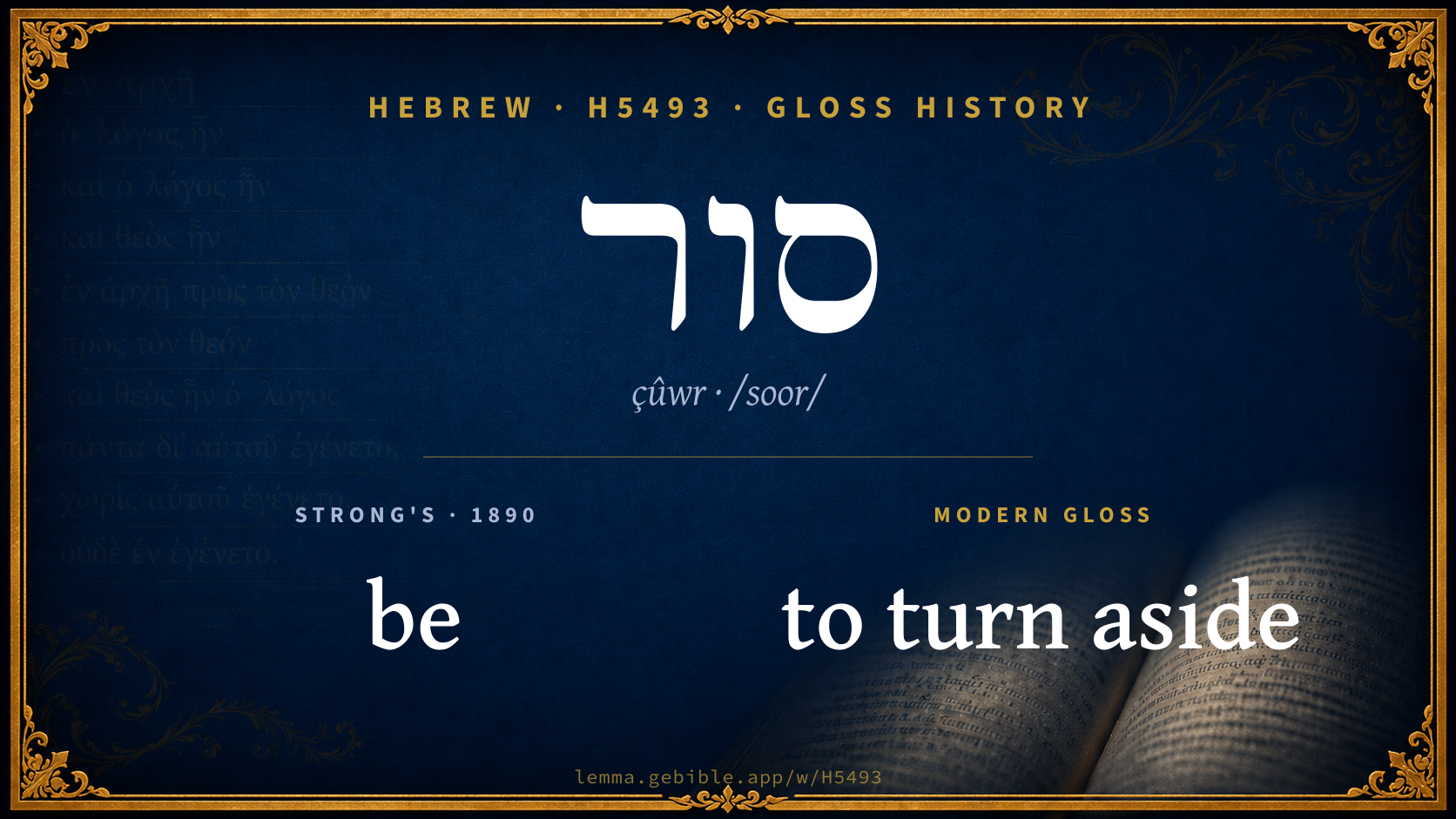
Gloss history
Strong's 1890 vs modern scholarship
About this word
Strong's H5493 catalogs a Hebrew word from the Hebrew Old Testament.
These counts are not copied from any lexicon or concordance. They are computed here, from the morphology-tagged Hebrew Old Testament. What Lemma adds →
- 283
- distinct verses
- The word appears in 283 distinct verses.
- 30 / 39
- OT books
- The word appears in 30 of 39 Old Testament books.
- #163
- by frequency
- Top 250 most frequent Hebrew words (rank 163 of 8,640 Hebrew words by occurrence).
View all 283 occurrences in the concordance →
By section of the Old Testament
By traditional corpus
Conventional, traditional groupings — biblical authorship is debated, so this is a traditional corpus grouping, not an authorship claim. Each share is this word’s portion of its verses in that division of the Hebrew canon. Each figure is a share of the word’s 283 distinct verses.
- Prophets (Nevi'im) 149 verses · 53%
- Writings (Ketuvim) 81 verses · 29%
- Torah (Pentateuch) 53 verses · 19%
How translations render this word
Counts come from each version’s own published word-to-Strong’s tagging or interlinear alignment — an approximate guide to how each version renders this word, not a word-level alignment the data otherwise carries. Because each total is that version’s own tagged count, the per-version totals vary from one another and need not match the appearance or distinct-verse counts above. These counts may also differ from a printed concordance because Lemma counts each distinctly tagged rendering and does not collapse phrase taggings into a single head-word total. This is a fixed set of word-tagged versions (KJV, ASV, BSB, ULT) and does not change with the reading translation you choose elsewhere. Each version’s license is shown beside its name below (and on Sources).
BDB lists this Strong’s number as 4 distinct words (homographs). Each count above pools all of them and is not split by sense — see the Senses section below. A low-frequency rendering may belong to a different one of those words, not the primary meaning.
- King James Version†: Depart 23×, Departed 9×, He departed 9×
- American Standard Version†: Depart 17×, Remove 9×, He departed 8×
- Berean Standard Bible†: Turn away 21×, Removed 19×, Turn aside 15×
- unfoldingWord Literal Text†: Turn aside 32×, Remove 27×, Turn away 27×
King James Version Public Domain
Renders H5493 across 308† tagged occurrences — most commonly:
Plus other, less common renderings. Plus 136 renderings that appear only once — usually multi-word phrases or single function words the recovered tagging swept in, not distinct renderings.
American Standard Version Public Domain
Renders H5493 across 306† tagged occurrences — most commonly:
Plus other, less common renderings. Plus 139 renderings that appear only once — usually multi-word phrases or single function words the recovered tagging swept in, not distinct renderings.
Berean Standard Bible Public Domain
Renders H5493 across 294† tagged occurrences — most commonly:
Plus other, less common renderings. Plus 120 renderings that appear only once — usually multi-word phrases or single function words the recovered tagging swept in, not distinct renderings. Not rendered by a distinct English word in 4 further occurrences.
unfoldingWord Literal Text CC BY-SA 4.0
Renders H5493 across 396† tagged occurrences — most commonly:
Plus other, less common renderings. Plus 89 renderings that appear only once — usually multi-word phrases or single function words the recovered tagging swept in, not distinct renderings.
11 senses and sub-senses in the full BDB
Hebrew verbs can shift meaning by stem (binyan): Qal is the basic action, Niphal is often passive or reflexive, Piel often intensifies or makes it factitive, and Hiphil is typically causative. The senses below are grouped under the stem BDB assigns to each. This entry also uses Hophal (the passive of Hiphil) and one or more reduplicated stems (the Pōlēl/Pilpēl type), which for hollow or geminate roots behave much like Piel — often intensive or iterative.
What do BDB’s symbols mean?
BDB uses these scholarly abbreviations:
| Symbol | Meaning |
|---|---|
| 𝔊 | the Septuagint (the ancient Greek translation, LXX) |
| 𝔙 | the Vulgate (the Latin translation) |
| 𝔖 | the Syriac version (the Peshitta) |
| 𝔗 | the Targum (the Aramaic translation) |
| ψ | the Psalms |
| √ | root (the underlying root or stem) |
| ‖ | parallel passage (a synonymous or contrasted parallel) |
| † | the dagger: every passage where the word occurs is cited |
The 11 senses and sub-senses the full Brown-Driver-Briggs lexicon distinguishes for this word, in lexicon order (not ranked by frequency), with BDB’s own verbatim wording and sub-sense lettering. Shown in Hebrew script with BDB’s own scholarly abbreviations. The condensed entry is in the Lexicon Entry tab. See also the Forms in the corpus table below.
סור I and (Ho 9
Qal
- Pf. 3 ms. סָר Ex 3:4 +; 3 fs. סָ֫רָה 1 S 16:14 +; 1 s. סָ֑רְתִּי ψ 119:102; 3 pl. סָרוּ Dt 9:12 +; 2 mpl. סַרְתֶּם v 16 +, etc.; Impf. 3 ms. יָסוּר Gn 49:10 +, וַיָּ֫סַר Ju 4:18 +; 3 fs. תָּסוּר 1 S 6:3 +; 1 s. cohort. אָסֻ֫רָה Ex 3:3; 3 mpl. יָסֻ֫רוּ Ex 25:15 +, etc.; Imv. ms. סוּר 2 S 2:22 +, etc.; Inf. abs. סוֹר Dn 9:5, סֹר v 11; cstr. סוּר Is 7:17 +; sf. שׂוּרִי Ho 9:12 (Ges§ 6 k Now); Pt. סָר Jb 1:1 +; f. cstr. סָרַת Pr 11:22; mpl. cstr. סָרֵי Je 6:28 (or from סרר, or שָׂר); pass. f. סוּרָה Is 49:21, c. intrans. meaning (Ges§ 50 f Köii. 1, 137), pl. sf. סוּרַי Je 17:13 Qr; and cstr. סוּרֵי 2:21;— e.g. Exodus 3:4
- 1. turn aside, out of one’s course 1 S 6:12 Dt 2:27, from following, מֵאַחֲרֵי pers. 2 S 2:21, 22, abs. v 23, from attacking, מֵעַל 2 Ch 20:10; turn in unto (for shelter, refuge, etc.), c. אֶל־, Gn 19:2, 3 (J) Ju 4:18(×3); 19:11, 12 2 K 4:11, c. לְ Ju 20:8, c. שָׁם 18:3; 19:15, שָׁ֫מָה 18:15 2 K 4:8 (+ inf.), v 10; c. הֵ֫נָּה Pr 9:4, 16 (in fig.); for purpose implied Ex 3:3 (J) Ru 4:1(×2), or expr. by inf. Ex 3:4 (J) Ju 14:8 Je 15:5 (in fig.); especially fig. turn aside from right path, from י׳, his commands, etc., usually c. מִן Ex 32:8 (J) Ju 2:17 Dt 9:12 + 7 times D, Pr 13:14 + 5 times Pr, + 10 times elsewhere, + 2 Ch 8:15 (ins. מִן); c. מֵאַחֲרֵי 1 S 12:20 + 4 times; c. מֵעַל Je 32:40 Ez 6:9; מִן + יָמִין etc. Dt 5:29; 17:11 2 K 22:2 = 2 Ch 34:2; abs. (sometimes = revolt) ψ 14:3 Je 5:23 Dt 11:16; 17:17 (subj. לֵבָב), וְסוּרַי Je 17:13 Qr (> יסורי Kt) read prob. וְסוּרֶיךָ those revolting from thee (Ew Gie); סוּרֵי הַגֶּפֶן נָכְרִיָּה Je 2:21 degenerate (shoots) of the foreign vine (fig.); סָרַת טַעַם Pr 11:22 a woman turning aside as to discretion, shewing lack of it; also from wrong path, sins (of Jerob.), etc., c. מִן 2 K 3:3; 14:24 + 7 times 2 K; c. מֵעַל 2 K 10:31; 15:18; c. מֵאַחֲרֵי 2 K 10:29; †סָר מֵרָע (pt.) Jb 1:1, 8; 2:3 also Is 59:15; סוּר מֵרָע (inf. and imv.) Jb 28:28 Pr 3:7; 13:19; 16:6, 17 ψ 34:15; 37:27. e.g. 1 Samuel 6:12
- 2. depart, usually c. מִן, of frogs Ex 8:7, flies v 25 (both J), sword 2 S 12:10; sceptre from Judah Gn 49:10 (poem in J): י׳’s hand 1 S 6:3, his kindness 2 S 7:15 (MT, but read אָסִיר 𝔊 𝔖 𝔙 ‖ 1 Ch 17:13 Th We Dr Klo Bu Kit HPS), his wrath Ez 16:42 (but del. Co Siegf Toy), depart from way = get out of the way, cease to obstruct Is 30:11, etc.; c. מִתּוֹךְ 1 S 15:6(×2); c. מֵעַל Is 7:17 Ju 16:19 Nu 12:10, etc.; of י׳ departing, מִן pers., Ho 9:12, מֵעַל Ju 16:20 1 S 28:16, מֵעִם 1 S 18:12; God, c. מִן Jb 21:14; 22:17, c. מֵעַל 1 S 28:15; רוּחַ י׳, c. מֵעִם 1 S 16:14; evil spirit, c. מֵעַל v 23; abs. depart [from Babyl.] Is 52:11(×2); = avoid contact La 4:15(×3); of wicked Jb 15:30 he shall not depart out of (מִנִּי) darkness, i.e. shall not avoid it, escape it; pt. pass. made to depart, thrust away, of Isr. under fig. of wife Is 49:21 (> act., according to BaNB § 124 c.). e.g. Exodus 8:7
- 3. of lifeless things = be removed, oppressor’s yoke, c. מֵעַל Is 14:25 cf. v 25 10:27; staves from (מִן) ark Ex 25:15; abs. iniquity Is 6:7; especially of בָּמוֹת 1 K 15:14; 22:44 2 K 12:4; 14:4; 15:4, 35 2 Ch 15:17; 20:33. e.g. Isaiah 14:25
- 4. = come to an end, Am 6:7 Is 11:13.—For סָר אֶל־ 1 S 22:14 read שַׂר עַל־ 𝔊 Th Dr Klo Bu Kit Löhr HPS; in 15:32 Th HPS del. סָר (after 𝔊 𝔙 𝔖) as dittogr.; סָר סָבְאָם Ho 4:18 v. סֹבֶא; Ho 7:14 read יָסוֹ֫רוּ for יָס֫וּרוּ (√ סרר q.v.); Je 6:28, it is uncertain whether (סוֹרְרִים) סָרֵי belongs here, revolters among the rebellious, or sub סרר, or even = שָׂרֵי princes, chiefs (cf. 1 S 22:14). e.g. Amos 6:7
Poʿlel
- Pf. 3 ms. דְּרָכַי סוֹרֵר La 3:11 he turned aside my ways (my steps). e.g. Lamentations 3:11
Hiphil
- Pf. 3 ms. הֵסִיר 2 K 18:4 +; 2 ms. וַהֲסִרֹ֫תָ consec. (Dr§ 110 (5) Obs.) 1 K 2:31; 1 s. הֲסִירֹ֫תִי 2 K 23:27 +, וַהֲסִרֹתִ֫י 1 S 17:46 +; 3 pl. הֵסִ֫ירוּ 2 Ch 30:14, etc.; Impf. 3 ms. יָסִיר Is 3:18 +, juss. יָסֵר Ex 8:4 +, וַיָּ֫סַר Gn 8:13 +; sf. וַיְסִרֵהוּ 1 S 18:13, וַיְסִרֶהָ 1 K 15:13, יְסִירֶנָּה Lv 3:4 +; 3 mpl. יָסִ֫ירוּ Is 5:23 +, etc.; Imv. ms. הָסֵר 1 K 20:24 +, הָסִיר Ez 21:31 (read הָסֵיר, הָסֵר); fs. הָסִ֫ירִי 1 S 1:14, etc.; Inf. abs. הָסֵר Gn 30:32 +; cstr. הָסִיר 2 K 6:32 +, etc.; Pt. מֵסִיר Is 3:1 + 3 times;— e.g. 2 Kings 18:4
- 1. cause to (turn aside,) depart, common word for remove, take away: c. מִן, Ex 8:4, 27; 33:23 (all J), 23:25 (E) Dt 7:15 1 S 28:3 Jos 7:13 (J) Ju 10:16 Is 3:1 ψ 18:23 (+ ‖ 2 S 22:23, read אָסִיר מִמֶּנִּי De Hup-Now HPS); shoulder from burden ψ 81:7; מֵסִיר אָזְנוֹ מִשְּׁמֹעַ Pr 28:9; + often, + Jb 33:17 (ins. מִן 𝔊 Ew Di De Hi Bu al.); c. מֵעַל, take off ring Gn 41:42 (E) Est 3:10, also 8:2 (abs.); garments Gn 38:14, 19 (J) Dt 21:13 Zc 3:4 1 S 17:39 (armour), also Ex 34:34 (P; abs.) and Ez 26:16 (Co ins. מֵעַל); take off head, מֵעַל 1 S 17:46, abs. 2 S 4:7; 16:9 2 K 6:32; c. מֵעַל also often fig. (from upon = from resting on, or burdening), plagues Ex 8:4; 10:17 (J), cf. Nu 21:7 (E), also 1 S 1:14 Am 5:23 1 K 2:31; reproach 1 S 17:26 Is 25:8; c. מֵעִם = from one’s presence 1 S 18:13, also of י׳ removing his kindness 1 Ch 16:13 + ‖ 2 S 7:15 (v. Qal 2); c. מֵעַל פָּנָיו, of י׳ removing Isr. 2 K 17:18, 23; 23:27; 24:3 Je 32:31; abs. 2 K 23:27; often abs., Gn 8:13 Noah removed the covering; remove = depose c. מִן 1 K 15:13 = 2 Ch 15:16 (v. מִן 7 b (b)), abs. 2 Ch 36:3, cf. Ju 9:29 Jb 34:20; remove בָּמוֹת, etc., 2 K 18:4, v 22 = Is 36:7 = 2 Ch 32:12, 2 K 23:19 2 Ch 30:14; 14:2, cf. 14:4; 17:5 (both c. מִן); = put away strange gods, etc., Gn 35:2 Jos 24:14, 23 (all E), 1 S 7:4, c. מִתּוֹךְ v 3 Is 58:9; once c. לְ, מֵסִיר שָׂפָה לְנֶאֱמָנִים Jb 12:20. e.g. Exodus 8:4
- 2. rarer uses are: put aside = leave undone Jos 11:15 (D); retract words Is 31:2 (of י׳); reject prayer ψ 66:20; abolish sacrifice Dn 11:31; turn one away מֵאַחֲרֵי, i.e. from following Dt 7:4; c. אֶל־ pers., remove the ark unto 2 S 6:10 = 1 Ch 13:13. e.g. Joshua 11:15
Hophal
- Pf. 3 ms. הוּסַר Lv 4:31 Dn 12:11; Impf. 3 ms. יוּסַר Lv 4:35; Pt. מוּסָר Is 17:1; pl. מוּסָרִים 1 S 21:7 (but final ם prob. dittogr. before מ We Dr Klo Kit HPS);—be taken away, removed: c. מִן Lv 4:35, מֵעַל v 31, מִלִּפְנֵי י׳ 1 S 21:7; מוּסָר מֵעִיר Is 17:1 Damascus is removed from being a city; abs. be abolished Dn 12:11 (cf. 11:31 Hiph.). e.g. Leviticus 4:31
סור II verb. properly Pt. of סור q.v.
סור III of a temple-gate
סור IV saw (‖ form of נָשַׂר
Qal
- Impf. 3 ms. וַיָּשַׂר 1 Ch 20:3 (but v. שׂים 1 a).—Ho 9:12 v. סור; Ju 9:22; Ho 8:4 v. שׂרר; 12:5 v. שׂרה. e.g. 1 Chronicles 20:3
Senses from the full Brown-Driver-Briggs lexicon (Brown, Driver, Briggs; Oxford 1906 — public domain), digitized via Sefaria, supplemented by the OpenScriptures HebrewLexicon (CC BY 4.0). Full attribution on Sources.
Word origin
I. and (Ho 9:12) [שׂוּר]300 vb. turn aside (NH Hiph. cause to turn aside, or apostatize; TelAm. sûru, n. rebel WklGloss.);—
II. adj.verb. properly Pt. of סור q.v.
III. n.pr. of a temple-gate;—שַׁעַר ס׳ 2 K 11:6 (> ‖ 2 Ch 23:5 שַׁעַר הַיְסוֹד, v. יְסוֹד), but del. ver. as gloss WeBleek’s Einl. 4:258 KmpKau Benz.
I. vb. saw (‖ form of נָשַׂר; denom. from מַשּׂוֹר?);—
— Brown-Driver-Briggs (Oxford 1906, public domain), digitized via Sefaria, supplemented by the OpenScriptures HebrewLexicon (CC BY 4.0). See Sources.
Origin: a primitive root
Jastrow Dictionary
A second Hebrew/Aramaic lexicon for comparison, covering Aramaic and post-biblical (Talmudic, Targumic, Midrashic) usage that the biblical-Hebrew BDB does not. Matched by lemma rather than by Strong’s number, so a lemma may carry more than one Jastrow headword (shown separately below), and the entries cover usage well beyond the Bible.
סוּר I
- (b. h.)
- 1. to go around; to turn; with ל to turn to, follow; with מן, מ־, to turn away; in gen. [to turn from the right path,] to go astray; to degenerate. Snh. 21ᵇ (ref. to Deut. XVII, 17) אני ארבה ולא אָסוּר I (Solomon) will take many wives and yet not go astray. Ber. 19ᵇ, a. fr. לאו דלא תָסוּר the prohibition inplied in the words, ‘thou shalt not deviate’ (from the decisions of the courts, the interpretations of the Rabbis, Deut. XVII, 11); a. fr. e.g. Deuteronomy 17:17
- 2. to pass away, cease. Num. R. s. 9 (ref. to Am. VI, 7) אותה שעה תָסוּר שמחת הסרוחים at that time shall the joy of the (corrupt) banqueters cease; a. e. e.g. Amos 6:7
- 1. to remove, take off. Num. R. s. 14 (play on סיר, Ps. LX, 10) והֵסַרְתִּי הצרעת מעליו and I removed the leprosy from him; שהסרתי אותו מן הטביעה whom I removed (saved) from drowning, v. טְבִיעָה I; Num. R. s. 12 הָסֵר הטומאה וכ׳ remove the uncleanness out of thy house; a. e. e.g. Psalms 60:10
- 2. to cause to deviate, to corrupt. Snh. II, 4 (ref. to Deut. XVII, 17) ובלבד שלא יהו מְסִירוֹת את לבו provided they (the wives) do not corrupt his heart; אפי׳ אחת ומְסִירָה וכ׳ even one wife, if she might corrupt his heart, he must not marry. Kidd. 68ᵇ (ref. to Deut. VII, 4) לרבות כל המְסִירִים this is to intimate the extension of the prohibition of intermarriage to all nations that might lead astray; Yeb. 23ᵃ; Ab. Zar. 36ᵇ המְסִירוֹת. e.g. Deuteronomy 17:17
- to be removed. Macc. 5ᵃ (ref. to סרה Deut. XIX, 16) עד שתּוּסַר גופה של עדות Ar. s. v. זמם (ed. שתסרה) until the testimony itself has been removed (an alibi has been proved). e.g. Deuteronomy 19:16
סוּר
- 1. to turn, esp. ס׳ סכינא (v. Ḥull. 17ᵇ, quot. s. v. טוּפְרָא) to turn the slaughtering knife on all sides, to examine. Erub. 63ᵃ רבינא סַר סכינא וכ׳ R. examined the slaughterer’s knife (assumed the rabbinical function of superintending the slaughtering) in Babylonia. Ḥull. 18ᵃ דלא סר וכ׳ who failed to examine his knife before an authorised scholar.
- 2. to go around, visit, superintend, esp. ס׳ ניכסיה (or ארעיה) to superintend one’s estate, examine, watch laborers &c.—Part. סָיֵיר. Ib. 105ᵃ מאן דסייר ניכסיה וכ׳ (Ar. סָאֵיר) he who goes around examining his property every day. Ib. וכ׳ אבא הוה ס׳ … ואנא לא סָיִירְנָא my father used to examine his estate twice a day, but I do it only once a day.
- same. B. Mets. 76ᵇ, sq. [read:] סַיְּירָהּ לארעיה וכ׳ (v. Rabb. D. S. a. l. note) he visited his fields &c. Gitt. 38ᵇ דמְסַיְּירֵי וכ׳ Rashi (ed. דסָיְירֵי) those who examine their property on the Sabbath; a. e.—V. סְעַר I.
סוּר II
- (b. h.) pr. n. שער הס׳ the gate of Sur, name of a Temple gate. Y. Erub. V, 22ᶜ
*סָוַר
- (cmp. צבר, v. סַוָּאר) to pile, arrange.—Part. pass. סָווּר; f. סְווּרָה; pl. סְווּרוֹת. Tosef. B. Bath. III, 6 העצים … האבנים ס׳ וכ׳ ed. Zuck. (Var. סוררות, some ed. סוירות, corr. acc.) wood or stones piled up whether for his untilled field (for building) or for his fence; v. סָדַר a. צָבַר.
סוֹר
- (= סאור, v. סִיאוּר) fermentation, froth, leaven; trnsf. (cmp. שְׂאוֹר, עִיסָה a. חָמַץ) germ, original nature, character. Snh. 92ᵇ סו̇רו̇ his haughty nature; [oth. opin.: its (the kiln’s) froth], v. מָקַק a. מָרַק. Kidd. 82ᵃ כל שעסקיו סורו רע … he who has a business which brings him in contact with women, has bad leaven in him (or else he would not have chosen such a trade). Hor. 13ᵃ מפני שסוֹרָן רע because they (the mice) are of a mischievous nature. B. Mets. 59ᵇ the Torah cautions repeatedly against ill-treating the proselyte (גֵּר), מפני שסורו רע because his original character is bad (into which ill treatment might cause him to relapse). Kidd. 17ᵇ שמא יחזור לסורו lest he (the proselyte) relapse &c., v. קִילְקוּל. Gen. R. s. 70 היה חוזר לסורו he (Aquila) might have gone back to his evil ways (to heathenism); v. סִיאוּר. Gen. R. s. 74, end (expl. למקומו, Gen. XXXII, 1) לסורו to his evil manners (sensual pleasures). Cant. R. to II, 5; a. e.—Pl. סוֹרִים degenerate, bad people. Num. R. s. 3 אפי׳ סוֹרֵיהֶן וכ׳ even the bad among them are charitable; (Midr. Till. to Ps. XCII בּוֹרִים שבהם). e.g. Genesis 32:1
A Dictionary of the Targumim, the Talmud Babli and Yerushalmi, and the Midrashic Literature (Marcus Jastrow; London, Luzac, 1903) — Public Domain. Digitized via Sefaria. Digitized via Sefaria. Full attribution on Sources.
Forms in the corpus
The 194 distinct written forms H5493 takes in the Hebrew Bible, most frequent first — each parse links to that stem’s occurrences in the concordance. Hebrew forms include their vowel points and cantillation, so a single lemma takes many written forms.
The 60 most common forms are shown; 134 rarer forms follow in the full concordance.
Same root — word family
Other BDB entries built from the same root as H5493, grouped by Strong’s listed origin. These share a root / origin per the lexicon — not necessarily a shared meaning. Each links to that word’s own entry.
Derived from this word
Proper names from this root
People and places named from this root — a name, not an additional meaning of the word.
Compare all same-root words → Showing 4 of 5 — not the complete family. 1 of the same-root words is a proper name (a person or place). They share a root, not necessarily a meaning.
Septuagint verse parallels
This word appears in 266 verses that also exist in the Greek Old Testament (Septuagint), out of the 283 Hebrew verses it occurs in. You can read those verses in Greek by switching the Old Testament edition to the Septuagint.
Read these verses in the Septuagint
- Genesis 8:13
- Exodus 3:3
- Leviticus 1:16
- Numbers 12:10
- Deuteronomy 2:27
- Joshua 1:7
- Judges 2:17
- Ruth 4:1
- 1 Samuel 1:14
- 2 Samuel 2:21
- 1 Kings 2:31
- 2 Kings 3:2
This is a verse-level parallel only — the same verses exist in both the Hebrew and Greek Old Testaments. No word-level Hebrew↔Greek correspondence is claimed: the data carries no such alignment, so no Greek word is shown as this Hebrew word’s translation. Coverage is not total — the Septuagint omits the deuterocanon and renumbers the Psalms, so some Hebrew verses have no direct Greek parallel.