
Proverbs 9:4

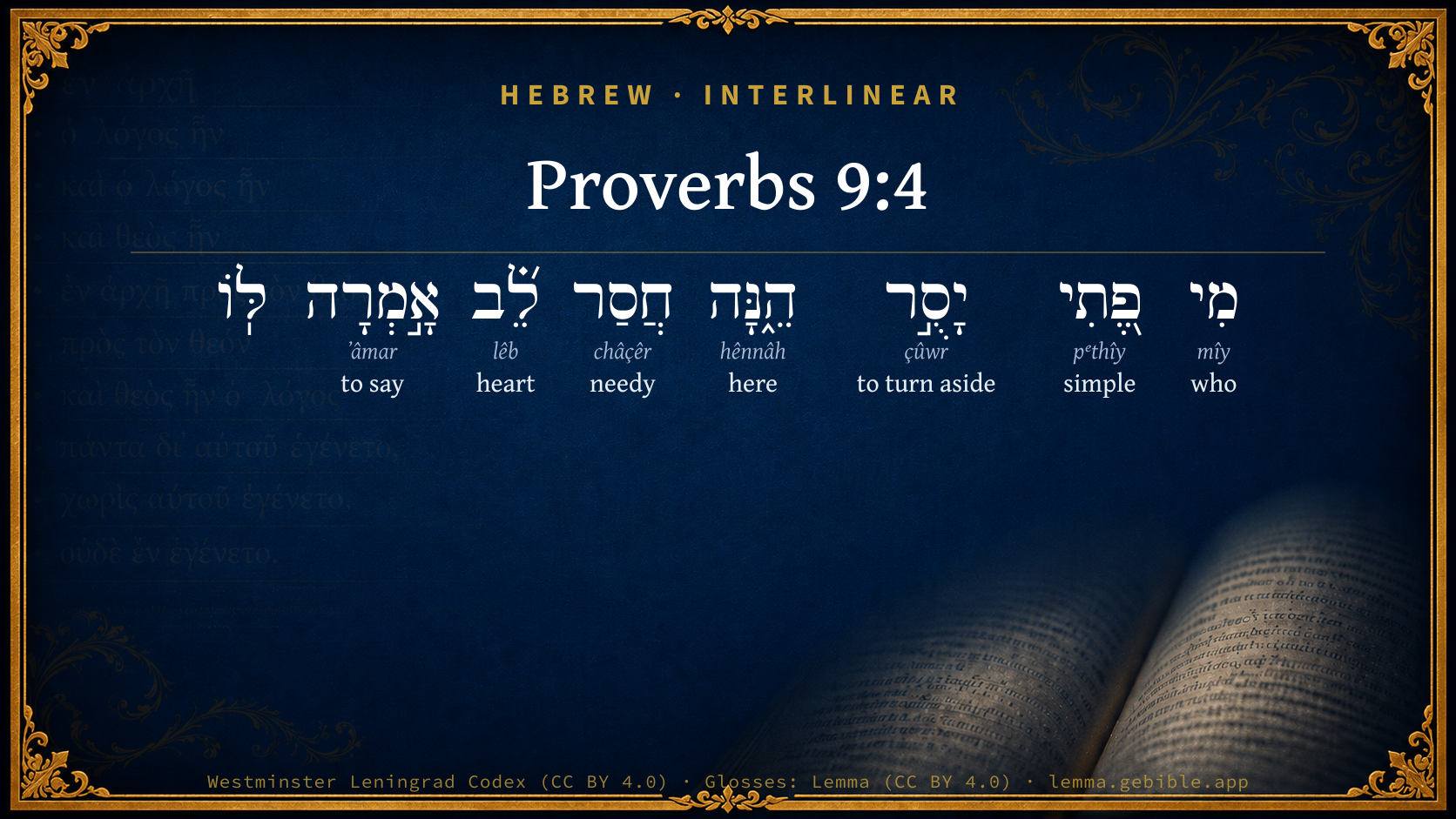
Hebrew (Westminster Leningrad Codex) Proverbs 9:4 appears in the Hebrew Old Testament. The text above is from the Westminster Leningrad Codex. Each word links to its Strong’s number, a concise gloss, and parsing drawn from the Open Scriptures Hebrew Bible morphology. Click any word for its full Brown-Driver-Briggs (BDB) entry.
Download image
Cite this verse

Proverbs 9:4 (World English Bible). Public Domain. Lemma interlinear Bible study tool, https://lemma.gebible.app/v/proverbs/9/4.

Show BibTeX & RIS
BibTeX
RIS
English Translation
"Whoever is simple, let him turn in here!" As for him who is void of understanding, she says to him,
World English Bible · Public Domain
Download a study sheet

One document with this verse’s original text, its word-by-word gloss line, the meaning frame, cross-references with their text, attributed commentary, and full source and license credits — printable, and it pastes into notes with its structure intact.

This verse Autodidact and up

Study sheet (.html) Plain text (.txt)

A passage Seminary Student

Up to 50 verses in one chapter. A passage sheet keeps up to 6 commentary sources and 12 cross-references per verse, in the order this page ranks them, and says so on the sheet whenever that leaves anything out. Ask for a single verse and you get the Autodidact verse sheet above.

Everything on this page stays free to read, with no account — the sheet is a download of what is already on screen, not access to it.

Want to remove ads? Support Godless Engineer
Compare translations 3

The same verse in 3 English versions, stacked beneath the original-language interlinear above. Click any original word for its lexicon entry.

Each is an independent rendering of the whole verse — the interlinear is not word-aligned to these translations.

Highlighted words mark where these versions differ — a whole-verse word diff, not a word-by-word alignment.

  • World English Bible Public Domain
    "Whoever is simple, let him turn in here!" As for him who is void of understanding, she says to him,
  • King James Version Public Domain
    Whoso is simple, let him turn in hither: as for him that wanteth understanding, she saith to him,
  • unfoldingWord Literal Text CC BY-SA 4.0
    “Whoever naive, let him turn aside here,” she says to him lacking of heart.

unfoldingWord Literal Text — © unfoldingWord, licensed CC BY-SA 4.0. Word-aligned USFM3 via Door43 (git.door43.org/unfoldingWord/en_ult).

Versions to compare (up to 4)

3 of 4 selected

Show all 18 translations

Every available English version of this verse, each an independent rendering of the whole verse.

  • World English Bible Public Domain
    "Whoever is simple, let him turn in here!" As for him who is void of understanding, she says to him,
  • Berean Standard Bible Public Domain
    “Whoever is simple, let him turn in here!” she says to him who lacks judgment.
  • Majority Standard Bible Public Domain
    “Whoever is simple, let him turn in here!” she says to him who lacks judgment.
  • King James Version Public Domain
    Whoso is simple, let him turn in hither: as for him that wanteth understanding, she saith to him,
  • American Standard Version (1901) Public Domain
    Whoso is simple, let him turn in hither: As for him that is void of understanding, she saith to him,
  • Revised Version (1885) Public Domain
    Whoso is simple, let him turn in hither: as for him that is void of understanding, she saith to him,
  • Geneva Bible (1599) Public Domain
    Who so is simple, let him come hither, and to him that is destitute of wisedome, she sayth,
  • Douay-Rheims (1899) Public Domain
    Whosoever is a little one, let him come to me. And to the unwise she said:
  • Young's Literal Translation Public Domain
    `Who `is' simple? let him turn aside hither.' Whoso lacketh heart: she hath said to him,
  • Literal Standard Version CC BY-SA 4.0
    “Who [is] simple? Let him turn aside here.” Whoever lacks heart: she has said to him,
  • Unlocked Literal Bible CC BY-SA 4.0
    “Who is naive? Let him turn aside here!” To the one lacking good sense she speaks.
  • unfoldingWord Literal Text CC BY-SA 4.0
    “Whoever naive, let him turn aside here,” she says to him lacking of heart.
  • Darby Bible Public Domain
    Whoso is simple, let him turn in hither. To him that is void of understanding, she saith,
  • World Messianic Bible Public Domain
    “Whoever is simple, let him turn in here!” As for him who is void of understanding, she says to him,
  • Webster's Bible Public Domain
    Whoever is simple, let him turn in hither: as for him that wanteth understanding, she saith to him,
  • Free Bible Version CC BY-SA 4.0
    “Everybody who needs to learn, come and see me!” To people who don't have any sense she says,
  • Bible in Basic English Public Domain
    Whoever is simple, let him come in here; and to him who has no sense, she says:
  • JPS Tanakh (1917) Public Domain
    'Whoso is thoughtless, let him turn in hither'; as for him that lacketh understanding, she saith to him:

Literal Standard Version (2020), Covenant Press — licensed CC BY-SA 4.0. Text via the HelloAO Bible API (eBible.org). Unlocked Literal Bible (unfoldingWord) — licensed CC BY-SA 4.0. Text via the HelloAO Bible API (eBible.org). unfoldingWord Literal Text — © unfoldingWord, licensed CC BY-SA 4.0. Word-aligned USFM3 via Door43 (git.door43.org/unfoldingWord/en_ult). Free Bible Version, Dr. Jonathan Gallagher — licensed CC BY-SA 4.0. Text via the HelloAO Bible API (eBible.org).

Word by word

More ways to search: Search by grammar → Find every occurrence → Compare this word →

Practice this passage: Drill this verse → Learn its vocabulary →

About this verse

These counts appear in no published source. They are computed here, from the morphology-tagged text and Lemma’s own curated glosses. What Lemma adds →

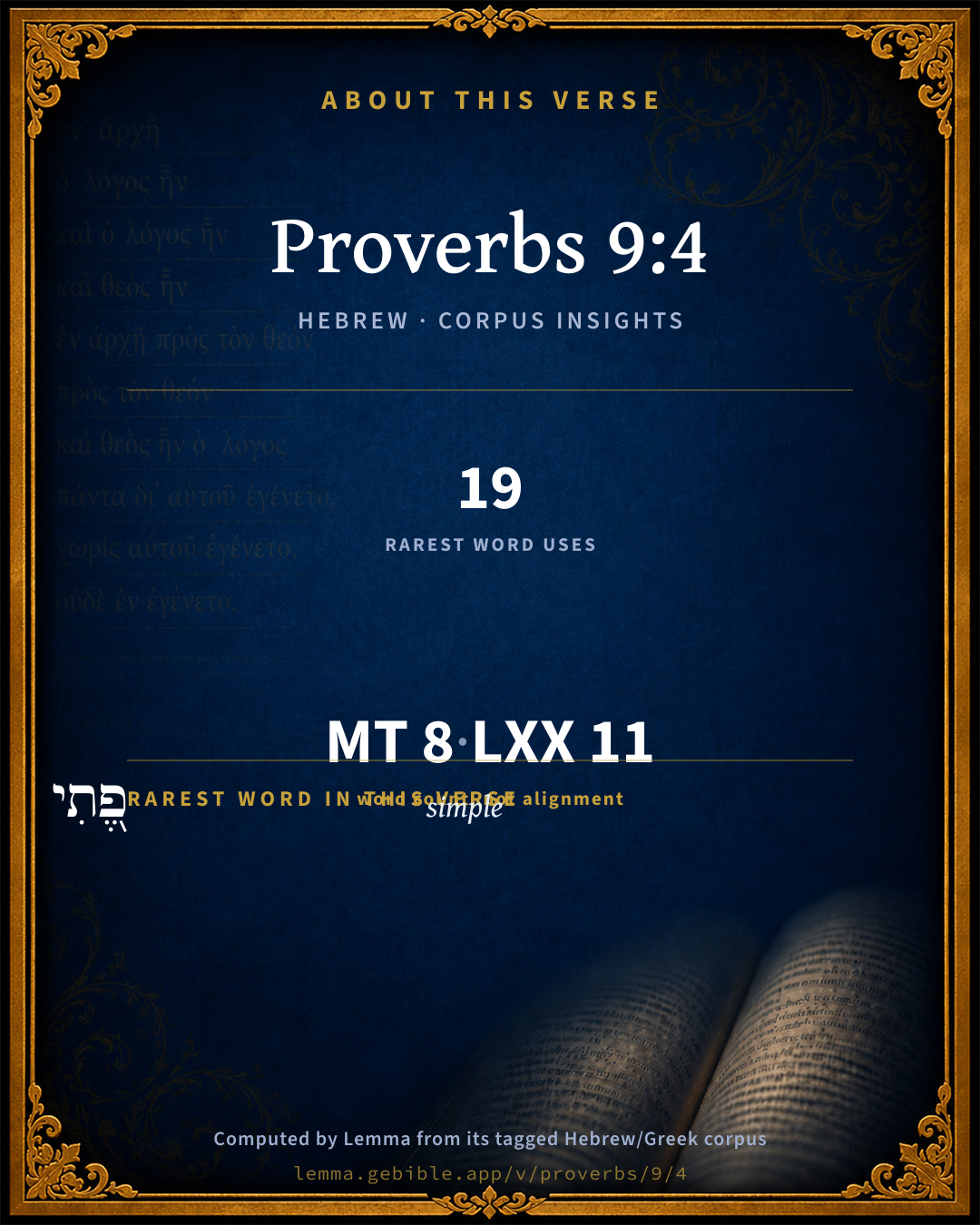
8
words
7
distinct lemmas
Wisdom
section

Notable vocabulary

The rarest word here is פֶ֭תִי simple H6612 — appearing just 19 times in the whole Hebrew Bible.

Shared distinctive vocabulary

פֶ֭תִי simple H6612 occurs in 18 verses of the Hebrew Bible. Also found in:

Grammatical profile

  • 2 verbs
  • 2 nouns
  • 1 adjective
  • 1 preposition
  • 1 adverb
  • 1 particle

Verb forms

  • יָסֻ֣ר Qal · Jussive
  • אָ֣מְרָה Qal · Perfect

Hebrew & Septuagint length

In English translation the verse runs 20 words from the Hebrew and 17 from the Septuagint (LXX English) — closely comparable.

A rough comparison of the two English renderings, which tokenize alike — not a word-level alignment.

Word counts can differ between the Hebrew and the Greek without any difference in meaning — e.g. the Hebrew direct-object marker אֵת has no separate Greek word, and Greek often adds the article ὁ.

In the original languages it is 8 Hebrew tokens and 11 Greek tokens — but the two are counted differently (Hebrew bundles its prefixes and suffixes into one token; the Greek is in lemma form), so that isn’t a like-for-like length.

Cross-references

9

Topical passages linked to Proverbs 9:4 in the Treasury of Scripture Knowledge — connected by theme and wording, ordered by reader-vote popularity; previews shown in the World English Bible.

  • Proverbs 6:32 He who commits adultery with a woman is void of understanding. He who does it destroys his own soul.
  • Proverbs 8:5 You simple, understand prudence. You fools, be of an understanding heart.
  • Proverbs 9:16 "Whoever is simple, let him turn in here." As for him who is void of understanding, she says to him,
  • Matthew 11:25 At that time, Jesus answered, "I thank you, Father, Lord of heaven and earth, that you hid these things from the wise and understanding, and revealed them to infants.
  • Psalms 19:7 Yahweh's law is perfect, restoring the soul. Yahweh's testimony is sure, making wise the simple.
  • Psalms 119:130 The entrance of your words gives light. It gives understanding to the simple.
  • Proverbs 1:22 "How long, you simple ones, will you love simplicity? How long will mockers delight themselves in mockery, And fools hate knowledge?
  • Revelation 3:17–18 Because you say, 'I am rich, and have gotten riches, and have need of nothing;' and don't know that you are the wretched one, miserable, poor, blind, and naked;
  • Revelation 22:17 The Spirit and the bride say, "Come!" He who hears, let him say, "Come!" He who is thirsty, let him come. He who desires, let him take the water of life freely.

Cross-references courtesy of OpenBible.info (CC BY 4.0).

Hebrew and Greek witnesses Masoretic Hebrew ↔ Greek Septuagint

The same verse in the two great witnesses to the Old Testament, shown verse-for-verse.

These are two independent witnesses, not word-aligned to each other, and the Septuagint is shown in lemma (dictionary) form.

Hebrew Proverbs 9:4 Masoretic · Westminster Leningrad Codex

מִי פֶ֭תִי יָסֻ֣ר הֵ֑נָּה חֲסַר לֵ֝֗ב אָ֣מְרָה לּֽוֹ

"Whoever is simple, let him turn in here!" As for him who is void of understanding, she says to him,

World English Bible · Public Domain

Greek LXX Proverbs 9:4 Septuagint · lemma form

ὅς εἰμί ἄφρων ἐκκλίνω πρός ἐγώ καί ὁ ἐνδεής φρήν εἶπον

Whoso is foolish, let him turn aside to me: and to them that lack understanding she says,

LXX2012 (modern English Septuagint) · Public Domain

On this verse, Keil & Delitzsch discusses the Septuagint’s reading. Read the note in Commentary ↓

Hebrew: Westminster Leningrad Codex (CC BY 4.0). Greek: Septuagint (public domain); English from LXX2012 (modern English Septuagint) (Public Domain). How the Septuagint differs from the Hebrew →

Commentary

Notes on Proverbs 9:4 from classic Christian and Jewish commentators (each source and its license shown beneath its notes). The classic Christian expositions comment on the surrounding passage and are grouped to its opening verse, so a note may address several verses; the Jewish commentaries on the Tanakh (Rashi and others) are per-verse, so they appear only where the commentator wrote on this verse.

Lemma curates 59 commentaries, every one of them public domain or Creative Commons licensed, each selected and text-cleaned for this edition rather than reprinted as found. About our sources →

Trapp's Complete Commentary

John Trapp

Pro 9:4 Whoso [is] simple, let him turn in hither: [as for] him that wanteth understanding, she saith to him,

Ver. 4. Whoso is simple.] And with it persuadable; that have not yet contracted that callum obductum, corneas fibras, brawny breasts, horny heart strings.

She saith to him.] It is Christ, then, that speaketh in his ministers: "He that heareth you heareth me." "Ye received it not as the word of man, but as it is indeed, the word of the ever living God."

John Trapp, A Commentary or Exposition upon All the Books of the Old and New Testament (1647–1656) — public domain. Text from a community e-Sword module.

Joseph Benson's Commentary

Pro 9:4-6. Whoso is simple — Ignorant, weak, and liable to be deceived, but willing to learn; let him turn in hither — For there is no man so ignorant but he is welcome to come and receive instruction. By this manner of speaking, Wisdom shows that she rejects those scholars who are proud and self-conceited. As for him that wanteth understanding — Hebrew, that wanteth a heart, which is put for understanding, Jer 5:21; Hos 7:11, and elsewhere. She saith to him, Come, eat of my bread — Partake of the provision which I have made; my nourishing and strengthening instructions; and drink of the wine which I have mingled — Receive my refreshing and invigorating comforts. Forsake the foolish — The ignorant and wicked; shun their company and their practices; converse not with them; conform not to their ways; have no fellowship with the unfruitful works of darkness, or with those that do such works. The first step toward virtue is to shun vice, and therefore to avoid the company of the vicious. And live — Arise from the dead and live indeed; not a mere animal life, such as brutes live, but now at length live the life of men, the life of Christians. Live a spiritual life, in union with God, and you shall live an eternal life in the enjoyment of him. And go in the way of understanding — Govern thyself by the rules of religion and right reason. It is not enough to forsake the foolish, but we must unite ourselves with those that walk in wisdom, and walk in the same spirit, and the same steps.

Joseph Benson's Commentary on the Old and New Testaments (1811–1818) — public domain. Text from a community e-Sword module.

Keil & Delitzsch

C. F. Keil & F. Delitzsch

Now follows the street-sermon of Wisdom inviting to her banquet:

4 Who is simple? let him come hither!"

Whoso wanteth understanding, to him she saith:

5 "Come, eat of my bread,

And drink of the wine which I have mingled!

6 Cease, ye simple, and live,

And walk straight on in the way of understanding."

The question מי פּתי (thus with Munach, not with Makkeph, it is to be written here and at Pro 9:16; vid., Baer's Torath Emeth, p. 40), quis est imperitus, is, as Psa 25:12, only a more animated expression for quisquis est. The retiring into the background of the נערות (servants), and the immediate appearance of Wisdom herself, together with the interruption, as was to be expected, of her connected discourses by the אמרה לּו, are signs that the pure execution of the allegorical representation is her at an end. Hitzig seeks, by the rejection of Pro 9:4, Pro 9:5, Pro 9:7-10, to bring in a logical sequence; but these interpolations which he cuts out are yet far more inconceivable than the proverbial discourses in the mouth of Wisdom, abandoning the figure of a banquet, which besides are wholly in the spirit of the author of this book. That Folly invites to her, Pro 9:16, in the same words as are used by Wisdom, Pro 9:4, is not strange; both address themselves to the simple (vid., on פּתי at Pro 1:4) and those devoid of understanding (as the youth, Pro 7:7), and seek to bring to their side those who are accessible to evil as to good, and do not dully distinguish between them, which the emulating devertat huc of both imports. The fourth verse points partly backwards, and partly forwards; 4a has its introduction in the תקרא of Pro 9:3; on the contrary, 4b is itself the introduction of what follows. The setting forth of the nom. absolutus חסר־לב is conditioned by the form of 4a; the מי (cf. 4a) is continued (in 4b) without its needing to be supplied: excors (= si quis est excors) dicit ei (not dixit, because syntactically subordinating itself to the תקרא). It is a nominal clause, whose virtual predicate (the devoid of understanding is thus and thus addressed by her) as in Pro 9:16.

Pro 9:5

The plur. of the address shows that the simple (inexperienced) and the devoid of understanding are regarded as essentially one and the same class of men. The בּ after לחם and שׁתה proceeds neither from the idea of eating into (hewing into) anything, nor from the eating with anything, i.e., inasmuch as one makes use of it, nor of pampering oneself with anything (as ראה ב); Michaelis at last makes a right decision (cf. Lev 22:11; Jdg 13:16; Job 21:25, and particularly לחם בּ, Psa 141:4): communicationem et participationem in re fruenda denotat; the lxx φάγετε τῶν ἐμῶν ἄρτων. The attributive מסכתּי stands with backward reference briefly for מסכתּיו. That Wisdom, Pro 9:2, offers flesh and wine, but here presents bread and wine, is no contradiction, which would lead us, with Hitzig, critically to reject Pro 9:4 and Pro 9:5 as spurious; לחם is the most common, all-comprehensive name for nourishment. Bertheau suitably compares Jahve's invitation, Isa 55:1, and that of Jesus, Joh 6:35.

Pro 9:6

That פתאים is a plur. with abstract signification (according to which the four Greek and the two Aramaean translations render it; the Graec. Venet., however, renders τοὺς νηπίους) is improbable; the author forms the abstr. Pro 9:13 otherwise, and the expression here would be doubtful. For פתאים is here to be rendered as the object-accus.: leave the simple, i.e., forsake this class of men (Ahron b. Joseph; Umbreit, Zckler); or also, which we prefer (since it is always a singular thought that the "simple" should leave the "simple"), as the vocative, and so that עזבוּ means not absolutely "leave off" (Hitzig), but so that the object to be thought of is to be taken from פתאים: give up, leave off, viz., the simple (Immanuel and others; on the contrary, Rashi, Meri, and others, as Ewald, Bertheau, decide in favour of פתאים as n. abstr.). Regarding וחיוּ, for et vivetis, vid., Pro 4:4. The lxx, paraphrasing: ἵνα εἰς τὸν αἰῶνα βασιλεύσητε. אשׁר is related to אשׁוּר (אשׁוּר) is דּרך to דּרך; the Piel, not in its intrans. (vid., Pro 4:14) but in its trans. sense (Isa 1:17; Isa 3:12, etc.), shows that the idea of going straight out and forwards connects itself therewith. The peculiarity of the פתי is just the absence of character.

Keil & Delitzsch — Biblical Commentary on the Old Testament (1861–1891) — public domain (CC PDM 1.0). Text via the HelloAO Bible API. (Old Testament only.)

Tyndale Open Study Notes

Tyndale Open Resources

9:4 Wisdom makes her appeal especially to the simple and those who lack good judgment because they have not yet decided between wisdom and folly. See 9:16, where Folly mimics and then perverts Wisdom’s words.

Tyndale Open Study Notes — © Tyndale Open Resources, licensed CC BY-SA 4.0. Text via the HelloAO Bible API.

Geneva Bible (1599)

Geneva Bible translators

He that knoweth his own ignorance, and is void of malice.

Geneva Bible (1599) marginal notes — public domain. Text via Bolls.life.

Jamieson, Fausset & Brown

Robert Jamieson, A. R. Fausset & David Brown

(Compare Pro 1:4; Pro 6:32). Wisdom not only supplies right but forbids wrong principles.

Jamieson, Fausset & Brown — Commentary Critical and Explanatory on the Whole Bible (1871) — public domain (CC PDM 1.0). Text via the HelloAO Bible API.

Adam Clarke's Commentary

Verse 4. Whoso is simple] Let the young, heedless, and giddy attend to my teaching.

Him that wanteth understanding] Literally, he that wanteth a heart; who is without courage, is feeble and fickle, and easily drawn aside from the holy commandment.

Adam Clarke's Commentary on the Bible (1810–1826) — public domain. Text from a community e-Sword/MySword module.

Ellicott's Commentary for English Readers

(4) Whoso is simple . . . as for him that wanteth understanding.—So God does not call many “wise men after the flesh, not many mighty, not many noble” (1Co_1:26); but chooses the “foolish,” “weak,” and “base,” whom man might overlook; not being willing that any should perish (2Pe_3:9), especially His “little ones” (Mat_18:14). who are liable to fall through their inexperience and want of judgment.

A Bible Commentary for English Readers, edited by Charles John Ellicott (1878–1897) — public domain. Text from a community e-Sword module.

John Gill's Exposition

Whoso is simple, let him turn in hither,.... Into Wisdom's house, so well built and furnished; the church of Christ, as a house of instruction; a school, where such who are "simple", weak, and foolish, may learn. Here are many instructors; saints instruct one another; ministers of the word are teachers; yea, Father, Son, and Spirit, here teach and instruct, and none teach like them. Here many lessons are to be learned concerning themselves, concerning Christ, and concerning their duty to God and men; all sorts of persons may learn here, such who know ever so much or ever so little. Or let him turn in here, as into an inn, into which passengers or travellers turn for accommodations; see Pro 9:15. The saints are travellers here, at a distance from their Father's house, and need refreshment by the way; the church of God is an inn of good accommodations; here is room enough to entertain them; here are good lodgings for rest and safety, and good provisions, and all of free cost. And now these are the words of Wisdom, or Christ, either in person, or by his maidens, his ministers, inviting such who are "simple" to turn in hither, and partake of the provisions in it; that is, not such who are quite stupid and insensible, sottish, incorrigible, and irreclaimable; but who are sensible of their folly and simplicity; who are but of weak capacities, apt to be credulous, and so easily imposed upon and deceived;

as for him that wanteth understanding; not the natural faculty of the understanding, nor an understanding of things natural and civil; but of things spiritual and evangelical, as of the grace of God; of salvation by Christ; of the work of the Spirit; of themselves and their state; of the Gospel, and the mysteries of it; and who are sensible of their ignorance and want of understanding; which is the first thing the Spirit of God convinces men of; or who are so in comparison of others, are weak in knowledge and experience. Now these Christ does not despise, but invites them into his house for instruction; and where can they be better? and who so fit and proper to be here, and be with Wisdom, than such as these?

she saith to him: as follows.

John Gill's Exposition of the Whole Bible (1746–1763) — public domain (CC PDM 1.0). Text via the HelloAO Bible API.

Haydock's Catholic Bible Commentary

One. Simple, but not inconstant, like children, 1 Corinthians xiv. 20. Pleasure addresses the same, (chap. vii. 7.) but for their destruction. (Calmet)

George Leo Haydock (1774–1849), Haydock's Catholic Family Bible and Commentary, 1859 edition — public domain. Excludes Psalms (Douay-Rheims chapter numbering differs from Protestant) and Deuterocanonical books (Catholic canon only).

Matthew Poole's English Annotations

Simple; ignorant, and weak, and subject to delusion, and willing to learn; to show that wisdom rejects those scholars who are proud and self-conceited.

Understanding, Heb. heart, which signifies understanding, Jer 5:21; Hos 7:11.

Matthew Poole's English Annotations on the Holy Bible (1683–1685) — public domain. Text from a community e-Sword/MySword module.

Whedon's Commentary on the Bible

Daniel D. Whedon

4. Simple — Uninstructed, a novice. (See on Pro_1:4.)

Wanteth understanding — Hebrew, lacketh heart, intelligence, sense. (See note on Pro_7:7.) Compare Pro_9:16.

Daniel D. Whedon (gen. ed.), Commentary on the Old and New Testaments (1874–1909) — public domain. Text from a community e-Sword module.

The Pulpit Commentary

Vers. 4-12. Here follows the invitation of Wisdom, urging the attendance of guests at the sumptuous banquet which she has prepared. (comp. Rev_19:9)

Whose is simple, lot him turn in hither. This is a direct address to the imprudent and inexperienced, (see on Pro_7:7) calling them to turn aside from the way on which they are going, and to come to her. Vulgate, si quis est parvulus veniat ad me, which reminds one of Christ"s tender words, "It is not the will of your Father which is in heaven, that one of these little ones should perish". (Mat_18:14)

As for him that wanteth understanding, she saith to him what follows (so ver. 16). Wisdom"s own speech is interrupted, and the writer himself introduces this little clause. She calls on the simple and the unwise, both as necessarily needing her teaching, and not yet inveterate in evil, nor wilfully opposed to better guidance. "The world by wisdom knew not God" and he "hath chosen the foolish things of the world to confound the wise, and the weak things of the world to confound the things that are mighty, and base things of the world, and things which are despised, hath God chosen". (1Co_1:21, 1Co_1:26, etc.; comp. Mat_11:25)

The Pulpit Commentary (1880–1919), ed. H.D.M. Spence-Jones & Joseph S. Exell — public domain. Text from a community e-Sword module.

John Wesley's Explanatory Notes

Simple - Ignorant, and weak.

John Wesley, Explanatory Notes Upon the Whole Bible (1754–1765) — public domain. Text via the GEBible commentary corpus.

Rashi

Rabbi Shlomo Yitzchaki (Rashi)

“Whoever is simple, let him turn in here” and learn it and become wise.

Rashi on the Tanakh — English translations: “The Judaica Press complete Tanach with Rashi, translated by A. J. Rosenberg” (CC BY 4.0); “Pentateuch with Rashi's commentary by M. Rosenbaum and A.M. Silbermann, 1929-1934” (public domain); “The Metsudah Tanach series, Lakewood, N.J” (CC BY 4.0); and “The Book of Joshua, Metsudah Publications, 1997” (CC BY 4.0). Text via Sefaria.

Lesson kit

Teaching starters — assembled from the data on this page, not authored interpretation. Every prompt links to the verse data it draws on. Edit before teaching.

Proverbs, in the Wisdom, opens this verse with 8 words (7 distinct Hebrew lemmas). Its most distinctive word is pᵉthîy (“simple”). A historical commentator’s framing appears above. Read the whole chapter for the surrounding context.

Discussion questions

  1. How does “simple” (pᵉthîy) shape what this verse is saying?
  2. Psalms 19:7 shares the word «simple» with this verse. How do the two illuminate each other?
  3. The translations on this page render this verse differently — a whole-verse word diff, not a word-by-word alignment. What might account for the different wordings?
  4. The verb «יָסֻ֣ר» is Qal Jussive. How does its form color the action?
  5. Reading how Trapp's Complete Commentary and Joseph Benson's Commentary read this verse, where do the two commentators agree and where do they part?

Things to notice

Reading settings

Reading text

Shown beneath each verse's original-language words.

Old Testament
Old Testament edition

Read the OT as the Masoretic Hebrew (MT) or the Greek Septuagint (LXX).

English shown for the Greek Septuagint (in the Hebrew ↔ Greek comparison).

Comparing translations? Open the Compare panel on any verse page to stack up to four side by side.