
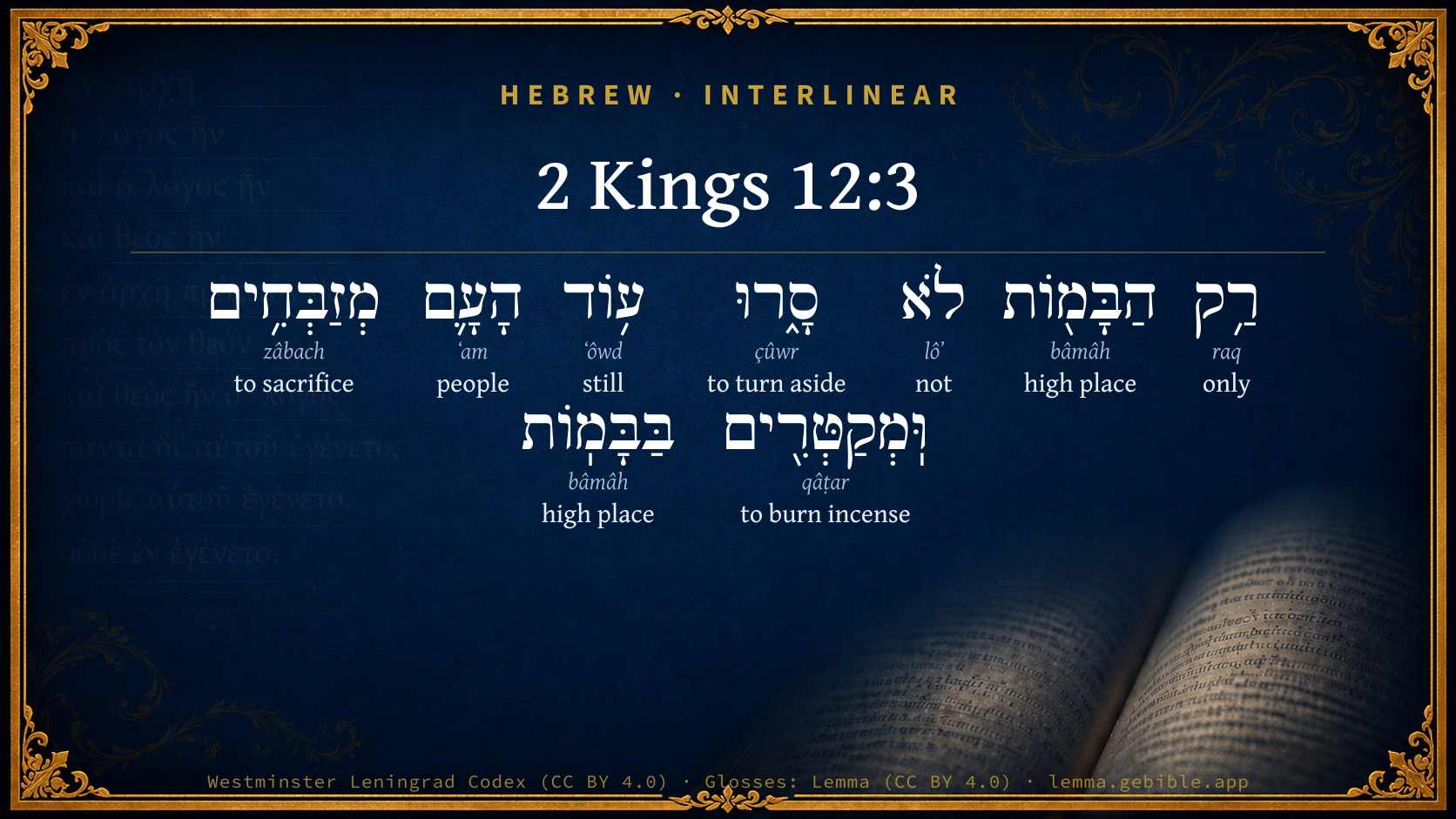
2 Kings 12:3

Hebrew (Westminster Leningrad Codex) 2 Kings 12:3 appears in the Hebrew Old Testament. The text above is from the Westminster Leningrad Codex. Each word links to its Strong’s number, a concise gloss, and parsing drawn from the Open Scriptures Hebrew Bible morphology. Click any word for its full Brown-Driver-Briggs (BDB) entry.
Download image
Cite this verse

2 Kings 12:3 (World English Bible). Public Domain. Lemma interlinear Bible study tool, https://lemma.gebible.app/v/2-kings/12/3.

Show BibTeX & RIS
BibTeX
RIS
English Translation
However the high places were not taken away; the people still sacrificed and burnt incense in the high places.
World English Bible · Public Domain
Download a study sheet

One document with this verse’s original text, its word-by-word gloss line, the meaning frame, cross-references with their text, attributed commentary, and full source and license credits — printable, and it pastes into notes with its structure intact.

This verse Autodidact and up

Study sheet (.html) Plain text (.txt)

A passage Seminary Student

Up to 50 verses in one chapter. A passage sheet keeps up to 6 commentary sources and 12 cross-references per verse, in the order this page ranks them, and says so on the sheet whenever that leaves anything out. Ask for a single verse and you get the Autodidact verse sheet above.

Everything on this page stays free to read, with no account — the sheet is a download of what is already on screen, not access to it.

Want to remove ads? Support Godless Engineer
Compare translations 3

The same verse in 3 English versions, stacked beneath the original-language interlinear above. Click any original word for its lexicon entry.

Each is an independent rendering of the whole verse — the interlinear is not word-aligned to these translations.

Highlighted words mark where these versions differ — a whole-verse word diff, not a word-by-word alignment.

  • World English Bible Public Domain
    However the high places were not taken away; the people still sacrificed and burnt incense in the high places.
  • King James Version Public Domain
    But the high places were not taken away: the people still sacrificed and burnt incense in the high places.
  • unfoldingWord Literal Text CC BY-SA 4.0
    Only they did not remove the high places. The people were still sacrificing and burning incense on the high places.

unfoldingWord Literal Text — © unfoldingWord, licensed CC BY-SA 4.0. Word-aligned USFM3 via Door43 (git.door43.org/unfoldingWord/en_ult).

Versions to compare (up to 4)

3 of 4 selected

Show all 18 translations

Every available English version of this verse, each an independent rendering of the whole verse.

  • World English Bible Public Domain
    However the high places were not taken away; the people still sacrificed and burnt incense in the high places.
  • Berean Standard Bible Public Domain
    Nevertheless, the high places were not removed; the people continued sacrificing and burning incense there.
  • Majority Standard Bible Public Domain
    Nevertheless, the high places were not removed; the people continued sacrificing and burning incense there.
  • King James Version Public Domain
    But the high places were not taken away: the people still sacrificed and burnt incense in the high places.
  • American Standard Version (1901) Public Domain
    Howbeit the high places were not taken away; the people still sacrificed and burnt incense in the high places.
  • Revised Version (1885) Public Domain
    Howbeit the high places were not taken away: the people still sacrificed and burnt incense in the high places.
  • Geneva Bible (1599) Public Domain
    But the hie places were not taken away: for the people offred yet and burnt incense in the hie places.
  • Douay-Rheims (1899) Public Domain
    But yet he took not away the high places: for the people still sacrificed and burnt incense in the high places.
  • Young's Literal Translation Public Domain
    only, the high places have not turned aside, still are the people sacrificing and making perfume in high places.
  • Literal Standard Version CC BY-SA 4.0
    only, the high places have not been removed—the people are still sacrificing and making incense in high places.
  • Unlocked Literal Bible CC BY-SA 4.0
    But the high places were not taken away. The people still sacrificed and burned incense on the high places.
  • unfoldingWord Literal Text CC BY-SA 4.0
    Only they did not remove the high places. The people were still sacrificing and burning incense on the high places.
  • Darby Bible Public Domain
    Only, the high places were not removed: the people still sacrificed and burned incense on the high places.
  • World Messianic Bible Public Domain
    However, the high places were not taken away. The people still sacrificed and burned incense in the high places.
  • Webster's Bible Public Domain
    But the high places were not taken away: the people still sacrificed and burnt incense in the high places.
  • Free Bible Version CC BY-SA 4.0
    Even so, the high places were not removed—the people went on sacrificing and presenting burnt offerings at these places.
  • Bible in Basic English Public Domain
    But the high places were not taken away; the people went on making offerings and burning them in the high places.
  • JPS Tanakh (1917) Public Domain
    (12-4) Howbeit the high places were not taken away; the people still sacrificed and offered in the high places.

Literal Standard Version (2020), Covenant Press — licensed CC BY-SA 4.0. Text via the HelloAO Bible API (eBible.org). Unlocked Literal Bible (unfoldingWord) — licensed CC BY-SA 4.0. Text via the HelloAO Bible API (eBible.org). unfoldingWord Literal Text — © unfoldingWord, licensed CC BY-SA 4.0. Word-aligned USFM3 via Door43 (git.door43.org/unfoldingWord/en_ult). Free Bible Version, Dr. Jonathan Gallagher — licensed CC BY-SA 4.0. Text via the HelloAO Bible API (eBible.org).

Word by word

More ways to search: Search by grammar → Find every occurrence → Compare this word →

Practice this passage: Drill this verse → Learn its vocabulary →

הַבָּמ֖וֹת
bâmâh
H1116
“the · high places”
Particle, Definite Article + Noun, Common, Feminine, Plural, Absolute
Part of Speech
Particle + Noun
Type
Common
Gender
Feminine
Number
Plural
State
Absolute
Full BDB Definition

Origin: from an unused root (meaning to be high)

TWOT: 253

high place, ridge, height, bamah (technical name for cultic platform) - high place, mountain - high places, battlefields - high places (as places of worship) - funeral mound?
  1. רַ֥ק raq H7535 “only” Particle, Accusative
  2. לֹא lôʼ H3808 “not” Particle, Negative
  3. סָ֑רוּ çûwr H5493 “to turn aside” Verb, Qal, Perfect, 3rd Person, Common, Plural
  4. ע֥וֹד ʻôwd H5750 “still” Adverb
  5. הָעָ֛ם ʻam H5971 “the · people” Particle, Definite Article + Noun, Common, Masculine, Singular, Absolute
  6. מְזַבְּחִ֥ים zâbach H2076 “sacrificing” Verb, Piel, Participle Active, Masculine, Plural, Absolute
  7. וּֽמְקַטְּרִ֖ים qâṭar H6999 “and · burning incense” Conjunction + Verb, Piel, Participle Active, Masculine, Plural, Absolute
  8. בַּבָּמֽוֹת bâmâh H1116 “in/at the · high places” Preposition, Determined + Noun, Common, Feminine, Plural, Absolute

About this verse

These counts appear in no published source. They are computed here, from the morphology-tagged text and Lemma’s own curated glosses. What Lemma adds →

9
words
8
distinct lemmas
Historical
section

Grammatical profile

  • 3 verbs
  • 3 nouns
  • 1 adverb
  • 2 particles

Verb forms

  • סָ֑רוּ Qal · Perfect
  • מְזַבְּחִ֥ים Piel · Participle Active
  • וּֽמְקַטְּרִ֖ים Piel · Participle Active

Repetition

A word recurs within this verse — often emphatic in Hebrew:

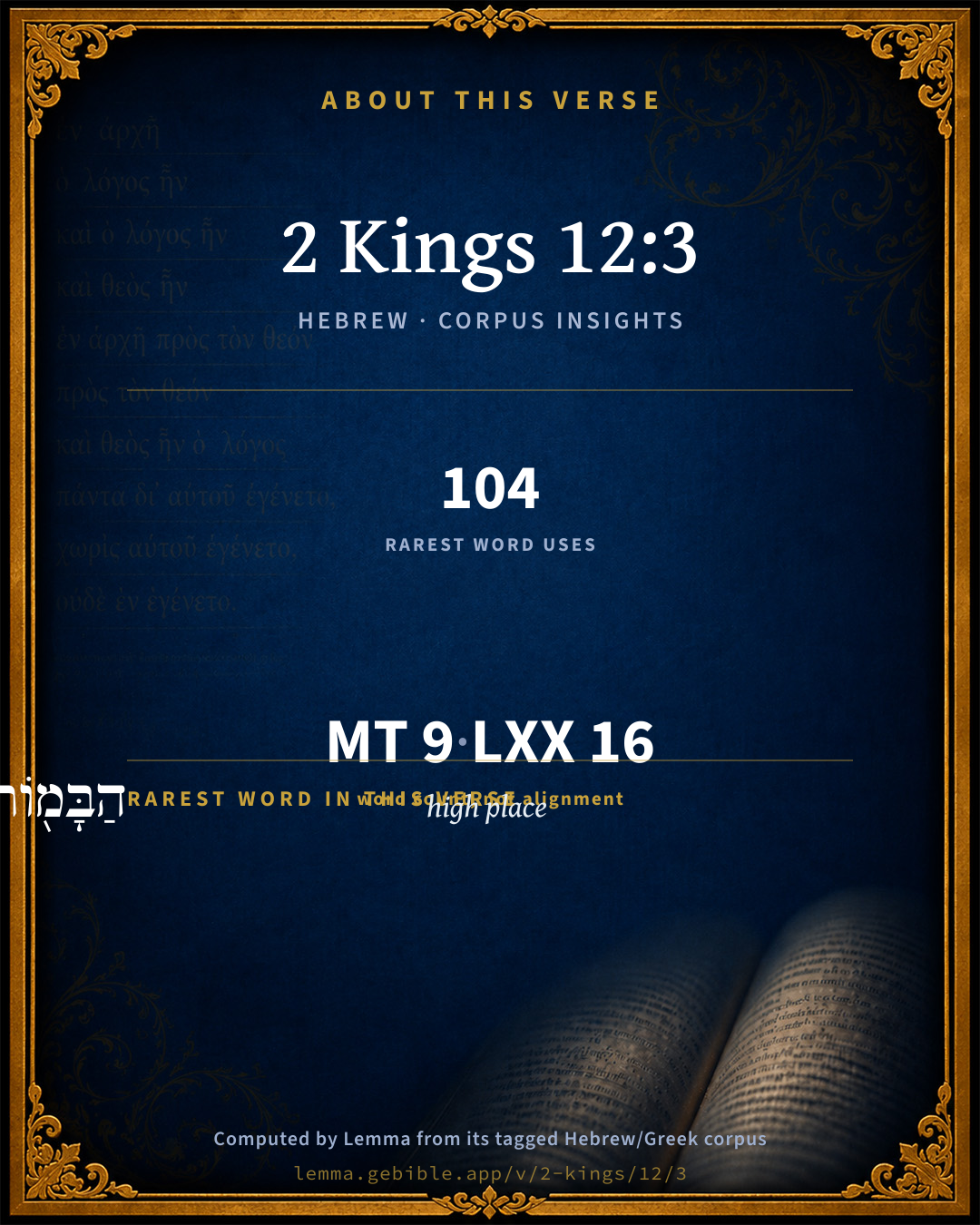
  • הַבָּמ֖וֹת high place H1116 ×2

Hebrew & Septuagint length

In English translation the verse runs 19 words from the Hebrew and 23 from the Septuagint (LXX English) — closely comparable.

A rough comparison of the two English renderings, which tokenize alike — not a word-level alignment.

Word counts can differ between the Hebrew and the Greek without any difference in meaning — e.g. the Hebrew direct-object marker אֵת has no separate Greek word, and Greek often adds the article ὁ.

In the original languages it is 9 Hebrew tokens and 16 Greek tokens — but the two are counted differently (Hebrew bundles its prefixes and suffixes into one token; the Greek is in lemma form), so that isn’t a like-for-like length.

Cross-references

7

Topical passages linked to 2 Kings 12:3 in the Treasury of Scripture Knowledge — connected by theme and wording, ordered by reader-vote popularity; previews shown in the World English Bible.

  • 2 Kings 14:4 However the high places were not taken away: the people still sacrificed and burnt incense in the high places.
  • 1 Kings 15:14 But the high places were not taken away: nevertheless the heart of Asa was perfect with Yahweh all his days.
  • 1 Kings 22:43 He walked in all the way of Asa his father; He didn't turn aside from it, doing that which was right in the eyes of Yahweh: however the high places were not taken away; the people still sacrificed and burnt incense in the high places.
  • 2 Kings 15:35 However the high places were not taken away: the people still sacrificed and burned incense in the high places. He built the upper gate of the house of Yahweh.
  • 2 Kings 18:4 He removed the high places, and broke the pillars, and cut down the Asherah: and he broke in pieces the brazen serpent that Moses had made; for to those days the children of Israel did burn incense to it; and he called it Nehushtan.
  • 2 Chronicles 31:4 Moreover he commanded the people who lived in Jerusalem to give the portion of the priests and the Levites, that they might give themselves to the law of Yahweh.
  • Jeremiah 2:20 For of old time I have broken your yoke, and burst your bonds; and you said, I will not serve; for on every high hill and under every green tree you did bow yourself, playing the prostitute.

Cross-references courtesy of OpenBible.info (CC BY 4.0).

Hebrew and Greek witnesses Masoretic Hebrew ↔ Greek Septuagint

The same verse in the two great witnesses to the Old Testament, shown verse-for-verse.

These are two independent witnesses, not word-aligned to each other, and the Septuagint is shown in lemma (dictionary) form.

Hebrew 2 Kings 12:3 Masoretic · Westminster Leningrad Codex

רַ֥ק הַבָּמ֖וֹת לֹא סָ֑רוּ ע֥וֹד הָעָ֛ם מְזַבְּחִ֥ים וּֽמְקַטְּרִ֖ים בַּבָּמֽוֹת

However the high places were not taken away; the people still sacrificed and burnt incense in the high places.

World English Bible · Public Domain

Greek LXX 2 Kings 12:3 Septuagint · lemma form

καί ποιέω ιωας ὁ εὐθής ἐνώπιον κύριος πᾶς ὁ ἡμέρα ὅς φωτίζω αὐτός ιωδαε ὁ ἱερεύς

Only there were not any of the high places removed, and the people still sacrificed there, and burned incense on the high places.

LXX2012 (modern English Septuagint) · Public Domain

Hebrew: Westminster Leningrad Codex (CC BY 4.0). Greek: Septuagint (public domain); English from LXX2012 (modern English Septuagint) (Public Domain). How the Septuagint differs from the Hebrew →

Targum (Aramaic paraphrase)

1

The Targum is the ancient Jewish Aramaic paraphrase of the Hebrew Scriptures — an interpretive translation, not the Hebrew text itself. Onkelos (literal) and Pseudo-Jonathan (expansive) render the Torah, and Jonathan the Prophets. Coverage is partial: where no permissively-licensed English translation exists for a verse, only the Aramaic is shown. This is verse-level text, not a word-by-word alignment to the Hebrew.

  1. Targum Jonathan Prophets (Joshua–Malachi)
    וַעֲבַד יְהוֹאָשׁ דְכָשַׁר קֳדָם יְיָ כָּל יוֹמוֹהִי כְּמָא דְאַלְפֵיהּ יְהוֹיָדָע כַּהֲנָא:

    (no public-domain English translation for this verse)

    Targum Jonathan — Aramaic: “Mikraot Gedolot” (public domain). English: “Sefaria Community Translation” (CC0 1.0 (public-domain dedication)); “London "Chaldee Paraphrase," 1871” (public domain). Text via Sefaria.

Commentary

Notes on 2 Kings 12:3 from classic Christian and Jewish commentators (each source and its license shown beneath its notes). The classic Christian expositions comment on the surrounding passage and are grouped to its opening verse, so a note may address several verses; the Jewish commentaries on the Tanakh (Rashi and others) are per-verse, so they appear only where the commentator wrote on this verse.

Lemma curates 59 commentaries, every one of them public domain or Creative Commons licensed, each selected and text-cleaned for this edition rather than reprinted as found. About our sources →

Trapp's Complete Commentary

John Trapp

2Ki 12:3 But the high places were not taken away: the people still sacrificed and burnt incense in the high places.

Ver. 3. But the high places.] Tyrannus ille trium literarum, mos; Custom had so prevailed, that Jehoiada durst not advise the king to cross the people in this superstition, lest it should cause a tumult; lest they should more regard commotioners than commissioners, and be more guided by rage, than by right; violence and obstinacy, like two untamed horses, drawing their desires in a blindfold career, as it fell out here in England when King Edward VI began to reform.

John Trapp, A Commentary or Exposition upon All the Books of the Old and New Testament (1647–1656) — public domain. Text from a community e-Sword module.

Joseph Benson's Commentary

2Ki 12:3. But the high places were not taken away — The people were so much and so strangely addicted to these private altars, (on which they sacrificed to the true God,) that the preceding kings, though men of riper years and greater power and courage than Jehoash, and firmly established on their thrones, were not able to remove them. And, therefore, it is not strange that Jehoiada could not now take them away, when the king was young, and not well settled in his kingdom, and when the people were more corrupt and disorderly through Athaliah’s mal-administration.

Joseph Benson's Commentary on the Old and New Testaments (1811–1818) — public domain. Text from a community e-Sword module.

Geneva Bible (1599)

Geneva Bible translators

So hard a thing it is for them, that are in authority, to be brought to the perfect obedience of God.

Geneva Bible (1599) marginal notes — public domain. Text via Bolls.life.

Jamieson, Fausset & Brown

Robert Jamieson, A. R. Fausset & David Brown

But the high places were not taken away--The popular fondness for the private and disorderly rites performed in the groves and recesses of hills was so inveterate that even the most powerful monarchs had been unable to accomplish their suppression; no wonder that in the early reign of a young king, and after the gross irregularities that had been allowed during the maladministration of Athaliah, the difficulty of putting an end to the superstitions associated with "the high places" was greatly increased.

Jamieson, Fausset & Brown — Commentary Critical and Explanatory on the Whole Bible (1871) — public domain (CC PDM 1.0). Text via the HelloAO Bible API.

Adam Clarke's Commentary

Verse 3. The high places were not taken away] Without the total destruction of these there could be no radical reform. The toleration of any species of idolatry in the land, whatever else was done in behalf of true religion, left, and in effect fostered, a seed which springing up, regenerated in time the whole infernal system. Jehoiada did not use his influence as he might have done; for as he had the king's heart and hand with him, he might have done what he pleased.

Adam Clarke's Commentary on the Bible (1810–1826) — public domain. Text from a community e-Sword/MySword module.

Ellicott's Commentary for English Readers

(3) But.—Save that; as at 2Ki_15:4. (For the statement of the verse, comp. 1Ki_15:14.)

Sacrificed . . . burnt.—Were wont to sacrifice . . . burn. The worship of the high places continued even under the régime of Jehoiada.

A Bible Commentary for English Readers, edited by Charles John Ellicott (1878–1897) — public domain. Text from a community e-Sword module.

The Cambridge Bible for Schools and Colleges

gen. ed. J. J. S. Perowne

3. But [R.V. Howbeit] the high places were not taken away] Worship having been permitted there before the temple was erected, it was difficult to draw the people away from them, as they would be nearer at hand than the one place set apart for sacrifice, viz. Jerusalem, and they would also have acquired a degree of consecration from long use.

The Cambridge Bible for Schools and Colleges (gen. ed. J. J. S. Perowne; Cambridge University Press, 1878–1918) — public domain. Text from a community e-Sword module.

John Gill's Exposition

But the high places were not taken away,.... Used before the temple was built, or set up in Rehoboam's time, Kg1 14:23 contrary to the law of God, which required that sacrifices should only be offered in the place the Lord chose to dwell in, Deu 12:4 the people still sacrificed and burnt incense in the high places; as they had done in the times of Athaliah, and though the pure worship of God was restored at Jerusalem; and indeed this they did in all preceding reigns; nor was it in the power of the best of kings, at least they did not think it safe to attempt to remove them till Hezekiah's time; so fond were the people of them because of their antiquity and supposed sanctity, and for the sake of ease.

the people still sacrificed and burnt incense in the high places; as they had done in the times of Athaliah, and though the pure worship of God was restored at Jerusalem; and indeed this they did in all preceding reigns; nor was it in the power of the best of kings, at least they did not think it safe to attempt to remove them till Hezekiah's time; so fond were the people of them because of their antiquity and supposed sanctity, and for the sake of ease.

2 Kings 12:4

kg2 12:4

kg2 12:4

kg2 12:4And Jehoash said to the priests,.... Being minded or having it in his heart, to repair the temple, as in Ch2 24:4 not only because it was the sanctuary of the Lord, though that chiefly, but because it had been a sanctuary to him, where he was hid and preserved six years:

all the money of the dedicated things that is brought into the house of the Lord: or rather, "that is to be brought", as De Dieu, and others render it, the particulars of which follow:

even the money of everyone that passeth the account; or that passeth among them that are numbered, as in Exo 30:13 that were upwards of twenty years of age, and bound to pay the half shekel for the ransom of their souls; and it is called the collection or burden Moses laid on them in the wilderness, Ch2 24:6.

the money that every man is set at; the price the priest set upon or estimated a man at, or whomsoever that belonged to him, that he devoted to the Lord, which by the law he was bound to pay for his redemption, and, till that was done, he and they were not his, but the Lord's, of which see Lev 27:1 and here the Targum calls it, the money of the redemption of souls, which is the gift of a man for the redemption of his soul:

and all the money that cometh into any man's heart to bring into the house of the Lord: vows and freewill offerings made of their own accord.

John Gill's Exposition of the Whole Bible (1746–1763) — public domain (CC PDM 1.0). Text via the HelloAO Bible API.

Albert Barnes' Notes on the Bible

The worship on the “high places” seems to have continued uninterruptedly to the time of Hezekiah, who abolished it 2Ki 18:4. It was, however, again established by Manasseh, his son 2Ki 21:3. The priests at this time cannot have regarded it as idolatrous, or Jehoiada would have put it during his regency.

Albert Barnes' Notes on the Bible (1834–1885) — public domain. Text from a community e-Sword/MySword module.

Haydock's Catholic Bible Commentary

Places, to the true God, but contrary to his law. The king was deterred from overturning these altars, through human policy; which did not meet with the divine approbation. (Calmet) See 3 Kings xxii. 24., and Deuteronomy xii. 8.

George Leo Haydock (1774–1849), Haydock's Catholic Family Bible and Commentary, 1859 edition — public domain. Excludes Psalms (Douay-Rheims chapter numbering differs from Protestant) and Deuterocanonical books (Catholic canon only).

Matthew Poole's English Annotations

The people were so fondly and strangely addicted to

the high places, that the foregoing kings, though men of riper years, and great power and courage, and finally settled in their thrones, could not take them away; and therefore it is not strange if Jehoiada could not now remove them, when the king was very young and tender, and not well settled in his kingdom, and when the people were more corrupt and disorderly through Athaliah’s maladministration.

Sacrificed and burnt incense in the high places to God.

Matthew Poole's English Annotations on the Holy Bible (1683–1685) — public domain. Text from a community e-Sword/MySword module.

Whedon's Commentary on the Bible

Daniel D. Whedon

3. High places were not taken away — And these were a constant temptation to idolatry. A nation that had been so thoroughly flooded with idolatrous practices as Israel could not be morally safe with these temptations ever before their eyes. The failure to abolish these was one great mistake of Joash and other kings who attempted reformation. Compare notes on 1Ki_3:2; 1Ki_15:14.

Daniel D. Whedon (gen. ed.), Commentary on the Old and New Testaments (1874–1909) — public domain. Text from a community e-Sword module.

The Pulpit Commentary

But the high places were not taken away. So it had been with the best of the previous kings of Judah, as Asa (1Ki_15:14) and Jehoshaphat; (1Ki_22:43) and so it was with the other "good" kings (2Ki_14:4 2Ki_15:4, 2Ki_15:35) until the reign of Hezekiah, by whom the high places were removed (see below,. (2Ki_18:4) We must remember that it was Jehovah who was worshipped in the "high places," not Baal, or Moloch, or Ashtoreth. (see the comment on 1Ki_15:14) The people still sacrificed and burnt incense in the high places. The people, not the king, in the earlier portion of his reign; but in the later portion, probably the king also. (see 2Ch_24:17, 2Ch_24:18)

The Pulpit Commentary (1880–1919), ed. H.D.M. Spence-Jones & Joseph S. Exell — public domain. Text from a community e-Sword module.

John Wesley's Explanatory Notes

Burnt incense - To the true God.

John Wesley, Explanatory Notes Upon the Whole Bible (1754–1765) — public domain. Text via the GEBible commentary corpus.

Rashi

Rabbi Shlomo Yitzchaki (Rashi)

All his days, as Yehoyoda the kohein instructed him. But after Yehoyoda died, the officers of Yehudah came to prostrate themselves before the king, and they deified him. They said to him, “One who enters the Holy of Holies for only a moment is in danger of dying, yet were hidden there for six years, so you are fit to be a deity.” Then the king listened to them. instructed him,” i.e., as long as Yehoyada was alive.—Radak Or, “all his days” refers to Yehoyada’s days. After Yehoyada died, Yoash began to worship asheirohs and other idols. When Zecharyoh prophesied against him, Yoash had him killed, and the following year Arom attacked Yerusholayim.

Rashi on the Tanakh — English translations: “The Judaica Press complete Tanach with Rashi, translated by A. J. Rosenberg” (CC BY 4.0); “Pentateuch with Rashi's commentary by M. Rosenbaum and A.M. Silbermann, 1929-1934” (public domain); “The Metsudah Tanach series, Lakewood, N.J” (CC BY 4.0); and “The Book of Joshua, Metsudah Publications, 1997” (CC BY 4.0). Text via Sefaria.

Lesson kit

Teaching starters — assembled from the data on this page, not authored interpretation. Every prompt links to the verse data it draws on. Edit before teaching.

2 Kings, in the Historical, opens this verse with 9 words (8 distinct Hebrew lemmas). Its most distinctive word is bâmâh (“high place”). A historical commentator’s framing appears above. Read the whole chapter for the surrounding context.

Discussion questions

  1. The word bâmâh carries the sense “high place.” How does it shape the verse?
  2. 2 Kings 14:4 shares this passage’s theme. How do the two illuminate each other?
  3. “high place” occurs 2× in this one verse. What is the effect of the repetition?
  4. These translations render this verse differently; the difference is in the English rendering, not the original. What questions does that raise?
  5. The verb «סָ֑רוּ» is Qal Perfect. How does its form color the action?
  6. Reading how Trapp's Complete Commentary and Joseph Benson's Commentary read this verse, where do the two commentators agree and where do they part?

Things to notice

Reading settings

Reading text

Shown beneath each verse's original-language words.

Old Testament
Old Testament edition

Read the OT as the Masoretic Hebrew (MT) or the Greek Septuagint (LXX).

English shown for the Greek Septuagint (in the Hebrew ↔ Greek comparison).

Comparing translations? Open the Compare panel on any verse page to stack up to four side by side.