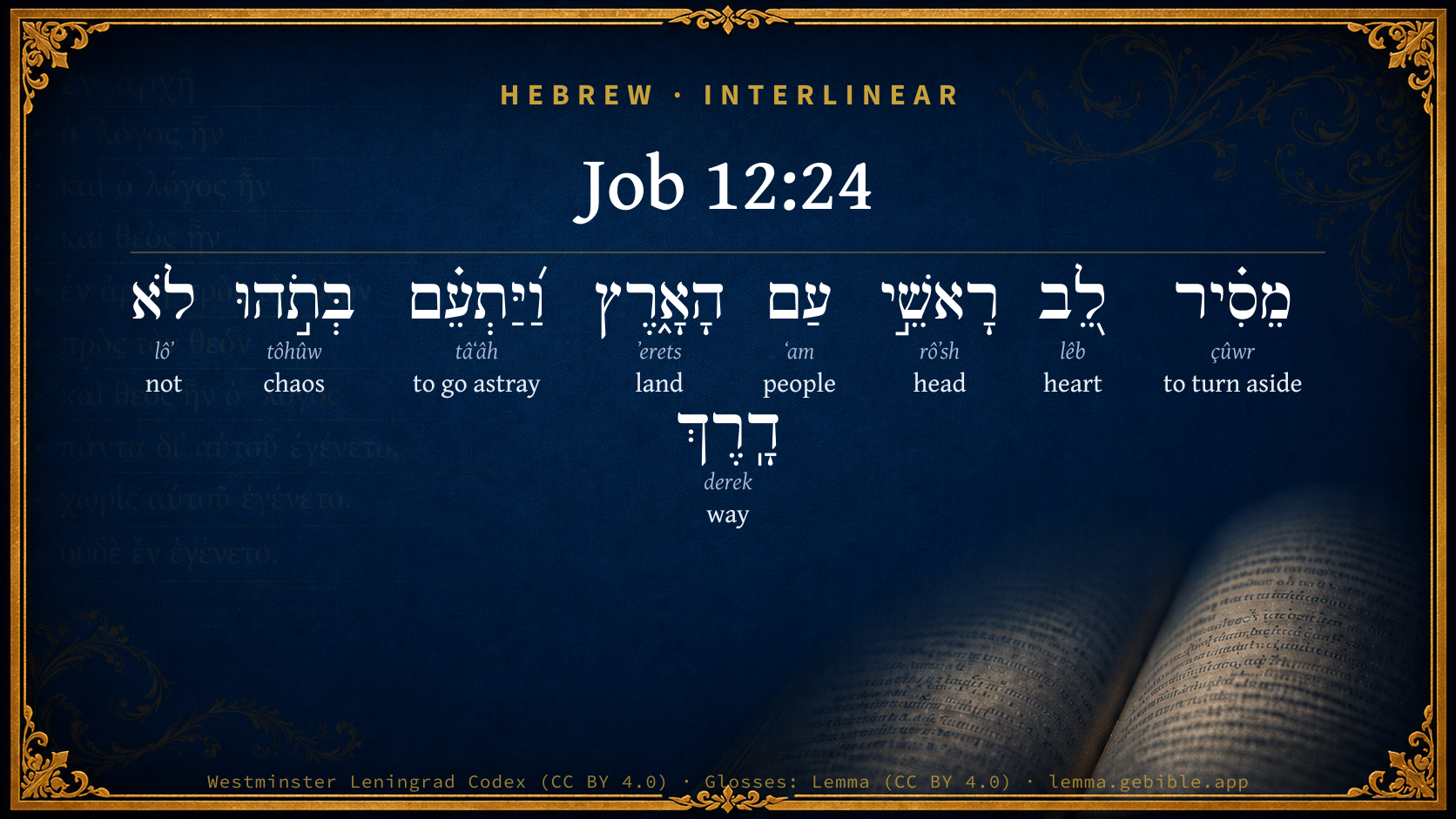
Job 12:24

Hebrew (Westminster Leningrad Codex) Job 12:24 appears in the Hebrew Old Testament. The text above is from the Westminster Leningrad Codex. Each word links to its Strong’s number, a concise gloss, and parsing drawn from the Open Scriptures Hebrew Bible morphology. Click any word for its full Brown-Driver-Briggs (BDB) entry.
Download image
Cite this verse

Job 12:24 (World English Bible). Public Domain. Lemma interlinear Bible study tool, https://lemma.gebible.app/v/job/12/24.

Show BibTeX & RIS
BibTeX
RIS
English Translation
He takes away understanding from the chiefs of the people of the earth, And causes them to wander in a wilderness where there is no way.
World English Bible · Public Domain
Download a study sheet

One document with this verse’s original text, its word-by-word gloss line, the meaning frame, cross-references with their text, attributed commentary, and full source and license credits — printable, and it pastes into notes with its structure intact.

This verse Autodidact and up

Study sheet (.html) Plain text (.txt)

A passage Seminary Student

Up to 50 verses in one chapter. A passage sheet keeps up to 6 commentary sources and 12 cross-references per verse, in the order this page ranks them, and says so on the sheet whenever that leaves anything out. Ask for a single verse and you get the Autodidact verse sheet above.

Everything on this page stays free to read, with no account — the sheet is a download of what is already on screen, not access to it.

Want to remove ads? Support Godless Engineer
Compare translations 3

The same verse in 3 English versions, stacked beneath the original-language interlinear above. Click any original word for its lexicon entry.

Each is an independent rendering of the whole verse — the interlinear is not word-aligned to these translations.

Highlighted words mark where these versions differ — a whole-verse word diff, not a word-by-word alignment.

  • World English Bible Public Domain
    He takes away understanding from the chiefs of the people of the earth, And causes them to wander in a wilderness where there is no way.
  • King James Version Public Domain
    He taketh away the heart of the chief of the people of the earth, and causeth them to wander in a wilderness where there is no way.
  • unfoldingWord Literal Text CC BY-SA 4.0
    the one removing a heart from the leaders of the people of the earth, and he causes them to wander in a wasteland no path.

unfoldingWord Literal Text — © unfoldingWord, licensed CC BY-SA 4.0. Word-aligned USFM3 via Door43 (git.door43.org/unfoldingWord/en_ult).

Versions to compare (up to 4)

3 of 4 selected

Show all 18 translations

Every available English version of this verse, each an independent rendering of the whole verse.

  • World English Bible Public Domain
    He takes away understanding from the chiefs of the people of the earth, And causes them to wander in a wilderness where there is no way.
  • Berean Standard Bible Public Domain
    He deprives the earth’s leaders of reason and makes them wander in a trackless wasteland.
  • Majority Standard Bible Public Domain
    He deprives the earth’s leaders of reason and makes them wander in a trackless wasteland.
  • King James Version Public Domain
    He taketh away the heart of the chief of the people of the earth, and causeth them to wander in a wilderness where there is no way.
  • American Standard Version (1901) Public Domain
    He taketh away understanding from the chiefs of the people of the earth, And causeth them to wander in a wilderness where there is no way.
  • Revised Version (1885) Public Domain
    He taketh away the heart of the chiefs of the people of the earth, and causeth them to wander in a wilderness where there is no way.
  • Geneva Bible (1599) Public Domain
    He taketh away the heartes of the that are the chiefe ouer the people of the earth, and maketh them to wander in the wildernes out of the way.
  • Douay-Rheims (1899) Public Domain
    He changeth the heart of the princes of the people of the earth, and deceiveth them that they walk in vain where there is no way.
  • Young's Literal Translation Public Domain
    Turning aside the heart Of the heads of the people of the land, And he causeth them to wander In vacancy -- no way!
  • Literal Standard Version CC BY-SA 4.0
    Turning aside the heart || Of the heads of the people of the land, || And He causes them to wander || In vacancy—no way!
  • Unlocked Literal Bible CC BY-SA 4.0
    He takes away understanding from the leaders of the people of the earth; he causes them to wander in a wilderness where there is no path.
  • unfoldingWord Literal Text CC BY-SA 4.0
    the one removing a heart from the leaders of the people of the earth, and he causes them to wander in a wasteland no path.
  • Darby Bible Public Domain
    He taketh away the understanding of the chiefs of the people of the earth, and causeth them to wander in a pathless waste.
  • World Messianic Bible Public Domain
    He takes away understanding from the chiefs of the people of the earth, and causes them to wander in a wilderness where there is no way.
  • Webster's Bible Public Domain
    He taketh away the heart of the chief of the people of the earth, and causeth them to wander in a wilderness where there is no way.
  • Free Bible Version CC BY-SA 4.0
    He removes the understanding of rulers and makes them wander in the wilderness.
  • Bible in Basic English Public Domain
    He takes away the wisdom of the rulers of the earth, and sends them wandering in a waste where there is no way.
  • JPS Tanakh (1917) Public Domain
    He taketh away the heart of the chiefs of the people of the land, and causeth them to wander in a wilderness where there is no way.

Literal Standard Version (2020), Covenant Press — licensed CC BY-SA 4.0. Text via the HelloAO Bible API (eBible.org). Unlocked Literal Bible (unfoldingWord) — licensed CC BY-SA 4.0. Text via the HelloAO Bible API (eBible.org). unfoldingWord Literal Text — © unfoldingWord, licensed CC BY-SA 4.0. Word-aligned USFM3 via Door43 (git.door43.org/unfoldingWord/en_ult). Free Bible Version, Dr. Jonathan Gallagher — licensed CC BY-SA 4.0. Text via the HelloAO Bible API (eBible.org).

Word by word

More ways to search: Search by grammar → Find every occurrence → Compare this word →

Practice this passage: Drill this verse → Learn its vocabulary →

בְּתֹ֣הוּ
tôhûw
H8414
“in/at · chaos”
Preposition + Noun, Common, Masculine, Singular, Absolute
Part of Speech
Preposition + Noun
Type
Common
Gender
Masculine
Number
Singular
State
Absolute
Full BDB Definition

Origin: from an unused root meaning to lie waste

TWOT: 2494a

formlessness, confusion, unreality, emptiness - formlessness (of primeval earth) - nothingness, empty space - that which is empty or unreal (of idols) (figuratively) - wasteland, wilderness (of solitary places) - place of chaos - vanity
  1. מֵסִ֗יר çûwr H5493 “turning aside” Verb, Hiphil, Participle Active, Masculine, Singular, Absolute
  2. לֵ֭ב lêb H3820 “heart of” Noun, Common, Masculine, Singular, Construct
  3. רָאשֵׁ֣י rôʼsh H7218 “heads of” Noun, Common, Masculine, Plural, Construct
  4. עַם ʻam H5971 “people of” Noun, Common, Masculine, Singular, Construct
  5. הָאָ֑רֶץ ʼerets H776 “the · land” Particle, Definite Article + Noun, Common, Both, Singular, Absolute
  6. וַ֝יַּתְעֵ֗ם tâʻâh H8582 “and · to go astray · them” Conjunction + Verb, Hiphil, Sequential Imperfect, 3rd Person, Masculine, Singular + Suffix, Personal, 3rd Person, Masculine, Plural
  7. לֹא lôʼ H3808 “not” Particle, Negative
  8. דָֽרֶךְ derek H1870 “way” Noun, Common, Both, Singular, Absolute

About this verse

These counts appear in no published source. They are computed here, from the morphology-tagged text and Lemma’s own curated glosses. What Lemma adds →

9
words
9
distinct lemmas
Wisdom
section

Notable vocabulary

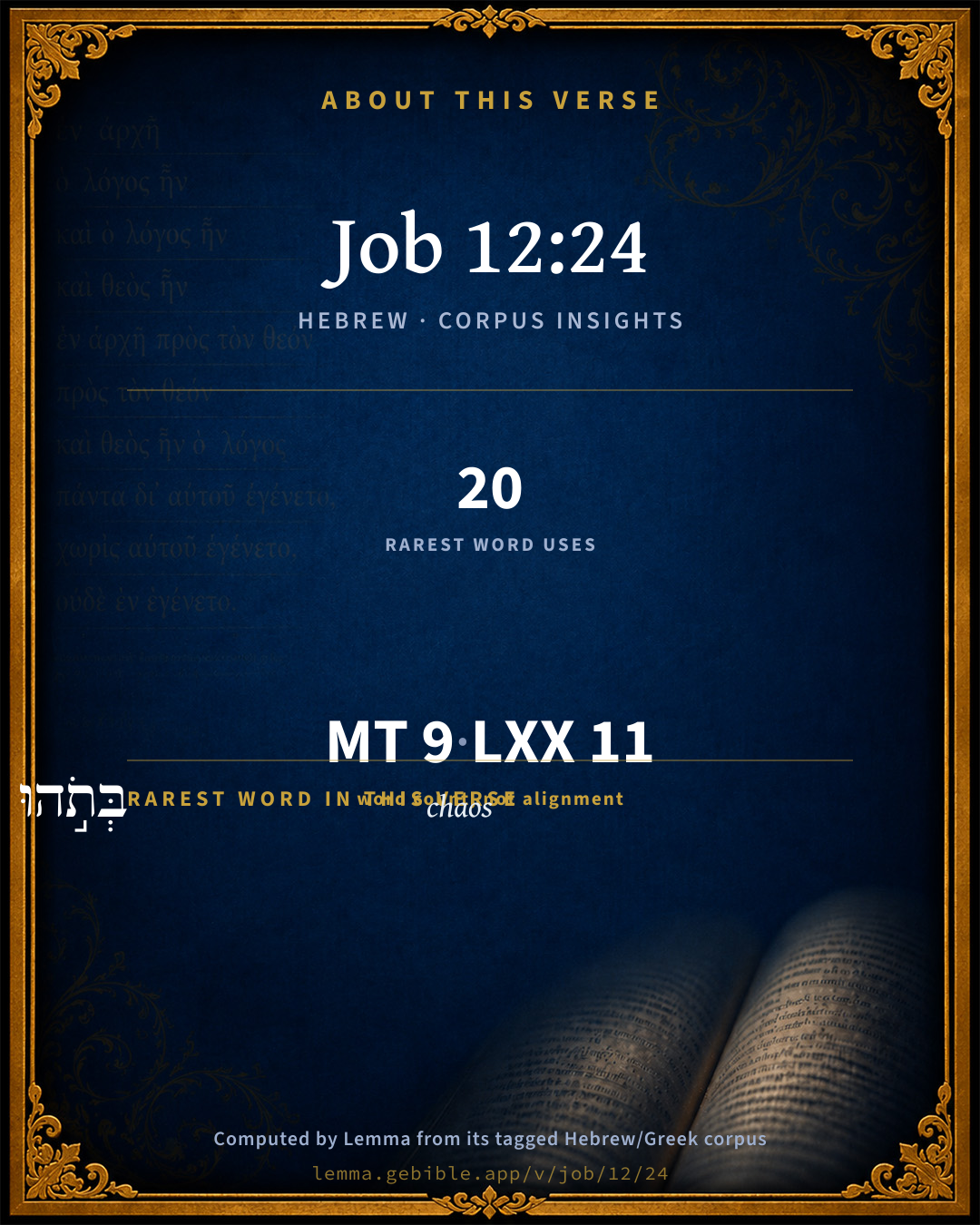
The rarest word here is בְּתֹ֣הוּ chaos H8414 — appearing just 20 times in the whole Hebrew Bible.

Shared distinctive vocabulary

בְּתֹ֣הוּ chaos H8414 occurs in 19 verses of the Hebrew Bible. Also found in:

Grammatical profile

  • 2 verbs
  • 6 nouns
  • 1 particle

Verb forms

  • מֵסִ֗יר Hiphil · Participle Active
  • וַ֝יַּתְעֵ֗ם Hiphil · Sequential Imperfect

Hebrew & Septuagint length

In English translation the verse runs 26 words from the Hebrew and 23 from the Septuagint (LXX English) — closely comparable.

A rough comparison of the two English renderings, which tokenize alike — not a word-level alignment.

Word counts can differ between the Hebrew and the Greek without any difference in meaning — e.g. the Hebrew direct-object marker אֵת has no separate Greek word, and Greek often adds the article ὁ.

In the original languages it is 9 Hebrew tokens and 11 Greek tokens — but the two are counted differently (Hebrew bundles its prefixes and suffixes into one token; the Greek is in lemma form), so that isn’t a like-for-like length.

Cross-references

9

Topical passages linked to Job 12:24 in the Treasury of Scripture Knowledge — connected by theme and wording, ordered by reader-vote popularity; previews shown in the World English Bible.

  • Psalms 107:40 He pours contempt on princes, And causes them to wander in a trackless waste.
  • Job 12:20 He removes the speech of those who are trusted, And takes away the understanding of the elders.
  • Hosea 7:11 "Ephraim is like an easily deceived dove, without understanding. They call to Egypt. They go to Assyria.
  • Job 17:4 For you have hidden their heart from understanding, Therefore shall you not exalt them.
  • Psalms 107:4 They wandered in the wilderness in a desert way. They found no city to live in.
  • Isaiah 6:9–10 He said, "Go, and tell this people, 'You hear indeed, But don't understand; And you see indeed, But don't perceive.'
  • Isaiah 19:1 The burden of Egypt. Behold, Yahweh rides on a swift cloud, and comes to Egypt: and the idols of Egypt shall tremble at his presence; and the heart of Egypt shall melt in the midst of it.
  • Daniel 4:16 let his heart be changed from man's, and let a animal's heart be given to him; and let seven times pass over him.
  • Daniel 4:33 The same hour was the thing fulfilled on Nebuchadnezzar: and he was driven from men, and ate grass as oxen, and his body was wet with the dew of the sky, until his hair was grown like eagles' [feathers], and his nails like birds' [claws].

Cross-references courtesy of OpenBible.info (CC BY 4.0).

Hebrew and Greek witnesses Masoretic Hebrew ↔ Greek Septuagint

The same verse in the two great witnesses to the Old Testament, shown verse-for-verse.

These are two independent witnesses, not word-aligned to each other, and the Septuagint is shown in lemma (dictionary) form.

Hebrew Job 12:24 Masoretic · Westminster Leningrad Codex

מֵסִ֗יר לֵ֭ב רָאשֵׁ֣י עַם הָאָ֑רֶץ וַ֝יַּתְעֵ֗ם בְּתֹ֣הוּ לֹא דָֽרֶךְ

He takes away understanding from the chiefs of the people of the earth, And causes them to wander in a wilderness where there is no way.

World English Bible · Public Domain

Greek LXX Job 12:24 Septuagint · lemma form

διαἀλλάσσω καρδία ἄρχων γῆ πλανάω δέ αὐτός ὁδός ὅς οὐ οἶδα

Perplexing the minds of the princes of the earth: and he causes them to wander in a way, they have not known, saying,

LXX2012 (modern English Septuagint) · Public Domain

Hebrew: Westminster Leningrad Codex (CC BY 4.0). Greek: Septuagint (public domain); English from LXX2012 (modern English Septuagint) (Public Domain). How the Septuagint differs from the Hebrew →

Commentary

Notes on Job 12:24 from classic Christian and Jewish commentators (each source and its license shown beneath its notes). The classic Christian expositions comment on the surrounding passage and are grouped to its opening verse, so a note may address several verses; the Jewish commentaries on the Tanakh (Rashi and others) are per-verse, so they appear only where the commentator wrote on this verse.

Lemma curates 59 commentaries, every one of them public domain or Creative Commons licensed, each selected and text-cleaned for this edition rather than reprinted as found. About our sources →

Trapp's Complete Commentary

John Trapp

Job 12:24 He taketh away the heart of the chief of the people of the earth, and causeth them to wander in a wilderness [where there is] no way.

Ver. 24. He taketh away the heart of the chief of the people] That is, of the greatest part of the people of the world (say some). These God suffereth to walk in their own ways, Act 14:16; to become vain in their imaginations, and their foolish heart is darkened; professing themselves to be wise, they become fools, Rom 1:21-22. As the philosophers of old, and the Chinese at this day, who are known to be ingenious, and used to say of themselves, that all other nations of the world see but with one eye, they only with two (Description of the World, of China and Cataia), yet continue they gross idolaters, mere heathens, having no less than a hundred thousand gods, which they worship one while and whip another, if they come not at a call. But the most interpreters, by chief or heads of the people, here understand their governors, of whom, though Job had said as much in effect before, {Job 12:17} viz. that God dispiriteth and besotteth them for a plague to the people who follow their rulers (and fall with them), as the body of a beast followeth the head; yet because few observe and improve this truth, therefore he repeateth and illustrateth it by three elegant similes. And first,

He causeth them to wander in a wilderness, &c.] Not knowing which way to extricate themselves. They beat their brains about it, but to no purpose; they are so bewildered and puzzled, as if they were treading a maze; and this God causeth, he is active in it, while he withdraws his light, and delivereth them up to their own foolish hearts, and to the prince of darkness, to be further benighted, 2Co 4:4.

John Trapp, A Commentary or Exposition upon All the Books of the Old and New Testament (1647–1656) — public domain. Text from a community e-Sword module.

Jamieson, Fausset & Brown

Robert Jamieson, A. R. Fausset & David Brown

heart--intelligence.

wander in a wilderness--figurative; not referring to any actual fact. This cannot be quoted to prove Job lived after Israel's wanderings in the desert. Psa 107:4, Psa 107:40 quotes this passage.

Jamieson, Fausset & Brown — Commentary Critical and Explanatory on the Whole Bible (1871) — public domain (CC PDM 1.0). Text via the HelloAO Bible API.

Adam Clarke's Commentary

Verse 24. He taketh away the heart of the chief] Suddenly deprives the leaders of great counsels, or mighty armies of courage; so that, panic-struck, they flee when none pursueth, or are confounded when about to enter on the accomplishment of important designs.

And causeth them to wander in a wilderness] A plain allusion to the journeyings of the Israelites in the deserts of Arabia, on their way to the promised land. Their chief, Aaron, had his courage all taken away by the clamours of the people; and so made them a molten calf to be the object of their worship, which defection from God was the cause of their wandering nearly forty years in the trackless wilderness. The reference is so marked, that it scarcely admits of a doubt; yet Houbigant and some others have called it in question, and suppose that those chiefs or heads of families which led out colonies into distant parts are principally intended. It answers too well to the case of the Israelites in the wilderness to admit of any other interpretation.

Adam Clarke's Commentary on the Bible (1810–1826) — public domain. Text from a community e-Sword/MySword module.

The Cambridge Bible for Schools and Colleges

gen. ed. J. J. S. Perowne

24. he taketh away the heart] i. e. the understanding; cf. on ch. Job_11:12.

in a wilderness] Same word as in ch. Job_6:18. The word is that rendered “without form,” Gen_1:2; Jer_4:23, i. e. chaos. The reference is to the confusion and perplexity into which the chiefs are thrown. The word is finely used Isa_45:19, I said not to the seed of Jacob seek ye me in the waste, i. e. in uncertain conditions (A. V., in vain).

The Cambridge Bible for Schools and Colleges (gen. ed. J. J. S. Perowne; Cambridge University Press, 1878–1918) — public domain. Text from a community e-Sword module.

John Gill's Exposition

They grope in the dark without light,.... Like blind men, as the men of Sodom, when they were struck with blindness; or "they grope", or "feel the dark, and not light" (g), as the Targum; as the Egyptian, did when such gross darkness was upon them as might be felt:

and he maketh them to stagger like a drunken man; that has lost his sight, his senses, and his feet, and knows not where he is, which way to go, nor how to keep on his legs, but reels to and fro, and is at the utmost loss what to do; all this is said of the heads or chief of the people, in consequence of their hearts being taken away, and so left destitute of wisdom and strength.

(g) "palpant tenebras et non lucem", Vatablus, Mercerus, Drusius, Schultens.

Next: Job Chapter 13

John Gill's Exposition of the Whole Bible (1746–1763) — public domain (CC PDM 1.0). Text via the HelloAO Bible API.

Albert Barnes' Notes on the Bible

He taketh away the heart - The word heart here evidently means mind, intelligence, wisdom; see the notes at Job 12:3.

Of the chief of the people - Hebrew “Heads of the people;” that is, of the rulers of the earth. The meaning is, that he leaves them to infatuated and distracted counsels. By withdrawing from them, he has power to frustrate their plans, and to leave them to an entire lack of wisdom; see the notes at Job 12:17.

And causeth them to wander in a wilderness - They are like persons in a vast waste of pathless sands without a waymark, a guide, or a path. The perplexity and confusion of the great ones of the earth could not be more strikingly represented than by the condition of such a lost traveler.

Albert Barnes' Notes on the Bible (1834–1885) — public domain. Text from a community e-Sword/MySword module.

Haydock's Catholic Bible Commentary

Changeth. Hebrew, "taketh away the heart," or prudence "of princes." Hence they follow the most absurd counsels, Isaias xxix. 19. (Calmet) --- No way. This was the case of Pharao, when he pursued the Israelites into the sea; (Tirinus) and the like may rationally be feared by those princes, who attempt to make innovations in the true religion, or in the sound laws of a kingdom. (Menochius)

George Leo Haydock (1774–1849), Haydock's Catholic Family Bible and Commentary, 1859 edition — public domain. Excludes Psalms (Douay-Rheims chapter numbering differs from Protestant) and Deuterocanonical books (Catholic canon only).

Matthew Poole's English Annotations

The heart; which signifies either,

1. Their courage, as Psa 76:12; or rather,

2. Their wisdom and counsel, as Job 5:13; Isa 3:4, as the following words show.

The chief; either for place and power, or for wisdom and conduct.

Causeth them to wander in a wilderness, i.e. fills them with confusion, and uncertainty, and perplexity of mind, so that they know not how to govern themselves or their people.

Matthew Poole's English Annotations on the Holy Bible (1683–1685) — public domain. Text from a community e-Sword/MySword module.

Whedon's Commentary on the Bible

Daniel D. Whedon

24. The heart — The same word, and perhaps the same allusion, as in Job_12:3. The first clause of the 21st verse, and the last clause of this, are literally reproduced in Psa_107:40. “A plain allusion,” says Dr. Adam Clarke, “to the journeyings of the Israelites in the deserts of Arabia on their way to the promised land.” The Koran has a similar thought in connexion with the leadership of Moses: “God causeth to err whom he pleaseth, and directeth whom he pleaseth.” (Sur. Job_14:5.)

Daniel D. Whedon (gen. ed.), Commentary on the Old and New Testaments (1874–1909) — public domain. Text from a community e-Sword module.

The Pulpit Commentary

He taketh away the heart of the chief of the people of the earth; rather. the chiefs of the people or "the popular chief talus" (Lee). He deprives these "chiefs" of their wisdom or courage, or both, and thus brings down the nations under their governance. And causeth them to wander in a wilderness where there is no way; rather, in a chaos one of the words used in Gen_1:2 to describe the condition of the material universe before God had ordered and arranged it. The chieftains, deprived of their "heart," are so confused and perplexed that they do not know what to do, or which way to turn.

The Pulpit Commentary (1880–1919), ed. H.D.M. Spence-Jones & Joseph S. Exell — public domain. Text from a community e-Sword module.

unfoldingWord translationNotes

Door43 World Missions Community

He takes away understanding from the leaders of the people of the earth

Taking away their understanding represents causing them to be unable to understand. AT: "He causes the leaders of the people of the earth to be unable to understand" (See: Metaphor)

to wander in a wilderness where there is no path

Wandering in a wilderness where there is no path represents being in a difficult situation and not knowing what to do. AT: "to be unsure of what to do like a person wandering in a wasteland with no path" (See: Metaphor)

They grope in the dark without light

Being in the dark without light represents lacking knowledge. AT: "They struggle to make decisions without knowledge as people struggle to walk in the dark without light" (See: Metaphor)

he makes them stagger like a drunk man

Staggering or wandering like a drunk man represents living without purpose. AT: "he makes them live without purpose like a drunk person who staggers as he walks" or "they wander aimlessly like a drunk person who staggers back and forth" (See: Simile)

translationWords

earth

desert

darkness

light

drunk

unfoldingWord translationNotes — © Distant Shores Media and the Door43 World Missions Community, licensed CC BY-SA 4.0. Source: git.door43.org/Door43/en_tn.

Rashi

Rabbi Shlomo Yitzchaki (Rashi)

in a wasteland not a road In a wasteland that is not a road.

Rashi on the Tanakh — English translations: “The Judaica Press complete Tanach with Rashi, translated by A. J. Rosenberg” (CC BY 4.0); “Pentateuch with Rashi's commentary by M. Rosenbaum and A.M. Silbermann, 1929-1934” (public domain); “The Metsudah Tanach series, Lakewood, N.J” (CC BY 4.0); and “The Book of Joshua, Metsudah Publications, 1997” (CC BY 4.0). Text via Sefaria.

Lesson kit

Teaching starters — assembled from the data on this page, not authored interpretation. Every prompt links to the verse data it draws on. Edit before teaching.

Job, in the Wisdom, opens this verse with 9 words (9 distinct Hebrew lemmas). Its most distinctive word is tôhûw (“chaos”). A historical commentator’s framing appears above. Read the whole chapter for the surrounding context.

Discussion questions

  1. How does “chaos” (tôhûw) shape what this verse is saying?
  2. Genesis 1:2 shares the word «chaos» with this verse. How do the two illuminate each other?
  3. These translations render this verse differently. What is at stake in choosing one wording over another?
  4. The verb «מֵסִ֗יר» is Hiphil Participle Active. How does its form color the action?
  5. Reading how Trapp's Complete Commentary and Jamieson, Fausset & Brown read this verse, where do the two commentators agree and where do they part?

Things to notice

Reading settings

Reading text

Shown beneath each verse's original-language words.

Old Testament
Old Testament edition

Read the OT as the Masoretic Hebrew (MT) or the Greek Septuagint (LXX).

English shown for the Greek Septuagint (in the Hebrew ↔ Greek comparison).

Comparing translations? Open the Compare panel on any verse page to stack up to four side by side.