
1 Kings 15:14

Hebrew (Westminster Leningrad Codex) 1 Kings 15:14 appears in the Hebrew Old Testament. The text above is from the Westminster Leningrad Codex. Each word links to its Strong’s number, a concise gloss, and parsing drawn from the Open Scriptures Hebrew Bible morphology. Click any word for its full Brown-Driver-Briggs (BDB) entry.
Download image
Cite this verse

1 Kings 15:14 (World English Bible). Public Domain. Lemma interlinear Bible study tool, https://lemma.gebible.app/v/1-kings/15/14.

Show BibTeX & RIS
BibTeX
RIS
English Translation
But the high places were not taken away: nevertheless the heart of Asa was perfect with Yahweh all his days.
World English Bible · Public Domain
Download a study sheet

One document with this verse’s original text, its word-by-word gloss line, the meaning frame, cross-references with their text, attributed commentary, and full source and license credits — printable, and it pastes into notes with its structure intact.

This verse Autodidact and up

Study sheet (.html) Plain text (.txt)

A passage Seminary Student

Up to 50 verses in one chapter. A passage sheet keeps up to 6 commentary sources and 12 cross-references per verse, in the order this page ranks them, and says so on the sheet whenever that leaves anything out. Ask for a single verse and you get the Autodidact verse sheet above.

Everything on this page stays free to read, with no account — the sheet is a download of what is already on screen, not access to it.

Want to remove ads? Support Godless Engineer
Compare translations 3

The same verse in 3 English versions, stacked beneath the original-language interlinear above. Click any original word for its lexicon entry.

Each is an independent rendering of the whole verse — the interlinear is not word-aligned to these translations.

Highlighted words mark where these versions differ — a whole-verse word diff, not a word-by-word alignment.

  • World English Bible Public Domain
    But the high places were not taken away: nevertheless the heart of Asa was perfect with Yahweh all his days.
  • King James Version Public Domain
    But the high places were not removed: nevertheless Asa's heart was perfect with the LORD all his days.
  • unfoldingWord Literal Text CC BY-SA 4.0
    But they did not remove the high places. Nevertheless, the heart of Asa was complete with Yahweh all of his days.

unfoldingWord Literal Text — © unfoldingWord, licensed CC BY-SA 4.0. Word-aligned USFM3 via Door43 (git.door43.org/unfoldingWord/en_ult).

Versions to compare (up to 4)

3 of 4 selected

Show all 18 translations

Every available English version of this verse, each an independent rendering of the whole verse.

  • World English Bible Public Domain
    But the high places were not taken away: nevertheless the heart of Asa was perfect with Yahweh all his days.
  • Berean Standard Bible Public Domain
    The high places were not removed, but Asa’s heart was fully devoted to the LORD all his days.
  • Majority Standard Bible Public Domain
    The high places were not removed, but Asa’s heart was fully devoted to the LORD all his days.
  • King James Version Public Domain
    But the high places were not removed: nevertheless Asa's heart was perfect with the LORD all his days.
  • American Standard Version (1901) Public Domain
    But the high places were not taken away: nevertheless the heart of Asa was perfect with Jehovah all his days.
  • Revised Version (1885) Public Domain
    But the high places were not taken away: nevertheless the heart of Asa was perfect with the LORD all his days.
  • Geneva Bible (1599) Public Domain
    But they put not downe the hie places. Neuertheles Asas heart was vpright with the Lord all his dayes.
  • Douay-Rheims (1899) Public Domain
    But the high places he did not take away. Nevertheless the heart of Asa was perfect with the Lord all his days:
  • Young's Literal Translation Public Domain
    and the high places have not turned aside; only, the heart of Asa hath been perfect with Jehovah all his days,
  • Literal Standard Version CC BY-SA 4.0
    but the high places have not been removed; only, the heart of Asa has been perfect with YHWH [for] all his days,
  • Unlocked Literal Bible CC BY-SA 4.0
    But the high places were not taken away. Nevertheless, Asa's heart was completely devoted to Yahweh all his days.
  • unfoldingWord Literal Text CC BY-SA 4.0
    But they did not remove the high places. Nevertheless, the heart of Asa was complete with Yahweh all of his days.
  • Darby Bible Public Domain
    But the high places were not removed; only, Asa's heart was perfect with Jehovah all his days.
  • World Messianic Bible Public Domain
    But the high places were not taken away. Nevertheless the heart of Asa was perfect with the LORD all his days.
  • Webster's Bible Public Domain
    But the high places were not removed: nevertheless Asa's heart was perfect with the LORD all his days.
  • Free Bible Version CC BY-SA 4.0
    Though the high places were not removed, Asa was completely committed to the Lord all his life.
  • Bible in Basic English Public Domain
    The high places, however, were not taken away: but still the heart of Asa was true to the Lord all his life.
  • JPS Tanakh (1917) Public Domain
    But the high places were not taken away; nevertheless the heart of Asa was whole with the LORD all his days.

Literal Standard Version (2020), Covenant Press — licensed CC BY-SA 4.0. Text via the HelloAO Bible API (eBible.org). Unlocked Literal Bible (unfoldingWord) — licensed CC BY-SA 4.0. Text via the HelloAO Bible API (eBible.org). unfoldingWord Literal Text — © unfoldingWord, licensed CC BY-SA 4.0. Word-aligned USFM3 via Door43 (git.door43.org/unfoldingWord/en_ult). Free Bible Version, Dr. Jonathan Gallagher — licensed CC BY-SA 4.0. Text via the HelloAO Bible API (eBible.org).

Word by word

More ways to search: Search by grammar → Find every occurrence → Compare this word →

Practice this passage: Drill this verse → Learn its vocabulary →

שָׁלֵ֛ם
shâlêm
H8003
“complete”
Adjective, Adjective, Masculine, Singular, Absolute
Part of Speech
Adjective
Type
Adjective
Gender
Masculine
Number
Singular
State
Absolute
Full BDB Definition

Origin: from H7999

TWOT: 2401d

complete, safe, peaceful, perfect, whole, full, at peace - complete - full, perfect - finished - safe, unharmed - peace (of covenant of peace, mind) - perfect, complete (of keeping covenant relation)
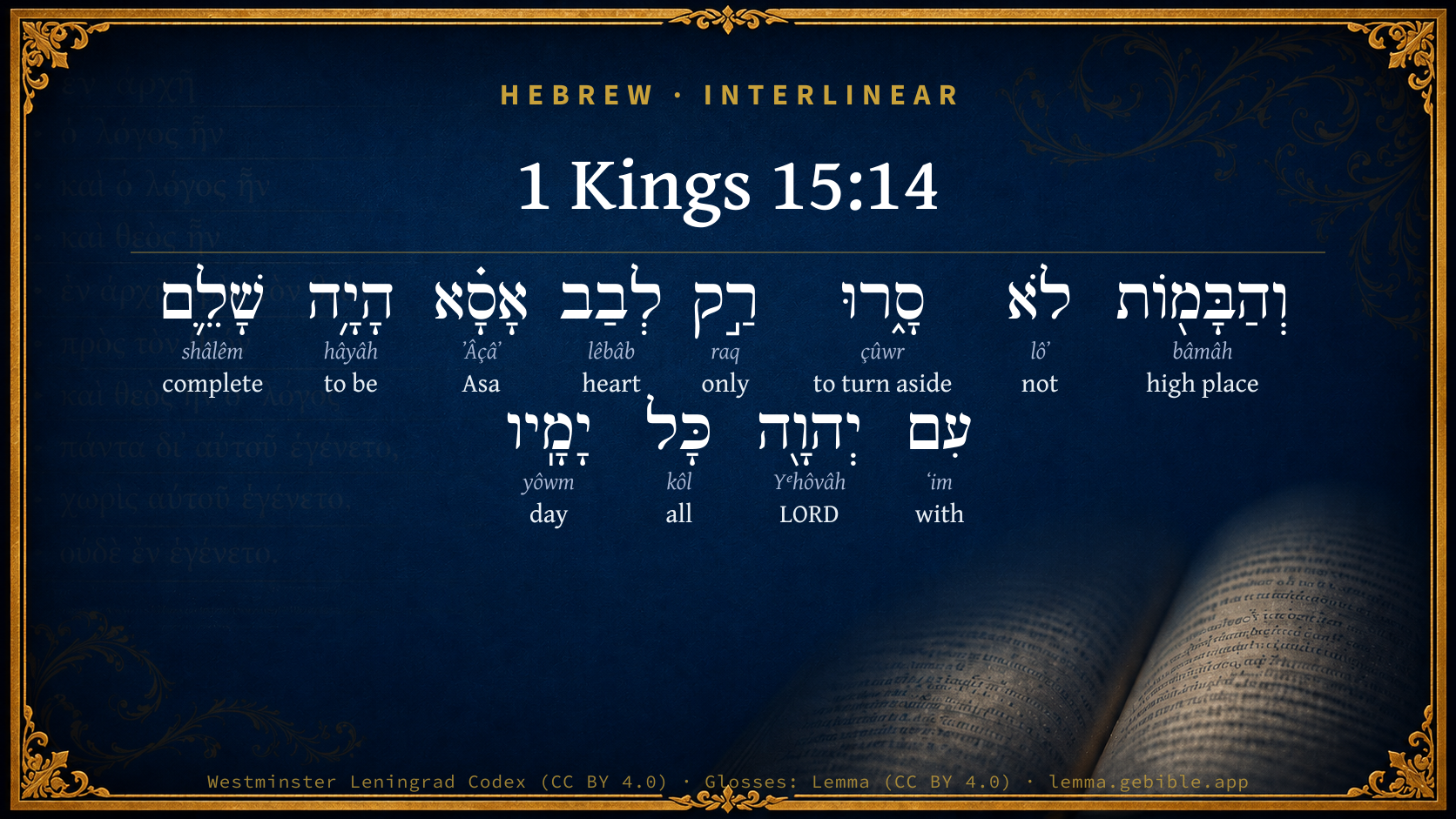
  1. וְהַבָּמ֖וֹת bâmâh H1116 “and · the · high places” Conjunction + Particle, Definite Article + Noun, Common, Feminine, Plural, Absolute
  2. לֹא lôʼ H3808 “not” Particle, Negative
  3. סָ֑רוּ çûwr H5493 “to turn aside” Verb, Qal, Perfect, 3rd Person, Common, Plural
  4. רַ֣ק raq H7535 “only” Particle, Accusative
  5. לְבַב lêbâb H3824 “heart of” Noun, Common, Masculine, Singular, Construct
  6. אָסָ֗א ʼÂçâʼ H609 “Asa” Noun, Proper
  7. הָיָ֥ה hâyâh H1961 “to be” Verb, Qal, Perfect, 3rd Person, Masculine, Singular
  8. עִם ʻim H5973 “with” Preposition
  9. יְהוָ֖ה Yᵉhôvâh H3068 “LORD” Noun, Proper
  10. כָּל kôl H3605 “all of” Noun, Common, Masculine, Singular, Construct
  11. יָמָֽיו yôwm H3117 “days · his” Noun, Common, Masculine, Plural, Construct + Suffix, Personal, 3rd Person, Masculine, Singular

About this verse

These counts appear in no published source. They are computed here, from the morphology-tagged text and Lemma’s own curated glosses. What Lemma adds →

12
words
12
distinct lemmas
Historical
section

Shared distinctive vocabulary

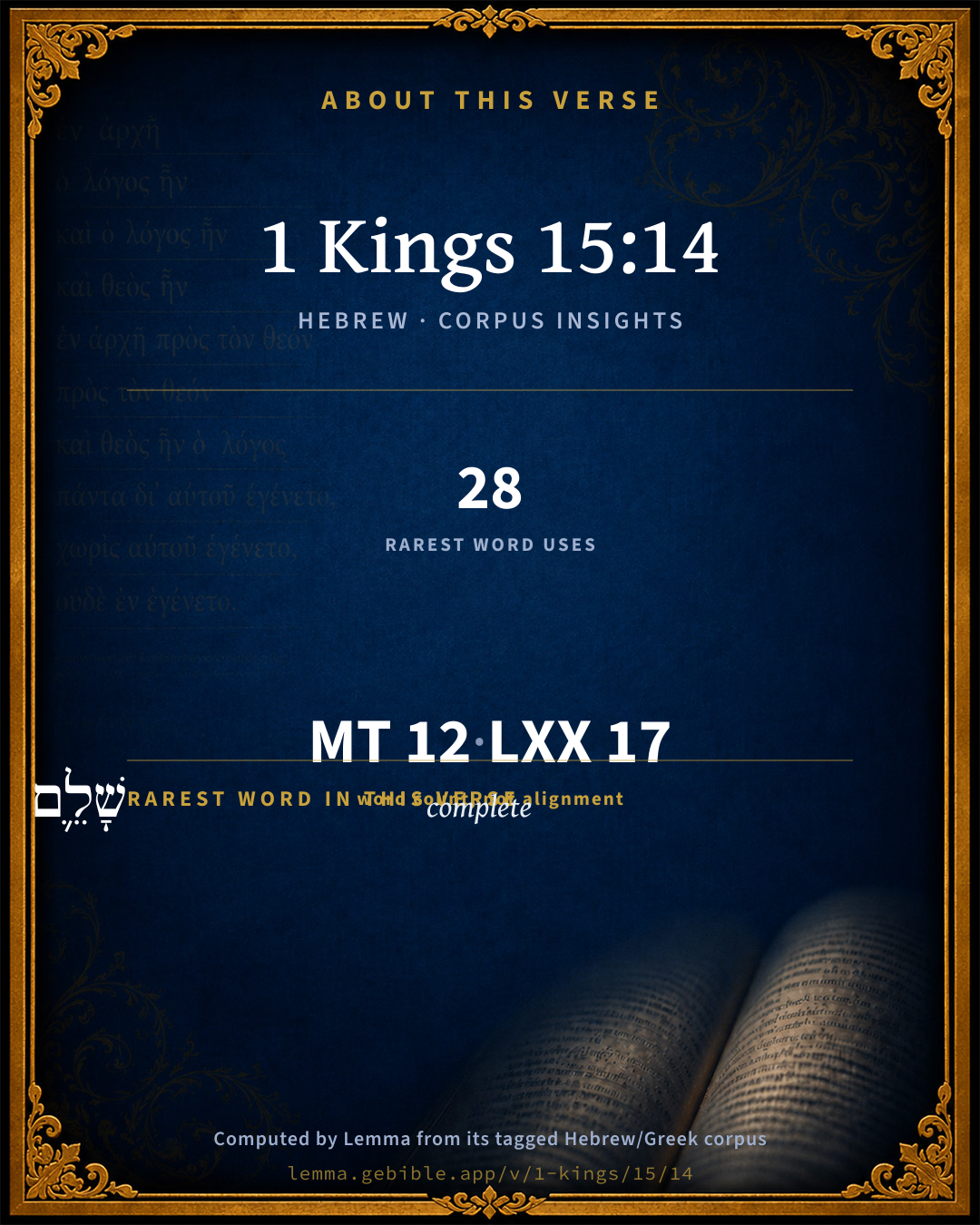
שָׁלֵ֛ם complete H8003 occurs in 27 verses of the Hebrew Bible. Also found in:

Grammatical profile

  • 2 verbs
  • 6 nouns
  • 1 adjective
  • 1 preposition
  • 2 particles

Verb forms

  • סָ֑רוּ Qal · Perfect
  • הָיָ֥ה Qal · Perfect

Hebrew & Septuagint length

In English translation the verse runs 20 words from the Hebrew and 20 from the Septuagint (LXX English) — the same length.

A rough comparison of the two English renderings, which tokenize alike — not a word-level alignment.

Word counts can differ between the Hebrew and the Greek without any difference in meaning — e.g. the Hebrew direct-object marker אֵת has no separate Greek word, and Greek often adds the article ὁ.

In the original languages it is 12 Hebrew tokens and 17 Greek tokens — but the two are counted differently (Hebrew bundles its prefixes and suffixes into one token; the Greek is in lemma form), so that isn’t a like-for-like length.

Cross-references

12

Topical passages linked to 1 Kings 15:14 in the Treasury of Scripture Knowledge — connected by theme and wording, ordered by reader-vote popularity; previews shown in the World English Bible.

  • 1 Kings 22:43 He walked in all the way of Asa his father; He didn't turn aside from it, doing that which was right in the eyes of Yahweh: however the high places were not taken away; the people still sacrificed and burnt incense in the high places.
  • 1 Kings 8:61 Let your heart therefore be perfect with Yahweh our God, to walk in his statutes, and to keep his commandments, as at this day.
  • 1 Kings 15:3 He walked in all the sins of his father, which he had done before him; and his heart was not perfect with Yahweh his God, as the heart of David his father.
  • 2 Kings 12:3 However the high places were not taken away; the people still sacrificed and burnt incense in the high places.
  • 2 Kings 14:4 However the high places were not taken away: the people still sacrificed and burnt incense in the high places.
  • 2 Chronicles 14:3 for he took away the foreign altars, and the high places, and broke down the pillars, and hewed down the Asherim,
  • 2 Chronicles 14:5 Also he took away out of all the cities of Judah the high places and the sun-images: and the kingdom was quiet before him.
  • 2 Chronicles 15:17–18 But the high places were not taken away out of Israel: nevertheless the heart of Asa was perfect all his days.
  • 1 Kings 11:4 For it happened, when Solomon was old, that his wives turned away his heart after other gods; and his heart was not perfect with Yahweh his God, as was the heart of David his father.
  • 2 Kings 15:4 However the high places were not taken away: the people still sacrificed and burnt incense in the high places.
  • 2 Chronicles 16:9 For the eyes of Yahweh run back and forth throughout the whole earth, to show himself strong in the behalf of them whose heart is perfect toward him. Herein you have done foolishly; for from henceforth you shall have wars.
  • 2 Chronicles 25:2 He did that which was right in the eyes of Yahweh, but not with a perfect heart.

Cross-references courtesy of OpenBible.info (CC BY 4.0).

Hebrew and Greek witnesses Masoretic Hebrew ↔ Greek Septuagint

The same verse in the two great witnesses to the Old Testament, shown verse-for-verse.

These are two independent witnesses, not word-aligned to each other, and the Septuagint is shown in lemma (dictionary) form.

Hebrew 1 Kings 15:14 Masoretic · Westminster Leningrad Codex

וְהַבָּמ֖וֹת לֹא סָ֑רוּ רַ֣ק לְבַב אָסָ֗א הָיָ֥ה שָׁלֵ֛ם עִם יְהוָ֖ה כָּל יָמָֽיו

But the high places were not taken away: nevertheless the heart of Asa was perfect with Yahweh all his days.

World English Bible · Public Domain

Greek LXX 1 Kings 15:14 Septuagint · lemma form

ὁ δέ ὑψηλός οὐ ἐκαἴρω πλήν ὁ καρδία ασα εἰμί τέλειος μετά κύριος πᾶς ὁ ἡμέρα αὐτός

But he removed not the high places; nevertheless the heart of Asa was perfect with the Lord all his days.

LXX2012 (modern English Septuagint) · Public Domain

Hebrew: Westminster Leningrad Codex (CC BY 4.0). Greek: Septuagint (public domain); English from LXX2012 (modern English Septuagint) (Public Domain). How the Septuagint differs from the Hebrew →

Targum (Aramaic paraphrase)

1

The Targum is the ancient Jewish Aramaic paraphrase of the Hebrew Scriptures — an interpretive translation, not the Hebrew text itself. Onkelos (literal) and Pseudo-Jonathan (expansive) render the Torah, and Jonathan the Prophets. Coverage is partial: where no permissively-licensed English translation exists for a verse, only the Aramaic is shown. This is verse-level text, not a word-by-word alignment to the Hebrew.

  1. Targum Jonathan Prophets (Joshua–Malachi)
    וּבָמָתָא לָא עַטְרָא לְחוֹד לִבָּא דְאָסָא הֲוָה שְׁלִים בִּדְחַלְתֵּיהּ דַייָ כָּל יוֹמוֹהִי:

    (no public-domain English translation for this verse)

    Targum Jonathan — Aramaic: “Mikraot Gedolot” (public domain). English: “Sefaria Community Translation” (CC0 1.0 (public-domain dedication)); “London "Chaldee Paraphrase," 1871” (public domain). Text via Sefaria.

Commentary

Notes on 1 Kings 15:14 from classic Christian and Jewish commentators (each source and its license shown beneath its notes). The classic Christian expositions comment on the surrounding passage and are grouped to its opening verse, so a note may address several verses; the Jewish commentaries on the Tanakh (Rashi and others) are per-verse, so they appear only where the commentator wrote on this verse.

Lemma curates 59 commentaries, every one of them public domain or Creative Commons licensed, each selected and text-cleaned for this edition rather than reprinted as found. About our sources →

Trapp's Complete Commentary

John Trapp

1Ki 15:14 But the high places were not removed: nevertheless Asa’s heart was perfect with the LORD all his days.

Ver. 14. But the high places were not removed,] sc., Such as were set up for the worship of God; for as for those that were set up in honour of idols, he removed them. But he should have done both, as did afterwards zealous Hezekiah and Josiah. It is with the saints as with Jonathan’s signal arrows - two fell short, and but one beyond the mark; so where one shooteth home to the mark of the high calling in Christ Jesus, many fall short.

Nevertheless Asa’s heart was perfect.] With one breath doth God report both these; such is his indulgency. He will not see weakness where he seeth truth. All Asa’s infirmities are covered with the mantle of sincerity. Contrarily in Jehu, the Holy Ghost, after a description of many excellent things done by him, doth at last as it were draw a cross line. {2Ki 10:31}

John Trapp, A Commentary or Exposition upon All the Books of the Old and New Testament (1647–1656) — public domain. Text from a community e-Sword module.

Joseph Benson's Commentary

1Ki 15:14. The high places were not removed — 2Ch 14:3. He took away the altars of the strange gods, and the high places where they were worshipped: but as for those high places where the true God was worshipped, he did not take them away; partly, because he thought there was no great evil in them, which had been used by David and Solomon, and other good men; partly because he thought the removal of them might do more hurt than their continuance, by occasioning the total neglect of God’s worship by many of the people, who either could not, or through want of faith and zeal would not, go up to Jerusalem to worship; now especially, when the Israelites, formerly their friends, were become their enemies, and watched all opportunities to invade or molest them. Asa’s heart was perfect — That is, he sincerely and constantly adhered to the worship of God. Though he could not hinder the people from using the high places, yet he entirely devoted himself to the worship of God in the manner and place prescribed by him.

Joseph Benson's Commentary on the Old and New Testaments (1811–1818) — public domain. Text from a community e-Sword module.

Tyndale Open Study Notes

Tyndale Open Resources

15:14-15 Although he allowed the pagan shrines to remain, Asa’s heart remained . . . faithful to the Lord. The pagan shrines apparently became locations for worshiping the Lord. In his latter days, Asa’s spiritual ardor appears to have diminished (2 Chr 16:7-12).

Tyndale Open Study Notes — © Tyndale Open Resources, licensed CC BY-SA 4.0. Text via the HelloAO Bible API.

Geneva Bible (1599)

Geneva Bible translators

For in that that he suffered them to worship God in other places, than he had appointed, it came of ignorance, and not of malice.

Geneva Bible (1599) marginal notes — public domain. Text via Bolls.life.

Adam Clarke's Commentary

Verse 14. The high places were not removed] He was not able to make a thorough reformation; this was reserved for his son Jehoshaphat.

Asa's heart was perfect] He worshipped the true God, and zealously promoted his service; see on 1Kg 15:3. And even the high places which he did not remove were probably those where the true God alone was worshipped; for that there were such high places the preceding history amply proves, and Jarchi intimates that these were places which individuals had erected for the worship of Jehovah.

Adam Clarke's Commentary on the Bible (1810–1826) — public domain. Text from a community e-Sword/MySword module.

Ellicott's Commentary for English Readers

(14) But the high places were not removed.—The record of the Chronicles—contrasting 2Ch_14:5 with 1Ki_15:17—indicates with tolerable plainness an attempt at this reform on Asa’s part, which was not carried out successfully. In spite of all experience of the corruptions inevitably resulting from them, the craving for local and visible sanctuaries, natural at all times, and especially in generations which had been degraded by gross idolatry, proved too strong for even earnest reformers. The historian, writing under the light of later experience, dwells on this imperfection of religious reform again and again.

A Bible Commentary for English Readers, edited by Charles John Ellicott (1878–1897) — public domain. Text from a community e-Sword module.

The Cambridge Bible for Schools and Colleges

gen. ed. J. J. S. Perowne

14. But the high places were not removed] R.V. taken away. The change is made that this passage may be rendered in the same way as 2Ch_15:17, with which it is identical. In Judah (we are told 2Ch_14:5) Asa did take away the high places, but in Israel (2Ch_15:17) they were not taken away. The mention of this as something which Asa might have been expected to effect shews that the conquests of his father and himself had given them much control (or influence) over the affairs of the northern kingdom. As the high places had been long tolerated, and the worship offered there had been accepted we can see how much more difficult it would be to put down this form of worship than any of the others. Hence, in spite of the continuance of the high places, Asa’s heart is said to have been ‘perfect with the Lord.’ The worship on the high places was long kept up. They are mentioned again 1Ki_22:44; 2Ki_12:3; 2Ki_14:4; 2Ki_15:4; 2Ki_15:35.

The Cambridge Bible for Schools and Colleges (gen. ed. J. J. S. Perowne; Cambridge University Press, 1878–1918) — public domain. Text from a community e-Sword module.

John Gill's Exposition

There is a league between me and thee, and between my father and thy father,.... For though Hezion, if he is the same with Rezon, was an adversary to Israel in the days of Solomon, Kg1 11:25, yet it seems his son was not, but was a confederate with the kings of Israel and Judah:

behold, I have sent unto thee a present of silver and gold; taken out of the treasury of the temple and his own treasury:

come and break thy league with Baasha king of Israel, that he may depart from me; it was sinful in him to take the money out of the temple, to which it was dedicated; it was more so to make use of it to bribe an Heathen to break his covenant and alliance with another, in order to serve him; in which he betrayed great distrust of the Lord, and of his power to help him; which was the more aggravated, when he had had such a wonderful appearance of God for him against the Ethiopians, see Ch2 16:7.

John Gill's Exposition of the Whole Bible (1746–1763) — public domain (CC PDM 1.0). Text via the HelloAO Bible API.

Albert Barnes' Notes on the Bible

2Ch 14:3 would seem at first sight to imply that he entirely put down the worship. But idolatry, if at one time put down, crept back afterward; or while Asa endeavored to sweep it wholly away, his subjects would not be controlled, but found a means of maintaining it in some places - not perhaps in the cities (see 2Ch 14:5), but in remote country districts, where the royal authority was weaker, and secrecy more practicable.

Albert Barnes' Notes on the Bible (1834–1885) — public domain. Text from a community e-Sword/MySword module.

Haydock's Catholic Bible Commentary

The high places. There were excelsa, or high places, of two different kinds. Some were set up and dedicated to the worship of idols, or strange gods: and these Asa removed, 2 Paralipomenon xiv. 2. Others were only altars of the true God, but were erected contrary to the law, which allowed of no sacrifices but in the temple; and these were not removed by Asa. (Challoner) --- They had been built before the temple, and tolerated by the prophets; (Calmet) and, though they were now improper for sacrifices, (Haydock) Asa thought it would be imprudent to molest them, (Calmet) as perhaps he could not take them away. (Du Hamel) --- He left also the ruins of (Haydock) the temples built by Solomon, (Worthington) on Mount Olivet, (4 Kings xxiii.; Menochius) as no longer dangerous. (Salien) --- Lord. Asa had his faults; but never forsook the worship of the Lord. (Challoner) --- In the same sense, David is so often praised as a just prince. Asa threw a prophet into prison, and placed his trust as much in physicians, &c., 2 Paralipomenon xvi. 10, 12. But he did penance, and deserves to be ranked (Calmet) among the few just kings of Juda. (Haydock)

George Leo Haydock (1774–1849), Haydock's Catholic Family Bible and Commentary, 1859 edition — public domain. Excludes Psalms (Douay-Rheims chapter numbering differs from Protestant) and Deuterocanonical books (Catholic canon only).

Matthew Poole's English Annotations

The high places were not removed.

Object. He did take these away, 2Ch 14:3.

Answ. He took away those which were devoted to the worship of idols, as is there said, he took away the altars of the strange gods, and the highplaces, to wit, where they were worshipped: but as for those high places where the true God was worshipped, he did not take them away; partly, because he thought there was no great evil in them, because they had been used by David and Solomon, and other good and wise men; and because the true God was there worshipped, and that in the manner, though not in the place, which God had appointed; and partly, because he thought the removal of them might do much more hurt than their continuance, to wit, by occasioning the total neglect of God’s worship by many of the people, who either could not, or through want of competent faith and zeal would not, go up to Jerusalem to worship, now especially, when the Israelites, their near neighbours, formerly their friends, were become their enemies, and watched all opportunities to invade or molest them, which they concluded they would do when all their males were gone up to Jerusalem; and partly, because the people were so obstinately bent towards them, that it was, or at least seemed to him, impossible to remove them without great offence, or such commotions as were highly dangerous to that church and state.

Asa’s heart was perfect with the Lord, i.e. he did sincerely and constantly adhere to the worship and service of God. Though he could not hinder the people from using the high places, yet he did entirely devote himself to the worship of God in the manner and place prescribed by God.

Matthew Poole's English Annotations on the Holy Bible (1683–1685) — public domain. Text from a community e-Sword/MySword module.

Whedon's Commentary on the Bible

Daniel D. Whedon

14. But the high places were not removed — That is, the high places, like those of 1Ki_3:2, where Jehovah, and not idols, was worshipped. According to 2Ch_14:3, he took away the altars of the strange gods, and the high places of the same; but the temple worship had probably fallen into such disrepute during the reigns of Rehoboam and Abijam that large numbers of the people resorted to the practice so common before the temple was built, (see 1Ki_3:2,) of sacrificing on high places. And this had now become so prevalent a practice that Asa could not effectually stop it.

Nevertheless Asa’s heart was perfect — That is, he followed the commandments of God with his whole heart, and in that respect was like David, 1Ki_14:8. The standard of perfection by which we are to measure the perfect ones of the Old Testament history is not the fulness of spiritual light and religious attainment which is set before us in the New Testament, but rather a singleness and earnestness of pious purpose to obey God and maintain the honour of his name.

All his days — His earnest purpose to maintain the true worship of God doubtless continued all his days; but he was angry with the prophet, who reproved him for seeking help of the king of Syria rather than of Jehovah, and imprisoned him; and in his disease he sought aid of the physicians instead of the Lord. 2Ch_16:10; 2Ch_16:12.

Daniel D. Whedon (gen. ed.), Commentary on the Old and New Testaments (1874–1909) — public domain. Text from a community e-Sword module.

The Pulpit Commentary

But the high places evidently such as are referred to in ch. 3, i.e., un authorized shrines of Jehovah; (cf. 2Ki_14:4) were not taken away lit., departed not. Yet we read in 2Ch_15:3, that Asa "took away the high places (cf. ver. 5). But it is clear, even from 2Ch_15:17, that all of them were not re moved, and the discrepancy arises from the well-known Eastern idiom of putting the whole for the part, of which we have in stances in Gen_7:19; Exo_9:25, etc. Cf. ver. 32; 2Ki_9:35, and see below. Asa probably aimed at removing all, and he may have removed all out of the cities, (2Ch_14:5) but some remained in the country districts or in remote places. Or he may have swept them away for a short time, and they may have been stealthily and gradually reintroduced. It may be interesting to remark here that down to the present day the cultus of the high places exists under a modified form, it is true in Palestine. Every traveller will remember the Mukama which crown almost every hill. The religion of the Fellahin, though nominally Mohammedan, is really, like that of China, a worship of the dead. "In almost every village of the country a small building, surmounted by a whitewashed dome, is observable, being the sacred chapel of the place; it is variously called Kubbeh, "dome," Mazor, "shrine," or Mukam, "station," the latter being a Hebrew word, used in the Bible for the places of the Canaanites (Deu_2:2) Just as in the time of Moses, so now the position chosen for the Mukam is generally conspicuous This Mukam represents the real religion of the peasant" (Conder, pp. 304 sqq.): nevertheless Asa"s heart was perfect with the Lord all his days. We have here a notable instance of the Oriental exaggeration just referred to. For the very same expression is used by the chronicler, (2Ch_15:17) who in the next chapter (2Ch_6:7-12) tells us of Asa"s unfaithfulness in his old age.

HOMILIES BY A. ROWLAND Ver. 14.

Religious sincerity.

A beautiful flower often springs from the midst of corruption. The more we realize the moral condition of Asa"s surroundings the more we wonder at the grace which made him what he was. His father was Abijam (or Abijah), the second king of Judah, of whom it is said, "He walked in all the sins of his father, which he had done before him." His education appears to have been entrusted to Maachah, his grandmother, a daughter of Absalom the rebel, and herself a gross idolatress. The remembrance of these facts makes the statement respecting this young prince the more surprising did that which was right in the eyes of the Lord, as did David his father." An independent spirit and a resolute will must have been coupled with his piety. Show from this the possibility of triumphing over the most adverse circumstances by those who sincerely seek to serve God. It is not, however, to his manly resolution, to his vigour, or to his political wisdom that our attention is specially called by the text, but to his RELIGIOUS SINCERITY.

I RELIGIOUS SINCERITY ASSERTS ITSELF IN REFORMING ZEAL (vers. 12, 13). It was only twenty years since the death of Solomon, yet irreligion and vice had corrupted the nation. Evil spreads more rapidly than good in a fallen world. The deadly fungus springs up in a night, the fruit tree grows slowly to perfection. A half-hearted or timid man would have been content to worship Jehovah himself, and thus silently rebuke the idolatry of his people; but Asa, being an earnest man, could not content himself with any laissez faire principle. With a strong hand he would put down evil wherever he could reach it. Often in God"s sight to leave evil alone, unrebuked, and uncombated is to share the guilt of those who commit it. It is the spirit of Cain, and not of Christ, that asks, "Am I my brother"s keeper?" Asa"s reforming zeal contains lessons to rulers, to employers, to parents, indeed to all who can mould the circumstances of others. See, therefore, how it made itself felt.

1. Opportunities for sin were diminished. Ver. 12 implies that there were those in Judah who made a traffic of vice. Corrupt themselves, they

2. corrupted others. There are places in Christian cities which should be swept away by the strong hand of law.

3. Incentives to sin were destroyed. The idol referred to (in ver. 15) is literally the horror." The obscene rites connected with its cultus will not bear investigation. Suffice it to say that this so-called worship provoked to vice of the most hideous kinds. Against provocations and incentives to sin how earnestly should parents guard their children, and masters and mistresses their servants. Impure literature is in the forefront of these; not only that which offends by its grossness, but that which secretly stains by its suggestions.

4. Influences for sin were removed. Sometimes vice is made popular by leaders of fashion or of policy. The unrighteousness of a clever man, the impurity of a leader in society are woefully far-reaching in their effects. Maachah, the queen-mother, was one of the most potent in Asa"s court, was his near relation, his early instructress; yet, with as much wisdom as courage, "he removed her from being queen," and destroyed her idol publicly and shamefully. It might be said that he was indebted to her, that she was aged and should be respected, or that she could not live long, and might therefore be tolerated. Such pleas would not avail with man whose "heart was perfect with the Lord." (Apply this.)

II RELIGIOUS SINCERITY PROCLAIMS ITSELF BY CONFIDENCE IN GOD. This confidence was at tile heart of Asa"s courage. Read our text in the light of the fuller history of the king (given in 2 Chronicles), and see how his confidence displayed itself.

1. He found rest in God in peril. Many adversaries would be raised by a reformation which was ruthless in its rigour. Idolatrous priests, the party led by Maachah, etc., would rebel; but Asa was not perturbed. God was his refuge and strength.

2. He offered prayer to God in his difficulty. As an example read 2Ch 14. Describe the incursion of the Ethiopian host, and this prayer of the king, "Lord, it is nothing with thee to help, whether with many, or with them that have no power: help us, O Lord our God, for we rest on thee, and in thy name we go against this multitude." A victory followed which was unique in the history of God"s people. Conquest waits on prayer in every struggle with evil

3. He consecrated himself and his people to God after their deliverance (see ver. 15, and compare with it 2Ch 15) He renewed the covenant, and afresh dedicated all he possessed to the Lord. So he deserved the high commendation, "Asa"s heart was perfect with the Lord all his days." It remains yet to be observed that

III RELIGIOUS SINCERITY MAY BE ASSOCIATED WITH IMPERFECT SERVICE. He failed to remove the high places. This Hezekiah and Josiah did. To leave them was to provide a way of return to the idolatrous practices he had put down. Beware of leaving lesser sins unconquered, after victory has been attained over grosset crimes. A.R.

The Pulpit Commentary (1880–1919), ed. H.D.M. Spence-Jones & Joseph S. Exell — public domain. Text from a community e-Sword module.

John Wesley's Explanatory Notes

High places - 2 Chron. xiv, 3. He took away the altars of the strange gods, and the high places where they were worshipped: but as for those high places where the true God was worshipped he did not take them away; partly, because he thought there was no great evil in them, which had been used by David and Solomon, and other good men; partly, because he thought the removal of them might do more hurt than their continuance, by occasioning the total neglect of God's worship by many of the people, who either could not, or, through want of faith and zeal, would not go up to Jerusalem to worship, now especially, when the Israelites, formerly their friends, were become their enemies, and watched all opportunities to invade or molest them. Was perfect - That is, he sincerely and constantly adhered to the worship of God. Though he could not hinder the people from using the high places, yet he entirely devoted himself to the worship of God in the manner and place prescribed by him.

John Wesley, Explanatory Notes Upon the Whole Bible (1754–1765) — public domain. Text via the GEBible commentary corpus.

Scofield Reference Notes

C. I. Scofield

high places

Cf. 2Ch 14:3. It appears that local sacrifices to Jehovah (though not according to the divine order) were offered in the times of the kings upon "high places" (cf) 1Sa 9:12. Apparently Asa’s mother had defiled one of these with an idol, 1Ki 15:13. Asa destroyed the idol and the idolatrous (but not the Jehovistic) "high places." But see "high places," (See Scofield "1Ki 3:2").

The Scofield Reference Bible (1917 edition), notes by C. I. Scofield — public domain. Text from a community e-Sword module.

unfoldingWord translationNotes

Door43 World Missions Community

But the high places were not taken away

This can be stated in active form. AT: "But Asa did not command the people to take away the high places" (See: Active or Passive)

Asa's heart was completely devoted

The heart represents the person. AT: "Asa was completely devoted" (See: Synecdoche)

all his days

"the whole time that he lived" or "throughout his whole life"

translationWords

high place

heart

house of God

set apart

silver

gold

unfoldingWord translationNotes — © Distant Shores Media and the Door43 World Missions Community, licensed CC BY-SA 4.0. Source: git.door43.org/Door43/en_tn.

Rashi

Rabbi Shlomo Yitzchaki (Rashi)

[However] the [private] altars he did not remove. The private altars upon which they had become accustomed to sacrifice to Heaven since Shiloh had been destroyed until the Beis [Hamikdosh] was built, when private altars were permissible, were not removed now, even though they were forbidden once the Beis [Hamikdosh] was built, and they were punished by premature death because of it.

Rashi on the Tanakh — English translations: “The Judaica Press complete Tanach with Rashi, translated by A. J. Rosenberg” (CC BY 4.0); “Pentateuch with Rashi's commentary by M. Rosenbaum and A.M. Silbermann, 1929-1934” (public domain); “The Metsudah Tanach series, Lakewood, N.J” (CC BY 4.0); and “The Book of Joshua, Metsudah Publications, 1997” (CC BY 4.0). Text via Sefaria.

Lesson kit

Teaching starters — assembled from the data on this page, not authored interpretation. Every prompt links to the verse data it draws on. Edit before teaching.

1 Kings, in the Historical, opens this verse with 12 words (12 distinct Hebrew lemmas). Its most distinctive word is shâlêm (“complete”). A historical commentator’s framing appears above. Read the whole chapter for the surrounding context.

Discussion questions

  1. The word shâlêm carries the sense “complete.” How does it shape the verse?
  2. Genesis 15:16 shares the word «complete» with this verse. How do the two illuminate each other?
  3. These translations render this verse differently. What is at stake in choosing one wording over another?
  4. The verb «סָ֑רוּ» is Qal Perfect. How does its form color the action?
  5. Reading how Trapp's Complete Commentary and Joseph Benson's Commentary read this verse, where do the two commentators agree and where do they part?

Things to notice

Reading settings

Reading text

Shown beneath each verse's original-language words.

Old Testament
Old Testament edition

Read the OT as the Masoretic Hebrew (MT) or the Greek Septuagint (LXX).

English shown for the Greek Septuagint (in the Hebrew ↔ Greek comparison).

Comparing translations? Open the Compare panel on any verse page to stack up to four side by side.