
Deuteronomy 4:9

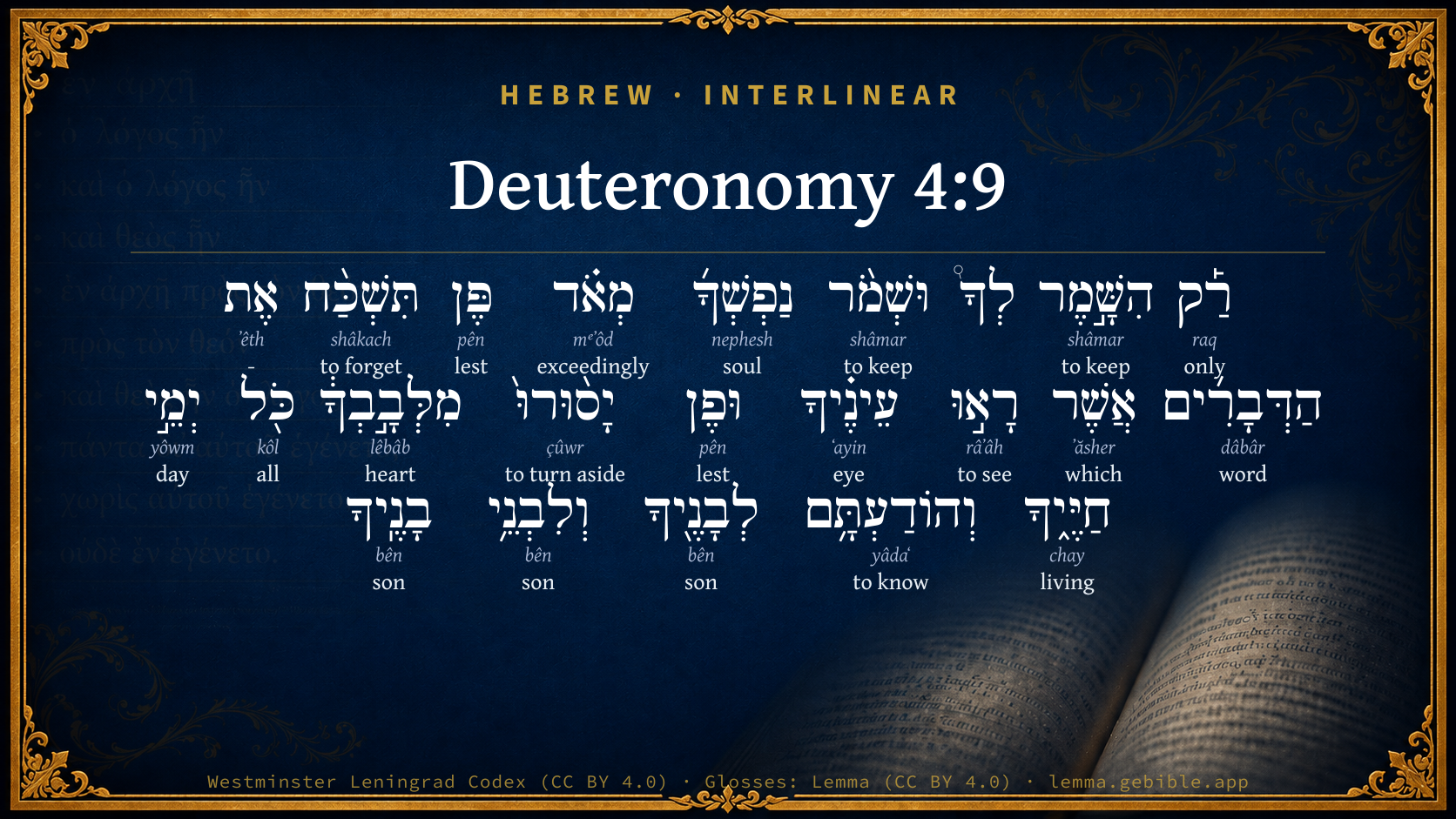
Hebrew (Westminster Leningrad Codex) Deuteronomy 4:9 appears in the Hebrew Old Testament. The text above is from the Westminster Leningrad Codex. Each word links to its Strong’s number, a concise gloss, and parsing drawn from the Open Scriptures Hebrew Bible morphology. Click any word for its full Brown-Driver-Briggs (BDB) entry.
Download image
Cite this verse

Deuteronomy 4:9 (World English Bible). Public Domain. Lemma interlinear Bible study tool, https://lemma.gebible.app/v/deuteronomy/4/9.

Show BibTeX & RIS
BibTeX
RIS
English Translation
Only take heed to yourself, and keep your soul diligently, lest you forget the things which your eyes saw, and lest they depart from your heart all the days of your life; but make them known to your children and your children's children;
World English Bible · Public Domain
Download a study sheet

One document with this verse’s original text, its word-by-word gloss line, the meaning frame, cross-references with their text, attributed commentary, and full source and license credits — printable, and it pastes into notes with its structure intact.

This verse Autodidact and up

Study sheet (.html) Plain text (.txt)

A passage Seminary Student

Up to 50 verses in one chapter. A passage sheet keeps up to 6 commentary sources and 12 cross-references per verse, in the order this page ranks them, and says so on the sheet whenever that leaves anything out. Ask for a single verse and you get the Autodidact verse sheet above.

Everything on this page stays free to read, with no account — the sheet is a download of what is already on screen, not access to it.

Want to remove ads? Support Godless Engineer
Compare translations 3

The same verse in 3 English versions, stacked beneath the original-language interlinear above. Click any original word for its lexicon entry.

Each is an independent rendering of the whole verse — the interlinear is not word-aligned to these translations.

Highlighted words mark where these versions differ — a whole-verse word diff, not a word-by-word alignment.

  • World English Bible Public Domain
    Only take heed to yourself, and keep your soul diligently, lest you forget the things which your eyes saw, and lest they depart from your heart all the days of your life; but make them known to your children and your children's children;
  • King James Version Public Domain
    Only take heed to thyself, and keep thy soul diligently, lest thou forget the things which thine eyes have seen, and lest they depart from thy heart all the days of thy life: but teach them thy sons, and thy sons' sons;
  • unfoldingWord Literal Text CC BY-SA 4.0
    Only guard yourself and guard your soul strongly, lest you forget the things which your eyes have seen, and lest they retreat from your heart all the days of your life. But make them known to your sons and to the sons of your sons.

unfoldingWord Literal Text — © unfoldingWord, licensed CC BY-SA 4.0. Word-aligned USFM3 via Door43 (git.door43.org/unfoldingWord/en_ult).

Versions to compare (up to 4)

3 of 4 selected

Show all 18 translations

Every available English version of this verse, each an independent rendering of the whole verse.

  • World English Bible Public Domain
    Only take heed to yourself, and keep your soul diligently, lest you forget the things which your eyes saw, and lest they depart from your heart all the days of your life; but make them known to your children and your children's children;
  • Berean Standard Bible Public Domain
    Only be on your guard and diligently watch yourselves, so that you do not forget the things your eyes have seen, and so that they do not slip from your heart as long as you live. Teach them to your children and grandchildren.
  • Majority Standard Bible Public Domain
    Only be on your guard and diligently watch yourselves, so that you do not forget the things your eyes have seen, and so that they do not slip from your heart as long as you live. Teach them to your children and grandchildren.
  • King James Version Public Domain
    Only take heed to thyself, and keep thy soul diligently, lest thou forget the things which thine eyes have seen, and lest they depart from thy heart all the days of thy life: but teach them thy sons, and thy sons' sons;
  • American Standard Version (1901) Public Domain
    Only take heed to thyself, and keep thy soul diligently, lest thou forget the things which thine eyes saw, and lest they depart from thy heart all the days of thy life; but make them known unto thy children and thy children's children;
  • Revised Version (1885) Public Domain
    Only take heed to thyself, and keep thy soul diligently, lest thou forget the things which thine eyes saw, and lest they depart from thy heart all the days of thy life; but make them known unto thy children and thy children’s children;
  • Geneva Bible (1599) Public Domain
    But take heede to thy selfe, and keepe thy soule diligently, that thou forget not the thinges which thine eyes haue seene, and that they depart not out of thine heart, all the dayes of thy life: but teach them thy sonnes, and thy sonnes sonnes:
  • Douay-Rheims (1899) Public Domain
    Keep thyself therefore, and thy soul carefully. Forget not the words that thy eyes have seen, and let them not go out of thy heart all the days of thy life. Thou shalt teach them to thy sons and to thy grandsons,
  • Young's Literal Translation Public Domain
    `Only, take heed to thyself, and watch thy soul exceedingly, lest thou forget the things which thine eyes have seen, and lest they turn aside from thy heart, all days of thy life; and thou hast made them known to thy sons, and to thy sons' sons.
  • Literal Standard Version CC BY-SA 4.0
    Only, take heed to yourself, and watch your soul exceedingly, lest you forget the things which your eyes have seen, and lest they turn aside from your heart all [the] days of your life; and you have made them known to your sons and to your sons’ sons.
  • Unlocked Literal Bible CC BY-SA 4.0
    Only pay attention and carefully guard yourself, so that you do not forget the things that your eyes have seen, so that they do not leave your heart for all the days of your life. Instead, make them known to your children and your children's children.
  • unfoldingWord Literal Text CC BY-SA 4.0
    Only guard yourself and guard your soul strongly, lest you forget the things which your eyes have seen, and lest they retreat from your heart all the days of your life. But make them known to your sons and to the sons of your sons.
  • Darby Bible Public Domain
    Only take heed to thyself, and keep thy soul diligently, lest thou forget the things that thine eyes have seen (and lest they depart from thy heart all the days of thy life; but thou shalt make them known to thy sons and to thy sons' sons),
  • World Messianic Bible Public Domain
    Only be careful, and keep your soul diligently, lest you forget the things which your eyes saw, and lest they depart from your heart all the days of your life; but make them known to your children and your children’s children—
  • Webster's Bible Public Domain
    Only take heed to thyself, and keep thy soul diligently, lest thou shouldst forget the things which thy eyes have seen, and lest they depart from thy heart all the days of thy life: but teach them to thy sons, and thy sons' sons:
  • Free Bible Version CC BY-SA 4.0
    Just make sure to be very careful, and really watch what you do, so you don't forget the things you've seen. Keep them in mind as long as you live. Teach them to your children and grandchildren.
  • Bible in Basic English Public Domain
    Only take care, and keep watch on your soul, for fear that the things which your eyes have seen go from your memory and from your heart all the days of your life; but let the knowledge of them be given to your children and to your children's children;
  • JPS Tanakh (1917) Public Domain
    Only take heed to thyself, and keep thy soul diligently, lest thou forget the things which thine eyes saw, and lest they depart from thy heart all the days of thy life; but make them known unto thy children and thy children's children;

Literal Standard Version (2020), Covenant Press — licensed CC BY-SA 4.0. Text via the HelloAO Bible API (eBible.org). Unlocked Literal Bible (unfoldingWord) — licensed CC BY-SA 4.0. Text via the HelloAO Bible API (eBible.org). unfoldingWord Literal Text — © unfoldingWord, licensed CC BY-SA 4.0. Word-aligned USFM3 via Door43 (git.door43.org/unfoldingWord/en_ult). Free Bible Version, Dr. Jonathan Gallagher — licensed CC BY-SA 4.0. Text via the HelloAO Bible API (eBible.org).

Word by word

More ways to search: Search by grammar → Find every occurrence → Compare this word →

Practice this passage: Drill this verse → Learn its vocabulary →

תִּשְׁכַּ֨ח
shâkach
H7911
“to forget”
Verb, Qal, Imperfect, 2nd Person, Masculine, Singular
Part of Speech
Verb
Stem
Qal
Form
Imperfect
Person
2nd Person
Gender
Masculine
Number
Singular
Full BDB Definition

Origin: a primitive root

TWOT: 2383

to forget, ignore, wither - (Qal) - to forget - to cease to care - (Niphal) to be forgotten - (Piel) to cause to forget - (Hiphil) to make or cause to forget - (Hithpael) to be forgotten
  1. רַ֡ק raq H7535 “only” Particle, Accusative
  2. הִשָּׁ֣מֶר shâmar H8104 “keep” Verb, Niphal, Imperative, 2nd Person, Masculine, Singular
  3. וּשְׁמֹ֨ר shâmar H8104 “and · keep” Conjunction + Verb, Qal, Imperative, 2nd Person, Masculine, Singular
  4. נַפְשְׁךָ֜ nephesh H5315 “soul · your” Noun, Common, Both, Singular, Construct + Suffix, Personal, 2nd Person, Masculine, Singular
  5. מְאֹ֗ד mᵉʼôd H3966 “exceedingly” Adverb
  6. פֶּן pên H6435 “lest” Conjunction
  7. אֶת ʼêth H853 “-” Particle, Direct Object
  8. הַדְּבָרִ֜ים dâbâr H1697 “the · words” Particle, Definite Article + Noun, Common, Masculine, Plural, Absolute
  9. אֲשֶׁר ʼăsher H834 “which” Particle, Relative
  10. רָא֣וּ râʼâh H7200 “to see” Verb, Qal, Perfect, 3rd Person, Common, Plural
  11. עֵינֶ֗יךָ ʻayin H5869 “eyes · your” Noun, Common, Both, Dual, Construct + Suffix, Personal, 2nd Person, Masculine, Singular
  12. וּפֶן pên H6435 “and · lest” Conjunction + Conjunction
  13. יָס֨וּרוּ֙ çûwr H5493 “to turn aside” Verb, Qal, Imperfect, 3rd Person, Masculine, Plural
  14. מִלְּבָ֣בְךָ֔ lêbâb H3824 “from · heart · your” Preposition + Noun, Common, Masculine, Singular, Construct + Suffix, Personal, 2nd Person, Masculine, Plural
  15. כֹּ֖ל kôl H3605 “all of” Noun, Common, Masculine, Singular, Construct
  16. יְמֵ֣י yôwm H3117 “days of” Noun, Common, Masculine, Plural, Construct
  17. חַיֶּ֑יךָ chay H2416 “living things · your” Noun, Common, Masculine, Plural, Construct + Suffix, Personal, 2nd Person, Masculine, Singular
  18. וְהוֹדַעְתָּ֥ם yâdaʻ H3045 “and · to know · them” Conjunction + Verb, Hiphil, Sequential Perfect, 2nd Person, Masculine, Singular + Suffix, Personal, 3rd Person, Masculine, Plural
  19. לְבָנֶ֖יךָ bên H1121 “to/for · sons · your” Preposition + Noun, Common, Masculine, Plural, Construct + Suffix, Personal, 2nd Person, Masculine, Singular
  20. וְלִבְנֵ֥י bên H1121 “and · to/for · sons of” Conjunction + Preposition + Noun, Common, Masculine, Plural, Construct
  21. בָנֶֽיךָ bên H1121 “sons · your” Noun, Common, Masculine, Plural, Construct + Suffix, Personal, 2nd Person, Masculine, Singular

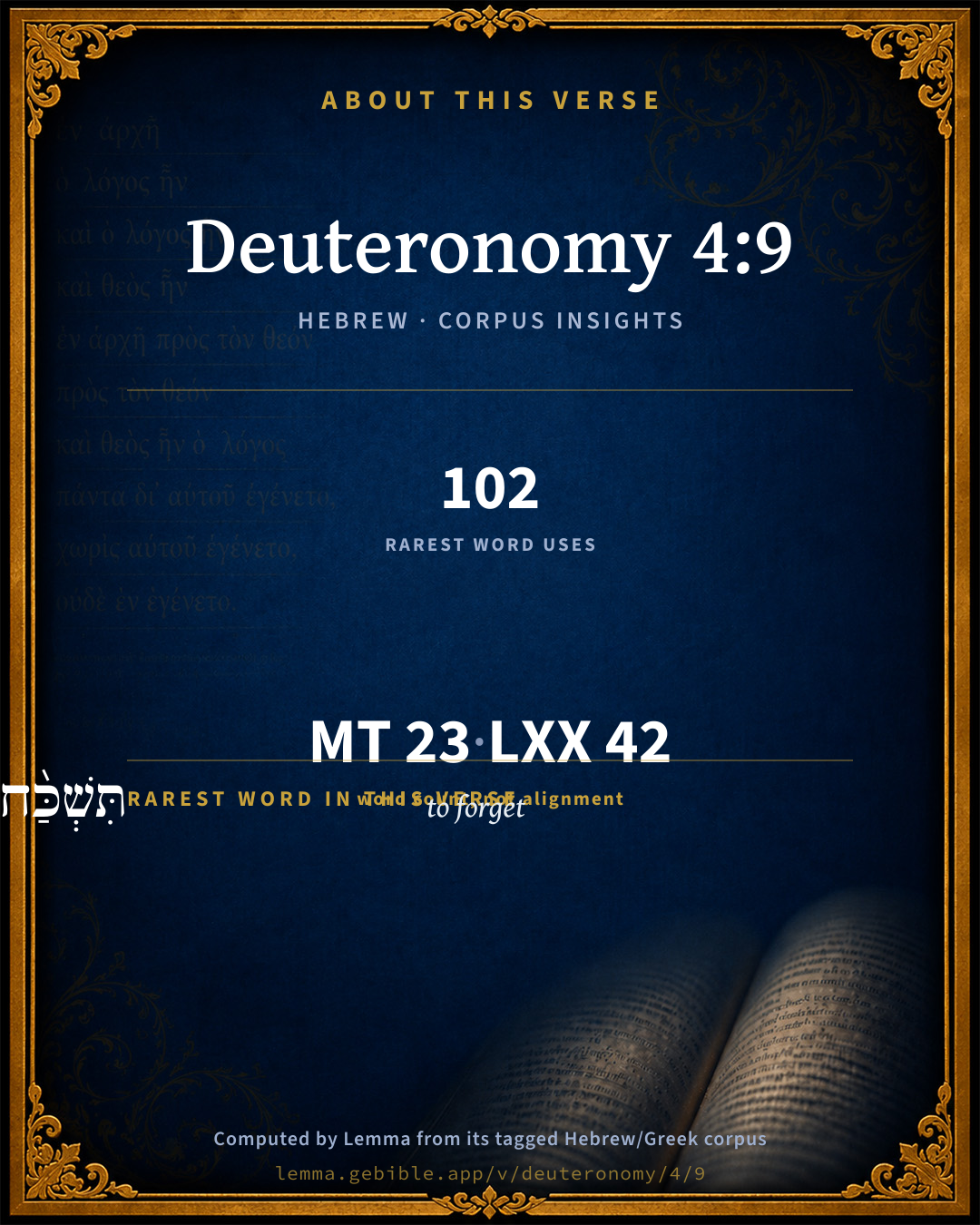
About this verse

These counts appear in no published source. They are computed here, from the morphology-tagged text and Lemma’s own curated glosses. What Lemma adds →

23
words
18
distinct lemmas
Pentateuch
section

Grammatical profile

  • 6 verbs
  • 10 nouns
  • 1 preposition
  • 2 conjunctions
  • 1 adverb
  • 3 particles

Verb forms

  • הִשָּׁ֣מֶר Niphal · Imperative
  • וּשְׁמֹ֨ר Qal · Imperative
  • תִּשְׁכַּ֨ח Qal · Imperfect
  • רָא֣וּ Qal · Perfect
  • יָס֨וּרוּ֙ Qal · Imperfect
  • וְהוֹדַעְתָּ֥ם Hiphil · Sequential Perfect

Repetition

Words recur within this verse — often emphatic in Hebrew:

  • לְבָנֶ֖יךָ son H1121 ×3
  • הִשָּׁ֣מֶר to keep H8104 ×2
  • פֶּן lest H6435 ×2

Hebrew & Septuagint length

In English translation the verse runs 43 words from the Hebrew and 44 from the Septuagint (LXX English) — closely comparable.

A rough comparison of the two English renderings, which tokenize alike — not a word-level alignment.

Word counts can differ between the Hebrew and the Greek without any difference in meaning — e.g. the Hebrew direct-object marker אֵת has no separate Greek word, and Greek often adds the article ὁ.

In the original languages it is 23 Hebrew tokens and 42 Greek tokens — but the two are counted differently (Hebrew bundles its prefixes and suffixes into one token; the Greek is in lemma form), so that isn’t a like-for-like length.

Cross-references

31

Topical passages linked to Deuteronomy 4:9 in the Treasury of Scripture Knowledge — connected by theme and wording, ordered by reader-vote popularity; previews shown in the World English Bible.

  • Deuteronomy 6:7 and you shall teach them diligently to your children, and shall talk of them when you sit in your house, and when you walk by the way, and when you lie down, and when you rise up.
  • Deuteronomy 11:19 You shall teach them your children, talking of them, when you sit in your house, and when you walk by the way, and when you lie down, and when you rise up.
  • Psalms 78:3–8 Which we have heard and known, And our fathers have told us.
  • Genesis 18:19 For I have known him, to the end that he may command his children and his household after him, that they may keep the way of Yahweh, to do righteousness and justice; to the end that Yahweh may bring on Abraham that which he has spoken of him."
  • Deuteronomy 32:46 He said to them, Set your heart to all the words which I testify to you this day, which you shall command your children to observe to do, [even] all the words of this law.
  • Ephesians 6:4 You fathers, don't provoke your children to wrath, but nurture them in the discipline and instruction of the Lord.
  • Exodus 13:8–9 You shall tell your son in that day, saying, 'It is because of that which Yahweh did for me when I came forth out of Egypt.'
  • Deuteronomy 29:29 The secret things belong to Yahweh our God; but the things that are revealed belong to us and to our children forever, that we may do all the words of this law.
  • Proverbs 4:20–23 My son, attend to my words. Turn your ear to my sayings.
  • Proverbs 4:1–13 Listen, sons, to a father's instruction. Pay attention and know understanding;
  • Proverbs 23:26 My son, give me your heart; And let your eyes keep in my ways.
  • Proverbs 3:1–3 My son, don't forget my teaching; But let your heart keep my commandments:
  • Revelation 3:3 Remember therefore how you have received and heard. Keep it, and repent. If therefore you won't watch, I will come as a thief, and you won't know what hour I will come upon you.
  • Proverbs 1:8 My son, listen to your father's instruction, And don't forsake your mother's teaching:
  • Psalms 71:18 Yes, even when I am old and gray-haired, God, don't forsake me, Until I have declared your strength to the next generation, Your might to everyone who is to come.
  • Hebrews 2:1 Therefore we ought to pay greater attention to the things that were heard, lest perhaps we drift away.
  • Joshua 4:6–7 that this may be a sign among you, that when your children ask in time to come, saying, What do you mean by these stones?
  • Proverbs 3:21 My son, let them not depart from your eyes. Keep sound wisdom and discretion:
  • Psalms 34:11–16 Come, you children, listen to me. I will teach you the fear of Yahweh.
  • Psalms 119:11 I have hidden your word in my heart, That I might not sin against you.
  • Joshua 4:21 He spoke to the children of Israel, saying, When your children shall ask their fathers in time to come, saying, What mean these stones?
  • Exodus 13:14–16 It shall be, when your son asks you in time to come, saying, 'What is this?' that you shall tell him, 'By strength of hand Yahweh brought us out from Egypt, from the house of bondage;
  • Proverbs 7:1 My son, keep my words. Lay up my commandments within you.
  • Hebrews 2:3 how will we escape if we neglect so great a salvation-- which at the first having been spoken through the Lord, was confirmed to us by those who heard;
  • Deuteronomy 4:23 Take heed to yourselves, lest you forget the covenant of Yahweh your God, which he made with you, and make you an engraved image in the form of anything which Yahweh your God has forbidden you.
  • Isaiah 38:19 The living, the living, he shall praise you, as I do this day: The father to the children shall make known your truth.
  • Deuteronomy 31:19 Now therefore write you this song for you, and teach you it the children of Israel: put it in their mouths, that this song may be a witness for me against the children of Israel.
  • James 2:22 You see that faith worked with his works, and by works faith was perfected;
  • Deuteronomy 4:15 Take therefore good heed to yourselves; for you saw no manner of form on the day that Yahweh spoke to you in Horeb out of the midst of the fire.
  • Joshua 1:18 Whoever he be who shall rebel against your commandment, and shall not listen to your words in all that you command him, he shall be put to death: only be strong and of good courage.
  • Luke 8:18 Be careful therefore how you hear. For whoever has, to him will be given; and whoever doesn't have, from him will be taken away even that which he thinks he has."

Cross-references courtesy of OpenBible.info (CC BY 4.0).

Hebrew and Greek witnesses Masoretic Hebrew ↔ Greek Septuagint

The same verse in the two great witnesses to the Old Testament, shown verse-for-verse.

These are two independent witnesses, not word-aligned to each other, and the Septuagint is shown in lemma (dictionary) form.

Hebrew Deuteronomy 4:9 Masoretic · Westminster Leningrad Codex

רַ֡ק הִשָּׁ֣מֶר לְךָ֩ וּשְׁמֹ֨ר נַפְשְׁךָ֜ מְאֹ֗ד פֶּן תִּשְׁכַּ֨ח אֶת הַדְּבָרִ֜ים אֲשֶׁר רָא֣וּ עֵינֶ֗יךָ וּפֶן יָס֨וּרוּ֙ מִלְּבָ֣בְךָ֔ כֹּ֖ל יְמֵ֣י חַיֶּ֑יךָ וְהוֹדַעְתָּ֥ם לְבָנֶ֖יךָ וְלִבְנֵ֥י בָנֶֽיךָ

Only take heed to yourself, and keep your soul diligently, lest you forget the things which your eyes saw, and lest they depart from your heart all the days of your life; but make them known to your children and your children's children;

World English Bible · Public Domain

Greek LXX Deuteronomy 4:9 Septuagint · lemma form

προςἔχω σεαυτοῦ καί φυλάσσω ὁ ψυχή σύ σφόδρα μή ἐπιλανθάνω πᾶς ὁ λόγος ὅς ὁράω ὁ ὀφθαλμός σύ καί μή ἀποἵστημι ἀπό ὁ καρδία σύ πᾶς ὁ ἡμέρα ὁ ζωή σύ καί συνβιβάζω ὁ υἱός σύ καί ὁ υἱός ὁ υἱός σύ

Take heed to yourself, and keep your heart diligently: forget not any of the things, which your eyes have seen, and let them not depart from your heart all the days of your life; and you shall teach your sons and your sons' sons,

LXX2012 (modern English Septuagint) · Public Domain

On this verse, The Cambridge Bible for Schools and Colleges discusses the Septuagint’s reading. Read the note in Commentary ↓

Hebrew: Westminster Leningrad Codex (CC BY 4.0). Greek: Septuagint (public domain); English from LXX2012 (modern English Septuagint) (Public Domain). How the Septuagint differs from the Hebrew →

Targum (Aramaic paraphrase)

2

The Targum is the ancient Jewish Aramaic paraphrase of the Hebrew Scriptures — an interpretive translation, not the Hebrew text itself. Onkelos (literal) and Pseudo-Jonathan (expansive) render the Torah, and Jonathan the Prophets. Coverage is partial: where no permissively-licensed English translation exists for a verse, only the Aramaic is shown. This is verse-level text, not a word-by-word alignment to the Hebrew.

  1. Targum Onkelos Torah (Genesis–Deuteronomy)
    לְחוֹד אִסְתַּמַר לָךְ וְטַר נַפְשָׁךְ לַחֲדָא דִילְמָא תִנְשֵׁי יָת פִּתְגָמַיָא דִי חֲזוֹ עֵינָיִךְ וְדִילְמָא יְעִדוּן מִלִבָּךְ כֹּל יוֹמֵי חַיָיךְ וּתְהוֹדְעִנוּן לִבְנָיךְ וְלִבְנֵי בְנָיִךְ

    (no public-domain English translation for this verse)

    Targum Onkelos — Aramaic: “Onkelos Genesis” (public domain); “Onkelos Exodus” (public domain); “Onkelos Leviticus” (public domain); “Onkelos Numbers” (public domain); “Onkelos Deuteronomy” (public domain). English: “Sefaria Community Translation” (CC0 1.0 (public-domain dedication)); “J.W. Etheridge. The Targums of Onkelos and Jonathan Ben Uzziel on the Pentateuch. London: Longmans, Green, 1862” (public domain). Text via Sefaria.

  2. Targum Pseudo-Jonathan Torah (Genesis–Deuteronomy)
    לְחוֹד אִסְתַּמְרוּ לְכוֹן וְטוּרוּ נַפְשָׁתֵיכוֹן לַחֲדָא דִלְמָא תִתְנְשׁוּן יַת פִּתְגָמַיָא דַחֲמִיתּוּן בְּסִינַי בְּעֵינֵיכוֹן וְדִלְמָא יְעִידוּן מִן לִבְּכוֹן כָּל יוֹמֵי חַיֵּיכוֹן וּתְלוֹפוּנוּן לִבְנֵיכוֹן וְלִבְנֵי בְנֵיכוֹן

    Only take heed to yourselves and diligently keep your souls, lest you forget the things which you beheld with your eyes at Sinai, and that they depart not from thy heart all the days of thy life, and you may teach them to your children, and to your childrens children;

    Targum Pseudo-Jonathan — Aramaic: “Targum Jonathan on Genesis” (public domain); “Targum Jonathan on Exodus” (public domain); “Targum Jonathan on Leviticus” (public domain); “Targum Jonathan on Numbers” (public domain); “Targum Jonathan on Deuteronomy” (public domain). English: “The Targum of Jonathan ben Uzziel, trans. J. W. Etheridge, London, 1862” (public domain). Text via Sefaria.

Commentary

Notes on Deuteronomy 4:9 from classic Christian and Jewish commentators (each source and its license shown beneath its notes). The classic Christian expositions comment on the surrounding passage and are grouped to its opening verse, so a note may address several verses; the Jewish commentaries on the Tanakh (Rashi and others) are per-verse, so they appear only where the commentator wrote on this verse.

Lemma curates 59 commentaries, every one of them public domain or Creative Commons licensed, each selected and text-cleaned for this edition rather than reprinted as found. About our sources →

The Cambridge Bible for Schools and Colleges

gen. ed. J. J. S. Perowne

9. Only] Not restriction to one point, but emphasis on the principle of the whole of the Law. For the use of this restrictive adverb so frequent in D see on Deu_10:15.

take heed to thyself] Found in JE, Gen_31:24, etc., but frequent in D—9 times thus, and 5 more generally.

keep thy soul diligently] Rather, guard well thyself (cp. 23 Pl.) or thy life; cp. 1, that ye may live.

lest thou forget the things which thine eyes saw] The experience of the nation as a whole is meant, and not only that of the generation addressed. So the prophets frequently call on their contemporaries to remember what happened to the nation long ago. Hence the transition in this verse to the Sg. is natural and does not imply another author. Similarly throughout the following discourse 5–11. See on Deu_10:21.

thy heart] The seat not of the emotions but of the practical intellect, or, as here, of the memory. Cp. our ‘to get by heart,’ ‘lay to heart.’

make them known unto thy children] First instance of the frequent enforcement to hand on the religious tradition: 10, Deu_6:7; Deu_6:20 f., Deu_11:19, Deu_31:13, Deu_32:46.

9–24. Against Idolatry

The truth that is beneath the whole Law: God is revealed not in images, but by words and deeds of redemption. Warned to lay their experience to heart (Deu_4:9), Israel are reminded of the revelation at Ḥoreb, solely by words and the covenant (Deu_4:10-14); let them recall they saw no form (Deu_4:15) lest they make any idol of any living thing in earth, air or sea (Deu_4:16-18) or worship the host of heaven, assigned by Jehovah to other peoples (Deu_4:19), but no gods for those whom He hath redeemed for Himself (Deu_4:20). For their sakes, Moses is not to cross Jordan (Deu_4:21 f.); so he enjoins them to take heed. Jehovah is a devouring fire (Deu_4:23 f.).

In substance the passage is a unity—except perhaps Deu_4:19. In form it is in the Pl. address with a few transitions to the Sg.; all, except Deu_4:10, confirmed by Sam. and LXX. These are typical of the various causes which may have led to frequent transitions. The Sg. is logically explicable in Deu_4:9, perhaps too in 10; coincides in 19 with the only change of subject, and so possibly marks a later addition; in 21 may be due to the later addition of a formula; while 24 is possibly a quotation and the preceding thee in 23 due to the attraction of its Sg. The language is in the main deuteronomic, but the section has been taken (along with 32–40) as from another hand than Deu_1:6 to Deu_4:8 (alternatively Deu_1:6 to Deu_4:4) on these grounds: that the same author would not have repeated in 21 f. what he has narrated in Deu_3:26; that 10 ff. imply that Moses is addressing the same generation as was alive at Ḥoreb and are therefore discrepant with Deu_1:35 ff. and Deu_2:16, while agreeing with the Second Discourse, cp. Deu_7:16; that of the phrases used some are found in D only in 5–26, 28 (lest thou forget, 9, 23, Deu_6:12, Deu_8:11; Deu_8:14; Deu_8:19, Deu_9:7, Deu_25:19; which thine eyes have seen, 9, Deu_7:19, Deu_10:21, cp. Deu_11:7; all the days of thy life, 9, Deu_6:2, Deu_16:3, Deu_17:19); others are found only in P (male and female, winged fowl, anything that creeps, 17 f.) or other late writers (figure, 16, iron furnace, 20). Note, too, people of inheritance, 20, for the usual peculiar people. The discrepancy (see below) is not conclusive; neither does the language necessarily imply an exilic date; even the phrases found elsewhere only in P are very general. The similarities to 5–26, 28 may imply a date subsequent to the latter; but are too few to render such an inference certain.

The Cambridge Bible for Schools and Colleges (gen. ed. J. J. S. Perowne; Cambridge University Press, 1878–1918) — public domain. Text from a community e-Sword module.

Trapp's Complete Commentary

John Trapp

Deu 4:9 Only take heed to thyself, and keep thy soul diligently, lest thou forget the things which thine eyes have seen, and lest they depart from thy heart all the days of thy life: but teach them thy sons, and thy sons’ sons;

Ver. 9. Only take heed.] Cavebis autem, si pavebis.

Lest thou forget.] Eaten bread is soon forgotten.

Teach them thy sons.] A special help against forgetfulness; yea, this is the best art of memory. Of all things God cannot abide to be forgotten.

John Trapp, A Commentary or Exposition upon All the Books of the Old and New Testament (1647–1656) — public domain. Text from a community e-Sword module.

Albert Barnes' Notes on the Bible

A full stop should end Deu 4:9; and Deu 4:10 begin, At the time that thou stoodest, etc. Deu 4:11 then ye came near, etc. Moses, exhorting to heedful observance of the Law, strives to renew the impressions of that tremendous scene which attended its promulgation at Sinai.

Albert Barnes' Notes on the Bible (1834–1885) — public domain. Text from a community e-Sword/MySword module.

The Biblical Illustrator

Joseph S. Exell

Deu_4:9

Only take heed to thyself, and keep thy soul diligently, lest thou forget the things which thine eyes have seen.

An important admonition

I. In what respects we are bound to take heed to ourselves.

1. Take heed to your health. When this is gone, how tedious and tasteless is life! The wretched subject of disease is ready to exclaim (Job_12:4; Job_12:13-15), Oh, what pain are some poor creatures doomed to bear! But in numberless instances some of the severest afflictions to which mankind are subject are the fruits of their own folly. Keep the body under: let your diet, your rest, your well-regulated tempers tend to the health of the human frame, not to its destruction.

2. Take heed to your character. A Christian is the highest style of man. In this quality is associated every holy temper and disposition. There is faith with its eagle eye, love with its burning flame, peace with its placid smile, humility with its lowly aspect, patience with its soothing balm, and as much of the heavenly treasure as can be conveyed into an earthen vessel. Therefore take heed to attain this character; and then be careful to preserve it.

(1) You may forfeit your Christian character by levity. Christian cheerfulness is widely different from worldly and unhallowed mirth.

(2) You may forfeit your Christian character by a haughty, high-minded disposition. There is no evil in the world so hostile to religion as pride.

(3) You may forfeit your Christian character by your tongue.

(4) This may be done by neglecting your relative duties.

3. Take heed to your souls. They are dark, and must be on lightened; guilty, and must be pardoned; enslaved, and must be redeemed; polluted, and must be sanctified; in danger, and must be saved.

4. Take heed to your time. Time wasted is existence lost; used, is life. Therefore part with it as with money, sparing it, and never paying a moment but in purchase of its worth.

5. Take heed to your conduct.

(1) Let it be consistent. See to it that you are in reality what you pretend to be.

(2) In order that your conduct may be consistent, let it be regulated by the Word of God. In the balances of the sanctuary weigh your principles and actions (Isa_8:20).

II. The reasons why the advice in the text should be followed.

1. The character of the speaker is the first motive I will bring before you. It is the eternal Jehovah; the God in whose hand your breath is, and whose are all your ways (Dan_5:23).

2. The reasonableness of the requisition is another argument why you should take heed to yourselves. Even animals which are governed by mere instinct take heed to themselves. In many cases they refuse to eat what would be injurious to them, and fly from danger the moment they perceive it; and shall reason fail to do for you what instinct accomplishes for them? (Jer_8:7.)

3. The dangers that await you afford another reason for the adoption of the advice in the text. Had you literally to walk in a road beset with snares, where you were liable to be entrapped every moment, would not the perils of your path be a sufficient inducement for you to take heed to yourselves? And do not more fearful dangers await you in your spiritual career? (R. Treffry.)

On experience-its use, its neglect, and its abuse

I. Under the first head, that of its use, it may be said, in general, that there is no knowledge so useful as that which is gained by experience.

1. Events are better remembered than precepts, and indeed it seems but just that that acquisition should turn out to be valuable which is so often dearly paid for with tears. He who heeds not the warnings of his elders, or his books, to abstain from excess, may be taught by sickness a lesson of moderation which he will not forget. Severe losses may now induce him to be prudent and provident who never till now could be brought to believe that prodigality begat want, or that riches had wings.

2. Besides the great personal benefits which flow from experience, it is also the source of more extended usefulness. For the guidance of life and conduct, there is no kind of wisdom which we can so confidently and beneficially communicate as the lessons of experience. And it is the high gratification of the virtuous old man that the trials which he has borne, the successes which he has enjoyed, place at his disposal the best means both of ensuring his own security, uprightness, and of relieving the perplexities and guiding the steps of the young and inexperienced. He who has gathered wisdom from many years can impart to others the legacies which each year has left him, and live while they are enjoyed, nor grow any poorer by making others richer.

II. It is a melancholy truth, that wisdom which may be so easily, I might say naturally, acquired is often neglected; wisdom, too, which, as we have seen, is so useful in the direction of our conduct, and in our intercourse with others. There is hardly a more pitiable object than a man who cannot, or will not, learn wisdom from experience; one who, to use the expressions of our text, forgets the things which his eyes have seen, and they depart from his heart all the days of his life. To brood over our cares, and too fondly to indulge our sorrows, and thus unfit ourselves for the active duties of life, is indeed unchristian and irrational; but both religion and reason require us to contemplate and force instruction from every wayward event for our future security and quiet; like Jacob, to hold every heaven-sent grief with which we have wrestled, and not to let it go till it has blessed us. We are wrong in being always so very anxious to drive away unpleasant thoughts; we must let them remain till they have cured us; we might as well drive away the surgeon from our doors who came to perform a painful though necessary operation. We must learn to look upon the occurrences of life not as insulated facts, but as borrowing illustration from the past, and reflecting it upon the future.

III. Of the neglect of experience we should speak with concern, with pity, or with reprobations--of its abuse we can speak only with the most unqualified abhorrence. By the abuse of experience I mean experience in the arts of the world employed not to warn, but to ensnare the simple and unsuspecting, and experience of its vices employed not to admonish but to correct innocence. (H. W. Beecher.)

The spiritual benefits of retrospection

It is to be feared that to many (so habitually unmindful are they of what they have been permitted to witness, both in the wider sphere of public and the more contracted one of private life) experiences are somewhat like the stern lights of a ship, which serve to illumine only that part of the water over which she has just sailed. It is far otherwise when, through the agency of supernatural grace communicated in answer to the prayer of faith, experience is sanctified, for it then becomes strongly conducive to spiritual health. If it be the province of Hope to paint the bow of promise upon the cloud, it is that of Memory to gather rays of the light of direction from the past, and to cause them to shine upon the path of religious duty, which is beset by so many temptations that every encouragement is needed, lest the travellers faint because of the way. Now, in directing your attention to some of the functions which a religiously disciplined memory performs in connection with the life of faith--

I. I would first ask you to observe that it is one of its offices to teach Christians to keep a more accurate register of their mercies than they are naturally disposed to do; to train them in resistance of the dangerous tendency to dwell with circumstantial precision, and often even selfish exaggeration, upon their trials. It is Memorys office to embalm their blessings, to preserve them from the decay to which time and the influence of an evil world would otherwise subject them.

II. Memory has also functions of momentous importance in connection with the true repentance to which we are called by Him who alone can enable us to sorrow after a godly sort. It is the office of a rightly trained memory to remove the concealments by which we seek to hide our delinquencies from ourselves, to dwell with emphasis upon passages in our history from referring to which we would naturally desire to escape, to keep the unwelcome but wholesome truth of our unworthiness before us that we may really feel our need of pardon and earnestly seek it where alone it can be found. In cases, too (which it is to be feared are very far from uncommon), in which spiritual declension has begun--cases of backsliding in heart--the memory of the past has much to effect in connection with the restoration of those who have so declined. The contrast which memory would lead them to institute between the comparatively happy time when they kept in the way of duty and the troublous time when they forsook it has been one which, rendered practically influential by the operation of the Spirit of Grace, has led them back to tread that path in which only rest can be found for the soul. Scripture is replete with testimony to the value of the past in preparing us for doing Gods will in that portion of the future which may be granted us, teaching those who are to take our places when we are called away by the inevitable summons to be in their time ready to serve their generation according to that will. To this consideration, namely, that of the responsibility which rests upon us to do all that lies in our power to bring up the rising generation in the service of Christ, we are led by the words of the final clause, Teach them thy sons, and thy sons sons. If those addressed in the words of the text could refer their children to the past for lessons of spiritual wisdom, they who are living under the new and better covenant cannot fail to find counsels in the retrospect of their experience to impress upon youthful minds. They may tell how they have seen evidences, how the fond hopes of religious parents can be blighted by the ungodliness of children, how they have seen health shattered by intemperance, brilliant prospects clouded by yielding to the allurements of a world at enmity with God! They may tell how they have witnessed exemplifications of the truth of those words quoted by an inspired Christian teacher from an heathen author, Evil communications corrupt good manners. Or they may turn from painful to pleasurable reminiscences. They may tell of instances of the beneficial results of the nurture and admonition in which children were brought up to live for Christ. They may speak of homes lightened by the joy imparted to souls influenced by the grace of God. (C. E. Tisdall.)

Diligent soul keeping

I. What soul keeping is. It is the keeping of a living being, and not of a mere inanimate thing. To have the charge of a priceless jewel is only the matter of wrapping it carefully up, putting it away in a safe place, and giving it an occasional look. But it is an altogether different matter to have the charge of a child. That means constant attention, perpetual claim on wisdom and self-denial. And soul keeping is the charge of a living being. Keeping a living creature, so as to help it to maintain vigour and grow into its very best, means--

1. That we must get to know and understand it; and such a knowledge includes the peculiarities of the individual as well as the general characteristics of the class or species to which it belongs. It means--

2. That we must adapt our ways to it, putting ourselves upon all efforts and upon all restraints that may be necessary in order to do our very best in its behalf. But it also means--

3. That in some things we make it take our ways, for it is the most serious responsibility of our trust that we have to put the impress of our own will and our own example on the living being we have in charge. We must, in some things, adapt ourselves to it, and in some other things make it shape its conduct to our wish. If we can take the deeper view, we may apprehend that the soul is the self. But just now another view will be more suggestive to us. We are to think of the soul as a trust from God--a self given to ourselves to keep for God, a living being put into our charge, as men put an animal from foreign climes, or a plant, into our care. And this becomes our chief life concern--to keep, in health, in vigour, in all due activity, that living thing, our soul. A figure may be taken from the ways of our doctors. It is true that they are concerned with the forms and features and expressions of positive disease; but they have a trust which is of far more importance. Our vitality is committed to their care. And mothers follow along the same lines. They are watchful, indeed, of every spot on the body or weakness in the limb of their children; but wise mothers are most anxious about keeping up the vitality, nourishing the very springs of life. There are the possibilities of throwing off the germs of disease, and unfolding into ideal completeness of beauty, in manhood or womanhood, if only the life can be kept in health and vigour. And so the Christian should be supremely concerned about the trust he has from God, and keep his soul with all diligence.

II. What kinds of care it involves.

1. We must be watchful of what goes into it. We put injurious things out of the way of children; but we too often fail in the equally important duty of putting evil things that seek entrance out of the way of our souls. But our Lord reminded us--

2. That we should be equally watchful of what comes out. He said, Out of the heart proceed evil thoughts,. . .and these defile the man. This is the complication of our keeping. We have to check the soul from giving expression to the bad things that are in it, because they grow strong by expression. But the kind of care involved in soul keeping may be put in another way.

It includes--

1. Taking care of the souls atmosphere. We say of plants and of persons, The climate does not agree with them: they never will be healthy while they remain in it! Our scientific teachers tell us that there is one element in the air we breathe which is absolutely and partly intellectual. The proper food for the emotional is all that goes under the name of prayer. The proper food for the intellectual is all that goes under the name of truth. Add this, that there is a practical side to the soul life, the food of which is duty, and we know that which it is fitting we should provide--prayer, truth, duty.

2. Taking care of the souls neighbours. Evil communications corrupt good manners. They who would keep their souls should not even stand in the way of sinners: much less can they venture to sit in the seat of the scornful.

III. What difficulties have soul keepers to overcome? Their name is Legion. But we may profitably fix our attention on two.

1. The outwardness of mens interests nowadays. We live in the street, and the hall, and the drawing room, rather than in the prayer chamber, and the tower of vision; and this makes soul keeping so hard

2. The pressure of bodily, and business, and family claims. Like Dr. Chalmers we are bustled out of our spirituality. Our time is seized upon by the world, and when he has done his daily will with us we are weary, too weary for the things of God. He who would keep his soul must meet and master these difficulties, and persistently set first, in his seekings, the kingdom of God and His righteousness. (The Weekly Pulpit.)

On the benefits of experience and reflection

The great source of all human knowledge is experience and that experience which teaches us practical wisdom, and informs us of the many evils that constantly wait on life, is acquired chiefly by observation and reflection. The historian makes it his peculiar glory that, by faithfully recording the fates of kingdoms, by delineating the virtues which raised some to magnificence, and the vices which brought others gradually to destruction, he anticipates the future by a true representation of the past, and teaches men wisdom by the examples of others. But though, from the short period of human life, the narrowness of our views, and other causes, we are obliged to recur to the experience of those who went before us for almost all our knowledge; yet the few events that happen to ourselves, or that fall within the circle of our own observation, make a far more lasting impression on us, and have a much greater influence over the heart.

I. First, let me exhort you, when you ponder in the path of life, not to let the remembrance of your disappointments, whatever they might have been, depart from your hearts. If the Sufferance of them has been grievous, let the remembrance of them be profitable. If they have crossed your inclinations, or withheld from you fancied pleasures, let them not die away without producing their proper effect in moderating the passions and inspiring that patient fortitude which, aided by prayer, will enable us, amidst all the storms of life, to maintain a character of dignified composure, resignation, and contentment.

II. Next to the disappointments of life, I wish you to reflect on the sorrows which you might have experienced. As the land is more grateful to the mariner after his vessel has been dashed against the rocks, and he himself has struggled with the waves of life, so is the recovery of peace to those who have escaped the storms of adversity. Many are the advantages we derive from this severe monitor, if we knew how to enjoy them. She seldom fails to soften and improve the heart.

III. Let me now direct your attention to a subject in which we are all equally interested--I mean the house of mourning and the chambers of death. Here also let us endeavour to learn what lessons experience would teach us. It is not in the giddy and fantastic scenes of pleasure that the mind improves in wisdom or in virtue; these, for the most part, are acquired by habits of reflection, and by taking such views of human affairs as dispose the soul to thought and meditation. For this cause the house of mourning is a house replete with instruction, and is on that account wisely preferred to the house of feasting. It is there that our religious principles acquire an energy not to be derived perhaps from any other source. It is there that those truths which were announced to us as glad tidings from heaven, and those duties which are founded on reason and contemplation, are strengthened and improved by the softest and most powerful emotions of the heart. In these melancholy moments we feel our own weakness and see the vanities of life. Temptations to guilt and misery no longer court us under the delusive forms of pleasure, and sin appears in all its native deformity. We confess the vice and folly of every mean pursuit, and the mind flees to the religion of Christ for comfort and support. (J. Hewlett, B. D.)

Take heed to thyself, etc

In the business of life there are three parties concerned, three parties of whose existence it behoves us to be equally and intensely conscious. These three are God on the one hand and our own individual souls on the other, and the one Mediator, Jesus Christ, who alone can join the two into one.

1. There is all the difference in the world between saying, Bear yourselves in mind, and saying, Bear in mind always the three, God and Christ and yourselves, whom Christ unites to God. For then there is no risk of selfishness, nor of idolatry, whether of ourselves or of anything else; we do but desire to keep alive and vigorous, not any false or evil life in us, but our true and most precious life, the life of God in and through His Son. But what we see happen very often is just the opposite to this. The life in ourselves, of which we are keenly conscious, never for an instant forgetting it, is but the life of our appetites and passions, and this life is quite distinct from God and from Christ. But while this life is very vigorous, our better life slumbers; we have our own desires, and they are evil, but we take our neighbours knowledge and faith and call them our own, and we live and believe according to our neighbours notions; so our nobler life shrinks up to nothing, and our sense of truth perishes from want of exercise.

2. In combining a keen sense of our own souls life with the sense of God and of Christ there is no room for pride or presumption, but the very contrary. We hold our knowledge and our faith but as Gods gifts, and are sure of them only so far as His power and wisdom and goodness are our warrant. Our knowledge, in fact, is but faith; we have no grounds for knowing as of ourselves, but great grounds for believing that Gods appointed evidence is true, and that in believing it we are trusting Him. (T. Arnold, D. D.)

Israel admonished

I. The evil anticipated--forgetfulness of their own past experience of Gods gracious dealings. Lest thou forget the things which thine eyes have seen, etc.

1. We cannot suppose that Moses thought it possible they should so far lose all traces of these events as that they should not, by any circumstance, be brought to remembrance.

2. But these things might be so forgotten--so little and so lightly thought of, as to depart from their hearts, so as to have no influence there. No correcting influence; error might be corrected by a heart-affecting remembrance of Gods distinguishing judgments and mercies (Deu_4:3-4), but such remembrance would be necessary. No chastening influence, such as that intended in Deu_4:5-20; consequently no cheering influence, such as Deu_4:36-40 might impart. In short, the things which their eyes had seen might be so forgotten as to produce no saving effect.

3. And Christians are as liable to this calamity as the Israelites were.

4. The greatness of the evil may be inferred from the greatness of the punishment threatened--the loss of Gods gracious presence for direction, defence, etc. (Deu_4:7); the loss of Canaan (Deu_4:27); and the heaviest of temporal calamities (Deu_4:26; Deu_28:16).

II. The preventives recommended. Only take heed to thyself, and keep thy soul, etc. The text suggests the necessity of--

1. Holy jealousy. Take heed; keep thy soul. Nothing is more dangerous than self-sufficiency and presumption; a vain confidence in what is called a good heart. Moses intimates that the soul needs watching and keeping.

2. Holy vigilance. Only take heed, and keep thy soul diligently. This advice is necessary because of our natural disposition to wander, and because of the allurements to which we are exposed. Grace may raise and sustain us. The soul may wander on wicked things; and such is its weakness that no man can say into what sin he may not fall. David fell into adultery and murder. Therefore keep thy soul diligently. Resist beginnings. But we are, perhaps, in greater danger from things which do not shock our sense of propriety, etc., but which serve, nevertheless, to divert our minds, and so to prevent a steady attention to the one thing needful, such as business, company, amusement, literature, etc. Therefore keep thy soul within proper bounds. Watch her motions, and check them ere they become irregular or excessive.

3. Holy exercises. Indolence is at once disgraceful and injurious. Satan finds the idle employment. What has been already advised includes much of exercise. But in addition we may say, Diligently meditate on Gods gracious dealings with you in former days, and examine what progress you make (Deu_8:2; Deu_8:11-18). Diligently pray for a continuance and increase of His favours. (Sketches of Four Hundred Sermons.)

Memory in religion

Let us just a moment longer think about memory, and what we owe to it. Our sense of personal identity is due to memory. If we had no memory of the past our lives would be a series of links not joined into a chain, and a host of beads without anything to string them together; there would be nothing to show us or make us feel that our life yesterday or today had any special connection, or were pages in the same book of history of the same person; and with the loss of this sense of personal identity would go all sense of personal responsibility and of continuous or energetic action. We would always be falling back again to our old starting point, and would lose every night what we gained every day. But memory is the subtle weaver that weaves all the various movements and events of every day into one continuous whole, into one conscientiously responsible and permanent life. The memory, then, is most necessary for the acquisition of wisdom. It is by the golden grain of experience treasured up in memory that we grow rich in practical wisdom. Some people, indeed, never seem to learn by what they pass through. They live in the present moment, without thought of yesterday and without hope of tomorrow, and all that happens is apparently forgotten just as soon as it is over. It is a precious gift, then, that God has given to us in memory, and its cultivation is indispensable and its proper use for all manhood and for all useful life. And now in our text Moses seeks to enlist this great power of memory on the side of religion--Lest thou forget, he says. And if Moses could thus appeal so forcibly to the people in his day, calling upon their memories to witness what God had done for them in Egypt and the desert, entitling Him to their grateful and obedient services, how much more may our memory be appealed to in these days. While it is true, however, that the memory to which Moses appeals has such a marvellous power, yet diseases and defects of memory are very common. There is no part of our complex mental system which is so liable to get disordered as memory. Certain events of the past seem, at times, to pass from the spirits vision when disease is beginning, even things which we should fancy a man could never forget--his own home, his relatives, and his ordinary work. Even when there is no actual disease, yet serious and dangerous defects of memory are very common. A slovenly and unreliable memory is a very common fault. We forget things because we are not interested in them. As we hear a fact which appeals to something in us, satisfying some desire, supplying some want, we appropriate it at once, we allow the tendrils of affection and desire to twine around it, and we fondly treasure it in our hearts. Then we will remember it forever, and can recall it in every hour of need. We might say, in fact, that defects of memory arise from improper training. We do not learn to concentrate our mind upon our work; we do not know how to fix our attention; we do not make an effort to understand things we read and hear. Take the reading of a book. Many readers turn over page after page, having read each of them, as they assure themselves, but nothing on any page makes any impression upon them, or only some striking incident or accident. Now, such defects of memory can be cured to a very large extent before they run into permanent weakness or mental disease, and while we have the opportunity surely it is worth our while to make an earnest and continuous effort to try to do it. And so with regard to religion. The root of much error and evil, of many difficulties in life and transgressions in action, lies in sins of memory. We remember, all of us, the facts of Bible history, but we have never cared to acknowledge their application. Now there are many things which tend to increase the defects of memory when we have to do with religious things. There is often no one to remind us of the lessons we have learned or the promises we have made; there is often no one to check us for our forgetfulness and wanderings, no voice from heaven speaks to us, no instantaneous punishment falls upon us for neglecting and forgetting them. Besides, the things that it is necessary for us to remember often produce pain when they are recalled, and the fear of pain paralyses our memory, while the rush of the world and of life sweeps us on to other thoughts and other things. If we only felt the importance of remembering these things the work would be half done. I know a lady, a Sabbath school teacher in the town of Newport, who has had the unique record that, as scholar and teacher, she has attended a school in that town for fifty-two years without a break. To her it was a matter of supreme importance to be in her place Sabbath after Sabbath, and everything in her weeks work was arranged accordingly. There was no danger that she would ever be absent or forget her Sabbath school when the hour for going to it arrived. If we get into the habit of forgetting our duty and the promise of God we are at the mercy of foes and in danger of the wrath of God, as Moses said; for God does not forget. But even to remember well is not enough. It is but a means to an end. There are some people who have prodigious memories, and they are very proud of it; some even make their livelihood by it. They can repeat a whole book after they have once read it. Often such a memory is only a wonder passing across the sky of life like a comet, and leaving no light and blessing behind. Sometimes it is a sign of mental disease, so that the other faculties of mind will soon be clouded. A splendid memory is a good thing, but it needs to be balanced by good judgment and needs to be actively used if it is to be the blessing it ought to be. When we turn to religion we find that there are many people who can remember well religious facts and doctrine, and arguments to prove them, but what use is it to them? Does it lead them to exercise self-control or self-denial? Alas, no! If memory is to be of use to us we must be true to memory as to conscience, we must be warned by what has happened in the past in the spiritual world; it must never be forgotten, so that we never go wilfully into the same temptation or commit the same mistake twice. In the verse out of which our text is taken, and at the end of it, there is one thing specially mentioned as necessary if memory is to be of use, and that is, that the things we remember we must teach to others. Teach them thy sons, and thy sons sons, and thus help to fix them in our mind in an accurate and orderly fashion. There is not one in this audience, I fancy, to whom the text does not appeal. It appeals to the young, Lest thou forget. You are strong and hopeful, and ever pushing up. There are some things a man can never forget with safety. As a man sows, so shall he reap: for all these things God will bring, thee into judgment. This text appeals to the prosperous. You look back with honest pride upon the days when others started side by side with you, with all the advantages you had, but they have fallen far behind and you have gone right ahead. Everything you have touched has turned to gold, Oh, the text appeals to you. There is no spot on earth more slippery or dangerous than the mountain top of prosperity. It is God who has given thee the power to get wealth and all these blessings, and He will continue them to you as a blessing as long as you use them to the glory of His Name. Our text appeals to the poor and lowly. The hand of God has been heavy upon you. Through no fault of your own you have fallen behind in the race of life. The text comes home to you, Lest thou forget. It may be that sometimes bitter thoughts take possession of your heart, envious thoughts against your fellows, and you are tempted to wrap yourselves up in selfish misanthropic thoughts, and then you lose all the benefit of all the lessons that God has been taking so much trouble to teach you. But there is no danger if you will only remember that God rules the world, that God makes no mistake, that God has promised to make all things work for good to those who love Him. (W. Park, M. A.)

Lest we forget

How good a gift is memory! Of all the gracious benefits conferred on mortal men by God there is none more useful, none more precious. By memory we are enabled to lay by a store of precious thoughts and gracious reminiscences against the days to come. By memory we can stud our minds with promises and precepts from the Word of God, as the midnight heavens are studded with the twinkling of stars. But alas! memory has fallen with the rest of our powers. Do you not know from sad experience how readily evil is retained? When you would fain erase it from the page, the dark letters still appear. Things that we thought we had with a tenacious grip are torn away from us, or slip from our grasp, and the place that knew them knows them no more. Our memories have failed us. By a good memory I mean a memory that lets slip that which is not worth holding, and holds as with a death grip that which is most worth preserving.

I. Notice first, that God graciously gives warning of the danger. Is not this right good of Him?

1. He knows us thoroughly--better, far better, than we know ourselves. The people of His choice were prone to forget Him, therefore did He constantly sound this warning note. To them, I suppose, it seemed impossible, certainly improbable, that they would forget the things that their eyes had seen. Forget Egypt, the furnace of iron? You would have thought that these experiences had been burned into them by the very fire of the furnace through which they passed. Forget their redemption and deliverance, the night of the Passover, and the passage of the Red Sea? Forget God, who had delivered them times out of number, who had spoken to them out of the midst of the fire? This same sad principle holds good today. We used to think that the experiences of our early Christian life would linger with us and influence us for good through all our days. As one who says I will remember, and makes a knot in his handkerchief in order to assist his memory, and then forgets why he made the knot, so our efforts to remember God and the things of God have proved fruitless. Are you not aware--let it be a matter for sorrowful confession if so--that you have sometimes forgotten that you have been purged from your old sins? You have been indulging in them again. That looks as if you had forgotten the cleansing from them. The peril still exists, but to be forewarned is to he forearmed. Moreover, God knows just when and where this peril is likely to be greatest. If you will turn to Deu_6:12 you will understand my meaning better. There is much meaning in the then. You must read what precedes it in Deu_6:10. There is no season so perilous, in this particular, as the season of prosperity. The fear is that when all things are crowding into us, God should be crowded out. You will find it comparatively easy to remember God and to recollect His dealings with you in the past when laid upon a bed of sickness, or when bereaved or troubled. Sometimes God permits these dispensations to give us a pause in the rush of life, and opportunity to call to remembrance.

II. He supplies valuable instruction. He does not content Himself with waving a red flag before us; He stops the train, and gives instructions to the driver and the guard. Take heed to thyself. It means literally, Be watchful. This is just where we fail, as a rule; the watchtower is deserted. Strengthen the guard rather than reduce it, and see to it that everything that would enter the mind is challenged as it approaches, and that all that would go out that should remain within the walls is prevented from passing through the portals. Keep thy soul diligently. It is the same idea as we have already mentioned. As one might call to another whom he saw to be in danger, Look out,--look out! Here is a further instruction, Teach them thy sons, and thy sons sons. For whose benefit, think you, is this instruction given? for that of the sons and of the grandsons? Yea, verily; but do they reap all the benefit? I tell you, sirs, one of the best ways to remember things that are most worth remembering is to pass them on to others.

III. I have this further to say, that He provides welcome aids to memory. He remembers our frame, He knows that we are but dust; therefore does He come to our assistance. He calls us like little children to His kindergarten school, and makes the learning easy. There are ways of schooling the mind and training the memory; there are certain aids and helps. The law of association serves a good purpose in this respect, and object lessons lend always a pleasing succour. Certainly it is so in the things of God. To Israel God gave the Passover, constantly repeating it to remind them of that wondrous night when He brought them out of the house of bondage with a high hand and an outstretched arm. To Israel He gave the varied ritual of the Mosaic dispensation, that they might never forget the doctrines of sin and of salvation, and that without the shedding of blood there is no remission. To Israel He gave the ark, in which was the pot of manna, Aarons rod that budded, and the tables of stone. All these were aids to memory. After just this fashion God deals with His spiritual Israel, providing aids to memory, lest we forget. Heavenly influences are with us constantly, angel ministries work for our help and succour; holy exercises, if we do but engage in them in the right spirit, tend in the same direction. Prayer brings us to the mercy seat, and sends us full-handed home. Praise puts a harp into our hands, and causes us to sing our thankfulness to God. The ordinances of worship and opportunities for service all help to keep us in touch with heaven, and to keep our hearts aglow with godliness. The Word is one of Gods aids to memory. You can hide the Word of the Lord in your heart, lest you forget. I would have you remember, too, that the ordinances that the Saviour has established are for this same purpose. Think of believers baptism. The Lords Supper is instituted for this same purpose; it is a reminder of all that has passed in connection with our spiritual experience. This do, said He, in remembrance of Me. How often we pray the prayer of the dying thief, Lord, remember me. It is a right good prayer. Mothers may forget their children rather than that Jesus should have us out of His mind, but I tell what is possible--that you and I should forget Him. (Thomas Spurgeon.)

Memory aided by sight and instruction

We may have no memory for words: had we committed the lesson to an intellectual recollection we might have been excused for forgetting somewhat of its continuity and exactness; the point is, that we are called to remember things which our eyes have seen. The eye is meant to be the ally of the memory. Many men can only remember through the vision; they have no memory for things abstract, but once let them see dearly an object or a writing, and they say they can hold the vision evermore. Gods providence appeals to the eye; Gods witnesses are eyewitnesses--not inventors, but men who can speak to transactions which have come under their immediate and personal observation; they have seen and tasted and handled of the Word of Life. What a loss it is to forget the noble past! How treacherous is the memory of ingratitude; all favours have gone for nothing; all kind words, all stimulating exhortations, all great and ennobling prayers--forgotten in one criminal act. To empty the memory is to silence the tongue of praise; not to cherish the recollection is to lose the keenest stimulus which can be applied to the excitement and progress of the soul. On the other hand, he whose memory is rich has a song for every day; he who recollects the past in all its deliverances, in all its sudden brightnesses, in all its revelations and appearances, cannot be terrified or chased by the spirit of fear; he lives a quiet life, deep as the peace of God. Can Moses suggest any way of keeping the memory of Gods providences quick and fresh? He lays down the true way of accomplishing this purpose: Teach them thy sons, and thy sons sons,--in other words, speak about them, dwell upon them, magnify them, be grateful for them; put down the day, the date, the punctual time when the great deliverances occurred, and when the splendid revelations were granted; and go over the history line by line and page by page, and thus keep the recollection verdant, quick as life, bright as light. What a reproach to those Christians who are dumb! How much they lose who never speak about God! To speak of the mercies of God is to increase the power of witness at another point. We first see, then we teach. The teaching of others is not to come until there has been clear perception on our own part. The eyewitness is doubly strong in whatever testimony he may make: not only can he tell a clear story from end to end, he can sign it with both hands, he can attest it with the certainty and precision of a man who has seen the things to which he sets his signature. Our Christianity amounts to nothing if it is not a personal experience. (J. Parker, D. D.)

Teach them thy sons.

Instruction of children

An Englishman visiting Sweden, noticing their care for educating children who are taken from the streets and highways and placed in special schools, inquired if it were not costly. He received the suggestive answer, Yes, it is costly, but not dear. We Swedes are not rich enough to let a child grow up in ignorance, misery, and crime, to become a scourge to society as well as a disgrace to himself. (The Lantern.)

Training of children

As Alexander the Great attained to have such a puissant army, whereby he conquered the world, by having children born and brought up in his camp, whereby they became so well acquainted and exercised with weapons from their swaddling clothes that they looked for no other wealth or country but to fight; even so, if thou wouldst have thy children either to do great matters, or to live honestly by their own virtuous endeavours, thou must acquaint them with painstaking in their youth, and so bring them up in the nurture and admonition of the Lord. (Cawdray.)

The echo of childhoods years

One of the most memorable incidents of my boyhood was the hearing of a remarkable echo at a famous health resort. Long after the voice had sounded there came back the echo of it, so distinct and clear as to seem a response. Is not the echo a parable of life? Childhoods years cannot be recalled, nor its actions repeated; yet they will re-echo for us in the coming days sounds of gladness or of sorrow as their character may have been. Through the corridors of memory the melody of a pure, noble, and unselfish youth will be heard, gladdening the heart of age when the days of action have given place to the days of reminiscence. (Great Thoughts.)

The Biblical Illustrator, edited by Joseph S. Exell (c. 1880s–1900s) — public domain. Text from a community e-Sword module.

Joseph Benson's Commentary

Deu 4:9-10. Only take heed — Their only danger was, lest they should grow careless and unmindful of all the wonderful things that God had done for them; for which reason he would have every Israelite to make these weighty concerns the subject of his most frequent study and intense meditation. Especially the day — When God delivered the law from mount Sinai to them, with such awful appearances of divine majesty. Thou stoodest — Some of them stood there in their own persons, though then they were but young; the rest in the loins of their parents.

Joseph Benson's Commentary on the Old and New Testaments (1811–1818) — public domain. Text from a community e-Sword module.

Keil & Delitzsch

C. F. Keil & F. Delitzsch

Israel was therefore not to forget the things which it had seen at Horeb with its own eyes.

Deu 4:9

"Only beware and take care of thyself." To "keep the soul," i.e., to take care of the soul as the seat of life, to defend one's life from danger and injury (Pro 13:3; Pro 19:16). "That thou do not forget את־הדּברים (the facts described in Ex 19-24), and that they do not depart from thy heart all the days of thy life," i.e., are not forgotten as long as thou livest, "and thou makest them known to thy children and thy children's children." These acts of God formed the foundation of the true religion, the real basis of the covenant legislation, and the firm guarantee of the objective truth and divinity of all the laws and ordinances which Moses gave to the people. And it was this which constituted the essential distinction between the religion of the Old Testament and all heathen religions, whose founders, it is true, professed to derive their doctrines and statutes from divine inspiration, but without giving any practical guarantee that their origin was truly divine.

Deu 4:10-12

In the words, "The day (היּום, adverbial accusative) "that thou stoodest before Jehovah thy God at Horeb," etc., Moses reminds the people of the leading features of those grand events: first of all of the fact that God directed him to gather the people together, that He might make known His words to them (Exo 19:9.), that they were to learn to fear Him all their life long, and to teach their children also (יראה, inf., like שׂנאה, Deu 1:27); and secondly (Deu 4:11), that they came near to the mountain which burned in fire (cf. Exo 19:17.). The expression, burning in fire "even to the heart of heaven," i.e., quite into the sky, is a rhetorical description of the awful majesty of the pillar of fire, in which the glory of the Lord appeared upon Sinai, intended to impress deeply upon the minds of the people the remembrance of this manifestation of God. And the expression, "darkness, clouds, and thick darkness," which is equivalent to the smoking of the great mountain (Exo 19:18), is employed with the same object. And lastly (Deu 4:12, Deu 4:13), he reminds them that the Lord spoke out of the midst of the fire, and adds this important remark, to prepare the way for what is to follow, "Ye heard the sound of the words, but ye did not see a shape," which not only agrees most fully with Ex 24, where it is stated that the sight of the glory of Jehovah upon the mountain appeared to the people as they stood at the foot of the mountain "like devouring fire" (Deu 4:17), and that even the elders who "saw God" upon the mountain at the conclusion of the covenant saw no form of God (Deu 4:11), but also with Exo 33:20, Exo 33:23, according to which no man can see the face (פּנים) of God. Even the similitude (Temunah) of Jehovah, which Moses saw when the Lord spoke to him mouth to mouth (Num 12:8), was not the form of the essential being of God which was visible to his bodily eyes, but simply a manifestation of the glory of God answering to his own intuition and perceptive faculty, which is not to be regarded as a form of God which was an adequate representation of the divine nature. The true God has no such form which is visible to the human eye.

Deu 4:13

The Israelites, therefore, could not see a form of God, but could only hear the voice of His words, when the Lord proclaimed His covenant to them, and gave utterance to the ten words, which He afterwards gave to Moses written upon two tables of stone (Exo 20:1-14 [17], and Exo 31:18, compared with Exo 24:12). On the "tables of stone," see at Exo 34:1.

Deu 4:14

When the Lord Himself had made known to the people in the ten words the covenant which He commanded them to do, He directed Moses to teach them laws and rights which they were to observe in Canaan, viz., the rights and statutes of the Sinaitic legislation, from Ex 21 onwards.

Keil & Delitzsch — Biblical Commentary on the Old Testament (1861–1891) — public domain (CC PDM 1.0). Text via the HelloAO Bible API. (Old Testament only.)

Geneva Bible (1599)

Geneva Bible translators

He addeth all these words, to show that we can never be careful enough to keep the law of God and to teach it to our posterity.

Geneva Bible (1599) marginal notes — public domain. Text via Bolls.life.

Adam Clarke's Commentary

Verse 9. Only take heed to thyself] Be circumspect and watchful.

Keep thy soul diligently] Be mindful of thy eternal interests. Whatever becomes of the body, take care of the soul.

Lest thou forget] God does his work that they may be had in everlasting remembrance; and he that forgets them, forgets his own mercies. Besides, if a man forget the work of God on his soul, he loses that work.

Lest they depart from thy heart] It is not sufficient to lay up Divine things in the memory, they must be laid up in the heart. Thy word have I hidden in my heart, says David, that I might not sin against thee. The life of God in the soul of man can alone preserve the soul to life everlasting; and this grace must be retained all the days of our life. When Adam fell, his condition was not meliorated by the reflection that he had been once in paradise; nor does it avail Satan now that he was once an angel of light. Those who let the grace of God depart from their hearts, lose that grace; and those who lose the grace, fall from the grace; and as some have fallen and risen no more, so may others; therefore, take heed to thyself, c. Were it impossible for men finally to fall from the grace of God, exhortations of this kind had never been given, because they would have been unnecessary, and God never does an unnecessary thing.

But teach them thy sons] If a man know the worth of his own soul, he will feel the importance of the salvation of the souls of his family. Those who neglect family religion, neglect personal religion if more attention were paid to the former, even among those called religious people, we should soon have a better state of civil society. On family religion God lays much stress; and no head of a family can neglect it without endangering the final salvation of his own soul. See Clarke on Ge 18:32, and See Clarke on Ge 19:38, and See Clarke on De 6:7.

Adam Clarke's Commentary on the Bible (1810–1826) — public domain. Text from a community e-Sword/MySword module.

Ellicott's Commentary for English Readers

(9) Only take heed to thyself.—The exhortation contained in the following verses lays special emphasis on one point—the worship of the invisible Jehovah without images. This more than anything else would tend to separate the religion of Israel from that of all other nations.

Teach them thy sons, and thy sons’ sons.—A command which Israel evidently failed to obey. For a generation speedily rose up “which knew not Jehovah nor yet the works which he had done for Israel” (Jdg_2:10). It is worth while to observe that we cannot find any trace of a system of national education in Israel until many years later. When education is purely parental, it is likely to be neglected in many instances. It is not every parent who finds himself able to “teach his sons, and his sons’ sons.”

A Bible Commentary for English Readers, edited by Charles John Ellicott (1878–1897) — public domain. Text from a community e-Sword module.

John Gill's Exposition

Only take heed to thyself,.... To walk according to this law, and not swerve from it:

and keep thy soul diligently; from the transgressions and breaches of it:

lest thou forget the things which thine eyes have seen; either the statutes and judgments set before them, and the circumstances of the delivery of them; or the punishment inflicted on the breakers of them; or the favours bestowed on those that observed them:

and lest they depart from thy heart all the days of thy life; out of thy mind and memory, and have no place in thy affections, through a neglect and disuse of them:

but teach them thy sons, and thy sons' sons; their children and grandchildren, that they may be trained up in them in their youth, and so not depart from them when grown up, and in years; see Deu 6:7.

John Gill's Exposition of the Whole Bible (1746–1763) — public domain (CC PDM 1.0). Text via the HelloAO Bible API.

Haydock's Catholic Bible Commentary

Words. Hebrew also, "things." (Haydock) --- Both sacred and profane authors use the term of seeing, to denote any of the senses, ver. 12. Eschylus (in Prometh.) says, "you shall neither see the form nor the voice of mortals."

George Leo Haydock (1774–1849), Haydock's Catholic Family Bible and Commentary, 1859 edition — public domain. Excludes Psalms (Douay-Rheims chapter numbering differs from Protestant) and Deuterocanonical books (Catholic canon only).

The Pulpit Commentary

Vers. 9-14. The possession of the oracles of God by Israel was a benefit to them only as these were kept in mind and reverently obeyed. Therefore they were to take heed and diligently beware of forgetting the circumstances under which the Law had been received at Horeb. God had then commanded the people to be gathered together, so that they stood before the Lord, were in his manifested presence, and were made to hear his voice speaking to them from amidst the fire and the clouds that covered the mount. They had thus actual evidence and guarantee that the Law they had received was Divine; and this they were to keep in mind as long as they lived, and to communicate to their children in all coming time, that so they might fear the Lord; for on this rested that covenant which God had made with Israel, and which they were to keep as the condition of their continuing to enjoy privilege and life.

Keep thy soul diligently; i.e. Be very careful to preserve thy life (cf. Job_2:6; Pro_13:3 Pro_16:17 Pro_19:16; in all which passages the same formula is used as here) The Hebrew (vpun) means primarily breath, then vital principle, natural life (anima), then soul life, the soul or mind (animus). The forgetting of the wonders they had seen would lead to their forgetting God, and so to their departing from him, and this would mar and ultimately destroy their life. (cf. Jos_23:11-16) The things which thine eyes have seen. (see Exo_19:10, etc.)

The religious education of children.

1. God"s way of handing down the fruits of present privilege.

2. God"s way of maintaining his witness in the world.

3. God"s way of extending his Church.

The natural law of the increase of population leads, where parents are faithful, to a constant increase in the number of the godly. J.O.

The Pulpit Commentary (1880–1919), ed. H.D.M. Spence-Jones & Joseph S. Exell — public domain. Text from a community e-Sword module.

unfoldingWord translationNotes

Door43 World Missions Community

General Information:

Moses continues to speak to the people of Israel.

Only pay attention ... guard yourself ... you do not forget ... your eyes ... your heart ... your life ... make them known to your children and your children's children ... you stood before Yahweh your God

Moses speaks to the Israelites as if they are one person, so all instances of "you," "your," and "yourself," as well as the commands "pay attention," "guard," and "make known" are singular. (See: Pronouns and Forms of You)

Only pay attention and carefully guard yourself

"Pay careful attention and be sure to remember these things always"

you do not forget ... they do not leave your heart

These phrases means the same thing and emphasize that the people of Israel must remember what they have seen. (See: Parallelism)

your eyes have seen

Here "eyes" are a synecdoche for the person. AT: "you have seen" (See: Synecdoche)

Assemble me the people

"Bring the people together and bring them to me"

translationWords

heart

know

children

Yahweh

God

Horeb

word

fear

unfoldingWord translationNotes — © Distant Shores Media and the Door43 World Missions Community, licensed CC BY-SA 4.0. Source: git.door43.org/Door43/en_tn.

Rashi

Rabbi Shlomo Yitzchaki (Rashi)

רק השמר לך … פן תשכח את הדברים ONLY TAKE HEED TO THYSELF … LEST THOU FORGET THE THINGS — But only then when you do not forget them but will do them in their correct manner, will you be accounted wise and understanding men, but if you do them in an incorrect manner through forgetfulness, you will be accounted foolish.

Rashi on the Tanakh — English translations: “The Judaica Press complete Tanach with Rashi, translated by A. J. Rosenberg” (CC BY 4.0); “Pentateuch with Rashi's commentary by M. Rosenbaum and A.M. Silbermann, 1929-1934” (public domain); “The Metsudah Tanach series, Lakewood, N.J” (CC BY 4.0); and “The Book of Joshua, Metsudah Publications, 1997” (CC BY 4.0). Text via Sefaria.

Ramban (Nachmanides)

Rabbi Moshe ben Nachman (Ramban / Nachmanides)

ONLY TAKE HEED TO THYSELF etc. LEST THOU FORGET THE THINGS. “[Only] then when you will not forget them and fulfill them in their true form, will you be accounted wise and understanding men; but if you pervert them due to forgetfulness you will be regarded as fools.” This is Rashi’s language. But it is completely incorrect. (take heed), it should be interpreted as a prohibition as will be explained. According to Rashi, however, it is not a prohibition, but a mere negation: if they do not observe the commandments, they will not be considered wise and understanding men. Rather, this verse, in my opinion, is a negative commandment in which he admonishes [us] severely [as follows]: For, as he stated that we should be careful concerning all the commandments and be heedful to perform the statutes and the ordinances, he again stated: “Only I warn you exceedingly to take heed and guard yourselves very, very much to remember whence the commandments came to you, that you should not forget the Revelation on Mount Sinai, nor all the things which your eyes saw there — the thunderings, and the lightnings, His glory and His greatness and His words that you have heard there out of the midst of the fire. And you should convey all the things which your eyes saw at that glorious Revelation unto thy children and thy children’s children forever.” He explained the reason [for this prohibition]: G-d made that Revelation so that you might learn to fear Him all the days and teach your children during all generations. Therefore, do so [remember the Revelation and convey it to your offspring] and do not forget it. Thus before mentioning the commandments which were proclaimed there [on Mount Sinai] he admonished with a negative commandment that we are not to forget a thing from the Revelation [of the Eternal at Mount Sinai], and we are never to remove it from our hearts. He further charged in the form of a positive commandment that we should inform all our children from generation to generation of everything that happened there — what we saw and what we heard., Vol. I, pp. 263-265). To resolve this difficulty we must say that Ramban includes the positive duty in the general commandment of teaching our children the words of the Torah (further 6:7; “The Commandments,” Vol. I, pp. 16-18), which of course includes the narrative of the Revelation.The benefit of this commandment is very great. For if the words of the Torah had come to us only through the mouth of Moses, even though his prophecy was verified with signs and wonders, yet if there [were to] arise in the midst of us a prophet or a dreamer of dreams and he were to command us [to do] the opposite of what the Torah commanded us, and he [were to] give us a sign or wonder, then a doubt would enter the people’s hearts. But since the Torah reaches us from the mouth of the Almighty to our ears, and our eyes behold that there is no intermediary, we will reject anyone who differs and who casts doubt [upon the words of the Torah] and will declare him to be false. No sign will help him, nor will any wonder save him from death at our hands for we know his falsehood. It is this which He stated there [before the Revelation], and they may also believe in thee [Moses] forever, for when we shall also transmit the matter [of the Revelation] to our children they will know that the thing was true without doubt as if all the generations had seen it, for we would not testify falsely to our children to cause them to inherit vanity and things wherein there is no profit, and they will not doubt at all the testimony we will give them. Instead they will believe for a certainty that all of us saw it with our eyes, and likewise [they will believe] all that we told them. This subject will come up again in the section, If there arise in the midst of thee a prophet, or a dreamer of dreams etc. I have already mentioned it there in the section of In the third month.

Ramban (Nachmanides) on the Tanakh — English translation: “Commentary on the Torah by Ramban (Nachmanides). Translated and annotated by Charles B. Chavel. New York, Shilo Pub. House, 1971-1976” (CC BY 4.0). Text via Sefaria.

Ibn Ezra

Rabbi Abraham ibn Ezra

Look out for yourself. Even if you forget everything else, do not forget the day that you stood at Sinai.

Ibn Ezra on the Tanakh — English translations: “Sefaria Community Translation” (CC0 1.0 (public-domain dedication)); “Yalkut, Sifsei Chachomim Chumash, Metsudah Publications, 2009” (CC BY 4.0); and “Commentary of Ibn Ezra on Isaiah - trans. by M. Friedlander, 1873” (public domain). Text via Sefaria.

Lesson kit

Teaching starters — assembled from the data on this page, not authored interpretation. Every prompt links to the verse data it draws on. Edit before teaching.

Deuteronomy, in the Pentateuch, opens this verse with 23 words (18 distinct Hebrew lemmas). Its most distinctive word is shâkach (“to forget”). A historical commentator’s framing appears above. Read the whole chapter for the surrounding context.

Discussion questions

  1. How does “to forget” (shâkach) shape what this verse is saying?
  2. Deuteronomy 6:7 shares this passage’s theme. How do the two illuminate each other?
  3. “son” occurs 3× in this one verse. What is the effect of the repetition?
  4. The translations on this page render this verse differently — a whole-verse word diff, not a word-by-word alignment. What might account for the different wordings?
  5. The verb «הִשָּׁ֣מֶר» is Niphal Imperative. How does its form color the action?
  6. Reading how The Cambridge Bible for Schools and Colleges and Trapp's Complete Commentary read this verse, where do the two commentators agree and where do they part?

Things to notice

Reading settings

Reading text

Shown beneath each verse's original-language words.

Old Testament
Old Testament edition

Read the OT as the Masoretic Hebrew (MT) or the Greek Septuagint (LXX).

English shown for the Greek Septuagint (in the Hebrew ↔ Greek comparison).

Comparing translations? Open the Compare panel on any verse page to stack up to four side by side.