
Numbers 21:7

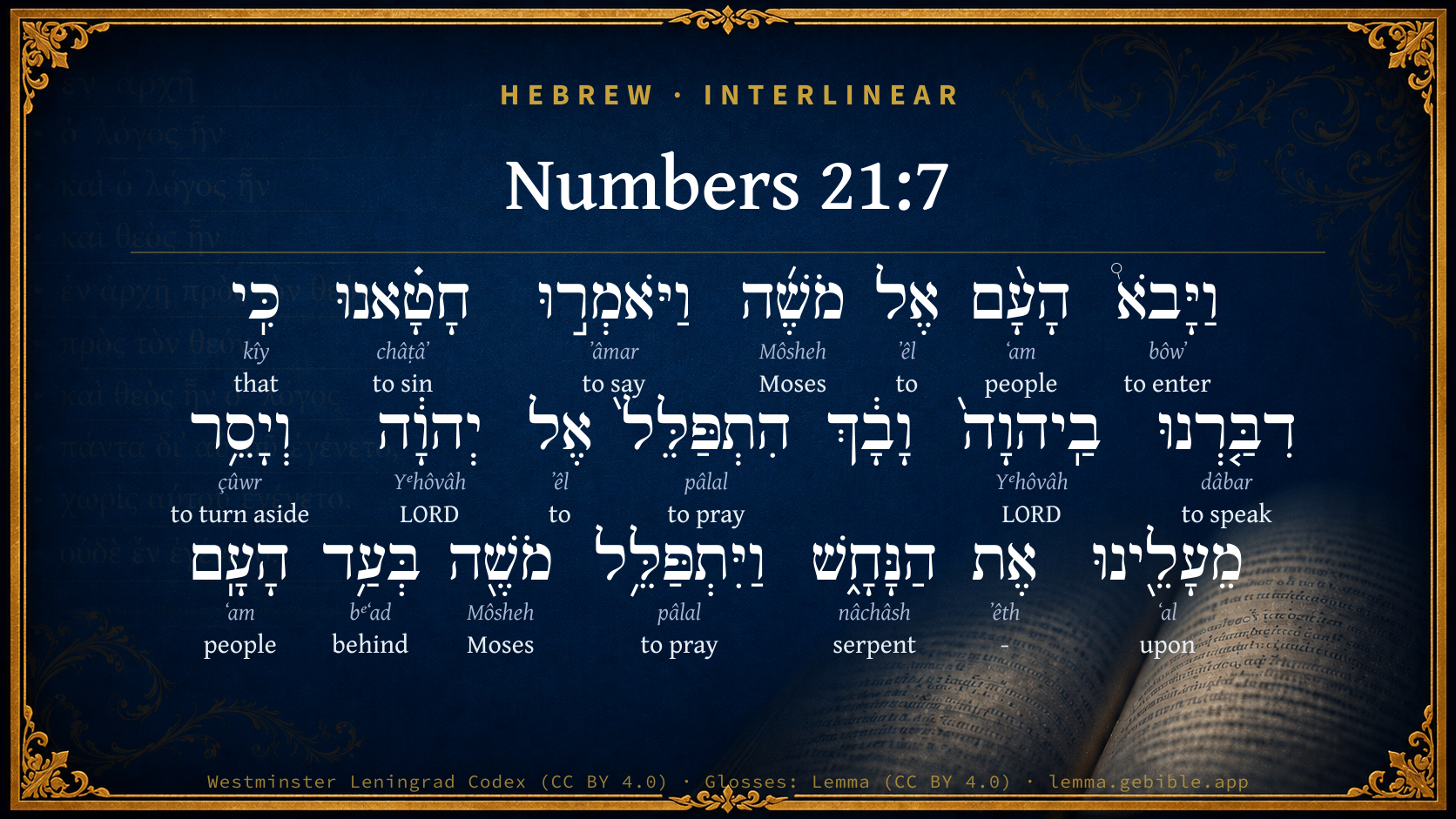
Hebrew (Westminster Leningrad Codex) Numbers 21:7 appears in the Hebrew Old Testament. The text above is from the Westminster Leningrad Codex. Each word links to its Strong’s number, a concise gloss, and parsing drawn from the Open Scriptures Hebrew Bible morphology. Click any word for its full Brown-Driver-Briggs (BDB) entry.
Download image
Cite this verse

Numbers 21:7 (World English Bible). Public Domain. Lemma interlinear Bible study tool, https://lemma.gebible.app/v/numbers/21/7.

Show BibTeX & RIS
BibTeX
RIS
English Translation
The people came to Moses, and said, We have sinned, because we have spoken against Yahweh, and against you; pray to Yahweh, that he take away the serpents from us. Moses prayed for the people.
World English Bible · Public Domain
Download a study sheet

One document with this verse’s original text, its word-by-word gloss line, the meaning frame, cross-references with their text, attributed commentary, and full source and license credits — printable, and it pastes into notes with its structure intact.

This verse Autodidact and up

Study sheet (.html) Plain text (.txt)

A passage Seminary Student

Up to 50 verses in one chapter. A passage sheet keeps up to 6 commentary sources and 12 cross-references per verse, in the order this page ranks them, and says so on the sheet whenever that leaves anything out. Ask for a single verse and you get the Autodidact verse sheet above.

Everything on this page stays free to read, with no account — the sheet is a download of what is already on screen, not access to it.

Want to remove ads? Support Godless Engineer
Compare translations 3

The same verse in 3 English versions, stacked beneath the original-language interlinear above. Click any original word for its lexicon entry.

Each is an independent rendering of the whole verse — the interlinear is not word-aligned to these translations.

Highlighted words mark where these versions differ — a whole-verse word diff, not a word-by-word alignment.

  • World English Bible Public Domain
    The people came to Moses, and said, We have sinned, because we have spoken against Yahweh, and against you; pray to Yahweh, that he take away the serpents from us. Moses prayed for the people.
  • King James Version Public Domain
    Therefore the people came to Moses, and said, We have sinned, for we have spoken against the LORD, and against thee; pray unto the LORD, that he take away the serpents from us. And Moses prayed for the people.
  • unfoldingWord Literal Text CC BY-SA 4.0
    And the people came to Moses and said, “We have sinned, for we spoke against Yahweh and against you. Pray to Yahweh, and let him remove from upon us the serpent.” And Moses prayed on behalf of the people.

unfoldingWord Literal Text — © unfoldingWord, licensed CC BY-SA 4.0. Word-aligned USFM3 via Door43 (git.door43.org/unfoldingWord/en_ult).

Versions to compare (up to 4)

3 of 4 selected

Show all 18 translations

Every available English version of this verse, each an independent rendering of the whole verse.

  • World English Bible Public Domain
    The people came to Moses, and said, We have sinned, because we have spoken against Yahweh, and against you; pray to Yahweh, that he take away the serpents from us. Moses prayed for the people.
  • Berean Standard Bible Public Domain
    Then the people came to Moses and said, “We have sinned by speaking against the LORD and against you. Intercede with the LORD so He will take the snakes away from us.” So Moses interceded for the people.
  • Majority Standard Bible Public Domain
    Then the people came to Moses and said, “We have sinned by speaking against the LORD and against you. Intercede with the LORD so He will take the snakes away from us.” So Moses interceded for the people.
  • King James Version Public Domain
    Therefore the people came to Moses, and said, We have sinned, for we have spoken against the LORD, and against thee; pray unto the LORD, that he take away the serpents from us. And Moses prayed for the people.
  • American Standard Version (1901) Public Domain
    And the people came to Moses, and said, We have sinned, because we have spoken against Jehovah, and against thee; pray unto Jehovah, that he take away the serpents from us. And Moses prayed for the people.
  • Revised Version (1885) Public Domain
    And the people came to Moses, and said, We have sinned, because we have spoken against the LORD, and against thee; pray unto the LORD, that he take away the serpents from us. And Moses prayed for the people.
  • Geneva Bible (1599) Public Domain
    Therefore the people came to Moses and said, We haue sinned: for wee haue spoken against the Lord, and against thee: pray to the Lord, that he take away the serpents from vs: and Moses prayed for the people.
  • Douay-Rheims (1899) Public Domain
    Upon which they came to Moses, and said: We have sinned, because we have spoken against the Lord and thee: pray that he may take away these serpents from us. And Moses prayed for the people.
  • Young's Literal Translation Public Domain
    and the people come in unto Moses and say, `We have sinned, for we have spoken against Jehovah, and against thee; pray unto Jehovah, and He doth turn aside from us the serpent;' and Moses prayeth in behalf of the people.
  • Literal Standard Version CC BY-SA 4.0
    and the people come to Moses and say, “We have sinned, for we have spoken against YHWH and against you; pray to YHWH that He turns the serpent aside from us”; and Moses prays in behalf of the people.
  • Unlocked Literal Bible CC BY-SA 4.0
    The people came to Moses and said, “We have sinned because we have spoken against Yahweh and you. Pray to Yahweh for him to take the snakes away from us.” So Moses prayed for the people.
  • unfoldingWord Literal Text CC BY-SA 4.0
    And the people came to Moses and said, “We have sinned, for we spoke against Yahweh and against you. Pray to Yahweh, and let him remove from upon us the serpent.” And Moses prayed on behalf of the people.
  • Darby Bible Public Domain
    And the people came to Moses and said, We have sinned, in that we have spoken against Jehovah, and against thee: pray to Jehovah that he take away the serpents from us. And Moses prayed for the people.
  • World Messianic Bible Public Domain
    The people came to Moses, and said, “We have sinned, because we have spoken against the LORD and against you. Pray to the LORD, that he take away the serpents from us.” Moses prayed for the people.
  • Webster's Bible Public Domain
    Therefore the people came to Moses, and said, We have sinned, for we have spoken against the LORD, and against thee; pray to the LORD, that he take away the serpents from us. And Moses prayed for the people.
  • Free Bible Version CC BY-SA 4.0
    The people went to see Moses and told him, “We were wrong to make complaints against the Lord and against you. Please pray to the Lord to get rid of the snakes from us.” Moses prayed to the Lord on their behalf.
  • Bible in Basic English Public Domain
    Then the people came to Moses and said, We have done wrong in crying out against the Lord and against you: make prayer to the Lord to take away the snakes from us. So Moses made prayer for the people.
  • JPS Tanakh (1917) Public Domain
    And the people came to Moses, and said: 'We have sinned, because we have spoken against the LORD, and against thee; pray unto the LORD, that He take away the serpents from us.' And Moses prayed for the people.

Literal Standard Version (2020), Covenant Press — licensed CC BY-SA 4.0. Text via the HelloAO Bible API (eBible.org). Unlocked Literal Bible (unfoldingWord) — licensed CC BY-SA 4.0. Text via the HelloAO Bible API (eBible.org). unfoldingWord Literal Text — © unfoldingWord, licensed CC BY-SA 4.0. Word-aligned USFM3 via Door43 (git.door43.org/unfoldingWord/en_ult). Free Bible Version, Dr. Jonathan Gallagher — licensed CC BY-SA 4.0. Text via the HelloAO Bible API (eBible.org).

Word by word

More ways to search: Search by grammar → Find every occurrence → Compare this word →

Practice this passage: Drill this verse → Learn its vocabulary →

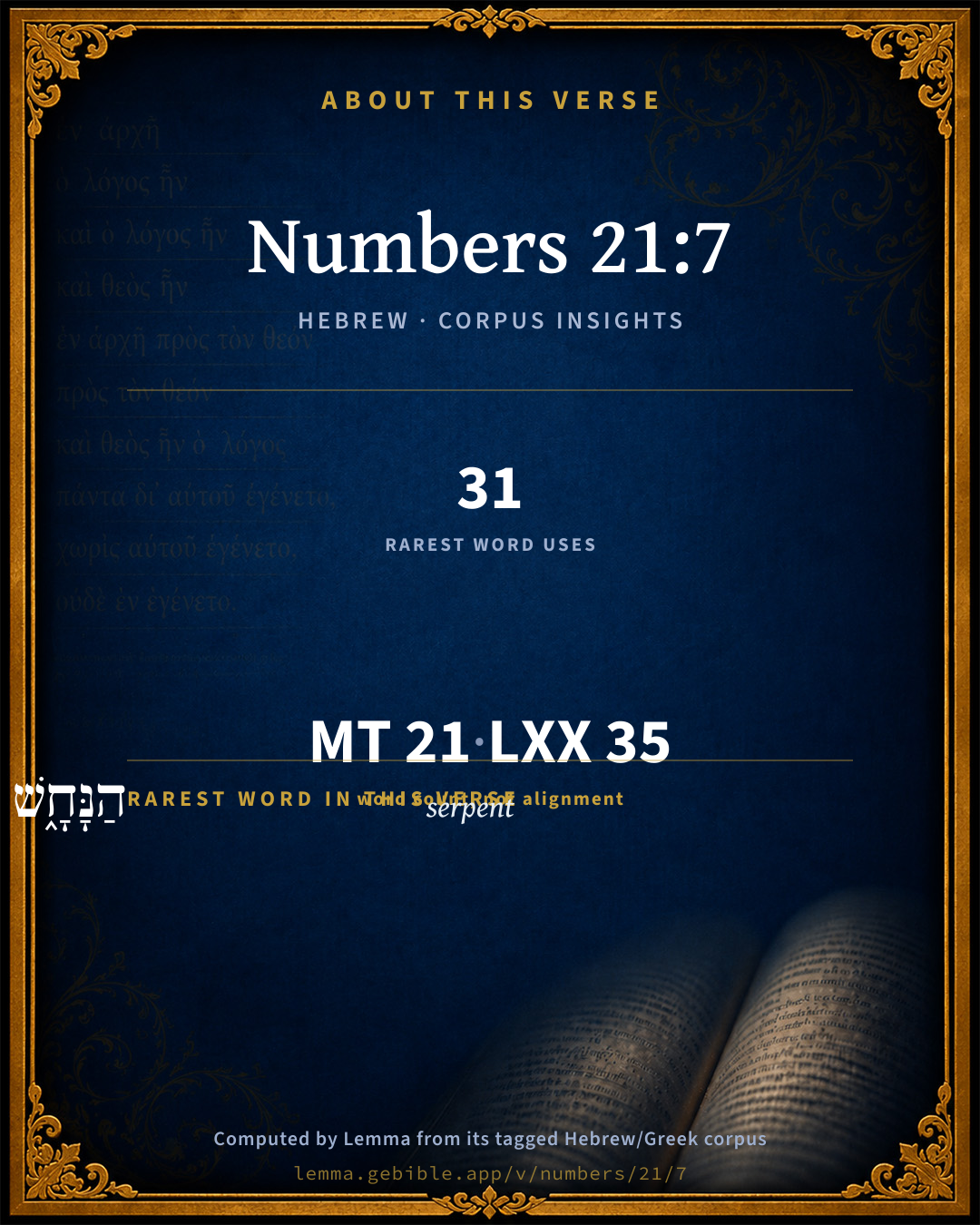
הַנָּחָ֑שׁ
nâchâsh
H5175
“the · serpent”
Particle, Definite Article + Noun, Common, Masculine, Singular, Absolute
Part of Speech
Particle + Noun
Type
Common
Gender
Masculine
Number
Singular
State
Absolute
Full BDB Definition

Origin: from H5172

TWOT: 1347a

serpent, snake - serpent - image (of serpent) - fleeing serpent (mythological)
  1. וַיָּבֹא֩ bôwʼ H935 “and · to enter” Conjunction + Verb, Qal, Sequential Imperfect, 3rd Person, Masculine, Singular
  2. הָעָ֨ם ʻam H5971 “the · people” Particle, Definite Article + Noun, Common, Masculine, Singular, Absolute
  3. אֶל ʼêl H413 “to” Preposition
  4. מֹשֶׁ֜ה Môsheh H4872 “Moses” Noun, Proper
  5. וַיֹּאמְר֣וּ ʼâmar H559 “and · to say” Conjunction + Verb, Qal, Sequential Imperfect, 3rd Person, Masculine, Plural
  6. חָטָ֗אנוּ châṭâʼ H2398 “to sin” Verb, Qal, Perfect, 1st Person, Common, Plural
  7. כִּֽי kîy H3588 “that” Conjunction
  8. דִבַּ֤רְנוּ dâbar H1696 “to speak” Verb, Piel, Perfect, 1st Person, Common, Plural
  9. בַֽיהוָה֙ Yᵉhôvâh H3068 “in/at · LORD” Preposition + Noun, Proper
  10. הִתְפַּלֵּל֙ pâlal H6419 “pray” Verb, Hithpael, Imperative, 2nd Person, Masculine, Singular
  11. אֶל ʼêl H413 “to” Preposition
  12. יְהוָ֔ה Yᵉhôvâh H3068 “LORD” Noun, Proper
  13. וְיָסֵ֥ר çûwr H5493 “and · to turn aside” Conjunction + Verb, Hiphil, Jussive, 3rd Person, Masculine, Singular
  14. מֵעָלֵ֖ינוּ ʻal H5921 “from · upon · us” Preposition + Preposition + Suffix, Personal, 1st Person, Common, Plural
  15. אֶת ʼêth H853 “-” Particle, Direct Object
  16. וַיִּתְפַּלֵּ֥ל pâlal H6419 “and · to pray” Conjunction + Verb, Hithpael, Sequential Imperfect, 3rd Person, Masculine, Singular
  17. מֹשֶׁ֖ה Môsheh H4872 “Moses” Noun, Proper
  18. בְּעַ֥ד bᵉʻad H1157 “behind” Preposition
  19. הָעָֽם ʻam H5971 “the · people” Particle, Definite Article + Noun, Common, Masculine, Singular, Absolute

About this verse

These counts appear in no published source. They are computed here, from the morphology-tagged text and Lemma’s own curated glosses. What Lemma adds →

21
words
15
distinct lemmas
Pentateuch
section

Shared distinctive vocabulary

הַנָּחָ֑שׁ serpent H5175 occurs in 28 verses of the Hebrew Bible. Also found in:

Grammatical profile

  • 7 verbs
  • 7 nouns
  • 5 prepositions
  • 1 conjunction
  • 1 particle

Verb forms

  • וַיָּבֹא֩ Qal · Sequential Imperfect
  • וַיֹּאמְר֣וּ Qal · Sequential Imperfect
  • חָטָ֗אנוּ Qal · Perfect
  • דִבַּ֤רְנוּ Piel · Perfect
  • הִתְפַּלֵּל֙ Hithpael · Imperative
  • וְיָסֵ֥ר Hiphil · Jussive
  • וַיִּתְפַּלֵּ֥ל Hithpael · Sequential Imperfect

Repetition

Words recur within this verse — often emphatic in Hebrew:

  • הָעָ֨ם people H5971 ×2
  • מֹשֶׁ֜ה Moses H4872 ×2
  • בַֽיהוָה֙ LORD H3068 ×2
  • הִתְפַּלֵּל֙ to pray H6419 ×2
  • אֶל to H413 ×2

Hebrew & Septuagint length

In English translation the verse runs 35 words from the Hebrew and 35 from the Septuagint (LXX English) — the same length.

A rough comparison of the two English renderings, which tokenize alike — not a word-level alignment.

Word counts can differ between the Hebrew and the Greek without any difference in meaning — e.g. the Hebrew direct-object marker אֵת has no separate Greek word, and Greek often adds the article ὁ.

In the original languages it is 21 Hebrew tokens and 35 Greek tokens — but the two are counted differently (Hebrew bundles its prefixes and suffixes into one token; the Greek is in lemma form), so that isn’t a like-for-like length.

Cross-references

25

Topical passages linked to Numbers 21:7 in the Treasury of Scripture Knowledge — connected by theme and wording, ordered by reader-vote popularity; previews shown in the World English Bible.

  • Acts 8:24 Simon answered, "Pray for me to the Lord, that none of the things which you have spoken happen to me."
  • Exodus 8:8 Then Pharaoh called for Moses and Aaron, and said, "Entreat Yahweh, that he take away the frogs from me, and from my people; and I will let the people go, that they may sacrifice to Yahweh."
  • Numbers 11:2 The people cried to Moses; and Moses prayed to Yahweh, and the fire abated.
  • Psalms 78:34 When he killed them, then they inquired after him. They returned and sought God earnestly.
  • Exodus 8:28 Pharaoh said, "I will let you go, that you may sacrifice to Yahweh your God in the wilderness, only you shall not go very far away. Pray for me."
  • 1 Kings 13:6 The king answered the man of God, Entreat now the favor of Yahweh your God, and pray for me, that my hand may be restored me again. The man of God entreated Yahweh, and the king's hand was restored him again, and became as it was before.
  • Genesis 20:7 Now therefore, restore the man's wife. For he is a prophet, and he will pray for you, and you will live. If you don't restore her, know for sure that you will die, you, and all who are yours."
  • Exodus 9:27–28 Pharaoh sent, and called for Moses and Aaron, and said to them, "I have sinned this time. Yahweh is righteous, and I and my people are wicked.
  • Exodus 32:11 Moses begged Yahweh his God, and said, "Yahweh, why does your wrath burn hot against your people, that you have brought forth out of the land of Egypt with great power and with a mighty hand?
  • Exodus 32:30 It happened on the next day, that Moses said to the people, "You have sinned a great sin. Now I will go up to Yahweh. Perhaps I shall make atonement for your sin."
  • Numbers 14:17–20 Now please let the power of the Lord be great, according as you have spoken, saying,
  • Deuteronomy 9:20 Yahweh was very angry with Aaron to destroy him: and I prayed for Aaron also at the same time.
  • Deuteronomy 9:26–29 I prayed to Yahweh, and said, Lord Yahweh, don't destroy your people and your inheritance, that you have redeemed through your greatness, that you have brought forth out of Egypt with a mighty hand.
  • 1 Samuel 12:19–23 All the people said to Samuel, Pray for your servants to Yahweh your God, that we not die; for we have added to all our sins [this] evil, to ask us a king.
  • 1 Samuel 15:24 Saul said to Samuel, I have sinned; for I have transgressed the commandment of Yahweh, and your words, because I feared the people, and obeyed their voice.
  • 1 Samuel 15:30 Then he said, I have sinned: yet honor me now, Please, before the elders of my people, and before Israel, and turn again with me, that I may worship Yahweh your God.
  • Job 42:8 Now therefore, take to yourselves seven bulls and seven rams, and go to my servant Job, and offer up for yourselves a burnt offering; and my servant Job shall pray for you, for I will accept him, that I not deal with you according to your folly. For you have not spoken of me the thing that is right, as my servant Job has."
  • Job 42:10 Yahweh turned the captivity of Job, when he prayed for his friends. Yahweh gave Job twice as much as he had before.
  • Psalms 106:23 Therefore he said that he would destroy them, Had Moses, his chosen, not stood before him in the breach, To turn away his wrath, so that he wouldn't destroy them.
  • Jeremiah 15:1 Then said Yahweh to me, Though Moses and Samuel stood before me, yet my mind would not be toward this people: cast them out of my sight, and let them go forth.
  • Jeremiah 37:3 Zedekiah the king sent Jehucal the son of Shelemiah, and Zephaniah the son of Maaseiah, the priest, to the prophet Jeremiah, saying, Pray now to Yahweh our God for us.
  • Hosea 5:15 I will go and return to my place, until they acknowledge their offense, And seek my face. In their affliction they will seek me earnestly."
  • Matthew 27:4 saying, "I have sinned in that I betrayed innocent blood." But they said, "What is that to us? You see to it."
  • Romans 10:1 Brothers, my heart's desire and my prayer to God is for Israel, that they may be saved.
  • James 5:16 Confess your offenses to one another, and pray one for another, that you may be healed. The effective, earnest prayer of a righteous man is powerfully effective.

Cross-references courtesy of OpenBible.info (CC BY 4.0).

Hebrew and Greek witnesses Masoretic Hebrew ↔ Greek Septuagint

The same verse in the two great witnesses to the Old Testament, shown verse-for-verse.

These are two independent witnesses, not word-aligned to each other, and the Septuagint is shown in lemma (dictionary) form.

Hebrew Numbers 21:7 Masoretic · Westminster Leningrad Codex

וַיָּבֹא֩ הָעָ֨ם אֶל מֹשֶׁ֜ה וַיֹּאמְר֣וּ חָטָ֗אנוּ כִּֽי דִבַּ֤רְנוּ בַֽיהוָה֙ וָבָ֔ךְ הִתְפַּלֵּל֙ אֶל יְהוָ֔ה וְיָסֵ֥ר מֵעָלֵ֖ינוּ אֶת הַנָּחָ֑שׁ וַיִּתְפַּלֵּ֥ל מֹשֶׁ֖ה בְּעַ֥ד הָעָֽם

The people came to Moses, and said, We have sinned, because we have spoken against Yahweh, and against you; pray to Yahweh, that he take away the serpents from us. Moses prayed for the people.

World English Bible · Public Domain

Greek LXX Numbers 21:7 Septuagint · lemma form

καί παραγίγνομαι ὁ λαός πρός μωυσῆς λέγω ὅτι ἁμαρτάνω ὅτι καταλαλέω κατά ὁ κύριος καί κατά σύ εὔχομαι οὖν πρός κύριος καί ἀποαἱρέω ἀπό ἐγώ ὁ ὄφις καί εὔχομαι μωυσῆς πρός κύριος περί ὁ λαός

And the people came to Moses and said, We have sinned, for we have spoken against the Lord, and against you: pray therefore to the Lord, and let him take away the serpent from us.

LXX2012 (modern English Septuagint) · Public Domain

Hebrew: Westminster Leningrad Codex (CC BY 4.0). Greek: Septuagint (public domain); English from LXX2012 (modern English Septuagint) (Public Domain). How the Septuagint differs from the Hebrew →

Targum (Aramaic paraphrase)

2

The Targum is the ancient Jewish Aramaic paraphrase of the Hebrew Scriptures — an interpretive translation, not the Hebrew text itself. Onkelos (literal) and Pseudo-Jonathan (expansive) render the Torah, and Jonathan the Prophets. Coverage is partial: where no permissively-licensed English translation exists for a verse, only the Aramaic is shown. This is verse-level text, not a word-by-word alignment to the Hebrew.

  1. Targum Onkelos Torah (Genesis–Deuteronomy)
    וַאֲתָא עַמָא לְמשֶׁה וַאֲמָרוּ חַבְנָא אֲרֵי אִתְרַעַמְנָא קֳדָם יְיָ וְעִמָךְ נְצֵינָא צַלִי קֲדָם יְיָ וְיַעֲדִי מִנָנָא יָת חִוְיָא וְצַלִי משֶׁה עַל עַמָא

    (no public-domain English translation for this verse)

    Targum Onkelos — Aramaic: “Onkelos Genesis” (public domain); “Onkelos Exodus” (public domain); “Onkelos Leviticus” (public domain); “Onkelos Numbers” (public domain); “Onkelos Deuteronomy” (public domain). English: “Sefaria Community Translation” (CC0 1.0 (public-domain dedication)); “J.W. Etheridge. The Targums of Onkelos and Jonathan Ben Uzziel on the Pentateuch. London: Longmans, Green, 1862” (public domain). Text via Sefaria.

  2. Targum Pseudo-Jonathan Torah (Genesis–Deuteronomy)
    וְאָתוּ עַמָא לְוַת משֶׁה וַאֲמָרוּ חַבְנָא אֲרוּם הַרְהִירְנָא וְאִשְׁתָּעִינָא בִיקַר שְׁכִינְתָּא דַיְיָ וְעִמָךְ נָצֵינָא צַלִי קֳדָם יְיָ וְיַעֲדִי מִינָנָא יַת מְחַת חִוְיָא וְצַלִי משֶׁה עַל עַמָא

    And the people came to Mosheh, and said: We have sinned, in thinking and speaking against the glory of the Lord's Shekinah, and in contending with thee. Pray before the Lord to remove the plague of serpents from us. And Mosheh prayed for the people.

    Targum Pseudo-Jonathan — Aramaic: “Targum Jonathan on Genesis” (public domain); “Targum Jonathan on Exodus” (public domain); “Targum Jonathan on Leviticus” (public domain); “Targum Jonathan on Numbers” (public domain); “Targum Jonathan on Deuteronomy” (public domain). English: “The Targum of Jonathan ben Uzziel, trans. J. W. Etheridge, London, 1862” (public domain). Text via Sefaria.

Commentary

Notes on Numbers 21:7 from classic Christian and Jewish commentators (each source and its license shown beneath its notes). The classic Christian expositions comment on the surrounding passage and are grouped to its opening verse, so a note may address several verses; the Jewish commentaries on the Tanakh (Rashi and others) are per-verse, so they appear only where the commentator wrote on this verse.

Lemma curates 59 commentaries, every one of them public domain or Creative Commons licensed, each selected and text-cleaned for this edition rather than reprinted as found. About our sources →

Trapp's Complete Commentary

John Trapp

Num 21:7 Therefore the people came to Moses, and said, We have sinned, for we have spoken against the LORD, and against thee; pray unto the LORD, that he take away the serpents from us. And Moses prayed for the people.

Ver. 7. Pray unto the Lord.] Prayer is the best lever at a dead lift.

Make thee a fiery serpent,] i.e., The similitude of such a one; an unlikely means to effect such a cure. Yea, some write, that it is deadly for those that are stung with a serpent to look upon brass. Certain it is, that this cure was not wrought by anything in the nature of the brazen serpent, but by the institution and ordination of God, to be also a type of Christ; a noble and notable figure of Christ lifted up on the cross, {Joh 3:14} or rather in his ordinances. {Gal 3:1} They that looked upon their sores, and not upon the sign, died for it; as those that looked on the sign, though but with one eye, though with but a squint eye, or but with half an eye, they were healed presently. So they that fix their eyes upon their sins only, and not upon their Saviour, despair and die; but those that look to Christ, being faithful in weakness, though weak in faith, are sure to be saved. It is but look up and live. Only look up, as they did that were wounded, weepingly, wishfully, pitifully, cravingly. See and sigh, look upon him whom you have pierced; let your sins be as so many Hazaels to you, and your hearts as so many Hadadrimmons. {Zec 12:10-11}

John Trapp, A Commentary or Exposition upon All the Books of the Old and New Testament (1647–1656) — public domain. Text from a community e-Sword module.

Tyndale Open Study Notes

Tyndale Open Resources

21:7-9 Jesus alluded to this incident when discussing his identity and mission (John 3:14-15). • By Hezekiah’s day (around 700 BC), this bronze snake had become an object of worship in Jerusalem (2 Kgs 18:4).

Tyndale Open Study Notes — © Tyndale Open Resources, licensed CC BY-SA 4.0. Text via the HelloAO Bible API.

Jamieson, Fausset & Brown

Robert Jamieson, A. R. Fausset & David Brown

the people came to Moses, and said, We have sinned--The severity of the scourge and the appalling extent of mortality brought them to a sense of sin, and through the intercessions of Moses, which they implored, they were miraculously healed. He was directed to make the figure of a serpent in brass, to be elevated on a pole or standard, that it might be seen at the extremities of the camp and that every bitten Israelite who looked to it might be healed. This peculiar method of cure was designed, in the first instance, to show that it was the efficacy of God's power and grace, not the effect of nature or art, and also that it might be a type of the power of faith in Christ to heal all who look to Him because of their sins (Joh 3:14-15; see also on Kg2 18:4).

Jamieson, Fausset & Brown — Commentary Critical and Explanatory on the Whole Bible (1871) — public domain (CC PDM 1.0). Text via the HelloAO Bible API.

John Gill's Exposition

Therefore the people came to Moses, and said, we have sinned,.... Being bitten with serpents, and some having died, the rest were frightened, and came and made an humble acknowledgment of their sins to Moses:

for we have spoken against the Lord, and against thee; murmuring at their being brought out of Egypt, and because they had no better provision in the wilderness; concluding they should die there for want, and never enter into the land of Canaan, of which evils they were now sensible, and confessed them:

pray unto the Lord that he take away the serpents from us; or "the serpent" (c), in the singular, which is put for the plural, as it often is; or the plague of the serpent, as the Targum of Jonathan, that it might cease, and they be no more distressed by them: they were sensible they came from God, and that none could remove them but him; and knowing that Moses was powerful in prayer, and had interest with God, they entreat him to be their intercessor, though they had spoken against him and used him ill:

and Moses prayed for the people; which proves him to be of a meek and forgiving spirit; who, though he had been so sadly reflected on, yet readily undertakes to pray to God for them.

(c) "serpentem", Montanus; "hunc serpentem", Piscator,

John Gill's Exposition of the Whole Bible (1746–1763) — public domain (CC PDM 1.0). Text via the HelloAO Bible API.

Whedon's Commentary on the Bible

Daniel D. Whedon

7. We have sinned — Man’s moral nature is so constituted that he instinctively ascribes natural evil to a moral cause — suffering to sin. This judgment was designed to arouse the torpid conscience. The awakened moral sense unerringly discovers the sin.

We have spoken against the Lord — The quickened memory brings back every word which has impeached the divine goodness and wisdom. So it may be in the judgment.

Against thee — The thoroughness of the confession is proof of its sincerity. It is easier to confess our sins against God than it is to make acknowledgment of wrong to man.

Pray unto the Lord — The religious nature of man shines out in the darkness of great calamities. He turns to some power above nature and implores its interposition. The pagan rushes to his temple, the Hebrew turns toward the tabernacle or temple, the Christian to the throne of grace.

And Moses prayed — There is scarcely any record of Moses’s prayers for himself; his prayers are generally for others. He was the mediator of the old covenant as Jesus is of the new. Gal_3:19. The burden of Moses’s prayer was, that the fiery serpents might be taken away. Like many of our prayers, it was not answered in form but in fact.

Daniel D. Whedon (gen. ed.), Commentary on the Old and New Testaments (1874–1909) — public domain. Text from a community e-Sword module.

The Pulpit Commentary

Pray unto the Lord. This is the first and only (recorded) occasion on which the people directly asked for the intercession of Moses, (cf., however, Num_11:2) although Pharaoh had done so several times, and never in vain.

The Pulpit Commentary (1880–1919), ed. H.D.M. Spence-Jones & Joseph S. Exell — public domain. Text from a community e-Sword module.

Rashi

Rabbi Shlomo Yitzchaki (Rashi)

ויתפלל משה AND MOSES PRAYED — From this we may learn that he of whom one seeks forgiveness should not be so cruel as not to forgive (cf. Midrash Tanchuma, Chukat 19).

Rashi on the Tanakh — English translations: “The Judaica Press complete Tanach with Rashi, translated by A. J. Rosenberg” (CC BY 4.0); “Pentateuch with Rashi's commentary by M. Rosenbaum and A.M. Silbermann, 1929-1934” (public domain); “The Metsudah Tanach series, Lakewood, N.J” (CC BY 4.0); and “The Book of Joshua, Metsudah Publications, 1997” (CC BY 4.0). Text via Sefaria.

Lesson kit

Teaching starters — assembled from the data on this page, not authored interpretation. Every prompt links to the verse data it draws on. Edit before teaching.

Numbers, in the Pentateuch, opens this verse with 21 words (15 distinct Hebrew lemmas). Its most distinctive word is nâchâsh (“serpent”). A historical commentator’s framing appears above. Read the whole chapter for the surrounding context.

Discussion questions

  1. What does “serpent” (nâchâsh) contribute to the verse as a whole?
  2. Genesis 3:1 shares the word «serpent» with this verse. How do the two illuminate each other?
  3. “people” occurs 2× in this one verse. What is the effect of the repetition?
  4. These translations render this verse differently; the difference is in the English rendering, not the original. What questions does that raise?
  5. The verb «וַיָּבֹא֩» is Qal Sequential Imperfect. How does its form color the action?
  6. Reading how Trapp's Complete Commentary and Tyndale Open Study Notes read this verse, where do the two commentators agree and where do they part?

Things to notice

Reading settings

Reading text

Shown beneath each verse's original-language words.

Old Testament
Old Testament edition

Read the OT as the Masoretic Hebrew (MT) or the Greek Septuagint (LXX).

English shown for the Greek Septuagint (in the Hebrew ↔ Greek comparison).

Comparing translations? Open the Compare panel on any verse page to stack up to four side by side.