
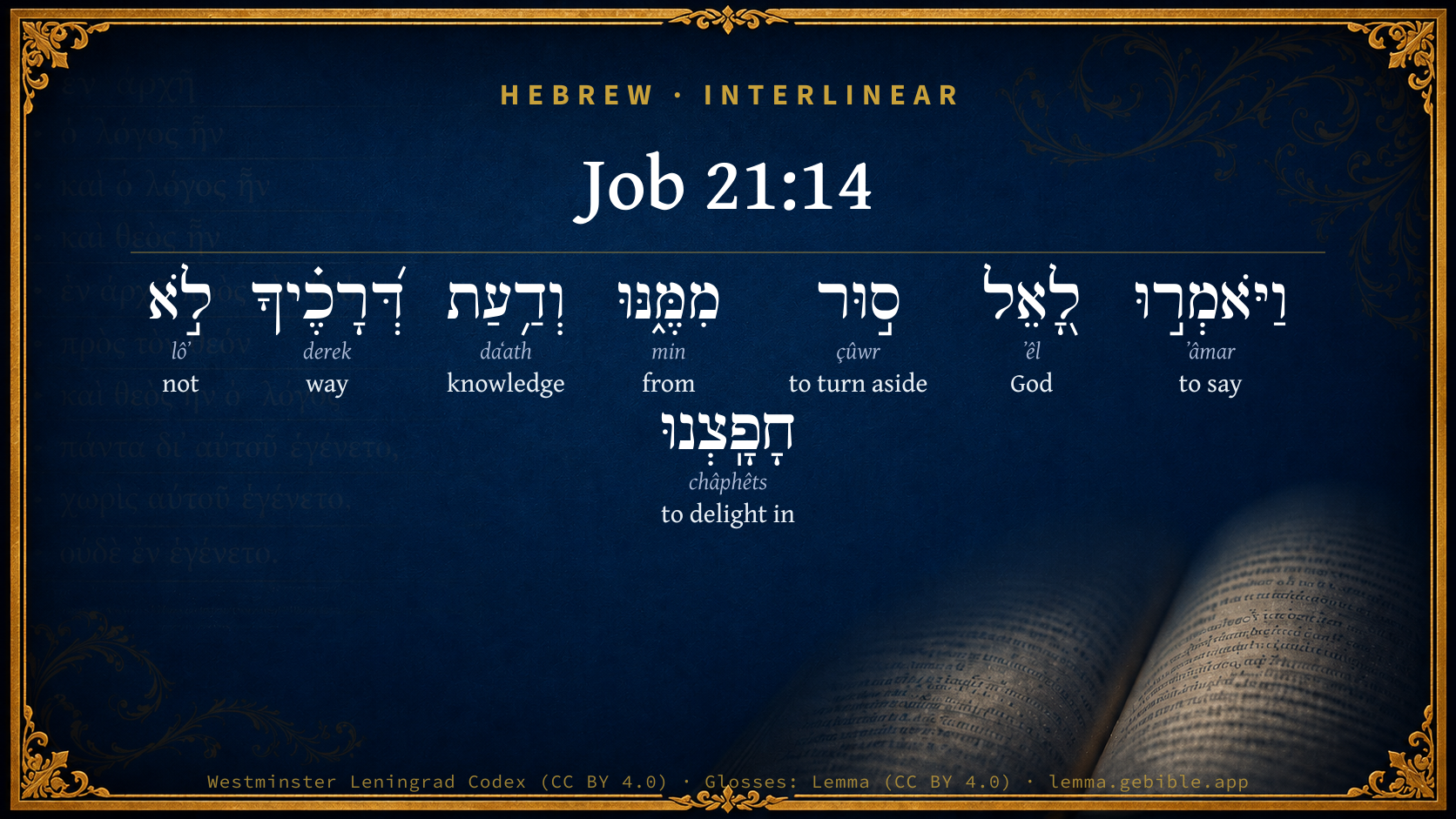
Job 21:14

Hebrew (Westminster Leningrad Codex) Job 21:14 appears in the Hebrew Old Testament. The text above is from the Westminster Leningrad Codex. Each word links to its Strong’s number, a concise gloss, and parsing drawn from the Open Scriptures Hebrew Bible morphology. Click any word for its full Brown-Driver-Briggs (BDB) entry.
Download image
Cite this verse

Job 21:14 (World English Bible). Public Domain. Lemma interlinear Bible study tool, https://lemma.gebible.app/v/job/21/14.

Show BibTeX & RIS
BibTeX
RIS
English Translation
They tell God, 'Depart from us, For we don't want to know about your ways.
World English Bible · Public Domain
Download a study sheet

One document with this verse’s original text, its word-by-word gloss line, the meaning frame, cross-references with their text, attributed commentary, and full source and license credits — printable, and it pastes into notes with its structure intact.

This verse Autodidact and up

Study sheet (.html) Plain text (.txt)

A passage Seminary Student

Up to 50 verses in one chapter. A passage sheet keeps up to 6 commentary sources and 12 cross-references per verse, in the order this page ranks them, and says so on the sheet whenever that leaves anything out. Ask for a single verse and you get the Autodidact verse sheet above.

Everything on this page stays free to read, with no account — the sheet is a download of what is already on screen, not access to it.

Want to remove ads? Support Godless Engineer
Compare translations 3

The same verse in 3 English versions, stacked beneath the original-language interlinear above. Click any original word for its lexicon entry.

Each is an independent rendering of the whole verse — the interlinear is not word-aligned to these translations.

Highlighted words mark where these versions differ — a whole-verse word diff, not a word-by-word alignment.

  • World English Bible Public Domain
    They tell God, 'Depart from us, For we don't want to know about your ways.
  • King James Version Public Domain
    Therefore they say unto God, Depart from us; for we desire not the knowledge of thy ways.
  • unfoldingWord Literal Text CC BY-SA 4.0
    They say to God, ‘Turn away from us, for we do not desire knowledge of your ways.

unfoldingWord Literal Text — © unfoldingWord, licensed CC BY-SA 4.0. Word-aligned USFM3 via Door43 (git.door43.org/unfoldingWord/en_ult).

Versions to compare (up to 4)

3 of 4 selected

Show all 18 translations

Every available English version of this verse, each an independent rendering of the whole verse.

  • World English Bible Public Domain
    They tell God, 'Depart from us, For we don't want to know about your ways.
  • Berean Standard Bible Public Domain
    Yet they say to God: ‘Leave us alone! For we have no desire to know Your ways.
  • Majority Standard Bible Public Domain
    Yet they say to God: ‘Leave us alone! For we have no desire to know Your ways.
  • King James Version Public Domain
    Therefore they say unto God, Depart from us; for we desire not the knowledge of thy ways.
  • American Standard Version (1901) Public Domain
    And they say unto God, Depart from us; For we desire not the knowledge of thy ways.
  • Revised Version (1885) Public Domain
    Yet they said unto God, Depart from us; for we desire not the knowledge of thy ways.
  • Geneva Bible (1599) Public Domain
    They say also vnto God, Depart from vs: for we desire not the knowledge of thy wayes.
  • Douay-Rheims (1899) Public Domain
    Who have said to God: Depart from us, we desire not the knowledge of thy ways.
  • Young's Literal Translation Public Domain
    And they say to God, `Turn aside from us, And the knowledge of Thy ways We have not desired.
  • Literal Standard Version CC BY-SA 4.0
    And they say to God, Turn aside from us, || And the knowledge of Your ways || We have not desired.
  • Unlocked Literal Bible CC BY-SA 4.0
    They say to God, 'Depart from us for we do not wish any knowledge of your ways.
  • unfoldingWord Literal Text CC BY-SA 4.0
    They say to God, ‘Turn away from us, for we do not desire knowledge of your ways.
  • Darby Bible Public Domain
    And they say unto ùGod, Depart from us, for we desire not the knowledge of thy ways!
  • World Messianic Bible Public Domain
    They tell God, ‘Depart from us, for we don’t want to know about your ways.
  • Webster's Bible Public Domain
    Therefore they say to God, Depart from us; for we desire not the knowledge of thy ways.
  • Free Bible Version CC BY-SA 4.0
    Yet they tell God, ‘Get lost! We don't want anything to do with you.
  • Bible in Basic English Public Domain
    Though they said to God, Go away from us, for we have no desire for the knowledge of your ways.
  • JPS Tanakh (1917) Public Domain
    Yet they said unto God: 'Depart from us; for we desire not the knowledge of Thy ways.

Literal Standard Version (2020), Covenant Press — licensed CC BY-SA 4.0. Text via the HelloAO Bible API (eBible.org). Unlocked Literal Bible (unfoldingWord) — licensed CC BY-SA 4.0. Text via the HelloAO Bible API (eBible.org). unfoldingWord Literal Text — © unfoldingWord, licensed CC BY-SA 4.0. Word-aligned USFM3 via Door43 (git.door43.org/unfoldingWord/en_ult). Free Bible Version, Dr. Jonathan Gallagher — licensed CC BY-SA 4.0. Text via the HelloAO Bible API (eBible.org).

Word by word

More ways to search: Search by grammar → Find every occurrence → Compare this word →

Practice this passage: Drill this verse → Learn its vocabulary →

חָפָֽצְנוּ
châphêts
H2654
“to delight in”
Verb, Qal, Perfect, 1st Person, Common, Plural
Part of Speech
Verb
Stem
Qal
Form
Perfect
Person
1st Person
Gender
Common
Number
Plural
Full BDB Definition

Origin: a primitive root

TWOT: 712 , 713

to delight in, take pleasure in, desire, be pleased with - (Qal) - of men - to take pleasure in, delight in - to delight, desire, be pleased to do - of God - to delight in, have pleasure in - to be pleased to do - to move, bend down - (Qal) to bend down
  1. וַיֹּאמְר֣וּ ʼâmar H559 “and · to say” Conjunction + Verb, Qal, Sequential Imperfect, 3rd Person, Masculine, Plural
  2. לָ֭אֵל ʼêl H410 “to/for the · God” Preposition, Determined + Noun, Common, Masculine, Singular, Absolute
  3. ס֣וּר çûwr H5493 “turn aside” Verb, Qal, Imperative, 2nd Person, Masculine, Singular
  4. מִמֶּ֑נּוּ min H4480 “from · us” Preposition + Suffix, Personal, 1st Person, Common, Plural
  5. וְדַ֥עַת daʻath H1847 “and · knowledge of” Conjunction + Noun, Common, Feminine, Singular, Construct
  6. דְּ֝רָכֶ֗יךָ derek H1870 “ways · your” Noun, Common, Both, Plural, Construct + Suffix, Personal, 2nd Person, Masculine, Singular
  7. לֹ֣א lôʼ H3808 “not” Particle, Negative

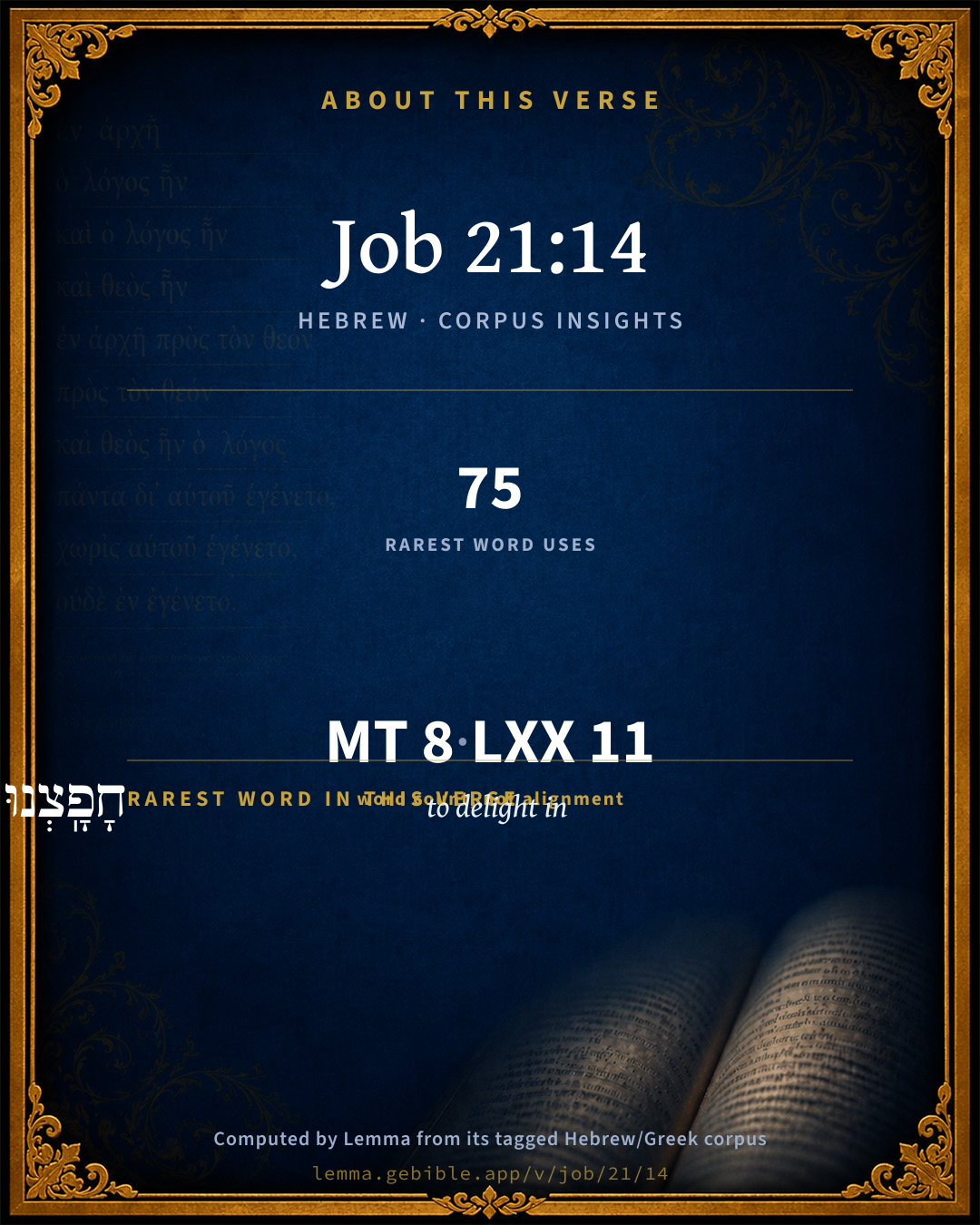
About this verse

These counts appear in no published source. They are computed here, from the morphology-tagged text and Lemma’s own curated glosses. What Lemma adds →

8
words
8
distinct lemmas
Wisdom
section

Grammatical profile

  • 3 verbs
  • 3 nouns
  • 1 preposition
  • 1 particle

Verb forms

  • וַיֹּאמְר֣וּ Qal · Sequential Imperfect
  • ס֣וּר Qal · Imperative
  • חָפָֽצְנוּ Qal · Perfect

Hebrew & Septuagint length

In English translation the verse runs 15 words from the Hebrew and 18 from the Septuagint (LXX English) — closely comparable.

A rough comparison of the two English renderings, which tokenize alike — not a word-level alignment.

Word counts can differ between the Hebrew and the Greek without any difference in meaning — e.g. the Hebrew direct-object marker אֵת has no separate Greek word, and Greek often adds the article ὁ.

In the original languages it is 8 Hebrew tokens and 11 Greek tokens — but the two are counted differently (Hebrew bundles its prefixes and suffixes into one token; the Greek is in lemma form), so that isn’t a like-for-like length.

Cross-references

16

Topical passages linked to Job 21:14 in the Treasury of Scripture Knowledge — connected by theme and wording, ordered by reader-vote popularity; previews shown in the World English Bible.

  • Job 22:17 Who said to God, 'Depart from us;' And, 'What can the Almighty do for us?'
  • Romans 8:7 because the mind of the flesh is hostile towards God; for it is not subject to God's law, neither indeed can it be.
  • Psalms 10:4 The wicked, in the pride of his face, Has no room in his thoughts for God.
  • 2 Thessalonians 2:10–12 and with all deception of wickedness for those who are being lost, because they didn't receive the love of the truth, that they might be saved.
  • Proverbs 1:29 Because they hated knowledge, And didn't choose the fear of Yahweh.
  • John 3:19–20 This is the judgment, that the light has come into the world, and men loved the darkness rather than the light; for their works were evil.
  • John 15:23–24 He who hates me, hates my Father also.
  • 2 Timothy 4:3–4 For the time will come when they will not listen to the sound doctrine, but, having itching ears, will heap up for themselves teachers after their own lusts;
  • Psalms 10:11 He says in his heart, "God has forgotten. He hides his face. He will never see it."
  • Proverbs 1:7 The fear of Yahweh is the beginning of knowledge; But the foolish despise wisdom and instruction.
  • Proverbs 1:22 "How long, you simple ones, will you love simplicity? How long will mockers delight themselves in mockery, And fools hate knowledge?
  • Habakkuk 1:15 He takes up all of them with the hook. He catches them in his net, and gathers them in his dragnet. Therefore he rejoices and is glad.
  • Luke 8:28 When he saw Jesus, he cried out, and fell down before him, and with a loud voice said, "What do I have to do with you, Jesus, you Son of the Most High God? I beg you, don't torment me!"
  • Luke 8:37 All the people of the surrounding country of the Gadarenes asked him to depart from them, for they were very much afraid. He entered into the boat, and returned.
  • John 8:45–47 But because I tell the truth, you don't believe me.
  • Romans 1:28 Even as they refused to have God in their knowledge, God gave them up to a reprobate mind, to do those things which are not fitting;

Cross-references courtesy of OpenBible.info (CC BY 4.0).

Hebrew and Greek witnesses Masoretic Hebrew ↔ Greek Septuagint

The same verse in the two great witnesses to the Old Testament, shown verse-for-verse.

These are two independent witnesses, not word-aligned to each other, and the Septuagint is shown in lemma (dictionary) form.

Hebrew Job 21:14 Masoretic · Westminster Leningrad Codex

וַיֹּאמְר֣וּ לָ֭אֵל ס֣וּר מִמֶּ֑נּוּ וְדַ֥עַת דְּ֝רָכֶ֗יךָ לֹ֣א חָפָֽצְנוּ

They tell God, 'Depart from us, For we don't want to know about your ways.

World English Bible · Public Domain

Greek LXX Job 21:14 Septuagint · lemma form

λέγω δέ κύριος ἀποἵστημι ἀπό ἐγώ ὁδός σύ οἶδα οὐ βούλομαι

Yet such a man says to the Lord, Depart from me; I desire not to know your ways.

LXX2012 (modern English Septuagint) · Public Domain

On this verse, Albert Barnes' Notes on the Bible discusses the Septuagint’s reading. Read the note in Commentary ↓

Hebrew: Westminster Leningrad Codex (CC BY 4.0). Greek: Septuagint (public domain); English from LXX2012 (modern English Septuagint) (Public Domain). How the Septuagint differs from the Hebrew →

Commentary

Notes on Job 21:14 from classic Christian and Jewish commentators (each source and its license shown beneath its notes). The classic Christian expositions comment on the surrounding passage and are grouped to its opening verse, so a note may address several verses; the Jewish commentaries on the Tanakh (Rashi and others) are per-verse, so they appear only where the commentator wrote on this verse.

Lemma curates 59 commentaries, every one of them public domain or Creative Commons licensed, each selected and text-cleaned for this edition rather than reprinted as found. About our sources →

Trapp's Complete Commentary

John Trapp

Job 21:14 Therefore they say unto God, Depart from us; for we desire not the knowledge of thy ways.

Ver. 14. Therefore they say unto God, Depart from us] Lest any should think, saith Merlin here, that Job speaks of such wicked as used a moderation in sinning, and (as the historian said of the emperor) rather lacked vice than were virtuous. Magis extra vitia, quam cum virtutibus (Tacit.). He describeth their great impiety by a rhetorical imitation, expressing the language of their heart, which is most base and blasphemous. For first they speak of God as if he were some lowly prized scoundrel; Apage, be packing; thus they reject his acquaintance, and would be rid of his company. Porro reieciunt Deum quotquot verbum eius contemnunt, saith Brentius here; now they reject God who slight his word and cast his commands behind them, Psa 50:17. Hence it follows by way of explanation,

For we desire not the knowledge of thy ways] Lo, they profess themselves to be of the number of those, qui ut liberius peccent, libenter ignorant, who are wilfully ignorant, and like not to retain God in their knowledge, Rom 1:28; or, if they profess to know him, yet "in works they deny him, being abominable, disobedient, and to every good work reprobate," Tit 1:16. Wicked men cannot abide God; such is their evil heart of unbelief, Heb 3:12, they get as far from him as they can, with Cain, and not only desire him to depart out of their coasts, with those swinish Gergesites, but churlishly say unto him, as here, Avaunt! room for us. They will neither have God in their heads, Psa 10:4, nor hearts, Psa 14:1, nor words, Psa 12:4, nor works, Tit 1:16. See this exemplified in those perverse Jews, lying children, children that would not hear the law of the Lord; which said to the seers, See not, - Get ye out of the way, turn aside out of the path; i.e. out of this tract of truth in dealing so plainly, and reproving us so roundly. Cause the Holy One of Israel to cease before us, let us henceforth hear no more of him, Isa 30:10-11. Now for such miscreants as these, who can say it is otherwise than righteous that God should regest one day upon them, Depart from me, ye wicked? (He loves to retaliate.) And that they who now say unto him, We desire not the knowledge of thy ways, shall hear from him, "I tell you, I know you not," Luk 13:27.

John Trapp, A Commentary or Exposition upon All the Books of the Old and New Testament (1647–1656) — public domain. Text from a community e-Sword module.

The Biblical Illustrator

Joseph S. Exell

Job_21:14

Depart from us; for we desire not the knowledge of Thy ways.

The riches of grace

Job shows that wicked men may prosper in life and health (verse 7); in their multitude of children (verse 8); in tranquillity and safety (verse 9); in success and increase of their substance (verse 10); in wealth, security, and pleasure (verses 11, 12, 13). Job sets down two things--their sin, in the text; their punishment, in verse 13. The text contains three things--Wicked mens contempt of grace. Their contempt of the means of grace. The profaneness of their lives. From the first of these,--a wicked mans contempt of grace, observe this doctrine:--That a wicked man doth not so much as desire saving grace. A true desire of grace is a supernatural appetite to grace not had for the goodness of it. Four things in this appetite--

1. It is an appetite of the soul to grace, when the heart doth even go out of itself for the attaining of grace. A hungry appetite signifies a hunger unfeigned, which is unsupportable without meat, so that he who truly desires grace cannot be without grace: nothing can satisfy him but meat, though he had all the wealth of the world. Hunger is irrepulsable, so he who truly desires grace will not let God alone, but begs and cries for it. And hunger is humble, it is not choice in its meat, it will be content with anything.

2. It is a supernatural appetite, distinguished from that which natural men have, and yet hate grace.

3. It is an appetite or desire after grace not had. No desire is desire indeed, but true desire; because grace is above the reach of nature; because grace is contrary to nature; because grace is a hell unto the natural man. The first step to grace is to see that we have no grace. Grace which wicked men desire, is not true grace. Thy hands and thy heart are full of corruption, so that though grace lie even at thy feet, yet thou canst not receive it up, unless thou empty thy hands and thy heart. Wherefore if there be any lust, though never so dear, any bosom sin, which thou wilt not part with; it is an evident sign that thou hast not a true desire of grace. It is a vehement desire, if true; a lukewarm desire is no true desire. Though delight be an effect of true desire, yet it is also a sign of grace, because grace in potentia is in the ordinance of God. Therefore the man that desires grace, he will delight in the ordinances of grace. The more delays the greater becomes the desire; delays are as oil cost into the fire, which makes the flame the greater. If thy desires be true, thou hast gotten some grace: examine therefore thyself. They that truly desire grace, desire the means of grace. Men that desire a crop of corn, they will be at the cost, charges, and pains, for ploughing, harrowing, and sowing of their ground. How shall we get our hearts truly to desire grace?

1. Learn to know it. Grace is such an admirable thing, that if men knew it, they could not bet desire it. The taste of grace is sweet and dainty, that if we could but once taste it, our hearts would ever water after it, and we should have little lust to the contrary evil. If you would desire grace, then purge out the ill-humours of sin out of thy soul. Fear to offend God, for the fear of evil is the desire of good. The desire of the righteous is only good; he desires God, and Christ, and the eternal love of God in Christ to be manifested to him, and therein he rests himself; but the hope of the wicked is indignation, he only desires the base self of the world; but the wrath of heaven is with that, and he shall bewail his own soul, that for such base things he should refuse the eternal good, and neglect it. In God there is all good. God is such a good, that without Him nothing is good. (William Penner, B. D.)

The sinners prayer

I. This prayer reveals to us the awful condition of the human heart. Lower than this neither man nor demon can sink, for what is it but saying, Evil be thou my good, darkness be thou my light? Here we have the climax of criminal audacity. The climax of self-deception. And the climax of ingratitude.

II. This prayer shows us the nearness of God to man. The difficulty is not for man to find God, but to avoid finding Him. There is underlying this prayer a profound consciousness of the Divine presence. The sinner fools that God is near, but he would be altogether without Him, if he could.

III. This prayer expresses the conviction of men, that the Lords claims upon them are founded on reason and truth. God invites them to reason with Him, to consider their ways, to ascertain the character of His commandments. They desire not the knowledge of Gods ways. It is this reluctance to give the Gospel any attention, this indisposition to think about eternal things, which hardens men in their sin and folly, and ensures their destruction.

IV. This prayer sets before us the great contrast which exists between the converted and the unconverted. Those who are not converted, pray in their hearts and lives that the Lord will depart from them. The converted thirst after God as the hart pants for the water brooks.

V. This prayer illustrates the long suffering of God. The very fact that men offer this prayer and still live, exhibits the Lords forbearance and compassion in the most striking manner.

VI. The answer to this prayer involves the most serious consequences to those who offer it. If persevered in, the answer will come. There is a bound beyond which men cannot pass with impunity. It is a fearful thing to be left alone of God, to be suffered to sin unrestrained, and to drink in iniquity like water. This is the result of the prayer being answered. (H. B. Ingrain.)

The language of impiety

The more God does for wicked men, the more ill affected they are towards Him.

I. Observe the language of impenitent prosperity.

1. They say. They not only conceive it in their thoughts, but utter it in words. Persons are lost to all fear and shame, when instead of suppressing, or so much as concealing their sinful thoughts, they can publish them abroad, and let the world know their strong propensity to evil.

2. They say unto God. To speak to the Lord is a great privilege, and to do it with humility, reverence, and delight, is an important duty. How opposite is the language we are contemplating. How full of irreverence and daring impiety!

3. Depart from us. The Divine presence is exceedingly desirable to a good man, nor can he be happy without it; but it is far otherwise with the carnal heart.

4. They impiously say, We desire not the knowledge of Thy ways. Sinners are not only ignorant, but willing to continue so. They dislike the way in which God walks. And they are equally averse to the way in which God has directed His creatures to walk, the way of holiness and happiness, of humility and self-denial, of faith and love, and evangelical obedience.

II. The sources of this impiety. No reason can be rendered for a thing in itself so unreasonable.

1. This ignorance proceeds from pride.

2. From practical atheism.

3. From hatred and aversion.

4. From slavish fear and dread.

5. There is an utter contrariety of nature which renders the sinner averse from God, and from a knowledge of His ways. Reflections--

(1) Without considering the depravity of human nature, nothing could appear more unaccountable, because nothing can be more unreasonable, than that man should feel averse from God, and from a knowledge of His ways.

(2) If anyone should presume to say to God, Depart from us; we desire not the knowledge of Thy ways, let him tremble at the consequences. If God takes him at his word, he will be given up to hardness of heart. (B. Beddome, M. A.)

God repudiated

I. God offers to instruct and guide men in the knowledge of his ways. Wicked men could not say to God, Depart, unless He came near to them. No truth is more clear than that our Lord really desires to instruct men in His ways, that He may bless them with His favour. In the Bible God has revealed the methods by which we may learn His will, gain His grace, and be saved; and this Word, with all its priceless offers, His providence has placed in our hands. In the whole capabilities of human thought can there be a more wonderful, a vaster idea than this: the absolute and Almighty Sovereign, instead of subduing rebellious subjects by power, perseveringly seeking to win them by love!

II. Some repel these gracious offers. The practical response of every unregenerate soul, acquainted with the Gospel, to these proffers of God, is Depart from me. This is the virtual utterance, not only of the profligate and profane, but of all who practically repudiate the law of the Lord as a rule of their lives. Every sinner makes the gratification of his own propensities and desires--not the will of the Lord--the rule of his life. Even what he does that is right and good, he does because he chooses, not because God requires it.

III. The sinners strange reason for his repulse of God. We desire not. Yet the human intellect craves for knowledge. Men want to know what history, literature, philosophy, science can teach. But of the ways of the great God, who made and governs all things, they desire not to know. See some of the causes of this unreasonable aversion.

1. The mode of acquiring knowledge of God is too humbling for the depraved, human will.

2. A subtle, scarcely acknowledged unbelief in the inspiration and authority of the Bible.

3. The supreme reason is the love of sin,

4. Others do not desire a knowledge of Gods ways now. Not yet, but at some convenient future season they hope to learn more of this matter. (J. L. Burrows, D. D.)

The Biblical Illustrator, edited by Joseph S. Exell (c. 1880s–1900s) — public domain. Text from a community e-Sword module.

Joseph Benson's Commentary

Job 21:14. Therefore — Because of their constant prosperity, they say unto God — Sometimes in words, but commonly in their thoughts and affections, and by the language of their lives, Depart from us — Let us not be troubled with the apprehension of our being under God’s eye, nor be restrained by the fear of him. Or, they bid him depart as one they do not need, nor have any occasion to apply to for help or comfort. The world is the portion which they have chosen, and with which they are satisfied, and in which they think themselves happy, and while they have that they can live without God. Justly will God say to them, Depart, who have bid him depart; and justly doth he now take them at their word. We desire not the knowledge of thy ways — Much less the practice of them. They that are resolved not to walk in God’s ways, desire not to know them, because their knowledge would be a continual reproach to their disobedience.

Joseph Benson's Commentary on the Old and New Testaments (1811–1818) — public domain. Text from a community e-Sword module.

Geneva Bible (1599)

Geneva Bible translators

They desire nothing more than to be exempt from all subjection that they should bear to God: thus Job showeth his adversaries, that if they reason only by that which is seen by common experience, the wicked that hate God, are better dealt withal, than they that love him.

Geneva Bible (1599) marginal notes — public domain. Text via Bolls.life.

Jamieson, Fausset & Brown

Robert Jamieson, A. R. Fausset & David Brown

Therefore--rather, "And yet they are such as say," &c., that is, say, not in so many words, but virtually, by their conduct (so the Gergesenes, Mat 8:34). How differently the godly (Isa 2:3).

ways--The course of action, which God points out; as in Psa 50:23, Margin.

Jamieson, Fausset & Brown — Commentary Critical and Explanatory on the Whole Bible (1871) — public domain (CC PDM 1.0). Text via the HelloAO Bible API.

Adam Clarke's Commentary

Verse 14. They say unto God ] This is the language of their conduct, though not directly of their lips.

Depart from us] Let us alone; we do not trouble thee. Thy ways are painful; we do not like cross-bearing. Thy ways are spiritual; we wish to live after the flesh. We have learned to do our own will; we do not wish to study thine.

Adam Clarke's Commentary on the Bible (1810–1826) — public domain. Text from a community e-Sword/MySword module.

Ellicott's Commentary for English Readers

(14) Therefore they say unto God.—Should be, Yet they said unto God, Depart from us, &c.

A Bible Commentary for English Readers, edited by Charles John Ellicott (1878–1897) — public domain. Text from a community e-Sword module.

The Cambridge Bible for Schools and Colleges

gen. ed. J. J. S. Perowne

14, 15. All this joy and prosperity they enjoyed though they had bidden God depart from them and renounced His service.

Therefore they say] Rather, though (lit. and) they said. Their godlessness was not merely that of passion, it was almost formal and reasoned. Coverdale’s rendering of the words, Who is the Almighty? is quaint and vigorous, “What maner of felowe is the Almightie that we shulde serve him?”

The Cambridge Bible for Schools and Colleges (gen. ed. J. J. S. Perowne; Cambridge University Press, 1878–1918) — public domain. Text from a community e-Sword module.

John Gill's Exposition

What is the Almighty, that we should serve him?.... "Who is he" (t)? as some render it; or what is there in him, in his nature, in his excellencies and perfections, that should oblige us to serve him? One would think the attribute of "Almighty", they own and acknowledge, is sufficient to engage to it, since he is the lawgiver that is able to save and to destroy, even to destroy with an everlasting destruction, both body and soul in hell, who obey him not; but fulness of riches, power, and authority, swell the mind with pride, and put men on asking such questions, and running such lengths as these; see Exo 5:2. The question is full of atheism, and suggests there was nothing in God excellent or worthy of any regard, or on account of which he should be served and worshipped; as if he was a mere idol, which is nothing in the world; and that he was indeed nothing in it, neither did good nor evil, nor concerned himself with the affairs of men; had forsaken the earth, and took no notice of what was doing is it; at least, the question supposes that such think themselves under no obligations to serve him, and shows them to be sons of Belial, without a yoke; that they neither are nor can he subject to the law of God without his grace; they are not willing God should reign over them, nor to be obedient to his commands and ordinances; but are for freeing themselves from all obligations to him, and choose to serve various lusts and pleasures; be the vassals of sin and Satan, rather than be the worshippers of God:

and what profit should we have if we pray unto him? Prayer is one part of the service of God, and may be here put for the whole: this, as all the rest, is very disagreeable to a natural man, who, as he is biased entirely by profit and gain, thinks there is nothing to be got by religious exercises; he observing, that the worshippers of God, as to external things, fare worse than those who do not pray unto him, or do not serve and worship him; see Mal 3:14; though there is much profit, and many things, and those most excellent and valuable, got by prayer; for whatsoever good men ask in prayer, believing, they receive, Mat 7:7. The Targum is

"if we pray in his Word,''

in the name of the essential Word, the Son of God; whereas to ask or pray in his name is the only way of succeeding; and such, who do ask in faith in his name, have what they ask for, Joh 14:15.

(t) "quis est?" V. L.

John Gill's Exposition of the Whole Bible (1746–1763) — public domain (CC PDM 1.0). Text via the HelloAO Bible API.

Albert Barnes' Notes on the Bible

Therefore - This would seem to indicate that the “result” of their living in this manner was that they rejected God, or that one of the consequences of their being prospered would be that they would cast off his government and authority; that they renounced him “because” they were thus prosperous, or because they wished to train up their children in merriment and dancing. All this may be true in itself, but that idea is not in the Hebrew. That is simply “and they say” - ויאמרו vayo'âmarû. So the Vulgate; the Septuagint; the Chaldee - ואמרו; and the Syriac. The word “therefore” should not have been inserted. Job is not affirming that their mode of life is a “reason” why they reject the claims of God, but that it is a simple “fact” that they “do” live, even in this prosperity, in the neglect of God. This is the gist of what he is saying, that being thus wicked they were in fact prospered, and not punished as his friends had maintained.

They say unto God - This is the language of their conduct. Men do not often formally and openly say this; but it is the language of their deportment.

Depart from us - This is about all that the wicked say of God. “They wish him to let them alone.” They do not desire that he would come into their habitations; they would be glad never more to hear his name. Yet what a state of mind is this! What must be the condition and character of the human heart when this desire is felt?

We desire not the knowledge of thy ways - We have no wish to become acquainted with God. His “ways” here mean his government, his law, his claims - whatever God does. Never was there a better description of the feelings of the human heart than is here expressed. The ways of God are displeasing to people, and they seek to crowd from their minds all respect to his commandments and claims. Yet, if this is the character of man, assuredly he is very far from being a holy being. What higher proof of depravity can there be, than that a man has no desire to know anything about a pure and holy God; no pleasure in becoming acquainted with his Maker!

Albert Barnes' Notes on the Bible (1834–1885) — public domain. Text from a community e-Sword/MySword module.

Haydock's Catholic Bible Commentary

Ways. The too common effect of riches, Proverbs xxx. 8., and Ecclesiasticus v. 2.

George Leo Haydock (1774–1849), Haydock's Catholic Family Bible and Commentary, 1859 edition — public domain. Excludes Psalms (Douay-Rheims chapter numbering differs from Protestant) and Deuterocanonical books (Catholic canon only).

Matthew Poole's English Annotations

Therefore; because of their constant prosperity. Heb. and, or yet. Though God be so gracious to them, yet they say and do thus to him.

They say; sometimes in words, but commonly in their thoughts and affections, and the language of their lives: see Psa 14:1; 36:1,2; Mal 3:14,15; Tit 1:16.

We desire not the knowledge of thy laws,

much less the practice.

Matthew Poole's English Annotations on the Holy Bible (1683–1685) — public domain. Text from a community e-Sword/MySword module.

Whedon's Commentary on the Bible

Daniel D. Whedon

14. Therefore — Better, And yet they say unto God.

Depart from us — This is the practical language of all irreligious life; the language of God at the last day is retributively the same, Depart from me. “If religion cost something, the want of it will cost infinitely more.” Lest after such a repulse even yet, in his love and mercy, he should draw nigh unto them, they say unto God: “We desire not the knowledge of thy ways.” “They seem to take as much care to guard against the inroad of ideas from that solemn quarter as the inhabitants of Holland do against the irruption of the sea… they endeavour to raise the groves of an earthly paradise to shade from sight that vista which opens to the distance of eternity.” — JNO. FOSTER, Essays, iv, lect. 8.

Daniel D. Whedon (gen. ed.), Commentary on the Old and New Testaments (1874–1909) — public domain. Text from a community e-Sword module.

The Pulpit Commentary

Therefore they say unto God, Depart from us. It is this impunity which leads the wicked to renounce God altogether. They think that they get on very well without God, and consequently have no need to serve him. Job puts their thoughts into words (vers. 14, 15), and thus very graphically represents their tone of feeling. For we desire not the knowledge of thy ways. The wicked feel no interest in God; they do not trouble themselves about him; his ways are "far above out of their sight," and they do not care to know them.

The Pulpit Commentary (1880–1919), ed. H.D.M. Spence-Jones & Joseph S. Exell — public domain. Text from a community e-Sword module.

John Wesley's Explanatory Notes

Therefore - Because of their constant prosperity. Say - Sometimes in words, but commonly in their thoughts and the language of their lives.

John Wesley, Explanatory Notes Upon the Whole Bible (1754–1765) — public domain. Text via the GEBible commentary corpus.

Lesson kit

Teaching starters — assembled from the data on this page, not authored interpretation. Every prompt links to the verse data it draws on. Edit before teaching.

Job, in the Wisdom, opens this verse with 8 words (8 distinct Hebrew lemmas). Its most distinctive word is châphêts (“to delight in”). A historical commentator’s framing appears above. Read the whole chapter for the surrounding context.

Discussion questions

  1. The word châphêts carries the sense “to delight in.” How does it shape the verse?
  2. How does Job 22:17, which shares this passage’s theme, read alongside this verse?
  3. The translations on this page render this verse differently — a whole-verse word diff, not a word-by-word alignment. What might account for the different wordings?
  4. «וַיֹּאמְר֣וּ» is a Qal Sequential Imperfect verb. How does that grammatical form shape the action described?
  5. Compare how Trapp's Complete Commentary and The Biblical Illustrator read this verse. Where do they agree or differ?

Things to notice

Reading settings

Reading text

Shown beneath each verse's original-language words.

Old Testament
Old Testament edition

Read the OT as the Masoretic Hebrew (MT) or the Greek Septuagint (LXX).

English shown for the Greek Septuagint (in the Hebrew ↔ Greek comparison).

Comparing translations? Open the Compare panel on any verse page to stack up to four side by side.