
2 Kings 10:31

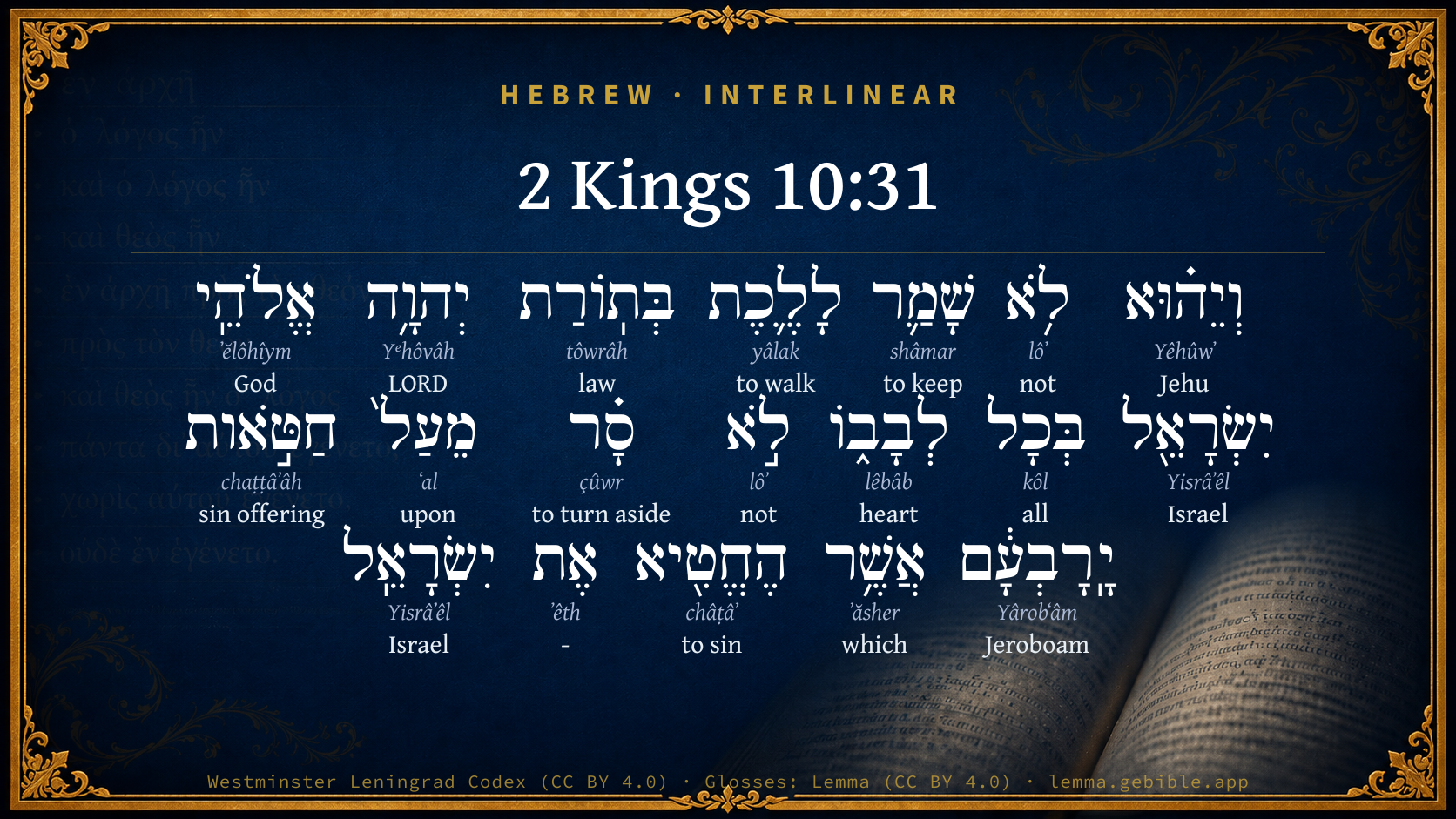
Hebrew (Westminster Leningrad Codex) 2 Kings 10:31 appears in the Hebrew Old Testament. The text above is from the Westminster Leningrad Codex. Each word links to its Strong’s number, a concise gloss, and parsing drawn from the Open Scriptures Hebrew Bible morphology. Click any word for its full Brown-Driver-Briggs (BDB) entry.
Download image
Cite this verse

2 Kings 10:31 (World English Bible). Public Domain. Lemma interlinear Bible study tool, https://lemma.gebible.app/v/2-kings/10/31.

Show BibTeX & RIS
BibTeX
RIS
English Translation
But Jehu took no heed to walk in the law of Yahweh, the God of Israel, with all his heart: he didn't depart from the sins of Jeroboam, with which he made Israel to sin.
World English Bible · Public Domain
Download a study sheet

One document with this verse’s original text, its word-by-word gloss line, the meaning frame, cross-references with their text, attributed commentary, and full source and license credits — printable, and it pastes into notes with its structure intact.

This verse Autodidact and up

Study sheet (.html) Plain text (.txt)

A passage Seminary Student

Up to 50 verses in one chapter. A passage sheet keeps up to 6 commentary sources and 12 cross-references per verse, in the order this page ranks them, and says so on the sheet whenever that leaves anything out. Ask for a single verse and you get the Autodidact verse sheet above.

Everything on this page stays free to read, with no account — the sheet is a download of what is already on screen, not access to it.

Want to remove ads? Support Godless Engineer
Compare translations 3

The same verse in 3 English versions, stacked beneath the original-language interlinear above. Click any original word for its lexicon entry.

Each is an independent rendering of the whole verse — the interlinear is not word-aligned to these translations.

Highlighted words mark where these versions differ — a whole-verse word diff, not a word-by-word alignment.

  • World English Bible Public Domain
    But Jehu took no heed to walk in the law of Yahweh, the God of Israel, with all his heart: he didn't depart from the sins of Jeroboam, with which he made Israel to sin.
  • King James Version Public Domain
    But Jehu took no heed to walk in the law of the LORD God of Israel with all his heart: for he departed not from the sins of Jeroboam, which made Israel to sin.
  • unfoldingWord Literal Text CC BY-SA 4.0
    But Jehu was not careful to walk in the law of Yahweh, the God of Israel, with all of his heart. He did not turn away from the sins of Jeroboam, who caused Israel to sin.

unfoldingWord Literal Text — © unfoldingWord, licensed CC BY-SA 4.0. Word-aligned USFM3 via Door43 (git.door43.org/unfoldingWord/en_ult).

Versions to compare (up to 4)

3 of 4 selected

Show all 18 translations

Every available English version of this verse, each an independent rendering of the whole verse.

  • World English Bible Public Domain
    But Jehu took no heed to walk in the law of Yahweh, the God of Israel, with all his heart: he didn't depart from the sins of Jeroboam, with which he made Israel to sin.
  • Berean Standard Bible Public Domain
    Yet Jehu was not careful to follow the instruction of the LORD, the God of Israel, with all his heart. He did not turn away from the sins that Jeroboam had caused Israel to commit.
  • Majority Standard Bible Public Domain
    Yet Jehu was not careful to follow the instruction of the LORD, the God of Israel, with all his heart. He did not turn away from the sins that Jeroboam had caused Israel to commit.
  • King James Version Public Domain
    But Jehu took no heed to walk in the law of the LORD God of Israel with all his heart: for he departed not from the sins of Jeroboam, which made Israel to sin.
  • American Standard Version (1901) Public Domain
    But Jehu took no heed to walk in the law of Jehovah, the God of Israel, with all his heart: he departed not from the sins of Jeroboam, wherewith he made Israel to sin.
  • Revised Version (1885) Public Domain
    But Jehu took no heed to walk in the law of the LORD, the God of Israel, with all his heart: he departed not from the sins of Jeroboam, wherewith he made Israel to sin.
  • Geneva Bible (1599) Public Domain
    But Iehu regarded not to walke in the law of the Lord God of Israel with all his heart: for hee departed not from the sinnes of Ieroboam, which made Israel to sinne.
  • Douay-Rheims (1899) Public Domain
    But Jehu took no heed to walk in the law of the Lord the God of Israel with all his heart: for he departed not from the sins of Jeroboam, who had made Israel to sin.
  • Young's Literal Translation Public Domain
    And Jehu hath not taken heed to walk in the law of Jehovah, God of Israel, with all his heart, he hath not turned aside from the sins of Jeroboam, that he caused Israel to sin.
  • Literal Standard Version CC BY-SA 4.0
    And Jehu has not taken heed to walk in the Law of YHWH, God of Israel, with all his heart; he has not turned aside from the sins of Jeroboam that he caused Israel to sin.
  • Unlocked Literal Bible CC BY-SA 4.0
    But Jehu took no care to walk in the law of Yahweh, the God of Israel, with all his heart. He did not turn away from the sins of Jeroboam, by which he made Israel sin.
  • unfoldingWord Literal Text CC BY-SA 4.0
    But Jehu was not careful to walk in the law of Yahweh, the God of Israel, with all of his heart. He did not turn away from the sins of Jeroboam, who caused Israel to sin.
  • Darby Bible Public Domain
    But Jehu took no heed to walk in the law of Jehovah the God of Israel with all his heart; he departed not from the sins of Jeroboam, who made Israel to sin.
  • World Messianic Bible Public Domain
    But Jehu took no heed to walk in the law of the LORD, the God of Israel, with all his heart. He didn’t depart from the sins of Jeroboam, with which he made Israel to sin.
  • Webster's Bible Public Domain
    But Jehu took no heed to walk in the law of the LORD God of Israel with all his heart: for he departed not from the sins of Jeroboam, who made Israel to sin.
  • Free Bible Version CC BY-SA 4.0
    But Jehu was not completely committed to following the law of the Lord, the God of Israel. He did not end the sins that Jeroboam had made Israel commit.
  • Bible in Basic English Public Domain
    But Jehu did not take care to keep the law of the Lord with all his heart: he did not keep himself from the sin which Jeroboam did and made Israel do.
  • JPS Tanakh (1917) Public Domain
    But Jehu took no heed to walk in the law of the LORD, the God of Israel, with all his heart; he departed not from the sins of Jeroboam, wherewith he made Israel to sin.

Literal Standard Version (2020), Covenant Press — licensed CC BY-SA 4.0. Text via the HelloAO Bible API (eBible.org). Unlocked Literal Bible (unfoldingWord) — licensed CC BY-SA 4.0. Text via the HelloAO Bible API (eBible.org). unfoldingWord Literal Text — © unfoldingWord, licensed CC BY-SA 4.0. Word-aligned USFM3 via Door43 (git.door43.org/unfoldingWord/en_ult). Free Bible Version, Dr. Jonathan Gallagher — licensed CC BY-SA 4.0. Text via the HelloAO Bible API (eBible.org).

Word by word

More ways to search: Search by grammar → Find every occurrence → Compare this word →

Practice this passage: Drill this verse → Learn its vocabulary →

וְיֵה֗וּא
Yêhûwʼ
H3058
“and · Jehu”
Conjunction + Noun, Proper
Part of Speech
Conjunction + Noun
Type
Proper
Full BDB Definition

Origin: from H3068 and H1931

TWOT: None

Jehu = "Jehovah is He" - the king of the northern kingdom Israel who overthrew the dynasty of Omri - son of Hanani and an Israelite prophet in the time of Baasha and Jehoshaphat - the Antothite, a Benjamite, one of David's mighty warriors - a descendant of Judah of the house of Hezron - son of Josibiah and a chief of the tribe of Simeon
  1. לֹ֥א lôʼ H3808 “not” Particle, Negative
  2. שָׁמַ֛ר shâmar H8104 “to keep” Verb, Qal, Perfect, 3rd Person, Masculine, Singular
  3. לָלֶ֛כֶת yâlak H3212 “to walk” Preposition + Verb, Qal, Infinitive Construct
  4. בְּתֽוֹרַת tôwrâh H8451 “in/at · law of” Preposition + Noun, Common, Feminine, Singular, Construct
  5. יְהוָ֥ה Yᵉhôvâh H3068 “LORD” Noun, Proper
  6. אֱלֹהֵֽי ʼĕlôhîym H430 “God(s) of” Noun, Common, Masculine, Plural, Construct
  7. יִשְׂרָאֵ֖ל Yisrâʼêl H3478 “Israel” Noun, Proper
  8. בְּכָל kôl H3605 “in/at · all of” Preposition + Noun, Common, Masculine, Singular, Construct
  9. לְבָב֑וֹ lêbâb H3824 “heart · his” Noun, Common, Masculine, Singular, Construct + Suffix, Personal, 3rd Person, Masculine, Singular
  10. לֹ֣א lôʼ H3808 “not” Particle, Negative
  11. סָ֗ר çûwr H5493 “to turn aside” Verb, Qal, Perfect, 3rd Person, Masculine, Singular
  12. מֵעַל֙ ʻal H5921 “from · upon” Preposition + Preposition
  13. חַטֹּ֣אות chaṭṭâʼâh H2403 “sin offerings of” Noun, Common, Feminine, Plural, Construct
  14. יָֽרָבְעָ֔ם Yârobʻâm H3379 “Jeroboam” Noun, Proper
  15. אֲשֶׁ֥ר ʼăsher H834 “which” Particle, Relative
  16. הֶחֱטִ֖יא châṭâʼ H2398 “to sin” Verb, Hiphil, Perfect, 3rd Person, Masculine, Singular
  17. אֶת ʼêth H853 “-” Particle, Direct Object
  18. יִשְׂרָאֵֽל Yisrâʼêl H3478 “Israel” Noun, Proper

About this verse

These counts appear in no published source. They are computed here, from the morphology-tagged text and Lemma’s own curated glosses. What Lemma adds →

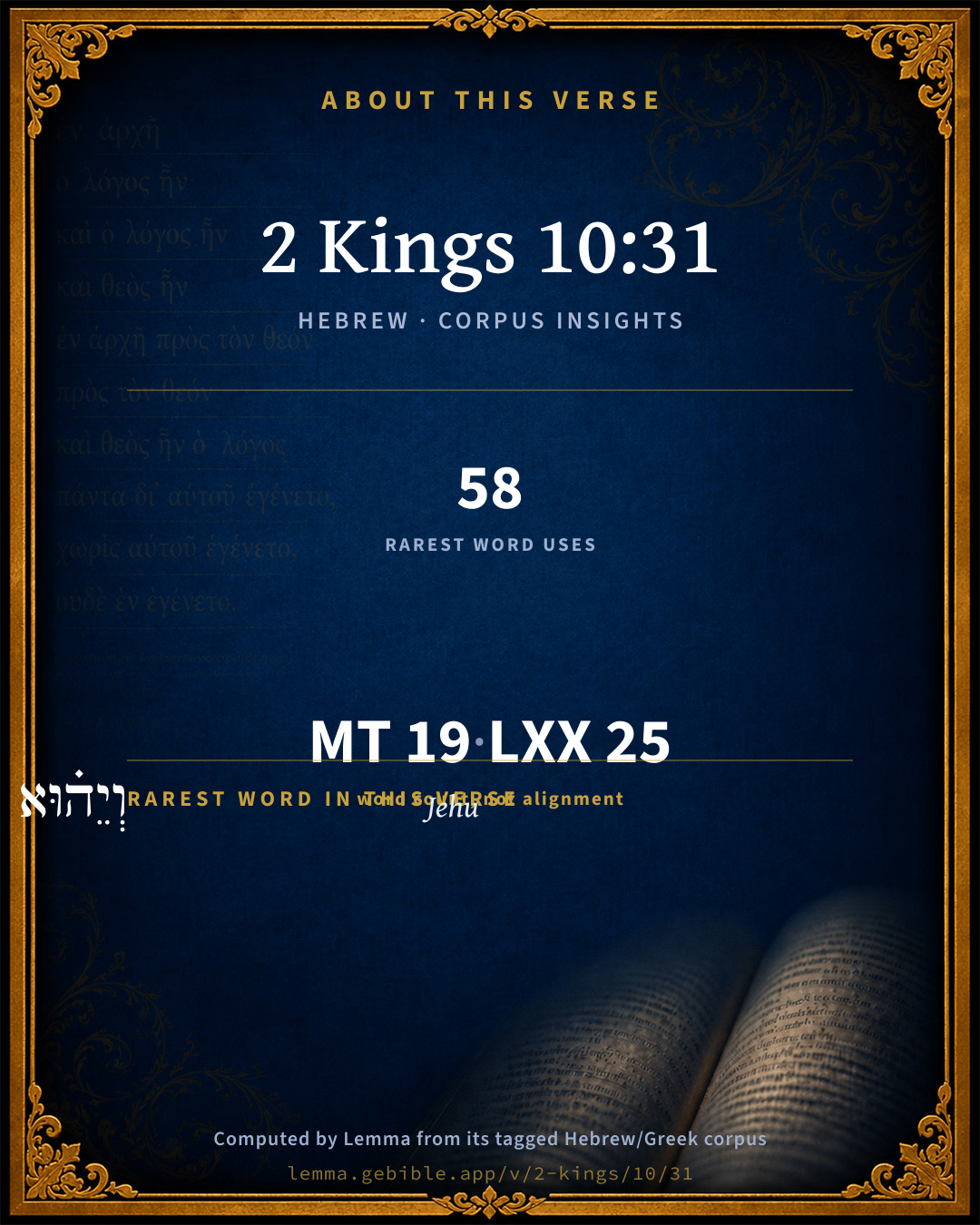
19
words
17
distinct lemmas
Historical
section

Shared distinctive vocabulary

וְיֵה֗וּא Jehu H3058 occurs in 54 verses of the Hebrew Bible. Also found in:

Grammatical profile

  • 4 verbs
  • 10 nouns
  • 1 preposition
  • 4 particles

Verb forms

  • שָׁמַ֛ר Qal · Perfect
  • לָלֶ֛כֶת Qal · Infinitive Construct
  • סָ֗ר Qal · Perfect
  • הֶחֱטִ֖יא Hiphil · Perfect

Repetition

Words recur within this verse — often emphatic in Hebrew:

  • יִשְׂרָאֵ֖ל Israel H3478 ×2
  • לֹ֥א not H3808 ×2

Hebrew & Septuagint length

In English translation the verse runs 35 words from the Hebrew and 34 from the Septuagint (LXX English) — closely comparable.

A rough comparison of the two English renderings, which tokenize alike — not a word-level alignment.

Word counts can differ between the Hebrew and the Greek without any difference in meaning — e.g. the Hebrew direct-object marker אֵת has no separate Greek word, and Greek often adds the article ὁ.

In the original languages it is 19 Hebrew tokens and 25 Greek tokens — but the two are counted differently (Hebrew bundles its prefixes and suffixes into one token; the Greek is in lemma form), so that isn’t a like-for-like length.

Cross-references

18

Topical passages linked to 2 Kings 10:31 in the Treasury of Scripture Knowledge — connected by theme and wording, ordered by reader-vote popularity; previews shown in the World English Bible.

  • 2 Kings 10:29 However from the sins of Jeroboam the son of Nebat, with which he made Israel to sin, Jehu didn't depart from after them, [to wit], the golden calves that were in Bethel, and that were in Dan.
  • Proverbs 4:23 Keep your heart with all diligence, For out of it is the wellspring of life.
  • Psalms 78:10 They didn't keep God's covenant, And refused to walk in his law.
  • Hebrews 2:1 Therefore we ought to pay greater attention to the things that were heard, lest perhaps we drift away.
  • Deuteronomy 4:15 Take therefore good heed to yourselves; for you saw no manner of form on the day that Yahweh spoke to you in Horeb out of the midst of the fire.
  • Deuteronomy 4:23 Take heed to yourselves, lest you forget the covenant of Yahweh your God, which he made with you, and make you an engraved image in the form of anything which Yahweh your God has forbidden you.
  • Deuteronomy 5:33 You shall walk in all the way which Yahweh your God has commanded you, that you may live, and that it may be well with you, and that you may prolong your days in the land which you shall possess.
  • Deuteronomy 10:12–13 Now, Israel, what does Yahweh your God require of you, but to fear Yahweh your God, to walk in all his ways, and to love him, and to serve Yahweh your God with all your heart and with all your soul,
  • 1 Kings 2:4 That Yahweh may establish his word which he spoke concerning me, saying, If your children take heed to their way, to walk before me in truth with all their heart and with all their soul, there shall not fail you (said he) a man on the throne of Israel.
  • 1 Kings 14:16 He will give Israel up because of the sins of Jeroboam, which he has sinned, and with which he has made Israel to sin.
  • 2 Kings 3:3 Nevertheless he cleaved to the sins of Jeroboam the son of Nebat, with which he made Israel to sin; he didn't depart from it.
  • 2 Chronicles 6:16 Now therefore, Yahweh, the God of Israel, keep with your servant David my father that which you have promised him, saying, There shall not fail you a man in my sight to sit on the throne of Israel, if only your children take heed to their way, to walk in my law as you have walked before me.
  • Nehemiah 10:29 They joined with their brothers, their nobles, and entered into a curse, and into an oath, to walk in God's law, which was given by Moses the servant of God, and to observe and do all the commandments of Yahweh our Lord, and his ordinances and his statutes;
  • Psalms 39:1 I said, "I will watch my ways, so that I don't sin with my tongue. I will keep my mouth with a bridle while the wicked is before me."
  • Psalms 119:9 How can a young man keep his way pure? By living according to your word.
  • Ezekiel 36:27 I will put my Spirit within you, and cause you to walk in my statutes, and you shall keep my ordinances, and do them.
  • Daniel 9:10 neither have we obeyed the voice of Yahweh our God, to walk in his laws, which he set before us by his servants the prophets.
  • Hebrews 12:15 looking carefully lest there be any man who falls short of the grace of God; lest any root of bitterness springing up trouble you, and thereby the many be defiled;

Cross-references courtesy of OpenBible.info (CC BY 4.0).

Hebrew and Greek witnesses Masoretic Hebrew ↔ Greek Septuagint

The same verse in the two great witnesses to the Old Testament, shown verse-for-verse.

These are two independent witnesses, not word-aligned to each other, and the Septuagint is shown in lemma (dictionary) form.

Hebrew 2 Kings 10:31 Masoretic · Westminster Leningrad Codex

וְיֵה֗וּא לֹ֥א שָׁמַ֛ר לָלֶ֛כֶת בְּתֽוֹרַת יְהוָ֥ה אֱלֹהֵֽי יִשְׂרָאֵ֖ל בְּכָל לְבָב֑וֹ לֹ֣א סָ֗ר מֵעַל֙ חַטֹּ֣אות יָֽרָבְעָ֔ם אֲשֶׁ֥ר הֶחֱטִ֖יא אֶת יִשְׂרָאֵֽל

But Jehu took no heed to walk in the law of Yahweh, the God of Israel, with all his heart: he didn't depart from the sins of Jeroboam, with which he made Israel to sin.

World English Bible · Public Domain

Greek LXX 2 Kings 10:31 Septuagint · lemma form

καί ιου οὐ φυλάσσω πορεύομαι ἐν νόμος κύριος θεός ἰσραήλ ἐν ὅλος καρδία αὐτός οὐ ἀποἵστημι ἐπάνωθεν ἁμαρτία ιεροβοαμ υἱός ναβατ ὅς ἐκἁμαρτάνω ὁ ἰσραήλ

But Ju took no heed to walk in the law of the Lord God of Israel with all his heart: he departed not from following the sins of Jeroboam, who made Israel to sin.

LXX2012 (modern English Septuagint) · Public Domain

Hebrew: Westminster Leningrad Codex (CC BY 4.0). Greek: Septuagint (public domain); English from LXX2012 (modern English Septuagint) (Public Domain). How the Septuagint differs from the Hebrew →

Targum (Aramaic paraphrase)

1

The Targum is the ancient Jewish Aramaic paraphrase of the Hebrew Scriptures — an interpretive translation, not the Hebrew text itself. Onkelos (literal) and Pseudo-Jonathan (expansive) render the Torah, and Jonathan the Prophets. Coverage is partial: where no permissively-licensed English translation exists for a verse, only the Aramaic is shown. This is verse-level text, not a word-by-word alignment to the Hebrew.

  1. Targum Jonathan Prophets (Joshua–Malachi)
    וְיֵהוּא לָא נְטַר לִמְהַךְ בְּאוֹרַיְתָא דַייָ אֱלָהָא דְיִשְׂרָאֵל בְּכָל לִבֵּיהּ לָא סְטָא מֵעַל חוֹבֵי יָרָבְעָם דְחַיֵב יַת יִשְׂרָאֵל:

    (no public-domain English translation for this verse)

    Targum Jonathan — Aramaic: “Mikraot Gedolot” (public domain). English: “Sefaria Community Translation” (CC0 1.0 (public-domain dedication)); “London "Chaldee Paraphrase," 1871” (public domain). Text via Sefaria.

Commentary

Notes on 2 Kings 10:31 from classic Christian and Jewish commentators (each source and its license shown beneath its notes). The classic Christian expositions comment on the surrounding passage and are grouped to its opening verse, so a note may address several verses; the Jewish commentaries on the Tanakh (Rashi and others) are per-verse, so they appear only where the commentator wrote on this verse.

Lemma curates 59 commentaries, every one of them public domain or Creative Commons licensed, each selected and text-cleaned for this edition rather than reprinted as found. About our sources →

Trapp's Complete Commentary

John Trapp

2Ki 10:31 But Jehu took no heed to walk in the law of the LORD God of Israel with all his heart: for he departed not from the sins of Jeroboam, which made Israel to sin.

Ver. 31. With all his heart.] He had a dispensatory conscience, a rotten heart, and that was his ruin. A man may recover of a fever, and die of a dropsy; so he that leaveth some gross sin, yet huggeth a less, is an undone person.

For he departed not from the sins of Jeroboam.] No, though the Lord had made him such large promises, as 2Ki 10:30, compare 2Co 7:1. Nevertheless he may as well deserve - as did Galba, and our Richard III - to be reckoned in the rank of bad men, but good princes.

John Trapp, A Commentary or Exposition upon All the Books of the Old and New Testament (1647–1656) — public domain. Text from a community e-Sword module.

The Biblical Illustrator

Joseph S. Exell

2Ki_10:31

Jehu took no heed to walk in law of the Lord.

Ruin wrought by neglect

I remember once seeing a bit of an old Roman road; the lava blocks were there, but for want of care, here a young sapling had grown up between two of them and had driven them apart; there they were split by the frost; here was a great ugly gap full of mud; and the whole thing ended in a jungle. How shall a man keep the road in repair? By taking heed thereto. Things that are left to go anyhow in this world have a strange knack of going one how. You do not need anything else than negligence to ensure that thing will come to grief. (A. Maclaren, D. D.)

Heedlessness perilous

There is no need that the man in a skiff amid Niagaras rapids should row toward the cataract; resting on his oars is quite enough to send him over the awful verge. It is the neglected wheel that capsizes the vehicle and maims for life the passengers. It is the neglected leak that sinks the ship. It is the neglected field that yields briers instead of bread. It is the neglected spark near the magazine whose tremendous explosion sends its hundreds of mangled wretches into eternity. The neglect of an officer to throw up a rocket on a certain night caused the fall of Antwerp, and postponed the deliverance of Holland for twenty or more years. The neglect of a sentinel to give an alarm hindered the fall of Sebastopol, and resulted in the loss of many thousand lives.

The Biblical Illustrator, edited by Joseph S. Exell (c. 1880s–1900s) — public domain. Text from a community e-Sword module.

Joseph Benson's Commentary

2Ki 10:31. But Jehu took no care to walk in the law of the Lord God of Israel — He abolished the worship of Baal, but did not keep up the worship of God, nor walk in his law. He showed great zeal and care for the rooting out of a false religion; but in the true religion he showed no care, took no heed: was not solicitous to please God and do his duty. With all his heart — His heart, his whole heart, was not engaged in, nor influenced by religion; nor was he truly zealous for the glory of God, and the advancement of true and genuine piety in himself and others. It is evident his own religion was very superficial, and yet God made use of him as an instrument of effecting some reformation in Israel. It is a pity that those who do good to others, are not always good themselves.

Joseph Benson's Commentary on the Old and New Testaments (1811–1818) — public domain. Text from a community e-Sword module.

Tyndale Open Study Notes

Tyndale Open Resources

10:31-33 In response to Jehu’s unfaithfulness, the Lord began to cut down the size of Israel’s territory, one of the curses for spiritual infidelity to the covenant (Deut 28:25). • The Aramean king Hazael moved southward, conquering areas east of the Jordan River north of the border of Moab. The Arameans continued the pressure against Israel throughout the reign of Jehu and into the reign of his son Jehoahaz (2 Kgs 12:17-18; 13:3).

Tyndale Open Study Notes — © Tyndale Open Resources, licensed CC BY-SA 4.0. Text via the HelloAO Bible API.

Adam Clarke's Commentary

Verse 31. Jehu took no heed] He never made it his study; indeed, he never intended to walk in this way; it neither suited his disposition nor his politics.

Adam Clarke's Commentary on the Bible (1810–1826) — public domain. Text from a community e-Sword/MySword module.

Ellicott's Commentary for English Readers

(31) But Jehu took no heed.—Or, Now Jehu had not been careful. This verse, rather than the next, begins a new paragraph.

To walk in the law—i.e., the Mosaic law, which forbids the use of images, such as the “calves.”

With all his heart.—This is explained by the next sentence. He had done honour to Jehovah by extirpating the foreign Baal-worship, but he supported the irregular mode of worshipping Jehovah established by Jeroboam as the state religion of the Northern kingdom.

For.—Not in the Hebrew.

A Bible Commentary for English Readers, edited by Charles John Ellicott (1878–1897) — public domain. Text from a community e-Sword module.

The Cambridge Bible for Schools and Colleges

gen. ed. J. J. S. Perowne

31. with all his heart] He only went partially on the right way, and probably personal ambition had much to do with his zeal against Baal. With the calves it was another matter. They formed, as it were, the emblems of Israel’s independence, and so the king’s feeling would be enlisted on their side.

The Cambridge Bible for Schools and Colleges (gen. ed. J. J. S. Perowne; Cambridge University Press, 1878–1918) — public domain. Text from a community e-Sword module.

John Gill's Exposition

From Jordan eastward,.... This was principally the coast on which Hazael smote them, to the east of the land of Canaan:

all the land of Gilead, the Gadites, and the Reubenites, and the Moabites; the country on the other side Jordan, given to these tribes by Moses, at their request, which were before the kingdoms of Sihon and of Og:

from Aroer, which is by the river Arnon, even Gilead and Bashan: countries which the Israelites first conquered, and were the first they lost.

John Gill's Exposition of the Whole Bible (1746–1763) — public domain (CC PDM 1.0). Text via the HelloAO Bible API.

Matthew Poole's English Annotations

With all his heart: His obedience wanted three necessary properties, care or heedfulness, universality, and sincerity.

He departed not from the sins of Jeroboam; his resolved continuance in one single course is justly alleged as an argument of his false-heartedness in all his other actions.

Matthew Poole's English Annotations on the Holy Bible (1683–1685) — public domain. Text from a community e-Sword/MySword module.

The Pulpit Commentary

But Jehu took no heed to walk in the Law of the Lord God of Israel with all his heart. Jehu"s character is thus summed up by Dean Stanley: "The character of Jehu is not difficult to understand, if we take it as a whole, and consider the general impression left upon us by the biblical account. He is exactly one of those men whom we are compelled to recognize, not for what is good or great in themselves, but as instruments for destroying evil, and preparing the way for good; such as Augustus Caesar at Rome, Sultan Mahmoud II in Turkey, or one closer at hand in the revolutions of our own time and neighborhood. A destiny, long kept in view by himself or ethers inscrutable secrecy and reserve in carrying out his plans a union of cold, remorseless tenacity with occasional bursts of furious, wayward, almost fanatical zeal; this is Jehu, as he is set before us in the historical narrative, the worst type of a son of Jacob the "supplanter"...without the noble and princely qualities of Israel; the most unlovely and the most coldly commended of all the heroes of his country" ("Lectures on the Jewish Church," vol. 2. p. 289). The estimate is lower than that formed by most other writers; but it is not far from the truth. For he departed not from the sins of Jeroboam, which made Israel to sin (comp. ver. 29).

The Pulpit Commentary (1880–1919), ed. H.D.M. Spence-Jones & Joseph S. Exell — public domain. Text from a community e-Sword module.

John Wesley's Explanatory Notes

Took no heed - Sin, clearly shewed that his heart was not right with God.

John Wesley, Explanatory Notes Upon the Whole Bible (1754–1765) — public domain. Text via the GEBible commentary corpus.

Lesson kit

Teaching starters — assembled from the data on this page, not authored interpretation. Every prompt links to the verse data it draws on. Edit before teaching.

2 Kings, in the Historical, opens this verse with 19 words (17 distinct Hebrew lemmas). Its most distinctive word is Yêhûwʼ (“Jehu”). A historical commentator’s framing appears above. Read the whole chapter for the surrounding context.

Discussion questions

  1. How does “Jehu” (Yêhûwʼ) shape what this verse is saying?
  2. How does 1 Kings 16:1, which shares the word «Jehu», read alongside this verse?
  3. What does the repetition of “Israel” (2× in this one verse) do in this verse?
  4. These translations render this verse differently. What is at stake in choosing one wording over another?
  5. «שָׁמַ֛ר» is a Qal Perfect verb. How does that grammatical form shape the action described?
  6. Compare how Trapp's Complete Commentary and The Biblical Illustrator read this verse. Where do they agree or differ?

Things to notice

Reading settings

Reading text

Shown beneath each verse's original-language words.

Old Testament
Old Testament edition

Read the OT as the Masoretic Hebrew (MT) or the Greek Septuagint (LXX).

English shown for the Greek Septuagint (in the Hebrew ↔ Greek comparison).

Comparing translations? Open the Compare panel on any verse page to stack up to four side by side.