
Leviticus 13:58

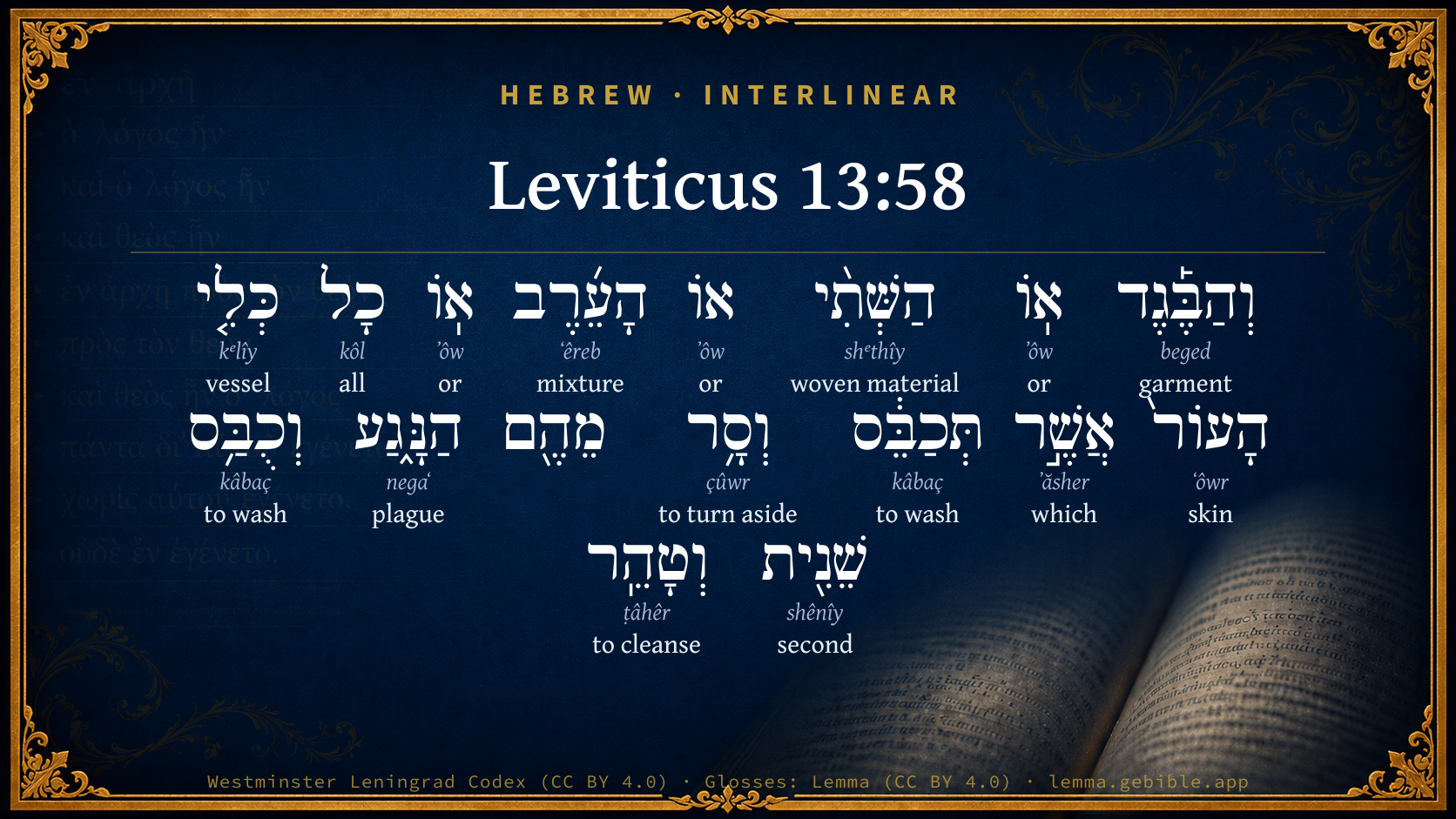
Hebrew (Westminster Leningrad Codex) Leviticus 13:58 appears in the Hebrew Old Testament. The text above is from the Westminster Leningrad Codex. Each word links to its Strong’s number, a concise gloss, and parsing drawn from the Open Scriptures Hebrew Bible morphology. Click any word for its full Brown-Driver-Briggs (BDB) entry.
Download image
Cite this verse

Leviticus 13:58 (World English Bible). Public Domain. Lemma interlinear Bible study tool, https://lemma.gebible.app/v/leviticus/13/58.

Show BibTeX & RIS
BibTeX
RIS
English Translation
The garment, either the warp, or the woof, or whatever thing of skin it is, which you shall wash, if the plague has departed from them, then it shall be washed the second time, and it will be clean."
World English Bible · Public Domain
Download a study sheet

One document with this verse’s original text, its word-by-word gloss line, the meaning frame, cross-references with their text, attributed commentary, and full source and license credits — printable, and it pastes into notes with its structure intact.

This verse Autodidact and up

Study sheet (.html) Plain text (.txt)

A passage Seminary Student

Up to 50 verses in one chapter. A passage sheet keeps up to 6 commentary sources and 12 cross-references per verse, in the order this page ranks them, and says so on the sheet whenever that leaves anything out. Ask for a single verse and you get the Autodidact verse sheet above.

Everything on this page stays free to read, with no account — the sheet is a download of what is already on screen, not access to it.

Want to remove ads? Support Godless Engineer
Compare translations 3

The same verse in 3 English versions, stacked beneath the original-language interlinear above. Click any original word for its lexicon entry.

Each is an independent rendering of the whole verse — the interlinear is not word-aligned to these translations.

Highlighted words mark where these versions differ — a whole-verse word diff, not a word-by-word alignment.

  • World English Bible Public Domain
    The garment, either the warp, or the woof, or whatever thing of skin it is, which you shall wash, if the plague has departed from them, then it shall be washed the second time, and it will be clean."
  • King James Version Public Domain
    And the garment, either warp, or woof, or whatsoever thing of skin it be, which thou shalt wash, if the plague be departed from them, then it shall be washed the second time, and shall be clean.
  • unfoldingWord Literal Text CC BY-SA 4.0
    But the clothing or the warp or the woof or any article of leather that you washed and the infection turned aside from them, it shall be washed a second, and it will be clean.

unfoldingWord Literal Text — © unfoldingWord, licensed CC BY-SA 4.0. Word-aligned USFM3 via Door43 (git.door43.org/unfoldingWord/en_ult).

Versions to compare (up to 4)

3 of 4 selected

Show all 18 translations

Every available English version of this verse, each an independent rendering of the whole verse.

  • World English Bible Public Domain
    The garment, either the warp, or the woof, or whatever thing of skin it is, which you shall wash, if the plague has departed from them, then it shall be washed the second time, and it will be clean."
  • Berean Standard Bible Public Domain
    If the mildew disappears from the fabric, weave, or knit, or any leather article after washing, then it is to be washed again, and it will be clean.
  • Majority Standard Bible Public Domain
    If the mildew disappears from the fabric, weave, or knit, or any leather article after washing, then it is to be washed again, and it will be clean.
  • King James Version Public Domain
    And the garment, either warp, or woof, or whatsoever thing of skin it be, which thou shalt wash, if the plague be departed from them, then it shall be washed the second time, and shall be clean.
  • American Standard Version (1901) Public Domain
    And the garment, either the warp, or the woof, or whatsoever thing of skin it be, which thou shalt wash, if the plague be departed from them, then it shall be washed the second time, and shall be clean.
  • Revised Version (1885) Public Domain
    And the garment, either the warp, or the woof, or whatsoever thing of skin it be, which thou shalt wash, if the plague be departed from them, then it shall be washed the second time, and shall be clean.
  • Geneva Bible (1599) Public Domain
    If thou hast washed ye garment or ye warpe, or ye woofe, or whatsouer thing of skin it be, if the plague be departed therefrom, then shall it be washed the second time, and be cleane.
  • Douay-Rheims (1899) Public Domain
    If it cease, he shall wash with water the parts that are pure, the second time, and they shall be clean.
  • Young's Literal Translation Public Domain
    `And the garment, or the warp, or the woof, or any vessel of skin which thou dost wash when the plague hath turned aside from them, then it hath been washed a second time, and hath been clean.
  • Literal Standard Version CC BY-SA 4.0
    And the garment, or the warp, or the woof, or any vessel of skin which you wash when the plague has turned aside from them, then it has been washed a second time, and has been clean.
  • Unlocked Literal Bible CC BY-SA 4.0
    The garment or anything woven or knitted from wool or linen material, or leather or anything made with leather—if you wash the item and the mildew is gone, then the item must be washed a second time, and it will be clean.
  • unfoldingWord Literal Text CC BY-SA 4.0
    But the clothing or the warp or the woof or any article of leather that you washed and the infection turned aside from them, it shall be washed a second, and it will be clean.
  • Darby Bible Public Domain
    But the garment, or the warp, or the woof, or whatever thing of skin which thou hast washed, and the sore departeth from them, it shall be washed a second time, and it is clean.
  • World Messianic Bible Public Domain
    The garment, either the warp, or the woof, or whatever thing of skin it is, which you shall wash, if the plague has departed from them, then it shall be washed the second time, and it will be clean.”
  • Webster's Bible Public Domain
    And the garment, either warp, or woof, or whatever thing of skin it is, which thou shalt wash, if the plague hath departed from them, then it shall be washed the second time, and shall be clean.
  • Free Bible Version CC BY-SA 4.0
    If the mold disappears after washing, then have it washed again, and it will be clean.
  • Bible in Basic English Public Domain
    And the material of the clothing, or anything of skin, which has been washed, if the mark has gone out of it, let it be washed a second time and it will be clean.
  • JPS Tanakh (1917) Public Domain
    And the garment, or the warp, or the woof, or whatsoever thing of skin it be, which thou shalt wash, if the plague be departed from them, then it shall be washed the second time, and shall be clean.

Literal Standard Version (2020), Covenant Press — licensed CC BY-SA 4.0. Text via the HelloAO Bible API (eBible.org). Unlocked Literal Bible (unfoldingWord) — licensed CC BY-SA 4.0. Text via the HelloAO Bible API (eBible.org). unfoldingWord Literal Text — © unfoldingWord, licensed CC BY-SA 4.0. Word-aligned USFM3 via Door43 (git.door43.org/unfoldingWord/en_ult). Free Bible Version, Dr. Jonathan Gallagher — licensed CC BY-SA 4.0. Text via the HelloAO Bible API (eBible.org).

Word by word

More ways to search: Search by grammar → Find every occurrence → Compare this word →

Practice this passage: Drill this verse → Learn its vocabulary →

הַשְּׁתִ֨י
shᵉthîy
H8359
“the · woven material”
Particle, Definite Article + Noun, Common, Masculine, Singular, Absolute
Part of Speech
Particle + Noun
Type
Common
Gender
Masculine
Number
Singular
State
Absolute
Full BDB Definition

Origin: from H7896

TWOT: 2479a

warp, woven material
  1. וְהַבֶּ֡גֶד beged H899 “and · the · garment” Conjunction + Particle, Definite Article + Noun, Common, Masculine, Singular, Absolute
  2. אֽוֹ ʼôw H176 “or” Conjunction
  3. אוֹ ʼôw H176 “or” Conjunction
  4. הָעֵ֜רֶב ʻêreb H6154 “the · mixture” Particle, Definite Article + Noun, Common, Masculine, Singular, Absolute
  5. אֽוֹ ʼôw H176 “or” Conjunction
  6. כָל kôl H3605 “all of” Noun, Common, Masculine, Singular, Construct
  7. כְּלִ֤י kᵉlîy H3627 “vessel of” Noun, Common, Masculine, Singular, Construct
  8. הָעוֹר֙ ʻôwr H5785 “the · skin” Particle, Definite Article + Noun, Common, Masculine, Singular, Absolute
  9. אֲשֶׁ֣ר ʼăsher H834 “which” Particle, Relative
  10. תְּכַבֵּ֔ס kâbaç H3526 “to wash” Verb, Piel, Imperfect, 2nd Person, Masculine, Singular
  11. וְסָ֥ר çûwr H5493 “and · to turn aside” Conjunction + Verb, Qal, Sequential Perfect, 3rd Person, Masculine, Singular
  12. הַנָּ֑גַע negaʻ H5061 “the · plague” Particle, Definite Article + Noun, Common, Masculine, Singular, Absolute
  13. וְכֻבַּ֥ס kâbaç H3526 “and · to wash” Conjunction + Verb, Pual, Sequential Perfect, 3rd Person, Masculine, Singular
  14. שֵׁנִ֖ית shênîy H8145 “second” Adjective, Ordinal number, Feminine, Singular, Absolute
  15. וְטָהֵֽר ṭâhêr H2891 “and · to cleanse” Conjunction + Verb, Qal, Sequential Perfect, 3rd Person, Masculine, Singular

About this verse

These counts appear in no published source. They are computed here, from the morphology-tagged text and Lemma’s own curated glosses. What Lemma adds →

17
words
13
distinct lemmas
Pentateuch
section

Notable vocabulary

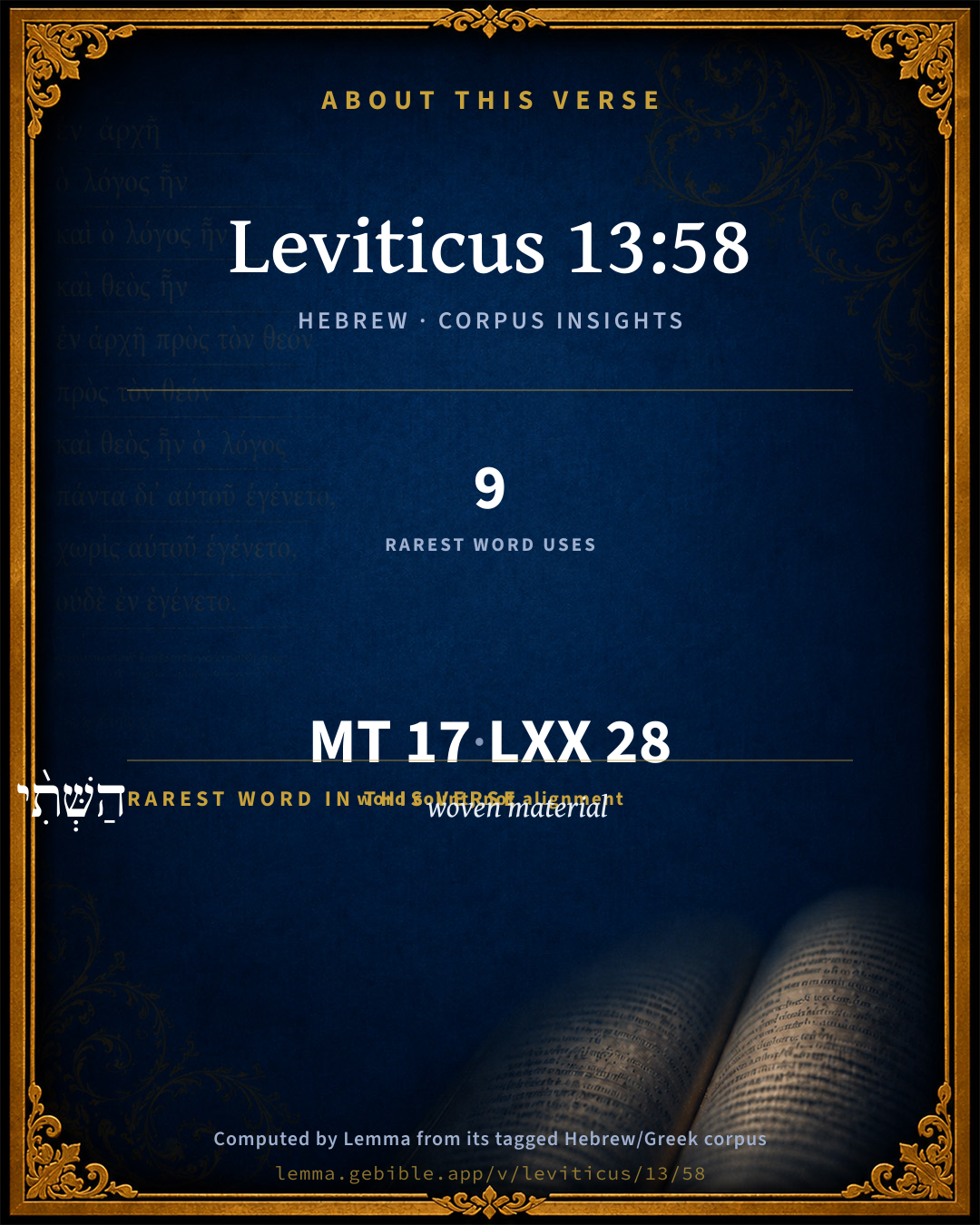
The rarest word here is הַשְּׁתִ֨י woven material H8359 — appearing just 9 times in the whole Hebrew Bible.

Shared distinctive vocabulary

הַשְּׁתִ֨י woven material H8359 occurs in 9 verses of the Hebrew Bible. Also found in:

Grammatical profile

  • 4 verbs
  • 7 nouns
  • 1 adjective
  • 1 preposition
  • 3 conjunctions
  • 1 particle

Verb forms

  • תְּכַבֵּ֔ס Piel · Imperfect
  • וְסָ֥ר Qal · Sequential Perfect
  • וְכֻבַּ֥ס Pual · Sequential Perfect
  • וְטָהֵֽר Qal · Sequential Perfect

Repetition

Words recur within this verse — often emphatic in Hebrew:

  • תְּכַבֵּ֔ס to wash H3526 ×2
  • אֽוֹ or H176 ×3

Hebrew & Septuagint length

In English translation the verse runs 39 words from the Hebrew and 33 from the Septuagint (LXX English) — closely comparable.

A rough comparison of the two English renderings, which tokenize alike — not a word-level alignment.

Word counts can differ between the Hebrew and the Greek without any difference in meaning — e.g. the Hebrew direct-object marker אֵת has no separate Greek word, and Greek often adds the article ὁ.

In the original languages it is 17 Hebrew tokens and 28 Greek tokens — but the two are counted differently (Hebrew bundles its prefixes and suffixes into one token; the Greek is in lemma form), so that isn’t a like-for-like length.

Cross-references

7

Topical passages linked to Leviticus 13:58 in the Treasury of Scripture Knowledge — connected by theme and wording, ordered by reader-vote popularity; previews shown in the World English Bible.

  • 2 Kings 5:10 Elisha sent a messenger to him, saying, Go and wash in the Jordan seven times, and your flesh shall come again to you, and you shall be clean.
  • 2 Kings 5:14 Then went he down, and dipped [himself] seven times in the Jordan, according to the saying of the man of God; and his flesh came again like the flesh of a little child, and he was clean.
  • Psalms 51:2 Wash me thoroughly from my iniquity. Cleanse me from my sin.
  • 2 Corinthians 7:1 Having therefore these promises, beloved, let us cleanse ourselves from all defilement of flesh and spirit, perfecting holiness in the fear of God.
  • 2 Corinthians 12:8 Concerning this thing, I begged the Lord three times that it might depart from me.
  • Hebrews 9:10 being only (with meats and drinks and various washings) fleshly ordinances, imposed until a time of reformation.
  • Revelation 1:5 and from Jesus Christ, the faithful witness, the firstborn of the dead, and the ruler of the kings of the earth. To him who loves us, and washed us from our sins by his blood;

Cross-references courtesy of OpenBible.info (CC BY 4.0).

Hebrew and Greek witnesses Masoretic Hebrew ↔ Greek Septuagint

The same verse in the two great witnesses to the Old Testament, shown verse-for-verse.

These are two independent witnesses, not word-aligned to each other, and the Septuagint is shown in lemma (dictionary) form.

Hebrew Leviticus 13:58 Masoretic · Westminster Leningrad Codex

וְהַבֶּ֡גֶד אֽוֹ הַשְּׁתִ֨י אוֹ הָעֵ֜רֶב אֽוֹ כָל כְּלִ֤י הָעוֹר֙ אֲשֶׁ֣ר תְּכַבֵּ֔ס וְסָ֥ר מֵהֶ֖ם הַנָּ֑גַע וְכֻבַּ֥ס שֵׁנִ֖ית וְטָהֵֽר

The garment, either the warp, or the woof, or whatever thing of skin it is, which you shall wash, if the plague has departed from them, then it shall be washed the second time, and it will be clean."

World English Bible · Public Domain

Greek LXX Leviticus 13:58 Septuagint · lemma form

καί ὁ ἱμάτιον ἤ ὁ στήμων ἤ ὁ κρόκη ἤ πᾶς σκεῦος δερμάτινος ὅς πλύνω καί ἀποἵστημι ἀπό αὐτός ὁ ἁφή καί πλύνω ὁ δεύτερος καί καθαρός εἰμί

And the garment, or the warp, or the woof, or any article of skin, which shall be washed, and the plague depart from it, shall also be washed again, and shall be clean.

LXX2012 (modern English Septuagint) · Public Domain

Hebrew: Westminster Leningrad Codex (CC BY 4.0). Greek: Septuagint (public domain); English from LXX2012 (modern English Septuagint) (Public Domain). How the Septuagint differs from the Hebrew →

Targum (Aramaic paraphrase)

2

The Targum is the ancient Jewish Aramaic paraphrase of the Hebrew Scriptures — an interpretive translation, not the Hebrew text itself. Onkelos (literal) and Pseudo-Jonathan (expansive) render the Torah, and Jonathan the Prophets. Coverage is partial: where no permissively-licensed English translation exists for a verse, only the Aramaic is shown. This is verse-level text, not a word-by-word alignment to the Hebrew.

  1. Targum Onkelos Torah (Genesis–Deuteronomy)
    וּלְבוּשָׁא אוֹ שַׁתְיָא אוֹ עַרְבָא אוֹ כָל מָאן דִמְשָׁךְ דִי יִתְחַוַר וְיֶעְדֵי מִנְהוֹן מַכְתָּשָׁא וְיִצְטַּבַּע תִּנְיָנוּת וְיִדְכֵּי

    (no public-domain English translation for this verse)

    Targum Onkelos — Aramaic: “Onkelos Genesis” (public domain); “Onkelos Exodus” (public domain); “Onkelos Leviticus” (public domain); “Onkelos Numbers” (public domain); “Onkelos Deuteronomy” (public domain). English: “Sefaria Community Translation” (CC0 1.0 (public-domain dedication)); “J.W. Etheridge. The Targums of Onkelos and Jonathan Ben Uzziel on the Pentateuch. London: Longmans, Green, 1862” (public domain). Text via Sefaria.

  2. Targum Pseudo-Jonathan Torah (Genesis–Deuteronomy)
    וּלְבוּשָׁא אוֹ שִׁיתְיָא אוֹ עַרְבָא אוֹ כָּל מַאן דִיצְלָא דִתְחַוָור וְיַעֲדֵי מִנֵיהּ מַכְתְּשָׁא וְיִצְטַבַּע תִּנְיָנוּת וְיִדְכֵּי

    And the garment, or the warp or woof, or anything of skin, which thou shalt wash and the plague depart from it shall be washed a second time, and it shall be clean.

    Targum Pseudo-Jonathan — Aramaic: “Targum Jonathan on Genesis” (public domain); “Targum Jonathan on Exodus” (public domain); “Targum Jonathan on Leviticus” (public domain); “Targum Jonathan on Numbers” (public domain); “Targum Jonathan on Deuteronomy” (public domain). English: “The Targum of Jonathan ben Uzziel, trans. J. W. Etheridge, London, 1862” (public domain). Text via Sefaria.

Commentary

Notes on Leviticus 13:58 from classic Christian and Jewish commentators (each source and its license shown beneath its notes). The classic Christian expositions comment on the surrounding passage and are grouped to its opening verse, so a note may address several verses; the Jewish commentaries on the Tanakh (Rashi and others) are per-verse, so they appear only where the commentator wrote on this verse.

Lemma curates 59 commentaries, every one of them public domain or Creative Commons licensed, each selected and text-cleaned for this edition rather than reprinted as found. About our sources →

Geneva Bible (1599)

Geneva Bible translators

To the intent he might be sure that the leprosy was departed, and that all occasion of infection might be taken away.

Geneva Bible (1599) marginal notes — public domain. Text via Bolls.life.

Adam Clarke's Commentary

Verse 58. It shall be washed the second time] According to the Jews the first washing was to put away the plague, the second to cleanse it.

BOTH among Jews and Gentiles the leprosy has been considered as a most expressive emblem of sin, the properties and circumstances of the one pointing out those of the other. The similitude or parallel has been usually run in the following manner: -

1. The leprosy began with a spot, a simple hidden infection being the cause.

2. This spot was very conspicuous, and argued the source whence it proceeded.

3. It was of a diffusive nature, soon spreading over the whole body.

4. It communicated its infectious nature, not only to the whole of the person's body, but also to his clothes and habitation.

5. It rendered the infected person loathsome, unfit for and dangerous to society because of its infectious nature.

6. The person infected was obliged to be separated from society, both religious and civil; to dwell by himself without the camp or city, and hold commerce with none.

7. He was obliged to proclaim his own uncleanness, publicly acknowledge his defilement, and, sensible of his plague, continue humbled and abased before God and man.

How expressive all these are of the nature of sin and the state of a sinner, a spiritual mind will at once perceive.

1. The original infection or corruption of nature is the grand hidden cause, source, and spring of all transgression.

2. Iniquity is a seed that has its growth, gradual increase, and perfection. As the various powers of the mind are developed, so it diffuses itself, infecting every passion and appetite through their whole extent and operation.

3. As it spreads in the mind, so it diffuses itself through the life; every action partaking of its influence, till the whole conduct becomes a tissue of transgression, because every imagination of the thoughts of a sinner's heart is only evil continually, Gen. vi. This is the natural state of man.

4. As a sinner is infected, so is he infectious; by his precept and example he spreads the infernal contagion wherever he goes; joining with the multitude to do evil, strengthening and being strengthened in the ways of sin and death, and becoming especially a snare and a curse to his own household.

5. That a sinner is abominable in the sight of God and of all good men, that he is unfit for the society of the righteous, and that he cannot, as such, be admitted into the kingdom of God, needs no proof.

6. It is owing to the universality of the evil that sinners are not expelled from society as the most dangerous of all monsters, and obliged to live without having any commerce with their fellow creatures. Ten lepers could associate together, because partaking of the same infection: and civil society is generally maintained, because composed of a leprous community.

7. He that wishes to be saved from his sins must humble himself before God and man, sensible of his own sore and the plague of his heart; confess his transgressions; look to God for a cure, from whom alone it can be received; and bring that Sacrifice by which alone the guilt can be taken away, and his soul be purified from all unrighteousness. See the conclusion of the following chapter (Le 14:53).

Adam Clarke's Commentary on the Bible (1810–1826) — public domain. Text from a community e-Sword/MySword module.

Ellicott's Commentary for English Readers

(58) And the garment . . . —According to Lev_13:54; Lev_13:56, the suspicious symptoms often disappeared after the stuffs had been washed and put in quarantine for a week, thus showing that it was not real leprosy. But though non-leprous, the garments had to be washed a second time before they could be pronounced fit for use.

A Bible Commentary for English Readers, edited by Charles John Ellicott (1878–1897) — public domain. Text from a community e-Sword module.

The Cambridge Bible for Schools and Colleges

gen. ed. J. J. S. Perowne

58. The garment which after washing (Lev_13:54) shews no further sign of the plague, is to be washed again, and then declared clean.

The Cambridge Bible for Schools and Colleges (gen. ed. J. J. S. Perowne; Cambridge University Press, 1878–1918) — public domain. Text from a community e-Sword module.

Rashi

Rabbi Shlomo Yitzchaki (Rashi)

וסר מהם הנגע IF THE PLAGUE BE DEPARTED FROM THEM — if when they washed it at first by the order of the priest (Leviticus 13:54), the plague departed from it entirely (cf. Sifra, Tazria Parashat Nega'im, Chapter 16 10),

וכבס שנית IT SHALL BE WASHED A SECOND TIME — here this expression denotes immersion in a ritual bath (not washing of the garment). The words used in the translation of the Targum for the expressions derived from the root כבס occurring in this section denote making white (cleaning, — e. g. ויתחור), “and it shall be made white” — except for this (וְכֻבַּס) which is not intended to mean making white but to mean immersion. For this reason it is translated in the Targum by ויצטבע — “it shall be dipped”. Similarly wherever it speaks of כבוס בגדים which intend “immersion” the Targum translation is ויצטבע, (this is the Targum of וְכֻבַּס‎ here and in Leviticus 15:17; the active וְכִבֶּס, is, of course, translated by ויצבע).

Rashi on the Tanakh — English translations: “The Judaica Press complete Tanach with Rashi, translated by A. J. Rosenberg” (CC BY 4.0); “Pentateuch with Rashi's commentary by M. Rosenbaum and A.M. Silbermann, 1929-1934” (public domain); “The Metsudah Tanach series, Lakewood, N.J” (CC BY 4.0); and “The Book of Joshua, Metsudah Publications, 1997” (CC BY 4.0). Text via Sefaria.

Lesson kit

Teaching starters — assembled from the data on this page, not authored interpretation. Every prompt links to the verse data it draws on. Edit before teaching.

Leviticus, in the Pentateuch, opens this verse with 17 words (13 distinct Hebrew lemmas). Its most distinctive word is shᵉthîy (“woven material”). A historical commentator’s framing appears above. Read the whole chapter for the surrounding context.

Discussion questions

  1. The word shᵉthîy carries the sense “woven material.” How does it shape the verse?
  2. How does Leviticus 13:48, which shares the word «woven material», read alongside this verse?
  3. What does the repetition of “to wash” (2× in this one verse) do in this verse?
  4. These translations render this verse differently. What is at stake in choosing one wording over another?
  5. «תְּכַבֵּ֔ס» is a Piel Imperfect verb. How does that grammatical form shape the action described?
  6. Compare how Geneva Bible (1599) and Adam Clarke's Commentary read this verse. Where do they agree or differ?

Things to notice

Reading settings

Reading text

Shown beneath each verse's original-language words.

Old Testament
Old Testament edition

Read the OT as the Masoretic Hebrew (MT) or the Greek Septuagint (LXX).

English shown for the Greek Septuagint (in the Hebrew ↔ Greek comparison).

Comparing translations? Open the Compare panel on any verse page to stack up to four side by side.