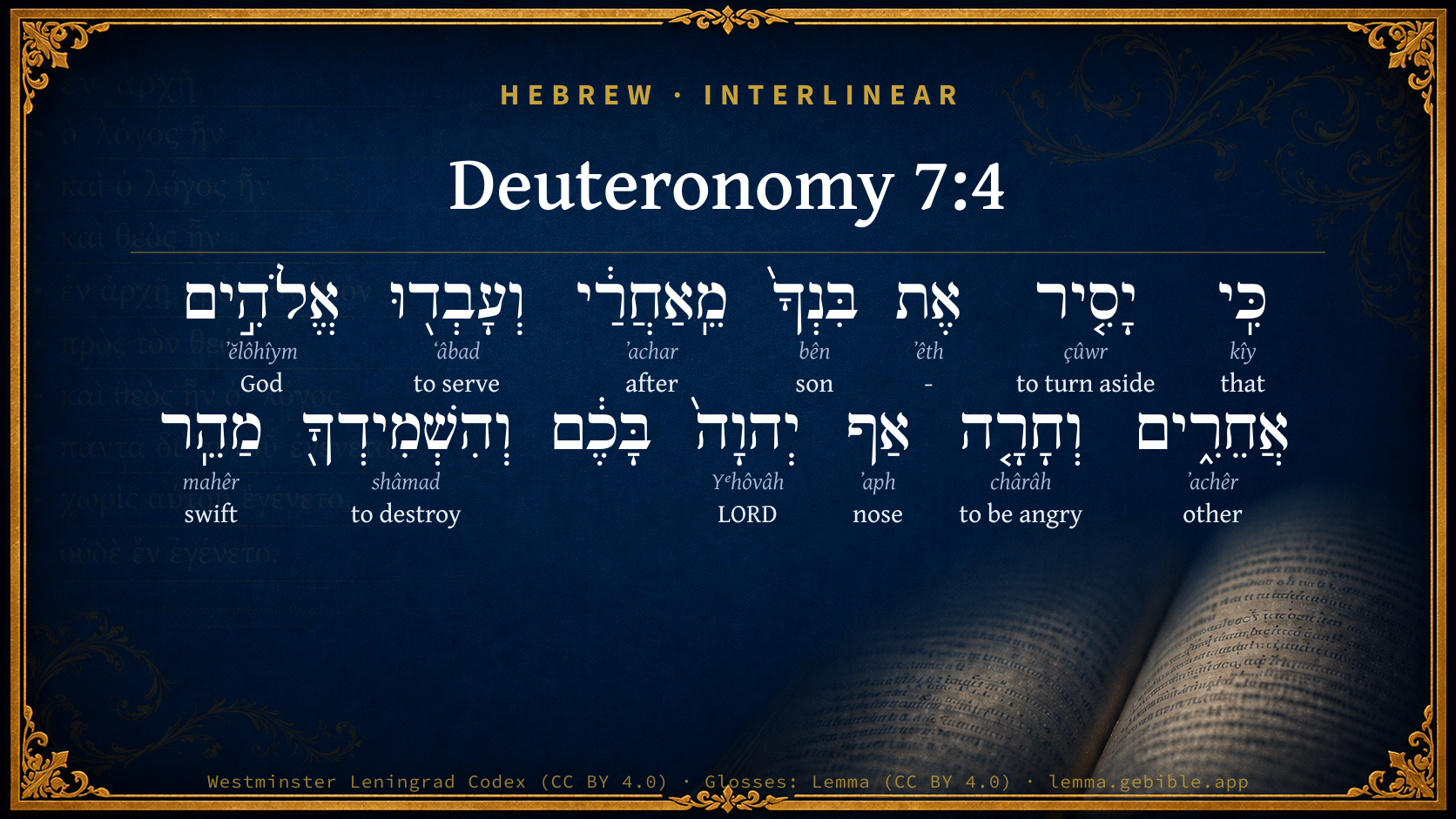
Deuteronomy 7:4

Hebrew (Westminster Leningrad Codex) Deuteronomy 7:4 appears in the Hebrew Old Testament. The text above is from the Westminster Leningrad Codex. Each word links to its Strong’s number, a concise gloss, and parsing drawn from the Open Scriptures Hebrew Bible morphology. Click any word for its full Brown-Driver-Briggs (BDB) entry.
Download image
Cite this verse

Deuteronomy 7:4 (World English Bible). Public Domain. Lemma interlinear Bible study tool, https://lemma.gebible.app/v/deuteronomy/7/4.

Show BibTeX & RIS
BibTeX
RIS
English Translation
For he will turn away your son from following me, that they may serve other gods: so will the anger of Yahweh be kindled against you, and he will destroy you quickly.
World English Bible · Public Domain
Download a study sheet

One document with this verse’s original text, its word-by-word gloss line, the meaning frame, cross-references with their text, attributed commentary, and full source and license credits — printable, and it pastes into notes with its structure intact.

This verse Autodidact and up

Study sheet (.html) Plain text (.txt)

A passage Seminary Student

Up to 50 verses in one chapter. A passage sheet keeps up to 6 commentary sources and 12 cross-references per verse, in the order this page ranks them, and says so on the sheet whenever that leaves anything out. Ask for a single verse and you get the Autodidact verse sheet above.

Everything on this page stays free to read, with no account — the sheet is a download of what is already on screen, not access to it.

Want to remove ads? Support Godless Engineer
Compare translations 3

The same verse in 3 English versions, stacked beneath the original-language interlinear above. Click any original word for its lexicon entry.

Each is an independent rendering of the whole verse — the interlinear is not word-aligned to these translations.

Highlighted words mark where these versions differ — a whole-verse word diff, not a word-by-word alignment.

  • World English Bible Public Domain
    For he will turn away your son from following me, that they may serve other gods: so will the anger of Yahweh be kindled against you, and he will destroy you quickly.
  • King James Version Public Domain
    For they will turn away thy son from following me, that they may serve other gods: so will the anger of the LORD be kindled against you, and destroy thee suddenly.
  • unfoldingWord Literal Text CC BY-SA 4.0
    For they will turn away your son from after me, and they will serve other gods. And the nose of Yahweh will burn against you, and he will destroy you quickly.

unfoldingWord Literal Text — © unfoldingWord, licensed CC BY-SA 4.0. Word-aligned USFM3 via Door43 (git.door43.org/unfoldingWord/en_ult).

Versions to compare (up to 4)

3 of 4 selected

Show all 18 translations

Every available English version of this verse, each an independent rendering of the whole verse.

  • World English Bible Public Domain
    For he will turn away your son from following me, that they may serve other gods: so will the anger of Yahweh be kindled against you, and he will destroy you quickly.
  • Berean Standard Bible Public Domain
    because they will turn your sons away from following Me to serve other gods. Then the anger of the LORD will burn against you, and He will swiftly destroy you.
  • Majority Standard Bible Public Domain
    because they will turn your sons away from following Me to serve other gods. Then the anger of the LORD will burn against you, and He will swiftly destroy you.
  • King James Version Public Domain
    For they will turn away thy son from following me, that they may serve other gods: so will the anger of the LORD be kindled against you, and destroy thee suddenly.
  • American Standard Version (1901) Public Domain
    For he will turn away thy son from following me, that they may serve other gods: so will the anger of Jehovah be kindled against you, and he will destroy thee quickly.
  • Revised Version (1885) Public Domain
    For he will turn away thy son from following me, that they may serve other gods: so will the anger of the LORD be kindled against you, and he will destroy thee quickly.
  • Geneva Bible (1599) Public Domain
    For they wil cause thy sonne to turne away from me, and to serue other gods: then will the wrath of the Lord waxe hote against you and destroy thee suddenly.
  • Douay-Rheims (1899) Public Domain
    For she will turn away thy son from following me, that he may rather serve strange gods, and the wrath of the Lord will be kindled, and will quickly destroy thee.
  • Young's Literal Translation Public Domain
    for he doth turn aside thy son from after Me, and they have served other gods, and the anger of Jehovah hath burned against you, and hath destroyed thee hastily.
  • Literal Standard Version CC BY-SA 4.0
    for he turns aside your son from after Me, and they have served other gods; and the anger of YHWH has burned against you and has destroyed you quickly.
  • Unlocked Literal Bible CC BY-SA 4.0
    For they will turn away your sons from following me, so that they may worship other gods. So the anger of Yahweh will be kindled against you, and he will destroy you quickly.
  • unfoldingWord Literal Text CC BY-SA 4.0
    For they will turn away your son from after me, and they will serve other gods. And the nose of Yahweh will burn against you, and he will destroy you quickly.
  • Darby Bible Public Domain
    for he will turn away thy son from following me, and they will serve other gods, and the anger of Jehovah will be kindled against you, and he will destroy thee quickly.
  • World Messianic Bible Public Domain
    For that would turn away your sons from following me, that they may serve other gods. So the LORD’s anger would be kindled against you, and he would destroy you quickly.
  • Webster's Bible Public Domain
    For they will turn away thy son from following me, that they may serve other gods: so will the anger of the LORD be kindled against you, and destroy thee suddenly.
  • Free Bible Version CC BY-SA 4.0
    because they will lead your children away from following me to worship other gods. Then the Lord will be angry with you, and he will quickly come and kill you.
  • Bible in Basic English Public Domain
    For through them your sons will be turned from me to the worship of other gods: and the Lord will be moved to wrath against you and send destruction on you quickly.
  • JPS Tanakh (1917) Public Domain
    For he will turn away thy son from following Me, that they may serve other gods; so will the anger of the LORD be kindled against you, and He will destroy thee quickly.

Literal Standard Version (2020), Covenant Press — licensed CC BY-SA 4.0. Text via the HelloAO Bible API (eBible.org). Unlocked Literal Bible (unfoldingWord) — licensed CC BY-SA 4.0. Text via the HelloAO Bible API (eBible.org). unfoldingWord Literal Text — © unfoldingWord, licensed CC BY-SA 4.0. Word-aligned USFM3 via Door43 (git.door43.org/unfoldingWord/en_ult). Free Bible Version, Dr. Jonathan Gallagher — licensed CC BY-SA 4.0. Text via the HelloAO Bible API (eBible.org).

Word by word

More ways to search: Search by grammar → Find every occurrence → Compare this word →

Practice this passage: Drill this verse → Learn its vocabulary →

מַהֵֽר
mahêr
H4118
“swift”
Verb, Piel, Infinitive Absolute
Part of Speech
Verb
Stem
Piel
Form
Infinitive Absolute
Full BDB Definition

Origin: from H4116

TWOT: 1152a , 1152b

hurrying, speedy, swift, hastening (adjective) - quickly, speedily (adverb)
  1. כִּֽי kîy H3588 “that” Conjunction
  2. יָסִ֤יר çûwr H5493 “to turn aside” Verb, Hiphil, Imperfect, 3rd Person, Masculine, Singular
  3. אֶת ʼêth H853 “-” Particle, Direct Object
  4. בִּנְךָ֙ bên H1121 “son · your” Noun, Common, Masculine, Singular, Construct + Suffix, Personal, 2nd Person, Masculine, Singular
  5. מֵֽאַחֲרַ֔י ʼachar H310 “from · after · me” Preposition + Preposition + Suffix, Personal, 1st Person, Common, Singular
  6. וְעָבְד֖וּ ʻâbad H5647 “and · to serve” Conjunction + Verb, Qal, Sequential Perfect, 3rd Person, Common, Plural
  7. אֱלֹהִ֣ים ʼĕlôhîym H430 “God(s)” Noun, Common, Masculine, Plural, Absolute
  8. אֲחֵרִ֑ים ʼachêr H312 “other” Adjective, Adjective, Masculine, Plural, Absolute
  9. וְחָרָ֤ה chârâh H2734 “and · to be angry” Conjunction + Verb, Qal, Sequential Perfect, 3rd Person, Masculine, Singular
  10. אַף ʼaph H639 “nose” Particle, Accusative
  11. יְהוָה֙ Yᵉhôvâh H3068 “LORD” Noun, Proper
  12. וְהִשְׁמִידְךָ֖ shâmad H8045 “and · to destroy · you” Conjunction + Verb, Hiphil, Sequential Perfect, 3rd Person, Masculine, Singular + Suffix, Personal, 2nd Person, Masculine, Singular

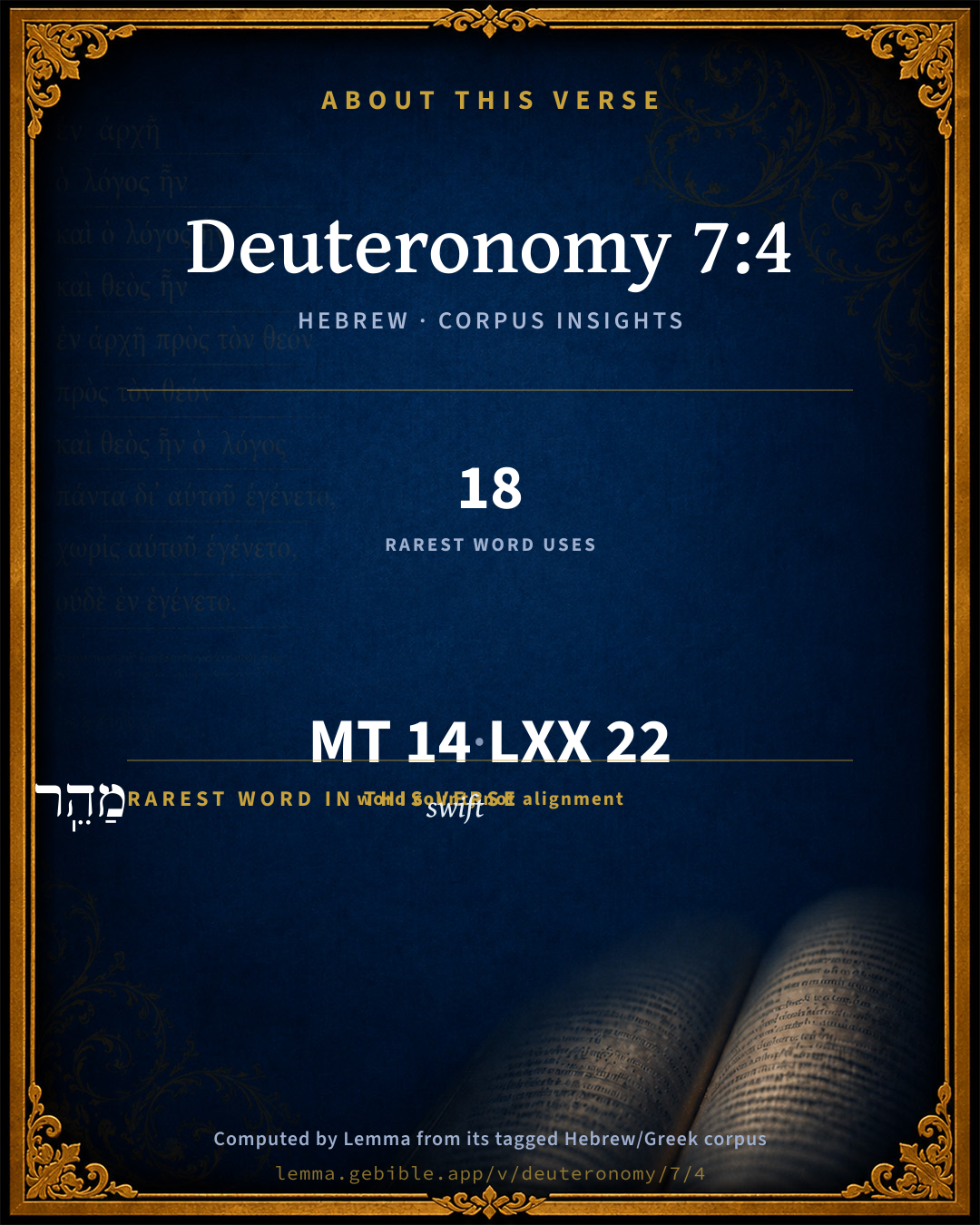
About this verse

These counts appear in no published source. They are computed here, from the morphology-tagged text and Lemma’s own curated glosses. What Lemma adds →

14
words
13
distinct lemmas
Pentateuch
section

Notable vocabulary

The rarest word here is מַהֵֽר swift H4118 — appearing just 18 times in the whole Hebrew Bible.

Shared distinctive vocabulary

מַהֵֽר swift H4118 occurs in 17 verses of the Hebrew Bible. Also found in:

Grammatical profile

  • 5 verbs
  • 3 nouns
  • 1 adjective
  • 2 prepositions
  • 1 conjunction
  • 2 particles

Verb forms

  • יָסִ֤יר Hiphil · Imperfect
  • וְעָבְד֖וּ Qal · Sequential Perfect
  • וְחָרָ֤ה Qal · Sequential Perfect
  • וְהִשְׁמִידְךָ֖ Hiphil · Sequential Perfect
  • מַהֵֽר Piel · Infinitive Absolute

Hebrew & Septuagint length

In English translation the verse runs 32 words from the Hebrew and 30 from the Septuagint (LXX English) — closely comparable.

A rough comparison of the two English renderings, which tokenize alike — not a word-level alignment.

Word counts can differ between the Hebrew and the Greek without any difference in meaning — e.g. the Hebrew direct-object marker אֵת has no separate Greek word, and Greek often adds the article ὁ.

In the original languages it is 14 Hebrew tokens and 22 Greek tokens — but the two are counted differently (Hebrew bundles its prefixes and suffixes into one token; the Greek is in lemma form), so that isn’t a like-for-like length.

Cross-references

8

Topical passages linked to Deuteronomy 7:4 in the Treasury of Scripture Knowledge — connected by theme and wording, ordered by reader-vote popularity; previews shown in the World English Bible.

  • Deuteronomy 6:15 for Yahweh your God in the midst of you is a jealous God; lest the anger of Yahweh your God be kindled against you, and he destroy you from off the face of the earth.
  • Exodus 20:5 you shall not bow yourself down to them, nor serve them, for I, Yahweh your God, am a jealous God, visiting the iniquity of the fathers on the children, on the third and on the fourth generation of those who hate me,
  • Deuteronomy 4:26 I call heaven and earth to witness against you this day, that you shall soon utterly perish from off the land whereunto you go over the Jordan to possess it; you shall not prolong your days on it, but shall utterly be destroyed.
  • Deuteronomy 32:16–17 They moved him to jealousy with strange [gods]; With abominations provoked they him to anger.
  • Judges 2:11 The children of Israel did that which was evil in the sight of Yahweh, and served the Baals;
  • Judges 2:20 The anger of Yahweh was kindled against Israel; and he said, Because this nation have transgressed my covenant which I commanded their fathers, and have not listened to my voice;
  • Judges 3:7–8 The children of Israel did that which was evil in the sight of Yahweh, and forgot Yahweh their God, and served the Baals and the Asheroth.
  • Judges 10:6–7 The children of Israel again did that which was evil in the sight of Yahweh, and served the Baals, and the Ashtaroth, and the gods of Syria, and the gods of Sidon, and the gods of Moab, and the gods of the children of Ammon, and the gods of the Philistines; and they forsook Yahweh, and didn't serve him.

Cross-references courtesy of OpenBible.info (CC BY 4.0).

Hebrew and Greek witnesses Masoretic Hebrew ↔ Greek Septuagint

The same verse in the two great witnesses to the Old Testament, shown verse-for-verse.

These are two independent witnesses, not word-aligned to each other, and the Septuagint is shown in lemma (dictionary) form.

Hebrew Deuteronomy 7:4 Masoretic · Westminster Leningrad Codex

כִּֽי יָסִ֤יר אֶת בִּנְךָ֙ מֵֽאַחֲרַ֔י וְעָבְד֖וּ אֱלֹהִ֣ים אֲחֵרִ֑ים וְחָרָ֤ה אַף יְהוָה֙ בָּכֶ֔ם וְהִשְׁמִידְךָ֖ מַהֵֽר

For he will turn away your son from following me, that they may serve other gods: so will the anger of Yahweh be kindled against you, and he will destroy you quickly.

World English Bible · Public Domain

Greek LXX Deuteronomy 7:4 Septuagint · lemma form

ἀποἵστημι γάρ ὁ υἱός σύ ἀπό ἐγώ καί λατρεύω θεός ἕτερος καί ὀργίζω θυμός κύριος εἰς σύ καί ἐκὀλεθρεύω σύ ὁ τάχος

For he will draw away your son from me, and he will serve other gods; and the Lord will be very angry with you, and will soon utterly destroy you.

LXX2012 (modern English Septuagint) · Public Domain

On this verse, The Cambridge Bible for Schools and Colleges discusses the Septuagint’s reading. Read the note in Commentary ↓

Hebrew: Westminster Leningrad Codex (CC BY 4.0). Greek: Septuagint (public domain); English from LXX2012 (modern English Septuagint) (Public Domain). How the Septuagint differs from the Hebrew →

Targum (Aramaic paraphrase)

2

The Targum is the ancient Jewish Aramaic paraphrase of the Hebrew Scriptures — an interpretive translation, not the Hebrew text itself. Onkelos (literal) and Pseudo-Jonathan (expansive) render the Torah, and Jonathan the Prophets. Coverage is partial: where no permissively-licensed English translation exists for a verse, only the Aramaic is shown. This is verse-level text, not a word-by-word alignment to the Hebrew.

  1. Targum Onkelos Torah (Genesis–Deuteronomy)
    אֲרֵי יַטְעֲיַן יָת בְּרָךְ מִבָּתַר פָּלְחָנִי וְיִפְלְחוּן לְטַעֲוַת עַמְמַיָא וְיִתְקֵף רָגְזָא דַיְיָ בְּכוֹן וִישֵׁצָךְ בִּפְרִיעַ

    (no public-domain English translation for this verse)

    Targum Onkelos — Aramaic: “Onkelos Genesis” (public domain); “Onkelos Exodus” (public domain); “Onkelos Leviticus” (public domain); “Onkelos Numbers” (public domain); “Onkelos Deuteronomy” (public domain). English: “Sefaria Community Translation” (CC0 1.0 (public-domain dedication)); “J.W. Etheridge. The Targums of Onkelos and Jonathan Ben Uzziel on the Pentateuch. London: Longmans, Green, 1862” (public domain). Text via Sefaria.

  2. Targum Pseudo-Jonathan Torah (Genesis–Deuteronomy)
    אֲרוּם יַטְעֲיָין בְּנָתֵיהוֹן יַת בְּנֵיכוֹן מִן בָּתַר פּוּלְחָנִי וְיִפְלְחוּן לְטַעֲוַת עַמְמַיָא וְיִתְקוֹף רוּגְזָא דַיְיָ בְּכוֹן וִישֵׁצִינְכוֹן בְּסַרְהוּבַיָא

    For their daughters will lead your sons away from My worship to serve the idols of the Gentiles; so will the anger of the Lord be kindled against you, and He will destroy you suddenly.

    Targum Pseudo-Jonathan — Aramaic: “Targum Jonathan on Genesis” (public domain); “Targum Jonathan on Exodus” (public domain); “Targum Jonathan on Leviticus” (public domain); “Targum Jonathan on Numbers” (public domain); “Targum Jonathan on Deuteronomy” (public domain). English: “The Targum of Jonathan ben Uzziel, trans. J. W. Etheridge, London, 1862” (public domain). Text via Sefaria.

Commentary

Notes on Deuteronomy 7:4 from classic Christian and Jewish commentators (each source and its license shown beneath its notes). The classic Christian expositions comment on the surrounding passage and are grouped to its opening verse, so a note may address several verses; the Jewish commentaries on the Tanakh (Rashi and others) are per-verse, so they appear only where the commentator wrote on this verse.

Lemma curates 59 commentaries, every one of them public domain or Creative Commons licensed, each selected and text-cleaned for this edition rather than reprinted as found. About our sources →

Trapp's Complete Commentary

John Trapp

Deu 7:4 For they will turn away thy son from following me, that they may serve other gods: so will the anger of the LORD be kindled against you, and destroy thee suddenly.

Ver. 4. For they will turn away thy son.] As the foreign women did Solomon. {1Ki 11:2-4} What is the reason the Pope will not dispense in Spain or Italy, if a Papist marry a Protestant, yet here they will, but in hope to draw more to them? The tyrant Mezentius tied the living bodies of his captives to the dead; but the dead did not revive by the living, the living rather putrified by the dead. {a}

{a} Corpora corporibus iungebat mortua vivis. - Virgil.

John Trapp, A Commentary or Exposition upon All the Books of the Old and New Testament (1647–1656) — public domain. Text from a community e-Sword module.

Joseph Benson's Commentary

Deu 7:4. To serve other gods — That is, there is manifest danger of apostacy and idolatry from such matches. Which reason doth both limit the prohibition to such of these as were unconverted, (otherwise Salmon married Rachab, Mat 1:5,) and also enlarges it to other idolatrous nations, as appears from 1Ki 11:2; Ezr 9:2; Neh 13:23.

Joseph Benson's Commentary on the Old and New Testaments (1811–1818) — public domain. Text from a community e-Sword module.

Geneva Bible (1599)

Geneva Bible translators

Or, any of them.

Geneva Bible (1599) marginal notes — public domain. Text via Bolls.life.

The Cambridge Bible for Schools and Colleges

gen. ed. J. J. S. Perowne

4. turn away thy son from following me] Expressed differently in Exo_34:16 b but to the same effect, that the influence of the foreign wife on her Israelite husband will be to lead him into idolatry. From after me (lit.): as the speaker is Moses, the me has been taken to be due to abbreviation of the divine name, and Jehovah is read; but in that case we should have had Jehovah thy God. Therefore retain me and take this as an instance, occurring again in Deu_17:3, Deu_28:20, Deu_29:5 (4), and frequent in the discourses of the prophets, of the merging of the speaker’s personality in that of the Deity, for whom he speaks.

against you] Transition for the moment to the Pl. (confirmed by Sam. and LXX). It is impossible to say whether this is original or an editorial addition.

quickly] Deu_4:26.

The Cambridge Bible for Schools and Colleges (gen. ed. J. J. S. Perowne; Cambridge University Press, 1878–1918) — public domain. Text from a community e-Sword module.

John Gill's Exposition

For they will turn away thy son from following me,.... From the pure worship of God, his word, statutes, and ordinances:

that they may serve other gods; worship their idols; that is, the daughters of Heathens, married to the sons of Israelites, would entice them from the worship of the true God to idolatry; so the Targum of Jonathan; as Solomon's wives drew him aside: or "he will turn away thy son" (d); meaning, as Jarchi observes, that the son of an Heathen, that marries the daughter of an Israelite, will turn away the son born of her to idolatry, called here the grandfather's son; though Aben Ezra says this respects the son mentioned in the preceding verse, that is, the son married to an Heathen woman, and not to a son born in such marriage:

so will the anger of the Lord be kindled against you, and destroy thee suddenly; by some immediate judgment striking dead at once; there being nothing more provoking to God than idolatry, that being directly contrary to his being, nature, perfections, honour, and glory, of which he is jealous.

(d) "faciet recedere": Pagninus, Montanus; so Junius and Tremellius, Piscator, Tigurine version, Vatablus, V. L. all in the singular number.

John Gill's Exposition of the Whole Bible (1746–1763) — public domain (CC PDM 1.0). Text via the HelloAO Bible API.

Haydock's Catholic Bible Commentary

Gods. So great is the natural tendency to evil, that though a woman be generally inclined to follow the inclinations and religion of her husband, yet, when his method of living is more repugnant to flesh and blood, she is but to apt to influence him to glide smoothly with her down the hill of pleasure, into the very abyss of dissolution. The prediction, she will turn, &c., is so often verified, that those who marry with unbelievers ought to tremble. (Haydock)

George Leo Haydock (1774–1849), Haydock's Catholic Family Bible and Commentary, 1859 edition — public domain. Excludes Psalms (Douay-Rheims chapter numbering differs from Protestant) and Deuterocanonical books (Catholic canon only).

Matthew Poole's English Annotations

i.e. There is manifest danger of apostacy and idolatry from such matches; which reason doth both limit the law to such of these as were unconverted, otherwise Salmon married Rahab, Mat 1:5, and enlarge it to other idolatrous nations, as appears from 1Ki 11:2; Ezr 9:2; Neh 13:23.

Matthew Poole's English Annotations on the Holy Bible (1683–1685) — public domain. Text from a community e-Sword/MySword module.

The Pulpit Commentary

From following me; literally, from after me, i.e. from being my servant and worshipper. Suddenly; rather, speedily (rhem, infin., of rhm; to be quick, to hasten, used as an adverb).

The Pulpit Commentary (1880–1919), ed. H.D.M. Spence-Jones & Joseph S. Exell — public domain. Text from a community e-Sword module.

John Wesley's Explanatory Notes

To serve other Gods - That is, there is manifest danger of apostacy and idolatry from such matches. Which reason doth both limit the law to such of these as are unconverted (otherwise Salmon married Rahab, Matt. i, 5) and enlarge it to other idolatrous nations, as appears from 1 Kings xi, 2 Ezra ix, 2 Neh. xiii, 23.

John Wesley, Explanatory Notes Upon the Whole Bible (1754–1765) — public domain. Text via the GEBible commentary corpus.

unfoldingWord translationNotes

Door43 World Missions Community

General Information:

Moses continues to tell the people of Israel Yahweh's words as if the Israelites are one person. (See: Forms of You)

For they will

"If you allow your children to marry the people from the other nations, the people from the other nations will"

So the anger of Yahweh will be kindled against you

Moses compares Yahweh's anger to someone starting a fire. This emphasizes Yahweh's power to destroy what makes him angry. This can be stated in active form. AT: "Yahweh will kindle his anger against you" or "Then Yahweh will become very angry with you" (See: Metaphor and Active or Passive)

against you

The word "you" refers to all the Israelites and so is plural. (See: Forms of You)

you will deal ... You will break ... dash ... cut ... burn

Moses is speaking to all the Israelites here, so these words are all plural. (See: Forms of You)

translationWords

turn

son

worship

false god

anger

Yahweh

altar

column

Asherah

image

false god

unfoldingWord translationNotes — © Distant Shores Media and the Door43 World Missions Community, licensed CC BY-SA 4.0. Source: git.door43.org/Door43/en_tn.

Rashi

Rabbi Shlomo Yitzchaki (Rashi)

כי יסיר את בנך מאחרי FOR HE WILL TURN AWAY THY SON FROM FOLLOWING ME — i.e., the son of the heathen when he marries thy daughter, will turn away thy son (grandson) whom thy daughter will bear unto him from following Me. This teaches us, that thy daughter's son who is born of a heathen is termed thy son, but thy son’s son, who is born of a heathen woman, is not termed thy son, but her son, for, you see, in regard to the statement: “his daughter thou shalt not take [to thy son]" it does not add “For she will turn away thy son (grandson) from following Me" (Yevamot 23a).

Rashi on the Tanakh — English translations: “The Judaica Press complete Tanach with Rashi, translated by A. J. Rosenberg” (CC BY 4.0); “Pentateuch with Rashi's commentary by M. Rosenbaum and A.M. Silbermann, 1929-1934” (public domain); “The Metsudah Tanach series, Lakewood, N.J” (CC BY 4.0); and “The Book of Joshua, Metsudah Publications, 1997” (CC BY 4.0). Text via Sefaria.

Lesson kit

Teaching starters — assembled from the data on this page, not authored interpretation. Every prompt links to the verse data it draws on. Edit before teaching.

Deuteronomy, in the Pentateuch, opens this verse with 14 words (13 distinct Hebrew lemmas). Its most distinctive word is mahêr (“swift”). A historical commentator’s framing appears above. Read the whole chapter for the surrounding context.

Discussion questions

  1. The word mahêr carries the sense “swift.” How does it shape the verse?
  2. Exodus 32:8 shares the word «swift» with this verse. How do the two illuminate each other?
  3. The translations on this page render this verse differently — a whole-verse word diff, not a word-by-word alignment. What might account for the different wordings?
  4. The verb «יָסִ֤יר» is Hiphil Imperfect. How does its form color the action?
  5. Reading how Trapp's Complete Commentary and Joseph Benson's Commentary read this verse, where do the two commentators agree and where do they part?

Things to notice

Reading settings

Reading text

Shown beneath each verse's original-language words.

Old Testament
Old Testament edition

Read the OT as the Masoretic Hebrew (MT) or the Greek Septuagint (LXX).

English shown for the Greek Septuagint (in the Hebrew ↔ Greek comparison).

Comparing translations? Open the Compare panel on any verse page to stack up to four side by side.