
2 Kings 4:10

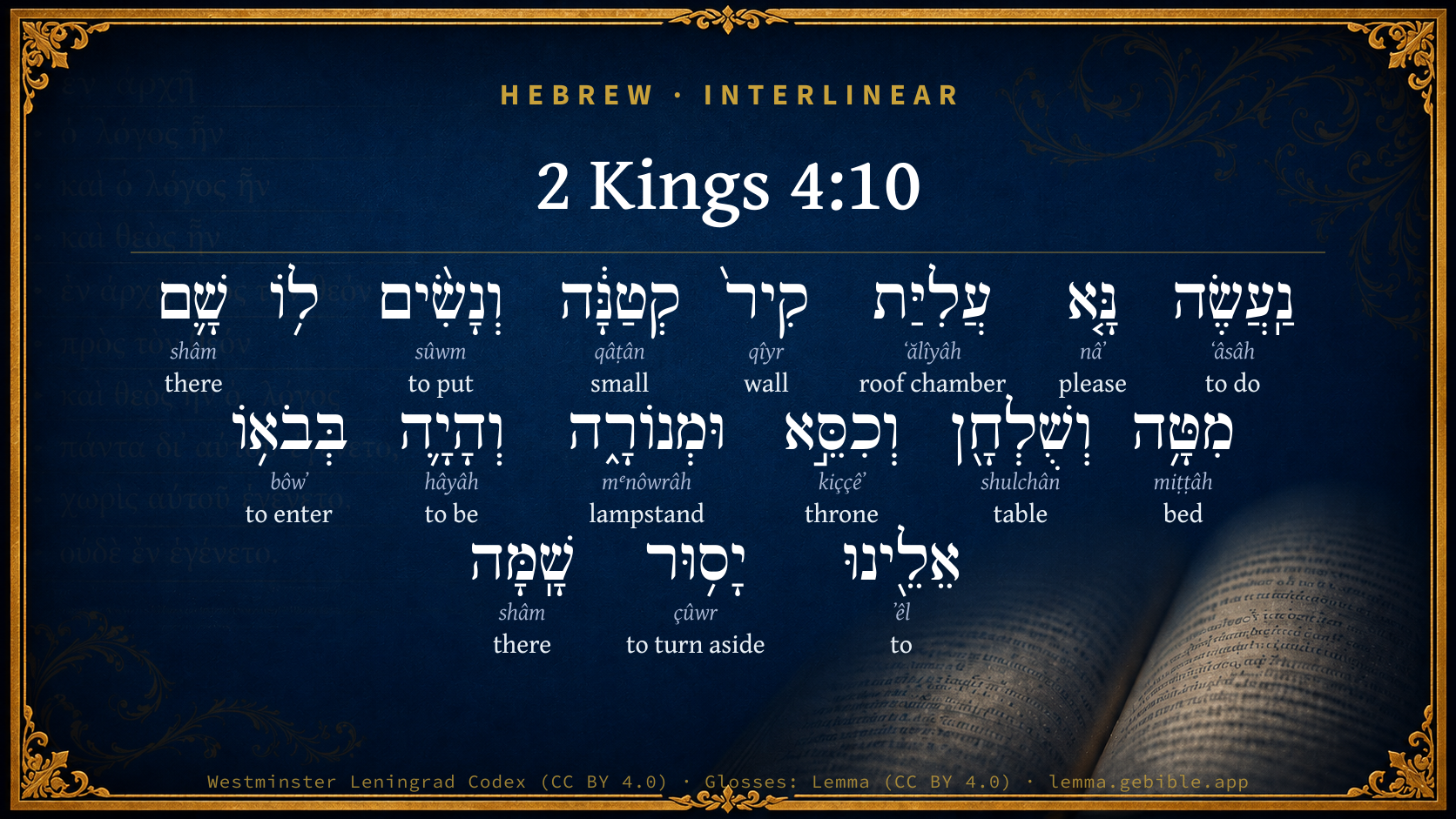
Hebrew (Westminster Leningrad Codex) 2 Kings 4:10 appears in the Hebrew Old Testament. The text above is from the Westminster Leningrad Codex. Each word links to its Strong’s number, a concise gloss, and parsing drawn from the Open Scriptures Hebrew Bible morphology. Click any word for its full Brown-Driver-Briggs (BDB) entry.
Download image
Cite this verse

2 Kings 4:10 (World English Bible). Public Domain. Lemma interlinear Bible study tool, https://lemma.gebible.app/v/2-kings/4/10.

Show BibTeX & RIS
BibTeX
RIS
English Translation
Let us make, Please, a little chamber on the wall; and let us set for him there a bed, and a table, and a seat, and a lamp stand: and it shall be, when he comes to us, that he shall turn in there.
World English Bible · Public Domain
Download a study sheet

One document with this verse’s original text, its word-by-word gloss line, the meaning frame, cross-references with their text, attributed commentary, and full source and license credits — printable, and it pastes into notes with its structure intact.

This verse Autodidact and up

Study sheet (.html) Plain text (.txt)

A passage Seminary Student

Up to 50 verses in one chapter. A passage sheet keeps up to 6 commentary sources and 12 cross-references per verse, in the order this page ranks them, and says so on the sheet whenever that leaves anything out. Ask for a single verse and you get the Autodidact verse sheet above.

Everything on this page stays free to read, with no account — the sheet is a download of what is already on screen, not access to it.

Want to remove ads? Support Godless Engineer
Compare translations 3

The same verse in 3 English versions, stacked beneath the original-language interlinear above. Click any original word for its lexicon entry.

Each is an independent rendering of the whole verse — the interlinear is not word-aligned to these translations.

Highlighted words mark where these versions differ — a whole-verse word diff, not a word-by-word alignment.

  • World English Bible Public Domain
    Let us make, Please, a little chamber on the wall; and let us set for him there a bed, and a table, and a seat, and a lamp stand: and it shall be, when he comes to us, that he shall turn in there.
  • King James Version Public Domain
    Let us make a little chamber, I pray thee, on the wall; and let us set for him there a bed, and a table, and a stool, and a candlestick: and it shall be, when he cometh to us, that he shall turn in thither.
  • unfoldingWord Literal Text CC BY-SA 4.0
    Please, let us make a small upper room of a wall, and let us put for him there a bed and a table and a chair and a lampstand. And it will be, when he comes to us, he may turn aside to there.”

unfoldingWord Literal Text — © unfoldingWord, licensed CC BY-SA 4.0. Word-aligned USFM3 via Door43 (git.door43.org/unfoldingWord/en_ult).

Versions to compare (up to 4)

3 of 4 selected

Show all 18 translations

Every available English version of this verse, each an independent rendering of the whole verse.

  • World English Bible Public Domain
    Let us make, Please, a little chamber on the wall; and let us set for him there a bed, and a table, and a seat, and a lamp stand: and it shall be, when he comes to us, that he shall turn in there.
  • Berean Standard Bible Public Domain
    Please let us make a small room upstairs and put in it a bed, a table, a chair, and a lamp for him. Then when he comes to us, he can stay there.”
  • Majority Standard Bible Public Domain
    Please let us make a small room upstairs and put in it a bed, a table, a chair, and a lamp for him. Then when he comes to us, he can stay there.”
  • King James Version Public Domain
    Let us make a little chamber, I pray thee, on the wall; and let us set for him there a bed, and a table, and a stool, and a candlestick: and it shall be, when he cometh to us, that he shall turn in thither.
  • American Standard Version (1901) Public Domain
    Let us make, I pray thee, a little chamber on the wall; and let us set for him there a bed, and a table, and a seat, and a candlestick: and it shall be, when he cometh to us, that he shall turn in thither.
  • Revised Version (1885) Public Domain
    Let us make, I pray thee, a little chamber on the wall; and let us set for him there a bed, and a table, and a stool, and a candlestick: and it shall be, when he cometh to us, that he shall turn in thither.
  • Geneva Bible (1599) Public Domain
    Let vs make him a litle chamber, I pray thee, with walles, and let vs set him there a bed, and a table, and a stoole, and a candlesticke, that hee may turne in thither when hee commeth to vs.
  • Douay-Rheims (1899) Public Domain
    Let us therefore make him a little chamber, and put a little bed in it for him, and a table, and a stool, and a candlestick, that when he cometh to us, he may abide there.
  • Young's Literal Translation Public Domain
    let us make, I pray thee, a little upper chamber of the wall, and we set for him there a bed, and a table, and a high seat, and a candlestick; and it hath been, in his coming in unto us, he doth turn aside thither.'
  • Literal Standard Version CC BY-SA 4.0
    please let us make a little upper chamber of the wall, and we set for him there a bed, and a table, and a high seat, and a lampstand; and it has been, in his coming to us, he turns aside there.”
  • Unlocked Literal Bible CC BY-SA 4.0
    Let us make a little room on the roof for Elisha, and let us put in it a bed, a table, a seat, and a lamp. Then when he comes to us, he will stay there.”
  • unfoldingWord Literal Text CC BY-SA 4.0
    Please, let us make a small upper room of a wall, and let us put for him there a bed and a table and a chair and a lampstand. And it will be, when he comes to us, he may turn aside to there.”
  • Darby Bible Public Domain
    Let us make, I pray thee, a small upper chamber with walls, and let us set for him there a bed, and a table, and a seat, and a lampstand; and it shall be when he cometh to us, he shall turn in thither.
  • World Messianic Bible Public Domain
    Please, let’s make a little room on the roof. Let’s set a bed, a table, a chair, and a lamp stand for him there. When he comes to us, he can stay there.”
  • Webster's Bible Public Domain
    Let us make a little chamber, I pray thee, on the wall; and let us set for him there a bed, and a table, and a stool, and a candlestick: and it shall be, when he cometh to us, that he shall turn in thither.
  • Free Bible Version CC BY-SA 4.0
    Please let's make a small room on the roof,. We can put a bed, a table, a chair, and a lamp in it for him. Then he can stay there whenever he visits us.”
  • Bible in Basic English Public Domain
    So let us make a little room on the wall; and put a bed there for him, and a table and a seat and a light; so that when he comes to us, he will be able to go in there.
  • JPS Tanakh (1917) Public Domain
    Let us make, I pray thee, a little chamber on the roof; and let us set for him there a bed, and a table, and a stool, and a candlestick; and it shall be, when he cometh to us, that he shall turn in thither.'

Literal Standard Version (2020), Covenant Press — licensed CC BY-SA 4.0. Text via the HelloAO Bible API (eBible.org). Unlocked Literal Bible (unfoldingWord) — licensed CC BY-SA 4.0. Text via the HelloAO Bible API (eBible.org). unfoldingWord Literal Text — © unfoldingWord, licensed CC BY-SA 4.0. Word-aligned USFM3 via Door43 (git.door43.org/unfoldingWord/en_ult). Free Bible Version, Dr. Jonathan Gallagher — licensed CC BY-SA 4.0. Text via the HelloAO Bible API (eBible.org).

Word by word

More ways to search: Search by grammar → Find every occurrence → Compare this word →

Practice this passage: Drill this verse → Learn its vocabulary →

עֲלִיַּת
ʻălîyâh
H5944
“roof chamber of”
Noun, Common, Feminine, Singular, Construct
Part of Speech
Noun
Type
Common
Gender
Feminine
Number
Singular
State
Construct
Full BDB Definition

Origin: from H5927

TWOT: 1624f

roof-room, roof chamber
  1. נַֽעֲשֶׂה ʻâsâh H6213 “to do” Verb, Qal, Cohortative, 1st Person, Common, Plural
  2. נָּ֤א nâʼ H4994 “please” Particle, Interjection
  3. קִיר֙ qîyr H7023 “wall” Noun, Common, Masculine, Singular, Absolute
  4. קְטַנָּ֔ה qâṭân H6996 “small” Adjective, Adjective, Feminine, Singular, Absolute
  5. וְנָשִׂ֨ים sûwm H7760 “and · to put” Conjunction + Verb, Qal, Imperfect, 1st Person, Common, Plural
  6. שָׁ֛ם shâm H8033 “there” Adverb
  7. מִטָּ֥ה miṭṭâh H4296 “bed” Noun, Common, Feminine, Singular, Absolute
  8. וְשֻׁלְחָ֖ן shulchân H7979 “and · table” Conjunction + Noun, Common, Masculine, Singular, Absolute
  9. וְכִסֵּ֣א kiççêʼ H3678 “and · throne” Conjunction + Noun, Common, Masculine, Singular, Absolute
  10. וּמְנוֹרָ֑ה mᵉnôwrâh H4501 “and · lampstand” Conjunction + Noun, Common, Feminine, Singular, Absolute
  11. וְהָיָ֛ה hâyâh H1961 “and · to be” Conjunction + Verb, Qal, Perfect, 3rd Person, Masculine, Singular
  12. בְּבֹא֥וֹ bôwʼ H935 “in/at · to enter · him” Preposition + Verb, Qal, Infinitive Construct + Suffix, Personal, 3rd Person, Masculine, Singular
  13. אֵלֵ֖ינוּ ʼêl H413 “to · us” Preposition + Suffix, Personal, 1st Person, Common, Plural
  14. יָס֥וּר çûwr H5493 “to turn aside” Verb, Qal, Imperfect, 3rd Person, Masculine, Singular
  15. שָֽׁמָּה shâm H8033 “there · toward” Adverb + Suffix, Demonstrative

About this verse

These counts appear in no published source. They are computed here, from the morphology-tagged text and Lemma’s own curated glosses. What Lemma adds →

17
words
15
distinct lemmas
Historical
section

Notable vocabulary

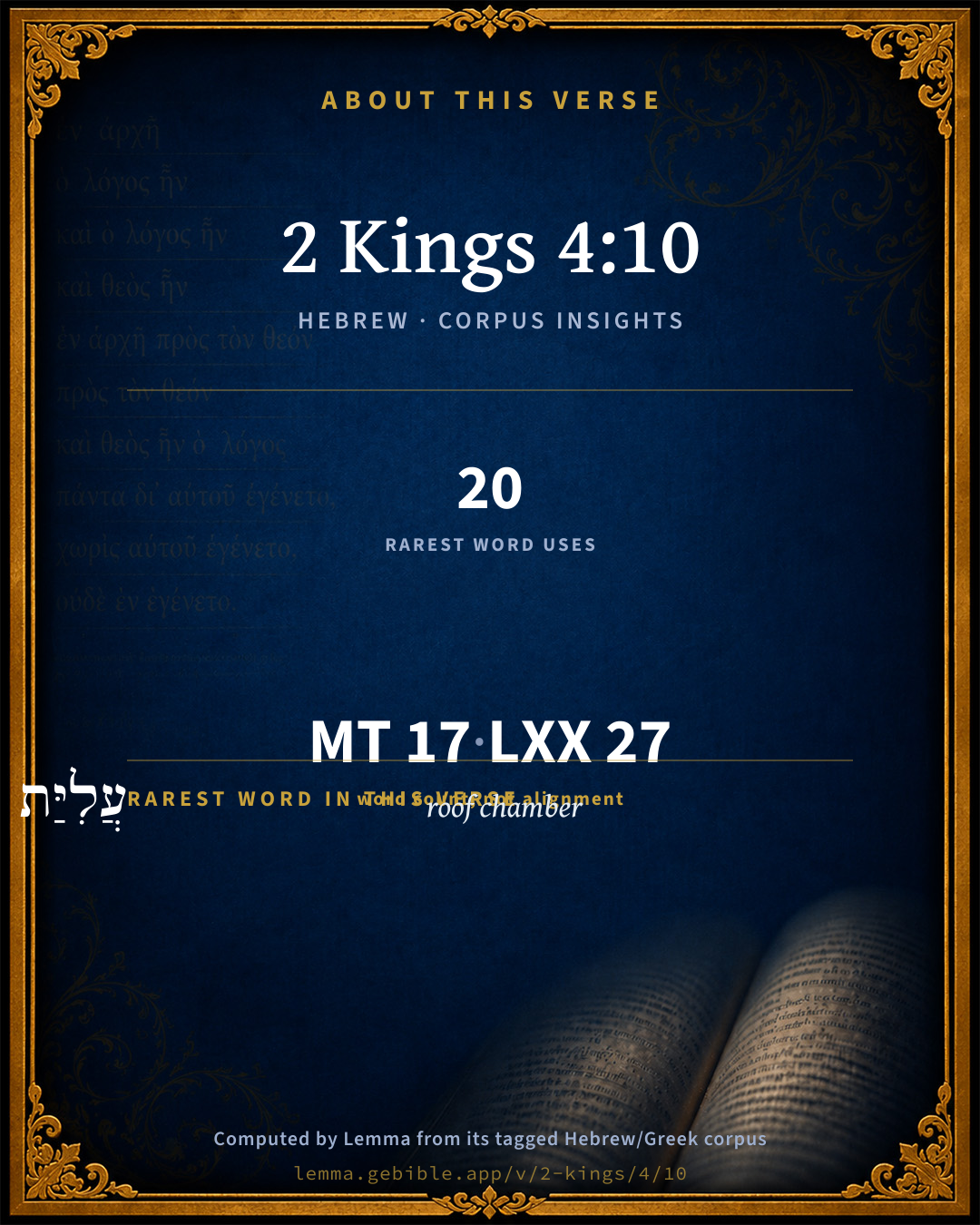
The rarest word here is עֲלִיַּת roof chamber H5944 — appearing just 20 times in the whole Hebrew Bible.

Shared distinctive vocabulary

עֲלִיַּת roof chamber H5944 occurs in 20 verses of the Hebrew Bible. Also found in:

Grammatical profile

  • 5 verbs
  • 6 nouns
  • 1 adjective
  • 2 prepositions
  • 2 adverbs
  • 1 particle

Verb forms

  • נַֽעֲשֶׂה Qal · Cohortative
  • וְנָשִׂ֨ים Qal · Imperfect
  • וְהָיָ֛ה Qal · Perfect
  • בְּבֹא֥וֹ Qal · Infinitive Construct
  • יָס֥וּר Qal · Imperfect

Repetition

A word recurs within this verse — often emphatic in Hebrew:

  • שָׁ֛ם there H8033 ×2

Hebrew & Septuagint length

In English translation the verse runs 44 words from the Hebrew and 48 from the Septuagint (LXX English) — closely comparable.

A rough comparison of the two English renderings, which tokenize alike — not a word-level alignment.

Word counts can differ between the Hebrew and the Greek without any difference in meaning — e.g. the Hebrew direct-object marker אֵת has no separate Greek word, and Greek often adds the article ὁ.

In the original languages it is 17 Hebrew tokens and 27 Greek tokens — but the two are counted differently (Hebrew bundles its prefixes and suffixes into one token; the Greek is in lemma form), so that isn’t a like-for-like length.

Cross-references

10

Topical passages linked to 2 Kings 4:10 in the Treasury of Scripture Knowledge — connected by theme and wording, ordered by reader-vote popularity; previews shown in the World English Bible.

  • Romans 12:13 contributing to the needs of the saints; given to hospitality.
  • Matthew 10:41–42 He who receives a prophet in the name of a prophet will receive a prophet's reward: and he who receives a righteous man in the name of a righteous man will receive a righteous man's reward.
  • Matthew 25:40 "The King will answer them, 'Most assuredly I tell you, inasmuch as you did it to one of the least of these my brothers, you did it to me.'
  • Hebrews 10:24 Let us consider how to provoke one another to love and good works,
  • 1 Peter 4:9–10 Be hospitable one to another without grumbling.
  • Isaiah 32:8 But the noble devises noble things; and in noble things shall he continue.
  • Mark 9:41 For whoever will give you a cup of water to drink in my name, because you are Christ's, most assuredly I tell you, he will in no way lose his reward.
  • Luke 8:3 and Joanna, the wife of Chuzas, Herod's steward; Susanna; and many others; who ministered to them from their possessions.
  • Hebrews 13:2 Don't forget to show hospitality to strangers, for in doing so, some have entertained angels without knowing it.
  • 1 Kings 17:19 He said to her, Give me your son. He took him out of her bosom, and carried him up into the chamber, where he abode, and laid him on his own bed.

Cross-references courtesy of OpenBible.info (CC BY 4.0).

Hebrew and Greek witnesses Masoretic Hebrew ↔ Greek Septuagint

The same verse in the two great witnesses to the Old Testament, shown verse-for-verse.

These are two independent witnesses, not word-aligned to each other, and the Septuagint is shown in lemma (dictionary) form.

Hebrew 2 Kings 4:10 Masoretic · Westminster Leningrad Codex

נַֽעֲשֶׂה נָּ֤א עֲלִיַּת קִיר֙ קְטַנָּ֔ה וְנָשִׂ֨ים ל֥וֹ שָׁ֛ם מִטָּ֥ה וְשֻׁלְחָ֖ן וְכִסֵּ֣א וּמְנוֹרָ֑ה וְהָיָ֛ה בְּבֹא֥וֹ אֵלֵ֖ינוּ יָס֥וּר שָֽׁמָּה

Let us make, Please, a little chamber on the wall; and let us set for him there a bed, and a table, and a seat, and a lamp stand: and it shall be, when he comes to us, that he shall turn in there.

World English Bible · Public Domain

Greek LXX 2 Kings 4:10 Septuagint · lemma form

ποιέω δή αὐτός ὑπερῷον τόπος μικρός καί τίθημι αὐτός ἐκεῖ κλίνη καί τράπεζα καί δίφρος καί λυχνία καί εἰμί ἐν ὁ εἰςπορεύομαι πρός ἐγώ καί ἐκκλίνω ἐκεῖ

Let us now make for him an upper chamber, a small place; and let us put there for him a bed, and a table, and a stool, and a candlestick: and it shall come to pass that when he comes in to us, he shall turn in there.

LXX2012 (modern English Septuagint) · Public Domain

Hebrew: Westminster Leningrad Codex (CC BY 4.0). Greek: Septuagint (public domain); English from LXX2012 (modern English Septuagint) (Public Domain). How the Septuagint differs from the Hebrew →

Targum (Aramaic paraphrase)

1

The Targum is the ancient Jewish Aramaic paraphrase of the Hebrew Scriptures — an interpretive translation, not the Hebrew text itself. Onkelos (literal) and Pseudo-Jonathan (expansive) render the Torah, and Jonathan the Prophets. Coverage is partial: where no permissively-licensed English translation exists for a verse, only the Aramaic is shown. This is verse-level text, not a word-by-word alignment to the Hebrew.

  1. Targum Jonathan Prophets (Joshua–Malachi)
    נַעְבֵּיד כְּעַן עֲלִיַת כָּתְלָא זְעֵירָא וּנְתַקֵן לֵיהּ תַּמָן אֲתַר עַרְסָא וּפְתוֹרָא וְכוּרְסַיָא וּמְנַרְתָּא וִיהֵי בְּמֵיתוֹהִי לְוָתָנָא יִתְפְּנֵי לְתַמָן:

    (no public-domain English translation for this verse)

    Targum Jonathan — Aramaic: “Mikraot Gedolot” (public domain). English: “Sefaria Community Translation” (CC0 1.0 (public-domain dedication)); “London "Chaldee Paraphrase," 1871” (public domain). Text via Sefaria.

Commentary

Notes on 2 Kings 4:10 from classic Christian and Jewish commentators (each source and its license shown beneath its notes). The classic Christian expositions comment on the surrounding passage and are grouped to its opening verse, so a note may address several verses; the Jewish commentaries on the Tanakh (Rashi and others) are per-verse, so they appear only where the commentator wrote on this verse.

Lemma curates 59 commentaries, every one of them public domain or Creative Commons licensed, each selected and text-cleaned for this edition rather than reprinted as found. About our sources →

Trapp's Complete Commentary

John Trapp

2Ki 4:10 Let us make a little chamber, I pray thee, on the wall; and let us set for him there a bed, and a table, and a stool, and a candlestick: and it shall be, when he cometh to us, that he shall turn in thither.

Ver. 10. Let us make a little chamber, I pray thee, on the wall.] Where he may be privately, and without disturbance. She knew the tumult of a large family, unfit for the quiet meditations of a prophet; retiredness is most meet for the thoughts of a seer.

John Trapp, A Commentary or Exposition upon All the Books of the Old and New Testament (1647–1656) — public domain. Text from a community e-Sword module.

The Biblical Illustrator

Joseph S. Exell

2Ki_4:10

Let us make a little chamber, I pray thee, on the wall.

The little chamber on the wall

I. How did this little chamber come to be? It originated in the quick and clear perception of this woman of Shunem. I perceive, she said to her husband, that this is an holy man of God, which passeth by us continually. I dont know that any very unusual faculty of perception was necessary for this. A much inferior person might have made the same observation as she made, but few would have made it in the same sense, and with the same fulness of meaning. What is said in one of the psalms, of the gods of the heathen, is true of too many human creatures. They have eyes, but they see not. They see the mere forms of things but not the inhering, underlying substance. They see the outward movements of things, but not the inward significance. And suppose different people looking out of the window; will they all see alike? We know they will not. Why, there are some people who could see the same persons pass for year after year and never make an inference. They have their own reasons, no doubt, for passing and repassing--what is that to me? There are other people who could not see them pass many days without having certain conjectures about them, and beginning to take an interest in them; we mean not the barren interest of a mere curiosity, which is common enough, but the deeper concern of the heart. That little boy is in a situation, for he passes the window daily at the same time. This woman who is going by is paler day by day, and wears sorrow on her face. Perhaps she has some great home care. Or she is brighter and happier, things are better with her. The perceiving, the observing eye, is the gate of knowledge, the quickener of sympathy, the informer to benevolence. It brings before the benevolent heart the material on which it can act. It is at least the hewer of wood and the drawer of water to nobler faculties than itself.

II. Immediate action is taken. This action gives expression to the good impulse which attended so very closely on the quick perception. Let us make a little chamber. There is a pleasure in seeing, simply as seeing. It is good to know men and things somewhat correctly; but the higher pleasure is later born, and is always associated with doing and with duty. And these two pleasures God hath joined together, although men are always rending them asunder. And so men, looking at the same things, take different courses. From the same point apparently they diverge--one along the pathway of duty and activity and helpfulness; and another by a shorter circuit, back again idly to the post of observation. Whatsoever thine hand findeth to do, do it. Make your little chamber, whatever it be, for helpfulness to others, as long as help can be given in that way.

III. Do not think of these duties of helpfulness as involving great exertion, or very considerable expenditure of time or money. It is not so. It is even in some cases very much the reverse, as in this case of the good Shunammite. Her gift, after all, is very simple, and to herself and her husband very inexpensive. And yet I think I see something on the walls--one, two, three inscriptions at any rate are there--only a single word in each. Now we dont need this famous room for rest or for writing, but we do need it very much for some higher purpose. Let us stay in it for a very little time until we can read together these inscriptions.

1. Considerateness is the first. There was evidently a thoughtful and respectful considerateness in the way this gift was offered to Elisha. Another word surely we can see in this little room, if we look--the word,

2. Simplicity. Nothing, in its way, could be simpler than this room and its furniture. A bed, and a table, and a stool, and a candlestick. Of course this chamber was only for a passing traveller and not for a permanent resident. But how easy it is to make a grand display for a passing traveller! Monarchs have been known before now to impoverish some noble families by accepting from them a munificence of hospitality beyond their means. And should we be wrong in supposing that the simplicity of this one chamber is, after all, but the expression of a simplicity that reigned through the whole house of this good woman in Shunem? How many things, said Socrates, there are which I do not need! How many things there are, which, although we do need them a little, we can yet do very well without! Here is a bed, and that meets the need of almost one-third of our whole time here on earth. Here is a table, and that meets the need--for intellectual persons, for commercial men, and for some workmen--of another third of our time. If I am neither sleeping, working, nor eating, and yet am detained in-doors, I cannot stand all day; well, here is a stool to sit on and think, or think of nothing. Year in and out, there are twelve hours of dark to pass through,--well, here is a candlestick, or lamp, with oil in it--light it, and let it burn. And so we are at the end of the inventory! Beautiful simplicity! There is just one word more I want you to decipher, and that is the word,

3. Contentment. The whole history of this chamber shows that an unusual contentment reigned in this home. If the inmates had been dissatisfied or ambitious, here is a fine opportunity to advance themselves. The very ladder of elevation comes within their reach. A word from the prophet would set them almost anywhere. (A. Raleigh, D. D.)

The Biblical Illustrator, edited by Joseph S. Exell (c. 1880s–1900s) — public domain. Text from a community e-Sword module.

Geneva Bible (1599)

Geneva Bible translators

Which should be separate from the rest of the house, that he might more commodiously give himself to study and prayers.

Geneva Bible (1599) marginal notes — public domain. Text via Bolls.life.

Jamieson, Fausset & Brown

Robert Jamieson, A. R. Fausset & David Brown

Let us make a little chamber--not build, but prepare it. She meant a room in the oleah, the porch, or gateway (Sa2 18:33; Kg1 17:19), attached to the front of the house, leading into the court and inner apartments. The front of the house, excepting the door, is a dead wall, and hence this room is called a chamber in the wall. It is usually appropriated to the use of strangers, or lodgers for a night, and, from its seclusion, convenient for study or retirement.

Jamieson, Fausset & Brown — Commentary Critical and Explanatory on the Whole Bible (1871) — public domain (CC PDM 1.0). Text via the HelloAO Bible API.

Adam Clarke's Commentary

Verse 10. Let us make a little chamber] See Clarke on Jdg 3:20. As the woman was convinced that Elisha was a prophet, she knew that he must have need of more privacy than the general state of her house could afford; and therefore she proposes what she knew would be a great acquisition to him, as he could live in this little chamber in as much privacy as if he were in his own house. The bed, the table, the stool, and the candlestick, were really every thing he could need, by way of accommodation, in such circumstances.

Adam Clarke's Commentary on the Bible (1810–1826) — public domain. Text from a community e-Sword/MySword module.

Ellicott's Commentary for English Readers

(10) A little chamber . . . on the wall.—Rather, a little upper chamber (‘alîyâh) with walls—i.e., a chamber on the roof of the house, walled on each side as a protection against the weather. (Comp. 1Ki_17:19.) Here the prophet would be secure from all interruption or intrusion on his privacy, and so would be likely to honour the house longer with his presence.

A bed.—The four things mentioned are the only essentials in Oriental furnishing.

A stool.—A chair of state. The same word means throne.

Candlestick.—Lamp-stand.

A Bible Commentary for English Readers, edited by Charles John Ellicott (1878–1897) — public domain. Text from a community e-Sword module.

The Cambridge Bible for Schools and Colleges

gen. ed. J. J. S. Perowne

10. Let us make] The R.V. brings ‘I pray thee’ to follow these words according to the Hebrew order.

a little chamber … on the wall] The Hebrew might mean either a chamber with a wall, a walled room, in contradistinction to one built of wood, or a building above the usual roof of the house and so supported by the walls. The latter seems to be the sense required here, for it is said (verse 21) that the mother went up when she wished to lay the dead child upon the prophet’s bed. As the roofs of Eastern houses can be reached by a staircase from outside, a chamber on the housetop (cf. Pro_21:9; Pro_25:24) would furnish the sort of privacy which Elisha would desire. He could also thus come in and go out without being mixed up with the movements of the household.

a bed] The articles here named form the proper furniture of an Eastern room, where a superabundance of such articles is nowhere found.

a stool] The word is that which is often rendered ‘throne’, and it probably in this case means the couch or divan which runs along the wall of an Eastern dwelling-room.

he shall turn in] The verb, which is the same as in verse 8, is that which Lot employs (Gen_19:2) in his invitation to the two angels. Preparation was made so that the prophet and his servant might be at rest, and come and go when they pleased. As a halting place in a long journey it would be very acceptable.

The Cambridge Bible for Schools and Colleges (gen. ed. J. J. S. Perowne; Cambridge University Press, 1878–1918) — public domain. Text from a community e-Sword module.

John Gill's Exposition

Let us make a little chamber, I pray thee, on the wall,.... Either of the city, to which their house might join, or of their garden, a little distance from the house; though the Jewish writers commonly understand it of a little edifice built up of walls of stone or bricks, and not one with reeds, or stud and mud:

let us set for him there a bed; that he may stay all night when he pleases:

and a table; not only to eat his food, but to write on, and lay his books on he reads. Of the table of a scholar of the wise men, in later times, we are told (t), that two thirds of it were covered with a cloth, and the other third was uncovered, on which stood the plates and the herbs:

and a stool; to sit upon at table:

and a candlestick; with a candle in it, to light him in the night to read by, and the like:

and it shall be, when he cometh to us, that he shall turn in thither; where he would be free from the noise of the house, and be more retired for prayer, reading, meditation, and study, and not be disturbed with the servants of the family, and be mixed with them; all this she contrived, both for his honour, and for his quietness and peace.

(t) Pirke Eliezer, c. 33.

John Gill's Exposition of the Whole Bible (1746–1763) — public domain (CC PDM 1.0). Text via the HelloAO Bible API.

Albert Barnes' Notes on the Bible

A little chamber on the wall - The room probably projected like a balcony beyond the lower apartments - an arrangement common in the East.

A stool - Rather, “a chair.” The “chair” and “table,” unusual in the sleeping-rooms of the East, indicate that the prophet was expected to use his apartment for study and retirement, not only as a sleeping-chamber.

Albert Barnes' Notes on the Bible (1834–1885) — public domain. Text from a community e-Sword/MySword module.

Haydock's Catholic Bible Commentary

Chamber. Hebrew adds, "on the wall," (Haydock) or surrounded "with walls," at the top of the house, where strangers usually lodged. (Calmet) --- After being entertained the first day with the family, they might retire, and live, as if they were at home; some presents being sent to them daily, at least among the Greeks of rank. (Vitruv. vi. 10.) --- The apartment of Eliseus might be separate from the house, that he might be less distracted in his meditations. (Menochius) (Vatable) --- Candlestick, on which many lamps, or even wood, might burn, Exodus xxv. 27. (Calmet)

George Leo Haydock (1774–1849), Haydock's Catholic Family Bible and Commentary, 1859 edition — public domain. Excludes Psalms (Douay-Rheims chapter numbering differs from Protestant) and Deuterocanonical books (Catholic canon only).

Matthew Poole's English Annotations

Let us make a little chamber on the wall, that he may be free from the noise of family business, and enjoy that privacy which, I perceive, he desireth for his prayers and meditations. He will not be troublesome or chargeable to us; he cares not for rich furniture or costly entertainment, and is content with bare necessaries.

Matthew Poole's English Annotations on the Holy Bible (1683–1685) — public domain. Text from a community e-Sword/MySword module.

Whedon's Commentary on the Bible

Daniel D. Whedon

10. Little chamber… on the wall — An aliyah, the most desirable and best fitted up room of an Eastern house. See note on 1Ki_17:19. An upper chamber would be more retired than any other part of the house, and therefore especially appropriate for a prophet.

Bed… table… stool… candlestick — Every accommodation for his convenience and comfort.

The room was accordingly occupied at convenient times by the prophet and his attendant servant.

Daniel D. Whedon (gen. ed.), Commentary on the Old and New Testaments (1874–1909) — public domain. Text from a community e-Sword module.

The Pulpit Commentary

Let us make a little chamber, I pray thee, on the wall. Thenius understands "a walled chamber," which he supposes to have been "built upon the flat roof of the house;" but it is more probable that a small addition to the existing upper chamber of the house is meant a tiny room resting partly upon the wall of the house, partly projecting beyond it, balcony fashion. Such sleeping-chambers are common in Oriental dwellings. And let us set for him there a bed, aria a table, and a stool, and a candlestick; raffler, a bed, and a table, and a chair, and a lamp the necessary furniture of an apartment which was to be used, not only; as a sleeping-chamber, but also for retirement, for study, and perhaps for literary composition. And it shall be, when he cometh to us, that he shall turn in thither. In the intervals between his active ministrations, a prophet would naturally desire quiet retirement, security from interruption. He would need to reflect, to meditate, to pray, perhaps to write. The Shunammite"s proposal shows, not only kindness, but thoughtfulness and appreciation.

The Pulpit Commentary (1880–1919), ed. H.D.M. Spence-Jones & Joseph S. Exell — public domain. Text from a community e-Sword module.

John Wesley's Explanatory Notes

On the wall - That he may be free from the noise of family business, and enjoy that privacy, which, I perceive, he desireth for his prayers and meditations. A bed, &c. - He will not be troublesome or chargeable to us: he cares not for rich furniture or costly entertainment, and is content with bare necessaries.

John Wesley, Explanatory Notes Upon the Whole Bible (1754–1765) — public domain. Text via the GEBible commentary corpus.

unfoldingWord translationNotes

Door43 World Missions Community

General Information:

The important woman continues talking to her husband about Elisha.

Let us

Here "us" refers to the important woman and her husband.

unfoldingWord translationNotes — © Distant Shores Media and the Door43 World Missions Community, licensed CC BY-SA 4.0. Source: git.door43.org/Door43/en_tn.

Lesson kit

Teaching starters — assembled from the data on this page, not authored interpretation. Every prompt links to the verse data it draws on. Edit before teaching.

2 Kings, in the Historical, opens this verse with 17 words (15 distinct Hebrew lemmas). Its most distinctive word is ʻălîyâh (“roof chamber”). A historical commentator’s framing appears above. Read the whole chapter for the surrounding context.

Discussion questions

  1. What does “roof chamber” (ʻălîyâh) contribute to the verse as a whole?
  2. How does Judges 3:20, which shares the word «roof chamber», read alongside this verse?
  3. What does the repetition of “there” (2× in this one verse) do in this verse?
  4. The translations on this page render this verse differently — a whole-verse word diff, not a word-by-word alignment. What might account for the different wordings?
  5. «נַֽעֲשֶׂה» is a Qal Cohortative verb. How does that grammatical form shape the action described?
  6. Compare how Trapp's Complete Commentary and The Biblical Illustrator read this verse. Where do they agree or differ?

Things to notice

Reading settings

Reading text

Shown beneath each verse's original-language words.

Old Testament
Old Testament edition

Read the OT as the Masoretic Hebrew (MT) or the Greek Septuagint (LXX).

English shown for the Greek Septuagint (in the Hebrew ↔ Greek comparison).

Comparing translations? Open the Compare panel on any verse page to stack up to four side by side.