
Deuteronomy 17:20

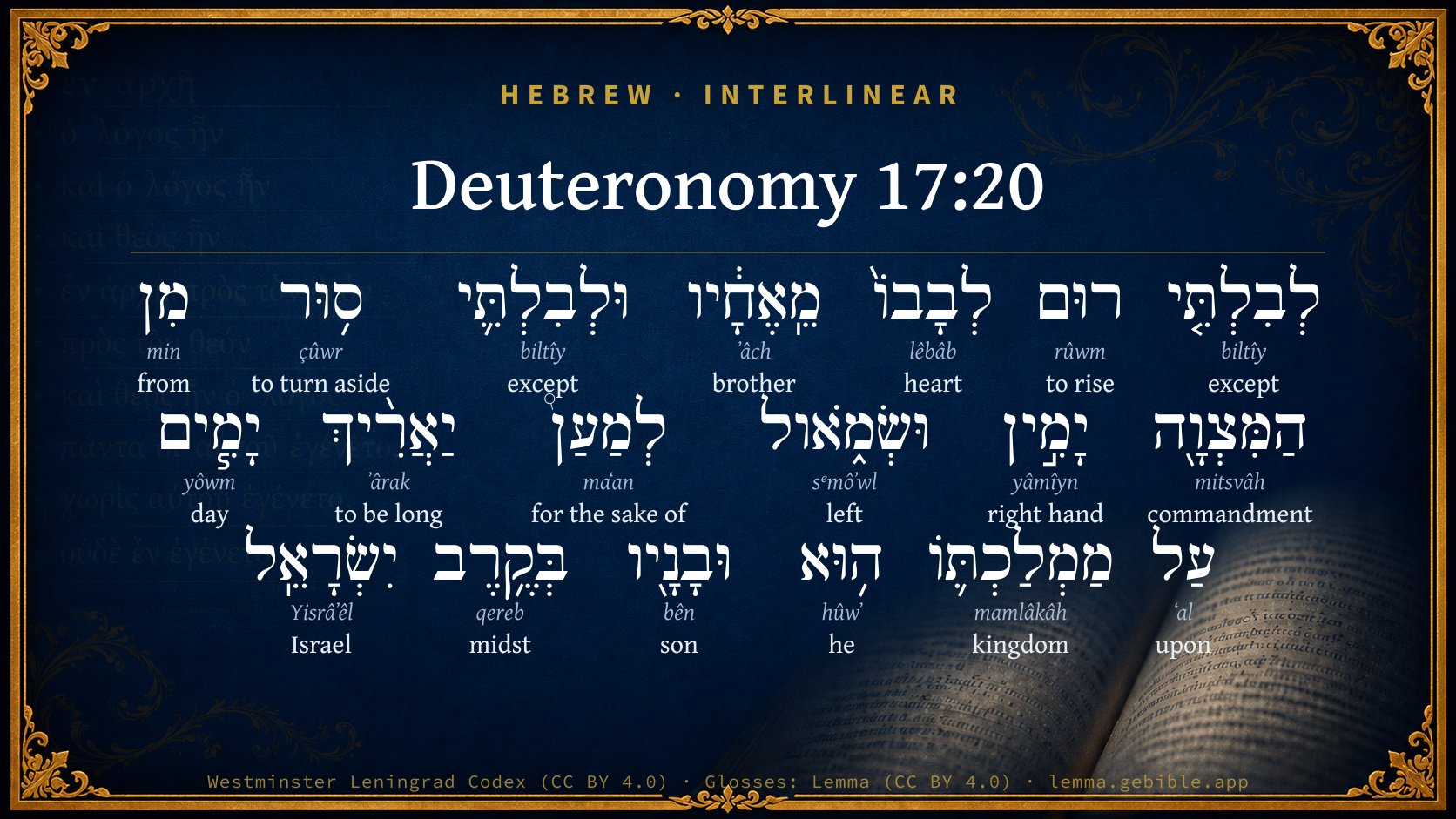
Hebrew (Westminster Leningrad Codex) Deuteronomy 17:20 appears in the Hebrew Old Testament. The text above is from the Westminster Leningrad Codex. Each word links to its Strong’s number, a concise gloss, and parsing drawn from the Open Scriptures Hebrew Bible morphology. Click any word for its full Brown-Driver-Briggs (BDB) entry.
Download image
Cite this verse

Deuteronomy 17:20 (World English Bible). Public Domain. Lemma interlinear Bible study tool, https://lemma.gebible.app/v/deuteronomy/17/20.

Show BibTeX & RIS
BibTeX
RIS
English Translation
that his heart not be lifted up above his brothers, and that he not turn aside from the commandment, to the right hand, or to the left: to the end that he may prolong his days in his kingdom, he and his children, in the midst of Israel.
World English Bible · Public Domain
Download a study sheet

One document with this verse’s original text, its word-by-word gloss line, the meaning frame, cross-references with their text, attributed commentary, and full source and license credits — printable, and it pastes into notes with its structure intact.

This verse Autodidact and up

Study sheet (.html) Plain text (.txt)

A passage Seminary Student

Up to 50 verses in one chapter. A passage sheet keeps up to 6 commentary sources and 12 cross-references per verse, in the order this page ranks them, and says so on the sheet whenever that leaves anything out. Ask for a single verse and you get the Autodidact verse sheet above.

Everything on this page stays free to read, with no account — the sheet is a download of what is already on screen, not access to it.

Want to remove ads? Support Godless Engineer
Compare translations 3

The same verse in 3 English versions, stacked beneath the original-language interlinear above. Click any original word for its lexicon entry.

Each is an independent rendering of the whole verse — the interlinear is not word-aligned to these translations.

Highlighted words mark where these versions differ — a whole-verse word diff, not a word-by-word alignment.

  • World English Bible Public Domain
    that his heart not be lifted up above his brothers, and that he not turn aside from the commandment, to the right hand, or to the left: to the end that he may prolong his days in his kingdom, he and his children, in the midst of Israel.
  • King James Version Public Domain
    That his heart be not lifted up above his brethren, and that he turn not aside from the commandment, to the right hand, or to the left: to the end that he may prolong his days in his kingdom, he, and his children, in the midst of Israel.
  • unfoldingWord Literal Text CC BY-SA 4.0
    so that his heart is not lifted up above his brothers, and so that he does not turn aside from the commandments, right or left, so that he will prolong days in his kingdom, he and his sons, in the midst of Israel.

unfoldingWord Literal Text — © unfoldingWord, licensed CC BY-SA 4.0. Word-aligned USFM3 via Door43 (git.door43.org/unfoldingWord/en_ult).

Versions to compare (up to 4)

3 of 4 selected

Show all 18 translations

Every available English version of this verse, each an independent rendering of the whole verse.

  • World English Bible Public Domain
    that his heart not be lifted up above his brothers, and that he not turn aside from the commandment, to the right hand, or to the left: to the end that he may prolong his days in his kingdom, he and his children, in the midst of Israel.
  • Berean Standard Bible Public Domain
    Then his heart will not be exalted above his countrymen, and he will not turn aside from the commandment, to the right or to the left, in order that he and his sons may reign many years over his kingdom in Israel.
  • Majority Standard Bible Public Domain
    Then his heart will not be exalted above his countrymen, and he will not turn aside from the commandment, to the right or to the left, in order that he and his sons may reign many years over his kingdom in Israel.
  • King James Version Public Domain
    That his heart be not lifted up above his brethren, and that he turn not aside from the commandment, to the right hand, or to the left: to the end that he may prolong his days in his kingdom, he, and his children, in the midst of Israel.
  • American Standard Version (1901) Public Domain
    that his heart be not lifted up above his brethren, and that he turn not aside from the commandment, to the right hand, or to the left: to the end that he may prolong his days in his kingdom, he and his children, in the midst of Israel.
  • Revised Version (1885) Public Domain
    that his heart be not lifted up above his brethren, and that he turn not aside from the commandment, to the right hand, or to the left: to the end that he may prolong his days in his kingdom, he and his children, in the midst of Israel.
  • Geneva Bible (1599) Public Domain
    That his heart be not lifted vp aboue his brethren, and that he turne not from the commandement, to the right hand or to the left, but that he may prolong his daies in his kingdom, he, and his sonnes in the middes of Israel.
  • Douay-Rheims (1899) Public Domain
    And that his heart be not lifted up with pride over his brethren, nor decline to the right or to the left, that he and his sons may reign a long time over Israel.
  • Young's Literal Translation Public Domain
    so that his heart is not high above his brethren, and so as not to turn aside from the command, right or left, so that he prolongeth days over his kingdom, he and his sons, in the midst of Israel.
  • Literal Standard Version CC BY-SA 4.0
    so that his heart is not high above his brothers, and so as not to turn aside from the command [to] the right or left, so that he prolongs days over his kingdom, he and his sons in the midst of Israel.”
  • Unlocked Literal Bible CC BY-SA 4.0
    He must do this so that his heart is not lifted up above his brothers, and so that he does not turn away from the commandments, to the right hand or to the left; for the purpose that he may prolong his days in his kingdom, he and his children, among Israel.
  • unfoldingWord Literal Text CC BY-SA 4.0
    so that his heart is not lifted up above his brothers, and so that he does not turn aside from the commandments, right or left, so that he will prolong days in his kingdom, he and his sons, in the midst of Israel.
  • Darby Bible Public Domain
    that his heart be not lifted up above his brethren, and that he turn not aside from the commandment, to the right hand, or to the left; that he may prolong his days in his kingdom, he, and his sons, in the midst of Israel.
  • World Messianic Bible Public Domain
    that his heart not be lifted up above his brothers, and that he not turn away from the commandment to the right hand, or to the left, to the end that he may prolong his days in his kingdom, he and his children, in the middle of Israel.
  • Webster's Bible Public Domain
    That his heart may not be lifted above his brethren, and that he may not turn aside from the commandment to the right hand or to the left: to the end that he may prolong his days in his kingdom, he, and his children, in the midst of Israel.
  • Free Bible Version CC BY-SA 4.0
    Then he won't think more of himself than his fellow Israelites, and he won't deviate from the commandments, so that he and his sons may have long reigns over the kingdom of Israel.
  • Bible in Basic English Public Domain
    So that his heart may not be lifted up over his countrymen, and he may not be turned away from the orders, to one side or the other: but that his life and the lives of his children may be long in his kingdom in Israel.
  • JPS Tanakh (1917) Public Domain
    that his heart be not lifted up above his brethren, and that he turn not aside from the commandment, to the right hand, or to the left; to the end that he may prolong his days in his kingdom, he and his children, in the midst of Israel.

Literal Standard Version (2020), Covenant Press — licensed CC BY-SA 4.0. Text via the HelloAO Bible API (eBible.org). Unlocked Literal Bible (unfoldingWord) — licensed CC BY-SA 4.0. Text via the HelloAO Bible API (eBible.org). unfoldingWord Literal Text — © unfoldingWord, licensed CC BY-SA 4.0. Word-aligned USFM3 via Door43 (git.door43.org/unfoldingWord/en_ult). Free Bible Version, Dr. Jonathan Gallagher — licensed CC BY-SA 4.0. Text via the HelloAO Bible API (eBible.org).

Word by word

More ways to search: Search by grammar → Find every occurrence → Compare this word →

Practice this passage: Drill this verse → Learn its vocabulary →

יַאֲרִ֨יךְ
ʼârak
H748
“to be long”
Verb, Hiphil, Imperfect, 3rd Person, Masculine, Singular
Part of Speech
Verb
Stem
Hiphil
Form
Imperfect
Person
3rd Person
Gender
Masculine
Number
Singular
Full BDB Definition

Origin: a primitive root

TWOT: 162

to be long, prolong - (Qal) to be long - (Hiphil) - to prolong (days) - to make long (tent cords) - to grow long, continue long
  1. לְבִלְתִּ֤י biltîy H1115 “to/for · except” Preposition + Conjunction
  2. רוּם rûwm H7311 “to rise” Verb, Qal, Infinitive Construct
  3. לְבָבוֹ֙ lêbâb H3824 “heart · his” Noun, Common, Masculine, Singular, Construct + Suffix, Personal, 3rd Person, Masculine, Singular
  4. מֵֽאֶחָ֔יו ʼâch H251 “from · brothers · his” Preposition + Noun, Common, Masculine, Plural, Construct + Suffix, Personal, 3rd Person, Masculine, Singular
  5. וּלְבִלְתִּ֛י biltîy H1115 “and · to/for · except” Conjunction + Preposition + Conjunction
  6. ס֥וּר çûwr H5493 “to turn aside” Verb, Qal, Infinitive Construct
  7. מִן min H4480 “from” Preposition
  8. הַמִּצְוָ֖ה mitsvâh H4687 “the · commandment” Particle, Definite Article + Noun, Common, Feminine, Singular, Absolute
  9. יָמִ֣ין yâmîyn H3225 “right hand” Noun, Common, Feminine, Singular, Absolute
  10. וּשְׂמֹ֑אול sᵉmôʼwl H8040 “and · left” Conjunction + Noun, Common, Masculine, Singular, Absolute
  11. לְמַעַן֩ maʻan H4616 “for the sake of” Preposition
  12. יָמִ֧ים yôwm H3117 “days” Noun, Common, Masculine, Plural, Absolute
  13. עַל ʻal H5921 “upon” Preposition
  14. מַמְלַכְתּ֛וֹ mamlâkâh H4467 “kingdom · his” Noun, Common, Feminine, Singular, Construct + Suffix, Personal, 3rd Person, Masculine, Singular
  15. ה֥וּא hûwʼ H1931 “he” Pronoun, Personal, 3rd Person, Masculine, Singular
  16. וּבָנָ֖יו bên H1121 “and · sons · his” Conjunction + Noun, Common, Masculine, Plural, Construct + Suffix, Personal, 3rd Person, Masculine, Singular
  17. בְּקֶ֥רֶב qereb H7130 “in/at · midst of” Preposition + Noun, Common, Masculine, Singular, Construct
  18. יִשְׂרָאֵֽל Yisrâʼêl H3478 “Israel” Noun, Proper

About this verse

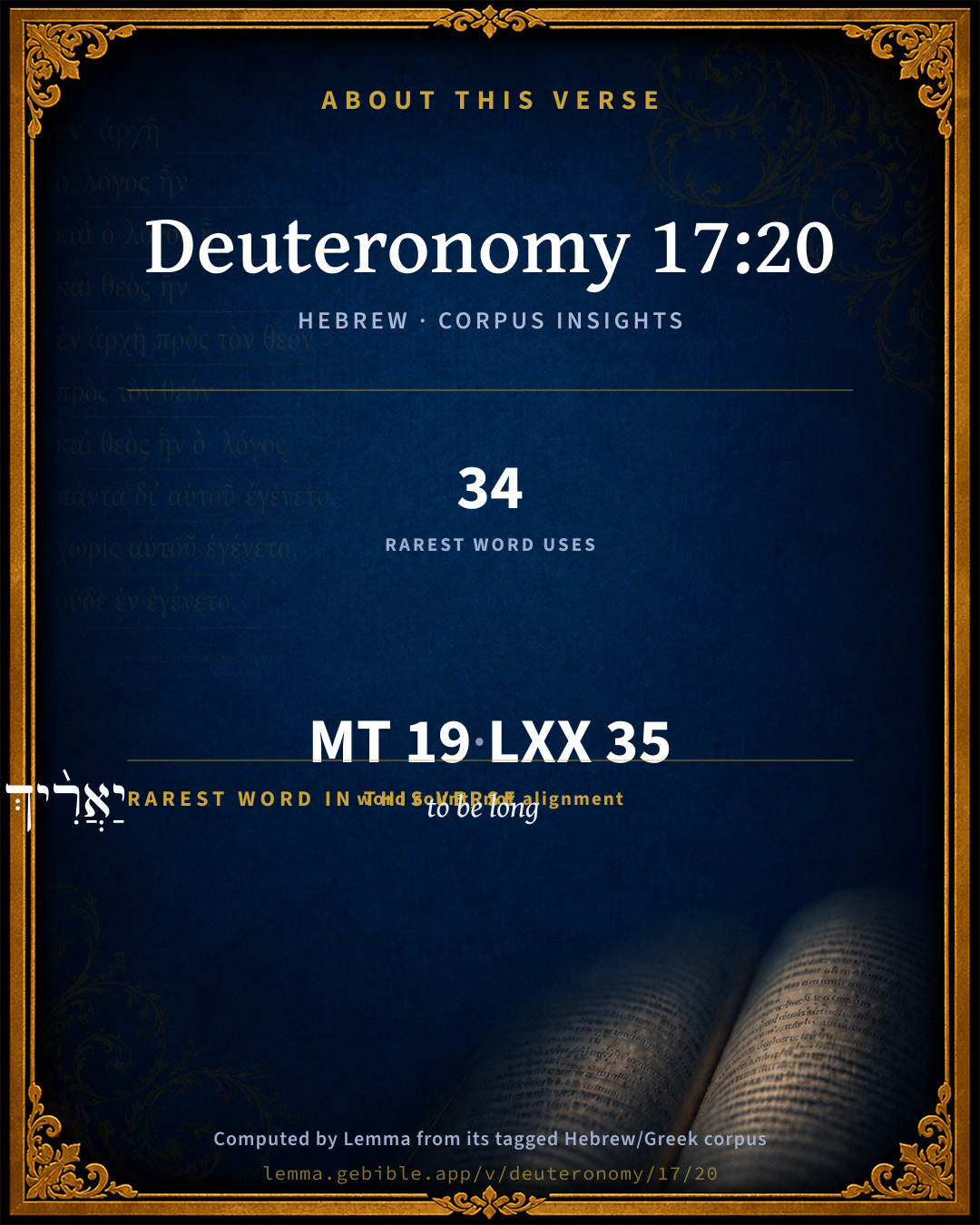
These counts appear in no published source. They are computed here, from the morphology-tagged text and Lemma’s own curated glosses. What Lemma adds →

19
words
18
distinct lemmas
Pentateuch
section

Shared distinctive vocabulary

יַאֲרִ֨יךְ to be long H748 occurs in 34 verses of the Hebrew Bible. Also found in:

Grammatical profile

  • 3 verbs
  • 10 nouns
  • 1 pronoun
  • 3 prepositions
  • 2 conjunctions

Verb forms

  • רוּם Qal · Infinitive Construct
  • ס֥וּר Qal · Infinitive Construct
  • יַאֲרִ֨יךְ Hiphil · Imperfect

Repetition

A word recurs within this verse — often emphatic in Hebrew:

  • לְבִלְתִּ֤י except H1115 ×2

Hebrew & Septuagint length

In English translation the verse runs 48 words from the Hebrew and 41 from the Septuagint (LXX English) — closely comparable.

A rough comparison of the two English renderings, which tokenize alike — not a word-level alignment.

Word counts can differ between the Hebrew and the Greek without any difference in meaning — e.g. the Hebrew direct-object marker אֵת has no separate Greek word, and Greek often adds the article ὁ.

In the original languages it is 19 Hebrew tokens and 35 Greek tokens — but the two are counted differently (Hebrew bundles its prefixes and suffixes into one token; the Greek is in lemma form), so that isn’t a like-for-like length.

Cross-references

34

Topical passages linked to Deuteronomy 17:20 in the Treasury of Scripture Knowledge — connected by theme and wording, ordered by reader-vote popularity; previews shown in the World English Bible.

  • Deuteronomy 5:32 You shall observe to do therefore as Yahweh your God has commanded you: you shall not turn aside to the right hand or to the left.
  • 1 Kings 15:5 because David did that which was right in the eyes of Yahweh, and didn't turn aside from anything that he commanded him all the days of his life, except only in the matter of Uriah the Hittite.
  • Psalms 131:1–2 Yahweh, my heart isn't haughty, nor my eyes lofty; Nor do I concern myself with great matters, Or things too wonderful for me.
  • Isaiah 2:12 For there will be a day of Yahweh of Hosts for all that is proud and haughty, And for all that is lifted up; And it shall be brought low:
  • Daniel 5:20–23 But when his heart was lifted up, and his spirit was hardened so that he dealt proudly, he was deposed from his kingly throne, and they took his glory from him:
  • Deuteronomy 4:2 You shall not add to the word which I command you, neither shall you diminish from it, that you may keep the commandments of Yahweh your God which I command you.
  • Deuteronomy 8:2 You shall remember all the way which Yahweh your God has led you these forty years in the wilderness, that he might humble you, to prove you, to know what was in your heart, whether you would keep his commandments, or not.
  • Deuteronomy 8:13–14 and when your herds and your flocks multiply, and your silver and your gold is multiplied, and all that you have is multiplied;
  • Deuteronomy 12:25 You shall not eat it; that it may go well with you, and with your children after you, when you shall do that which is right in the eyes of Yahweh.
  • Deuteronomy 12:28 Observe and hear all these words which I command you, that it may go well with you, and with your children after you forever, when you do that which is good and right in the eyes of Yahweh your God.
  • Deuteronomy 12:32 Whatever thing I command you, that shall you observe to do: you shall not add thereto, nor diminish from it.
  • Deuteronomy 17:11 according to the tenor of the law which they shall teach you, and according to the judgment which they shall tell you, you shall do; you shall not turn aside from the sentence which they shall show you, to the right hand, nor to the left.
  • 1 Samuel 13:13–14 Samuel said to Saul, You have done foolishly; you have not kept the commandment of Yahweh your God, which he commanded you: for now would Yahweh have established your kingdom on Israel forever.
  • 1 Samuel 15:23 For rebellion is as the sin of witchcraft, and stubbornness is as idolatry and teraphim. Because you have rejected the word of Yahweh, he has also rejected you from being king.
  • 1 Kings 11:12–13 Notwithstanding in your days I will not do it, for David your father's sake: but I will tear it out of the hand of your son.
  • 1 Kings 11:34 However I will not take the whole kingdom out of his hand; but I will make him prince all the days of his life, for David my servant's sake whom I chose, who kept my commandments and my statutes;
  • 1 Kings 11:36 To his son will I give one tribe, that David my servant may have a lamp always before me in Jerusalem, the city which I have chosen me to put my name there.
  • 2 Kings 10:30 Yahweh said to Jehu, Because you have done well in executing that which is right in my eyes, [and] have done to the house of Ahab according to all that was in my heart, your sons of the fourth generation shall sit on the throne of Israel.
  • 2 Kings 14:10 You have indeed struck Edom, and your heart has lifted you up: glory of it, and abide at home; for why should you meddle to [your] hurt, that you should fall, even you, and Judah with you?
  • 2 Chronicles 25:19 You say, Behold, you have struck Edom; and your heart lifts you up to boast: abide now at home; why should you meddle to [your] hurt, that you should fall, even you, and Judah with you?
  • 2 Chronicles 26:16 But when he was strong, his heart was lifted up, so that he did corruptly, and he trespassed against Yahweh his God; for he went into the temple of Yahweh to burn incense on the altar of incense.
  • 2 Chronicles 32:25–26 But Hezekiah didn't render again according to the benefit done to him; for his heart was lifted up: therefore there was wrath on him, and on Judah and Jerusalem.
  • 2 Chronicles 33:12 When he was in distress, he begged Yahweh his God, and humbled himself greatly before the God of his fathers.
  • 2 Chronicles 33:19 His prayer also, and how [God] was entreated of him, and all his sin and his trespass, and the places in which he built high places, and set up the Asherim and the engraved images, before he humbled himself: behold, they are written in the history of Hozai.
  • 2 Chronicles 33:23 He didn't humble himself before Yahweh, as Manasseh his father had humbled himself; but this same Amon trespassed more and more.
  • 2 Chronicles 34:27 because your heart was tender, and you did humble yourself before God, when you heard his words against this place, and against the inhabitants of it, and have humbled yourself before me, and have torn your clothes, and wept before me; I also have heard you, says Yahweh.
  • Psalms 19:11 Moreover by them is your servant warned. In keeping them there is great reward.
  • Psalms 132:12 If your children will keep my covenant, My testimony that I will teach them, Their children also will sit on your throne forevermore."
  • Proverbs 10:27 The fear of Yahweh prolongs days, But the years of the wicked shall be shortened.
  • Proverbs 27:24 For riches are not forever, Nor does even the crown endure to all generations.
  • Ecclesiastes 8:13 But it shall not be well with the wicked, neither shall he lengthen days like a shadow; because he doesn't fear God.
  • Habakkuk 2:4 Behold, his soul is puffed up. It is not upright in him, but the righteous will live by his faith.
  • 2 Corinthians 12:7 By reason of the exceeding greatness of the revelations, that I should not be exalted excessively, there was given to me a thorn in the flesh, a messenger of Satan to buffet me, that I should not be exalted excessively.
  • 1 Peter 5:5 Likewise, you younger ones, be subject to the elder. Yes, all of you gird yourselves with humility, to subject yourselves to one another; for "God resists the proud, but gives grace to the humble."

Cross-references courtesy of OpenBible.info (CC BY 4.0).

Hebrew and Greek witnesses Masoretic Hebrew ↔ Greek Septuagint

The same verse in the two great witnesses to the Old Testament, shown verse-for-verse.

These are two independent witnesses, not word-aligned to each other, and the Septuagint is shown in lemma (dictionary) form.

Hebrew Deuteronomy 17:20 Masoretic · Westminster Leningrad Codex

לְבִלְתִּ֤י רוּם לְבָבוֹ֙ מֵֽאֶחָ֔יו וּלְבִלְתִּ֛י ס֥וּר מִן הַמִּצְוָ֖ה יָמִ֣ין וּשְׂמֹ֑אול לְמַעַן֩ יַאֲרִ֨יךְ יָמִ֧ים עַל מַמְלַכְתּ֛וֹ ה֥וּא וּבָנָ֖יו בְּקֶ֥רֶב יִשְׂרָאֵֽל

that his heart not be lifted up above his brothers, and that he not turn aside from the commandment, to the right hand, or to the left: to the end that he may prolong his days in his kingdom, he and his children, in the midst of Israel.

World English Bible · Public Domain

Greek LXX Deuteronomy 17:20 Septuagint · lemma form

ἵνα μή ὑψόω ὁ καρδία αὐτός ἀπό ὁ ἀδελφός αὐτός ἵνα μή παραβαίνω ἀπό ὁ ἐντολή δεξιός ἤ ἀριστερός ὅπως ἄν μακροχρονίζω ἐπί ὁ ἀρχή αὐτός αὐτός καί ὁ υἱός αὐτός ἐν ὁ υἱός ἰσραήλ

that his heart be not lifted up above his brethren, that he depart not from the commandments on the right hand or on the left; that he and his sons may reign long in his dominion among the children of Israel.

LXX2012 (modern English Septuagint) · Public Domain

Hebrew: Westminster Leningrad Codex (CC BY 4.0). Greek: Septuagint (public domain); English from LXX2012 (modern English Septuagint) (Public Domain). How the Septuagint differs from the Hebrew →

Targum (Aramaic paraphrase)

2

The Targum is the ancient Jewish Aramaic paraphrase of the Hebrew Scriptures — an interpretive translation, not the Hebrew text itself. Onkelos (literal) and Pseudo-Jonathan (expansive) render the Torah, and Jonathan the Prophets. Coverage is partial: where no permissively-licensed English translation exists for a verse, only the Aramaic is shown. This is verse-level text, not a word-by-word alignment to the Hebrew.

  1. Targum Onkelos Torah (Genesis–Deuteronomy)
    בְּדִיל דְלָא יְרִים לִבֵּהּ מֵאֲחוֹהִי וּבְדִיל דְלָא יִסְטֵּי מִן תַּפְקֶדְתָּא יַמִינָא וּשְׂמָאלָא בְּדִיל דְיוֹרֵךְ יוֹמִין עַל מַלְכוּתֵהּ הוּא וּבְנוֹהִי בְּגוֹ יִשְׂרָאֵל

    (no public-domain English translation for this verse)

    Targum Onkelos — Aramaic: “Onkelos Genesis” (public domain); “Onkelos Exodus” (public domain); “Onkelos Leviticus” (public domain); “Onkelos Numbers” (public domain); “Onkelos Deuteronomy” (public domain). English: “Sefaria Community Translation” (CC0 1.0 (public-domain dedication)); “J.W. Etheridge. The Targums of Onkelos and Jonathan Ben Uzziel on the Pentateuch. London: Longmans, Green, 1862” (public domain). Text via Sefaria.

  2. Targum Pseudo-Jonathan Torah (Genesis–Deuteronomy)
    מְטוּל דְּלָא יָגִיס לִבֵּיהּ יַתִּיר מִן אָחוֹי וּמְטוּל דְּלָא יִסְטֵי מִן תַּפְקֵידְתָּא לְיַמִינָא וְלִשְמָאלָא מִן בִּגְלַל דְּיִנְגוֹד יוֹמִין עַל מַלְכוּתֵיהּ הוּא וּבְנוֹי בֵּינֵי יִשְרָאֵל

    that his heart may not be arrogant toward his brethren, nor decline from the precepts to the right or the left, and that his days may be prolonged over his kingdom, his and his sons among Israel.

    Targum Pseudo-Jonathan — Aramaic: “Targum Jonathan on Genesis” (public domain); “Targum Jonathan on Exodus” (public domain); “Targum Jonathan on Leviticus” (public domain); “Targum Jonathan on Numbers” (public domain); “Targum Jonathan on Deuteronomy” (public domain). English: “The Targum of Jonathan ben Uzziel, trans. J. W. Etheridge, London, 1862” (public domain). Text via Sefaria.

Commentary

Notes on Deuteronomy 17:20 from classic Christian and Jewish commentators (each source and its license shown beneath its notes). The classic Christian expositions comment on the surrounding passage and are grouped to its opening verse, so a note may address several verses; the Jewish commentaries on the Tanakh (Rashi and others) are per-verse, so they appear only where the commentator wrote on this verse.

Lemma curates 59 commentaries, every one of them public domain or Creative Commons licensed, each selected and text-cleaned for this edition rather than reprinted as found. About our sources →

Trapp's Complete Commentary

John Trapp

Deu 17:20 That his heart be not lifted up above his brethren, and that he turn not aside from the commandment, [to] the right hand, or [to] the left: to the end that he may prolong [his] days in his kingdom, he, and his children, in the midst of Israel.

Ver. 20. That his heart be not lifted up.] That his good and his blood rise not together as that king of Tyre’s did, {Eze 28:2} and that Lucifer, son of the morning. {Isa 14:12-13} See my "Commonplace of Arrogancy." Of Caligula it is said, that there never was a better servant, or a worse lord. Vespasian is said to be the only man that became better by the empire. The most of the emperors grew so insolent, that they got nothing by their preferment, nisi ut citius interficerentur, but to be sooner slain.

John Trapp, A Commentary or Exposition upon All the Books of the Old and New Testament (1647–1656) — public domain. Text from a community e-Sword module.

Joseph Benson's Commentary

Deu 17:20. That his heart be not lifted up — He intimates, that the Scriptures, diligently read, are a powerful means to keep a person humble, because they show him that, though a king, he is subject to a higher monarch, to whom he must give an account of all his administrations, and receive from him his sentence, agreeably to their quality, which is sufficient to abate the pride of the haughtiest person in the world.

Joseph Benson's Commentary on the Old and New Testaments (1811–1818) — public domain. Text from a community e-Sword module.

Geneva Bible (1599)

Geneva Bible translators

Whereby is meant, that Kings ought so to love their subjects as nature bindeth one brother to love another.

Geneva Bible (1599) marginal notes — public domain. Text via Bolls.life.

Jamieson, Fausset & Brown

Robert Jamieson, A. R. Fausset & David Brown

that he may prolong his days in his kingdom, he and his children--From this it appears that the crown in Israel was to be hereditary, unless forfeited by personal crime.

Next: Deuteronomy Chapter 18

Jamieson, Fausset & Brown — Commentary Critical and Explanatory on the Whole Bible (1871) — public domain (CC PDM 1.0). Text via the HelloAO Bible API.

Adam Clarke's Commentary

Verse 20. He, and his children, in the midst of Israel.] From this verse it has been inferred that the crown of Israel was designed to be hereditary, and this is very probable; for long experience has proved to almost all the nations of the world that hereditary succession in the regal government is, on the whole, the safest, and best calculated to secure the public tranquillity.

Adam Clarke's Commentary on the Bible (1810–1826) — public domain. Text from a community e-Sword/MySword module.

Ellicott's Commentary for English Readers

(20) To the end that he may prolong his days in his kingdom, he, and his children.—Shows that the kingdom in Israel would be hereditary only so far as Jehovah willed it to be so. Again we may say that the striking fact that no dynasty except that of David ever continued for more than five generations, and only two dynasties for more than two generations, while David’s dynasty was perpetual by promise, could hardly have escaped notice, if known to the writer of this book.

A Bible Commentary for English Readers, edited by Charles John Ellicott (1878–1897) — public domain. Text from a community e-Sword module.

The Cambridge Bible for Schools and Colleges

gen. ed. J. J. S. Perowne

20. that his heart, etc.] Cp. Deu_8:2. Turn not aside, Deu_5:32, Prolong days, Deu_4:40. Cullen (140) thinks that in mentioning Torah and Miṣwah separately in Deu_17:19-20 the writer refers to two distinct works. This is by no means clear; he may be using them here as parallel terms.

The Cambridge Bible for Schools and Colleges (gen. ed. J. J. S. Perowne; Cambridge University Press, 1878–1918) — public domain. Text from a community e-Sword module.

John Gill's Exposition

That his heart be not lifted up above his brethren,.... On account of his office, the dignity of it, considering that he was subject to the law of God, and accountable to the Lord for all his actions:

and that he turn not aside from the commandment, to the right hand or to the left; not in the least deviate from the law of God in the whole of his conduct, and particularly in the exercise of his kingly office:

to the end that he may prolong his days in his kingdom; ruling well according to the laws of God being the way to rule long:

he and his children in the midst of Israel; this shows, as Jarchi observes, that if his son was fit for the kingdom, he was to be preferred to any other man; for though it was elective, yet to be continued in the same family, provided they walked in the ways of the Lord, and observed his laws.

Next: Deuteronomy Chapter 18

John Gill's Exposition of the Whole Bible (1746–1763) — public domain (CC PDM 1.0). Text via the HelloAO Bible API.

Haydock's Catholic Bible Commentary

With pride. This is not expressed in Hebrew, but it is clearly (Haydock) implied. Humility is the most difficult virtue for a prince to practice, amid the flattery of his courtiers, and the splendour with which he is environed. See St. Augustine, City of God v. 24. (Calmet) --- His sons. Wicked kings seldom left a quiet possession of the throne to their heirs. (Menochius) --- David and his posterity reigned in succession, by an effect of the divine bounty. (Calmet)

George Leo Haydock (1774–1849), Haydock's Catholic Family Bible and Commentary, 1859 edition — public domain. Excludes Psalms (Douay-Rheims chapter numbering differs from Protestant) and Deuterocanonical books (Catholic canon only).

Matthew Poole's English Annotations

That his heart be not lifted up; he intimates, that the Scriptures, diligently read and studied, are a powerful and probable means to keep him humble, because they show him that, though a king, he is subject to a higher Monarch, to whom he must give an account of all his administrations and actions, and receive from him his sentence and doom agreeable to their quality, which is sufficient to abate the pride of the haughtiest person in the world, if he duly consider it.

Matthew Poole's English Annotations on the Holy Bible (1683–1685) — public domain. Text from a community e-Sword/MySword module.

The Pulpit Commentary

That his heart be not lifted up above his brethren. "Not imagining himself to be above all laws, nor slighting his subjects, as unworthy of his notice, but taking a due care to promote their happiness" (Patrick). He, and his children; properly, his sons (wynb). The legislator anticipated not an elective monarchy, but one hereditary in the same family (cf. Michaelis, "Laws of Moses," pt. 1.

The Pulpit Commentary (1880–1919), ed. H.D.M. Spence-Jones & Joseph S. Exell — public domain. Text from a community e-Sword module.

John Wesley's Explanatory Notes

If his heart be not lifted up - He intimates, that the scriptures diligently read, are a powerful means to keep him humble, because they shew him in that, tho' a king, he is subject to an higher monarch, to whom he must give an account of all his administrations, and receive from him his sentence agreeable to their quality, which is sufficient to abate the pride of the haughtiest person in the world.

John Wesley, Explanatory Notes Upon the Whole Bible (1754–1765) — public domain. Text via the GEBible commentary corpus.

unfoldingWord translationNotes

Door43 World Missions Community

so that his heart is not lifted up above his brothers

Here "his heart" refers to the whole person. A king becoming arrogant is spoken of as if his heart were lifted up. AT: "so that he does not become arrogant" or "so that he does not think he is better than his fellow Israelites" (See: Synecdoche and Metaphor)

so that he does not turn away from the commandments, to the right hand or to the left

A king disobeying God's commands is spoken of as if a person were to turn off the correct path. This can be stated in positive form. AT: "so that he does not disobey any of the commandments" or "so that he obeys all of the commandments" (See: Metaphor and Litotes)

prolong his days

Long days is a metaphor for a long life. See how you translated a similar phrase "prolong your days" in Deuteronomy 4:26. AT: "be able to live a long time" (See: Metaphor)

translationWords

heart

brother

command

Israel

unfoldingWord translationNotes — © Distant Shores Media and the Door43 World Missions Community, licensed CC BY-SA 4.0. Source: git.door43.org/Door43/en_tn.

Rashi

Rabbi Shlomo Yitzchaki (Rashi)

ולבלתי סור מן המצוה AND THAT HE DEPART NOT FROM THE COMMANDMENT — not even from a less important command given to him by means of a prophet.

למען יאריך ימים TO THE END THAT HE MAY PROLONG HIS DAYS [IN HIS KINGDOM] — From the positive statement you may derive the negative (that if he does not fulfil the commandments his kingdom will not endure). And so, indeed, do we find in the case of Saul that Samuel said to him, (I Samuel 10:8) “Seven days shalt thou tarry, till I come unto thee” to offer burnt sacrifices, and it is written, (I Samuel 13:8) “and he tarried seven days”, but he did not keep his promise to wait the whole of the seventh day and had scarcely finished offering the burnt offering when Samuel came (I Samuel 10:10) and said to him (I Samuel 10:13-14) “Thou hast done foolishly; thou hast not kept [the commandment of the Lord thy God, which He commanded thee; for now would the Lord have established thy kingdom upon Israel forever;] but now thy kingdom shall not continue”. Thus you learn that for the neglect of an unimportant command given by means of a prophet he was severely punished.

הוא ובניו [THAT HE MAY PROLONG HIS DAYS IN HIS KINGDOM] HE, AND HIS CHILDREN — This tells you that if his son is worthy of becoming king he has to be given preference to any other person (Horayot 11b).

Rashi on the Tanakh — English translations: “The Judaica Press complete Tanach with Rashi, translated by A. J. Rosenberg” (CC BY 4.0); “Pentateuch with Rashi's commentary by M. Rosenbaum and A.M. Silbermann, 1929-1934” (public domain); “The Metsudah Tanach series, Lakewood, N.J” (CC BY 4.0); and “The Book of Joshua, Metsudah Publications, 1997” (CC BY 4.0). Text via Sefaria.

Ramban (Nachmanides)

Rabbi Moshe ben Nachman (Ramban / Nachmanides)

THAT HIS HEART BE NOT LIFTED UP ABOVE HIS BRETHREN. Here in the Torah a prohibition against conceit is alluded to, for Scripture prohibited even the king from indulging in conceit and haughtiness of heart, surely other people who are not of such commendable excellence [or merit, are forbidden to be haughty]. Scripture has thus admonished him for whom it is proper to be haughty and majestic that his heart must be as humble as that of his brethren of lower status, because conceit is a reprehensible character-trait, and it is loathsome to G-d even in a king. To G-d alone is the greatness, Verse 11. and exaltation, and to Him alone is the praise, and in [the knowledge of] Him may man glory, as the matter is explained by King Solomon, Every man that is proud in heart is an abomination to the Eternal. It is further written, But let him that glorieth glory in this, that he understandeth, and knoweth Me.

Ramban (Nachmanides) on the Tanakh — English translation: “Commentary on the Torah by Ramban (Nachmanides). Translated and annotated by Charles B. Chavel. New York, Shilo Pub. House, 1971-1976” (CC BY 4.0). Text via Sefaria.

Lesson kit

Teaching starters — assembled from the data on this page, not authored interpretation. Every prompt links to the verse data it draws on. Edit before teaching.

Deuteronomy, in the Pentateuch, opens this verse with 19 words (18 distinct Hebrew lemmas). Its most distinctive word is ʼârak (“to be long”). A historical commentator’s framing appears above. Read the whole chapter for the surrounding context.

Discussion questions

  1. The word ʼârak carries the sense “to be long.” How does it shape the verse?
  2. How does Genesis 26:8, which shares the word «to be long», read alongside this verse?
  3. What does the repetition of “except” (2× in this one verse) do in this verse?
  4. The translations on this page render this verse differently — a whole-verse word diff, not a word-by-word alignment. What might account for the different wordings?
  5. «רוּם» is a Qal Infinitive Construct verb. How does that grammatical form shape the action described?
  6. Compare how Trapp's Complete Commentary and Joseph Benson's Commentary read this verse. Where do they agree or differ?

Things to notice

Reading settings

Reading text

Shown beneath each verse's original-language words.

Old Testament
Old Testament edition

Read the OT as the Masoretic Hebrew (MT) or the Greek Septuagint (LXX).

English shown for the Greek Septuagint (in the Hebrew ↔ Greek comparison).

Comparing translations? Open the Compare panel on any verse page to stack up to four side by side.