
Psalms 39:10

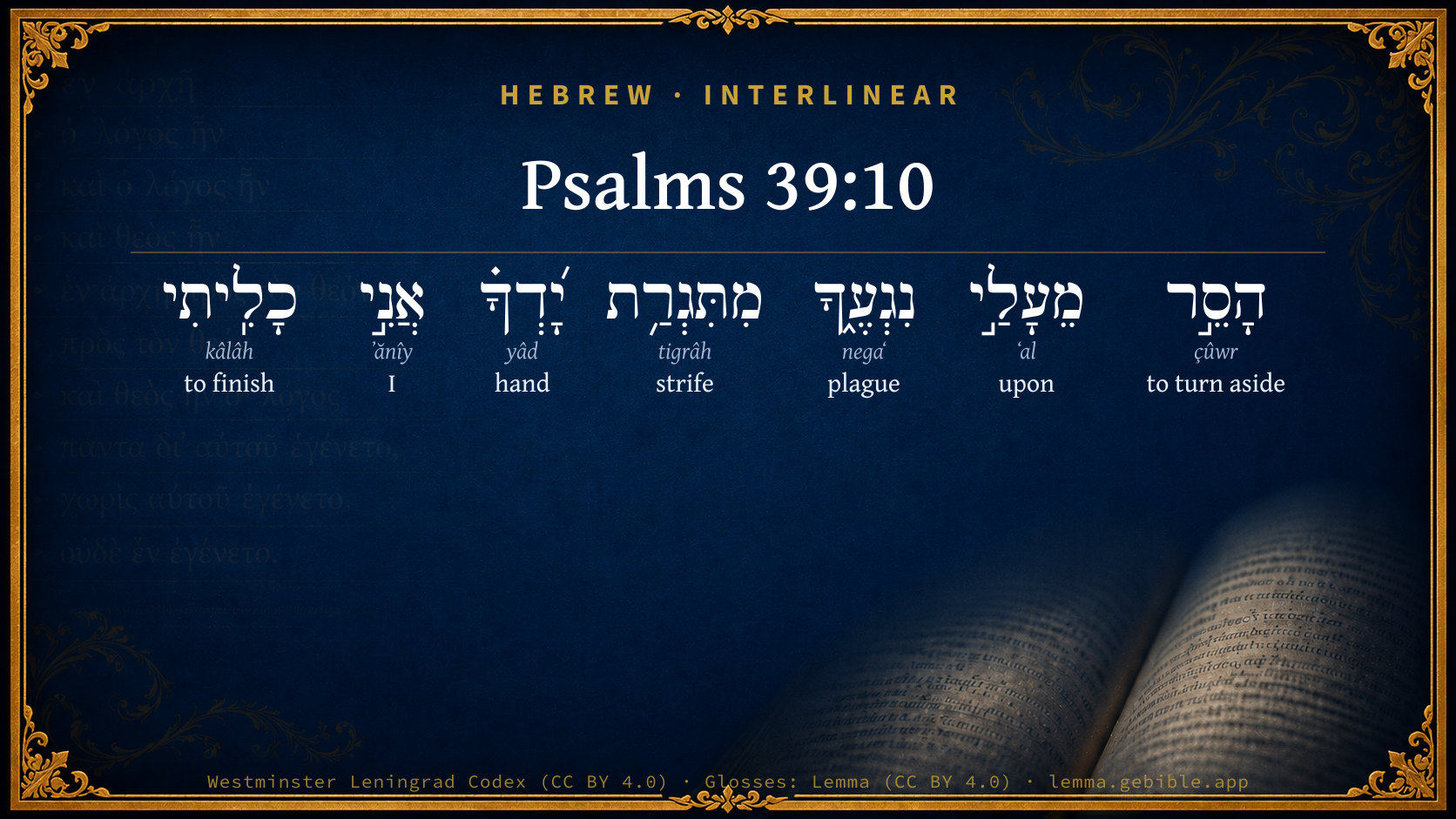
Hebrew (Westminster Leningrad Codex) Psalms 39:10 appears in the Hebrew Old Testament. The text above is from the Westminster Leningrad Codex. Each word links to its Strong’s number, a concise gloss, and parsing drawn from the Open Scriptures Hebrew Bible morphology. Click any word for its full Brown-Driver-Briggs (BDB) entry.
Download image
Cite this verse

Psalms 39:10 (World English Bible). Public Domain. Lemma interlinear Bible study tool, https://lemma.gebible.app/v/psalms/39/10.

Show BibTeX & RIS
BibTeX
RIS
English Translation
Remove your scourge away from me. I am overcome by the blow of your hand.
World English Bible · Public Domain
Highlights
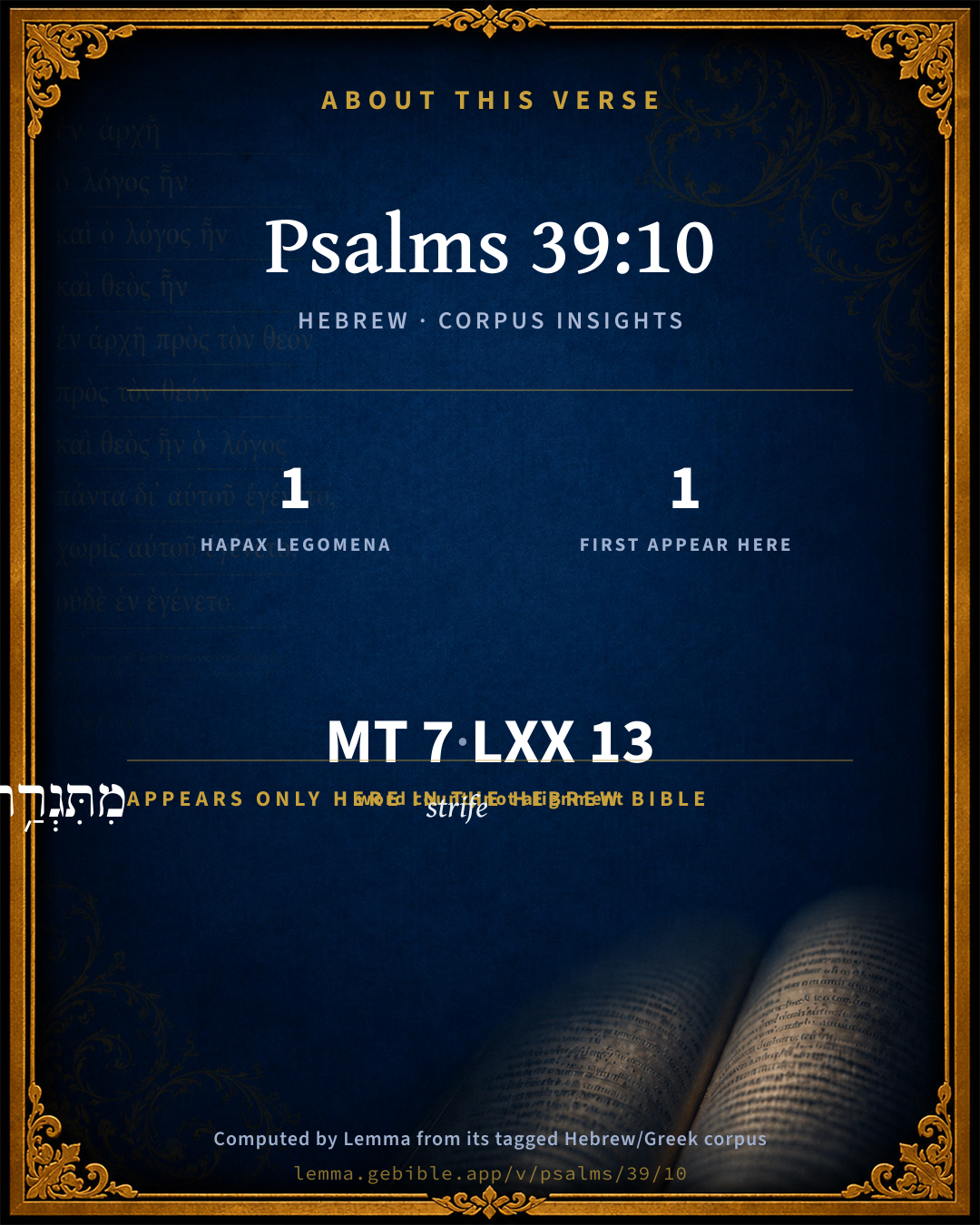
  • 1 hapax legomenon — only here in the Hebrew Bible
  • 1 first appearance in the Hebrew Bible
Full analysis ↓
Download a study sheet

One document with this verse’s original text, its word-by-word gloss line, the meaning frame, cross-references with their text, attributed commentary, and full source and license credits — printable, and it pastes into notes with its structure intact.

This verse Autodidact and up

Study sheet (.html) Plain text (.txt)

A passage Seminary Student

Up to 50 verses in one chapter. A passage sheet keeps up to 6 commentary sources and 12 cross-references per verse, in the order this page ranks them, and says so on the sheet whenever that leaves anything out. Ask for a single verse and you get the Autodidact verse sheet above.

Everything on this page stays free to read, with no account — the sheet is a download of what is already on screen, not access to it.

Want to remove ads? Support Godless Engineer
Compare translations 3

The same verse in 3 English versions, stacked beneath the original-language interlinear above. Click any original word for its lexicon entry.

Each is an independent rendering of the whole verse — the interlinear is not word-aligned to these translations.

Highlighted words mark where these versions differ — a whole-verse word diff, not a word-by-word alignment.

  • World English Bible Public Domain
    Remove your scourge away from me. I am overcome by the blow of your hand.
  • King James Version Public Domain
    Remove thy stroke away from me: I am consumed by the blow of thine hand.
  • unfoldingWord Literal Text CC BY-SA 4.0
    Remove your plague from upon me; from the blow of your hand, I, I am finished.

unfoldingWord Literal Text — © unfoldingWord, licensed CC BY-SA 4.0. Word-aligned USFM3 via Door43 (git.door43.org/unfoldingWord/en_ult).

Versions to compare (up to 4)

3 of 4 selected

Show all 18 translations

Every available English version of this verse, each an independent rendering of the whole verse.

  • World English Bible Public Domain
    Remove your scourge away from me. I am overcome by the blow of your hand.
  • Berean Standard Bible Public Domain
    Remove Your scourge from me; I am perishing by the force of Your hand.
  • Majority Standard Bible Public Domain
    Remove Your scourge from me; I am perishing by the force of Your hand.
  • King James Version Public Domain
    Remove thy stroke away from me: I am consumed by the blow of thine hand.
  • American Standard Version (1901) Public Domain
    Remove thy stroke away from me: I am consumed by the blow of thy hand.
  • Revised Version (1885) Public Domain
    Remove thy stroke away from me: I am consumed by the blow of thine hand.
  • Geneva Bible (1599) Public Domain
    Take thy plague away from mee: for I am consumed by the stroke of thine hand.
  • Douay-Rheims (1899) Public Domain
    I was dumb, and I opened not my mouth, because thou hast done it.
  • Young's Literal Translation Public Domain
    Turn aside from off me Thy stroke, From the striving of Thy hand I have been consumed.
  • Literal Standard Version CC BY-SA 4.0
    Turn aside Your stroke from off me, || From the striving of Your hand I have been consumed.
  • Unlocked Literal Bible CC BY-SA 4.0
    Stop wounding me; I am overwhelmed by the blow of your hand.
  • unfoldingWord Literal Text CC BY-SA 4.0
    Remove your plague from upon me; from the blow of your hand, I, I am finished.
  • Darby Bible Public Domain
    Remove thy stroke away from me: I am consumed by the blow of thy hand.
  • World Messianic Bible Public Domain
    Remove your scourge away from me. I am overcome by the blow of your hand.
  • Webster's Bible Public Domain
    \\39:9\\I was dumb, I opened not my mouth; because thou didst it.
  • Free Bible Version CC BY-SA 4.0
    Please stop hitting me! Your beating has worn me out!
  • Bible in Basic English Public Domain
    No longer let your hand be hard on me; I am wasted by the blows of your hand.
  • JPS Tanakh (1917) Public Domain
    (39-11) Remove Thy stroke from off me; I am consumed by the blow of Thy hand.

Literal Standard Version (2020), Covenant Press — licensed CC BY-SA 4.0. Text via the HelloAO Bible API (eBible.org). Unlocked Literal Bible (unfoldingWord) — licensed CC BY-SA 4.0. Text via the HelloAO Bible API (eBible.org). unfoldingWord Literal Text — © unfoldingWord, licensed CC BY-SA 4.0. Word-aligned USFM3 via Door43 (git.door43.org/unfoldingWord/en_ult). Free Bible Version, Dr. Jonathan Gallagher — licensed CC BY-SA 4.0. Text via the HelloAO Bible API (eBible.org).

Word by word

More ways to search: Search by grammar → Find every occurrence → Compare this word →

Practice this passage: Drill this verse → Learn its vocabulary →

About this verse

These counts appear in no published source. They are computed here, from the morphology-tagged text and Lemma’s own curated glosses. What Lemma adds →

7
words
7
distinct lemmas
Wisdom
section

Notable vocabulary

1 hapax legomenon — a word that appears only here in the entire Hebrew Bible:

  • מִתִּגְרַ֥ת strife H8409

First appearance in Scripture

This word makes its first canonical appearance in the Hebrew Bible here:

  • מִתִּגְרַ֥ת strife H8409

Grammatical profile

  • 2 verbs
  • 3 nouns
  • 1 pronoun
  • 1 preposition

Verb forms

  • הָסֵ֣ר Hiphil · Imperative
  • כָלִֽיתִי Qal · Perfect

Hebrew & Septuagint length

In English translation the verse runs 15 words from the Hebrew and 16 from the Septuagint (LXX English) — closely comparable.

A rough comparison of the two English renderings, which tokenize alike — not a word-level alignment.

Word counts can differ between the Hebrew and the Greek without any difference in meaning — e.g. the Hebrew direct-object marker אֵת has no separate Greek word, and Greek often adds the article ὁ.

In the original languages it is 7 Hebrew tokens and 13 Greek tokens — but the two are counted differently (Hebrew bundles its prefixes and suffixes into one token; the Greek is in lemma form), so that isn’t a like-for-like length.

Cross-references

7

Topical passages linked to Psalms 39:10 in the Treasury of Scripture Knowledge — connected by theme and wording, ordered by reader-vote popularity; previews shown in the World English Bible.

  • Job 9:34 Let him take his rod away from me, Let his terror not make me afraid:
  • Job 13:21 Withdraw your hand far from me; And don't let your terror make me afraid.
  • Psalms 25:16–17 Turn to me, and have mercy on me, For I am desolate and afflicted.
  • Psalms 32:4 For day and night your hand was heavy on me. My strength was sapped in the heat of summer. Selah.
  • Psalms 38:3–4 There is no soundness in my flesh because of your indignation, Neither is there any health in my bones because of my sin.
  • 1 Samuel 6:5 Therefore you shall make images of your tumors, and images of your mice that mar the land; and you shall give glory to the God of Israel: peradventure he will lighten his hand from off you, and from off your gods, and from off your land.
  • Job 40:8 Will you even annul my judgment? Will you condemn me, that you may be justified?

Cross-references courtesy of OpenBible.info (CC BY 4.0).

Hebrew and Greek witnesses Masoretic Hebrew ↔ Greek Septuagint

The same verse in the two great witnesses to the Old Testament, shown verse-for-verse.

You’re reading Greek Psalm 38 (Hebrew Psalm 39). The Septuagint counts the superscription, so verse numbers can differ from the Hebrew — chapter-level alignment, not verse-by-verse. Numbering follows Rahlfs.

These are two independent witnesses, not word-aligned to each other, and the Septuagint is shown in lemma (dictionary) form.

Hebrew Psalms 39:10 Masoretic · Westminster Leningrad Codex

הָסֵ֣ר מֵעָלַ֣י נִגְעֶ֑ךָ מִתִּגְרַ֥ת יָ֝דְךָ֗ אֲנִ֣י כָלִֽיתִי

Remove your scourge away from me. I am overcome by the blow of your hand.

World English Bible · Public Domain

Greek LXX Greek Psalm 38:10 Septuagint · lemma form

κωφάω καί οὐ ἀναοἴγω ὁ στόμα ἐγώ ὅτι σύ εἰμί ὁ ποιέω ἐγώ

Remove your scourges from me: I have fainted by reason of the strength of your hand.

LXX2012 (modern English Septuagint) · Public Domain

On this verse, Ellicott's Commentary for English Readers discusses the Septuagint’s reading. Read the note in Commentary ↓

Hebrew: Westminster Leningrad Codex (CC BY 4.0). Greek: Septuagint (public domain); English from LXX2012 (modern English Septuagint) (Public Domain). How the Septuagint differs from the Hebrew →

Commentary

Notes on Psalms 39:10 from classic Christian and Jewish commentators (each source and its license shown beneath its notes). The classic Christian expositions comment on the surrounding passage and are grouped to its opening verse, so a note may address several verses; the Jewish commentaries on the Tanakh (Rashi and others) are per-verse, so they appear only where the commentator wrote on this verse.

Lemma curates 59 commentaries, every one of them public domain or Creative Commons licensed, each selected and text-cleaned for this edition rather than reprinted as found. About our sources →

Trapp's Complete Commentary

John Trapp

Psa 39:10 Remove thy stroke away from me: I am consumed by the blow of thine hand.

Ver. 10. Remove thy stroke away from me] Having first prayed off his sin, he would now pray off his pain, though it less troubled him; and for ease he repaireth to Jehovah, that healeth as well as woundeth, Hos 6:1.

- nam qui tibi vulnera fecit,

Solus Achilleo tollere more potest

(Ovid. Trist).

I am consumed by the blow of thine hand] Heb. By the conflict or buffetings. Oh, keep out of his fingers, for it is a fearful thing to fall into them, Heb 10:31, Cavebis autem si pavebis.

John Trapp, A Commentary or Exposition upon All the Books of the Old and New Testament (1647–1656) — public domain. Text from a community e-Sword module.

Joseph Benson's Commentary

Psa 39:10-11. Remove thy stroke away from me — But though I may not, I will not, open my mouth to complain, yet I may open it to pray, that thou wouldest take off the judgment that thou hast inflicted upon me. I am consumed, &c. — Help me, therefore, before I be utterly and irrecoverably lost. When thou with rebukes — That is, with punishments, which are often so called; dost correct man for iniquity — Dost punish him as his iniquity deserves. Thou makest his beauty to consume away — Hebrew, חמודו, chamudo, desiderabile ejus, his desirable things, as this word signifies, Lam 1:11; Dan 9:23; Dan 10:3; Dan 10:11; Dan 10:19; his comeliness, strength, wealth, prosperity, and all his present excellences and felicities; like a moth — As a moth is easily crushed to pieces with a touch. Thus the Chaldee paraphrase, Like a moth broken asunder: or, rather, as a moth consumeth a garment, as Job 13:28; Isa 50:9, to which God compares his judgments secretly and insensibly consuming a people, Isa 51:8; Hos 5:12. Surely every man is vanity — As was affirmed, Psa 39:5, and is hereby confirmed. For though men in the height of their prosperity will not believe it, yet when God contendeth with them by his judgments, they are forced to acknowledge it.

Joseph Benson's Commentary on the Old and New Testaments (1811–1818) — public domain. Text from a community e-Sword module.

J. A. Alexander on Psalms

Joseph Addison Alexander

11. (Psa 39:10). Remove from upon me thy stroke; from the strife of thy hand I have wasted away (or consumed). The silence vowed in the preceding verse had reference merely to repining and undutiful complaint, not to prayer, which he immediately subjoins. Remove, or retaining the form of the original, cause to remove, make to depart, take away, withdraw, not merely from me, but from upon me, implying previous pressure. Thy stroke, thy chastisement, thy punishment. See above, on Psa 38:12(11). The same thing is intended by the strife of thy hand, the judgments of God being sometimes represented as a controversy or contention between him and the afflicted person. See Isa 66:16, Eze 38:22. The last verb is not a passive but a neuter, as in Ps. xxxviii. 20. Here again. the pronoun is emphatic. I, even I, and not merely men in general, know this by experience.

Joseph Addison Alexander, The Psalms Translated and Explained (1850) — public domain. Text from a community e-Sword module.

Adam Clarke's Commentary

Verse 10. Remove thy stroke away from me] This seems to be a figure taken from gladiators, or persons contending in single combat. One is wounded so as to be able to maintain the fight no longer: he therefore gives in, and prays his adversary to spare his life. I am conquered; I can hold the contest no longer: thou art too powerful for me. He cries what our ancestors used to term craven; the word spoken by him who was conquered in the battle ordeal, or trial by combat.

Adam Clarke's Commentary on the Bible (1810–1826) — public domain. Text from a community e-Sword/MySword module.

John Calvin's Commentaries

10 Take away thy stroke from me. David here confirms the prayer which he had already presented, namely, that having obtained pardon from God, he might, at the same time, be gently dealt with by him. This prayer, however, does not disturb the silence of which he had just made mention; for our desires and prayers, if they are framed according to the rule of God’s word, are not inconsiderate and noisy so as to provoke the divine displeasure against us, but proceed from the calm stillness which faith and patience produce in our hearts. It is indeed true, that when any one prays earnestly to God, he cannot fail to mix up with it his own feelings, pour forth his complaints, and manifest an extreme ardor. But we see that David, who formerly bewailed his miseries in loud lamentations, now sets himself calmly to consider and weigh what he merited, and prays for pardon. His meaning is, that God would mitigate the punishment which he had inflicted upon him. The reason immediately follows; for I have fainted by the blow of thy hand. In thus speaking, David does not allege this as an excuse to extenuate his fault, but desires that he may be borne with in his infirmity. As he says with respect to himself individually, that he is consumed, because he feels that the hand of God is against him, so he immediately states in the 11th verse the same truth in general terms, telling us, that if God should begin to deal with us according to the strict demands of the law, the consequence would be, that all would perish, and be utterly overwhelmed under his wrath. He plainly shows, first, that he is speaking not of any one man, or even of men generally, for he makes use of a Hebrew word, which denotes a man renowned for his valor, courage, or excellence; and then, secondly, he says, that if God should set himself to chastise such persons, every thing which they esteem precious in themselves would consume away or be dissolved. The sum is, that among men there is no one endued with such power and glory whom the wrath of God, if it burn fiercely against him, will not forthwith bring to nothing. But it will be necessary to examine the words more minutely. David does not simply describe the dreadful character of God’s wrath; but at the same time he declares and sets forth his righteousness in all the punishments which he inflicts upon men. The judgments of God sometimes strike fear and dread into the hearts even of heathen men, but their blindness fills them with such rage, that they still continue to fight against God. By the term rebukes, David means severe punishments, such as are the tokens of strict justice and signs of divine wrath. We know that God often exercises the rod of his chastisement upon true believers, but he does it in such a manner as that in punishing them he at the same time gives them a taste of his mercy and his love, and not only tempers the chastisements with which he visits them, but also mingles them with comfort, which serves to render them much more tolerable. David, then, is not speaking in this place of fatherly chastisement, but of the punishment which God inflicts upon the reprobate, when, like an inexorable judge in the exercise of his office, he executes against them the judgment which they have merited. He tells us that when God makes this rigour to be felt, there is no man who does not forthwith consume or pine away. At first view the comparison of God to a moth may seem absurd; for what relation is there, it may be said, between a small moth-worm and the infinite majesty of God? I answer, That David has with much propriety made use of this simile, that we may know that although God does not openly thunder from heaven against the reprobate, yet his secret curse ceases not to consume them away, just as the moth, though unperceived, wastes by its secret gnawing a piece of cloth or wood. At the same time, he alludes to the excellency of man, which he says is destroyed as it were by corruption, when God is offended, even as the moth destroys the most precious cloths by wasting them. The Scriptures often very appropriately employ various similitudes in this Way, and are wont to apply them sometimes in one view and sometimes in another. When Hezekiah (Isaiah 38:13) compares God to a lion, he does so in reference to the feelings of his own mind, because he was so prostrated and overwhelmed with fear and terror. But in this place David teaches us, that although the world may not perceive the dreadful vengeance of God, yet it consumes the reprobate by secretly gnawing them. This sentence, that every man is vanity, is again very properly repeated; for until we are overcome by the power of God, and as it were humbled in the dust, we never search into our own hearts, that the knowledge of our own vanity may divest us of all presumption. Whence is it that men are so foolishly satisfied with themselves, yea, and even applaud themselves, unless it be that, so long as God bears with them, they are wilfully blind to their own infirmities? The only remedy, then, by which men are cured of pride is when, alarmed with a sense of God’s wrath, they begin not only to be dissatisfied with themselves, but also to humble themselves even to the dust.

John Calvin's Commentaries (1540-1563) — public domain. Text from the Calvin Translation Society English edition (1840s-50s) via the Christian Classics Ethereal Library (ccel.org). Calvin's coverage is partial (roughly two-thirds of the Bible); uncommented books and verses are honest gaps, never fabricated. The 19th-century editor's footnotes and remarks are omitted so the notes are faithfully Calvin's own voice.

Ellicott's Commentary for English Readers

(10) Stroke.—See Note to Psa_38:11.

Blow.—Margin, “conflict.” A word only found here; from a root meaning rough. LXX. and Vulg. have “strength.”

Calvin’s last words are said to have been a reminiscence of this verse.

A Bible Commentary for English Readers, edited by Charles John Ellicott (1878–1897) — public domain. Text from a community e-Sword module.

The Cambridge Bible for Schools and Colleges

gen. ed. J. J. S. Perowne

10. stroke] The same word as that rendered plague in Psa_38:11. Cp. Job_9:34.

I am consumed &c.] By the conflict of thy hand am I consumed. ‘I’ stands in emphatic contrast with ‘thy hand’. When the power of the Almighty contends with me, I, frail mortal that I am, must needs perish. Cp. Job_10:2 ff.

10–13. Petition for relief (10, 11) and respite (12, 13).

The Cambridge Bible for Schools and Colleges (gen. ed. J. J. S. Perowne; Cambridge University Press, 1878–1918) — public domain. Text from a community e-Sword module.

John Gill's Exposition

Remove thy stroke away from me,.... The psalmist still considers his affliction as coming from the hand of God, as his stroke upon him, and which lay as a heavy burden on him, and which God only could remove; and to him he applies for the removal of it, who is to be sought unto by his people to do such things for them; nor is such an application any ways contrary to that silence and patience before expressed;

I am consumed by the blow of thine hand; meaning either that his flesh was consumed by his affliction, which came from the hand of God, or he should be consumed if he did not remove it: he could not bear up under it, but must sink and die; if he continued to strive and contend with him, his spirit would fail before him, and the soul that he had made; and therefore he entreats he would remember he was but dust, and remove his hand from him; for this is a reason enforcing the preceding petition.

John Gill's Exposition of the Whole Bible (1746–1763) — public domain (CC PDM 1.0). Text via the HelloAO Bible API.

Albert Barnes' Notes on the Bible

Remove thy stroke away from me - And yet this calm submission, as expressed in Psa 39:9, does not take away the desire that the hand of God may be removed, and that the suffering that is brought upon us may cease. Perfect submission is not inconsistent with the prayer that, if it be the will of God, the calamity may be removed: Luk 22:42. On the word here rendered “stroke” - נגע nega‛ - see the notes at Psa 38:11. It is equivalent here to chastisement, or judgment. It refers to the trial which he was then enduring, whatever it was, which had given occasion to the feelings that he says Psa 39:1-2 he had felt bound to suppress when in the presence of the wicked, but in reference to which he had learned entirely to acquiesce Psa 39:9. From that trial itself he now prays that he may be delivered.

I am consumed - I am wasting away. I cannot long bear up under it. I must sink down to the grave if it is not removed. See Psa 39:13.

By the blow of thine hand - Margin, as in Hebrew: “conflict.” That is, the blow which God brings on anyone when he has, as it were, a “strife” or a “conflict” with him. It is designed here to express his affliction, as if God had “struck” him.

Albert Barnes' Notes on the Bible (1834–1885) — public domain. Text from a community e-Sword/MySword module.

Matthew Poole's English Annotations

But although I may not, I will not, open my mouth to complain of thee, yet I may open it to complain and pray to thee, that thou wouldst take off the judgment which thou hast inflicted upon me.

I am consumed; help me, therefore, before I be utterly and irrecoverably lost.

Matthew Poole's English Annotations on the Holy Bible (1683–1685) — public domain. Text from a community e-Sword/MySword module.

The Treasury of David

Charles H. Spurgeon

Ver. 10. Remove thy stroke away from me. Silence from all repining did not prevent the voice of prayer, which must never cease. In all probability the Lord would grant the psalmist's petition, for he usually removes affliction when we are resigned to it; if we kiss the rod, our Father always burns it. When we are still, the rod is soon still. It is quite consistent with resignation to pray for the removal of a trial. David was fully acquiescent in the divine will, and yet found it in his heart to pray for deliverance; indeed, it was while he was rebellious that he was prayerless about his trial, and only when he became submissive did he plead for mercy. I am consumed by the blow of thine hand. Good pleas may be found in our weakness and distress. It is well to show our Father the bruises which his scourge has made, for peradventure his fatherly pity will bind his hands, and move him to comfort us in his bosom. It is not to consume us, but to consume our sins, that the Lord aims at in his chastisements.

Ver. 10. Remove thy plague away from me: thy plague and mine; thine by affliction, mine by passion; thine because thou didst send it, mine because I endure it; thine because it comes from thy justice, mine because it answers my injustice; remit what I have done, and remove what thou hast done. But whosoever laid it on, the Lord will take it off. Thomas Adams.

Ver. 10. Remove, etc. Having first prayed off his sin, he would now pray off his pain, though it less troubled him; and for ease he repairs to Jehovah that healeth, as well as woundeth. Ho 6:1. John Trapp.

Ver. 10.

1. Afflictions are sent by God. Thy strokes. They are strokes of his hand, not of the rod of the law, but of the shepherd's rod. Every affliction is his stroke.

2. Afflictions are removed by God. Remove. He asks not for miracles, but that God in his own way, in the use of natural means, would interpose for his deliverance. We should seek his blessing upon the means employed for our deliverance both by ourselves and others. "Cause to remove, "etc.

3. Afflictions have their end from God. I am consumed by the conflict, etc. God hath a controversy with his people. It is a conflict between his will and their wills. The psalmist owns himself conquered and subdued in the struggle. We should be more anxious that this end should be accomplished than that the affliction should be removed, and when this is accomplished the affliction will be removed. G. Rogers.

Ver. 10.

1. The cause of our trials: "for iniquity." Oh, this trial is come to take away my comforts, my peace of mind, and the divine smile! No, this is all the fruit to take away their sinthe dross, none of the gold sin, nothing but sin.

2. The effect of our trials. All that he counted desirable in this life, but not for his real good, is consumed. His robes which are beautiful in men's esteem are moth eaten, but the robe of righteousness upon his soul cannot decay.

3. The design of our trials. They are not penal inflictions, but friendly rebukes and fatherly corrections. On Christ our Surety the penal consequences were laid, upon us their paternal chastisements only.

4. The reasonableness of our trials. "Surely every man is vanity." How in a world like this could any expect to be exempt from trials! The world is the same to the Christian as before, and his body is the same. He has a converted soul in an unconverted body, and how can he escape the external ills of life? G. Rogers.

Psalms 39:11*

Charles H. Spurgeon's The Treasury of David (1869–1885) — public domain. Psalms only. Text from a community e-Sword/MySword module.

The Pulpit Commentary

Remove thy stroke away from me. (comp. Psa_38:11) I am consumed by the blow of thine hand; literally, by the quarrel of thine hand. But our version gives the true meaning. The "quarrel" has led the "hand" to deal the "stroke" by which the sufferer is "consumed" or "wasted away" (Kay).

The Pulpit Commentary (1880–1919), ed. H.D.M. Spence-Jones & Joseph S. Exell — public domain. Text from a community e-Sword module.

John Wesley's Explanatory Notes

Remove - Take off the judgment which thou hast inflicted upon me. I am - Help me before I am utterly lost.

John Wesley, Explanatory Notes Upon the Whole Bible (1754–1765) — public domain. Text via the GEBible commentary corpus.

unfoldingWord translationNotes

Door43 World Missions Community

Stop wounding me

God's punishment of the writer is spoken of as if God was wounding him with a weapon. AT: "Please stop punishing me" (See: Metaphor)

I am overwhelmed

"I am defeated completely"

the blow of your hand

God's punishment of the writer is spoken of as if God was striking him with his fist. Here "hand" represents God's judgment. AT: "your judgment on me" (See: Metaphor)

consume the things they desire like a moth

God will take away the things they value in the same way as a moth eats a piece of cloth. AT: "consume the things they desire like a moth eats away at clothing" (See: Simile)

all people are nothing but vapor

The writer speaks of the frailty of people as if they were mist that disappears quickly. AT: "everyone is completely fragile" (See: Metaphor)

translationWords

hand

discipline

consume

people group

selah

unfoldingWord translationNotes — © Distant Shores Media and the Door43 World Missions Community, licensed CC BY-SA 4.0. Source: git.door43.org/Door43/en_tn.

Rashi

Rabbi Shlomo Yitzchaki (Rashi)

because You have done it For You brought upon us trouble more than all nations.

Rashi on the Tanakh — English translations: “The Judaica Press complete Tanach with Rashi, translated by A. J. Rosenberg” (CC BY 4.0); “Pentateuch with Rashi's commentary by M. Rosenbaum and A.M. Silbermann, 1929-1934” (public domain); “The Metsudah Tanach series, Lakewood, N.J” (CC BY 4.0); and “The Book of Joshua, Metsudah Publications, 1997” (CC BY 4.0). Text via Sefaria.

Lesson kit

Teaching starters — assembled from the data on this page, not authored interpretation. Every prompt links to the verse data it draws on. Edit before teaching.

Psalms, in the Wisdom, opens this verse with 7 words (7 distinct Hebrew lemmas). Its most distinctive word is tigrâh (“strife”). A historical commentator’s framing appears above. Read the whole chapter for the surrounding context.

Discussion questions

  1. The word tigrâh carries the sense “strife.” How does it shape the verse?
  2. 1 word here appears nowhere else in the Hebrew Bible. Why might the author reach for such rare wording?
  3. This is the first place “strife” appears in Scripture (first appears here). What does its debut here establish?
  4. How does Job 9:34, which shares this passage’s theme, read alongside this verse?
  5. These translations render this verse differently. What is at stake in choosing one wording over another?
  6. «הָסֵ֣ר» is a Hiphil Imperative verb. How does that grammatical form shape the action described?
  7. Compare how Trapp's Complete Commentary and Joseph Benson's Commentary read this verse. Where do they agree or differ?

Things to notice

Reading settings

Reading text

Shown beneath each verse's original-language words.

Old Testament
Old Testament edition

Read the OT as the Masoretic Hebrew (MT) or the Greek Septuagint (LXX).

English shown for the Greek Septuagint (in the Hebrew ↔ Greek comparison).

Comparing translations? Open the Compare panel on any verse page to stack up to four side by side.