2 Chronicles 14:5

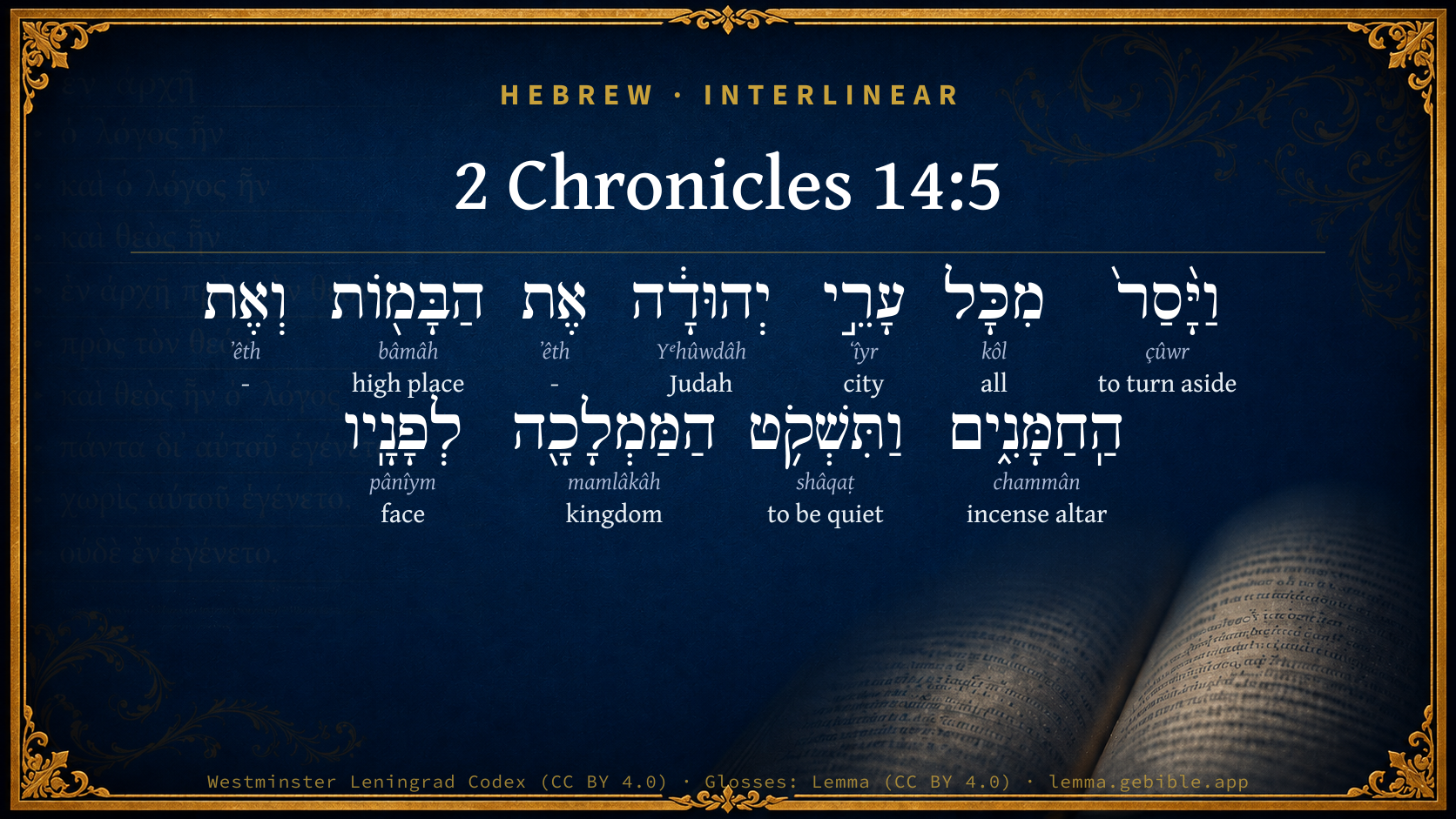
Hebrew (Westminster Leningrad Codex) 2 Chronicles 14:5 appears in the Hebrew Old Testament. The text above is from the Westminster Leningrad Codex. Each word links to its Strong’s number, a concise gloss, and parsing drawn from the Open Scriptures Hebrew Bible morphology. Click any word for its full Brown-Driver-Briggs (BDB) entry.
Download image
Cite this verse

2 Chronicles 14:5 (World English Bible). Public Domain. Lemma interlinear Bible study tool, https://lemma.gebible.app/v/2-chronicles/14/5.

Show BibTeX & RIS
BibTeX
RIS
English Translation
Also he took away out of all the cities of Judah the high places and the sun-images: and the kingdom was quiet before him.
World English Bible · Public Domain
Download a study sheet

One document with this verse’s original text, its word-by-word gloss line, the meaning frame, cross-references with their text, attributed commentary, and full source and license credits — printable, and it pastes into notes with its structure intact.

This verse Autodidact and up

Study sheet (.html) Plain text (.txt)

A passage Seminary Student

Up to 50 verses in one chapter. A passage sheet keeps up to 6 commentary sources and 12 cross-references per verse, in the order this page ranks them, and says so on the sheet whenever that leaves anything out. Ask for a single verse and you get the Autodidact verse sheet above.

Everything on this page stays free to read, with no account — the sheet is a download of what is already on screen, not access to it.

Want to remove ads? Support Godless Engineer
Compare translations 3

The same verse in 3 English versions, stacked beneath the original-language interlinear above. Click any original word for its lexicon entry.

Each is an independent rendering of the whole verse — the interlinear is not word-aligned to these translations.

Highlighted words mark where these versions differ — a whole-verse word diff, not a word-by-word alignment.

  • World English Bible Public Domain
    Also he took away out of all the cities of Judah the high places and the sun-images: and the kingdom was quiet before him.
  • King James Version Public Domain
    Also he took away out of all the cities of Judah the high places and the images: and the kingdom was quiet before him.
  • unfoldingWord Literal Text CC BY-SA 4.0
    And he took away from all the cities of Judah the high places and the incense altars. And the kingdom was quiet before him.

unfoldingWord Literal Text — © unfoldingWord, licensed CC BY-SA 4.0. Word-aligned USFM3 via Door43 (git.door43.org/unfoldingWord/en_ult).

Versions to compare (up to 4)

3 of 4 selected

Show all 18 translations

Every available English version of this verse, each an independent rendering of the whole verse.

  • World English Bible Public Domain
    Also he took away out of all the cities of Judah the high places and the sun-images: and the kingdom was quiet before him.
  • Berean Standard Bible Public Domain
    He also removed the high places and incense altars from all the cities of Judah, and under him the kingdom was at peace.
  • Majority Standard Bible Public Domain
    He also removed the high places and incense altars from all the cities of Judah, and under him the kingdom was at peace.
  • King James Version Public Domain
    Also he took away out of all the cities of Judah the high places and the images: and the kingdom was quiet before him.
  • American Standard Version (1901) Public Domain
    Also he took away out of all the cities of Judah the high places and the sun-images: and the kingdom was quiet before him.
  • Revised Version (1885) Public Domain
    Also he took away out of all the cities of Judah the high places and the sun-images: and the kingdom was quiet before him.
  • Geneva Bible (1599) Public Domain
    And he tooke away out of all the cities of Iudah the hie places, and the images: therefore the kingdome was quiet before him.
  • Douay-Rheims (1899) Public Domain
    And he took away out of all the cities of Juda the altars, and temples, and reigned in peace.
  • Young's Literal Translation Public Domain
    and he turneth aside out of all cities of Judah the high places and the images, and the kingdom is quiet before him.
  • Literal Standard Version CC BY-SA 4.0
    and he turns aside the high places and the images out of all cities of Judah, and the kingdom is quiet before him.
  • Unlocked Literal Bible CC BY-SA 4.0
    Also he took away the high places and the incense altars from all the cities of Judah. The kingdom had rest under him.
  • unfoldingWord Literal Text CC BY-SA 4.0
    And he took away from all the cities of Judah the high places and the incense altars. And the kingdom was quiet before him.
  • Darby Bible Public Domain
    And he removed out of all the cities of Judah the high places and the sun-images; and the kingdom was quiet before him.
  • World Messianic Bible Public Domain
    Also he took away out of all the cities of Judah the high places and the sun images; and the kingdom was quiet before him.
  • Webster's Bible Public Domain
    Also he took away out of all the cities of Judah the high places and the images: and the kingdom was quiet before him.
  • Free Bible Version CC BY-SA 4.0
    He also took down the high places and the incense altars from all the towns of Judah. Under his rule the kingdom was at peace.
  • Bible in Basic English Public Domain
    And he took away the high places and the sun-images from all the towns of Judah; and the kingdom was quiet under his rule.
  • JPS Tanakh (1917) Public Domain
    (14-4) Also he took away out of all the cities of Judah the high places and the sun-images; and the kingdom was quiet before him.

Literal Standard Version (2020), Covenant Press — licensed CC BY-SA 4.0. Text via the HelloAO Bible API (eBible.org). Unlocked Literal Bible (unfoldingWord) — licensed CC BY-SA 4.0. Text via the HelloAO Bible API (eBible.org). unfoldingWord Literal Text — © unfoldingWord, licensed CC BY-SA 4.0. Word-aligned USFM3 via Door43 (git.door43.org/unfoldingWord/en_ult). Free Bible Version, Dr. Jonathan Gallagher — licensed CC BY-SA 4.0. Text via the HelloAO Bible API (eBible.org).

Word by word

More ways to search: Search by grammar → Find every occurrence → Compare this word →

Practice this passage: Drill this verse → Learn its vocabulary →

הַֽחַמָּנִ֑ים
chammân
H2553
“the · incense altars”
Particle, Definite Article + Noun, Common, Masculine, Plural, Absolute
Part of Speech
Particle + Noun
Type
Common
Gender
Masculine
Number
Plural
State
Absolute
Full BDB Definition

Origin: from H2535

TWOT: TWOT- 677d

incense altar, sun-pillar, idol, image - used in idolatrous worship
  1. וַיָּ֨סַר֙ çûwr H5493 “and · to turn aside” Conjunction + Verb, Hiphil, Sequential Imperfect, 3rd Person, Masculine, Singular
  2. מִכָּל kôl H3605 “from · all of” Preposition + Noun, Common, Masculine, Singular, Construct
  3. עָרֵ֣י ʻîyr H5892 “cities of” Noun, Common, Feminine, Plural, Construct
  4. יְהוּדָ֔ה Yᵉhûwdâh H3063 “Judah” Noun, Proper
  5. אֶת ʼêth H853 “-” Particle, Direct Object
  6. הַבָּמ֖וֹת bâmâh H1116 “the · high places” Particle, Definite Article + Noun, Common, Feminine, Plural, Absolute
  7. וְאֶת ʼêth H853 “and · -” Conjunction + Particle, Direct Object
  8. וַתִּשְׁקֹ֥ט shâqaṭ H8252 “and · to be quiet” Conjunction + Verb, Qal, Sequential Imperfect, 3rd Person, Feminine, Singular
  9. הַמַּמְלָכָ֖ה mamlâkâh H4467 “the · kingdom” Particle, Definite Article + Noun, Common, Feminine, Singular, Absolute
  10. לְפָנָֽיו pânîym H6440 “to/for · face(s) · his” Preposition + Noun, Common, Both, Plural, Construct + Suffix, Personal, 3rd Person, Masculine, Singular

About this verse

These counts appear in no published source. They are computed here, from the morphology-tagged text and Lemma’s own curated glosses. What Lemma adds →

11
words
10
distinct lemmas
Historical
section

Notable vocabulary

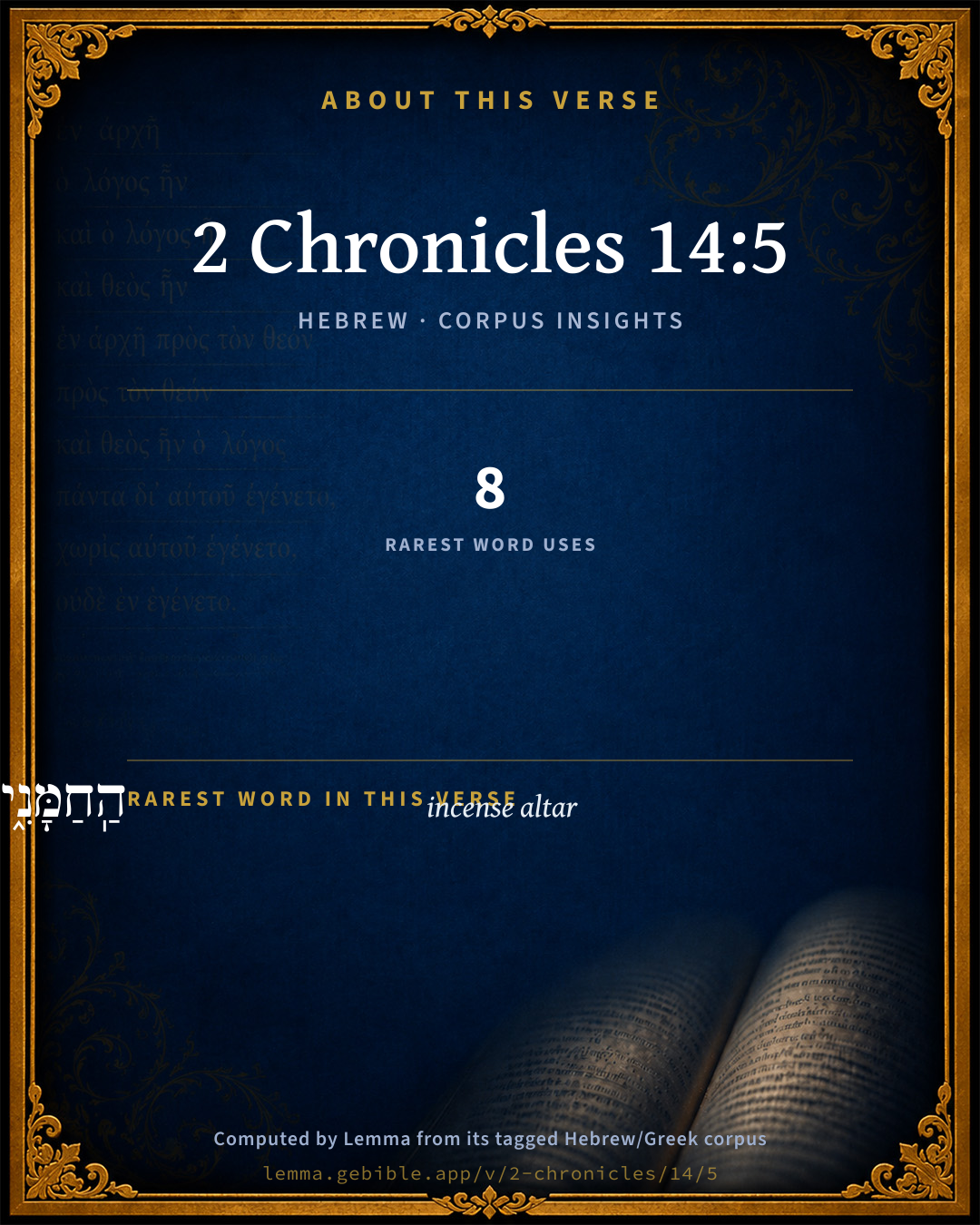
The rarest word here is הַֽחַמָּנִ֑ים incense altar H2553 — appearing just 8 times in the whole Hebrew Bible.

Shared distinctive vocabulary

הַֽחַמָּנִ֑ים incense altar H2553 occurs in 8 verses of the Hebrew Bible. Also found in:

Grammatical profile

  • 2 verbs
  • 7 nouns
  • 2 particles

Verb forms

  • וַיָּ֨סַר֙ Hiphil · Sequential Imperfect
  • וַתִּשְׁקֹ֥ט Qal · Sequential Imperfect

Hebrew & Septuagint length

In English translation the verse runs 24 words from the Hebrew and 18 from the Septuagint (LXX English) — closely comparable.

A rough comparison of the two English renderings, which tokenize alike — not a word-level alignment.

Word counts can differ between the Hebrew and the Greek without any difference in meaning — e.g. the Hebrew direct-object marker אֵת has no separate Greek word, and Greek often adds the article ὁ.

Cross-references

2

Topical passages linked to 2 Chronicles 14:5 in the Treasury of Scripture Knowledge — connected by theme and wording, ordered by reader-vote popularity; previews shown in the World English Bible.

  • 2 Chronicles 34:4 They broke down the altars of the Baals in his presence; and the sun-images that were on high above them he hewed down; and the Asherim, and the engraved images, and the molten images, he broke in pieces, and made dust of them, and strewed it on the graves [of those] who had sacrificed to them.
  • 2 Chronicles 34:7 He broke down the altars, and beat the Asherim and the engraved images into powder, and hewed down all the sun-images throughout all the land of Israel, and returned to Jerusalem.

Cross-references courtesy of OpenBible.info (CC BY 4.0).

Hebrew and Greek witnesses Masoretic Hebrew ↔ Greek Septuagint

The same verse in the two great witnesses to the Old Testament, shown verse-for-verse.

These are two independent witnesses, not word-aligned to each other, and the Septuagint is shown in lemma (dictionary) form.

Hebrew 2 Chronicles 14:5 Masoretic · Westminster Leningrad Codex

וַיָּ֨סַר֙ מִכָּל עָרֵ֣י יְהוּדָ֔ה אֶת הַבָּמ֖וֹת וְאֶת הַֽחַמָּנִ֑ים וַתִּשְׁקֹ֥ט הַמַּמְלָכָ֖ה לְפָנָֽיו

Also he took away out of all the cities of Judah the high places and the sun-images: and the kingdom was quiet before him.

World English Bible · Public Domain

Greek LXX 2 Chronicles 14:5 Septuagint · lemma form

πόλις τειχήρης ἐν γῆ ἰουδά ὅτι εἰρηνεύω ὁ γῆ καί οὐ εἰμί αὐτός πόλεμος ἐν ὁ ἔτος οὗτος ὅτι καταπαύω αὐτός κύριος

And he removed from all the cities of Juda the altars and the idols, and established in quietness

LXX2012 (modern English Septuagint) · Public Domain

Hebrew: Westminster Leningrad Codex (CC BY 4.0). Greek: Septuagint (public domain); English from LXX2012 (modern English Septuagint) (Public Domain). How the Septuagint differs from the Hebrew →

Commentary

Notes on 2 Chronicles 14:5 from classic Christian and Jewish commentators (each source and its license shown beneath its notes). The classic Christian expositions comment on the surrounding passage and are grouped to its opening verse, so a note may address several verses; the Jewish commentaries on the Tanakh (Rashi and others) are per-verse, so they appear only where the commentator wrote on this verse.

Lemma curates 59 commentaries, every one of them public domain or Creative Commons licensed, each selected and text-cleaned for this edition rather than reprinted as found. About our sources →

Trapp's Complete Commentary

John Trapp

2Ch 14:5 Also he took away out of all the cities of Judah the high places and the images: and the kingdom was quiet before him.

Ver. 5. And the images.] Heb., The sun images: Hammonim, the images of Jupiter Ammon, as some {a} will have it.

{a} A Lapide.

John Trapp, A Commentary or Exposition upon All the Books of the Old and New Testament (1647–1656) — public domain. Text from a community e-Sword module.

Geneva Bible (1599)

Geneva Bible translators

He showeth that the rest and quietness of kingdoms standeth in abolishing idolatry, and advancing true religion.

Geneva Bible (1599) marginal notes — public domain. Text via Bolls.life.

Jamieson, Fausset & Brown

Robert Jamieson, A. R. Fausset & David Brown

he took away . . . the high places--that is, those devoted to idolatrous rites.

took away out of all the cities of Judah the high places and the images--All public objects and relics of idolatry in Jerusalem and other cities through his kingdom were destroyed; but those high places where God was worshipped under the figure of an ox, as at Beth-el, were allowed to remain (Kg1 15:14); so far the reformation was incomplete.

Jamieson, Fausset & Brown — Commentary Critical and Explanatory on the Whole Bible (1871) — public domain (CC PDM 1.0). Text via the HelloAO Bible API.

The Cambridge Bible for Schools and Colleges

gen. ed. J. J. S. Perowne

5. the images] R.V. the sun-images. Cp. 2Ch_34:4; Isa_17:8; Isa_27:9, The Heb. word (“ḥamman”) is of uncertain meaning, and it is possible that no kind of image is meant, but rather the hearth on which the sacred fire was kept. The Heb. root means “to be hot.” (W. R. Smith, Religion of the Semites, p. 489.)

The Cambridge Bible for Schools and Colleges (gen. ed. J. J. S. Perowne; Cambridge University Press, 1878–1918) — public domain. Text from a community e-Sword module.

John Gill's Exposition

And he built fenced cities in Judah,.... For his defence against the kingdom of Israel and other nations, as Rehoboam had done before him; and which might have been demolished by Shishak king of Egypt, when he took them, Ch2 11:5.

for the land had rest; according to the Targum, the land of Israel rested, and gave no disturbance to the kingdom of Judah, not having recovered the blow given them by Abijah; but it is rather to be understood of the land of Judah, which, as it did not attempt the reduction of the ten tribes, so it was neither attacked by them, nor any other enemy: and he had no war in those years; in the ten years mentioned, Ch2 14:1, neither with Israel nor any other nation: because the Lord had given him rest; that he might be at leisure to do the above things; all rest is from the Lord, civil, spiritual, and eternal.

John Gill's Exposition of the Whole Bible (1746–1763) — public domain (CC PDM 1.0). Text via the HelloAO Bible API.

Albert Barnes' Notes on the Bible

Images - See the margin, sun-images; and Lev 26:30 note.

Albert Barnes' Notes on the Bible (1834–1885) — public domain. Text from a community e-Sword/MySword module.

Haydock's Catholic Bible Commentary

Altars. Hebrew, "high places, and the Chamanim," or temple of the sun, Leviticus xxvi. 30. (Calmet) --- Protestants, "images." (Haydock) --- Asa was encouraged to perfect the work which he had begun, by the exhortation of Azarias, chap. xv. 8. (Calmet)

George Leo Haydock (1774–1849), Haydock's Catholic Family Bible and Commentary, 1859 edition — public domain. Excludes Psalms (Douay-Rheims chapter numbering differs from Protestant) and Deuterocanonical books (Catholic canon only).

The Pulpit Commentary

The images; Hebrew, The images spoken of here are, of coarse, not the same with those (noted upon already) of ver. 3. The present khammanim are mentioned seven times beside, viz. 2Ch_34:4, 2Ch_34:7; Isa_17:8 Isa_27:9; Eze_6:4, Eze_6:6.

Gesenius says Khamman is an epithet of Baal as bearing rule over the sun (hm; j,"heat," or "the sun"), in the oft-found compound expression, Mj lBo; he thinks the plural ( invariably found in the Old Testament, is short for He does not agree with the translation of Haenaker ("Miscell. Phoen.," p. 50), "sun-image" by aid of the word ls,p, understood, images said to have been of a pyramid form, and placed in the most sacred positions of Baal-temples. This, however, is the rendering adopted by not a few modern commentators. (so 2Ch_34:4) Gesenius would render "the Sun-Bard," or "the Sun-Lord," i.e. statues of the sun, representing a deity to whom (see "Phoen. Inseript.") votive stones,were inscribed. In his "Thesaurus" (p. 489) Gesenius instances the Phoenician inscriptions, as showing that our chemmanim denoted statues of both Baal, the sun-god, and Astarte, the moon-goddess.

The Pulpit Commentary (1880–1919), ed. H.D.M. Spence-Jones & Joseph S. Exell — public domain. Text from a community e-Sword module.

unfoldingWord translationNotes

Door43 World Missions Community

he took away the high places ... He built fortified cities

Since Asa was king, he may have told his officials to do these things. AT: "he had his people take away the high places ... He had his workers build fortified cities" (See: Metonymy)

The kingdom had rest under him

There being no war is spoken of as if the kingdom had rest. AT: "The kingdom had peace under him" (See: Metaphor)

under him

"under his reign." A king ruling a kingdom is spoken of as if the king is over the kingdom or the kingdom is under the king. AT: "during his reign" or "while he was king" (See: Metaphor)

the land was quiet

There being no war is spoken of as if the land were quiet. AT: "there was peace in the land" (See: Metaphor)

translationWords

high place

incense

altar

Judah

kingdom

peace

unfoldingWord translationNotes — © Distant Shores Media and the Door43 World Missions Community, licensed CC BY-SA 4.0. Source: git.door43.org/Door43/en_tn.

Lesson kit

Teaching starters — assembled from the data on this page, not authored interpretation. Every prompt links to the verse data it draws on. Edit before teaching.

2 Chronicles, in the Historical, opens this verse with 11 words (10 distinct Hebrew lemmas). Its most distinctive word is chammân (“incense altar”). A historical commentator’s framing appears above. Read the whole chapter for the surrounding context.

Discussion questions

  1. How does “incense altar” (chammân) shape what this verse is saying?
  2. Leviticus 26:30 shares the word «incense altar» with this verse. How do the two illuminate each other?
  3. The translations on this page render this verse differently — a whole-verse word diff, not a word-by-word alignment. What might account for the different wordings?
  4. The verb «וַיָּ֨סַר֙» is Hiphil Sequential Imperfect. How does its form color the action?
  5. Reading how Trapp's Complete Commentary and Geneva Bible (1599) read this verse, where do the two commentators agree and where do they part?

Things to notice

Reading settings

Reading text

Shown beneath each verse's original-language words.

Old Testament
Old Testament edition

Read the OT as the Masoretic Hebrew (MT) or the Greek Septuagint (LXX).

English shown for the Greek Septuagint (in the Hebrew ↔ Greek comparison).

Comparing translations? Open the Compare panel on any verse page to stack up to four side by side.