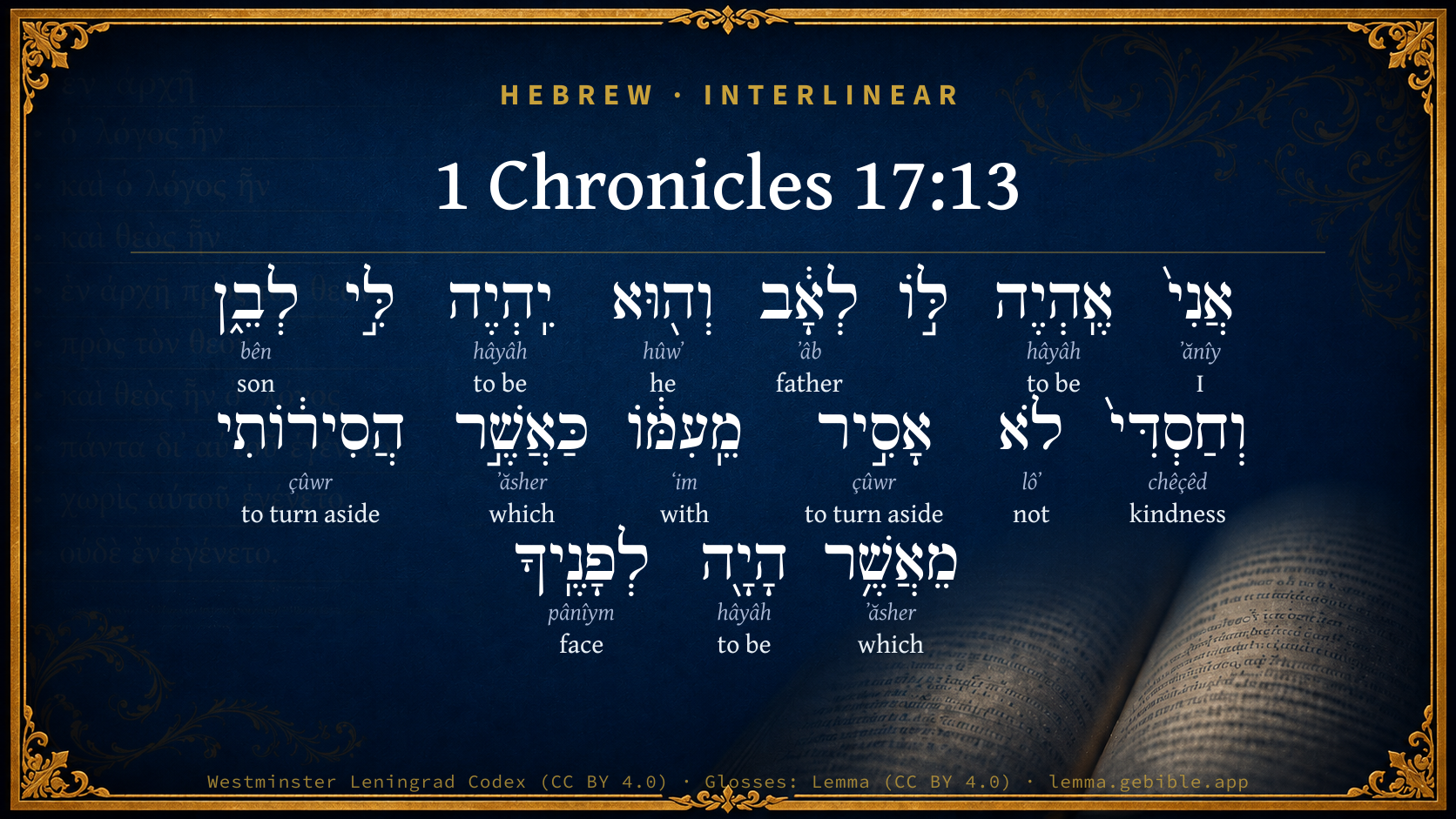
1 Chronicles 17:13

Hebrew (Westminster Leningrad Codex) 1 Chronicles 17:13 appears in the Hebrew Old Testament. The text above is from the Westminster Leningrad Codex. Each word links to its Strong’s number, a concise gloss, and parsing drawn from the Open Scriptures Hebrew Bible morphology. Click any word for its full Brown-Driver-Briggs (BDB) entry.
Download image
Cite this verse

1 Chronicles 17:13 (World English Bible). Public Domain. Lemma interlinear Bible study tool, https://lemma.gebible.app/v/1-chronicles/17/13.

Show BibTeX & RIS
BibTeX
RIS
English Translation
I will be his father, and he shall be my son: and I will not take my loving kindness away from him, as I took it from him that was before you;
World English Bible · Public Domain
Download a study sheet

One document with this verse’s original text, its word-by-word gloss line, the meaning frame, cross-references with their text, attributed commentary, and full source and license credits — printable, and it pastes into notes with its structure intact.

This verse Autodidact and up

Study sheet (.html) Plain text (.txt)

A passage Seminary Student

Up to 50 verses in one chapter. A passage sheet keeps up to 6 commentary sources and 12 cross-references per verse, in the order this page ranks them, and says so on the sheet whenever that leaves anything out. Ask for a single verse and you get the Autodidact verse sheet above.

Everything on this page stays free to read, with no account — the sheet is a download of what is already on screen, not access to it.

Want to remove ads? Support Godless Engineer
Compare translations 3

The same verse in 3 English versions, stacked beneath the original-language interlinear above. Click any original word for its lexicon entry.

Each is an independent rendering of the whole verse — the interlinear is not word-aligned to these translations.

Highlighted words mark where these versions differ — a whole-verse word diff, not a word-by-word alignment.

  • World English Bible Public Domain
    I will be his father, and he shall be my son: and I will not take my loving kindness away from him, as I took it from him that was before you;
  • King James Version Public Domain
    I will be his father, and he shall be my son: and I will not take my mercy away from him, as I took it from him that was before thee:
  • unfoldingWord Literal Text CC BY-SA 4.0
    I, I will be a father to him, and he, he will be a son to me. And I will not turn away my covenant faithfulness from with him as I turned away from who was to your face.

unfoldingWord Literal Text — © unfoldingWord, licensed CC BY-SA 4.0. Word-aligned USFM3 via Door43 (git.door43.org/unfoldingWord/en_ult).

Versions to compare (up to 4)

3 of 4 selected

Show all 18 translations

Every available English version of this verse, each an independent rendering of the whole verse.

  • World English Bible Public Domain
    I will be his father, and he shall be my son: and I will not take my loving kindness away from him, as I took it from him that was before you;
  • Berean Standard Bible Public Domain
    I will be his Father, and he will be My son. And I will never remove My loving devotion from him as I removed it from your predecessor.
  • Majority Standard Bible Public Domain
    I will be his Father, and he will be My son. And I will never remove My loving devotion from him as I removed it from your predecessor.
  • King James Version Public Domain
    I will be his father, and he shall be my son: and I will not take my mercy away from him, as I took it from him that was before thee:
  • American Standard Version (1901) Public Domain
    I will be his father, and he shall be my son: and I will not take my lovingkindness away from him, as I took it from him that was before thee;
  • Revised Version (1885) Public Domain
    I will be his father, and he shall be my son: and I will not take my mercy away from him, as I took it from him that was before thee:
  • Geneva Bible (1599) Public Domain
    I wil be his father, and he shalbe my sonne, aud I will not take my mercie away from him, as I tooke it from him that was before thee.
  • Douay-Rheims (1899) Public Domain
    I will be to him a father, and he shall be to me a son: and I will not take my mercy away from him, as I took it from him that was before thee.
  • Young's Literal Translation Public Domain
    I am to him for a father, and he is to Me for a son, and My kindness I turn not aside from him as I turned it aside from him who was before thee,
  • Literal Standard Version CC BY-SA 4.0
    I am to him for a father, and he is to Me for a son, and I do not turn aside My kindness from him as I turned it aside from him who was before you,
  • Unlocked Literal Bible CC BY-SA 4.0
    I will be a father to him, and he will be my son. I will not take my covenant faithfulness away from him, as I took it from Saul, who ruled before you.
  • unfoldingWord Literal Text CC BY-SA 4.0
    I, I will be a father to him, and he, he will be a son to me. And I will not turn away my covenant faithfulness from with him as I turned away from who was to your face.
  • Darby Bible Public Domain
    I will be his father, and he shall be my son; and I will not take away my mercy from him, as I took it from him that was before thee;
  • World Messianic Bible Public Domain
    I will be his father, and he will be my son. I will not take my loving kindness away from him, as I took it from him who was before you;
  • Webster's Bible Public Domain
    I will be his father, and he shall be my son: and I will not take my mercy away from him, as I took it from him that was before thee:
  • Free Bible Version CC BY-SA 4.0
    I will be a father to him, and he will be a son to me. I will never take away my kindness and love from him, as I did in the case of the one who ruled before you.
  • Bible in Basic English Public Domain
    I will be to him a father and he will be to me a son; and I will not take my mercy away from him as I took it from him who was before you;
  • JPS Tanakh (1917) Public Domain
    I will be to him for a father, and he shall be to Me for a son; and I will not take My mercy away from him, as I took it from him that was before thee;

Literal Standard Version (2020), Covenant Press — licensed CC BY-SA 4.0. Text via the HelloAO Bible API (eBible.org). Unlocked Literal Bible (unfoldingWord) — licensed CC BY-SA 4.0. Text via the HelloAO Bible API (eBible.org). unfoldingWord Literal Text — © unfoldingWord, licensed CC BY-SA 4.0. Word-aligned USFM3 via Door43 (git.door43.org/unfoldingWord/en_ult). Free Bible Version, Dr. Jonathan Gallagher — licensed CC BY-SA 4.0. Text via the HelloAO Bible API (eBible.org).

Word by word

More ways to search: Search by grammar → Find every occurrence → Compare this word →

Practice this passage: Drill this verse → Learn its vocabulary →

וְחַסְדִּי֙
chêçêd
H2617
“and · kindness · my”
Conjunction + Noun, Common, Masculine, Singular, Construct + Suffix, Personal, 1st Person, Common, Singular
Part of Speech
Conjunction + Noun
Type
Common
Gender
Masculine
Number
Singular
State
Construct
Full BDB Definition

Origin: from H2616

TWOT: 698a , 699a

goodness, kindness, faithfulness - a reproach, shame
  1. אֲנִי֙ ʼănîy H589 “I” Pronoun, Personal, 1st Person, Common, Singular
  2. אֶֽהְיֶה hâyâh H1961 “to be” Verb, Qal, Imperfect, 1st Person, Common, Singular
  3. לְאָ֔ב ʼâb H1 “to/for · father” Preposition + Noun, Common, Masculine, Singular, Absolute
  4. וְה֖וּא hûwʼ H1931 “and · he” Conjunction + Pronoun, Personal, 3rd Person, Masculine, Singular
  5. יִֽהְיֶה hâyâh H1961 “to be” Verb, Qal, Imperfect, 3rd Person, Masculine, Singular
  6. לְבֵ֑ן bên H1121 “to/for · son” Preposition + Noun, Common, Masculine, Singular, Absolute
  7. לֹא lôʼ H3808 “not” Particle, Negative
  8. אָסִ֣יר çûwr H5493 “to turn aside” Verb, Hiphil, Imperfect, 1st Person, Common, Singular
  9. מֵֽעִמּ֔וֹ ʻim H5973 “from · with · him” Preposition + Preposition + Suffix, Personal, 3rd Person, Masculine, Singular
  10. כַּאֲשֶׁ֣ר ʼăsher H834 “like/as · which” Preposition + Particle, Relative
  11. הֲסִיר֔וֹתִי çûwr H5493 “to turn aside” Verb, Hiphil, Perfect, 1st Person, Common, Singular
  12. מֵאֲשֶׁ֥ר ʼăsher H834 “from · which” Preposition + Particle, Relative
  13. הָיָ֖ה hâyâh H1961 “to be” Verb, Qal, Perfect, 3rd Person, Masculine, Singular
  14. לְפָנֶֽיךָ pânîym H6440 “to/for · face(s) · your” Preposition + Noun, Common, Both, Plural, Construct + Suffix, Personal, 2nd Person, Masculine, Singular

About this verse

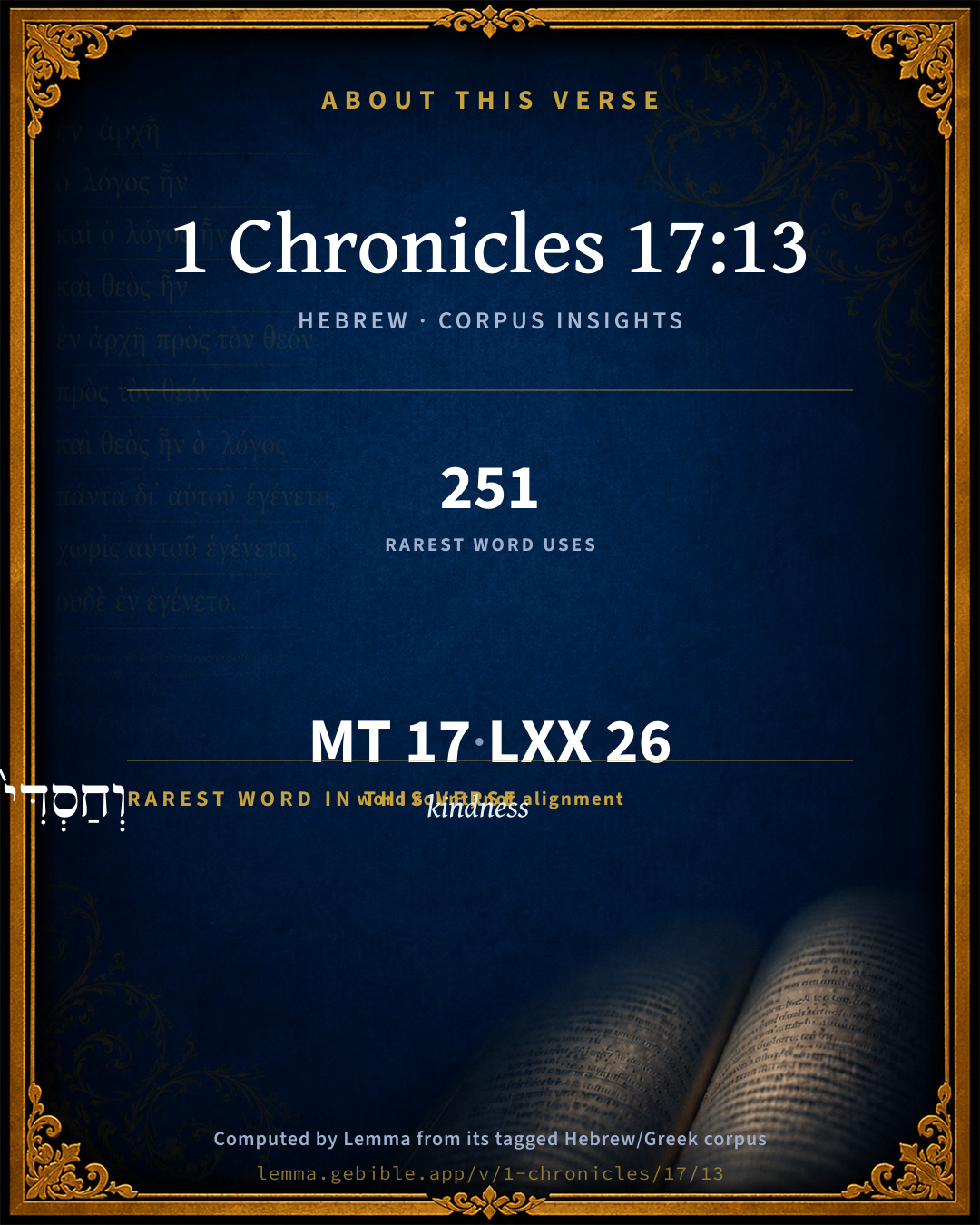
These counts appear in no published source. They are computed here, from the morphology-tagged text and Lemma’s own curated glosses. What Lemma adds →

17
words
11
distinct lemmas
Historical
section

Grammatical profile

  • 5 verbs
  • 4 nouns
  • 2 pronouns
  • 3 prepositions
  • 3 particles

Verb forms

  • אֶֽהְיֶה Qal · Imperfect
  • יִֽהְיֶה Qal · Imperfect
  • אָסִ֣יר Hiphil · Imperfect
  • הֲסִיר֔וֹתִי Hiphil · Perfect
  • הָיָ֖ה Qal · Perfect

Repetition

Words recur within this verse — often emphatic in Hebrew:

  • אֶֽהְיֶה to be H1961 ×3
  • אָסִ֣יר to turn aside H5493 ×2
  • כַּאֲשֶׁ֣ר which H834 ×2

Hebrew & Septuagint length

In English translation the verse runs 32 words from the Hebrew and 34 from the Septuagint (LXX English) — closely comparable.

A rough comparison of the two English renderings, which tokenize alike — not a word-level alignment.

Word counts can differ between the Hebrew and the Greek without any difference in meaning — e.g. the Hebrew direct-object marker אֵת has no separate Greek word, and Greek often adds the article ὁ.

In the original languages it is 17 Hebrew tokens and 26 Greek tokens — but the two are counted differently (Hebrew bundles its prefixes and suffixes into one token; the Greek is in lemma form), so that isn’t a like-for-like length.

Cross-references

15

Topical passages linked to 1 Chronicles 17:13 in the Treasury of Scripture Knowledge — connected by theme and wording, ordered by reader-vote popularity; previews shown in the World English Bible.

  • Hebrews 1:5 For to which of the angels did he say at any time, "You are my Son, Today have I become your father?" and again, "I will be to him a Father, And he will be to me a Son?"
  • Psalms 2:7 I will tell of the decree. Yahweh said to me, "You are my son. Today I have become your father.
  • 1 Samuel 15:28 Samuel said to him, Yahweh has torn the kingdom of Israel from you this day, and has given it to a neighbor of yours who is better than you.
  • 1 Chronicles 10:14 and didn't inquire of Yahweh: therefore he killed him, and turned the kingdom to David the son of Jesse.
  • 1 Chronicles 17:12 He shall build me a house, and I will establish his throne forever.
  • Psalms 2:12 Kiss the son, lest he be angry, and you perish in the way, For his wrath will soon be kindled. Blessed are all those who take refuge in him.
  • Isaiah 55:3 Turn your ear, and come to me; hear, and your soul shall live: and I will make an everlasting covenant with you, even the sure mercies of David.
  • 2 Corinthians 6:18 I will be to you a Father. You will be to me sons and daughters,' says the Lord Almighty."
  • 2 Samuel 7:14–16 I will be his father, and he shall be my son: if he commit iniquity, I will chasten him with the rod of men, and with the stripes of the children of men;
  • 1 Kings 11:12–13 Notwithstanding in your days I will not do it, for David your father's sake: but I will tear it out of the hand of your son.
  • 1 Kings 11:36 To his son will I give one tribe, that David my servant may have a lamp always before me in Jerusalem, the city which I have chosen me to put my name there.
  • Psalms 89:26–37 He will call to me, 'You are my Father, My God, and the rock of my salvation!'
  • Luke 1:32 He will be great, and will be called the Son of the Most High. The Lord God will give him the throne of his father, David,
  • Luke 9:35 A voice came out of the cloud, saying, "This is my beloved Son. Listen to him!"
  • John 3:35 The Father loves the Son, and has given all things into his hand.

Cross-references courtesy of OpenBible.info (CC BY 4.0).

Hebrew and Greek witnesses Masoretic Hebrew ↔ Greek Septuagint

The same verse in the two great witnesses to the Old Testament, shown verse-for-verse.

These are two independent witnesses, not word-aligned to each other, and the Septuagint is shown in lemma (dictionary) form.

Hebrew 1 Chronicles 17:13 Masoretic · Westminster Leningrad Codex

אֲנִי֙ אֶֽהְיֶה לּ֣וֹ לְאָ֔ב וְה֖וּא יִֽהְיֶה לִּ֣י לְבֵ֑ן וְחַסְדִּי֙ לֹא אָסִ֣יר מֵֽעִמּ֔וֹ כַּאֲשֶׁ֣ר הֲסִיר֔וֹתִי מֵאֲשֶׁ֥ר הָיָ֖ה לְפָנֶֽיךָ

I will be his father, and he shall be my son: and I will not take my loving kindness away from him, as I took it from him that was before you;

World English Bible · Public Domain

Greek LXX 1 Chronicles 17:13 Septuagint · lemma form

ἐγώ εἰμί αὐτός εἰς πατήρ καί αὐτός εἰμί ἐγώ εἰς υἱός καί ὁ ἔλεος ἐγώ οὐ ἀποἵστημι ἀπό αὐτός ὡς ἀποἵστημι ἀπό ὁ εἰμί ἔμπροσθεν σύ

I will be to him a father, and he shall be to me a son: and my mercy will I not withdraw from him, as I withdrew it from them that were before you.

LXX2012 (modern English Septuagint) · Public Domain

On this verse, Ellicott's Commentary for English Readers discusses the Septuagint’s reading. Read the note in Commentary ↓

Hebrew: Westminster Leningrad Codex (CC BY 4.0). Greek: Septuagint (public domain); English from LXX2012 (modern English Septuagint) (Public Domain). How the Septuagint differs from the Hebrew →

Commentary

Notes on 1 Chronicles 17:13 from classic Christian and Jewish commentators (each source and its license shown beneath its notes). The classic Christian expositions comment on the surrounding passage and are grouped to its opening verse, so a note may address several verses; the Jewish commentaries on the Tanakh (Rashi and others) are per-verse, so they appear only where the commentator wrote on this verse.

Lemma curates 59 commentaries, every one of them public domain or Creative Commons licensed, each selected and text-cleaned for this edition rather than reprinted as found. About our sources →

Tyndale Open Study Notes

Tyndale Open Resources

17:13 The Chronicler made this declaration about Solomon in particular (see 22:9; 28:5-6; cp. 2 Sam 7:14).

Tyndale Open Study Notes — © Tyndale Open Resources, licensed CC BY-SA 4.0. Text via the HelloAO Bible API.

Geneva Bible (1599)

Geneva Bible translators

Which was Saul.

Geneva Bible (1599) marginal notes — public domain. Text via Bolls.life.

Jamieson, Fausset & Brown

Robert Jamieson, A. R. Fausset & David Brown

I will not take my mercy away from him, as I took it from him that was before thee--My procedure in dealing with him will be different from My disposal of Saul. Should his misconduct call for personal chastisement, I shall spare his family. If I see it necessary to withdraw My favor and help for a time, it will be a corrective discipline only to reform and restore, not to destroy. (On this passage some have founded an argument for Solomon's repentance and return to God).

Jamieson, Fausset & Brown — Commentary Critical and Explanatory on the Whole Bible (1871) — public domain (CC PDM 1.0). Text via the HelloAO Bible API.

Adam Clarke's Commentary

Verse 13. I will not take my mercy away from him] I will not cut off his family from the throne, as I did that of his predecessor Saul.

Adam Clarke's Commentary on the Bible (1810–1826) — public domain. Text from a community e-Sword/MySword module.

Ellicott's Commentary for English Readers

(13) I will be his father . . .—Heb., I (on my part) will become a father unto him, and he (on his part) shall become a son to me. (Comp. Psa_2:7.) After these words, Samuel adds: “If he commit iniquity I will chasten him with the rod of men, and with the stripes of the children of men.” The omission is probably not a mere abridgment. The reference in this prophecy looks beyond Solomon to Him of whom the greatest princes of the house of David were but imperfect types. The warning here omitted was amply fulfilled in the history of Solomon and his successors but it could not apply to the true Anointed of Jehovah, and is therefore suppressed as a transitory element in the prophecy.

And I will not take my mercy away.—Samuel, “and my mercy shall not depart”—the same verb in a different form. But the LXX., Syriac, and Vulgate there agree with Chronicles.

As I took it (away) from him that was before thee.—Samuel, “as I took it away from Said whom I took away from before thee; “repeating the same verb thrice. Our text is probably more correct. So Vulg. and LXX. virtually; but Syriac, “My mercies shall not depart from him, as I made [them] depart from Saul who was before thee.”

A Bible Commentary for English Readers, edited by Charles John Ellicott (1878–1897) — public domain. Text from a community e-Sword module.

The Cambridge Bible for Schools and Colleges

gen. ed. J. J. S. Perowne

13. my son] Here Sam. adds, If he commit iniquity, I will chasten him with the rod of men and with the stripes of the children of men.

as I took it from him that was before thee] Sam. as I took it from Saul whom I put away before thee.

The Cambridge Bible for Schools and Colleges (gen. ed. J. J. S. Perowne; Cambridge University Press, 1878–1918) — public domain. Text from a community e-Sword module.

Albert Barnes' Notes on the Bible

My son - The minatory clause which occurs after this in Samuel is here omitted, because the writer is not about to record the sins of Solomon, or the sufferings 1 Kings 11:9-40 which he thereby brought upon himself.

Albert Barnes' Notes on the Bible (1834–1885) — public domain. Text from a community e-Sword/MySword module.

Haydock's Catholic Bible Commentary

Thee. The posterity of Saul lost the throne. (Haydock) --- If Solomon was reprobated, his children were permitted to reign. It is also presumed that he did penance; though this is not certain.

George Leo Haydock (1774–1849), Haydock's Catholic Family Bible and Commentary, 1859 edition — public domain. Excludes Psalms (Douay-Rheims chapter numbering differs from Protestant) and Deuterocanonical books (Catholic canon only).

The Pulpit Commentary

Father and son.

These words are by the author of the Epistle to the Hebrews applied to the Lord Jesus Christ, who was, in an especially and pre-eminent sense, the Son of God. Yet the context, and still more the parallel passage in the Second Book of Samuel, makes it evident that they were originally spoken with reference to Solomon. We are warranted, by the teaching of the New Testament, in applying them to all those who are children of God by faith in Christ Jesus, who have been adopted into the spiritual family, and made heirs of Divine promises. Of this glorious doctrine of the Divine Fatherhood, so clearly and powerfully revealed in the New Testament, there are intimations, such as the present, in various parts of the Old Testament Scriptures.

I IN WHAT GOD"S FATHERHOOD CONSISTS. This is shown to some extent in the context, and in the narrative of Solomon"s early life and reign. But generally speaking we may rejoice that the fatherhood of God is shown in:

1. His providential care. As a Father, our Creator supplies the wants, both temporal and spiritual, of his dependent family.

2. His tender love. There is more than goodness, more than bounty, in God"s treatment of his children. They have a moral nature able to appreciate kindness, forbearance, sympathy, and love. And, in his treatment of them, he has adapted his communications and his conduct to their spiritual need.

3. His wise discipline. It is distinctive of a true father"s sway, that it aims at the highest good of the children. God certainly appoints trials for his offspring, and he reveals to us the consolatory truth, "Whom he loveth he scourgeth, and chastensth every child whom he receiveth." When we suffer he is not insensible. "Like as a father pitieth his children, so the Lord pitieth them that fear him.

4. His purposes for his childrens future. As a father looks forward, and trains his son for the duties and responsibilities of after-life, so the great Father in heaven is maturing us for other scenes, higher employments, purer joys.

II WHAT HUMAN SONSHIP INVOLVES. A true son is sensible of his father"s watchful care, thoughtful kindness, tender affection. And he renders a filial return. In worship there is involved:

1. Gratitude. From God"s spiritual family there goes up to heaven a daily song of thanksgiving and praise, for favour and forbearance never failing.

2. Reverence and submission. The awful superiority of God must impress every just mind. The prayer offered will begin with the ascription, "Hallowed be thy Name.

3. Love. For, though so high, God is yet a Father, and "we love him,because he first loved us.

4. Obedience. This is the true test of filial reverence and of filial affection. There is no unfailing proof of love"s sincerity save this.

5. Likeness. For, born anew by God"s Spirit, God"s children are imitators of God, resembling him in the moral features of his holy and amiable character. Admire the glorious work of the Divine and gracious Spirit.

T.

The Pulpit Commentary (1880–1919), ed. H.D.M. Spence-Jones & Joseph S. Exell — public domain. Text from a community e-Sword module.

unfoldingWord translationNotes

Door43 World Missions Community

Connecting Statement:

Yahweh continues describing his promises to King David through the prophet Nathan.

I will be a father to him, and he will be my son

The prophecy in 1Ch 17:11-14 refers to Solomon, David's son. But, aspects of the prophecy will be fulfilled by Jesus. So, here it is best to translate the words "father" and "son" with your normal words for a biological father and son.

I will not take my covenant faithfulness away from him, as I took it from Saul

The abstract noun "faithfulness" can be translated as "faithfully." AT: "I will never stop faithfully loving him, as I stopped loving Saul" (See: Abstract Nouns)

I will set him over my house and in my kingdom forever, and his throne will be established forever

These two phrases have similar meanings and emphasize that David's dynasty will last forever. (See: Parallelism)

his throne will be established forever

This can be stated in active form. AT: "I will establish his throne forever" (See: Active or Passive)

his throne

A king's right to rule is referred to by the place a king sits. AT: "his right to rule" (See: Metonymy)

reported to him

"told him"

all these words

Here "words" represents what Yahweh said. (See: Metonymy)

translationWords

ancestor

son

covenant faithfulness

Saul (OT)

rule

house

Nathan

David

vision

unfoldingWord translationNotes — © Distant Shores Media and the Door43 World Missions Community, licensed CC BY-SA 4.0. Source: git.door43.org/Door43/en_tn.

Rashi

Rabbi Shlomo Yitzchaki (Rashi)

I shall be to him as a father, and he will be to Me as a son And in Samuel (II 7:14), it is written: “... so that when he goes astray, I will chasten him with the rod of men.” The meaning is that if he sins against Me, I will chasten him immediately, as a man who chastens his son with a rod of men, insofar that He raised up against him as adversaries Rezon and Hadad, and on that verse, it is appropriate to say, “... and I shall not remove My loving kindness from him as I removed it from [Saul] who was before you,” and when he sinned before Me, I removed the kingdom from him and from his seed. In Samuel (ibid. 15) it is written: “from Saul.” The reason it is not written here: “so that when he goes astray, etc.” is because of David’s honor, for he does not wish to speak of this in this Book, because it is denigrating to the house of David.

Rashi on the Tanakh — English translations: “The Judaica Press complete Tanach with Rashi, translated by A. J. Rosenberg” (CC BY 4.0); “Pentateuch with Rashi's commentary by M. Rosenbaum and A.M. Silbermann, 1929-1934” (public domain); “The Metsudah Tanach series, Lakewood, N.J” (CC BY 4.0); and “The Book of Joshua, Metsudah Publications, 1997” (CC BY 4.0). Text via Sefaria.

Lesson kit

Teaching starters — assembled from the data on this page, not authored interpretation. Every prompt links to the verse data it draws on. Edit before teaching.

1 Chronicles, in the Historical, opens this verse with 17 words (11 distinct Hebrew lemmas). Its most distinctive word is chêçêd (“kindness”). A historical commentator’s framing appears above. Read the whole chapter for the surrounding context.

Discussion questions

  1. What does “kindness” (chêçêd) contribute to the verse as a whole?
  2. How does Hebrews 1:5, which shares this passage’s theme, read alongside this verse?
  3. What does the repetition of “to be” (3× in this one verse) do in this verse?
  4. The translations on this page render this verse differently — a whole-verse word diff, not a word-by-word alignment. What might account for the different wordings?
  5. «אֶֽהְיֶה» is a Qal Imperfect verb. How does that grammatical form shape the action described?
  6. Compare how Tyndale Open Study Notes and Geneva Bible (1599) read this verse. Where do they agree or differ?

Things to notice

Reading settings

Reading text

Shown beneath each verse's original-language words.

Old Testament
Old Testament edition

Read the OT as the Masoretic Hebrew (MT) or the Greek Septuagint (LXX).

English shown for the Greek Septuagint (in the Hebrew ↔ Greek comparison).

Comparing translations? Open the Compare panel on any verse page to stack up to four side by side.