
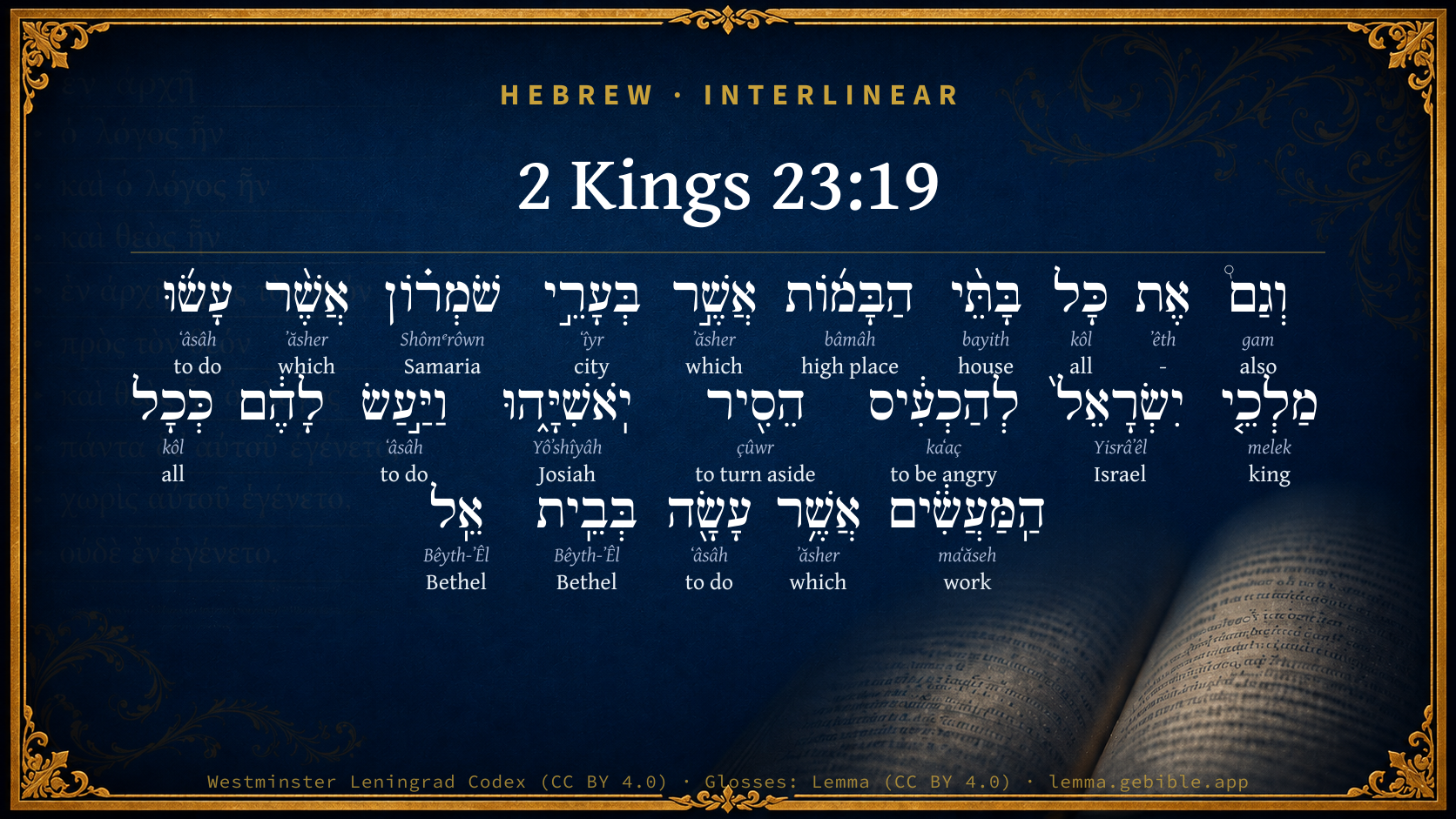
2 Kings 23:19

Hebrew (Westminster Leningrad Codex) 2 Kings 23:19 appears in the Hebrew Old Testament. The text above is from the Westminster Leningrad Codex. Each word links to its Strong’s number, a concise gloss, and parsing drawn from the Open Scriptures Hebrew Bible morphology. Click any word for its full Brown-Driver-Briggs (BDB) entry.
Download image
Cite this verse

2 Kings 23:19 (World English Bible). Public Domain. Lemma interlinear Bible study tool, https://lemma.gebible.app/v/2-kings/23/19.

Show BibTeX & RIS
BibTeX
RIS
English Translation
All the houses also of the high places that were in the cities of Samaria, which the kings of Israel had made to provoke [Yahweh] to anger, Josiah took away, and did to them according to all the acts that he had done in Bethel.
World English Bible · Public Domain
Download a study sheet

One document with this verse’s original text, its word-by-word gloss line, the meaning frame, cross-references with their text, attributed commentary, and full source and license credits — printable, and it pastes into notes with its structure intact.

This verse Autodidact and up

Study sheet (.html) Plain text (.txt)

A passage Seminary Student

Up to 50 verses in one chapter. A passage sheet keeps up to 6 commentary sources and 12 cross-references per verse, in the order this page ranks them, and says so on the sheet whenever that leaves anything out. Ask for a single verse and you get the Autodidact verse sheet above.

Everything on this page stays free to read, with no account — the sheet is a download of what is already on screen, not access to it.

Want to remove ads? Support Godless Engineer
Compare translations 3

The same verse in 3 English versions, stacked beneath the original-language interlinear above. Click any original word for its lexicon entry.

Each is an independent rendering of the whole verse — the interlinear is not word-aligned to these translations.

Highlighted words mark where these versions differ — a whole-verse word diff, not a word-by-word alignment.

  • World English Bible Public Domain
    All the houses also of the high places that were in the cities of Samaria, which the kings of Israel had made to provoke [Yahweh] to anger, Josiah took away, and did to them according to all the acts that he had done in Bethel.
  • King James Version Public Domain
    And all the houses also of the high places that were in the cities of Samaria, which the kings of Israel had made to provoke the Lord to anger, Josiah took away, and did to them according to all the acts that he had done in Bethel.
  • unfoldingWord Literal Text CC BY-SA 4.0
    And Josiah also removed all of the houses of the high places that in the cities of Samaria, which the kings of Israel had made, provoking anger. And he did to them like all of the works that he had done in Bethel.

unfoldingWord Literal Text — © unfoldingWord, licensed CC BY-SA 4.0. Word-aligned USFM3 via Door43 (git.door43.org/unfoldingWord/en_ult).

Versions to compare (up to 4)

3 of 4 selected

Show all 18 translations

Every available English version of this verse, each an independent rendering of the whole verse.

  • World English Bible Public Domain
    All the houses also of the high places that were in the cities of Samaria, which the kings of Israel had made to provoke [Yahweh] to anger, Josiah took away, and did to them according to all the acts that he had done in Bethel.
  • Berean Standard Bible Public Domain
    Just as Josiah had done at Bethel, so also in the cities of Samaria he removed all the shrines of the high places set up by the kings of Israel who had provoked the LORD to anger.
  • Majority Standard Bible Public Domain
    Just as Josiah had done at Bethel, so also in the cities of Samaria he removed all the shrines of the high places set up by the kings of Israel who had provoked the LORD to anger.
  • King James Version Public Domain
    And all the houses also of the high places that were in the cities of Samaria, which the kings of Israel had made to provoke the Lord to anger, Josiah took away, and did to them according to all the acts that he had done in Bethel.
  • American Standard Version (1901) Public Domain
    And all the houses also of the high places that were in the cities of Samaria, which the kings of Israel had made to provoke `Jehovah' to anger, Josiah took away, and did to them according to all the acts that he had done in Beth-el.
  • Revised Version (1885) Public Domain
    And all the houses also of the high places that were in the cities of Samaria, which the kings of Israel had made to provoke the LORD to anger, Josiah took away, and did to them according to all the acts that he had done in Beth-el.
  • Geneva Bible (1599) Public Domain
    Iosiah also tooke away all the houses of the hie places, which were in the cities of Samaria, which the Kings of Israel had made to anger the Lord, and did to them according to all the factes that he had done in Beth-el.
  • Douay-Rheims (1899) Public Domain
    Moreover all the temples of the high places, which were in the cities of Samaria, which the kings of Israel had made to provoke the Lord, Josias took away: and he did to them according to all the acts that he had done in Bethel.
  • Young's Literal Translation Public Domain
    And also all the houses of the high places that `are' in the cities of Samaria, that the kings of Israel made to provoke to anger, hath Josiah turned aside, and doth to them according to all the deeds that he did in Beth-El.
  • Literal Standard Version CC BY-SA 4.0
    And also all the houses of the high places that [are] in the cities of Samaria, that the kings of Israel made to provoke to anger, Josiah has turned aside, and does to them according to all the deeds that he did in Beth-El.
  • Unlocked Literal Bible CC BY-SA 4.0
    Then Josiah removed all the houses on the high places that were in the cities of Samaria, which the kings of Israel had made, and that provoked Yahweh to anger. He did to them exactly what had been done at Bethel.
  • unfoldingWord Literal Text CC BY-SA 4.0
    And Josiah also removed all of the houses of the high places that in the cities of Samaria, which the kings of Israel had made, provoking anger. And he did to them like all of the works that he had done in Bethel.
  • Darby Bible Public Domain
    And all the houses also of the high places that were in the cities of Samaria, which the kings of Israel had made to provoke [Jehovah] to anger, Josiah removed, and did to them according to all the acts that he had done in Bethel.
  • World Messianic Bible Public Domain
    All the houses also of the high places that were in the cities of Samaria, which the kings of Israel had made to provoke the LORD to anger, Josiah took away, and did to them according to all the acts that he had done in Bethel.
  • Webster's Bible Public Domain
    And all the houses also of the high places that were in the cities of Samaria, which the kings of Israel had made to provoke the LORD to anger, Josiah took away, and did to them according to all the acts that he had done in Beth-el.
  • Free Bible Version CC BY-SA 4.0
    Josiah destroyed, just as he did at Bethel, all the shrines of the high places in the towns of Samaria that the kings of Israel had built that had angered the Lord.
  • Bible in Basic English Public Domain
    Then Josiah took away all the houses of the high places in the towns of Samaria, which the kings of Israel had put up, moving the Lord to wrath, and he did with them as he had done in Beth-el.
  • JPS Tanakh (1917) Public Domain
    And all the houses also of the high places that were in the cities of Samaria, which the kings of Israel had made to provoke the LORD, Josiah took away, and did to them according to all the acts that he had done in Beth-el.

Literal Standard Version (2020), Covenant Press — licensed CC BY-SA 4.0. Text via the HelloAO Bible API (eBible.org). Unlocked Literal Bible (unfoldingWord) — licensed CC BY-SA 4.0. Text via the HelloAO Bible API (eBible.org). unfoldingWord Literal Text — © unfoldingWord, licensed CC BY-SA 4.0. Word-aligned USFM3 via Door43 (git.door43.org/unfoldingWord/en_ult). Free Bible Version, Dr. Jonathan Gallagher — licensed CC BY-SA 4.0. Text via the HelloAO Bible API (eBible.org).

Word by word

More ways to search: Search by grammar → Find every occurrence → Compare this word →

Practice this passage: Drill this verse → Learn its vocabulary →

יֹֽאשִׁיָּ֑הוּ
Yôʼshîyâh
H2977
“Josiah”
Noun, Proper
Part of Speech
Noun
Type
Proper
Full BDB Definition

Origin: from the same root as H803 and H3050

TWOT: None

Josiah = "whom Jehovah heals" - son of Amon by Jedidah who succeeded his father to the throne of Judah and reigned for 31 years; his reign is noteworthy for the great revivals back to the worship of Jehovah which he led - a returned exile and son of Zephaniah at whose house took place the solemn and symbolical crowning of Joshua the high priest in the time of Zechariah the prophet
  1. וְגַם֩ gam H1571 “and · also” Conjunction + Particle, Accusative
  2. אֶת ʼêth H853 “-” Particle, Direct Object
  3. כָּל kôl H3605 “all of” Noun, Common, Masculine, Singular, Construct
  4. בָּתֵּ֨י bayith H1004 “houses of” Noun, Common, Masculine, Plural, Construct
  5. הַבָּמ֜וֹת bâmâh H1116 “the · high places” Particle, Definite Article + Noun, Common, Feminine, Plural, Absolute
  6. אֲשֶׁ֣ר ʼăsher H834 “which” Particle, Relative
  7. בְּעָרֵ֣י ʻîyr H5892 “in/at · cities of” Preposition + Noun, Common, Feminine, Plural, Construct
  8. שֹׁמְר֗וֹן Shômᵉrôwn H8111 “Samaria” Noun, Proper
  9. אֲשֶׁ֨ר ʼăsher H834 “which” Particle, Relative
  10. עָשׂ֜וּ ʻâsâh H6213 “to do” Verb, Qal, Perfect, 3rd Person, Common, Plural
  11. מַלְכֵ֤י melek H4428 “kings of” Noun, Common, Masculine, Plural, Construct
  12. יִשְׂרָאֵל֙ Yisrâʼêl H3478 “Israel” Noun, Proper
  13. לְהַכְעִ֔יס kaʻaç H3707 “to be angry” Preposition + Verb, Hiphil, Infinitive Construct
  14. הֵסִ֖יר çûwr H5493 “to turn aside” Verb, Hiphil, Perfect, 3rd Person, Masculine, Singular
  15. וַיַּ֣עַשׂ ʻâsâh H6213 “and · to do” Conjunction + Verb, Qal, Sequential Imperfect, 3rd Person, Masculine, Singular
  16. כְּכָל kôl H3605 “like/as · all of” Preposition + Noun, Common, Masculine, Singular, Construct
  17. הַֽמַּעֲשִׂ֔ים maʻăseh H4639 “the · works” Particle, Definite Article + Noun, Common, Masculine, Plural, Absolute
  18. אֲשֶׁ֥ר ʼăsher H834 “which” Particle, Relative
  19. עָשָׂ֖ה ʻâsâh H6213 “to do” Verb, Qal, Perfect, 3rd Person, Masculine, Singular
  20. בְּבֵֽית Bêyth-ʼÊl H1008 “in/at · Bethel” Preposition + Noun, Proper
  21. אֵֽל Bêyth-ʼÊl H1008 “Bethel” Noun, Proper

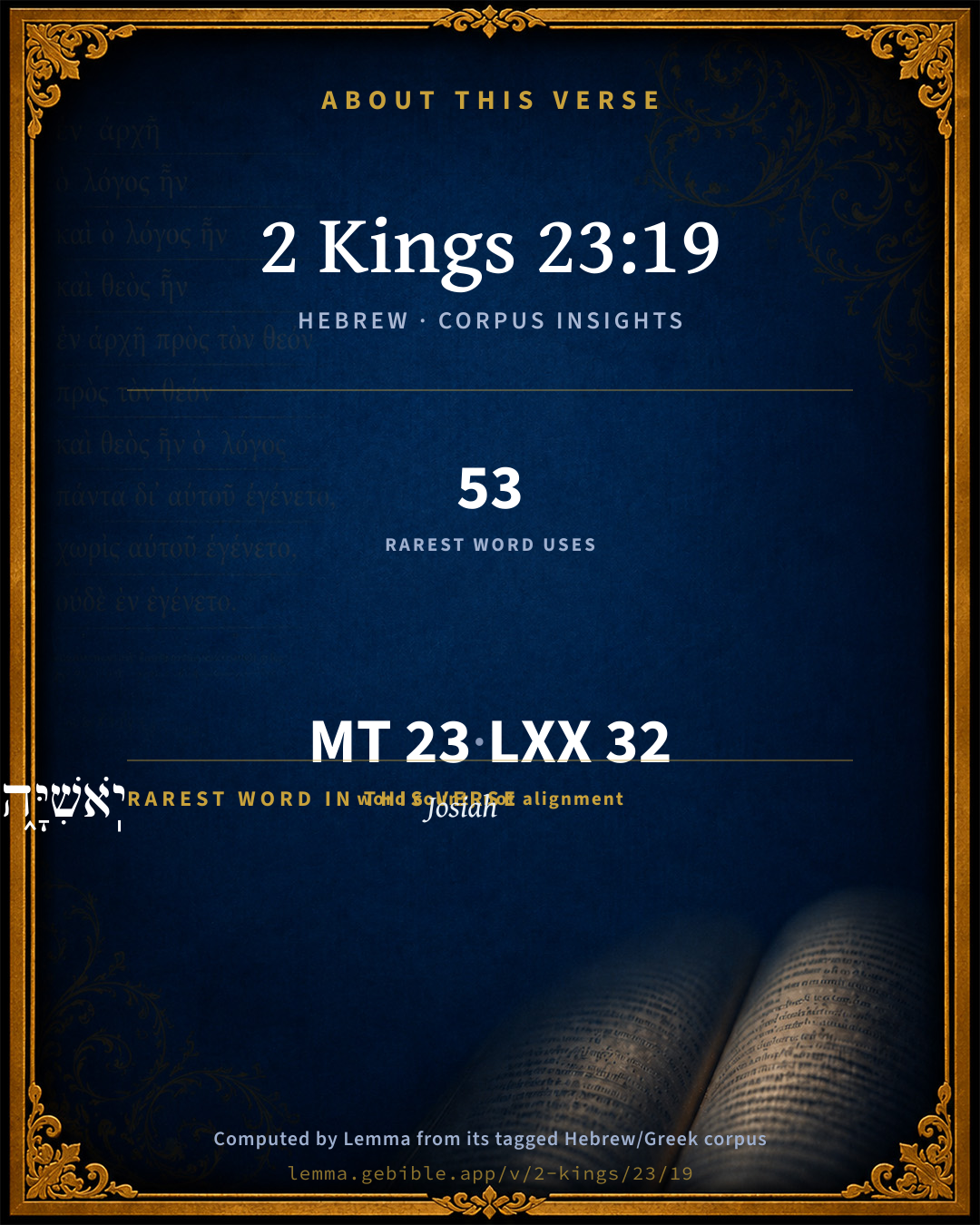
About this verse

These counts appear in no published source. They are computed here, from the morphology-tagged text and Lemma’s own curated glosses. What Lemma adds →

23
words
16
distinct lemmas
Historical
section

Shared distinctive vocabulary

יֹֽאשִׁיָּ֑הוּ Josiah H2977 occurs in 48 verses of the Hebrew Bible. Also found in:

Grammatical profile

  • 5 verbs
  • 12 nouns
  • 1 preposition
  • 5 particles

Verb forms

  • עָשׂ֜וּ Qal · Perfect
  • לְהַכְעִ֔יס Hiphil · Infinitive Construct
  • הֵסִ֖יר Hiphil · Perfect
  • וַיַּ֣עַשׂ Qal · Sequential Imperfect
  • עָשָׂ֖ה Qal · Perfect

Repetition

Words recur within this verse — often emphatic in Hebrew:

  • עָשׂ֜וּ to do H6213 ×3
  • כָּל all H3605 ×2
  • בְּבֵֽית Bethel H1008 ×2
  • אֲשֶׁ֣ר which H834 ×3

Hebrew & Septuagint length

In English translation the verse runs 45 words from the Hebrew and 37 from the Septuagint (LXX English) — closely comparable.

A rough comparison of the two English renderings, which tokenize alike — not a word-level alignment.

Word counts can differ between the Hebrew and the Greek without any difference in meaning — e.g. the Hebrew direct-object marker אֵת has no separate Greek word, and Greek often adds the article ὁ.

In the original languages it is 23 Hebrew tokens and 32 Greek tokens — but the two are counted differently (Hebrew bundles its prefixes and suffixes into one token; the Greek is in lemma form), so that isn’t a like-for-like length.

Cross-references

14

Topical passages linked to 2 Kings 23:19 in the Treasury of Scripture Knowledge — connected by theme and wording, ordered by reader-vote popularity; previews shown in the World English Bible.

  • 2 Chronicles 34:6–7 [So did he] in the cities of Manasseh and Ephraim and Simeon, even to Naphtali, in their ruins round about.
  • 1 Kings 12:31 He made houses of high places, and made priests from among all the people, who were not of the sons of Levi.
  • 1 Kings 13:32 For the saying which he cried by the word of Yahweh against the altar in Bethel, and against all the houses of the high places which are in the cities of Samaria, shall surely happen.
  • 1 Kings 16:33 Ahab made the Asherah; and Ahab did yet more to provoke Yahweh, the God of Israel, to anger than all the kings of Israel who were before him.
  • 2 Kings 8:18 He walked in the way of the kings of Israel, as did the house of Ahab: for he had the daughter of Ahab as wife; and he did that which was evil in the sight of Yahweh.
  • 2 Kings 17:9 The children of Israel did secretly things that were not right against Yahweh their God: and they built them high places in all their cities, from the tower of the watchmen to the fortified city;
  • 2 Kings 17:16–18 They forsook all the commandments of Yahweh their God, and made them molten images, even two calves, and made an Asherah, and worshiped all the host of the sky, and served Baal.
  • 2 Kings 21:6 He made his son to pass through the fire, and practiced sorcery, and used enchantments, and dealt with those who had familiar spirits, and with wizards: he worked much evil in the sight of Yahweh, to provoke him to anger.
  • 2 Chronicles 30:6–11 So the posts went with the letters from the king and his princes throughout all Israel and Judah, and according to the commandment of the king, saying, You children of Israel, turn again to Yahweh, the God of Abraham, Isaac, and Israel, that he may return to the remnant that have escaped of you out of the hand of the kings of Assyria.
  • 2 Chronicles 31:1 Now when all this was finished, all Israel who were present went out to the cities of Judah, and broke in pieces the pillars, and hewed down the Asherim, and broke down the high places and the altars out of all Judah and Benjamin, in Ephraim also and Manasseh, until they had destroyed them all. Then all the children of Israel returned, every man to his possession, into their own cities.
  • Psalms 78:58 For they provoked him to anger with their high places, And moved him to jealousy with their engraved images.
  • Jeremiah 7:18–19 The children gather wood, and the fathers kindle the fire, and the women knead the dough, to make cakes to the queen of the sky, and to pour out drink-offerings to other gods, that they may provoke me to anger.
  • Ezekiel 8:17–18 Then he said to me, Have you seen [this], son of man? Is it a light thing to the house of Judah that they commit the abominations which they commit here? for they have filled the land with violence, and have turned again to provoke me to anger: and, behold, they put the branch to their nose.
  • Micah 6:16 For the statutes of Omri are kept, And all the works of the house of Ahab. You walk in their counsels, That I may make you a ruin, And her inhabitants a hissing; And you will bear the reproach of my people."

Cross-references courtesy of OpenBible.info (CC BY 4.0).

Hebrew and Greek witnesses Masoretic Hebrew ↔ Greek Septuagint

The same verse in the two great witnesses to the Old Testament, shown verse-for-verse.

These are two independent witnesses, not word-aligned to each other, and the Septuagint is shown in lemma (dictionary) form.

Hebrew 2 Kings 23:19 Masoretic · Westminster Leningrad Codex

וְגַם֩ אֶת כָּל בָּתֵּ֨י הַבָּמ֜וֹת אֲשֶׁ֣ר בְּעָרֵ֣י שֹׁמְר֗וֹן אֲשֶׁ֨ר עָשׂ֜וּ מַלְכֵ֤י יִשְׂרָאֵל֙ לְהַכְעִ֔יס הֵסִ֖יר יֹֽאשִׁיָּ֑הוּ וַיַּ֣עַשׂ לָהֶ֔ם כְּכָל הַֽמַּעֲשִׂ֔ים אֲשֶׁ֥ר עָשָׂ֖ה בְּבֵֽית אֵֽל

All the houses also of the high places that were in the cities of Samaria, which the kings of Israel had made to provoke [Yahweh] to anger, Josiah took away, and did to them according to all the acts that he had done in Bethel.

World English Bible · Public Domain

Greek LXX 2 Kings 23:19 Septuagint · lemma form

καί γέ εἰς πᾶς ὁ οἶκος ὁ ὑψηλός ὁ ἐν ὁ πόλις σαμαρεία ὅς ποιέω βασιλεύς ἰσραήλ παραὀργίζω κύριος ἀποἵστημι ιωσιας καί ποιέω ἐν αὐτός πᾶς ὁ ἔργον ὅς ποιέω ἐν βαιθηλ

Moreover Josias removed all the houses of the high places that were in the cities of Samaria, which the kings of Israel made to provoke the Lord, and did to them all that he did in Baethel.

LXX2012 (modern English Septuagint) · Public Domain

Hebrew: Westminster Leningrad Codex (CC BY 4.0). Greek: Septuagint (public domain); English from LXX2012 (modern English Septuagint) (Public Domain). How the Septuagint differs from the Hebrew →

Targum (Aramaic paraphrase)

1

The Targum is the ancient Jewish Aramaic paraphrase of the Hebrew Scriptures — an interpretive translation, not the Hebrew text itself. Onkelos (literal) and Pseudo-Jonathan (expansive) render the Torah, and Jonathan the Prophets. Coverage is partial: where no permissively-licensed English translation exists for a verse, only the Aramaic is shown. This is verse-level text, not a word-by-word alignment to the Hebrew.

  1. Targum Jonathan Prophets (Joshua–Malachi)
    וְאַף יַת כָּל בָּתֵּי בָּמָתָא דִי בְּקִירְוֵי שֹׁמְרוֹן דִי עֲבָדוּ מַלְכֵי יִשְׂרָאֵל לְאַרְגָזָא פַּלֵי יֹאשִׁיָהוּ וַעֲבַד לְהוֹן כְּכָל עֲבִידָא דַעֲבַד בְבֵית אֵל:

    (no public-domain English translation for this verse)

    Targum Jonathan — Aramaic: “Mikraot Gedolot” (public domain). English: “Sefaria Community Translation” (CC0 1.0 (public-domain dedication)); “London "Chaldee Paraphrase," 1871” (public domain). Text via Sefaria.

Commentary

Notes on 2 Kings 23:19 from classic Christian and Jewish commentators (each source and its license shown beneath its notes). The classic Christian expositions comment on the surrounding passage and are grouped to its opening verse, so a note may address several verses; the Jewish commentaries on the Tanakh (Rashi and others) are per-verse, so they appear only where the commentator wrote on this verse.

Lemma curates 59 commentaries, every one of them public domain or Creative Commons licensed, each selected and text-cleaned for this edition rather than reprinted as found. About our sources →

Trapp's Complete Commentary

John Trapp

2Ki 23:19 And all the houses also of the high places that [were] in the cities of Samaria, which the kings of Israel had made to provoke [the LORD] to anger, Josiah took away, and did to them according to all the acts that he had done in Bethel.

Ver. 19. And did to them according.] See on 2Ki 23:15.

John Trapp, A Commentary or Exposition upon All the Books of the Old and New Testament (1647–1656) — public domain. Text from a community e-Sword module.

Tyndale Open Study Notes

Tyndale Open Resources

23:19-20 pagan shrines . . . of Samaria: Josiah’s religious purge extended throughout the former northern kingdom (see also 2 Chr 34:6-7). Josiah’s freedom to carry out such reforms testifies to his strength and Assyria’s growing weakness (see study note on 2 Kgs 23:29).

Tyndale Open Study Notes — © Tyndale Open Resources, licensed CC BY-SA 4.0. Text via the HelloAO Bible API.

Adam Clarke's Commentary

Verse 19. That were in the cities of Samaria] Israel had now no king; and Josiah, of the blood royal of Judah, had certainly a direct right to the kingdom; he had, at this time, an especial commission from God, to reform every abuse through the whole land-all that ground that was given by the Lord as an inheritance to the twelve sons of Jacob. Therefore he had every right to carry his plans of reformation into the Samaritan states.

Adam Clarke's Commentary on the Bible (1810–1826) — public domain. Text from a community e-Sword/MySword module.

Ellicott's Commentary for English Readers

(19) The houses also of the high places—i.e., temples or chapels attached to the high places.

Josiah took away.—Comp. 2Ch_34:6, from which it appears that the king’s zeal carried him as far as Naphtali. The question has been asked, how it was that Josiah was able to proceed thus beyond the limits of his own territory. It is possible that, as a vassal of Assyria, he enjoyed a certain amount of authority over the old domains of the ten tribes. We have no record of either fact, but his opposition to Necho favours the idea that he recognised the Assyrian sovereign as his suzerain. Moreover, it is in itself likely that the remnant of Israel would be drawn towards Judah and its king as the surviving representatives of the past glories of their race, and would sympathise in his reformation, just as the Samaritans, in the times of the return, were eager to participate in the rebuilding of the Temple. (Comp. 2Ch_34:9.) Another supposition is that, as the fall of the Assyrian empire was imminent, no notice was taken of Josiah’s proceedings in the west.

A Bible Commentary for English Readers, edited by Charles John Ellicott (1878–1897) — public domain. Text from a community e-Sword module.

The Cambridge Bible for Schools and Colleges

gen. ed. J. J. S. Perowne

19. high places that were in the cities of Samaria] It would seem from this that when the ten tribes had been carried away the king of Judah exercised some sort of authority over the people in the northern kingdom. But the high places in Samaria were most likely the places in which purely heathen idolatry was practised. They therefore differed from the high places in Judah, and to their priests Josiah was more severe than to the Levitical priests who had conducted the worship of Jehovah on the high places in his own kingdom. The injunction to slay idolaters is found in Deu_17:2-5.

The Cambridge Bible for Schools and Colleges (gen. ed. J. J. S. Perowne; Cambridge University Press, 1878–1918) — public domain. Text from a community e-Sword module.

John Gill's Exposition

And he slew all the priests of the high places that were there,.... The idolatrous priests who sacrificed to Baal, and other Heathen deities; for as for others that burnt incense in high places, yet to the true God, those he spared, though they were not suffered to officiate at the altar of God: the others he slew

upon the altars; where they sacrificed:

and burnt men's bones upon them: the bones of the priests, and worshippers of idols, as he had done at Bethel:

and returned to Jerusalem; after he had gone through the land, both of Judah and Israel, and abolished idolatrous worship everywhere.

John Gill's Exposition of the Whole Bible (1746–1763) — public domain (CC PDM 1.0). Text via the HelloAO Bible API.

Matthew Poole's English Annotations

By what authority he did this, See Poole "2Ki 23:15".

Matthew Poole's English Annotations on the Holy Bible (1683–1685) — public domain. Text from a community e-Sword/MySword module.

Whedon's Commentary on the Bible

Daniel D. Whedon

19. Houses also of the high places — Temples erected on heights, and devoted to idolatrous purposes.

Daniel D. Whedon (gen. ed.), Commentary on the Old and New Testaments (1874–1909) — public domain. Text from a community e-Sword module.

The Pulpit Commentary

And all the houses also of the high places that were in the cities of Samaria. The writer of Chronicles enters into more detail. Josiah, he says, carried out his destruction of the high places, the groves, and the images "in the cities of Manasseh, and Ephraim, and Simeon, even unto Naphtali" (2Ch_34:6) i.e. to the northern limit of the Holy Land, which was occupied by Naphtali and Asher. By what right Josiah exercised sovereign authority in the old kingdom of Samaria, which the Assyrians had conquered and attached to their empire, can only be conjectured. Some have supposed that the Assyrians had enlarged his sovereignty, and placed Samaria under his rule; others regard him as having transferred his allegiance to Nabopolassar, and having been made by him viceroy over Palestine. But it is, perhaps, most probable that he merely took advantage of the political commotions of the time to extend his dominion so far as it seemed safe to do so. Asshur-bani-pal, the last energetic King of Assyria, appears to have ceased to reign in Josiah"s fourteenth year, when he was succeeded by a weak monarch, Asshur-ebil-ili. Great troubles now broke out. The Scythians ravaged Western Asia far and wide. Assyria was attacked by the Medea and Babylonians in combination. Under these circumstances, Josiah found himself practically independent, and began to entertain ambitious projects. He "extended his dominion from Jerusalem over Samaria" (Ewald). Assyria was too much occupied to take any notice. Baby-Ionia was in the thick of the struggle. Josiah found himself able to reunite under his own headship all the scattered portions of the old Israelite kingdom, except, perhaps, the trans-Jordanic district. He levied taxes in Samaria as freely as in Judaea. (2Ch_33:9) He reformed on the same model the religions of both countries. When finally he had to fight for his throne, he marched his army into the northern portion of Samaria, and there fought the battle which cost him his life. Which the kings of Israel had made to provoke the Lord to anger. The earlier kings of Israel had simply allowed the "high places" to continue, without actively increasing or multiplying them; but Manasseh had re-established them after their destruction by Hezekiah, (2Ki_21:3) and Amen had probably done the same after Manasseh"s tardy reformation. Jonah took away, and did to them according to all the acts that he done in Bethel (see above, ver. 15).

The Pulpit Commentary (1880–1919), ed. H.D.M. Spence-Jones & Joseph S. Exell — public domain. Text from a community e-Sword module.

unfoldingWord translationNotes

Door43 World Missions Community

Josiah removed ... He did ... He slaughtered ... he burned

It might be best to translate so that the reader understands that other people, perhaps Hilkiah and "the priests under him" (2 Kings 23:4), might have helped Josiah do these things. (See: Assumed Knowledge and Implicit Information)

what had been done

"what he had done"

he burned human bones on them

You may need to make explicit why he burned the bones. "he burned human bones on them so no one would use them again" (See: Assumed Knowledge and Implicit Information)

translationWords

high place

Yahweh

anger

priest

Jerusalem

unfoldingWord translationNotes — © Distant Shores Media and the Door43 World Missions Community, licensed CC BY-SA 4.0. Source: git.door43.org/Door43/en_tn.

Rashi

Rabbi Shlomo Yitzchaki (Rashi)

In the cities of Shomron. For Yeshayohu was king over all Yisroel, of those who returned from the ten tribes through Yirmiyohu.

Rashi on the Tanakh — English translations: “The Judaica Press complete Tanach with Rashi, translated by A. J. Rosenberg” (CC BY 4.0); “Pentateuch with Rashi's commentary by M. Rosenbaum and A.M. Silbermann, 1929-1934” (public domain); “The Metsudah Tanach series, Lakewood, N.J” (CC BY 4.0); and “The Book of Joshua, Metsudah Publications, 1997” (CC BY 4.0). Text via Sefaria.

Lesson kit

Teaching starters — assembled from the data on this page, not authored interpretation. Every prompt links to the verse data it draws on. Edit before teaching.

2 Kings, in the Historical, opens this verse with 23 words (16 distinct Hebrew lemmas). Its most distinctive word is Yôʼshîyâh (“Josiah”). A historical commentator’s framing appears above. Read the whole chapter for the surrounding context.

Discussion questions

  1. The word Yôʼshîyâh carries the sense “Josiah.” How does it shape the verse?
  2. How does 1 Kings 13:2, which shares the word «Josiah», read alongside this verse?
  3. What does the repetition of “to do” (3× in this one verse) do in this verse?
  4. The translations on this page render this verse differently — a whole-verse word diff, not a word-by-word alignment. What might account for the different wordings?
  5. «עָשׂ֜וּ» is a Qal Perfect verb. How does that grammatical form shape the action described?
  6. Compare how Trapp's Complete Commentary and Tyndale Open Study Notes read this verse. Where do they agree or differ?

Things to notice

Reading settings

Reading text

Shown beneath each verse's original-language words.

Old Testament
Old Testament edition

Read the OT as the Masoretic Hebrew (MT) or the Greek Septuagint (LXX).

English shown for the Greek Septuagint (in the Hebrew ↔ Greek comparison).

Comparing translations? Open the Compare panel on any verse page to stack up to four side by side.