
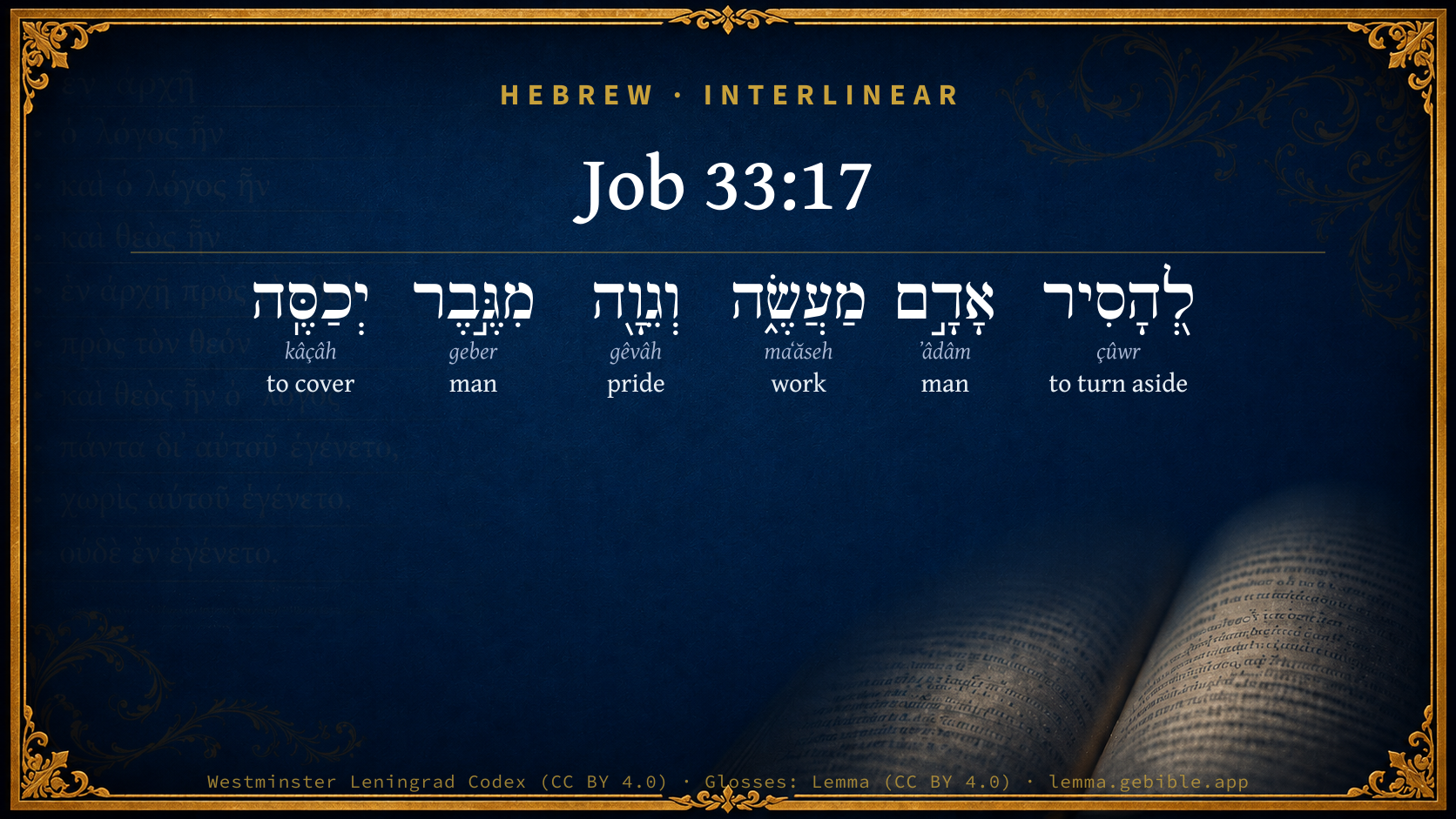
Job 33:17

Hebrew (Westminster Leningrad Codex) Job 33:17 appears in the Hebrew Old Testament. The text above is from the Westminster Leningrad Codex. Each word links to its Strong’s number, a concise gloss, and parsing drawn from the Open Scriptures Hebrew Bible morphology. Click any word for its full Brown-Driver-Briggs (BDB) entry.
Download image
Cite this verse

Job 33:17 (World English Bible). Public Domain. Lemma interlinear Bible study tool, https://lemma.gebible.app/v/job/33/17.

Show BibTeX & RIS
BibTeX
RIS
English Translation
That he may withdraw man from his purpose, And hide pride from man.
World English Bible · Public Domain
Download a study sheet

One document with this verse’s original text, its word-by-word gloss line, the meaning frame, cross-references with their text, attributed commentary, and full source and license credits — printable, and it pastes into notes with its structure intact.

This verse Autodidact and up

Study sheet (.html) Plain text (.txt)

A passage Seminary Student

Up to 50 verses in one chapter. A passage sheet keeps up to 6 commentary sources and 12 cross-references per verse, in the order this page ranks them, and says so on the sheet whenever that leaves anything out. Ask for a single verse and you get the Autodidact verse sheet above.

Everything on this page stays free to read, with no account — the sheet is a download of what is already on screen, not access to it.

Want to remove ads? Support Godless Engineer
Compare translations 3

The same verse in 3 English versions, stacked beneath the original-language interlinear above. Click any original word for its lexicon entry.

Each is an independent rendering of the whole verse — the interlinear is not word-aligned to these translations.

Highlighted words mark where these versions differ — a whole-verse word diff, not a word-by-word alignment.

  • World English Bible Public Domain
    That he may withdraw man from his purpose, And hide pride from man.
  • King James Version Public Domain
    That he may withdraw man from his purpose, and hide pride from man.
  • unfoldingWord Literal Text CC BY-SA 4.0
    to bring a man back from doing and to conceal pride from a man.

unfoldingWord Literal Text — © unfoldingWord, licensed CC BY-SA 4.0. Word-aligned USFM3 via Door43 (git.door43.org/unfoldingWord/en_ult).

Versions to compare (up to 4)

3 of 4 selected

Show all 18 translations

Every available English version of this verse, each an independent rendering of the whole verse.

  • World English Bible Public Domain
    That he may withdraw man from his purpose, And hide pride from man.
  • Berean Standard Bible Public Domain
    to turn a man from wrongdoing and keep him from pride,
  • Majority Standard Bible Public Domain
    to turn a man from wrongdoing and keep him from pride,
  • King James Version Public Domain
    That he may withdraw man from his purpose, and hide pride from man.
  • American Standard Version (1901) Public Domain
    That he may withdraw man `from his' purpose, And hide pride from man;
  • Revised Version (1885) Public Domain
    That he may withdraw man from his purpose, and hide pride from man;
  • Geneva Bible (1599) Public Domain
    That he might cause man to turne away from his enterprise, and that he might hide the pride of man,
  • Douay-Rheims (1899) Public Domain
    That he may withdraw a man from the things he is doing, and may deliver him from pride.
  • Young's Literal Translation Public Domain
    To turn aside man `from' doing, And pride from man He concealeth.
  • Literal Standard Version CC BY-SA 4.0
    To turn aside man [from] doing, || And He conceals pride from man.
  • Unlocked Literal Bible CC BY-SA 4.0
    in order to pull man back from his sinful purposes, and keep pride from him.
  • unfoldingWord Literal Text CC BY-SA 4.0
    to bring a man back from doing and to conceal pride from a man.
  • Darby Bible Public Domain
    That he may withdraw man [from his] work, and hide pride from man.
  • World Messianic Bible Public Domain
    that he may withdraw man from his purpose, and hide pride from man.
  • Webster's Bible Public Domain
    That he may withdraw man from his purpose, and hide pride from man.
  • Free Bible Version CC BY-SA 4.0
    to turn them away from doing wrong and to stop them from becoming proud.
  • Bible in Basic English Public Domain
    In order that man may be turned from his evil works, and that pride may be taken away from him;
  • JPS Tanakh (1917) Public Domain
    That men may put away their purpose, and that He may hide pride from man;

Literal Standard Version (2020), Covenant Press — licensed CC BY-SA 4.0. Text via the HelloAO Bible API (eBible.org). Unlocked Literal Bible (unfoldingWord) — licensed CC BY-SA 4.0. Text via the HelloAO Bible API (eBible.org). unfoldingWord Literal Text — © unfoldingWord, licensed CC BY-SA 4.0. Word-aligned USFM3 via Door43 (git.door43.org/unfoldingWord/en_ult). Free Bible Version, Dr. Jonathan Gallagher — licensed CC BY-SA 4.0. Text via the HelloAO Bible API (eBible.org).

Word by word

More ways to search: Search by grammar → Find every occurrence → Compare this word →

Practice this passage: Drill this verse → Learn its vocabulary →

About this verse

These counts appear in no published source. They are computed here, from the morphology-tagged text and Lemma’s own curated glosses. What Lemma adds →

6
words
6
distinct lemmas
Wisdom
section

Notable vocabulary

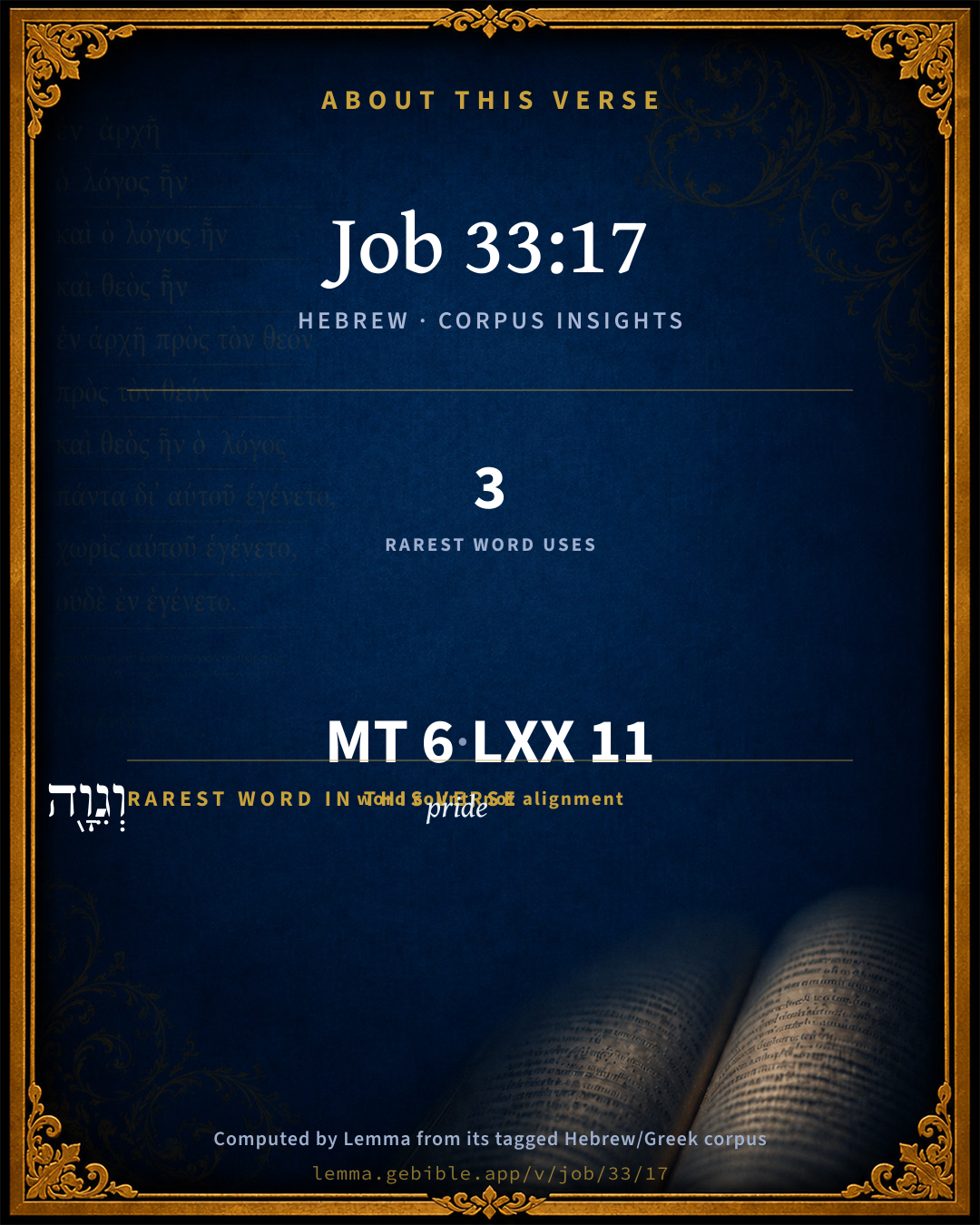
The rarest word here is וְגֵוָ֖ה pride H1466 — appearing just 3 times in the whole Hebrew Bible.

Shared distinctive vocabulary

וְגֵוָ֖ה pride H1466 occurs in 3 verses of the Hebrew Bible. Also found in:

Grammatical profile

  • 2 verbs
  • 4 nouns

Verb forms

  • לְ֭הָסִיר Hiphil · Infinitive Construct
  • יְכַסֶּֽה Piel · Imperfect

Hebrew & Septuagint length

In English translation the verse runs 13 words from the Hebrew and 14 from the Septuagint (LXX English) — closely comparable.

A rough comparison of the two English renderings, which tokenize alike — not a word-level alignment.

Word counts can differ between the Hebrew and the Greek without any difference in meaning — e.g. the Hebrew direct-object marker אֵת has no separate Greek word, and Greek often adds the article ὁ.

In the original languages it is 6 Hebrew tokens and 11 Greek tokens — but the two are counted differently (Hebrew bundles its prefixes and suffixes into one token; the Greek is in lemma form), so that isn’t a like-for-like length.

Cross-references

12

Topical passages linked to Job 33:17 in the Treasury of Scripture Knowledge — connected by theme and wording, ordered by reader-vote popularity; previews shown in the World English Bible.

  • Isaiah 2:11 The lofty looks of man will be brought low, The haughtiness of men will be bowed down, And Yahweh alone will be exalted in that day.
  • James 4:10 Humble yourselves in the sight of the Lord, and he will exalt you.
  • Genesis 20:6 God said to him in the dream, "Yes, I know that in the integrity of your heart you have done this, and I also withheld you from sinning against me. Therefore I didn't allow you to touch her.
  • 2 Chronicles 32:25 But Hezekiah didn't render again according to the benefit done to him; for his heart was lifted up: therefore there was wrath on him, and on Judah and Jerusalem.
  • Job 17:11 My days are past, my plans are broken off, As are the thoughts of my heart.
  • Matthew 27:19 While he was sitting on the judgment seat, his wife sent to him, saying, "Have nothing to do with that righteous man, for I have suffered many things this day in a dream because of him."
  • 2 Corinthians 12:7 By reason of the exceeding greatness of the revelations, that I should not be exalted excessively, there was given to me a thorn in the flesh, a messenger of Satan to buffet me, that I should not be exalted excessively.
  • Deuteronomy 8:16 who fed you in the wilderness with manna, which your fathers didn't know; that he might humble you, and that he might prove you, to do you good at your latter end:
  • Isaiah 23:9 Yahweh of hosts has purposed it, to stain the pride of all glory, to bring into contempt all the honorable of the earth.
  • Daniel 4:30–37 The king spoke and said, Is not this great Babylon, which I have built for the royal dwelling-place, by the might of my power and for the glory of my majesty?
  • Hosea 2:6 Therefore, behold, I will hedge up your way with thorns, And I will build a wall against her, That she can't find her way.
  • Acts 9:2–6 and asked for letters from him to the synagogues of Damascus, that if he found any who were of the Way, whether men or women, he might bring them bound to Jerusalem.

Cross-references courtesy of OpenBible.info (CC BY 4.0).

Hebrew and Greek witnesses Masoretic Hebrew ↔ Greek Septuagint

The same verse in the two great witnesses to the Old Testament, shown verse-for-verse.

These are two independent witnesses, not word-aligned to each other, and the Septuagint is shown in lemma (dictionary) form.

Hebrew Job 33:17 Masoretic · Westminster Leningrad Codex

לְ֭הָסִיר אָדָ֣ם מַעֲשֶׂ֑ה וְגֵוָ֖ה מִגֶּ֣בֶר יְכַסֶּֽה

That he may withdraw man from his purpose, And hide pride from man.

World English Bible · Public Domain

Greek LXX Job 33:17 Septuagint · lemma form

ἀποστρέφω ἄνθρωπος ἐκ ἀδικία ὁ δέ σῶμα αὐτός ἀπό πτῶμα ῥύομαι

to turn a man from unrighteousness, and he delivers his body from a fall.

LXX2012 (modern English Septuagint) · Public Domain

On this verse, Haydock's Catholic Bible Commentary discusses the Septuagint’s reading. Read the note in Commentary ↓

Hebrew: Westminster Leningrad Codex (CC BY 4.0). Greek: Septuagint (public domain); English from LXX2012 (modern English Septuagint) (Public Domain). How the Septuagint differs from the Hebrew →

Commentary

Notes on Job 33:17 from classic Christian and Jewish commentators (each source and its license shown beneath its notes). The classic Christian expositions comment on the surrounding passage and are grouped to its opening verse, so a note may address several verses; the Jewish commentaries on the Tanakh (Rashi and others) are per-verse, so they appear only where the commentator wrote on this verse.

Lemma curates 59 commentaries, every one of them public domain or Creative Commons licensed, each selected and text-cleaned for this edition rather than reprinted as found. About our sources →

The Cambridge Bible for Schools and Colleges

gen. ed. J. J. S. Perowne

17, 18. The object of this intervention of God is the gracious one of anticipating the sinner in the evil which he meditates and hindering it, and withdrawing him from his sinful purpose, Job_33:17; and the effect of it is that man is preserved from committing deadly sin, which would have brought destruction upon him, Job_33:18.

The “sword” or javelin, Job_33:18, is a figure for God’s destructive judgments; comp. ch. Job_36:12.

The Cambridge Bible for Schools and Colleges (gen. ed. J. J. S. Perowne; Cambridge University Press, 1878–1918) — public domain. Text from a community e-Sword module.

Trapp's Complete Commentary

John Trapp

Job 33:17 That he may withdraw man [from his] purpose, and hide pride from man.

Ver. 17. That he may withdraw man from his purpose] Or, rather, practice. Heb. work, that is, evil work, called a man’s own work, Heb 4:10; for when we do evil we work de nostro, et secundum hominem, 1Co 3:3, as when the devil speaketh a lie he speaketh of his own, Joh 8:44. Now from such bad work God taketb men off, by dreams sometimes, as he did Abimelech, Gen 20:3, and Laban, Gen 31:24 but more frequently by corrections of instruction, which are the way of life, Pro 6:23 : Christianornm Theologia, as Luther calleth it; Virtutum officina, as Ambrose; Bonorum omnium thesaurus, as Brentius upon this text.

And hide pride from man] Which else, as a master pock, will break out in his forehead and testify to his face. By pride we may understand all other sins, which God both covereth and cureth in his penitent people; but pride is fitly instanced, because it was one of the first sins, and is still the root and source of all other sins. God therefore humbleth all under his mighty hand, and preserveth them from the perilous pinnacle of self exaltation; as he dealt with Paul, both when he met him on the way to Damascus, and unhorsed him, as also when by that thorn in the flesh he let out the swollen matter of pride out of his heart, which might else have broken forth into odious and loathsome practices.

John Trapp, A Commentary or Exposition upon All the Books of the Old and New Testament (1647–1656) — public domain. Text from a community e-Sword module.

Geneva Bible (1599)

Geneva Bible translators

He showeth for what end God sendeth afflictions: to beat down man’s pride, and to turn from evil.

Geneva Bible (1599) marginal notes — public domain. Text via Bolls.life.

Jamieson, Fausset & Brown

Robert Jamieson, A. R. Fausset & David Brown

purpose--Margin, "work." So Job 36:9. So "business" in a bad sense (Sa1 20:19). Elihu alludes to Job's words (Job 17:11). "Pride," an open "pit" (Job 33:18) which God hides or covers up, lest man should fall into it. Even the godly need to learn the lesson which trials teach, to "humble themselves under the mighty hand of God."

Jamieson, Fausset & Brown — Commentary Critical and Explanatory on the Whole Bible (1871) — public domain (CC PDM 1.0). Text via the HelloAO Bible API.

Ellicott's Commentary for English Readers

(17) From his purpose.—Rather, That He may witharaw man from carrying out his evil actions, and may remove that pride from man which he secretly cherishes. This is the main point of Elihu’s teaching: that the purposes of God are disciplinary, to keep man from the sin which otherwise he would be prone to commit. In this way Job might have been a righteous man, and yet be justly chastened lest he should prove unrighteous.

A Bible Commentary for English Readers, edited by Charles John Ellicott (1878–1897) — public domain. Text from a community e-Sword module.

John Gill's Exposition

That he may withdraw a man from his purpose,.... Or "work" (m), his wicked work, as the Targum; either which he has begun upon, or which he designed to do. Thus Abimelech and Laban were restrained from their intentions by a divine admonition in a dream, the one from taking Abraham's wife, as he intended, and the other from doing harm to Jacob, which he designed:

and hide pride from man; by pardoning his sins, in which there is always pride, so some; pardon of sin being expressed by covering it, Psa 32:1; or rather by repressing, weakening, and preventing it; and that by not suffering vain and proud men to perform their enterprises, but obliging them to submit to the will of God, and humble themselves under his mighty hand. These are the ends proposed, and which are effected through the Lord speaking to men in dreams, opening their ears, and sending instructions to them; and others also for their good follow.

(m) "opere", Pagninus, Montanus, Mercerus, &c.

John Gill's Exposition of the Whole Bible (1746–1763) — public domain (CC PDM 1.0). Text via the HelloAO Bible API.

Albert Barnes' Notes on the Bible

That he may withdraw man from his purpose - Margin, “work.” The sense is plain. God designs to warn him of the consequences of executing a plan of iniquity. He alarms him by showing him that his course will lead to punishment, and by representing to him in the night visions, the dreadful woes of the future world into which he is about to plunge. The object is to deter him from committing the deed of guilt which he had contemplated, and to turn him to the paths of righteousness. Is it unreasonable to suppose that the same thing may occur now, and that God may have a purpose in the dreams which often visit the man who has formed a plan of iniquity, or who is living a life of sin? It cannot be doubted that such people often have alarming dreams; that these dreams are such as are fitted to deter them from the commission of their contemplated wickedness; and that in fact they not unfrequently do it.

What shall hinder us from supposing that God intends that the workings of the mind when the senses are locked in repose, shall be the means of alarming the guilty, and of leading them to reflection? Why should not mind thus be its own admonisher, and be made the instrument of restraining the guilty then, as really as by its sober reasonings and reflections when awake? Many a wicked man has been checked in a career of wickedness by a frightful dream; and not a few have been brought to a degree of reflection which has resulted in sound conversion by the alarm caused on the mind by having the consequences of a career of wickedness traced out in the visions of the night. The case of Colonel Gardiner cannot be forgotten - though in that instance it was rather “a vision of the night” than a dream. He was meditating an act of wickedness. and was alone in his room awaiting the appointed hour. In the silence of the night, and in the solitude of his room, he seemed to see the Savior on the cross. This view, however, it may be accounted for, restrained him from the contemplated act of wickedness, and he became an eminently pious man; see Doddridge’s Life of Col. Gardiner. The mind, with all its faculties, is under the control of God, and no one can demonstrate that he does not make its actings, even in the wanderings of a dream, the designed means of checking the sinner, and of saving the soul.

And hide pride from man - Probably the particular thing which Elihu here referred to, was pride and arrogance toward God; or an insolent bearing toward him, and a reliance on one’s own merits. This was the particular thing in Job which Elihu seems to have thought required animadversion, and probably he meant to intimate that all people had such communications from God by dreams as to save them from such arrogance.

Albert Barnes' Notes on the Bible (1834–1885) — public domain. Text from a community e-Sword/MySword module.

Haydock's Catholic Bible Commentary

Him. Septuagint, "his body from the fall [of iniquity.]" (Grabe) (Haydock)

George Leo Haydock (1774–1849), Haydock's Catholic Family Bible and Commentary, 1859 edition — public domain. Excludes Psalms (Douay-Rheims chapter numbering differs from Protestant) and Deuterocanonical books (Catholic canon only).

Matthew Poole's English Annotations

That he, i.e. God, who was expressed Job 33:14, and designed by this pronoun he both in the foregoing and following verses.

From his purpose, i.e. from the execution of his purpose. Heb. from his work, i.e. from his evil work as the Chaldee and LXX. understand it; from sin, which is truly and fitly called man’s work, because it hath its rise in and from him, and is his own proper work, and very agreeable to his nature in his present corrupt estate; as, on the contrary, all the good that is in man is God’s proper and peculiar work, and is generally ascribed to him in Scripture. So this is noted as the design of God’s giving man this warning, to keep him from executing that evil work which possibly he had designed to do; of which see examples, Gen 20:5,6; 31:24.

Hide pride, i.e. either,

1. To take it away, as God is said to hide sin, when he quite removes and forgives it, Psa 32:1; and sorrow is said to be hid, Job 3:10, when it never is nor was; and understanding is said to be hid when it perisheth, Isa 29:14. And

pride is here mentioned as the root of those evil purposes or works last mentioned; which for the most part proceed from haughtiness of spirit, whereby men scorn to submit themselves and their wills and actions to God’s authority, and presume to advance themselves above God, and resolve to follow their own wills and lusts in spite of God, and with contempt of him. Or pride may be here put for all matter or occasion of pride. And God by this means is said to

hide pride from man, because by these glorious and terrible representations of his Divine majesty to a man, he takes him off from the contemplation and admiration of his own excellency, which men are generally very prone to reflect upon, and brings him to a sight of his own nothingness and weakness, and to a sense of his dependence upon God, and to a humble and ready submission to his will and pleasure.

Matthew Poole's English Annotations on the Holy Bible (1683–1685) — public domain. Text from a community e-Sword/MySword module.

Whedon's Commentary on the Bible

Daniel D. Whedon

17. Purpose — מעשׂה, deed; used, like the Latin facinus, in the sense of evil deed. Of the two words employed for man, the second, geber, expresses might, and thus forms an antithesis. For “weak man,” (adham,) God interposes obstacles to the commission of sin, and from “the man of might” covers up (hides) the dazzling object of temptation. No one can estimate the restraint God thus exercises over the soul. Were there no protecting grace there would be but little, if any, human virtue. Pride is specially mentioned, because it is a sin to which human beings are most easily subjected, a kind of leader among temptations, and a vice, too, when once in possession, which cleaveth with a tenaciousness greater than that of all other sins.

Daniel D. Whedon (gen. ed.), Commentary on the Old and New Testaments (1874–1909) — public domain. Text from a community e-Sword module.

The Pulpit Commentary

That he (i.e. God) may withdraw man from his purpose; literally, from his work, assumed to be a wrongful work. Elihu regards the Divine teaching through visions as intended to elevate and purify men. Sometimes God so works upon them as to make them abandon an evil course on which they had entered. Sometimes his object is to save them from indulgence in an evil temper into which, without his help, they might have fallen. In this latter case he may occasionally hide pride from man. Elihu, perhaps, thinks that Job is unduly proud of his integrity.

The Pulpit Commentary (1880–1919), ed. H.D.M. Spence-Jones & Joseph S. Exell — public domain. Text from a community e-Sword module.

John Wesley's Explanatory Notes

Pride - And God by this means is said to hide pride from man, because by these glorious representations of his Divine majesty to man, he takes him off from the admiration of his own excellency, and brings him to a sight of his own weakness, and to an humble and ready submission to his will.

John Wesley, Explanatory Notes Upon the Whole Bible (1754–1765) — public domain. Text via the GEBible commentary corpus.

Rashi

Rabbi Shlomo Yitzchaki (Rashi)

To restrain man in his illness.

a deed that he had intended to do.

and He covers haughtiness from man with his suffering, in order to vanquish him and humble him to repent, so that he withhold his soul from utter death.

haughtiness Heb. וְגֵוָה, like גַאֲוָה.

Rashi on the Tanakh — English translations: “The Judaica Press complete Tanach with Rashi, translated by A. J. Rosenberg” (CC BY 4.0); “Pentateuch with Rashi's commentary by M. Rosenbaum and A.M. Silbermann, 1929-1934” (public domain); “The Metsudah Tanach series, Lakewood, N.J” (CC BY 4.0); and “The Book of Joshua, Metsudah Publications, 1997” (CC BY 4.0). Text via Sefaria.

Lesson kit

Teaching starters — assembled from the data on this page, not authored interpretation. Every prompt links to the verse data it draws on. Edit before teaching.

Job, in the Wisdom, opens this verse with 6 words (6 distinct Hebrew lemmas). Its most distinctive word is gêvâh (“pride”). A historical commentator’s framing appears above. Read the whole chapter for the surrounding context.

Discussion questions

  1. What does “pride” (gêvâh) contribute to the verse as a whole?
  2. How does Job 22:29, which shares the word «pride», read alongside this verse?
  3. These translations render this verse differently; the difference is in the English rendering, not the original. What questions does that raise?
  4. «לְ֭הָסִיר» is a Hiphil Infinitive Construct verb. How does that grammatical form shape the action described?
  5. Compare how The Cambridge Bible for Schools and Colleges and Trapp's Complete Commentary read this verse. Where do they agree or differ?

Things to notice

Reading settings

Reading text

Shown beneath each verse's original-language words.

Old Testament
Old Testament edition

Read the OT as the Masoretic Hebrew (MT) or the Greek Septuagint (LXX).

English shown for the Greek Septuagint (in the Hebrew ↔ Greek comparison).

Comparing translations? Open the Compare panel on any verse page to stack up to four side by side.