Daniel 12:11

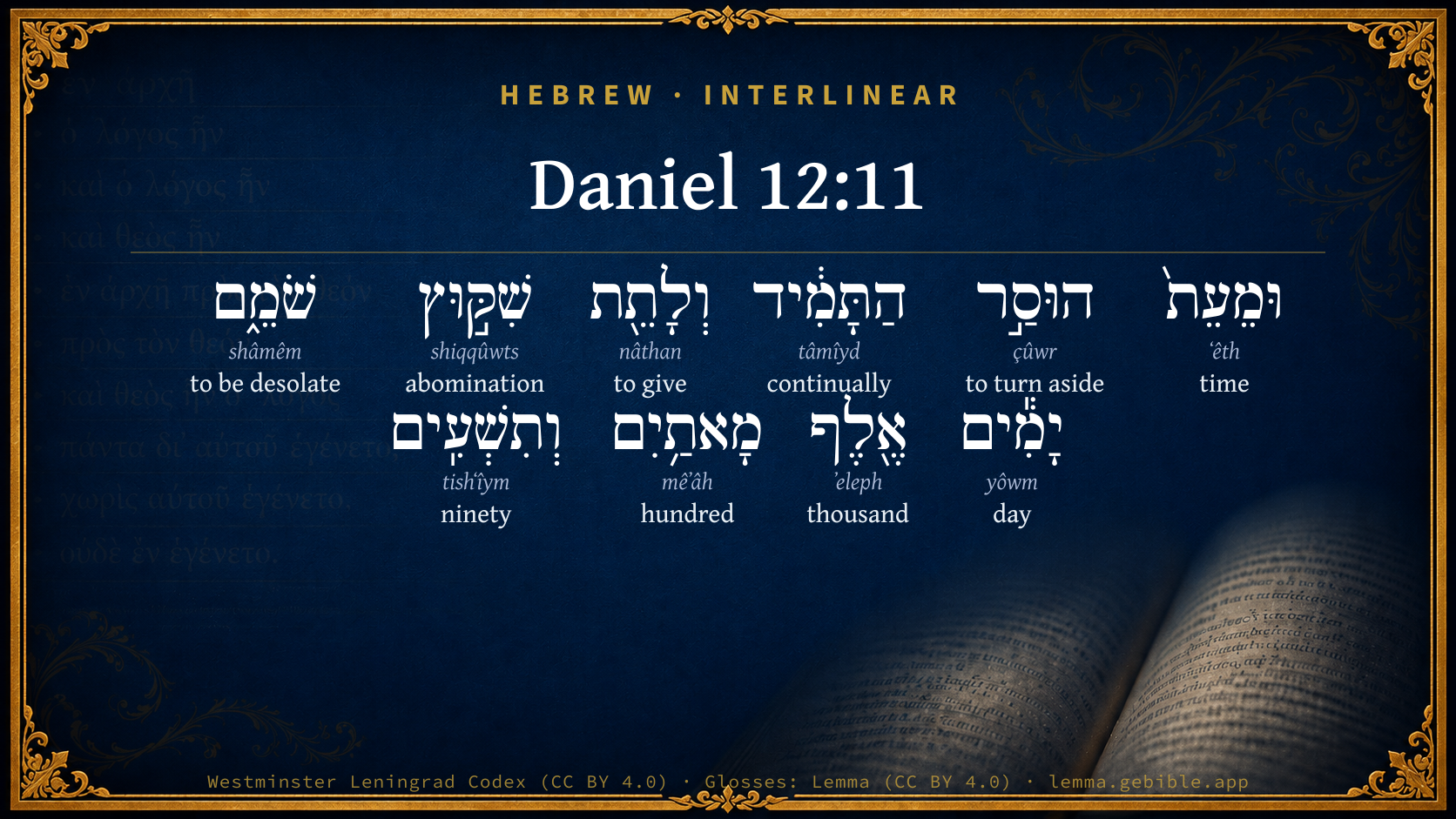
Hebrew (Westminster Leningrad Codex) Daniel 12:11 appears in the Hebrew Old Testament. The text above is from the Westminster Leningrad Codex. Each word links to its Strong’s number, a concise gloss, and parsing drawn from the Open Scriptures Hebrew Bible morphology. Click any word for its full Brown-Driver-Briggs (BDB) entry.
Download image
Cite this verse

Daniel 12:11 (World English Bible). Public Domain. Lemma interlinear Bible study tool, https://lemma.gebible.app/v/daniel/12/11.

Show BibTeX & RIS
BibTeX
RIS
English Translation
From the time that the continual [burnt offering] shall be taken away, and the abomination that makes desolate set up, there shall be one thousand two hundred ninety days.
World English Bible · Public Domain
Download a study sheet

One document with this verse’s original text, its word-by-word gloss line, the meaning frame, cross-references with their text, attributed commentary, and full source and license credits — printable, and it pastes into notes with its structure intact.

This verse Autodidact and up

Study sheet (.html) Plain text (.txt)

A passage Seminary Student

Up to 50 verses in one chapter. A passage sheet keeps up to 6 commentary sources and 12 cross-references per verse, in the order this page ranks them, and says so on the sheet whenever that leaves anything out. Ask for a single verse and you get the Autodidact verse sheet above.

Everything on this page stays free to read, with no account — the sheet is a download of what is already on screen, not access to it.

Want to remove ads? Support Godless Engineer
Compare translations 3

The same verse in 3 English versions, stacked beneath the original-language interlinear above. Click any original word for its lexicon entry.

Each is an independent rendering of the whole verse — the interlinear is not word-aligned to these translations.

Highlighted words mark where these versions differ — a whole-verse word diff, not a word-by-word alignment.

  • World English Bible Public Domain
    From the time that the continual [burnt offering] shall be taken away, and the abomination that makes desolate set up, there shall be one thousand two hundred ninety days.
  • King James Version Public Domain
    And from the time that the daily sacrifice shall be taken away, and the abomination that maketh desolate set up, there shall be a thousand two hundred and ninety days.
  • unfoldingWord Literal Text CC BY-SA 4.0
    From the time that the regular burnt offering is taken away and the abomination that causes desolation is set up, there will be 1, 290 days.

unfoldingWord Literal Text — © unfoldingWord, licensed CC BY-SA 4.0. Word-aligned USFM3 via Door43 (git.door43.org/unfoldingWord/en_ult).

Versions to compare (up to 4)

3 of 4 selected

Show all 18 translations

Every available English version of this verse, each an independent rendering of the whole verse.

  • World English Bible Public Domain
    From the time that the continual [burnt offering] shall be taken away, and the abomination that makes desolate set up, there shall be one thousand two hundred ninety days.
  • Berean Standard Bible Public Domain
    And from the time the daily sacrifice is abolished and the abomination of desolation set up, there will be 1,290 days.
  • Majority Standard Bible Public Domain
    And from the time the daily sacrifice is abolished and the abomination of desolation set up, there will be 1,290 days.
  • King James Version Public Domain
    And from the time that the daily sacrifice shall be taken away, and the abomination that maketh desolate set up, there shall be a thousand two hundred and ninety days.
  • American Standard Version (1901) Public Domain
    And from the time that the continual `burnt-offering' shall be taken away, and the abomination that maketh desolate set up, there shall be a thousand and two hundred and ninety days.
  • Revised Version (1885) Public Domain
    And from the time that the continual burnt offering shall be taken away, and the abomination that maketh desolate set up, there shall be a thousand two hundred and ninety days.
  • Geneva Bible (1599) Public Domain
    And from the time that the daily sacrifice shalbe take away and the abominable desolatio set vp, there shalbe a thousand, two hundreth and ninetie daies.
  • Douay-Rheims (1899) Public Domain
    And from the time when the continual sacrifice shall be taken away, and the abomination unto desolation shall be set up, there shall be a thousand two hundred ninety days,
  • Young's Literal Translation Public Domain
    and from the time of the turning aside of the perpetual `sacrifice', and to the giving out of the desolating abomination, `are' days a thousand, two hundred, and ninety.
  • Literal Standard Version CC BY-SA 4.0
    and from the time of the turning aside of the continuous [sacrifice], and to the giving out of the desolating abomination, [are] one thousand, two hundred, and ninety days.
  • Unlocked Literal Bible CC BY-SA 4.0
    From the time that the regular burnt offering is taken away and the abomination that causes complete desolation is set up, there will be 1,290 days.
  • unfoldingWord Literal Text CC BY-SA 4.0
    From the time that the regular burnt offering is taken away and the abomination that causes desolation is set up, there will be 1, 290 days.
  • Darby Bible Public Domain
    And from the time that the continual [sacrifice] is taken away, and the abomination that maketh desolate set up, [there shall be] a thousand, two hundred, and ninety days.
  • World Messianic Bible Public Domain
    “From the time that the continual burnt offering is taken away and the abomination that makes desolate set up, there will be one thousand two hundred ninety days.
  • Webster's Bible Public Domain
    And from the time that the daily sacrifice shall be taken away, and the abomination that maketh desolate set up, there shall be a thousand two hundred and ninety days.
  • Free Bible Version CC BY-SA 4.0
    From the time the continual ministry is stopped in order to set up the idolatry that causes devastation will be one thousand two hundred and ninety days.
  • Bible in Basic English Public Domain
    And from the time when the regular burned offering is taken away, and an unclean thing causing fear is put up, there will be a thousand, two hundred and ninety days.
  • JPS Tanakh (1917) Public Domain
    And from the time that the continual burnt-offering shall be taken away, and the detestable thing that causes appalment set up, there shall be a thousand two hundred and ninety days.

Literal Standard Version (2020), Covenant Press — licensed CC BY-SA 4.0. Text via the HelloAO Bible API (eBible.org). Unlocked Literal Bible (unfoldingWord) — licensed CC BY-SA 4.0. Text via the HelloAO Bible API (eBible.org). unfoldingWord Literal Text — © unfoldingWord, licensed CC BY-SA 4.0. Word-aligned USFM3 via Door43 (git.door43.org/unfoldingWord/en_ult). Free Bible Version, Dr. Jonathan Gallagher — licensed CC BY-SA 4.0. Text via the HelloAO Bible API (eBible.org).

Word by word

More ways to search: Search by grammar → Find every occurrence → Compare this word →

Practice this passage: Drill this verse → Learn its vocabulary →

וְתִשְׁעִֽים
tishʻîym
H8673
“and · ninety”
Conjunction + Adjective, Cardinal number, Both, Plural, Absolute
Part of Speech
Conjunction + Adjective
Type
Cardinal number
Gender
Both
Number
Plural
State
Absolute
Full BDB Definition

Origin: multiple from H8672

TWOT: 2552

ninety
  1. וּמֵעֵת֙ ʻêth H6256 “and · from · time” Conjunction + Preposition + Noun, Common, Both, Singular, Absolute
  2. הוּסַ֣ר çûwr H5493 “to turn aside” Verb, Hophal, Perfect, 3rd Person, Masculine, Singular
  3. הַתָּמִ֔יד tâmîyd H8548 “the · continually” Particle, Definite Article + Noun, Common, Masculine, Singular, Absolute
  4. וְלָתֵ֖ת nâthan H5414 “and · to give” Conjunction + Preposition + Verb, Qal, Infinitive Construct
  5. שִׁקּ֣וּץ shiqqûwts H8251 “abomination” Noun, Common, Masculine, Singular, Absolute
  6. שֹׁמֵ֑ם shâmêm H8074 “being desolate” Verb, Qal, Participle Active, Masculine, Singular, Absolute
  7. יָמִ֕ים yôwm H3117 “days” Noun, Common, Masculine, Plural, Absolute
  8. אֶ֖לֶף ʼeleph H505 “thousand” Adjective, Cardinal number, Both, Singular, Absolute
  9. מָאתַ֥יִם mêʼâh H3967 “hundred” Adjective, Cardinal number, Both, Dual, Absolute

About this verse

These counts appear in no published source. They are computed here, from the morphology-tagged text and Lemma’s own curated glosses. What Lemma adds →

10
words
10
distinct lemmas
Prophets
section

Notable vocabulary

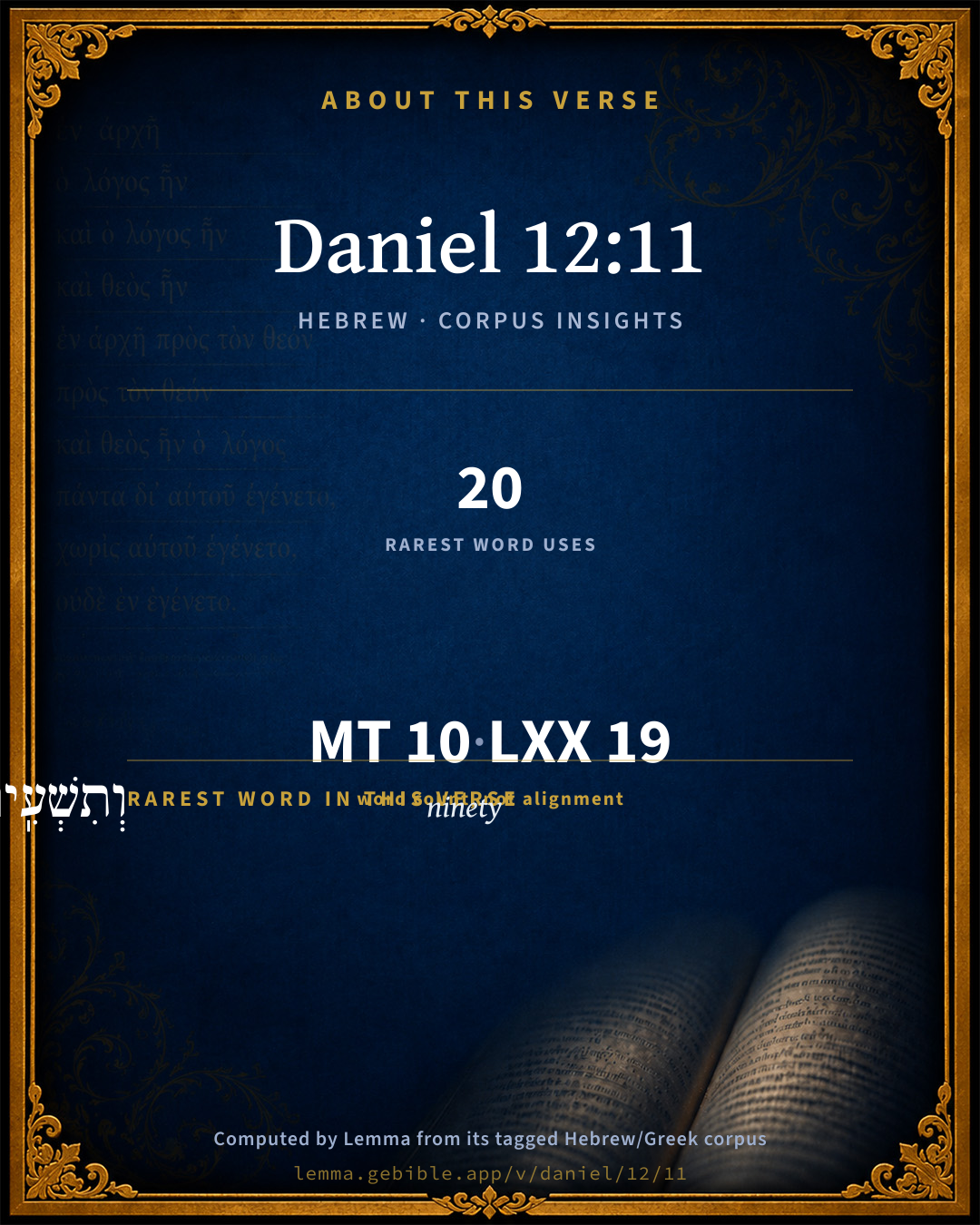
The rarest word here is וְתִשְׁעִֽים ninety H8673 — appearing just 20 times in the whole Hebrew Bible.

Shared distinctive vocabulary

וְתִשְׁעִֽים ninety H8673 occurs in 20 verses of the Hebrew Bible. Also found in:

Grammatical profile

  • 3 verbs
  • 4 nouns
  • 3 adjectives

Verb forms

  • הוּסַ֣ר Hophal · Perfect
  • וְלָתֵ֖ת Qal · Infinitive Construct
  • שֹׁמֵ֑ם Qal · Participle Active

Hebrew & Septuagint length

In English translation the verse runs 29 words from the Hebrew and 30 from the Septuagint (LXX English) — closely comparable.

A rough comparison of the two English renderings, which tokenize alike — not a word-level alignment.

Word counts can differ between the Hebrew and the Greek without any difference in meaning — e.g. the Hebrew direct-object marker אֵת has no separate Greek word, and Greek often adds the article ὁ.

In the original languages it is 10 Hebrew tokens and 19 Greek tokens — but the two are counted differently (Hebrew bundles its prefixes and suffixes into one token; the Greek is in lemma form), so that isn’t a like-for-like length.

Cross-references

11

Topical passages linked to Daniel 12:11 in the Treasury of Scripture Knowledge — connected by theme and wording, ordered by reader-vote popularity; previews shown in the World English Bible.

  • Daniel 11:31 Forces shall stand on his part, and they shall profane the sanctuary, even the fortress, and shall take away the continual [burnt offering], and they shall set up the abomination that makes desolate.
  • Matthew 24:15 "When, therefore, you see the abomination of desolation, which was spoken of through Daniel the prophet, standing in the holy place (let the reader understand),
  • Daniel 9:27 He shall make a firm covenant with many for one week: and in the midst of the week he shall cause the sacrifice and the offering to cease; and on the wing of abominations [shall come] one who makes desolate; and even to the full end, and that determined, shall [wrath] be poured out on the desolate.
  • Mark 13:14 But when you see the abomination of desolation, spoken of by Daniel the prophet, standing where it ought not (let the reader understand), then let those who are in Judea flee to the mountains,
  • Revelation 11:2 Leave out the court which is outside of the temple, and don't measure it, for it has been given to the gentiles. They will tread the holy city under foot for forty-two months.
  • Revelation 13:5 A mouth speaking great things and blasphemy was given to him. Authority to make war for forty-two months was given to him.
  • Daniel 7:25 He shall speak words against the Most High, and shall wear out the saints of the Most High; and he shall think to change the times and the law; and they shall be given into his hand until a time and times and half a time.
  • Daniel 8:11–14 Yes, it magnified itself, even to the prince of the host; and it took away from him the continual [burnt offering], and the place of his sanctuary was cast down.
  • Daniel 1:12 Prove your servants, I beg you, ten days; and let them give us pulse to eat, and water to drink.
  • Daniel 8:26 The vision of the evenings and mornings which has been told is true: but seal up the vision; for it belongs to many days [to come].
  • Revelation 12:6 The woman fled into the wilderness, where she has a place prepared by God, that there they may nourish her one thousand two hundred sixty days.

Cross-references courtesy of OpenBible.info (CC BY 4.0).

Hebrew and Greek witnesses Masoretic Hebrew ↔ Greek Septuagint

The same verse in the two great witnesses to the Old Testament, shown verse-for-verse.

These are two independent witnesses, not word-aligned to each other, and the Septuagint is shown in lemma (dictionary) form.

Hebrew Daniel 12:11 Masoretic · Westminster Leningrad Codex

וּמֵעֵת֙ הוּסַ֣ר הַתָּמִ֔יד וְלָתֵ֖ת שִׁקּ֣וּץ שֹׁמֵ֑ם יָמִ֕ים אֶ֖לֶף מָאתַ֥יִם וְתִשְׁעִֽים

From the time that the continual [burnt offering] shall be taken away, and the abomination that makes desolate set up, there shall be one thousand two hundred ninety days.

World English Bible · Public Domain

Greek LXX Daniel 12:11 Septuagint · lemma form

ἀπό οὗ ἄν ἀποἵστημι ὁ θυσία διά πᾶς καί ἑτοιμάζω δίδωμι ὁ βδέλυγμα ὁ ἐρημώσις ἡμέρα χίλιοι διακόσιοι ἐνενήκοντα

And from the time of the removal of the perpetual sacrifice, when the abomination of desolation shall be set up, there shall be a thousand two hundred and ninety days.

LXX2012 (modern English Septuagint) · Public Domain

On this verse, The Pulpit Commentary discusses the Septuagint’s reading. Read the note in Commentary ↓

Hebrew: Westminster Leningrad Codex (CC BY 4.0). Greek: Septuagint (public domain); English from LXX2012 (modern English Septuagint) (Public Domain). How the Septuagint differs from the Hebrew →

Commentary

Notes on Daniel 12:11 from classic Christian and Jewish commentators (each source and its license shown beneath its notes). The classic Christian expositions comment on the surrounding passage and are grouped to its opening verse, so a note may address several verses; the Jewish commentaries on the Tanakh (Rashi and others) are per-verse, so they appear only where the commentator wrote on this verse.

Lemma curates 59 commentaries, every one of them public domain or Creative Commons licensed, each selected and text-cleaned for this edition rather than reprinted as found. About our sources →

Adam Clarke's Commentary

Verse 11. From the time that the daily sacrifice shall be taken away] See the notes on Da 11:25-27.

The abomination that maketh desolate set up] I believe, with Bp. Newton, that this is a proverbial phrase; and may be applied to any thing substituted in the place of, or set up in opposition to, the ordinances of God, his worship, his truth, c. Adrian's temple, built in the place of God's temple at Jerusalem, the church of St. Sophia turned into a Mohammedan mosque, c., &c., may be termed abominations that make desolate. Perhaps Mohammedanism may be the abomination which sprang up A.D. 612. If we reckon one thousand two hundred and ninety years, Da 12:11, from that time, it will bring us down to A.D. 1902, when we might presume from this calculation, that the religion of the FALSE PROPHET will cease to prevail in the world which from the present year, 1825, is distant only seventy-seven years.

Adam Clarke's Commentary on the Bible (1810–1826) — public domain. Text from a community e-Sword/MySword module.

Trapp's Complete Commentary

John Trapp

Dan 12:11 And from the time [that] the daily [sacrifice] shall be taken away, and the abomination that maketh desolate set up, [there shall be] a thousand two hundred and ninety days.

Ver. 11. And from the time that the daily sacrifice shall be taken away,] sc., By Antiochus, as hath been before said; and with the knowledge whereof I would have thee to rest satisfied.

There shall be a thousand two hundred and ninety days.] Which are the three years and a half mentioned before, saith Diodate, with thirteen days over, for some unknown reason. The wonderful numberer hath all in numerato. The Russians use to say in a difficult question, God, and our great duke, know all this. The Jews in like case say, Messiah, when he comes, will tell us all things we desire to be informed of.

John Trapp, A Commentary or Exposition upon All the Books of the Old and New Testament (1647–1656) — public domain. Text from a community e-Sword module.

Joseph Benson's Commentary

Dan 12:11-12. And from the time that the daily sacrifice shall be taken away — It is here declared, that the whole time that these calamities would last, should run somewhat beyond a time, times, and half a time, namely, thirty days beyond it; for a time, times, and a half signify only twelve hundred and sixty days, whereas here twelve hundred and ninety is mentioned as the term of duration; for which space of time, but not longer, the daily sacrifice should be taken away, or prohibited, and an idol be placed in the temple. Blessed is he that waiteth, or survives, and cometh to the thousand three hundred and five and thirty days — This period is forty-five days longer than the term last mentioned, or the twelve hundred and ninety days; and, if taken literally, and interpreted of the time of Antiochus’s persecution, is supposed to be spoken of the time of his death, when the Jewish nation was not only delivered from their calamities, but also from all fear of their being renewed.

Those who extend these predictions to the times of Popery and Mohammedanism, suppose that the expressions made use of to describe Antiochus’s persecutions are here applied to the desolations made by antichrist, of which those made by Antiochus were a figure: see note on Dan 8:14; Dan 11:36. And indeed they are expressions evidently applicable to different events, and have been accomplished at different times. “The setting up of the abomination of desolation,” says Bishop Newton, “appears to be a general phrase, and comprehensive of various events. It is applied by the writer of the first book of Maccabees, chap. 1Ma 1:54, to the profanation of the temple by Antiochus, and his setting up the image of Jupiter Olympus upon the altar of God. It is applied by our Saviour, Mat 24:15, to the destruction of the city and temple by the Romans, under the conduct of Titus. It may, for the same reason, be applied to the Emperor Adrian’s building a temple to Jupiter Capitolinus, in the same place where the temple of God had stood; and to the misery of the Jews, and the desolation of Judea that followed. It may, with equal justice, be applied to the Mohammedans’ invading and desolating Christendom, and converting the churches into mosques: and this latter event seems to have been particularly intended in this passage. If this interpretation be true, the religion of Mohammed will prevail in the East for the space of twelve hundred and sixty years, and then a great and glorious revolution will follow; perhaps the restoration of the Jews, perhaps the destruction of antichrist: but another still greater and more glorious will succeed; and what can this be so probably as the full conversion of the Gentiles to the church of Christ, and the beginning of the millennium, or the reign of the saints upon earth? For, Dan 12:12, Blessed is he that waiteth and cometh to the thousand three hundred and five and thirty days. Here, then, are three different periods assigned, twelve hundred and sixty, twelve hundred and ninety, and thirteen hundred and thirty-five years; but what is the precise time of their beginning, and consequently of their ending, as well as what are the great and signal events which will take place at the end of each period, we can only conjecture, time alone can with certainty discover. It is, indeed, no wonder, that we cannot fully understand and explain these things: for, as the angel said to Daniel himself, though many should run to and fro, should inquire and examine into these things, and thereby knowledge should be increased; yet the full understanding of them is reserved for the time of the end, to which time the words are closed up and sealed. But, however, the great uncertainty of these events, which remain yet to be fulfilled, cannot shake the credit and certainty of those which have already been accomplished.

“Upon the whole, what an amazing prophecy is this! comprehending so many various events, and extending through so many successive ages, from the first establishment of the Persian empire, above five hundred and thirty years before Christ, to the general resurrection! And the farther it extends, and the more it comprehends, the more amazing and the more divine it must appear. What stronger and more convincing proofs can be given or required of a divine providence, and a divine revelation; that there is a God who directs and orders the transactions of the world; and that Daniel was a prophet divinely inspired by him, a man greatly beloved, as he is often addressed by an angel! Our blessed Saviour hath bestowed upon him the appellation of Daniel the prophet, Mat 24:15, and that is authority sufficient for any Christian; but, in the course of these notes, such instances and attestations of his being a prophet have been produced as an infidel cannot deny, or if he denies cannot disprove. In short, we see how well Daniel deserves the character which his contemporary, Ezekiel, hath given of him, Eze 14:14-20; Eze 28:3, for his piety and wisdom; and these usually go together: for, as the angel says above, Dan 12:10, None of the wicked shall understand, but the wise shall understand. Happy are they who both know the will of God and do it.”

Joseph Benson's Commentary on the Old and New Testaments (1811–1818) — public domain. Text from a community e-Sword module.

Whedon's Commentary on the Bible

Daniel D. Whedon

11, 12. See notes Dan_8:11; Dan_11:31. These numbers are still a mystery even to the “wise.” A “time, times, and half a time,” if literally calculated as three and a half years, would amount to twelve hundred and sixty days. Daniel’s twelve hundred and ninety days and thirteen hundred and thirty-five days could hardly both be identical with the “time, times, and half a time,” unless, as Dr. Terry holds, these differences may have been designed to suggest that the “time, times, and dividing of a time could not be reckoned with mathematical accuracy.” (Compare Mat_24:34-36; Act_1:7.) Behrmann has pointed out, however, that if the intercalary month, which was reckoned by the Babylonians and Hebrews at regular intervals, be counted with the three and one half years, the result is exactly twelve hundred and ninety days. Most modern scholars who follow the historical method seek an explanation of these varying numbers in the events following the defilement of the temple by Antiochus.

The abomination that maketh desolate mentioned here certainly refers primarily to the altar of Jupiter, erected upon Jehovah’s altar of burnt offering, or to the statue of Jupiter which was doubtless in front of this altar. This abomination was set up Chislev (December) 25, B.C. 168 (1Ma_1:54; 2Ma_6:2; Josephus, Antiquities, XII, Dan_5:4), and it was not until Chislev 25, B.C. 165, that the daily sacrifices were restored (1Ma_4:52; 2Ma_10:5; Josephus, Antiquities, XII, Dan_7:6). It is perfectly plain that a period of time had elapsed before the setting up of the idol altar during which the temple was desecrated by the presence of the heathen, and equally clear that a period of time elapsed after the restoring of the daily sacrifices before the death of Antiochus occurred. It is in connection with these events that most modern scholars attempt to explain these numbers, supposing, for example, that the twelve hundred and ninety days end with the rededication of the temple and the thirteen hundred and thirty-five days with the death of Antiochus. Our knowledge of the period is not, however, sufficiently definite to absolutely prove this. Some scholars think that these numbers were made indefinite purposely, to represent an unknown period of time lying just beyond the date at which the temple altar was rededicated; during which brief though indefinite period the prophet saw in vision the death of this wild beast, followed by the dawning of eternal blessedness under the rule of the Messianic Son of man. (Compare Dan_7:13-14; Dan_8:13-14; Dan_12:11.) We believe that the numbers used should not be pressed into the same compass as if found in a modern table of dates. Numbers were the ordinary channels through which religious lessons were taught in ancient times (see Introduction to Ezekiel, “Symbolism,” VIII), and beyond all the possible historical applications of these at present inexplicable numbers there may lie a deeper symbolical meaning which future students of the Word may see unveiled. And once more let it be said that, far beyond the primary and local meaning of the prophet’s words and symbols, there may lie an eternal and more glorious meaning. As Delitzsch says: “The prophets behold the future by means of the light of divine illumination as we do the sidereal heavens. To us the stars appear as if they were on one level; we do not distinguish their distance from us and from one another” (History of Redemption, note p. 147).

Daniel D. Whedon (gen. ed.), Commentary on the Old and New Testaments (1874–1909) — public domain. Text from a community e-Sword module.

Keil & Delitzsch

C. F. Keil & F. Delitzsch

The angel gives to the prophet yet one revelation more regarding the duration of the time of tribulation and its end, which should help him to understand the earlier answer. The words, "from the time that the daily sacrifice shall be taken away, and the abomination of the desolation," so distinctly point back to Dan 11:31, that they must here be referred, as there, to the wickedness of Antiochus in his desecrating the sanctuary of the Lord. The circumstance that the שׁקּוּץ (abomination) is here described as שׁמם and in Dan 11:31 as משׁמם, indicates no material distinction. In Dan 11:31, where the subject spoken of is the proceedings of the enemy of God causing desolation, the abomination is viewed as משׁמם, bringing desolation; here, with reference to the end of those proceedings, as שׁמם, brought to desolation; cf. under Dan 9:27. All interpreters therefore have found in these two verses statements regarding the duration of the persecutions carried on by Antiochus Epiphanes, and have sought to compare them with the period of 2300 evening-mornings mentioned in Dan 8:14, in order thus to reckon the duration of the time during which this enemy of God shall prosecute his wicked designs.

But as the opinion is regarding the reckoning of the 2300 evening-mornings in Dan 8:14 are very diverse from each other, so also are they here. First the interpretation of ולתת (and set up) is disputed. Wieseler is decidedly wrong in thinking that it designates the terminsu ad quem to הוּסר מעת (from the time shall be removed), as is generally acknowledged. Hitzig thinks that with ולתת the foregoing infin. הוּסר is continued, as Ecc 9:1; Jer 17:10; Jer 19:12, and therewith a second terminus a quo supposed. This, however, is only admissible if this second terminus stands in union with the first, and a second terminus ad quem also stands over against it as the parallel to the later terminus ad quem. Both here denote: the daily sacrifice shall be taken away forty-five days before the setting up of the βδέλυγμα ἐρημώσεως, and by so much the date in Dan 12:12 comes below that of Dan 12:11. According to this, both verses are to be understood thus: from the time of the taking away of the daily sacrifice as 1290 days, and from the time of the setting up of the abomination of desolation are 1335 days. But this interpretation is utterly destitute of support. In the first place, Hitzig has laid its foundation, that the setting up of the idol-abomination is separated from the cessation of the worship of Jehovah by forty-five days, only by a process of reasoning in a circle. In the second place, the המחכּה אשׁרי (blessed is he that waiteth), Dan 12:12, decidedly opposes the combining of the 1335 days with the setting up of the idol-abomination; and further, the grammatical interpretation of ולתת is not justified. The passages quoted in its favour are all of a different character; there a clause with definite time always goes before, on which the infinitive clause depends. Kranichfeld seeks therefore to take הוּסר also not as an infinitive, but as a relative asyndetical connection of the praeter. proph. to עת, by which, however, no better result is gained. For with the relative interpretation of הוּסר: the time, since it is taken away ... ולתת cannot so connect itself that this infinitive yet depends on עת. The clause beginning with ולתת cannot be otherwise interpreted than as a final clause dependent on וגו הוּסר מעת; thus here and in Dan 2:16, as in the passages quoted by Hitzig, in the sense: to set (to set up) the abomination, so that the placing of the abomination of desolation is viewed as the object of the taking away of the תּמיד (daily sacrifice). From this grammatically correct interpretation of the two clauses it does not, however, follow that the setting up of the idol-abomination first followed later than the removal of the daily sacrifice, so that ולתת signified "to set up afterwards," as Kliefoth seeks to interpret it for the purpose of facilitating the reckoning of the 1290 days. Both can be done at the same time, the one immediately after the other.

A terminus ad quem is not named in both of the definitions. This appears from the words "blessed is he that waiteth ... ." By this it is said that after the 1335 days the time of tribulation shall be past. Since all interpreters rightly understand that the 1290 and the 1335 days have the same terminus a quo, and thus that the 1290 days are comprehended in the 1335, the latter period extending beyond the former by only forty-five days; then the oppression cannot properly last longer than 1290 days, if he who reaches to the 1335 days is to be regarded as blessed.

With regard to the reckoning of these two periods of time, we have already shown that neither the one nor the other accords with the 2300 evening-mornings, and that there is no ground for reckoning those 2300 evening-mornings for the sake of these verses before us as 1150 days. Moreover, we have there already shown how the diversity of the two statements is explained from this, that in Dan 8:14 a different terminus a quo is named from that in Dan 12:11.; and besides have remarked, that according to 1 Macc. 1:54, 59, cf. with 4:52, the cessation of the Mosaic order of worship by sacrifice lasted for a period of only three years and ten days. Now if these three years and ten days are reckoned according to the sun-year at 365 days, or according to the moon-year at 354 days with the addition of an intercalary month, they amount to 1105 or 1102 days. The majority of modern interpreters identify, it is true, the 1290 days with the 3 1/2 times (= years), and these two statements agree so far, since 3 1/2 years make either 1279 or 1285 days. But the identifying of the two is not justified. In Dan 12:11 the subject plainly is the taking away of the worship of Jehovah and the setting up of the worship of idols in its stead, for which the Maccabean times furnish an historical fulfilment; in Dan 12:7,however, the angel speaks of a tribulation which extends so far that the strength of the holy people is altogether broken, which cannot be said of the oppression of Israel by Antiochus, since a stop was put to the conduct of this enemy by the courageous revolt of the Maccabees, and the power of valiant men put an end to the abomination of the desolation of the sanctuary. The oppression mentioned in Dan 12:7 corresponds not only in fact, but also with respect to its duration, with the tribulation which the hostile king of the time of the end, who shall arise from the fourth world-kingdom, shall bring upon the holy people, since, as already remarked, the 3 1/2 times literally correspond with Dan 7:25. But Dan 12:11 and Dan 12:12 treat of a different, namely, an earlier, period of oppression than Dan 12:7, so the 1290 and the 1335 days are not reckoned after the 3 1/2 times (Dan 12:11 and Daniel 7:35); and for the Maccabean period of tribulation there remain only the 2300 evening-mornings (Dan 8:14) for comparison, if we count the evening-mornings, contrary to the usage of the words, as half-days, and so reduce them to 1150 days. But if herewith we take into consideration the historical evidence of the duration of the oppression under Antiochus, the 1290 days would agree with it only if we either fix the taking away of the legal worship from 185 to 188 days, i.e., six months and five or eight days, before the setting up of the idol-altar on Jehovah's altar of burnt-offering, or, if these two facta occurred simultaneously, extend the terminus ad quem by six months and five or eight days beyond the day of the re-consecration of the altar. For both suppositions historical evidence is wanting. The former is perhaps probable from 1 Macc. 4:45, cf. with v. 54; but, on the contrary, for the second, history furnishes no epoch-making event of such significance as that the cessation of the oppression could be defined by it.

The majority of modern interpreters, in the reckoning of the 1290 and the 1335 days, proceed from Dan 8:14, and with them Kliefoth holds, firstly, that the 2300 evening-mornings are 1150 days, the termination of which constitutes the epoch of the re-consecration of the temple, on the 25th of the month Kisleu of the year 148 of the Seleucidan aera (i.e., 164 b.c.); and secondly, he supposes that the terminus a quo of the 2300 evening-mornings (Dan 8:14 and of the 1290 or 1335 days is the same, namely, the taking of Jerusalem by Apollonius (1 Macc. 1:29ff.), and the setting aside of the תּמיד which followed immediately after it was taken, about 140 days earlier than the setting up of the idol-altar. As the terminus ad quem of the 2300 evening-mornings the re-consecration of the temple is taken, with which the power of Antiochus over Israel was broken, and the beginning of the restoration made. No terminus ad quem is named in this passage before us, but perhaps it lies in the greater number of the days, as well as in this, that this passage speaks regarding the entire setting aside of the power of Antiochus-an evidence and a clear argument for this, that in Dan 12:11, Dan 12:12 a further terminus ad quem, reaching beyond the purification of the temple, is to be supposed. This terminus is the death of Antiochus. "It is true," Kliefoth further argues, "we cannot establish it to a day and an hour, that between the putting away of the daily sacrifice and the death of Antiochus 1290 days intervened, since of both facta we do not know the date of the day. But this we know from the book of the Maccabees, that the consecration of the temple took place on the 25th day of the month Kisleu in the 148th year of the Seleucidan aera, and that Antiochus died in the 149th year; and if we now add the 140 days, the excess of 2300 above 1290 after the consecration of the temple, we certainly come into the year 149. The circumstance also, that in the whole connection of this chapter the tendency is constantly toward the end of Antiochus, the Antichrist, induces us to place the death of that persecutor as the terminus ad quem of the 1290 days. Consequently we shall not err if, with Bleek, Kirmss, Hitzig, Delitzsch, Hofmann, Auberlen, Zndel, we suppose, that as the purifying of the temple is the end of the 2300 evening-mornings, so the death of Antiochus is the end of the 1290 days. The end of the 1335 days, Dan 12:12, must then be an event which lies forty-five days beyond the death of Antiochus, and which certainly attests the termination of the persecution under Antiochus and the commencement of better days, and which at least bears clear evidence of the introduction of a better time, and of a settled and secure state of things. We are not able to adduce proof of such a definite event which took place exactly fort-five days after the death of Antiochus, simply because we do not know the date of the death of Antiochus. The circumstances, however, of the times after the death of Antiochus furnish the possibility of such an event. The successor of Antiochus Epiphanes, Antiochus Eupator, certainly wrote to the Jews, after they had vanquished his host under Lysias, asking from them a peace; but the alienation between them continued nevertheless, and did not absolutely end till the victory over Nicanor, 2 Macc. 11-15. Hence there was opportunity enough for an event of the kind spoken of, though we may not be able, from the scantiness and the chronological uncertainty of the records of these times, to prove it positively." Hereupon Kliefoth enters upon the conjectures advanced by Hitzig regarding the unknown joyful event, and finds that nothing important can be brought forward in opposition to this especially, that the termination of the 1335 days may be the point of time when the tidings of the death of Antiochus, who died in Babylonia, reached the Jews in Palestine, and occasioned their rejoicing, since it might easily require forty-five days to carry the tidings of that even to Jerusalem; and finally he throws out the question, whether on the whole the more extended period of 1335 days must have its termination in a single definite event, whether by the extension of the 1290 days by fort-five days the meaning may not be, that whoever lives beyond this period of 1290 days, i.e., the death of Antiochus, in patience and in fidelity to the truth, is to be esteemed blessed. "The forty-five days were then only added to express the living beyond that time, and the form of this expression was chosen for the purpose of continuing that contained in Dan 12:11."

We cannot, however, concur in this view, because not only is its principal position without foundation, but also its contents are irreconcilable with historical facts. To change the 2300 evening-mornings into 1150 days cannot be exegetically justified, because according to the Hebrew mode of computation evening and morning do not constitute a half but a whole day. But if the 2300 evening-mornings are to be reckoned as so many days, then neither their terminus a quo nor their terminus ad quem stands in a definite relation to the 1290 days, from which a conclusion may be drawn regarding the terminus ad quem of the latter. Then the death of Antiochus Epiphanes does not furnish a turning-point for the commencement of a better time. According to 1 Macc. 6:18-54, the war against the Jews was carried on by his successor Eupator more violently than before. And on the news that Philippus, returning from Persia, sought to deprive him of the government, Lysias advised the king to make peace with the Jews, and to promise to them that they would be permitted to live according to their own laws. On this the Jews opened the citadel of Zion; but the king, after he had entered into it, violated his oath, and ordered its walls to be demolished. It was not till two years after the death of Antiochus Epiphanes that Judas gained a decisive victory over Nicanor, which was celebrated by the Jews by a joyful festival, which they resolved to keep every year in memory of that victory (1 Macc. 7:26-50). In these circumstances it is wholly impossible to suppose an event forty-five days after the death of Antiochus which could clearly be regarded as the beginning of a better time, and of a settled and secure state of things, or to regard the reception in Palestine of the news of the death of Antiochus as an event so joyful, that they were to be esteemed as blessed who should live to hear the tidings.

After all, we must oppose the opinion that the 1290 and the 1335 days are to be regarded as historical and to be reckoned chronologically, ad we are decidedly of opinion that these numbers are to be interpreted symbolically, notwithstanding that days as a measure of time are named. This much seems to be certain, that the 1290 days denote in general the period of Israel's sorest affliction on the part of Antiochus Epiphanes by the taking away of the Mosaic ordinance of worship and the setting up of the worship of idols, but without giving a statement of the duration of this oppression which can be chronologically reckoned. By the naming of "days" instead of "times" the idea of an immeasurable duration of the tribulation is set aside, and the time of it is limited to a period of moderate duration which is exactly measured out by God. But this is more strictly represented by the second definition, by which it is increased by 45 days: 1335 days, with the expiry of which the oppression shall so wholly cease, that every one shall be blessed who lives till these days come. For 45 days have the same relation to 1290 that 1 1/2 have to 43, and thus designate a proportionally very brief time. But as to this relation, the two numbers themselves show nothing. If we reduce them to the measure of time usual for the definition of longer periods, the 1290 days amount to 54 months, or 3 years and 7 months, and the 1335 days to 44 1/2 months, or 3 years and 8 1/2 months, since generally, and still more in symbolical definitions of time, the year is wont to be reckoned at 12 months, and the months at 30 days. Each of the two periods of time thus amounts to a little more than 3 1/2 years; the first exceeds by 1 month and the second by 2 1/2 months, only a little more than the half of 7 years - a period occurring several times in the O.T. as the period of divine judgments. By the reduction of the days to years and parts of a year the two expressions are placed in a distinct relation to the 3 1/2 times, which already appears natural by the connection of the two questions in Dan 12:6, Dan 12:8. On the one hand, by the circumstance that the 1290 days amount to somewhat more than 3 1/2 years, the idea that "times" stands for years is set aside; but on the other hand, by the use of "days" as a measure of time, the obscurity of the idea: time, times, and half a time, is lessened, and Daniel's inquiry as to the end of the terrible things is answered in a way which might help him to the understanding of the first answer, which was to him wholly unintelligible.

Such an answer contains the two definitions of the time under the supposition that the hostile undertakings of Antiochus against Judaism, in their progress and their issue, form a type of the persecution of the last enemy Antichrist against the church of the Lord, or that the taking away of the daily sacrifice and the setting up of the idol-abomination by Antiochus Epiphanes shows in a figure how the Antichrist at the time of the end shall take away the worship of the true God, renounce the God of his fathers, and make war his god, and thereby bring affliction upon the church of God, of which the oppression which Antiochus brought upon the theocracy furnished a historical pattern. But this typical relation of the two periods of oppression is clearly set forth in Daniel 11:21-12:3, since in the conduct and proceedings of the hostile king two stadia are distinguished, which so correspond to each other in all essential points that the first, Dan 11:21-35, is related to the second, Daniel 11:35-12:3, as the beginning and the first attempt is related to the complete accomplishment. This also appears in the wars of this king against the king of the south (Dan 11:25-29, cf. with Dan 11:40-43), and in the consequences which this war had for his relation to the people of God. On his return from the first victorious war against the south, he lifted up his heart against the holy covenant (Dan 11:28), and being irritated by the failure of the renewed war against the south and against the holy covenant, he desolated the sanctuary (vv. 30, 31); finally, in the war at the time of the end, when Egypt and the lands fell wholly under his power, and when, alarmed by tidings from the east and the north, he thought to destroy many, he erected his palace - tent in the Holy Land, so that he might here aim a destructive blow against all his enemies - in this last assault he came to his end (Dan 11:40-45).

Yet more distinctly the typical relation shows itself in the description of the undertakings of the enemy of God against the holy covenant, and their consequences for the members of the covenant nation. In this respect the first stadium of his enmity against the God of Israel culminates in the taking away of His worship, and in the setting up of the abomination of desolation, i.e., the worship of idols, in the sanctuary of the Lord. Against this abomination the wise of the people of God raise themselves up, and they bring by their rising up "a little help," and accomplish a purification of the people (Dan 11:31-35). In the second stadium, i.e., at the time of the end, the hostile king raises himself against the God of gods, and above every god (Dan 11:37), and brings upon the people of God an oppression such as has never been from the beginning of the world till now; but this oppression ends, by virtue of the help of the archangel Michael, with the deliverance of the people of God and the consummation by the resurrection of the dead, of some to everlasting life, and of some to everlasting shame (Dan 12:1-3).

If thus the angel of the Lord, after he said to Daniel that he might rest as to the non-understanding of his communication regarding the end of the wonderful things (Dan 12:7), because the prophecy shall at the time of the end give to the wise knowledge for the purifying of many through the tribulation, so answers the question of Daniel as to the אלּה אחרית that he defines in symbolically significant numbers the duration of the sufferings from the removal of the worship of Jehovah to the commencement of better times, with which all oppression shall cease, then he gave therewith a measure of time, according to which all those who have understanding, who have lived through this time of oppression, or who have learned regarding it from history, may be able to measure the duration of the last tribulation and its end so far beforehand, as, according to the fatherly and wise counsel of God, it is permitted to us to know the times of the end and of our consummation. For, from the comparison of this passage with that in Dan 8:14 regarding the duration of the crushing under feet of the holy people by the enemy rising from the Javanic world-kingdom, it is clear that as the 2300 evening-mornings do not contain a complete heptad of years, so the 1290 days contain only a little more than half a heptad. In this lies the comfort, that the severest time of oppression shall not endure much longer than half the time of the whole period of oppression. And if we compare with this the testimony of history regarding the persecution of the Old Covenant people under Antiochus, in consequence of which God permitted the suppression of His worship, and the substitution of idol-worship in its stead, for not fully 3 1/2 years, but only for 3 years and 10 days, then we are able to gather the assurance that He shall also shorten, for the sake of His elect, the 3 1/2 times of the last tribulation. We should rest here, that His grace is sufficient for us (Co2 12:9). For as God revealed to the prophets, who prophesied of the grace that should come unto us, the sufferings of Christ and the glory that should follow, that they might search and inquire what and what manner of time the Spirit of Christ who was in them did signify; so in the times of the accomplishment, we who are living are not exempted from searching and inquiring, but are led by the prophetic word to consider the signs of the times in the light of this word, and from that which is already fulfilled, as well as from the nature and manner of the fulfilment, to confirm our faith, for the endurance amid the tribulations which prophecy has made known to us, that God, according to His eternal gracious counsel, has measured them according to their beginning, middle, and end, that thereby we shall be purified and guarded for the eternal life.

Keil & Delitzsch — Biblical Commentary on the Old Testament (1861–1891) — public domain (CC PDM 1.0). Text via the HelloAO Bible API. (Old Testament only.)

Tyndale Open Study Notes

Tyndale Open Resources

12:11-12 the sacrilegious object that causes desecration: See 8:13-14, 23-26; 11:29-35. See also study note on 9:27. • God’s people must wait and remain faithful when the events of the end come. • 1,290 days . . . 1,335 days: Some interpreters see these numbers as relating to specific events in the reign of Antiochus IV Epiphanes. Others see them as purely symbolic. The number 1,290 equals 43 lunar months of 30 days each, which is approximately 3½ years in the solar calendar. This might represent the final half of the final “set of seven” (9:27). The number 1,335 might represent simply an extra 45 days of waiting until the end. Those who endure the whole time, and then some, will see God act on behalf of his people.

Tyndale Open Study Notes — © Tyndale Open Resources, licensed CC BY-SA 4.0. Text via the HelloAO Bible API.

Geneva Bible (1599)

Geneva Bible translators

From the time that Christ by his sacrifice shall take away the sacrifice and ceremonies of the Law.

Signifying that the time shall be long of Christ’s second coming, and yet the children of God ought not to be discouraged, though it be deferred.

Geneva Bible (1599) marginal notes — public domain. Text via Bolls.life.

Jamieson, Fausset & Brown

Robert Jamieson, A. R. Fausset & David Brown

from . . . sacrifice . . . taken way . . . abomination-- (Dan 11:31). As to this epoch, which probably is prophetically germinant and manifold; the profanation of the temple by Antiochus (in the month Ijar of the year 145 B.C., till the restoration of the worship by Judas Maccabeus on the twenty-fifth day of the ninth month [Chisleu] of 148 B.C., according to the Seleucid era, 1290 days; forty-five days more elapsed before Antiochus' death in the month Shebat of 148 B.C., so ending the Jews' calamities [MAURER]); by pagan Rome, after Christ's death; by Mohammed; by Antichrist, the culmination of apostate Rome. The "abomination" must reach its climax (see AUBERLEN'S translation, "summit," Dan 9:27), and the measure of iniquity be full, before Messiah comes.

thousand two hundred and ninety days--a month beyond the "time, times, and a half" (Dan 12:7). In Dan 12:12, forty-five days more are added, in all 1335 days. TREGELLES thinks Jesus at His coming will deliver the Jews. An interval elapses, during which their consciences are awakened to repentance and faith in Him. A second interval elapses in which Israel's outcasts are gathered, and then the united blessing takes place. These stages are marked by the 1260, 1290, and 1335 days. CUMMING thinks the 1260 years begin when Justinian in 533 subjected the Eastern churches to John II, bishop of Rome; ending in 1792, when the Code Napoleon was established and the Pope was dishonored. 1290 reach to 1822, about the time of the waning of the Turkish power, the successor to Greece in the empire of the East. Forty-five years more end in 1867, the end of "the times of the Gentiles." See Lev 26:24, "seven times," that is, 7 X 360, or 2520 years: 652 B.C. is the date of Judah's captivity, beginning under Manasseh 2520 from this date end in 1868, thus nearly harmonizing with the previous date, 1867. See on Dan 8:14. The seventh millenary of the world [CLINTON] begins in 1862. Seven years to 1869 (the date of the second advent) constitute the reign of the personal Antichrist; in the last three and a half, the period of final tribulation, Enoch (or else Moses) and Elijah, the two witnesses, prophesy in sackcloth. This theory is very dubious (compare Mat 24:36; Act 1:7; Th1 5:2; Pe2 3:10); still the event alone can tell whether the chronological coincidences of such theories are fortuitous, or solid data on which to fix the future times. HALES makes the periods 1260, 1290, 1335, begin with the Roman destruction of Jerusalem and end with the precursory dawn of the Reformation, the preaching of Wycliffe and Huss.

Jamieson, Fausset & Brown — Commentary Critical and Explanatory on the Whole Bible (1871) — public domain (CC PDM 1.0). Text via the HelloAO Bible API.

John Calvin's Commentaries

In consequence of the obscurity of this passage it has been twisted in a variety of ways. At the end of the ninth chapter I have shewn the impossibility of its referring to the profanation of the Temple which occurred under the tyranny of Antiochus; on this occasion the angel bears witness to such a complete destruction of the Temple, as to leave no room for the hope of its repair and restoration. Then the circumstances of the time convinces us of this. For he then said, Christ shall confirm the covenant with many for one week, and shall cause the sacrifices and oblation to cease. Afterwards, the abomination that stupifieth shall be added, and desolation or stupor, and then death will distill, says he, upon the astonished or stupefied one. The angel, therefore, there treats of the perpetual devastation of the Temple. So in this passage, without doubt;, he treats of the period after the destruction of the Temple; there could be no hope of restoration, as the law with all its ceremonies would then arrive at its termination. With This view Christ quotes this passage in Matthew 24, while he admonishes his hearers diligently to attend to it. Let him who reads, understand, says he. We have stated this prophecy to be obscure, and hence it requires no ordinary degree of the closest attention. First of all, we must hold this point; the time now treated by the angel begins at the last destruction of the Temple. That devastation happened as soon as the gospel began to be promulgated. God then deserted his Temple, because it was only founded for a time, and was but a shadow, until the Jews so completely violated the whole covenant that no sanctity remained in either the Temple, the nation, or the land itself. Some restrict this to those standards which Tiberius erected on the very highest pinnacle of the Temple, and others to the statue of Caligula, but I have already stated my view of these opinions as too forced. I have no hesitation in referring this language of the angel to that profanation of the Temple which happened after the manifestation of Christ, when sacrifices ceased, and the shadows of the law were abolished. From the time, therefore, at which the sacrifice really ceased to be offered; this refers to the period at which Christ by his advent should abolish the shadows of the law, thus making all offering of sacrifices to God totally valueless. From that time, therefore. Next, from the time at which the stupefying abomination shall have been set up God’s wrath followed the profanation of the Temple. The Jews never anticipated the final cessation of their ceremonies, and always boasted in their peculiar external worship, and unless God had openly demonstrated it before their eyes, they would never have renounced their sacrifices and rites as mere shadowy representations. Hence Jerusalem and their Temple were exposed to the vengeance of the Gentiles. This, therefore, was the setting up of this stupefying abomination; it was a clear testimony to the wrath of God, exhorting the Jews in their confusion to boast no longer in their Temple and its holiness.

Therefore, from that period there shall be 1290 days These days make up three years and a half. I have no hesitation in supposing the angel to speak metaphorically. As he previously put one year, or two years, and half a year, for long duration of time, and a happy issue, so he now puts 1290 days. And for what reason? To shew us what must happen when anxieties and troubles oppress us. If a man should fall sick, he will not say, Here I have already been one month, but I have a year before me — he will not say, Here I have been three days, but now I languish wretchedly for thirty or sixty. The angel, then, purposely puts days for years, implying — although that time may seem immeasurably prolonged, and may frighten us by its duration, and completely prostrate the spirits of the pious, yet it must be endured. The number of days then is 1290, yet there is no reason why the sons of God should despair in consequence of this number, because they ought always to return to this principle — if those afflictions await us for a time and times, the half time will follow afterwards.

Then he adds, Happy is he who shall have waited and endured until the 1335 days. In numerical calculations I am no conjurer, and those who expound this passage with too great subtlety, only trifle in their own speculations, and detract from the authority of the prophecy. Some think the days should be understood as years, and thus make the number of years 2600. The time which elapsed from this prophecy to the advent of Christ was about 600 years. From this advent 2000 years remain, and they think this is the assigned period until the end of the world, as the law also flourished about 2000 years from the date of its promulgation to its fulfillment at Christ’s advent. Hence they fix upon this sense. But they are quite wrong in separating the 1290 days from the 1335, for they clearly refer to the same period, with a slight exception. It is as if the angel had said, although half the time should be prorogued, yet the faithful ought constantly to persist in the hope of deliverance. For he adds, about two months, or a month and a half, or thereabouts. By half a time, we said, the issue was pointed out, as Christ informs us in Matthew 24:22. Unless those days had been shortened, no flesh would have been safe. Reference is clearly made here to that abbreviation of the time for the Church’s sake. But the angel now adds forty-five days, which make a month and a half, implying — God will put off the deliverance of his Church beyond six months, and yet we must be strong and of good courage, and persevere in your watchfulness. God at length will not disappoint you — he will succor you in all your woes, and gather you to his blessed rest. Hence, the next clause of the prophecy is this, —

John Calvin's Commentaries (1540-1563) — public domain. Text from the Calvin Translation Society English edition (1840s-50s) via the Christian Classics Ethereal Library (ccel.org). Calvin's coverage is partial (roughly two-thirds of the Bible); uncommented books and verses are honest gaps, never fabricated. The 19th-century editor's footnotes and remarks are omitted so the notes are faithfully Calvin's own voice.

Ellicott's Commentary for English Readers

(11) From the time.—It appears as if at this verse the prophecy recurs to the more immediate future, and that these words point to the same subject as Dan_11:31. The language used respecting the “abomination” is almost verbally the same as that in Dan_8:3; Dan_8:11; Dan_9:27, and prevents us from arriving at any other conclusion. The great and apparently insoluble difficulty is the relation which the 1,290 or the 1,335 days occupy with regard to the 2,300 days, or the time, times, and the dividing of a time. Assuming that these four periods all commence at the same epoch (see Note on Dan_8:14), the death of Antiochus closes the 1,290 days, and the 1,335 days point to some event which occurred forty-five days, or a month and a half, later. The principal objection to this view is that the exact date of the death of Antiochus is uncertain, and therefore all calculations based upon the precise day of his death must be untrustworthy. It is obvious that neither of the two periods mentioned in this and the following verse can be made to agree with three years and a half without setting the rules of arithmetic at defiance. Also the obscurity which rests over the greater portion of the history of Israel should guard us against assuming that we can explain all the contents of the last three chapters by means of what occurred in those times, and also against assuming our historical facts from Daniel, and then making use of them to illustrate his prophecies.

A Bible Commentary for English Readers, edited by Charles John Ellicott (1878–1897) — public domain. Text from a community e-Sword module.

The Cambridge Bible for Schools and Colleges

gen. ed. J. J. S. Perowne

11, 12. The duration of the persecution defined.

that the continual (burnt-offering) shall be taken away] as Dan_11:31; cf. Dan_8:11.

and the abomination that appalleth set up] also as Dan_11:31 (cf. Dan_8:13, Dan_9:27): see the notes on these passages.

a thousand two hundred and ninety days] the terminus a quo Isaiah 15 Chisleu [Dec.], b.c. 168 (1Ma_1:54); and 1290 days, reckoned from this date, would end in June—according to Cornill, Siebzig Wochen, p. 29, on June 6—b.c. 164. The death of Antiochus took place in the course of b.c. 164: the exact date of it is not known; but it is not improbable that it is pictured by the writer as synchronizing with the end of the 1290 days.

The Cambridge Bible for Schools and Colleges (gen. ed. J. J. S. Perowne; Cambridge University Press, 1878–1918) — public domain. Text from a community e-Sword module.

John Gill's Exposition

And from the time that the daily sacrifice shall be taken away,.... This is in part an answer to the above questions, as they relate to the end of things: some dates are given, by which it might in general be known when and how these things would end: and these dates begin with the removal of the daily sacrifice; that is, the doctrine of atonement and satisfaction for sin by the sacrifice of Christ, the antitype of the daily sacrifice under the law; this was taken away by antichrist, when he got to his height; when he established the doctrine of works, and opposed the merits of men to the merits of Christ, and his own pardons, indulgences, penances, &c. to the satisfaction of Christ:

and the abomination that maketh desolate; image worship; the abomination of the Mass, and other acts of idolatry and superstition:

there shall be a thousand two hundred and ninety days; from the beginning of the reign of antichrist to the end of it are one thousand two hundred and sixty days or years, or forty two months, which is the same, according to Rev 13:5, here thirty days or years are added, which begin where the other end, and is the time allotted for the conversion of the Jews, and other things, making way for the kingdom of Christ; and which the reign of antichrist was an hinderance of, but should now immediately take place.

John Gill's Exposition of the Whole Bible (1746–1763) — public domain (CC PDM 1.0). Text via the HelloAO Bible API.

Albert Barnes' Notes on the Bible

And from the time - Though the angel had said Dan 12:4, Dan 12:9 that his communication was closed, and that he imparted all that he was commissioned to communicate to Daniel, yet, as it would seem, in reply to the earnest request of Daniel, he volunteers an additional statement, in regard to certain important periods that were to occur in the future. The language, however, is very obscure; and it would appear, from Dan 12:13, that the angel scarcely expected that Daniel would understand it. The statement relates to certain periods that would succeed the time when the daily sacrifice would be taken away. Two such periods are mentioned as marking important epochs in the future.

That the daily sacrifice shall be taken away - This is the point of reckoning - the terminus a quo. The “taking away of the daily sacrifice” refers, undoubtedly, to some act, or some state of things, by which it would be made to cease; by which the daily offerings at Jerusalem would be either temporarily suspended or totally abolished. See the notes at Dan 8:11; Dan 9:27; Dan 11:31. The language here is applicable to either of two events: to the act of Antiochus, causing the daily sacrifice to cease in Jerusalem Dan 8:11; Dan 11:31, or to the final closing of those sacrifices by the death of the Messiah as the great offering to whom they referred, and the destruction of the temple and the altar by the Romans, Dan 9:27. The view taken in the interpretation of this passage will depend on the question to which of these there is allusion here by the angel, or whether there is an allusion to both. The language evidently is applicable to both, and might be employed with reference to either.

And the abomination that maketh desolate set up - See these words explained in the notes at Dan 8:13; Dan 9:27; Dan 11:31. The same remark may be made here which was made respecting the previous expression - that the language is applicable to two quite distinct events, and events which were separated by a long interval of time: to the act of Antiochus in setting up an image of Jupiter in the temple, and to a similar act on the part of the Romans when the temple was finally destroyed. The view which is taken of the time referred to here will depend on the question which of these is to be regarded as the stand-point or the terminus a quo, or whether the language is designedly so used that an important epoch was to occur in both cases within a specified period after these events. On these points there has been great diversity of opinion.

There shall be a thousand two hundred and ninety days - If this is to be taken literally, it would be three years and two hundred and ten days, reckoning the year at 360 days, and is thirty days more than the three years and a half referred to in Dan 12:7. Prof. Stuart, who supposes that the time is to be taken literally, and that the passage refers exclusively to Antiochus Epiphanes, explains the application of the language in the following manner: “Antiochus took away the daily sacrifice as is here declared. This was in the latter part of May, 168 b.c. Profane history does not indeed give us the day, but it designates the year and the season. As we have already seen (compare the extract copied from Prof. Stuart on Dan 7:24-28), about three and a half years elapsed, after the temple worship was entirely broken up, before Judas Maccabeus expurgated the temple and restored its rites. The terminus ad quem is not mentioned in the verse now before us; but still it is plainly implied. The end of the 1290 days must, of course, be marked by some signal event, just as the commencement of them is so marked. And as the suppression of the temple rites constitutes the definitive mark of the commencement, so it would seem plain that the restoration of the same rites must mark the conclusion of the period which is designated.

The ‘time of the end,’ i. e., the period at the close of which the persecutions of Antiochus would cease, is distinctly adverted to in Dan 7:25; Dan 11:30-35; Dan 12:7. The nature of the case, in the verse before us, shows that the same period is tacitly referred to in the words of the speaker. No doubt remains that his march (the march of Antiochus) from Antioch to Egypt, for hostile purposes, was in the spring of the year 168 b.c. He was delayed for some time on this march by ambassadors from Egypt, who met him in Coelo-Syria. Very naturally, therefore, we may conclude that he arrived opposite Jerusalem in the latter part of May, and that there and then he commissioned Apollonius to rifle and profane the temple. The exact time from the period when this was done, down to the time of the expurgation, seems to have been, and is designated as being, 1290 days.” - Hints on Prophecy, pp. 94, 95. It is evident, however, that there is here no clear making out of the exact time by any historical records, though it is in itself not improbable. Still the great difficulty is, that in the supposition that the “time, and times, and an half” refers to Antiochus, as denoting the period of his persecutions, thus limiting it to three years and a half - a period which can be made out without material difficulty (compare the notes at Dan 7:24-28) - that another time or period should be mentioned here of thirty days more, concerning which there is no corresponding event in the historical facts, or at least none that can now be demonstrated to have occurred. See the remarks at the close of the next verses.

Albert Barnes' Notes on the Bible (1834–1885) — public domain. Text from a community e-Sword/MySword module.

Haydock's Catholic Bible Commentary

Days: thirteen more than three and a half, as we reckon. The odd number might be neglected. (ver. 7.) The abomination continued three years and ten days, but the sacrifices had been discontinued six months and three days before. See Chap. viii. 14. If Daniel speak of lunar years, as is probable, the difference would only be two days. (Calmet) --- From the abolishing of the mass as much as possible, and the practice of heresy and abomination, unto the end of antichrist’s persecution, 1290 days shall elapse. (Worthington)

George Leo Haydock (1774–1849), Haydock's Catholic Family Bible and Commentary, 1859 edition — public domain. Excludes Psalms (Douay-Rheims chapter numbering differs from Protestant) and Deuterocanonical books (Catholic canon only).

The Pulpit Commentary

And from the time that the daily sacrifice shall be taken away, and the abomination that maketh desolate set up, there shall be a thousand two hundred and ninety days. The Septuagint is, "From the time the sacrifice is taken away for ever, and the abomination of desolation is prepared to be set up, are a thousand two hundred and ninety days." The translator must have had tlO (olath) before him, and read it hl (olah), else he could not have translated dymuiT; "for ever," and written "sacrifice" also. The Hebrew copyist, following the usage of Palestine, which makes "sacrifice" understood after "continual," had omitted it in the text followed by the Massoretes. Theodotion"s rendering is, "From the time of the change of the daily sacrifice (ejn delecismov) and the abomination of desolation set up ("given," doqhsetai) is a thousand two hundred and ninety days." The Peshitta and Vulgate do not call for remarks. This verse is a veritable cruz interpretum. From the time that the daily sacrifice shall be taken away. This event is referred to in Dan_11:31. Whether the eleventh chapter is earlier or later is in our opinionscarcely doubtful. Also in Dan_8:11 we have the taking away of the daily sacrifice mentioned as one of the deeds of Antiochus. While the reference in ch. 11. and ch. 8. is to the action of Antiochus, it is not necessary to maintain that this refers to him; other oppressors might take away the daily sacrifice. This clause certainly seems to give the terminus a quo, but it is difficult to fix the date m question. Certainly from the fact that the words used here are used by the writer of the eleventh chapter to describe the actions of Antiochus, and that in RAPC 1Ma 1:54 there is also a similar identification, we might be inclined to take the event here mentioned as the starting-point of the twelve hundred and ninety days. But the acknowledged impossibility of fitting the days to the chronology militates against this view. And the abomination that maketh desolate set up. At first sight the reader is inclined to follow Wieseler, and regard this as a statement of the terminus ad quem. The grammatical difficulties against this view are forcible. Although l... mi, "from" and "to," are sometimes used for d ... mi, "from... until," it is rare, and the intrusion of w, "and," is strong against this interpretation. Yet it seems strange that two termini a quo should be assigned and no terminus ad quota. A thousand two hundred and ninety days. While this seems to be the same period as that reckoned in the seventh verse, "a time, times, and half a time," yet it is not absolutely coincident. It is thirty days more than three and a half times the prophetic year of three hundred and sixty, and eleven days more than three and a half mean solar years. As we have already said, if we take the profanation of the temple, 25th Casleu, 145 Seleucid era, as our starting-point, it is impossible to fix any great deliverance or any event of importance which happened some three years and seven months after. Antiochus may have died seven months after the news arrived of the reconsecration of the temple; but we have no data. As above stated, the death of Antiochus wrought but little alteration in the condition of the Jews. If we regard the days as literal days, there is one period that nearly coincides with the twelve hundred and ninety days our Lord"s ministry upon the earth. It is difficult to understand how our Lord"s commencing his ministry was the removing of the daily sacrifice. Yet in the "heavenlies" it might be so. Further, we sometimes reckon "from" a period to come, as we can say, "We are yet weeks from harvest, midsummer, or Christmas." So the Crucifixion as the fulfilment of all the sacrifices of the Law may be regarded as their removal. Certainly in his crucifixion was the real abomination which maketh desolate set up. It suits the next verse. From our Lord"s crucifixion to his ascension there would be exactly forty-five days if, as is commonly believed, his ascension, as his resurrection, took place on a Sunday. This, however, is merely a thought thrown out. If we take the date indicated by our Lord, the war against the Jews, dating from Vespasian"s march to Ptolemais in the beginning of A.D. 67 to the capture of the temple and the cessation of the daily sacrifice (Josephus, "Bell. Jud:," 6:2:1), is not far off twelve hundred and ninety days. From this to the final capture of the city is close upon forty-five days. If we, however, take a day for a year, then another series of possible solutions are before us, all more or less faulty. One has the merit of postponing the solution to a date still future. The capture of Jerusalem by the Arabs in A.D. 637 is made the starting-point; if we add to that twelve hundred and ninety years, we have A.D. 1927. The Mohammedan power may have fallen by that time; anything may have happened then. All these various solutions, all more or less unsatisfactory, prove that no solution is possible. If the fulfilment is yet in the future, circumstances may convey to us the interpretation. We must remember the vision was sealed to "the time of the end." Professor Fuller suggests that Babylonian discovery may at some future date throw light on Daniel"s use of numbers.

The Pulpit Commentary (1880–1919), ed. H.D.M. Spence-Jones & Joseph S. Exell — public domain. Text from a community e-Sword module.

Scofield Reference Notes

C. I. Scofield

abomination

(See Scofield "Dan 9:27").

The Scofield Reference Bible (1917 edition), notes by C. I. Scofield — public domain. Text from a community e-Sword module.

Rashi

Rabbi Shlomo Yitzchaki (Rashi)

And from the time the daily sacrifice was removed in order to place a silent abomination in its stead, are days of one thousand two hundred and ninety years since the daily sacrifice was removed until it will be restored in the days of our King Messiah, and this calculation coincides with the calculation of (8:14): “evening and morning, two thousand and three hundred” from the day of their exile to Egypt until the final redemption: Egyptian exile 210; From their Exodus until the First Temple 480; First Temple 410; Babylonian exile 70; Second Temple 420; Totalling 1590. The daily sacrifice was removed six years before the destruction, which equals 1584. Add 1290, and the total sum is 2874; like the numerical value of בֹּקֶר עֶרֶב [574] plus 2300 [2874].

Rashi on the Tanakh — English translations: “The Judaica Press complete Tanach with Rashi, translated by A. J. Rosenberg” (CC BY 4.0); “Pentateuch with Rashi's commentary by M. Rosenbaum and A.M. Silbermann, 1929-1934” (public domain); “The Metsudah Tanach series, Lakewood, N.J” (CC BY 4.0); and “The Book of Joshua, Metsudah Publications, 1997” (CC BY 4.0). Text via Sefaria.

Lesson kit

Teaching starters — assembled from the data on this page, not authored interpretation. Every prompt links to the verse data it draws on. Edit before teaching.

Daniel, in the Prophets, opens this verse with 10 words (10 distinct Hebrew lemmas). Its most distinctive word is tishʻîym (“ninety”). A historical commentator’s framing appears above. Read the whole chapter for the surrounding context.

Discussion questions

  1. How does “ninety” (tishʻîym) shape what this verse is saying?
  2. Genesis 5:9 shares the word «ninety» with this verse. How do the two illuminate each other?
  3. These translations render this verse differently; the difference is in the English rendering, not the original. What questions does that raise?
  4. The verb «הוּסַ֣ר» is Hophal Perfect. How does its form color the action?
  5. Reading how Adam Clarke's Commentary and Trapp's Complete Commentary read this verse, where do the two commentators agree and where do they part?

Things to notice

Reading settings

Reading text

Shown beneath each verse's original-language words.

Old Testament
Old Testament edition

Read the OT as the Masoretic Hebrew (MT) or the Greek Septuagint (LXX).

English shown for the Greek Septuagint (in the Hebrew ↔ Greek comparison).

Comparing translations? Open the Compare panel on any verse page to stack up to four side by side.