
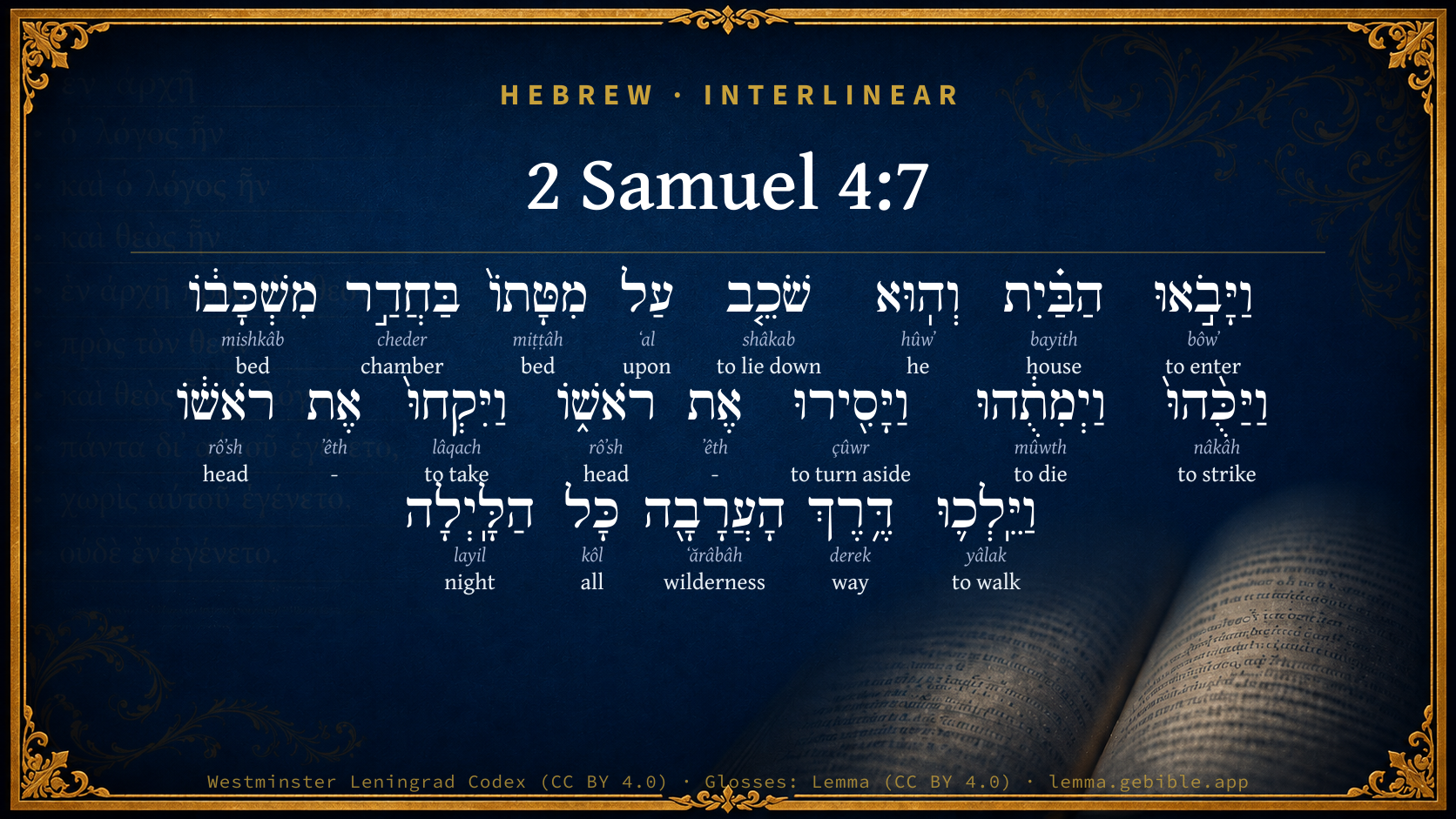
2 Samuel 4:7

Hebrew (Westminster Leningrad Codex) 2 Samuel 4:7 appears in the Hebrew Old Testament. The text above is from the Westminster Leningrad Codex. Each word links to its Strong’s number, a concise gloss, and parsing drawn from the Open Scriptures Hebrew Bible morphology. Click any word for its full Brown-Driver-Briggs (BDB) entry.
Download image
Cite this verse

2 Samuel 4:7 (World English Bible). Public Domain. Lemma interlinear Bible study tool, https://lemma.gebible.app/v/2-samuel/4/7.

Show BibTeX & RIS
BibTeX
RIS
English Translation
Now when they came into the house, as he lay on his bed in his bedchamber, they struck him, and killed him, and beheaded him, and took his head, and went by the way of the Arabah all night.
World English Bible · Public Domain
Download a study sheet

One document with this verse’s original text, its word-by-word gloss line, the meaning frame, cross-references with their text, attributed commentary, and full source and license credits — printable, and it pastes into notes with its structure intact.

This verse Autodidact and up

Study sheet (.html) Plain text (.txt)

A passage Seminary Student

Up to 50 verses in one chapter. A passage sheet keeps up to 6 commentary sources and 12 cross-references per verse, in the order this page ranks them, and says so on the sheet whenever that leaves anything out. Ask for a single verse and you get the Autodidact verse sheet above.

Everything on this page stays free to read, with no account — the sheet is a download of what is already on screen, not access to it.

Want to remove ads? Support Godless Engineer
Compare translations 3

The same verse in 3 English versions, stacked beneath the original-language interlinear above. Click any original word for its lexicon entry.

Each is an independent rendering of the whole verse — the interlinear is not word-aligned to these translations.

Highlighted words mark where these versions differ — a whole-verse word diff, not a word-by-word alignment.

  • World English Bible Public Domain
    Now when they came into the house, as he lay on his bed in his bedchamber, they struck him, and killed him, and beheaded him, and took his head, and went by the way of the Arabah all night.
  • King James Version Public Domain
    For when they came into the house, he lay on his bed in his bedchamber, and they smote him, and slew him, and beheaded him, and took his head, and gat them away through the plain all night.
  • unfoldingWord Literal Text CC BY-SA 4.0
    For they entered the house, and he was lying on his bed in the chamber of his bed, and they struck him, and they killed him, and they removed his head. And they took his head, and they walked the way of the Arabah all of the night.

unfoldingWord Literal Text — © unfoldingWord, licensed CC BY-SA 4.0. Word-aligned USFM3 via Door43 (git.door43.org/unfoldingWord/en_ult).

Versions to compare (up to 4)

3 of 4 selected

Show all 18 translations

Every available English version of this verse, each an independent rendering of the whole verse.

  • World English Bible Public Domain
    Now when they came into the house, as he lay on his bed in his bedchamber, they struck him, and killed him, and beheaded him, and took his head, and went by the way of the Arabah all night.
  • Berean Standard Bible Public Domain
    They had entered the house while Ish-bosheth was lying on his bed, and having stabbed and killed him, they beheaded him, took his head, and traveled all night by way of the Arabah.
  • Majority Standard Bible Public Domain
    They had entered the house while Ish-bosheth was lying on his bed, and having stabbed and killed him, they beheaded him, took his head, and traveled all night by way of the Arabah.
  • King James Version Public Domain
    For when they came into the house, he lay on his bed in his bedchamber, and they smote him, and slew him, and beheaded him, and took his head, and gat them away through the plain all night.
  • American Standard Version (1901) Public Domain
    Now when they came into the house, as he lay on his bed in his bedchamber, they smote him, and slew him, and beheaded him, and took his head, and went by the way of the Arabah all night.
  • Revised Version (1885) Public Domain
    Now when they came into the house, as he lay on his bed in his bedchamber, they smote him, and slew him, and beheaded him, and took his head, and went by the way of the Arabah all night.
  • Geneva Bible (1599) Public Domain
    For when they came into the house, he slept on his bed in his bed chamber, and they smote him, and slewe him, and beheaded him, and tooke his head, and gate them away through the plaine all the night.
  • Douay-Rheims (1899) Public Domain
    For when they came into the house, be was sleeping upon his bed in a parlour, and they struck him and killed him: and taking away his head they went off by the way of the wilderness, walking all night.
  • Young's Literal Translation Public Domain
    yea, they come in to the house, and he is lying on his bed, in the inner part of his bed-chamber, and they smite him, and put him to death, and turn aside his head, and they take his head, and go the way of the plain all the night,
  • Literal Standard Version CC BY-SA 4.0
    indeed, they come into the house, and he is lying on his bed, in the inner part of his bed-chamber, and they strike him, and put him to death, and turn his head aside, and they take his head, and go the way of the plain all the night,
  • Unlocked Literal Bible CC BY-SA 4.0
    So after they entered the house, they attacked him and killed him as he was lying on his bed in his room. Then they cut off his head and carried it away, traveling on the road all night to the Arabah.
  • unfoldingWord Literal Text CC BY-SA 4.0
    For they entered the house, and he was lying on his bed in the chamber of his bed, and they struck him, and they killed him, and they removed his head. And they took his head, and they walked the way of the Arabah all of the night.
  • Darby Bible Public Domain
    They came into the house, as he lay on his bed in his bedchamber, and they smote him, and slew him, and beheaded him; and they took his head, and went by the way of the plain all night.
  • World Messianic Bible Public Domain
    Now when they came into the house as he lay on his bed in his bedroom, they struck him, killed him, beheaded him, and took his head, and went by the way of the Arabah all night.
  • Webster's Bible Public Domain
    For when they came into the house, he lay on his bed in his bed-chamber, and they smote him, and slew him, and beheaded him, and took his head, and went away through the plain all night.
  • Free Bible Version CC BY-SA 4.0
    They had gone into the house while Ishbosheth was asleep on his bed in his bedroom. After stabbing and killing him, they cut off his head which they took with them, and they traveled all night by the Jordan Valley road.
  • Bible in Basic English Public Domain
    And when they came into the house, Ish-bosheth was stretched on his bed in his bedroom; and they made an attack on him and put him to death, and, cutting off his head, they took it with them and went by the road through the Arabah all night.
  • JPS Tanakh (1917) Public Domain
    Now when they came into the house, as he lay on his bed in his bed-chamber, they smote him, and slew him, and beheaded him, and took his head, and went by the way of the Arabah all night.

Literal Standard Version (2020), Covenant Press — licensed CC BY-SA 4.0. Text via the HelloAO Bible API (eBible.org). Unlocked Literal Bible (unfoldingWord) — licensed CC BY-SA 4.0. Text via the HelloAO Bible API (eBible.org). unfoldingWord Literal Text — © unfoldingWord, licensed CC BY-SA 4.0. Word-aligned USFM3 via Door43 (git.door43.org/unfoldingWord/en_ult). Free Bible Version, Dr. Jonathan Gallagher — licensed CC BY-SA 4.0. Text via the HelloAO Bible API (eBible.org).

Word by word

More ways to search: Search by grammar → Find every occurrence → Compare this word →

Practice this passage: Drill this verse → Learn its vocabulary →

מִטָּתוֹ֙
miṭṭâh
H4296
“bed · his”
Noun, Common, Feminine, Singular, Construct + Suffix, Personal, 3rd Person, Masculine, Singular
Part of Speech
Noun
Type
Common
Gender
Feminine
Number
Singular
State
Construct
Full BDB Definition

Origin: from H5186

TWOT: 1352c

couch, bed, bier
  1. וַיָּבֹ֣אוּ bôwʼ H935 “and · to enter” Conjunction + Verb, Qal, Sequential Imperfect, 3rd Person, Masculine, Plural
  2. הַבַּ֗יִת bayith H1004 “the · house” Particle, Definite Article + Noun, Common, Masculine, Singular, Absolute
  3. וְהֽוּא hûwʼ H1931 “and · he” Conjunction + Pronoun, Personal, 3rd Person, Masculine, Singular
  4. שֹׁכֵ֤ב shâkab H7901 “lying down” Verb, Qal, Participle Active, Masculine, Singular, Absolute
  5. עַל ʻal H5921 “upon” Preposition
  6. בַּחֲדַ֣ר cheder H2315 “in/at · chamber of” Preposition + Noun, Common, Masculine, Singular, Construct
  7. מִשְׁכָּב֔וֹ mishkâb H4904 “bed · his” Noun, Common, Masculine, Singular, Construct + Suffix, Personal, 3rd Person, Masculine, Singular
  8. וַיַּכֻּ֨הוּ֙ nâkâh H5221 “and · to strike · him” Conjunction + Verb, Hiphil, Sequential Imperfect, 3rd Person, Masculine, Plural + Suffix, Personal, 3rd Person, Masculine, Singular
  9. וַיְמִתֻ֔הוּ mûwth H4191 “and · to die · him” Conjunction + Verb, Hiphil, Sequential Imperfect, 3rd Person, Masculine, Plural + Suffix, Personal, 3rd Person, Masculine, Singular
  10. וַיָּסִ֖ירוּ çûwr H5493 “and · to turn aside” Conjunction + Verb, Hiphil, Sequential Imperfect, 3rd Person, Masculine, Plural
  11. אֶת ʼêth H853 “-” Particle, Direct Object
  12. רֹאשׁ֑וֹ rôʼsh H7218 “head · his” Noun, Common, Masculine, Singular, Construct + Suffix, Personal, 3rd Person, Masculine, Singular
  13. וַיִּקְחוּ֙ lâqach H3947 “and · to take” Conjunction + Verb, Qal, Sequential Imperfect, 3rd Person, Masculine, Plural
  14. אֶת ʼêth H853 “-” Particle, Direct Object
  15. רֹאשׁ֔וֹ rôʼsh H7218 “head · his” Noun, Common, Masculine, Singular, Construct + Suffix, Personal, 3rd Person, Masculine, Singular
  16. וַיֵּֽלְכ֛וּ yâlak H3212 “and · to walk” Conjunction + Verb, Qal, Sequential Imperfect, 3rd Person, Masculine, Plural
  17. דֶּ֥רֶךְ derek H1870 “way of” Noun, Common, Both, Singular, Construct
  18. הָעֲרָבָ֖ה ʻărâbâh H6160 “the · wilderness” Particle, Definite Article + Noun, Common, Feminine, Singular, Absolute
  19. כָּל kôl H3605 “all of” Noun, Common, Masculine, Singular, Construct
  20. הַלָּֽיְלָה layil H3915 “the · night” Particle, Definite Article + Noun, Common, Masculine, Singular, Absolute

About this verse

These counts appear in no published source. They are computed here, from the morphology-tagged text and Lemma’s own curated glosses. What Lemma adds →

21
words
19
distinct lemmas
Historical
section

Shared distinctive vocabulary

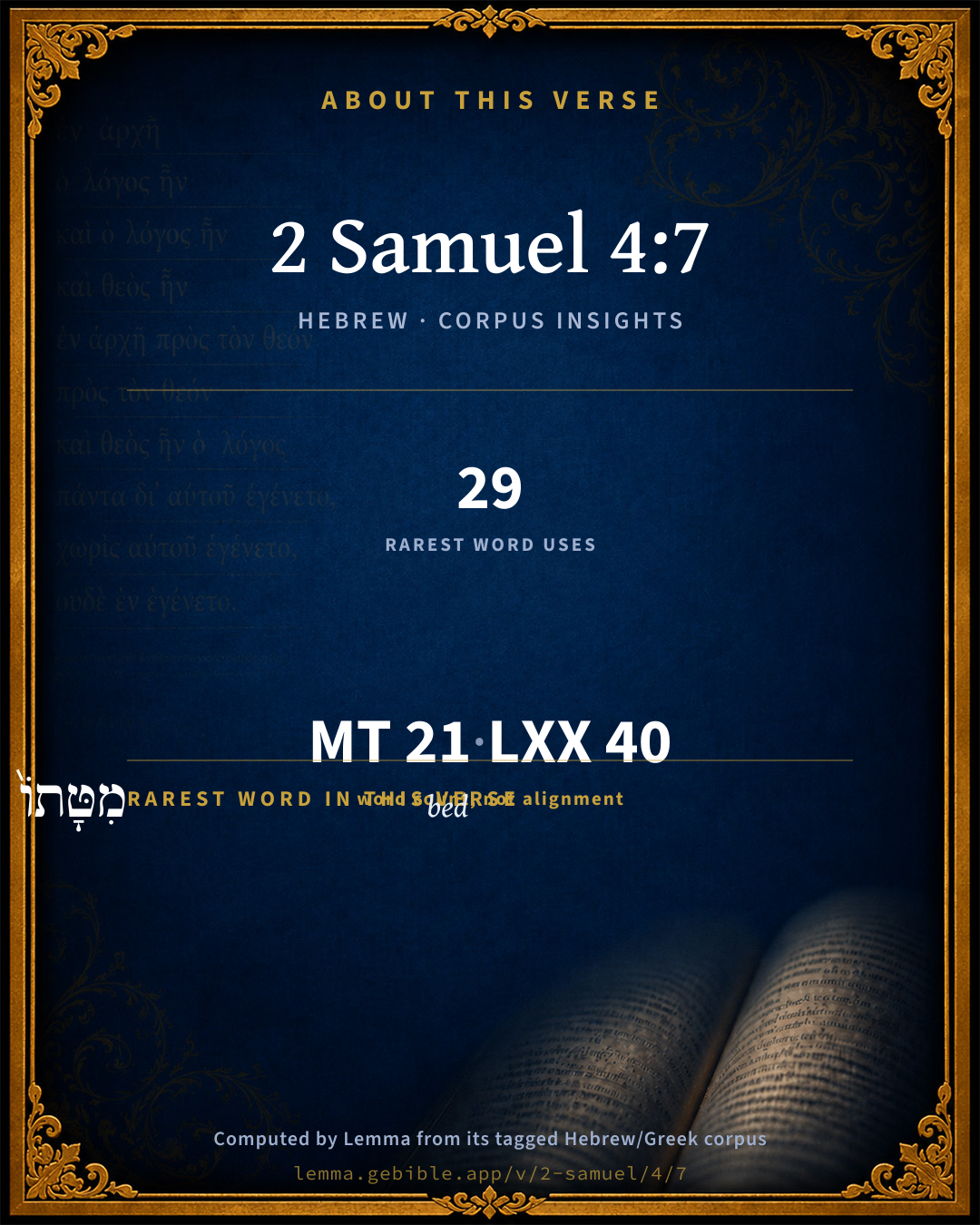
מִטָּתוֹ֙ bed H4296 occurs in 29 verses of the Hebrew Bible. Also found in:

Grammatical profile

  • 7 verbs
  • 10 nouns
  • 1 pronoun
  • 1 preposition
  • 2 particles

Verb forms

  • וַיָּבֹ֣אוּ Qal · Sequential Imperfect
  • שֹׁכֵ֤ב Qal · Participle Active
  • וַיַּכֻּ֨הוּ֙ Hiphil · Sequential Imperfect
  • וַיְמִתֻ֔הוּ Hiphil · Sequential Imperfect
  • וַיָּסִ֖ירוּ Hiphil · Sequential Imperfect
  • וַיִּקְחוּ֙ Qal · Sequential Imperfect
  • וַיֵּֽלְכ֛וּ Qal · Sequential Imperfect

Repetition

A word recurs within this verse — often emphatic in Hebrew:

  • רֹאשׁ֑וֹ head H7218 ×2

Hebrew & Septuagint length

In English translation the verse runs 39 words from the Hebrew and 36 from the Septuagint (LXX English) — closely comparable.

A rough comparison of the two English renderings, which tokenize alike — not a word-level alignment.

Word counts can differ between the Hebrew and the Greek without any difference in meaning — e.g. the Hebrew direct-object marker אֵת has no separate Greek word, and Greek often adds the article ὁ.

In the original languages it is 21 Hebrew tokens and 40 Greek tokens — but the two are counted differently (Hebrew bundles its prefixes and suffixes into one token; the Greek is in lemma form), so that isn’t a like-for-like length.

Cross-references

6

Topical passages linked to 2 Samuel 4:7 in the Treasury of Scripture Knowledge — connected by theme and wording, ordered by reader-vote popularity; previews shown in the World English Bible.

  • 1 Samuel 17:54 David took the head of the Philistine, and brought it to Jerusalem; but he put his armor in his tent.
  • 1 Samuel 31:9 They cut off his head, and stripped off his armor, and sent into the land of the Philistines round about, to carry the news to the house of their idols, and to the people.
  • 2 Samuel 2:29 Abner and his men went all that night through the Arabah; and they passed over the Jordan, and went through all Bithron, and came to Mahanaim.
  • 2 Kings 10:6–7 Then he wrote a letter the second time to them, saying, If you be on my side, and if you will listen to my voice, take the heads of the men your master's sons, and come to me to Jezreel by tomorrow this time. Now the king's sons, being seventy persons, were with the great men of the city, who brought them up.
  • Matthew 14:11 His head was brought on a platter, and given to the young lady: and she brought it to her mother.
  • Mark 6:28–29 and brought his head on a platter, and gave it to the young lady; and the young lady gave it to her mother.

Cross-references courtesy of OpenBible.info (CC BY 4.0).

Hebrew and Greek witnesses Masoretic Hebrew ↔ Greek Septuagint

The same verse in the two great witnesses to the Old Testament, shown verse-for-verse.

These are two independent witnesses, not word-aligned to each other, and the Septuagint is shown in lemma (dictionary) form.

Hebrew 2 Samuel 4:7 Masoretic · Westminster Leningrad Codex

וַיָּבֹ֣אוּ הַבַּ֗יִת וְהֽוּא שֹׁכֵ֤ב עַל מִטָּתוֹ֙ בַּחֲדַ֣ר מִשְׁכָּב֔וֹ וַיַּכֻּ֨הוּ֙ וַיְמִתֻ֔הוּ וַיָּסִ֖ירוּ אֶת רֹאשׁ֑וֹ וַיִּקְחוּ֙ אֶת רֹאשׁ֔וֹ וַיֵּֽלְכ֛וּ דֶּ֥רֶךְ הָעֲרָבָ֖ה כָּל הַלָּֽיְלָה

Now when they came into the house, as he lay on his bed in his bedchamber, they struck him, and killed him, and beheaded him, and took his head, and went by the way of the Arabah all night.

World English Bible · Public Domain

Greek LXX 2 Samuel 4:7 Septuagint · lemma form

καί εἰςἔρχομαι εἰς ὁ οἶκος καί μεμφιβοσθε καταεὕδω ἐπί ὁ κλίνη αὐτός ἐν ὁ κοιτών αὐτός καί τύπτω αὐτός καί θανατόω καί ἀποαἱρέω ὁ κεφαλή αὐτός καί λαμβάνω ὁ κεφαλή αὐτός καί ἀποἔρχομαι ὁδός ὁ κατά δυσμή ὅλος ὁ νύξ

And Jebosthe was sleeping on his bed in his chamber: and they strike him, and kill him, and take off his head: and they took his head, and went all the night by the western road.

LXX2012 (modern English Septuagint) · Public Domain

On this verse, Haydock's Catholic Bible Commentary discusses the Septuagint’s reading. Read the note in Commentary ↓

Hebrew: Westminster Leningrad Codex (CC BY 4.0). Greek: Septuagint (public domain); English from LXX2012 (modern English Septuagint) (Public Domain). How the Septuagint differs from the Hebrew →

Targum (Aramaic paraphrase)

1

The Targum is the ancient Jewish Aramaic paraphrase of the Hebrew Scriptures — an interpretive translation, not the Hebrew text itself. Onkelos (literal) and Pseudo-Jonathan (expansive) render the Torah, and Jonathan the Prophets. Coverage is partial: where no permissively-licensed English translation exists for a verse, only the Aramaic is shown. This is verse-level text, not a word-by-word alignment to the Hebrew.

  1. Targum Jonathan Prophets (Joshua–Malachi)
    וַאֲתוֹ לְבֵיתָא וְהוּא שָׁכִיב עַל עַרְסֵיהּ בְּאִדְרוֹן בֵּית מִשְׁכְּבֵיהּ וּמְחוֹהִי וְקַטְלוֹהִי וְאַעְדִיאוּ יַת רֵישֵׁיהּ וּנְסִיבוּ יַת רֵישֵׁיהּ וַאֲזַלוּ בְּאוֹרַח מֵישְׁרָא כָּל לַיְלְיָא:

    (no public-domain English translation for this verse)

    Targum Jonathan — Aramaic: “Mikraot Gedolot” (public domain). English: “Sefaria Community Translation” (CC0 1.0 (public-domain dedication)); “London "Chaldee Paraphrase," 1871” (public domain). Text via Sefaria.

Commentary

Notes on 2 Samuel 4:7 from classic Christian and Jewish commentators (each source and its license shown beneath its notes). The classic Christian expositions comment on the surrounding passage and are grouped to its opening verse, so a note may address several verses; the Jewish commentaries on the Tanakh (Rashi and others) are per-verse, so they appear only where the commentator wrote on this verse.

Lemma curates 59 commentaries, every one of them public domain or Creative Commons licensed, each selected and text-cleaned for this edition rather than reprinted as found. About our sources →

Ellicott's Commentary for English Readers

(7) Took his head.—There is no difficulty with the repetition in 2Sa_4:7 of what has been already mentioned inverse 6, for it is common in the Scripture narratives to repeat statements when any additional fact (as here, the carrying off of the head) is to be mentioned. (See, e.g., 2Sa_3:22-23, where Joab’s arrival is twice mentioned, and 2Sa_5:1-3, where the mention of the assembly at Hebron is repeated.)

Through the plain.—As in 2Sa_2:29, the Arabah, or valley of the Jordan, the natural way from Mahanaim to Hebron.

A Bible Commentary for English Readers, edited by Charles John Ellicott (1878–1897) — public domain. Text from a community e-Sword module.

Trapp's Complete Commentary

John Trapp

2Sa 4:7 For when they came into the house, he lay on his bed in his bedchamber, and they smote him, and slew him, and beheaded him, and took his head, and gat them away through the plain all night.

Ver. 7. He lay on his bed.] Dreading no danger. So great need have we to commit ourselves to God, when we go to our rest, that whether we live or die, we may be his.

They smote him, and slew him.] So do surfeiting and drunkenness slay the soul, saith Hugo, of the spiritual sleeper; taking away his heart. {Hos 4:11}

John Trapp, A Commentary or Exposition upon All the Books of the Old and New Testament (1647–1656) — public domain. Text from a community e-Sword module.

Joseph Benson's Commentary

2Sa 4:7-8. They smote him, and slew him, &c. — The privacy of the place gave them opportunity to do all this, without discovery. And gat them away through the plain, from Mahanaim to Hebron — It being for the most part a flat country, till they came to ascend the mountain, on the side of which Hebron stood. Hath avenged the king of Saul and of his seed — For they were all now extinguished except his grandson Mephibosheth, who was of no account because of his lameness.

Joseph Benson's Commentary on the Old and New Testaments (1811–1818) — public domain. Text from a community e-Sword module.

Keil & Delitzsch

C. F. Keil & F. Delitzsch

Punishment of the murderers by David. - Sa2 4:7. As the thread of the narrative was broken by the explanatory remarks in Sa2 4:6, it is resumed here by the repetition of the words וגו ויּבאוּ: "They came into the house, as he lay upon his bed in his bed-chamber, and smote him, and slew him," for the purpose of attaching the account of the further progress of the affair, viz., that they cut off his head, took it and went by the way of the Arabah (the valley of the Jordan: see Sa2 2:29) the whole night, and brought the head of Ishbosheth unto David to Hebron with these words: "Behold (= there thou hast) the head of Ishbosheth, the son of Saul thine enemy, who sought thy life; and thus hath Jehovah avenged my lord the king this day upon Saul and his seed." No motive is assigned for this action. But there can be little doubt that it was no other than the hope of obtaining a great reward from David. Thus they presumed "to spread the name of God and His providence as a cloak and covering over their villany, as the wicked are accustomed to do" (Berleb. Bible).

Keil & Delitzsch — Biblical Commentary on the Old Testament (1861–1891) — public domain (CC PDM 1.0). Text via the HelloAO Bible API. (Old Testament only.)

Geneva Bible (1599)

Geneva Bible translators

Or, wilderness.

Geneva Bible (1599) marginal notes — public domain. Text via Bolls.life.

Jamieson, Fausset & Brown

Robert Jamieson, A. R. Fausset & David Brown

when they came into the house, he lay on his bed--Rechab and Baanah came in the heat of the day, when they knew that Ish-bosheth, their master, would be resting on his divan; and as it was necessary, for the reason just given, to have the corn the day before it was needed, their coming at that time, though it might be a little earlier than usual, created no suspicion, and attracted no notice [HARMER].

gat them away through the plain--that is, the valley of the Jordan, through which their way lay from Mahanaim to Hebron.

Jamieson, Fausset & Brown — Commentary Critical and Explanatory on the Whole Bible (1871) — public domain (CC PDM 1.0). Text via the HelloAO Bible API.

The Cambridge Bible for Schools and Colleges

gen. ed. J. J. S. Perowne

7. through the plain] By the way of the Arabah. See note on ch. 2Sa_2:29. From Mahanaim to Hebron was a distance of about 80 or 90 miles.

The Cambridge Bible for Schools and Colleges (gen. ed. J. J. S. Perowne; Cambridge University Press, 1878–1918) — public domain. Text from a community e-Sword module.

John Gill's Exposition

And they brought the head of Ishbosheth unto David to Hebron,.... Supposing it would have been a very acceptable present to him:

and said to the king, behold the head of Ishbosheth the son of Saul thine enemy, which sought thy life; all which, his relation to Saul, his enmity to David, and his designs upon his life, are artfully put together to raise the indignation of David against him, and make their present of his head to him the more agreeable:

and the Lord hath avenged my lord the king this day of Saul and of his seed; for all the evils and injuries they had done him; this being the last of the sons of Saul by a lawful wife, the two remaining were by a concubine; and these men impiously ascribe to the Lord what they with wicked hands had done.

John Gill's Exposition of the Whole Bible (1746–1763) — public domain (CC PDM 1.0). Text via the HelloAO Bible API.

Haydock's Catholic Bible Commentary

Parlour. Hebrew, "bed-chamber." --- Wilderness. Avoiding places frequented. (Haydock) --- The distance was about 40 leagues, which they could not travel in one night. (Calmet) --- Adrichomius says it was 30 hours’ walk. Septuagint, "west-ward." (Haydock)

George Leo Haydock (1774–1849), Haydock's Catholic Family Bible and Commentary, 1859 edition — public domain. Excludes Psalms (Douay-Rheims chapter numbering differs from Protestant) and Deuterocanonical books (Catholic canon only).

Matthew Poole's English Annotations

Through the plain, i.e. in the way from Mahanaim to Hebron; which for the most part was a plain country.

Matthew Poole's English Annotations on the Holy Bible (1683–1685) — public domain. Text from a community e-Sword/MySword module.

Whedon's Commentary on the Bible

Daniel D. Whedon

7. Took his head — They probably carried it in a sack, in which they pretended to fetch wheat. They could not otherwise have well escaped at midday.

Through the plain — The Jordan valley. See on 2Sa_2:29.

Daniel D. Whedon (gen. ed.), Commentary on the Old and New Testaments (1874–1909) — public domain. Text from a community e-Sword module.

Lesson kit

Teaching starters — assembled from the data on this page, not authored interpretation. Every prompt links to the verse data it draws on. Edit before teaching.

2 Samuel, in the Historical, opens this verse with 21 words (19 distinct Hebrew lemmas). Its most distinctive word is miṭṭâh (“bed”). A historical commentator’s framing appears above. Read the whole chapter for the surrounding context.

Discussion questions

  1. The word miṭṭâh carries the sense “bed.” How does it shape the verse?
  2. Genesis 47:31 shares the word «bed» with this verse. How do the two illuminate each other?
  3. “head” occurs 2× in this one verse. What is the effect of the repetition?
  4. The translations on this page render this verse differently — a whole-verse word diff, not a word-by-word alignment. What might account for the different wordings?
  5. The verb «וַיָּבֹ֣אוּ» is Qal Sequential Imperfect. How does its form color the action?
  6. Reading how Ellicott's Commentary for English Readers and Trapp's Complete Commentary read this verse, where do the two commentators agree and where do they part?

Things to notice

Reading settings

Reading text

Shown beneath each verse's original-language words.

Old Testament
Old Testament edition

Read the OT as the Masoretic Hebrew (MT) or the Greek Septuagint (LXX).

English shown for the Greek Septuagint (in the Hebrew ↔ Greek comparison).

Comparing translations? Open the Compare panel on any verse page to stack up to four side by side.