
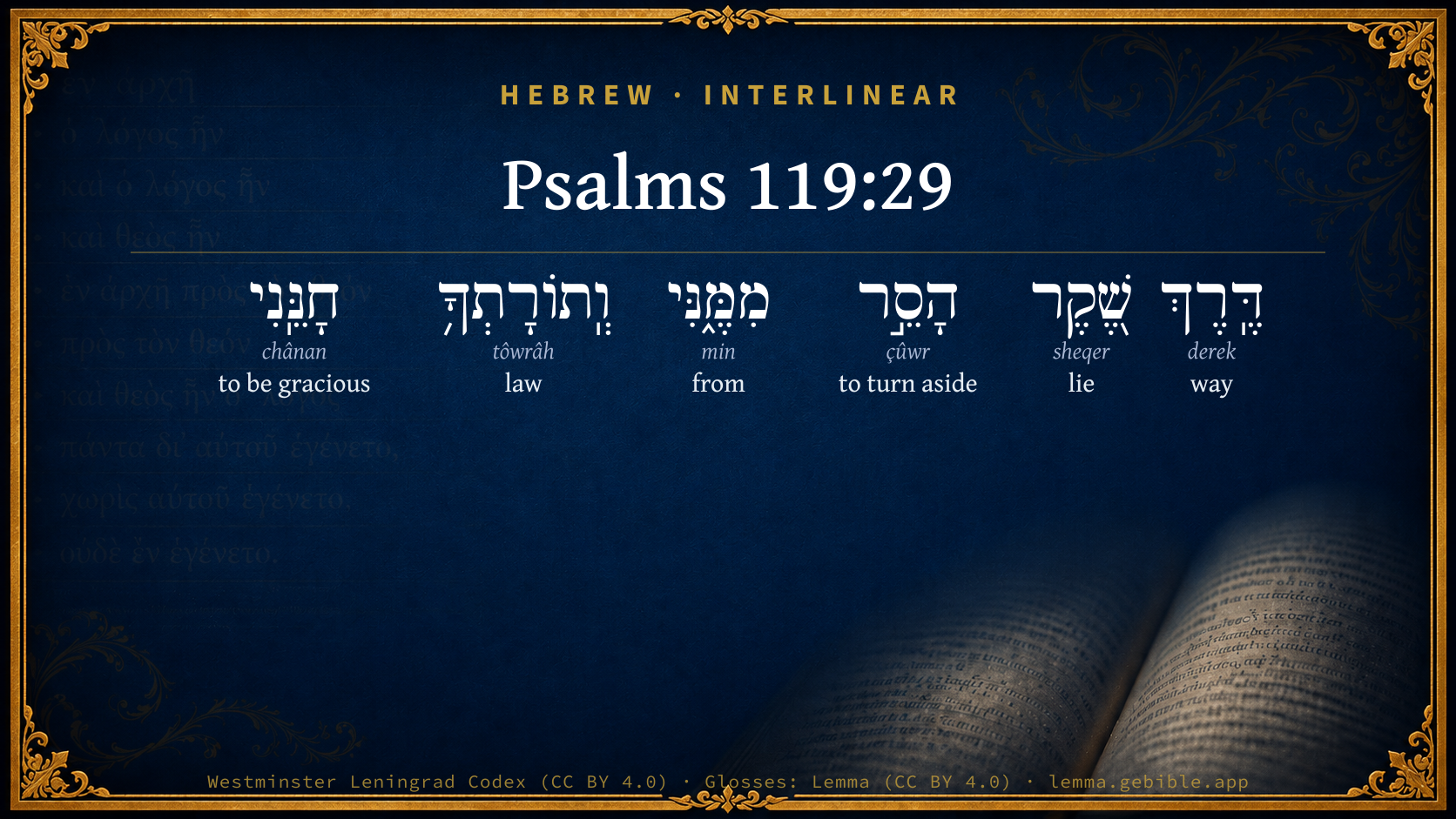
Psalms 119:29

Hebrew (Westminster Leningrad Codex) Psalms 119:29 appears in the Hebrew Old Testament. The text above is from the Westminster Leningrad Codex. Each word links to its Strong’s number, a concise gloss, and parsing drawn from the Open Scriptures Hebrew Bible morphology. Click any word for its full Brown-Driver-Briggs (BDB) entry.
Download image
Cite this verse

Psalms 119:29 (World English Bible). Public Domain. Lemma interlinear Bible study tool, https://lemma.gebible.app/v/psalms/119/29.

Show BibTeX & RIS
BibTeX
RIS
English Translation
Keep me from the way of deceit. Grant me your law graciously!
World English Bible · Public Domain
Download a study sheet

One document with this verse’s original text, its word-by-word gloss line, the meaning frame, cross-references with their text, attributed commentary, and full source and license credits — printable, and it pastes into notes with its structure intact.

This verse Autodidact and up

Study sheet (.html) Plain text (.txt)

A passage Seminary Student

Up to 50 verses in one chapter. A passage sheet keeps up to 6 commentary sources and 12 cross-references per verse, in the order this page ranks them, and says so on the sheet whenever that leaves anything out. Ask for a single verse and you get the Autodidact verse sheet above.

Everything on this page stays free to read, with no account — the sheet is a download of what is already on screen, not access to it.

Want to remove ads? Support Godless Engineer
Compare translations 3

The same verse in 3 English versions, stacked beneath the original-language interlinear above. Click any original word for its lexicon entry.

Each is an independent rendering of the whole verse — the interlinear is not word-aligned to these translations.

Highlighted words mark where these versions differ — a whole-verse word diff, not a word-by-word alignment.

  • World English Bible Public Domain
    Keep me from the way of deceit. Grant me your law graciously!
  • King James Version Public Domain
    Remove from me the way of lying: and grant me thy law graciously.
  • unfoldingWord Literal Text CC BY-SA 4.0
    Turn from me the path of deceit, and favor me with your teaching.

unfoldingWord Literal Text — © unfoldingWord, licensed CC BY-SA 4.0. Word-aligned USFM3 via Door43 (git.door43.org/unfoldingWord/en_ult).

Versions to compare (up to 4)

3 of 4 selected

Show all 17 translations

Every available English version of this verse, each an independent rendering of the whole verse.

  • World English Bible Public Domain
    Keep me from the way of deceit. Grant me your law graciously!
  • Berean Standard Bible Public Domain
    Remove me from the path of deceit and graciously grant me Your law.
  • Majority Standard Bible Public Domain
    Remove me from the path of deceit and graciously grant me Your law.
  • King James Version Public Domain
    Remove from me the way of lying: and grant me thy law graciously.
  • American Standard Version (1901) Public Domain
    Remove from me the way of falsehood; And grant me thy law graciously.
  • Revised Version (1885) Public Domain
    Remove from me the way of falsehood: and grant me thy law graciously.
  • Geneva Bible (1599) Public Domain
    Take from mee the way of lying, and graunt me graciously thy Lawe.
  • Young's Literal Translation Public Domain
    The way of falsehood turn aside from me And with Thy law favour me.
  • Literal Standard Version CC BY-SA 4.0
    Turn aside the way of falsehood from me || And favor me with Your law.
  • Unlocked Literal Bible CC BY-SA 4.0
    Turn from me the path of deceit; graciously teach me your law.
  • unfoldingWord Literal Text CC BY-SA 4.0
    Turn from me the path of deceit, and favor me with your teaching.
  • Darby Bible Public Domain
    Remove from me the way of falsehood, and graciously grant me thy law.
  • World Messianic Bible Public Domain
    Keep me from the way of deceit. Grant me your Torah graciously!
  • Webster's Bible Public Domain
    Remove from me the way of lying: and grant me thy law graciously.
  • Free Bible Version CC BY-SA 4.0
    Stop me fooling myself; kindly teach me your law.
  • Bible in Basic English Public Domain
    Take from me every false way; and in mercy give me your law.
  • JPS Tanakh (1917) Public Domain
    Remove from me the way of falsehood; and grant me Thy law graciously.

Literal Standard Version (2020), Covenant Press — licensed CC BY-SA 4.0. Text via the HelloAO Bible API (eBible.org). Unlocked Literal Bible (unfoldingWord) — licensed CC BY-SA 4.0. Text via the HelloAO Bible API (eBible.org). unfoldingWord Literal Text — © unfoldingWord, licensed CC BY-SA 4.0. Word-aligned USFM3 via Door43 (git.door43.org/unfoldingWord/en_ult). Free Bible Version, Dr. Jonathan Gallagher — licensed CC BY-SA 4.0. Text via the HelloAO Bible API (eBible.org).

Word by word

More ways to search: Search by grammar → Find every occurrence → Compare this word →

Practice this passage: Drill this verse → Learn its vocabulary →

חָנֵּֽנִי
chânan
H2603
“be gracious · me”
Verb, Qal, Imperative, 2nd Person, Masculine, Singular + Suffix, Personal, 1st Person, Common, Singular
Part of Speech
Verb
Stem
Qal
Form
Imperative
Person
2nd Person
Gender
Masculine
Number
Singular
Full BDB Definition

Origin: a primitive root [compare H2583 ]

TWOT: 694 , 695

to be gracious, show favour, pity - (Qal) to show favour, be gracious - (Niphal) to be pitied - (Piel) to make gracious, make favourable, be gracious - (Poel) to direct favour to, have mercy on - (Hophal) to be shown favour, be shown consideration - (Hithpael) to seek favour, implore favour - to be loathsome
  1. דֶּֽרֶךְ derek H1870 “way of” Noun, Common, Both, Singular, Construct
  2. שֶׁ֭קֶר sheqer H8267 “lie” Noun, Common, Masculine, Singular, Absolute
  3. הָסֵ֣ר çûwr H5493 “turn aside” Verb, Hiphil, Imperative, 2nd Person, Masculine, Singular
  4. מִמֶּ֑נִּי min H4480 “from · me” Preposition + Suffix, Personal, 1st Person, Common, Singular
  5. וְֽתוֹרָתְךָ֥ tôwrâh H8451 “and · law · your” Conjunction + Noun, Common, Feminine, Singular, Construct + Suffix, Personal, 2nd Person, Masculine, Singular

About this verse

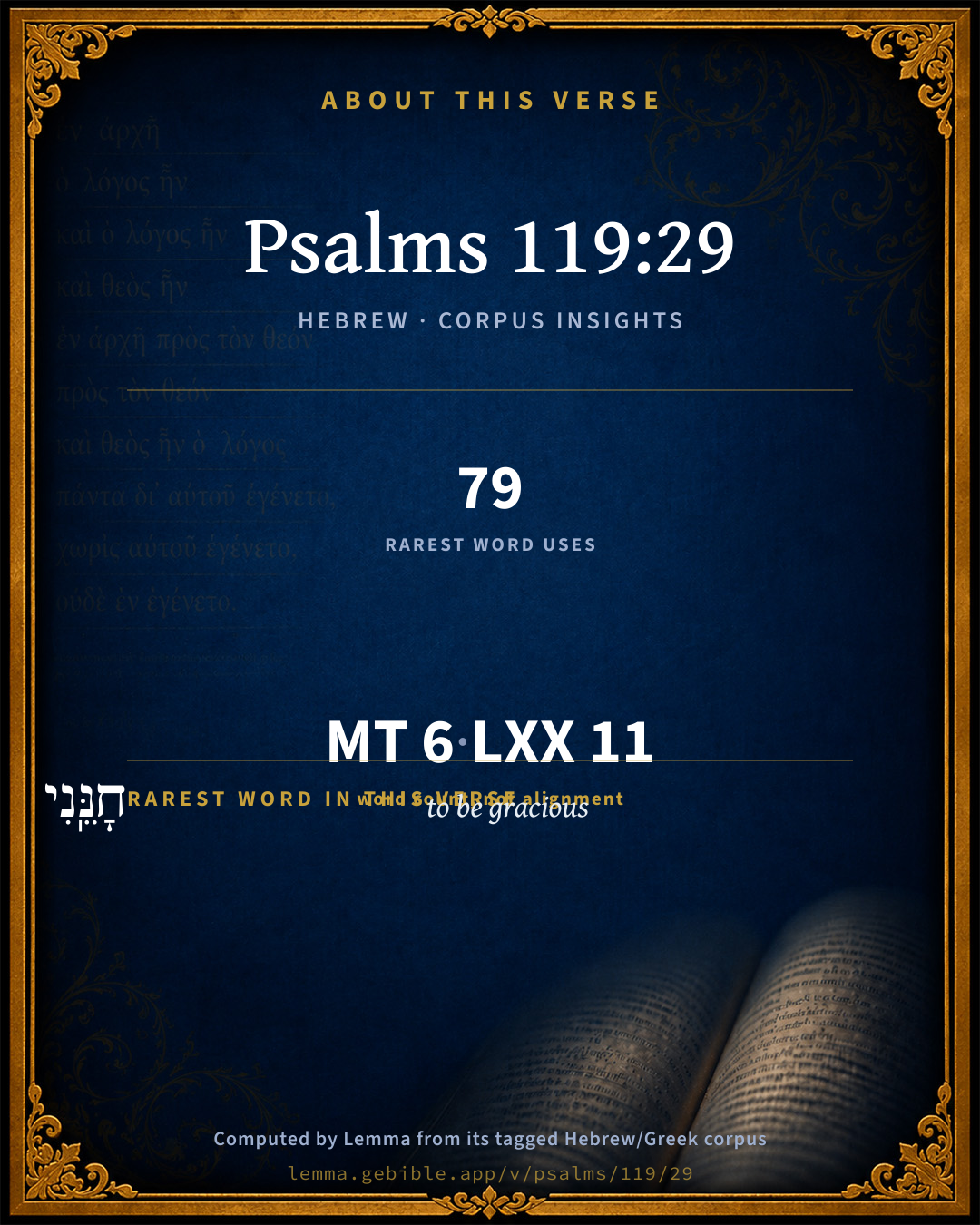
These counts appear in no published source. They are computed here, from the morphology-tagged text and Lemma’s own curated glosses. What Lemma adds →

6
words
6
distinct lemmas
Wisdom
section

Grammatical profile

  • 2 verbs
  • 3 nouns
  • 1 preposition

Verb forms

  • הָסֵ֣ר Hiphil · Imperative
  • חָנֵּֽנִי Qal · Imperative

Hebrew & Septuagint length

In English translation the verse runs 12 words from the Hebrew and 15 from the Septuagint (LXX English) — closely comparable.

A rough comparison of the two English renderings, which tokenize alike — not a word-level alignment.

Word counts can differ between the Hebrew and the Greek without any difference in meaning — e.g. the Hebrew direct-object marker אֵת has no separate Greek word, and Greek often adds the article ὁ.

In the original languages it is 6 Hebrew tokens and 11 Greek tokens — but the two are counted differently (Hebrew bundles its prefixes and suffixes into one token; the Greek is in lemma form), so that isn’t a like-for-like length.

Cross-references

16

Topical passages linked to Psalms 119:29 in the Treasury of Scripture Knowledge — connected by theme and wording, ordered by reader-vote popularity; previews shown in the World English Bible.

  • 1 John 2:4 One who says, "I know him," and doesn't keep his commandments, is a liar, and the truth isn't in him.
  • Proverbs 30:8 Remove far from me falsehood and lies. Give me neither poverty nor riches. Feed me with the food that is needful for me;
  • 1 John 1:8 If we say that we have no sin, we deceive ourselves, and the truth is not in us.
  • Psalms 119:37 Turn my eyes away from looking at worthless things. Revive me in your ways.
  • Hebrews 8:10–11 "For this is the covenant that I will make with the house of Israel. After those days," says the Lord; "I will put my laws into their mind, I will also write them on their heart. I will be to them a God, And they will be to me a people.
  • Ephesians 4:22–25 that you put away, as concerning your former way of life, the old man, that grows corrupt after the lusts of deceit;
  • Revelation 22:15 Outside are the dogs, the sorcerers, the sexually immoral, the murderers, the idolaters, and everyone who loves and practices falsehood.
  • Psalms 119:5 Oh that my ways were steadfast To obey your statutes!
  • Psalms 119:163 I hate and abhor falsehood. I love your law.
  • Psalms 141:3–4 Set a watch, Yahweh, before my mouth. Keep the door of my lips.
  • Jeremiah 16:19 Yahweh, my strength, and my stronghold, and my refuge in the day of affliction, to you shall the nations come from the ends of the earth, and shall say, Our fathers have inherited nothing but lies, [even] vanity and things in which there is no profit.
  • Jonah 2:8 Those who regard lying vanities forsake their own mercy.
  • Psalms 119:104 Through your precepts, I get understanding; Therefore I hate every false way.
  • Psalms 119:128 Therefore I consider all of your precepts to be right. I hate every false way.
  • Isaiah 44:20 He feeds on ashes; a deceived heart has turned him aside; and he can't deliver his soul, nor say, Is there not a lie in my right hand?
  • Jeremiah 31:33–34 But this is the covenant that I will make with the house of Israel after those days, says Yahweh: I will put my law in their inward parts, and in their heart will I write it; and I will be their God, and they shall be my people:

Cross-references courtesy of OpenBible.info (CC BY 4.0).

Hebrew and Greek witnesses Masoretic Hebrew ↔ Greek Septuagint

The same verse in the two great witnesses to the Old Testament, shown verse-for-verse.

You’re reading Greek Psalm 118 (Hebrew Psalm 119). The Septuagint counts the superscription, so verse numbers can differ from the Hebrew — chapter-level alignment, not verse-by-verse. Numbering follows Rahlfs.

These are two independent witnesses, not word-aligned to each other, and the Septuagint is shown in lemma (dictionary) form.

Hebrew Psalms 119:29 Masoretic · Westminster Leningrad Codex

דֶּֽרֶךְ שֶׁ֭קֶר הָסֵ֣ר מִמֶּ֑נִּי וְֽתוֹרָתְךָ֥ חָנֵּֽנִי

Keep me from the way of deceit. Grant me your law graciously!

World English Bible · Public Domain

Greek LXX Greek Psalm 118:29 Septuagint · lemma form

ὁδός ἀδικία ἀποἵστημι ἀπό ἐγώ καί ὁ νόμος σύ ἐλεέω ἐγώ

Remove from me the way of iniquity; and be merciful to me by your law.

LXX2012 (modern English Septuagint) · Public Domain

On this verse, Joseph Benson's Commentary discusses the Septuagint’s reading. Read the note in Commentary ↓

Hebrew: Westminster Leningrad Codex (CC BY 4.0). Greek: Septuagint (public domain); English from LXX2012 (modern English Septuagint) (Public Domain). How the Septuagint differs from the Hebrew →

Commentary

Notes on Psalms 119:29 from classic Christian and Jewish commentators (each source and its license shown beneath its notes). The classic Christian expositions comment on the surrounding passage and are grouped to its opening verse, so a note may address several verses; the Jewish commentaries on the Tanakh (Rashi and others) are per-verse, so they appear only where the commentator wrote on this verse.

Lemma curates 59 commentaries, every one of them public domain or Creative Commons licensed, each selected and text-cleaned for this edition rather than reprinted as found. About our sources →

Trapp's Complete Commentary

John Trapp

Psa 119:29 Remove from me the way of lying: and grant me thy law graciously.

Ver. 29. Remove from me the way of lying] A sin that David, through diffidence, fell into frequently. See 1Sa 21:2; 1Sa 21:8, where he roundly telleth three or four lies; and the like he did, 1Sa 27:8; 1Sa 27:10 : this evil he saw by himself, and here prayeth against it.

And grant me thy law] For a preservative from this foul sin; herein gratify me, good Lord.

John Trapp, A Commentary or Exposition upon All the Books of the Old and New Testament (1647–1656) — public domain. Text from a community e-Sword module.

The Biblical Illustrator

Joseph S. Exell

Psa_119:29

Remove from me the way of lying: and grant me Thy law graciously.

Lying

I. The faculty of lying. Man has a faculty for misrepresenting facts and for deceiving men. The mere possession of this faculty is not necessarily wrong; all depends upon the motives that inspire it, and the uses to which it is directed.

II. The professity of lying. Most venal lies spring from the following wrong states of heart.

1. Fear.

2. Vanity.

3. Greed.

4. Ambition.

III. The habit of lying.

1. Popular. How rare are true men in this world of shams!

2. Dangerous. It is inimical to moral health, beset with perils, and leading to moral ruin. (Homilist.)

But had not David the law already?

No doubt he wanted not the Book of the Law: he heard it, he read it, he professed it; yea, someway he understood it. What, then, is it he craves? Surely, that the law might be so imprinted in his heart, that it might abolish that natural vanity, and deceit of sin, which carrieth him to the offence of God. A necessary petition for these days; wherein the knowledge of the Word is exceeding great, but the zeal, spiritual life, and feeling of the hearts of men is not answerable unto it. They think all is welt, in that publicly they profess it. They hear it with their ears; they speak of it with their mouths; they read it in their books finely bound; though in that duty many fail also. But certainly when they think they have it, they want it; so long as it is not printed in the table of their heart, to frame their motions, affections and actions conformable to it. And this is it which David here craves. (Bishop Cowper.)

The Biblical Illustrator, edited by Joseph S. Exell (c. 1880s–1900s) — public domain. Text from a community e-Sword module.

Joseph Benson's Commentary

Psa 119:29-30. Remove from me the way of lying — Hebrew, דרךְ שׁקר, dereech sheker, the way of falsehood or deceit, of guile or dissimulation. Let me neither practise it myself, nor countenance, nor be deceived by it in others. The LXX. render it, οδον αδικιας, the way of unrighteousness. “It is plain,” says Dr. Horne, “that the way of truth, in the latter of these two verses, is opposed to the way of lying, or of falsehood, in the former. The one comprehends every thing in doctrine and practice that is right, and therefore true; the other denotes every thing which is wrong, and therefore false. Of these two ways man hath his choice. God points out to him the former by his word, and offers to conduct him in it by his Spirit. Satan shows him the latter, and endeavours to seduce him into it by his temptations. The psalmist declares himself to have chosen God’s way, and to have laid the Scriptures before him, as the chart by which to direct his course. He therefore prays that the other way may be far removed from him; and that God would vouchsafe him such thorough acquaintance with the way of truth as might prevent him from ever wandering into the path of error. How much depends upon the road we choose! How difficult is it, in a divided and distracted world, to choose aright! Yet this choice, so important, so difficult, frequently remains to be made by us, when we have neither judgment to choose, nor strength to travel!”

Joseph Benson's Commentary on the Old and New Testaments (1811–1818) — public domain. Text from a community e-Sword module.

J. A. Alexander on Psalms

Joseph Addison Alexander

29. (Psa 119:29) The way of falsehood remove from me, and thy law grant unto me graciously. The way mentioned in the first clause is that of unfaithfulness to God's covenant, or of apostasy from it. See above, Psa 119:21. Remove, a causative in Hebrew, meaning make to depart. The common version of the last verb, as above given, is a correct paraphrase of the Hebrew verb which means to be gracious, to act graciously, and here still more specifically, to give graciously, to bestow as a free favour. To give the law is still, as in the preceding verses, to make it known by a divine illumination.

Joseph Addison Alexander, The Psalms Translated and Explained (1850) — public domain. Text from a community e-Sword module.

Tyndale Open Study Notes

Tyndale Open Resources

119:29 lying to myself: Self-deception is a fruit of sinful human nature (Jer 17:9); it leads to folly. • Access to God’s word is a privilege, not a right.

Tyndale Open Study Notes — © Tyndale Open Resources, licensed CC BY-SA 4.0. Text via the HelloAO Bible API.

Geneva Bible (1599)

Geneva Bible translators

Instruct me in thy word, whereby my mind may be purged from vanity, and taught to obey thy will.

Geneva Bible (1599) marginal notes — public domain. Text via Bolls.life.

Adam Clarke's Commentary

Verse 29. The way of lying] The propensity to falsity and prevarication, whatsoever is contrary to truth. Remove me from its solicitations, and remove it from me. "Grant me thy law graciously;" give it to me as a rule of moral conduct; but give it to me graciously through the Gospel; and then it will not be the letter that killeth, but will be sanctified to me, so as to become to me holy, just, and GOOD.

Adam Clarke's Commentary on the Bible (1810–1826) — public domain. Text from a community e-Sword/MySword module.

John Calvin's Commentaries

29. Take away from me the way of falsehood. Knowing how prone the nature of man is to vanity and falsehood, he first asks the sanctification of his thoughts, lest, being entangled by the snares of Satan, he fall into error. Next, that he may be kept from falsehood, he prays to be fortified with the doctrine of the law. The second clause of the verse is interpreted variously. Some render it, make thy law pleasant to me. And as the law is disagreeable to the flesh, which it subdues and keeps under, there is good cause why God should be asked to render it acceptable and pleasant to us. Some expound it, have mercy upon me according to thy law as if the prophet should draw pity from the fountain-head itself, because God in his law promised it to the faithful. Both of these meanings appear to me forced; and, therefore, I am more disposed to adopt another, freely grant to me thy law. The original term, חנני channeni, cannot be translated otherwise in Latin than, gratify thou me; an uncouth and barbarous expression I admit, yet that will give me: little concern, provided my readers comprehend the prophet’s meaning. The amount is, that being full of blindness, nothing is more easy than for us to be greatly deceived by error. And, therefor unless God teach us by the Spirit of wisdom, we will presently be hurried away into various errors. The means of our being preserved from error are stated to consist in his instructing us in his law. He makes use of the term to gratify. “It is indeed an incomparable kindness that men are directed by thy law, but in consequence of thy kindness being unmerited, I have no hesitation in asking of thee to admit me as a participator of this thy kindness.” If the prophet, who for some time previous served God, in now aspiring after farther attainments, does not ask for a larger measure of grace to be communicated to him meritoriously, but confesses it to be the free gift of God, then that impious tenet, which obtains in the papacy, that an increase of grace is awarded to merit as deserving of it, must fall to the ground.

John Calvin's Commentaries (1540-1563) — public domain. Text from the Calvin Translation Society English edition (1840s-50s) via the Christian Classics Ethereal Library (ccel.org). Calvin's coverage is partial (roughly two-thirds of the Bible); uncommented books and verses are honest gaps, never fabricated. The 19th-century editor's footnotes and remarks are omitted so the notes are faithfully Calvin's own voice.

Ellicott's Commentary for English Readers

(29) Way of lying.—Not of falsehood to men so much as insincerity and unfaithfulness towards God, the opposite of the truth and faithfulness of Psa_119:30.

Grant me.—Rather, be gracious to me according to thy law. This is the persistent cry of the psalm.

A Bible Commentary for English Readers, edited by Charles John Ellicott (1878–1897) — public domain. Text from a community e-Sword module.

The Cambridge Bible for Schools and Colleges

gen. ed. J. J. S. Perowne

29, 30. The way of falsehood (cp. 104, 128), all conduct that is not governed by God’s truth, is contrasted with the way of faithfulness, of loyalty to Him. Though he has made the great choice, and set before himself (Psa_16:8) the declarations of God’s Will as the rule of his life, he prays that God will keep him from disloyalty, and that for this end He will graciously impart to him fresh instruction in His law.

The Cambridge Bible for Schools and Colleges (gen. ed. J. J. S. Perowne; Cambridge University Press, 1878–1918) — public domain. Text from a community e-Sword module.

John Gill's Exposition

I have stuck unto thy testimonies,.... The word of God, the Scriptures of truth, and the doctrines contained in them. These he closely adhered to, was glued unto them as it were; having firmly believed them, he steadfastly professed them; nor could he be moved from them by any temptations whatever, notwithstanding the reproach cast upon them and him for their sake, or the opposition made unto them;

O Lord, put me not to shame: or let me not be ashamed of the choice I have made, of the testimonies I adhere unto, of my hope and confidence in the Lord and his word; or suffer me not to do anything, any sinful action, that may expose me to shame and contempt.

John Gill's Exposition of the Whole Bible (1746–1763) — public domain (CC PDM 1.0). Text via the HelloAO Bible API.

Albert Barnes' Notes on the Bible

Remove from me - Take it from me; cause it to depart; let me not be under its influence or power.

The way of lying - Every false, deceitful, hypocritical way. We are not to suppose that the psalmist was addicted to lying, but that he felt he was, like all people, in danger of acting from false views, from wrong motives, or under the influence of delusion and deceit. It is a prayer that he might always be sincere and truthful. No man who knows his own heart can doubt the propriety of this prayer. On nothing does a man need more to examine himself; in nothing does he more need the grace of God, than that he may be sincere.

And grant me thy law graciously - The knowledge of thy law; grace to obey thy law. The single word rendered “grant graciously” is a word which implies the idea of mercy or favor. It was not a thing which he claimed as a right; it was that for which he was dependent on the mercy of God.

Albert Barnes' Notes on the Bible (1834–1885) — public domain. Text from a community e-Sword/MySword module.

Matthew Poole's English Annotations

The way of lying; or, of falsehood; either,

1. The practice of lying, and dissembling, and cheating, which is so rife in Saul’s court, and in the courts of most princes; but, Lord, let it not be so in my courts. Or rather,

2. Every false way of doctrine or worship; for to this way he opposeth God’s law in the next clause. And he justly prayeth to God to keep him from apostacy, heresy, idolatry, and superstition, because his own corrupt nature of itself and without God’s grace was prone to these errors, and not only heathens, but many Israelites, did frequently fall into them.

Grant me thy law graciously; vouchsafe unto me an accurate knowledge and firm belief of thy word, and that I may constantly attend and adhere to it, and govern myself by it in all things.

Matthew Poole's English Annotations on the Holy Bible (1683–1685) — public domain. Text from a community e-Sword/MySword module.

The Treasury of David

Charles H. Spurgeon

Ver. 29. Remove from me the way of lying. This is the way of sin, error, idolatry, folly, self righteousness, formalism, hypocrisy. David would not only be kept from that way, but have it kept from him; he cannot endure to have it near him, he would have it swept away from his sight. He desired to be right and upright, true and in the truth; but he feared that a measure of falsehood would cling to him unless the Lord took it away, and therefore he earnestly cried for its removal. False motives may at times sway us, and we may fall into mistaken notions of our own spiritual condition before God, which erroneous conceits may be kept up by a natural prejudice in our own layout, and so we may be confirmed in a delusion, and abide under error unless grace comes to the rescue. No true heart can rest in a false view of itself; it finds no anchorage, but is tossed to and fro till it gets into the truth and the truth into it. The true born child of heaven sighs out and cries against a lie, desiring to have it taken away as much as a man desires to be set at a distance from a venomous serpent or a raging lion.

And grant me thy law graciously. He is in a gracious state who looks upon the law itself as a gift of grace. David wishes to have the law opened up to his understanding, engraved upon his heart, and carried out in his life; for this he seeks the Lord, and pleads for it as a gracious grant. No doubt he viewed this as the only mode of deliverance from the power of falsehood: if the law be not in our hearts the lie will enter. David would seem to have remembered those times when, according to the eastern fashion, he had practised deceit for his own preservation, and he saw that he had been weak and erring on that point; therefore he was bowed down in spirit and begged to be quickened and delivered from transgressing in that manner any more. Holy men cannot review their sins without tears, nor weep over them without entreating to be saved from further offending.

There is an evident opposition between falsehood and the gracious power of God's law. The only way to expel the lie is to accept the truth. Grace also has a clear affinity to truth: no sooner do we meet with the sound of the word "graciously" than we hear the footfall of truth: "I have chosen the way of truth." Grace and truth are ever linked together, and a belief of the doctrines of grace is a grand preservative from deadly error.

In the fifth of the preceding octave (Ps 119:21) David cries out against pride, and here against lying these are much the same thing. Is not pride the greatest of all lies?

Ver. 29. It says, Remove from me the way, and not me from the way; because that way of iniquity is within us, for we are born children of wrath, and the passions innate in us run to the he, and make the wretched way of crimes in our souls. Thomas Le Blanc.

Ver. 29. Remove from me the way of lying. Here he acknowledgeth that although he were already exercised in the law of God and in his knowledge, and that although he were a prophet to teach others, nevertheless he was subject to a number of wicked thoughts and imaginations which might always wickedly lead him from the right way, except God had held him with his mighty and strong hand. And this is a point which we ought here rightly to note; for we see how men greatly abuse themselves. When any of us shall have had a good beginning, we straightway think that we are at the highest; we never bethink us to pray any more to God, when once he hath showed us favour enough to serve our turns; but if we have done any small deed, we by and by lift up ourselves and wonder at our great virtues, thinking straightway that the Devil can win no more of us. This foolish arrogancy causeth God to let us go astray, so that we fall mightily, yea, that we break both arms and legs, and are in great hazard of breaking our necks. I speak not now of our natural body, but of our soul. Let us look upon David himself; for he it is that hath made proof hereof. It came to pass that he villainously and wickedly erred when he took Bathsheba the wife of his subject, Uriah, to play the whoremonger with her, that he was the cause of so execrable a murder, yea, and that of many; for he did as much as in him lay, to cause the whole army of the Lord and all the people of Israel to be utterly overthrown. See, then, the great negligence and security into which David fell; and see also wherefore he saith, "Alas, my good God, I beseech thee so to guide me, that I may forsake the way of lying." John Calvin.

Ver. 29. Lying. A sin that David, through diffidence, fell into frequently. See 1Sa 21:2, 8, where he roundly telleth three or four lies; and the like he did, 1Sa 27:8, 10: this evil he saw by himself, and here prayeth against it. John Trapp.

Ver. 29. The way of lying, etc. Lying ways are all ways, except the ways of God's commandments: reason, sense, example, custom, event, deceivable lusts, these tell a man he is safe, or that he shall repent of them, and take no hurt in the end, and they promise ease and blessedness, but perform it not. Such as desire to obey God must be kept from evil ways: we are not so sanctified but that temptation will injure our graces. As a fire in kindling, not thoroughly alight, may be quenched by a little water, so may our holiness be damped by temptation. We find within us a proneness to false ways, as candles new blown out are soon blown in again. Therefore as burnt children dread the fire, so do we fear the way of lying. God doth not suffer temptations to come into the presence of some; and in others God maketh the heart averse from sin when the temptation is present. We must come out of the ways of sin, ere we can walk in the ways of God. Paul Bayne.

Ver. 29. The way of lying. The whole life of sin is a lie from beginning to end. The word "lying" occurs eight times in this Psalm. William S. Plumer.

Ver. 29. The way of lying. By the way of lying is to be understood all that is in man's nature, not agreeable to the word, whether it be counsels, or conclusions of the heart, or external actions; and it is called a lying way, because nature promises a good to be gotten by sin which man shall not find in it. William Cowper.

Ver. 29. The way of lying. The prophet here desireth to be confirmed by God against all corruptions in doctrine, and disorder of conversation, which Satan by his witty and wily instruments doth seek to set abroach in the world. These are called "the way of lying."

1. Because they are invented by Satan, the father of lies.

2. They are countenanced by man's wit, the storehouse of lies.

3. They seem to be that, which they are not, which is of the nature of lies.

4. They are contrary to God and his truth, the discoverers of lies. Richard Greenham.

Ver. 29. Grant me thy law graciously. He opposes the law of God to the way of lying. First, because it is the only rule of all truth, both in religion and manners: that which is not agreeable to it is but a lie which shall deceive men. Secondly, it destroys and shall at length utterly destroy all contrary errors. As the rod of Aaron devoured the rods of the enchanters: so the word, which is the rod of the mouth of God, shall, in the end, eat up and consume all untruths whatsoever. Thirdly, according to the sentence of this word, so shall it be unto every man; it deceives none. Men shall find by experience it is true: he who walks in a way condemned by the word, shall come to a miserable end. And, on the contrary, it cannot but be well with them who live according to this rule. William Cowper.

Ver. 29. Grant me thy law graciously. David had ever the book of the law; for every king of Israel was to have it always by him, and the Rabbis say, written with his own hand. But, "Grant me thy law graciously; "that is, he desires he might have it not only written by him, but upon him, to have it imprinted upon his heart, that he might have a heart to observe and keep it. That is the blessing he begs for, "the law"; and this is begged "graciously, "or upon terms of grace, merely according to thine own favour, and good pleasure. Here is,

1. The sin deprecated, "Remove from me the way of lying."

2. The good supplicated and asked, "Grant me thy law graciously."

In the first clause you have his malady, David had been enticed to a course of lying. In the second we have his remedy, and that is the law of God. Thomas Manton.

Ver. 29. The way of lying.

1. Describe the way of lying. Various paths, e.g., erroneous views of doctrine: false grounds of faith: looseness of practice: shrinking from the daily cross.

2. Show why it is thus named. It does not furnish its promised pleasures. It does not lead to its professed goal. It lies through the territory of the father of lies.

3. Notice the peculiarity in the prayer against it. Not remove me from, but remove from me: for the way of lying is within us.

4. Our deliverance from the way of lying lies with God. C.A.D.

Ver. 29-30.

1. The way of lying, our wish to have it removed, and the method of answer.

2. The way of truth, our choice, and the method of carrying it out.

Psalms 119:30*

Charles H. Spurgeon's The Treasury of David (1869–1885) — public domain. Psalms only. Text from a community e-Sword/MySword module.

The Pulpit Commentary

Remove from me the way of lying; i.e. the way of apostasy, or irreligion, of departure from God. And grant me thy Law graciously. Make it known to me by a Divine illumination.

Vers. 29, 30, 128, 163. The false way and the false word.

The love of Divine truth cannot coexist with the tolerance of any kind of falsity; they are mutually exclusive. We have

I THE FALSE WAY AND THE FALSE WORD.

1. The false way. This may be the way of

(1) religious error, involving the miserable falsities and the dark immoralities of heathenism;

(2) religious affectation, the making pretence of conviction which is not held, and of feelings which are not felt;

(3) vice, which cheats by promising continued pleasure and yielding dissatisfaction, pain, shame, and death;

(4) vanity, which also fails to keep its promise, holding out high hopes at the start, but ending in disenchantment, dreariness, and disgust;

(5) procrastination, which beguiles and betrays.

2. The false word. This may be either

(1) falsehood itself the open, unblushing lie; or

(2) false suggestion keeping to the truth in word, but conveying an essentially false idea; or

(3) exaggeration, which is one part truth and one part falsehood, the former being often just enough to float the latter without excusing or even extenuating the wrong.

II THE HOLY AND WISE HATRED OF EVIL. "I hate;" "I hate and abhor." These strong words are not too strong. We are "to abhor that which is evil;" to turn towards it a spirit of uttermost aversion. This is:

1. Holy; for it is God-like. "Lying lips are an abomination" to him. It is Christ-like. We know what he thought of the pretentiousness of an unreal and worldly pietism (see Matthew 23).

2. It is wise; for falsity of thought and speech undermines character, dissociates from the true and good, leads down to spiritual and eternal death.

III THE RIGHT AFFECTION. It is well, indeed, for those who can say, "Now love I thy Law;" it is everything to delight in the loving, cleansing, upholding truth of God; and, more especially, to love and therefore follow him who himself is the Truth and the Wisdom of God. (Joh_14:6 1Co_1:24)

The Pulpit Commentary (1880–1919), ed. H.D.M. Spence-Jones & Joseph S. Exell — public domain. Text from a community e-Sword module.

John Wesley's Explanatory Notes

Grant me - Vouchsafe me an accurate knowledge of thy word, and let me govern myself by it in all things.

John Wesley, Explanatory Notes Upon the Whole Bible (1754–1765) — public domain. Text via the GEBible commentary corpus.

unfoldingWord translationNotes

Door43 World Missions Community

Turn from me the path of deceit

The word "path" here refers to a way of behaving. AT: "Keep me from following the path of deceit" or "Prevent me from being deceptive" (See: Metaphor)

deceit

Possible meanings are 1) "lying" or 2) "believing lies" or "following lies."

the way of faithfulness

How a person behaves or acts is spoken as if it were a road or way. AT: "to be faithful to you" (See: Metaphor)

translationWords

turn

deceive

grace

faithful

righteous

decree

unfoldingWord translationNotes — © Distant Shores Media and the Door43 World Missions Community, licensed CC BY-SA 4.0. Source: git.door43.org/Door43/en_tn.

Lesson kit

Teaching starters — assembled from the data on this page, not authored interpretation. Every prompt links to the verse data it draws on. Edit before teaching.

Psalms, in the Wisdom, opens this verse with 6 words (6 distinct Hebrew lemmas). Its most distinctive word is chânan (“to be gracious”). A historical commentator’s framing appears above. Read the whole chapter for the surrounding context.

Discussion questions

  1. The word chânan carries the sense “to be gracious.” How does it shape the verse?
  2. 1 John 2:4 shares this passage’s theme. How do the two illuminate each other?
  3. The translations on this page render this verse differently — a whole-verse word diff, not a word-by-word alignment. What might account for the different wordings?
  4. The verb «הָסֵ֣ר» is Hiphil Imperative. How does its form color the action?
  5. Reading how Trapp's Complete Commentary and The Biblical Illustrator read this verse, where do the two commentators agree and where do they part?

Things to notice

Reading settings

Reading text

Shown beneath each verse's original-language words.

Old Testament
Old Testament edition

Read the OT as the Masoretic Hebrew (MT) or the Greek Septuagint (LXX).

English shown for the Greek Septuagint (in the Hebrew ↔ Greek comparison).

Comparing translations? Open the Compare panel on any verse page to stack up to four side by side.