
2 Kings 15:4

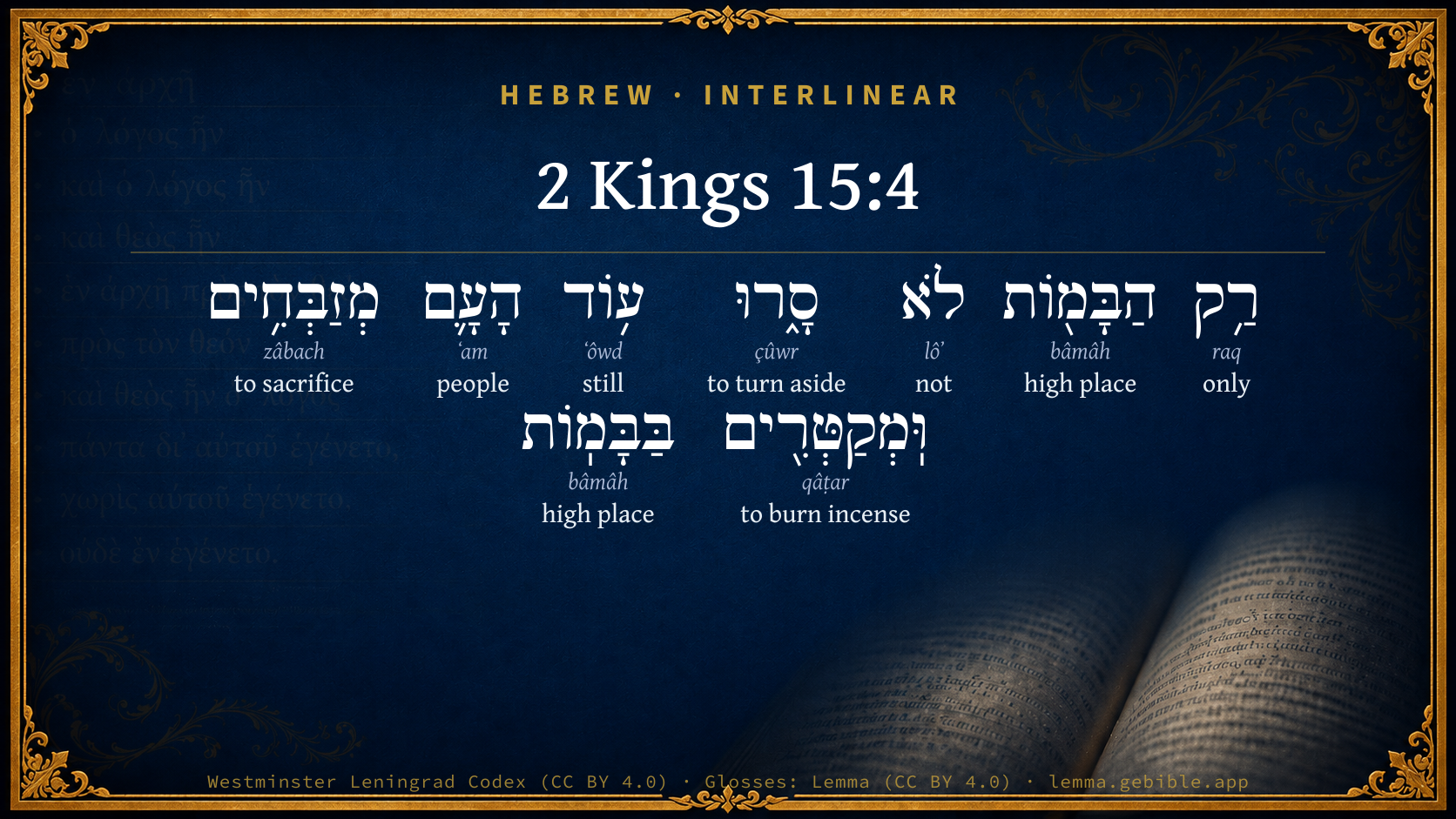
Hebrew (Westminster Leningrad Codex) 2 Kings 15:4 appears in the Hebrew Old Testament. The text above is from the Westminster Leningrad Codex. Each word links to its Strong’s number, a concise gloss, and parsing drawn from the Open Scriptures Hebrew Bible morphology. Click any word for its full Brown-Driver-Briggs (BDB) entry.
Download image
Cite this verse

2 Kings 15:4 (World English Bible). Public Domain. Lemma interlinear Bible study tool, https://lemma.gebible.app/v/2-kings/15/4.

Show BibTeX & RIS
BibTeX
RIS
English Translation
However the high places were not taken away: the people still sacrificed and burnt incense in the high places.
World English Bible · Public Domain
Download a study sheet

One document with this verse’s original text, its word-by-word gloss line, the meaning frame, cross-references with their text, attributed commentary, and full source and license credits — printable, and it pastes into notes with its structure intact.

This verse Autodidact and up

Study sheet (.html) Plain text (.txt)

A passage Seminary Student

Up to 50 verses in one chapter. A passage sheet keeps up to 6 commentary sources and 12 cross-references per verse, in the order this page ranks them, and says so on the sheet whenever that leaves anything out. Ask for a single verse and you get the Autodidact verse sheet above.

Everything on this page stays free to read, with no account — the sheet is a download of what is already on screen, not access to it.

Want to remove ads? Support Godless Engineer
Compare translations 3

The same verse in 3 English versions, stacked beneath the original-language interlinear above. Click any original word for its lexicon entry.

Each is an independent rendering of the whole verse — the interlinear is not word-aligned to these translations.

Highlighted words mark where these versions differ — a whole-verse word diff, not a word-by-word alignment.

  • World English Bible Public Domain
    However the high places were not taken away: the people still sacrificed and burnt incense in the high places.
  • King James Version Public Domain
    Save that the high places were not removed: the people sacrificed and burnt incense still on the high places.
  • unfoldingWord Literal Text CC BY-SA 4.0
    Only, the high places were not removed. The people still were sacrificing and burning incense at the high places.

unfoldingWord Literal Text — © unfoldingWord, licensed CC BY-SA 4.0. Word-aligned USFM3 via Door43 (git.door43.org/unfoldingWord/en_ult).

Versions to compare (up to 4)

3 of 4 selected

Show all 18 translations

Every available English version of this verse, each an independent rendering of the whole verse.

  • World English Bible Public Domain
    However the high places were not taken away: the people still sacrificed and burnt incense in the high places.
  • Berean Standard Bible Public Domain
    Nevertheless, the high places were not taken away; the people continued sacrificing and burning incense there.
  • Majority Standard Bible Public Domain
    Nevertheless, the high places were not taken away; the people continued sacrificing and burning incense there.
  • King James Version Public Domain
    Save that the high places were not removed: the people sacrificed and burnt incense still on the high places.
  • American Standard Version (1901) Public Domain
    Howbeit the high places were not taken away: the people still sacrificed and burnt incense in the high places.
  • Revised Version (1885) Public Domain
    Howbeit the high places were not taken away: the people still sacrificed and burnt incense in the high places.
  • Geneva Bible (1599) Public Domain
    But the hie places were not put away: for the people yet offered, and burned incense in the hie places.
  • Douay-Rheims (1899) Public Domain
    But the high places he did not destroy: for the people sacrificed and burnt incense in the high places.
  • Young's Literal Translation Public Domain
    only, the high places have not turned aside -- yet are the people sacrificing and making perfume in high places.
  • Literal Standard Version CC BY-SA 4.0
    only, the high places have not been removed—the people are still sacrificing and making incense in high places.
  • Unlocked Literal Bible CC BY-SA 4.0
    However, the high places were not taken away. The people still sacrificed and burned incense at the high places.
  • unfoldingWord Literal Text CC BY-SA 4.0
    Only, the high places were not removed. The people still were sacrificing and burning incense at the high places.
  • Darby Bible Public Domain
    Only, the high places were not removed: the people still sacrificed and burned incense on the high places.
  • World Messianic Bible Public Domain
    However, the high places were not taken away. The people still sacrificed and burned incense in the high places.
  • Webster's Bible Public Domain
    Save that the high places were not removed: the people sacrificed and burnt incense still on the high places.
  • Free Bible Version CC BY-SA 4.0
    But the high places were not removed. The people still were sacrificing and presenting burnt offerings in those places.
  • Bible in Basic English Public Domain
    But he did not take away the high places, and the people still went on making offerings and burning them in the high places.
  • JPS Tanakh (1917) Public Domain
    Howbeit the high places were not taken away; the people still sacrificed and offered in the high places.

Literal Standard Version (2020), Covenant Press — licensed CC BY-SA 4.0. Text via the HelloAO Bible API (eBible.org). Unlocked Literal Bible (unfoldingWord) — licensed CC BY-SA 4.0. Text via the HelloAO Bible API (eBible.org). unfoldingWord Literal Text — © unfoldingWord, licensed CC BY-SA 4.0. Word-aligned USFM3 via Door43 (git.door43.org/unfoldingWord/en_ult). Free Bible Version, Dr. Jonathan Gallagher — licensed CC BY-SA 4.0. Text via the HelloAO Bible API (eBible.org).

Word by word

More ways to search: Search by grammar → Find every occurrence → Compare this word →

Practice this passage: Drill this verse → Learn its vocabulary →

הַבָּמ֖וֹת
bâmâh
H1116
“the · high places”
Particle, Definite Article + Noun, Common, Feminine, Plural, Absolute
Part of Speech
Particle + Noun
Type
Common
Gender
Feminine
Number
Plural
State
Absolute
Full BDB Definition

Origin: from an unused root (meaning to be high)

TWOT: 253

high place, ridge, height, bamah (technical name for cultic platform) - high place, mountain - high places, battlefields - high places (as places of worship) - funeral mound?
  1. רַ֥ק raq H7535 “only” Particle, Accusative
  2. לֹא lôʼ H3808 “not” Particle, Negative
  3. סָ֑רוּ çûwr H5493 “to turn aside” Verb, Qal, Perfect, 3rd Person, Common, Plural
  4. ע֥וֹד ʻôwd H5750 “still” Adverb
  5. הָעָ֛ם ʻam H5971 “the · people” Particle, Definite Article + Noun, Common, Masculine, Singular, Absolute
  6. מְזַבְּחִ֥ים zâbach H2076 “sacrificing” Verb, Piel, Participle Active, Masculine, Plural, Absolute
  7. וּֽמְקַטְּרִ֖ים qâṭar H6999 “and · burning incense” Conjunction + Verb, Piel, Participle Active, Masculine, Plural, Absolute
  8. בַּבָּמֽוֹת bâmâh H1116 “in/at the · high places” Preposition, Determined + Noun, Common, Feminine, Plural, Absolute

About this verse

These counts appear in no published source. They are computed here, from the morphology-tagged text and Lemma’s own curated glosses. What Lemma adds →

9
words
8
distinct lemmas
Historical
section

Grammatical profile

  • 3 verbs
  • 3 nouns
  • 1 adverb
  • 2 particles

Verb forms

  • סָ֑רוּ Qal · Perfect
  • מְזַבְּחִ֥ים Piel · Participle Active
  • וּֽמְקַטְּרִ֖ים Piel · Participle Active

Repetition

A word recurs within this verse — often emphatic in Hebrew:

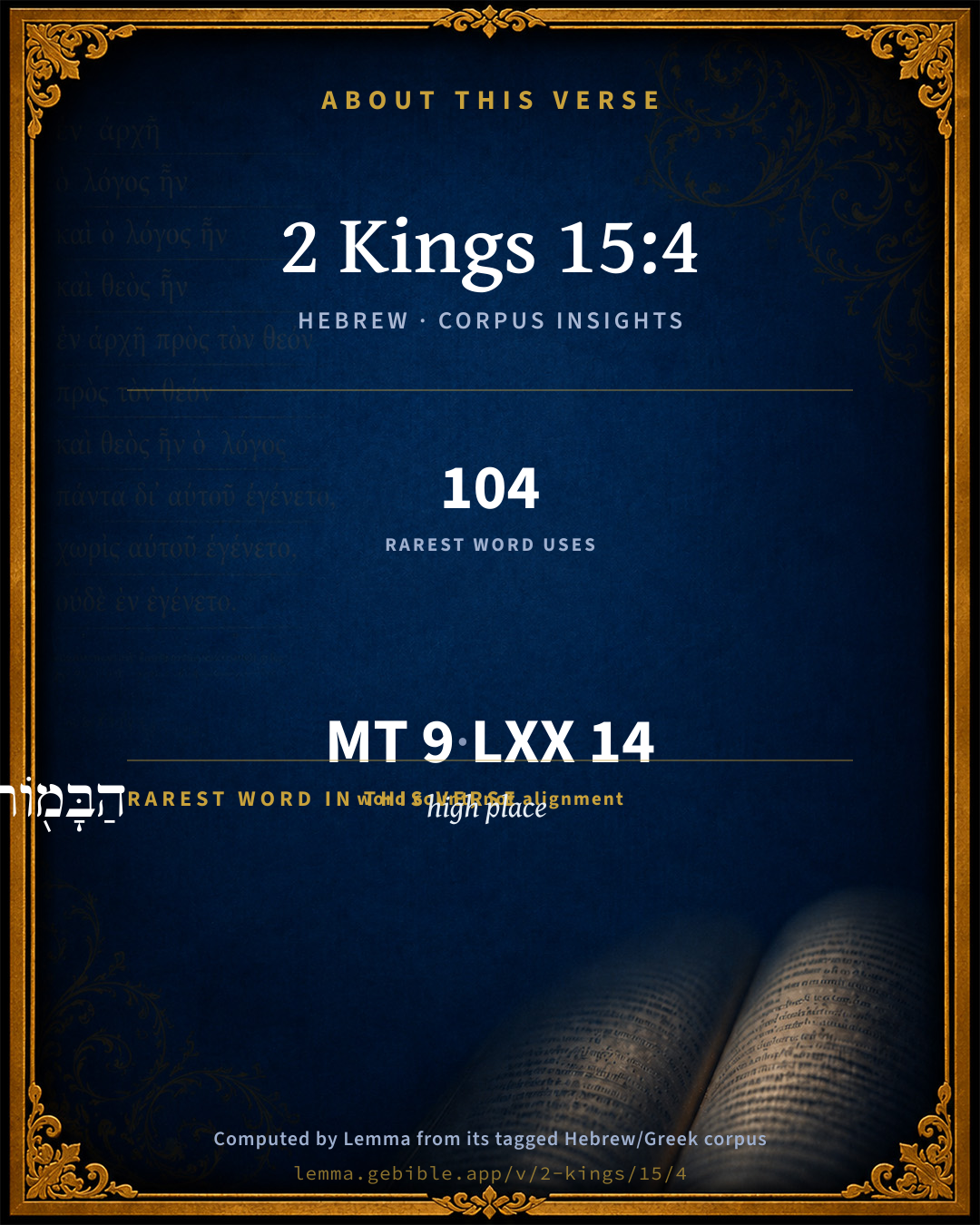
  • הַבָּמ֖וֹת high place H1116 ×2

Hebrew & Septuagint length

In English translation the verse runs 19 words from the Hebrew and 22 from the Septuagint (LXX English) — closely comparable.

A rough comparison of the two English renderings, which tokenize alike — not a word-level alignment.

Word counts can differ between the Hebrew and the Greek without any difference in meaning — e.g. the Hebrew direct-object marker אֵת has no separate Greek word, and Greek often adds the article ὁ.

In the original languages it is 9 Hebrew tokens and 14 Greek tokens — but the two are counted differently (Hebrew bundles its prefixes and suffixes into one token; the Greek is in lemma form), so that isn’t a like-for-like length.

Cross-references

9

Topical passages linked to 2 Kings 15:4 in the Treasury of Scripture Knowledge — connected by theme and wording, ordered by reader-vote popularity; previews shown in the World English Bible.

  • 1 Kings 15:14 But the high places were not taken away: nevertheless the heart of Asa was perfect with Yahweh all his days.
  • 1 Kings 22:43 He walked in all the way of Asa his father; He didn't turn aside from it, doing that which was right in the eyes of Yahweh: however the high places were not taken away; the people still sacrificed and burnt incense in the high places.
  • 2 Kings 12:3 However the high places were not taken away; the people still sacrificed and burnt incense in the high places.
  • 2 Kings 14:4 However the high places were not taken away: the people still sacrificed and burnt incense in the high places.
  • 2 Kings 15:35 However the high places were not taken away: the people still sacrificed and burned incense in the high places. He built the upper gate of the house of Yahweh.
  • 2 Kings 18:4 He removed the high places, and broke the pillars, and cut down the Asherah: and he broke in pieces the brazen serpent that Moses had made; for to those days the children of Israel did burn incense to it; and he called it Nehushtan.
  • 2 Chronicles 17:6 His heart was lifted up in the ways of Yahweh: and furthermore he took away the high places and the Asherim out of Judah.
  • 2 Chronicles 32:12 Has not the same Hezekiah taken away his high places and his altars, and commanded Judah and Jerusalem, saying, You shall worship before one altar, and on it shall you burn incense?
  • 2 Chronicles 34:3 For in the eighth year of his reign, while he was yet young, he began to seek after the God of David his father; and in the twelfth year he began to purge Judah and Jerusalem from the high places, and the Asherim, and the engraved images, and the molten images.

Cross-references courtesy of OpenBible.info (CC BY 4.0).

Hebrew and Greek witnesses Masoretic Hebrew ↔ Greek Septuagint

The same verse in the two great witnesses to the Old Testament, shown verse-for-verse.

These are two independent witnesses, not word-aligned to each other, and the Septuagint is shown in lemma (dictionary) form.

Hebrew 2 Kings 15:4 Masoretic · Westminster Leningrad Codex

רַ֥ק הַבָּמ֖וֹת לֹא סָ֑רוּ ע֥וֹד הָעָ֛ם מְזַבְּחִ֥ים וּֽמְקַטְּרִ֖ים בַּבָּמֽוֹת

However the high places were not taken away: the people still sacrificed and burnt incense in the high places.

World English Bible · Public Domain

Greek LXX 2 Kings 15:4 Septuagint · lemma form

πλήν ὁ ὑψηλός οὐ ἐκαἴρω ἔτι ὁ λαός θυσιάζω καί θυμιάζω ἐν ὁ ὑψηλός

Only he took not away any of the high places: as yet the people sacrificed and burnt incense on the high places.

LXX2012 (modern English Septuagint) · Public Domain

Hebrew: Westminster Leningrad Codex (CC BY 4.0). Greek: Septuagint (public domain); English from LXX2012 (modern English Septuagint) (Public Domain). How the Septuagint differs from the Hebrew →

Targum (Aramaic paraphrase)

1

The Targum is the ancient Jewish Aramaic paraphrase of the Hebrew Scriptures — an interpretive translation, not the Hebrew text itself. Onkelos (literal) and Pseudo-Jonathan (expansive) render the Torah, and Jonathan the Prophets. Coverage is partial: where no permissively-licensed English translation exists for a verse, only the Aramaic is shown. This is verse-level text, not a word-by-word alignment to the Hebrew.

  1. Targum Jonathan Prophets (Joshua–Malachi)
    לְחוֹד בָּמָתָא לָא עָטָרָא עַד כְּעַן עַמָא מְדַבְּחִין וּמַסְקִין בּוּסְמָא עַל בָּמָתָא:

    (no public-domain English translation for this verse)

    Targum Jonathan — Aramaic: “Mikraot Gedolot” (public domain). English: “Sefaria Community Translation” (CC0 1.0 (public-domain dedication)); “London "Chaldee Paraphrase," 1871” (public domain). Text via Sefaria.

Commentary

Notes on 2 Kings 15:4 from classic Christian and Jewish commentators (each source and its license shown beneath its notes). The classic Christian expositions comment on the surrounding passage and are grouped to its opening verse, so a note may address several verses; the Jewish commentaries on the Tanakh (Rashi and others) are per-verse, so they appear only where the commentator wrote on this verse.

Lemma curates 59 commentaries, every one of them public domain or Creative Commons licensed, each selected and text-cleaned for this edition rather than reprinted as found. About our sources →

Trapp's Complete Commentary

John Trapp

2Ki 15:4 Save that the high places were not removed: the people sacrificed and burnt incense still on the high places.

Ver. 4. The high places were not removed.] No, not in his best times. This, if it did not loose, yet it lessened his crown of glory.

John Trapp, A Commentary or Exposition upon All the Books of the Old and New Testament (1647–1656) — public domain. Text from a community e-Sword module.

Tyndale Open Study Notes

Tyndale Open Resources

15:4 In spite of his good spiritual evaluation, Uzziah continued to allow worship at the pagan shrines (14:4).

Tyndale Open Study Notes — © Tyndale Open Resources, licensed CC BY-SA 4.0. Text via the HelloAO Bible API.

The Cambridge Bible for Schools and Colleges

gen. ed. J. J. S. Perowne

4. save that [R.V. Howbeit] the high places] The rendering is thus made to agree with verse 25 of this chapter, where the Hebrew is the same. The Chronicler at this point supplies us with many particulars of Azariah’s history unnoticed in Kings. Azariah, he says, ‘sought God in the days of Zechariah’, a prophet, who appears to have been, the king’s counsellor. He made war with success upon the Philistines, the Arabians and the Mehunim. The Ammonites became tributary to him, and he fortified Jerusalem. He built many towers, and digged many wells, had much cattle and many labourers in husbandry, ‘for he loved husbandry’. He had also a large and well-ordered army of more than three hundred thousand men, and at their head were two thousand six hundred mighty men of valour. The king provided largely for their equipment with both defensive and offensive armour, and he also contrived many cunning engines of war, so that ‘his name spread far abroad, for he was marvellously helped till he was strong’.

The Cambridge Bible for Schools and Colleges (gen. ed. J. J. S. Perowne; Cambridge University Press, 1878–1918) — public domain. Text from a community e-Sword module.

John Gill's Exposition

And the Lord smote the king,.... With leprosy; the reason of it was, because he intruded into the priest's office, and went into the temple to burn incense on the altar of incense, Ch2 26:19,

so that he was a leper unto the day of his death; but how long it was to it from his being smitten cannot be said with certainty; Dr. Lightfoot (l) thinks he died the same year he was smitten:

and dwelt in a several house: without Jerusalem, as the Targum; for lepers, according to the law, were to dwell separate without the camp or city, Lev 13:46 the word for "several" signifies "free" (m); here he lived alone, free from the company and conversation of men, free from the business of government, his son doing that for him, and in the country, where he might freely walk about, as lepers did, and take the air; the Jews say (n), his house was among the graves, where he was free among the dead, as the phrase is, Psa 88:5, but not likely; much better is what Abendana observes from R. Jonah, that the word, in the Arabic (o) language, signifies a little house, and so this might be in which he dwelt out of the city, in comparison of his palace:

and Jotham the king's son was over the house; had the direction of the palace, and the management of all affairs in it:

judging the people of the land; administering justice in all cases, for which they came to him, and so filled up his father's place; he did not depose his father, nor take upon him to be king, only did the business of one.

(l) Works, vol. 1. p. 99. (m) "in domo libero", V. L. Tigurine version, &c. (n) T. Hieros. apud Jarchium in loc. (o) "in exiqua domo resedit assidue", Castel. Lexic. col. 1345.

John Gill's Exposition of the Whole Bible (1746–1763) — public domain (CC PDM 1.0). Text via the HelloAO Bible API.

Haydock's Catholic Bible Commentary

But. In this he was not different from his father, chap. xiv. 4.

George Leo Haydock (1774–1849), Haydock's Catholic Family Bible and Commentary, 1859 edition — public domain. Excludes Psalms (Douay-Rheims chapter numbering differs from Protestant) and Deuterocanonical books (Catholic canon only).

Matthew Poole's English Annotations

Save that; understand this as howbeit, 2Ki 14:4.

Matthew Poole's English Annotations on the Holy Bible (1683–1685) — public domain. Text from a community e-Sword/MySword module.

The Pulpit Commentary

Save that the high places were not removed: the people sacrificed and burnt incense still on the high places. (comp. 2Ki_14:4, and the comment ad loc.)

The Pulpit Commentary (1880–1919), ed. H.D.M. Spence-Jones & Joseph S. Exell — public domain. Text from a community e-Sword module.

unfoldingWord translationNotes

Door43 World Missions Community

the high places were not taken away

This can be stated in active form. AT: "no one took away the high places" or "Azariah did not have anyone take the high places away" (See: Active or Passive)

were not taken away

Being taken away represents being destroyed. AT: "were not destroyed" (See: Metaphor)

to the day of his death

The abstract noun "death" can be expressed with the verb "die." AT: "until the day he died" (See: Abstract Nouns)

Jotham, the king's son, was over the household

The word "household" refers to the people living in the king's palace. Because Azariah was a leper, he had to live in a separate house. So his son, Jotham, took charge over the palace.

was over the household

Being over the household represents having authority over those in it. AT: "was in charge of the household" or "had authority over those in Azariah's palace" (See: Metaphor)

translationWords

high place

sacrifice

incense

afflicted

leper

die

Jotham

household

unfoldingWord translationNotes — © Distant Shores Media and the Door43 World Missions Community, licensed CC BY-SA 4.0. Source: git.door43.org/Door43/en_tn.

Lesson kit

Teaching starters — assembled from the data on this page, not authored interpretation. Every prompt links to the verse data it draws on. Edit before teaching.

2 Kings, in the Historical, opens this verse with 9 words (8 distinct Hebrew lemmas). Its most distinctive word is bâmâh (“high place”). A historical commentator’s framing appears above. Read the whole chapter for the surrounding context.

Discussion questions

  1. How does “high place” (bâmâh) shape what this verse is saying?
  2. 1 Kings 15:14 shares this passage’s theme. How do the two illuminate each other?
  3. “high place” occurs 2× in this one verse. What is the effect of the repetition?
  4. These translations render this verse differently. What is at stake in choosing one wording over another?
  5. The verb «סָ֑רוּ» is Qal Perfect. How does its form color the action?
  6. Reading how Trapp's Complete Commentary and Tyndale Open Study Notes read this verse, where do the two commentators agree and where do they part?

Things to notice

Reading settings

Reading text

Shown beneath each verse's original-language words.

Old Testament
Old Testament edition

Read the OT as the Masoretic Hebrew (MT) or the Greek Septuagint (LXX).

English shown for the Greek Septuagint (in the Hebrew ↔ Greek comparison).

Comparing translations? Open the Compare panel on any verse page to stack up to four side by side.