
1 Samuel 22:14

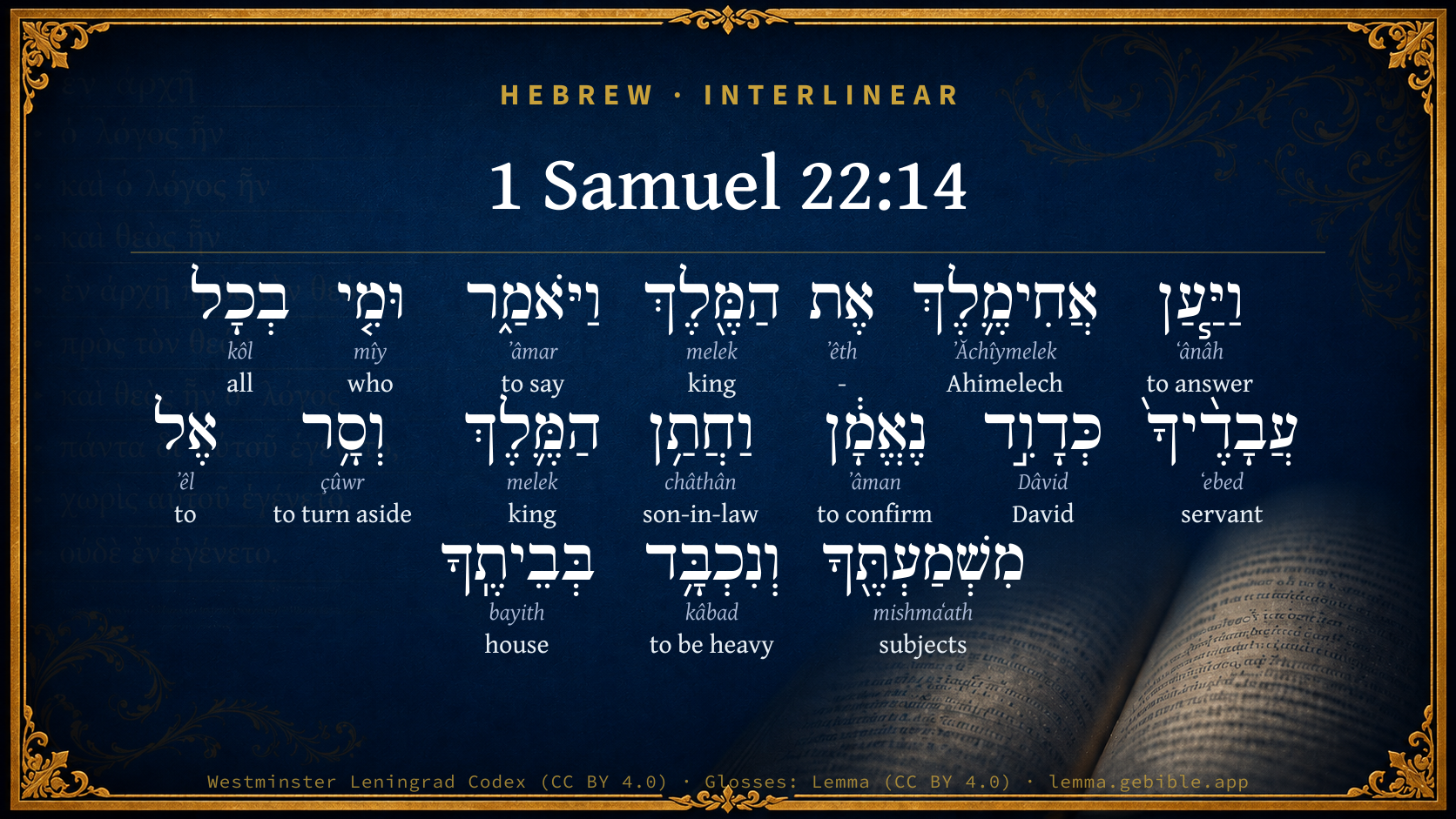
Hebrew (Westminster Leningrad Codex) 1 Samuel 22:14 appears in the Hebrew Old Testament. The text above is from the Westminster Leningrad Codex. Each word links to its Strong’s number, a concise gloss, and parsing drawn from the Open Scriptures Hebrew Bible morphology. Click any word for its full Brown-Driver-Briggs (BDB) entry.
Download image
Cite this verse

1 Samuel 22:14 (World English Bible). Public Domain. Lemma interlinear Bible study tool, https://lemma.gebible.app/v/1-samuel/22/14.

Show BibTeX & RIS
BibTeX
RIS
English Translation
Then Ahimelech answered the king, and said, Who among all your servants is so faithful as David, who is the king's son-in-law, and is taken into your council, and is honorable in your house?
World English Bible · Public Domain
Highlights
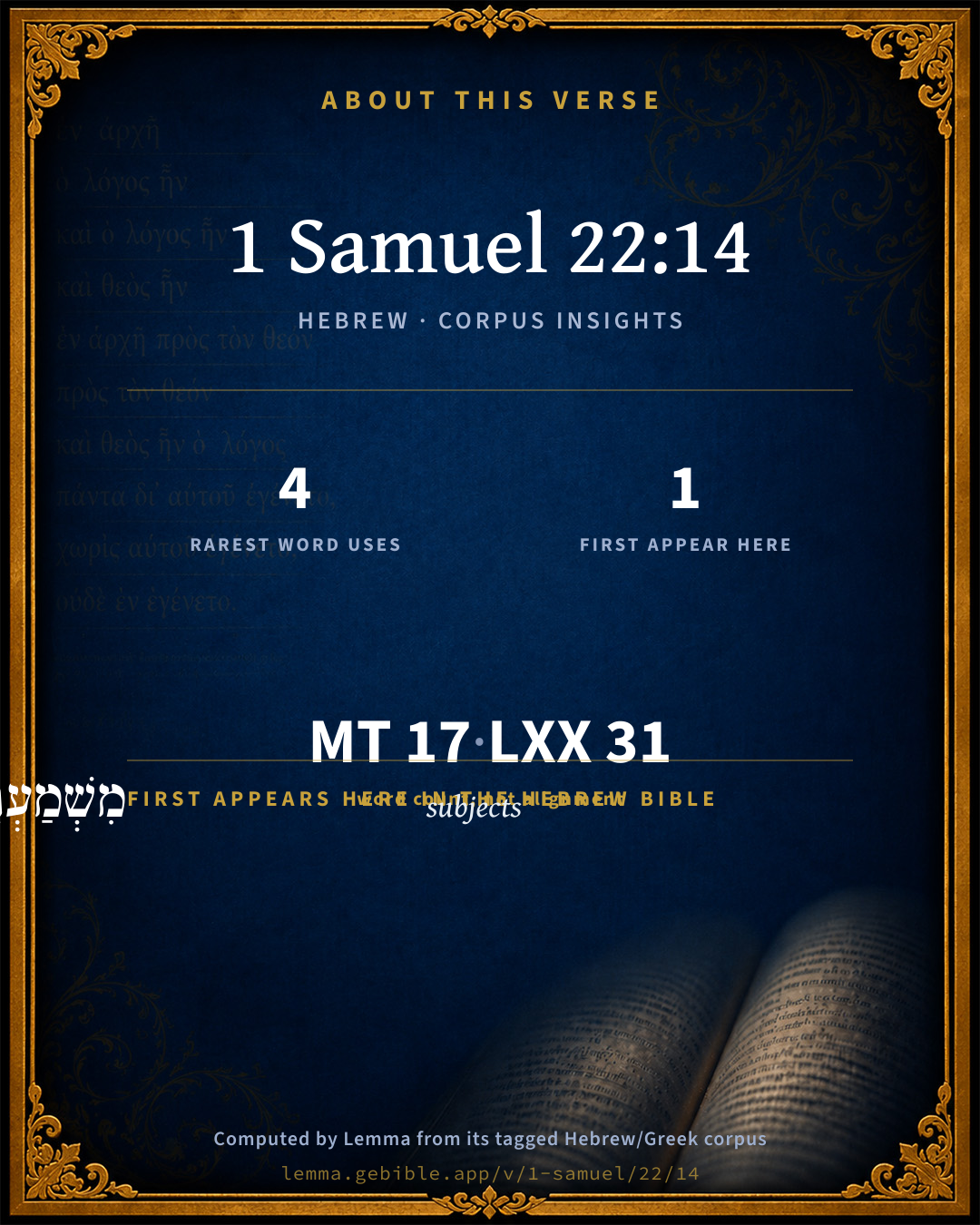
  • 1 first appearance in the Hebrew Bible
Full analysis ↓
Download a study sheet

One document with this verse’s original text, its word-by-word gloss line, the meaning frame, cross-references with their text, attributed commentary, and full source and license credits — printable, and it pastes into notes with its structure intact.

This verse Autodidact and up

Study sheet (.html) Plain text (.txt)

A passage Seminary Student

Up to 50 verses in one chapter. A passage sheet keeps up to 6 commentary sources and 12 cross-references per verse, in the order this page ranks them, and says so on the sheet whenever that leaves anything out. Ask for a single verse and you get the Autodidact verse sheet above.

Everything on this page stays free to read, with no account — the sheet is a download of what is already on screen, not access to it.

Want to remove ads? Support Godless Engineer
Compare translations 3

The same verse in 3 English versions, stacked beneath the original-language interlinear above. Click any original word for its lexicon entry.

Each is an independent rendering of the whole verse — the interlinear is not word-aligned to these translations.

Highlighted words mark where these versions differ — a whole-verse word diff, not a word-by-word alignment.

  • World English Bible Public Domain
    Then Ahimelech answered the king, and said, Who among all your servants is so faithful as David, who is the king's son-in-law, and is taken into your council, and is honorable in your house?
  • King James Version Public Domain
    Then Ahimelech answered the king, and said, And who is so faithful among all thy servants as David, which is the king's son in law, and goeth at thy bidding, and is honorable in thine house?
  • unfoldingWord Literal Text CC BY-SA 4.0
    And Ahimelech answered the king and said, “Now who among all of your servants is being faithful like David, and the son-in-law of the king, and commander over your bodyguard, and being honored in your house?

unfoldingWord Literal Text — © unfoldingWord, licensed CC BY-SA 4.0. Word-aligned USFM3 via Door43 (git.door43.org/unfoldingWord/en_ult).

Versions to compare (up to 4)

3 of 4 selected

Show all 18 translations

Every available English version of this verse, each an independent rendering of the whole verse.

  • World English Bible Public Domain
    Then Ahimelech answered the king, and said, Who among all your servants is so faithful as David, who is the king's son-in-law, and is taken into your council, and is honorable in your house?
  • Berean Standard Bible Public Domain
    Ahimelech answered the king, “Who among all your servants is as faithful as David, the king’s son-in-law, the captain of your bodyguard who is honored in your house?
  • Majority Standard Bible Public Domain
    Ahimelech answered the king, “Who among all your servants is as faithful as David, the king’s son-in-law, the captain of your bodyguard and honored in your house?
  • King James Version Public Domain
    Then Ahimelech answered the king, and said, And who is so faithful among all thy servants as David, which is the king's son in law, and goeth at thy bidding, and is honorable in thine house?
  • American Standard Version (1901) Public Domain
    Then Ahimelech answered the king, and said, And who among all thy servants is so faithful as David, who is the king's son-in-law, and is taken into thy council, and is honorable in thy house?
  • Revised Version (1885) Public Domain
    Then Ahimelech answered the king, and said, And who among all thy servants is so faithful as David, which is the king’s son in law, and is taken into thy council, and is honourable in thine house?
  • Geneva Bible (1599) Public Domain
    And Ahimelech answered the King, and sayde, Who is so faithfull among all thy seruants as Dauid, being also the Kings sonne in lawe, and goeth at thy commandement, and is honourable in thine house?
  • Douay-Rheims (1899) Public Domain
    And Achimelech answering the king, said: And who amongst all thy servants is so faithful as David, who is the king's son in law, and goeth forth at thy bidding, and is honourable in thy house?
  • Young's Literal Translation Public Domain
    And Ahimelech answereth the king and saith, `And who among all thy servants `is' as David -- faithful, and son-in-law of the king, and hath turned aside unto thy council, and is honoured in thy house?
  • Literal Standard Version CC BY-SA 4.0
    And Ahimelech answers the king and says, “And who among all your servants [is] as David—faithful, and son-in-law of the king, and has turned aside to your council, and is honored in your house?
  • Unlocked Literal Bible CC BY-SA 4.0
    Then Ahimelech answered the king and said, “Who among all your servants is so faithful as David, who is the king's son-in-law and is over your bodyguard, and is honored in your house?
  • unfoldingWord Literal Text CC BY-SA 4.0
    And Ahimelech answered the king and said, “Now who among all of your servants is being faithful like David, and the son-in-law of the king, and commander over your bodyguard, and being honored in your house?
  • Darby Bible Public Domain
    And Ahimelech answered the king and said, And who is so faithful among all thy servants as David, who is the king's son-in-law, and has access to thy secret council, and is honourable in thy house?
  • World Messianic Bible Public Domain
    Then Ahimelech answered the king, and said, “Who among all your servants is so faithful as David, who is the king’s son-in-law, captain of your body guard, and honored in your house?
  • Webster's Bible Public Domain
    Then Ahimelech answered the king, and said, And who is so faithful among all thy servants as David, who is the king's son-in-law, and goeth at thy bidding, and is honorable in thy house?
  • Free Bible Version CC BY-SA 4.0
    “Who of all your officers is as trustworthy as David, the king's son-in-law? He is in charge of your bodyguard, and highly respected in your family!” Ahimelech responded.
  • Bible in Basic English Public Domain
    Then Ahimelech answering said to the king, Who among all your servants is so true to you as David, who is the king's son-in-law, and is a captain of your armed men, and has a place of honour in your house?
  • JPS Tanakh (1917) Public Domain
    Then Ahimelech answered the king, and said: 'And who among all thy servants is so trusted as David, who is the king's son-in-law, and giveth heed unto thy bidding, and is honourable in thy house?

Literal Standard Version (2020), Covenant Press — licensed CC BY-SA 4.0. Text via the HelloAO Bible API (eBible.org). Unlocked Literal Bible (unfoldingWord) — licensed CC BY-SA 4.0. Text via the HelloAO Bible API (eBible.org). unfoldingWord Literal Text — © unfoldingWord, licensed CC BY-SA 4.0. Word-aligned USFM3 via Door43 (git.door43.org/unfoldingWord/en_ult). Free Bible Version, Dr. Jonathan Gallagher — licensed CC BY-SA 4.0. Text via the HelloAO Bible API (eBible.org).

Word by word

More ways to search: Search by grammar → Find every occurrence → Compare this word →

Practice this passage: Drill this verse → Learn its vocabulary →

מִשְׁמַעְתֶּ֖ךָ
mishmaʻath
H4928
“subjects · your”
Noun, Common, Feminine, Singular, Construct + Suffix, Personal, 2nd Person, Masculine, Singular
Part of Speech
Noun
Type
Common
Gender
Feminine
Number
Singular
State
Construct
Full BDB Definition

Origin: from H4926

TWOT: 2412g

subjects, body of subjects, bodyguard, listeners, obedient ones - bodyguard - subjects
  1. וַיַּ֧עַן ʻânâh H6030 “and · to answer” Conjunction + Verb, Qal, Sequential Imperfect, 3rd Person, Masculine, Singular
  2. אֲחִימֶ֛לֶךְ ʼĂchîymelek H288 “Ahimelech” Noun, Proper
  3. אֶת ʼêth H853 “-” Particle, Direct Object
  4. הַמֶּ֖לֶךְ melek H4428 “the · king” Particle, Definite Article + Noun, Common, Masculine, Singular, Absolute
  5. וַיֹּאמַ֑ר ʼâmar H559 “and · to say” Conjunction + Verb, Qal, Sequential Imperfect, 3rd Person, Masculine, Singular
  6. וּמִ֤י mîy H4310 “and · who” Conjunction + Particle, Interrogative
  7. בְכָל kôl H3605 “in/at · all of” Preposition + Noun, Common, Masculine, Singular, Construct
  8. עֲבָדֶ֨יךָ֙ ʻebed H5650 “servants · your” Noun, Common, Masculine, Plural, Construct + Suffix, Personal, 2nd Person, Masculine, Singular
  9. כְּדָוִ֣ד Dâvid H1732 “like/as · David” Preposition + Noun, Proper
  10. נֶאֱמָ֔ן ʼâman H539 “confirming” Verb, Niphal, Participle Active, Masculine, Singular, Absolute
  11. וַחֲתַ֥ן châthân H2860 “and · son-in-law of” Conjunction + Noun, Common, Masculine, Singular, Construct
  12. הַמֶּ֛לֶךְ melek H4428 “the · king” Particle, Definite Article + Noun, Common, Masculine, Singular, Absolute
  13. וְסָ֥ר çûwr H5493 “and · turning aside” Conjunction + Verb, Qal, Participle Active, Masculine, Singular, Absolute
  14. אֶל ʼêl H413 “to” Preposition
  15. וְנִכְבָּ֥ד kâbad H3513 “and · being heavy” Conjunction + Verb, Niphal, Participle Active, Masculine, Singular, Absolute
  16. בְּבֵיתֶֽךָ bayith H1004 “in/at · house · your” Preposition + Noun, Common, Masculine, Singular, Construct + Suffix, Personal, 2nd Person, Masculine, Singular

About this verse

These counts appear in no published source. They are computed here, from the morphology-tagged text and Lemma’s own curated glosses. What Lemma adds →

17
words
16
distinct lemmas
Historical
section

Notable vocabulary

The rarest word here is מִשְׁמַעְתֶּ֖ךָ subjects H4928 — appearing just 4 times in the whole Hebrew Bible.

First appearance in Scripture

This word makes its first canonical appearance in the Hebrew Bible here:

  • מִשְׁמַעְתֶּ֖ךָ subjects H4928

Shared distinctive vocabulary

מִשְׁמַעְתֶּ֖ךָ subjects H4928 occurs in 4 verses of the Hebrew Bible. Also found in:

Grammatical profile

  • 5 verbs
  • 9 nouns
  • 1 preposition
  • 2 particles

Verb forms

  • וַיַּ֧עַן Qal · Sequential Imperfect
  • וַיֹּאמַ֑ר Qal · Sequential Imperfect
  • נֶאֱמָ֔ן Niphal · Participle Active
  • וְסָ֥ר Qal · Participle Active
  • וְנִכְבָּ֥ד Niphal · Participle Active

Repetition

A word recurs within this verse — often emphatic in Hebrew:

  • הַמֶּ֖לֶךְ king H4428 ×2

Hebrew & Septuagint length

In English translation the verse runs 34 words from the Hebrew and 40 from the Septuagint (LXX English) — closely comparable.

A rough comparison of the two English renderings, which tokenize alike — not a word-level alignment.

Word counts can differ between the Hebrew and the Greek without any difference in meaning — e.g. the Hebrew direct-object marker אֵת has no separate Greek word, and Greek often adds the article ὁ.

In the original languages it is 17 Hebrew tokens and 31 Greek tokens — but the two are counted differently (Hebrew bundles its prefixes and suffixes into one token; the Greek is in lemma form), so that isn’t a like-for-like length.

Cross-references

12

Topical passages linked to 1 Samuel 22:14 in the Treasury of Scripture Knowledge — connected by theme and wording, ordered by reader-vote popularity; previews shown in the World English Bible.

  • 1 Samuel 19:4–5 Jonathan spoke good of David to Saul his father, and said to him, Don't let the king sin against his servant, against David; because he has not sinned against you, and because his works have been very good toward you:
  • 1 Samuel 20:32 Jonathan answered Saul his father, and said to him, "Why should he be put to death? What has he done?"
  • 1 Samuel 17:25 The men of Israel said, Have you seen this man who is come up? surely to defy Israel is he come up: and it shall be, that the man who kills him, the king will enrich him with great riches, and will give him his daughter, and make his father's house free in Israel.
  • 1 Samuel 18:13 Therefore Saul removed him from him, and made him his captain over a thousand; and he went out and came in before the people.
  • 1 Samuel 18:27 and David arose and went, he and his men, and killed of the Philistines two hundred men; and David brought their foreskins, and they gave them in full number to the king, that he might be the king's son-in-law. Saul gave him Michal his daughter as wife.
  • 1 Samuel 21:2 David said to Ahimelech the priest, The king has commanded me a business, and has said to me, Let no man know anything of the business about which I send you, and what I have commanded you: and I have appointed the young men to such and such a place.
  • 1 Samuel 22:13 Saul said to him, Why have you conspired against me, you and the son of Jesse, in that you have given him bread, and a sword, and have inquired of God for him, that he should rise against me, to lie in wait, as at this day?
  • 1 Samuel 24:11 Moreover, my father, behold, yes, see the skirt of your robe in my hand; for in that I cut off the skirt of your robe, and didn't kill you, know you and see that there is neither evil nor disobedience in my hand, and I have not sinned against you, though you hunt after my life to take it.
  • 1 Samuel 26:23 Yahweh will render to every man his righteousness and his faithfulness; because Yahweh delivered you into my hand today, and I wouldn't put forth my hand against Yahweh's anointed.
  • 2 Samuel 22:23–25 For all his ordinances were before me; As for his statutes, I did not depart from them.
  • Proverbs 24:11–12 Rescue those who are being led away to death! Indeed, hold back those who are staggering to the slaughter!
  • Proverbs 31:8–9 Open your mouth for the mute, In the cause of all who are left desolate.

Cross-references courtesy of OpenBible.info (CC BY 4.0).

Hebrew and Greek witnesses Masoretic Hebrew ↔ Greek Septuagint

The same verse in the two great witnesses to the Old Testament, shown verse-for-verse.

These are two independent witnesses, not word-aligned to each other, and the Septuagint is shown in lemma (dictionary) form.

Hebrew 1 Samuel 22:14 Masoretic · Westminster Leningrad Codex

וַיַּ֧עַן אֲחִימֶ֛לֶךְ אֶת הַמֶּ֖לֶךְ וַיֹּאמַ֑ר וּמִ֤י בְכָל עֲבָדֶ֨יךָ֙ כְּדָוִ֣ד נֶאֱמָ֔ן וַחֲתַ֥ן הַמֶּ֛לֶךְ וְסָ֥ר אֶל מִשְׁמַעְתֶּ֖ךָ וְנִכְבָּ֥ד בְּבֵיתֶֽךָ

Then Ahimelech answered the king, and said, Who among all your servants is so faithful as David, who is the king's son-in-law, and is taken into your council, and is honorable in your house?

World English Bible · Public Domain

Greek LXX 1 Samuel 22:14 Septuagint · lemma form

καί ἀποκρίνω ὁ βασιλεύς καί εἶπον καί τίς ἐν πᾶς ὁ δοῦλος σύ ὡς δαυίδ πιστός καί γαμβρός ὁ βασιλεύς καί ἄρχω πᾶς παράγγελμα σύ καί ἔνδοξος ἐν ὁ οἶκος σύ

And he answered the king, and said, And who is there among all your servants faithful as David, and he is a son-in-law of the king, and he is executor of all your commands, and is honorable in your house?

LXX2012 (modern English Septuagint) · Public Domain

Hebrew: Westminster Leningrad Codex (CC BY 4.0). Greek: Septuagint (public domain); English from LXX2012 (modern English Septuagint) (Public Domain). How the Septuagint differs from the Hebrew →

Targum (Aramaic paraphrase)

1

The Targum is the ancient Jewish Aramaic paraphrase of the Hebrew Scriptures — an interpretive translation, not the Hebrew text itself. Onkelos (literal) and Pseudo-Jonathan (expansive) render the Torah, and Jonathan the Prophets. Coverage is partial: where no permissively-licensed English translation exists for a verse, only the Aramaic is shown. This is verse-level text, not a word-by-word alignment to the Hebrew.

  1. Targum Jonathan Prophets (Joshua–Malachi)
    וַאֲתֵיב אֲחִימֶלֶךְ יַת מַלְכָּא וַאֲמַר וּמָן בְּכָל עַבְדָךְ כְּדָוִד מְהֵימָן וְחַתְנָא דְמַלְכָּא וְרַב עַל מִשְׁמַעְתָּךְ וְיַקִיר בְּבֵיתָךְ:

    (no public-domain English translation for this verse)

    Targum Jonathan — Aramaic: “Mikraot Gedolot” (public domain). English: “Sefaria Community Translation” (CC0 1.0 (public-domain dedication)); “London "Chaldee Paraphrase," 1871” (public domain). Text via Sefaria.

Commentary

Notes on 1 Samuel 22:14 from classic Christian and Jewish commentators (each source and its license shown beneath its notes). The classic Christian expositions comment on the surrounding passage and are grouped to its opening verse, so a note may address several verses; the Jewish commentaries on the Tanakh (Rashi and others) are per-verse, so they appear only where the commentator wrote on this verse.

Lemma curates 59 commentaries, every one of them public domain or Creative Commons licensed, each selected and text-cleaned for this edition rather than reprinted as found. About our sources →

Trapp's Complete Commentary

John Trapp

1Sa 22:14 Then Ahimelech answered the king, and said, And who [is so] faithful among all thy servants as David, which is the king’s son in law, and goeth at thy bidding, and is honourable in thine house?

Ver. 14. And who is so faithful, &c.] This, some {a} think, was not so wisely spoken by Ahimelech - viz., thus highly to commend David, whom he saw to be under so great displeasure now, whatever he had been formerly. Others hold that he did all in the honesty and integrity of his heart; giving David his due, and tacitly taxing Saul of tyranny.

{a} Peter Martyr.

John Trapp, A Commentary or Exposition upon All the Books of the Old and New Testament (1647–1656) — public domain. Text from a community e-Sword module.

The Biblical Illustrator

Joseph S. Exell

1Sa_22:14

And Ahimelech answered the king, and said, And who is so faithful among all thy servants as David.

In defence of the king

Now, it was for acts of kindness to David, the outcast and fugitive, that Ahimelech the high priest was confronted by the infuriated king. Ahimelech answered the king and said, And who is so faithful among all thy servants as David, the kings son-in-law, who goes at thy bidding and is honourable in thine house? Did I pray for him as against thee? That were far from me. Let not the king accuse me falsely; for as to trouble between Saul and David I knew nothing, less or more. Brave words, O priest! Never did martyr witness more magnificently for the truth, and never with less hope of pardon. The gigantic figure of the king, clad in armour and terrible in wrath, towered before the white-robed priest. It is a vary beautiful, even if it be a very costly, thing to live a righteous life. The whole spirit and range of heroism is to be found in that order of piety which this high priest illustrated and adorned. Analyse this great high priestly life.

I. It was a life often up in defence of the kings better nature against his worse nature. He aimed to rescue Saul from Saul. It is as if he had said, Why do you so unking yourself as to injure a man who would not injure you? David is your friend. Jealousy demeans you. Jealousy and not David is your real foe.

II. Again, it was a life given up in defence of Ahimelechs own better nature against his lower nature. Doubtless this high priestly life was of value to him who had it. But he made no plea foe it. He pleaded only for the life of the outcast and fugitive.

III. It was a life given up in defence of the innocent fugitive. Ahimelech, friend of the king, dared to defend the outcast David.

IV. Now consider that this defence--three fold--is worth whatever it costs. The defence of my neighbours better nature against his worse nature; of my own better nature against my worse nature, and of Christ against the world, is worth whatever it may cost. First, because a mans soul, or immortal nature, is of more value to him than any imaginable physical safety or comfort. Second, because my neighbours better nature is of more value to the world and to me, than anything else I can give to the world, or the world can give me. This world has enough of everything but goodness. It does not need that I give it anything, unless I can give it goodness. Let me help a man to conquer himself and I am a philanthropist. Third, it is worth all it costs because, in defending the outcast against the king, we may be defending the king against the outcast. In the councils of heaven Saul the king is the outcast and David the outcast is the king. This striking reversal of the real and the apparent is one of the most ordinary of processes when heaven looks at earth. Things are not what they seem. However little the evidence of it, Righteousness is the one true monarch over men. (Edward Braislin, D. D.)

.

The Biblical Illustrator, edited by Joseph S. Exell (c. 1880s–1900s) — public domain. Text from a community e-Sword module.

Joseph Benson's Commentary

1Sa 22:14. Ahimelech said, Who is so faithful, &c. — Or, rather, Who was so faithful, &c.; for it cannot be supposed, after Saul had just accused David of a conspiracy against him, that the high-priest would say he was then faithful. His apology, which sufficiently shows his innocence as to the things of which Saul accuses him, is, that since David had been held by all to be a most loyal subject, as well as a person of great honour, and in high favour with the king, having married his daughter, what could he think but that David was sent by the king, as he said he was, upon some business of public concern? Thus he does not take upon him to determine the difference between Saul and David, nor affirm what David now was; but only declares what David had formerly been, and what he was still, for any thing he knew to the contrary.

Joseph Benson's Commentary on the Old and New Testaments (1811–1818) — public domain. Text from a community e-Sword module.

Tyndale Open Study Notes

Tyndale Open Resources

22:14 your son-in-law: David had married Saul’s daughter (18:17-29).

Tyndale Open Study Notes — © Tyndale Open Resources, licensed CC BY-SA 4.0. Text via the HelloAO Bible API.

Adam Clarke's Commentary

Verse 14. And who is so faithful] The word נאמן neeman, which we here translate faithful, is probably the name of an officer. See Clarke on Nu 12:7.

Adam Clarke's Commentary on the Bible (1810–1826) — public domain. Text from a community e-Sword/MySword module.

Ellicott's Commentary for English Readers

(14) Who is so faithful among all thy servants?—The words of the high priest were quiet and dignified, and no doubt spoke the general sentiments of the people respecting David. What he—the guardian of the sanctuary—had done, he had done as a matter of course for one so closely related to the king—for one, too, ever loyal and devoted as David had ever proved himself.

A Bible Commentary for English Readers, edited by Charles John Ellicott (1878–1897) — public domain. Text from a community e-Sword module.

The Cambridge Bible for Schools and Colleges

gen. ed. J. J. S. Perowne

14. goeth at thy bidding] Probably, “has access to thy audience,” i.e. is a trusted privy-councillor. Cp. 2Sa_23:23, marg.

The Cambridge Bible for Schools and Colleges (gen. ed. J. J. S. Perowne; Cambridge University Press, 1878–1918) — public domain. Text from a community e-Sword module.

John Gill's Exposition

Then Ahimelech answered the king, and said,.... First with respect to David, and then with regard to himself; with respect to David as follows:

and who is so faithful amongst thy servants as David; I considered him, as if he should say, as a servant of thine, upon an errand of thine, and doing thy business; and as a faithful one, none more so, and as such I valued and regarded him, not as a rebel to thee, having no such thought of him:

which is the king's son in law; who has behaved himself so well, and thou hast entertained such an opinion of him, as to take him into thy family, and marry thy daughter to him; wherefore showing him favour, and doing him honour, was doing honour to thee and thy family, and surely there can be no blame in that:

and goeth at thy bidding; has always been ready to execute thy commands, and obey thine orders, let them be what they will; as to go out against an enemy, and fight Saul's battles for him:

and is honourable in thine house? behaved honourably there, and highly esteemed by all, as well as had the honour bestowed upon him to be the king's son-in-law, and made captain of a thousand; and therefore who could think that showing respect to such a man could be deemed treason and conspiracy, or he be thought to be a traitor to the king? and then with respect to himself he answers,

John Gill's Exposition of the Whole Bible (1746–1763) — public domain (CC PDM 1.0). Text via the HelloAO Bible API.

Albert Barnes' Notes on the Bible

Goeth at thy bidding - Better, “has access to thy (private) audience,” or council (compare 2Sa 23:23, margin).

Albert Barnes' Notes on the Bible (1834–1885) — public domain. Text from a community e-Sword/MySword module.

Haydock's Catholic Bible Commentary

Faithful....and honourable, are titles given to people of great distinction at court, chap. ix. 6., Numbers xii. 7., and Genesis xxxiv. 19.

George Leo Haydock (1774–1849), Haydock's Catholic Family Bible and Commentary, 1859 edition — public domain. Excludes Psalms (Douay-Rheims chapter numbering differs from Protestant) and Deuterocanonical books (Catholic canon only).

Matthew Poole's English Annotations

He doth not determine the differences between Saul and David, nor affirm what David now was; but only declared what David had formerly been, both really, and in public fame and opinion.

Matthew Poole's English Annotations on the Holy Bible (1683–1685) — public domain. Text from a community e-Sword/MySword module.

Whedon's Commentary on the Bible

Daniel D. Whedon

14. Goeth at thy bidding — Rather, approaches into thy privy council; that is, has access to thy private audience, and is one of thy confidential advisers.

Daniel D. Whedon (gen. ed.), Commentary on the Old and New Testaments (1874–1909) — public domain. Text from a community e-Sword module.

The Pulpit Commentary

Vers. 14-16. Ahimelech"s answers are those of an innocent man who had supposed that what he did was a matter of course. But his enumeration of David"s privileges of rank and station probably only embittered the king. In his eyes David was of all Saul s officers the most faithful, both trusty and trusted. (see on 1Sa_2:35) He was, moreover, the king"s son-in-law; but the next words, he goeth at thy bidding, more probably mean, "has admission to thy audience," i.e. is thy privy councillor, with the right of entering unbidden the royal presence. (comp. 2Sa_23:23, margin; 1Ch_11:25) Did I then begin to enquire of God for him? Though the meaning of these words is disputed, yet there seems no sufficient reason for taking them in any other than their natural sense. It was probably usual to consult God by the Urim and Thummim on all matters of importance, and David, as a high officer of Saul"s court, must often have done so before starting on such expeditions as are referred to in 1Sa_18:13. But the Bible is singularly reticent in such matters, and it is only incidentally that we learn how fully the Mosaic law entered into the daily life of the people. But for this frightful crime we should not even have known that Saul had brought the ark into his own neighbourhood, and restored the services of the sanctuary. But just as he took care to have Ahiah in attendance upon him in war, so we cannot doubt but that his main object in placing the priests at Nob was to have the benefit of the Divine counsel in his wars. It would be quite unreasonable to suppose that such consultations required the king"s personal attendance. Thy servant knew nothing of all this, less or more. Whatever Ahimelech had done had been in perfect good faith, and though David"s conduct must have seemed to him suspicious, yet there was nothing that would have justified him in acting differently. Nevertheless, in spite of his transparent innocence, Saul orders the slaughter not only of God"s high priest, but of the whole body of the priesthood whom he had placed at Nob, and now had summoned for this ferocious purpose into his presence.

The Pulpit Commentary (1880–1919), ed. H.D.M. Spence-Jones & Joseph S. Exell — public domain. Text from a community e-Sword module.

John Wesley's Explanatory Notes

And said - He doth not determine the difference between Saul and David; nor affirm what David now was: but only declared what David formerly had been, and what he was still, for anything he knew to the contrary.

John Wesley, Explanatory Notes Upon the Whole Bible (1754–1765) — public domain. Text via the GEBible commentary corpus.

unfoldingWord translationNotes

Door43 World Missions Community

Who among all your servants is so faithful as David ... house?

This rhetorical question can be translated as a statement. AT: "None of your servants is as faithful as David ... house." (See: Rhetorical Question)

bodyguard

a person or group of people who protect someone

is honored in your house

The word "house" is a metonym for the family that lives in the house. This can be translated in active form. AT: "whom your family honors" (See: Metonymy and Active or Passive)

Is today the first time I have prayed to God to help him?

Ahimelech asks himself this question before Saul can ask it, then immediately answers it. This rhetorical question can be translated as a statement. AT: "This is not the first time I have prayed to God to help David." (See: Rhetorical Question)

Far be it from me!

This idiom means "Absolutely not!" (See: Idiom)

Do not let the king impute anything to his servant or to all the house of my father. For your servant knows nothing

Ahimelech speaks of himself in the third person as the "servant." Ahimelech also refers to Saul in the third person as "the king." Ahimelech speaks this way to show respect to Saul. AT: "Please, King Saul, do not consider me, your servant, or anyone in the house of my father to be guilty. For I know nothing" (See: First, Second, or Third Person)

impute

to consider someone guilty

to all the house of my father

Here "house" represents "family." AT: "to all my father's family" (See: Metonymy)

translationWords

king

servant

faithful

David

honor

God

know

unfoldingWord translationNotes — © Distant Shores Media and the Door43 World Missions Community, licensed CC BY-SA 4.0. Source: git.door43.org/Door43/en_tn.

Rashi

Rabbi Shlomo Yitzchaki (Rashi)

Who bows to your bidding. As in "And they turned [וַיָסֻרוּ] to him," meaning that he is near to service you and to obey your orders. How then was I to know that he was not going on your mission?

Rashi on the Tanakh — English translations: “The Judaica Press complete Tanach with Rashi, translated by A. J. Rosenberg” (CC BY 4.0); “Pentateuch with Rashi's commentary by M. Rosenbaum and A.M. Silbermann, 1929-1934” (public domain); “The Metsudah Tanach series, Lakewood, N.J” (CC BY 4.0); and “The Book of Joshua, Metsudah Publications, 1997” (CC BY 4.0). Text via Sefaria.

Lesson kit

Teaching starters — assembled from the data on this page, not authored interpretation. Every prompt links to the verse data it draws on. Edit before teaching.

1 Samuel, in the Historical, opens this verse with 17 words (16 distinct Hebrew lemmas). Its most distinctive word is mishmaʻath (“subjects”). A historical commentator’s framing appears above. Read the whole chapter for the surrounding context.

Discussion questions

  1. How does “subjects” (mishmaʻath) shape what this verse is saying?
  2. This is the first place “subjects” appears in Scripture (first appears here). What does its debut here establish?
  3. How does 2 Samuel 23:23, which shares the word «subjects», read alongside this verse?
  4. What does the repetition of “king” (2× in this one verse) do in this verse?
  5. The translations on this page render this verse differently — a whole-verse word diff, not a word-by-word alignment. What might account for the different wordings?
  6. «וַיַּ֧עַן» is a Qal Sequential Imperfect verb. How does that grammatical form shape the action described?
  7. Compare how Trapp's Complete Commentary and The Biblical Illustrator read this verse. Where do they agree or differ?

Things to notice

Reading settings

Reading text

Shown beneath each verse's original-language words.

Old Testament
Old Testament edition

Read the OT as the Masoretic Hebrew (MT) or the Greek Septuagint (LXX).

English shown for the Greek Septuagint (in the Hebrew ↔ Greek comparison).

Comparing translations? Open the Compare panel on any verse page to stack up to four side by side.