1 Samuel 18:13

Hebrew (Westminster Leningrad Codex) 1 Samuel 18:13 appears in the Hebrew Old Testament. The text above is from the Westminster Leningrad Codex. Each word links to its Strong’s number, a concise gloss, and parsing drawn from the Open Scriptures Hebrew Bible morphology. Click any word for its full Brown-Driver-Briggs (BDB) entry.
Download image
Cite this verse

1 Samuel 18:13 (World English Bible). Public Domain. Lemma interlinear Bible study tool, https://lemma.gebible.app/v/1-samuel/18/13.

Show BibTeX & RIS
BibTeX
RIS
English Translation
Therefore Saul removed him from him, and made him his captain over a thousand; and he went out and came in before the people.
World English Bible · Public Domain
Download a study sheet

One document with this verse’s original text, its word-by-word gloss line, the meaning frame, cross-references with their text, attributed commentary, and full source and license credits — printable, and it pastes into notes with its structure intact.

This verse Autodidact and up

Study sheet (.html) Plain text (.txt)

A passage Seminary Student

Up to 50 verses in one chapter. A passage sheet keeps up to 6 commentary sources and 12 cross-references per verse, in the order this page ranks them, and says so on the sheet whenever that leaves anything out. Ask for a single verse and you get the Autodidact verse sheet above.

Everything on this page stays free to read, with no account — the sheet is a download of what is already on screen, not access to it.

Want to remove ads? Support Godless Engineer
Compare translations 3

The same verse in 3 English versions, stacked beneath the original-language interlinear above. Click any original word for its lexicon entry.

Each is an independent rendering of the whole verse — the interlinear is not word-aligned to these translations.

Highlighted words mark where these versions differ — a whole-verse word diff, not a word-by-word alignment.

  • World English Bible Public Domain
    Therefore Saul removed him from him, and made him his captain over a thousand; and he went out and came in before the people.
  • King James Version Public Domain
    Therefore Saul removed him from him, and made him his captain over a thousand; and he went out and came in before the people.
  • unfoldingWord Literal Text CC BY-SA 4.0
    So Saul removed him from with him and made him a commander of a thousand for himself. And he went out and came in to the face of the people.

unfoldingWord Literal Text — © unfoldingWord, licensed CC BY-SA 4.0. Word-aligned USFM3 via Door43 (git.door43.org/unfoldingWord/en_ult).

Versions to compare (up to 4)

3 of 4 selected

Show all 18 translations

Every available English version of this verse, each an independent rendering of the whole verse.

  • World English Bible Public Domain
    Therefore Saul removed him from him, and made him his captain over a thousand; and he went out and came in before the people.
  • Berean Standard Bible Public Domain
    Therefore Saul sent David away and gave him command of a thousand men. David led the troops out to battle and back,
  • Majority Standard Bible Public Domain
    Therefore Saul sent David away and gave him command of a thousand men. David led the troops out to battle and back,
  • King James Version Public Domain
    Therefore Saul removed him from him, and made him his captain over a thousand; and he went out and came in before the people.
  • American Standard Version (1901) Public Domain
    Therefore Saul removed him from him, and made him his captain over a thousand; and he went out and came in before the people.
  • Revised Version (1885) Public Domain
    Therefore Saul removed him from him, and made him his captain over a thousand; and he went out and came in before the people.
  • Geneva Bible (1599) Public Domain
    Therefore Saul put him from him, and made him a captaine ouer a thousand, and he went out and in before the people.
  • Douay-Rheims (1899) Public Domain
    Therefore Saul removed him from him, and made him a captain over a thousand men, and he went out and came in before the people.
  • Young's Literal Translation Public Domain
    and Saul turneth him aside from him, and appointeth him to himself head of a thousand, and he goeth out an cometh in, before the people.
  • Literal Standard Version CC BY-SA 4.0
    and Saul turns him aside from him, and appoints him to himself [for] head of one thousand, and he goes out and comes in, before the people.
  • Unlocked Literal Bible CC BY-SA 4.0
    So Saul removed him from his presence and appointed him a commander of a thousand. In this way David went out and came in before the people.
  • unfoldingWord Literal Text CC BY-SA 4.0
    So Saul removed him from with him and made him a commander of a thousand for himself. And he went out and came in to the face of the people.
  • Darby Bible Public Domain
    And Saul removed him from him, and made him his captain over a thousand; and he went out and came in before the people.
  • World Messianic Bible Public Domain
    Therefore Saul removed him from his presence, and made him his captain over a thousand; and he went out and came in before the people.
  • Webster's Bible Public Domain
    Therefore Saul removed him from him, and made him his captain over a thousand; and he went out and came in before the people.
  • Free Bible Version CC BY-SA 4.0
    So Saul sent David away and made him a commander of a thousand soldiers, leading them out and back as part of the army.
  • Bible in Basic English Public Domain
    So Saul sent him away, and made him a captain over a thousand; and he went about his business before the people.
  • JPS Tanakh (1917) Public Domain
    Therefore Saul removed him from him, and made him his captain over a thousand; and he went out and came in before the people.

Literal Standard Version (2020), Covenant Press — licensed CC BY-SA 4.0. Text via the HelloAO Bible API (eBible.org). Unlocked Literal Bible (unfoldingWord) — licensed CC BY-SA 4.0. Text via the HelloAO Bible API (eBible.org). unfoldingWord Literal Text — © unfoldingWord, licensed CC BY-SA 4.0. Word-aligned USFM3 via Door43 (git.door43.org/unfoldingWord/en_ult). Free Bible Version, Dr. Jonathan Gallagher — licensed CC BY-SA 4.0. Text via the HelloAO Bible API (eBible.org).

Word by word

More ways to search: Search by grammar → Find every occurrence → Compare this word →

Practice this passage: Drill this verse → Learn its vocabulary →

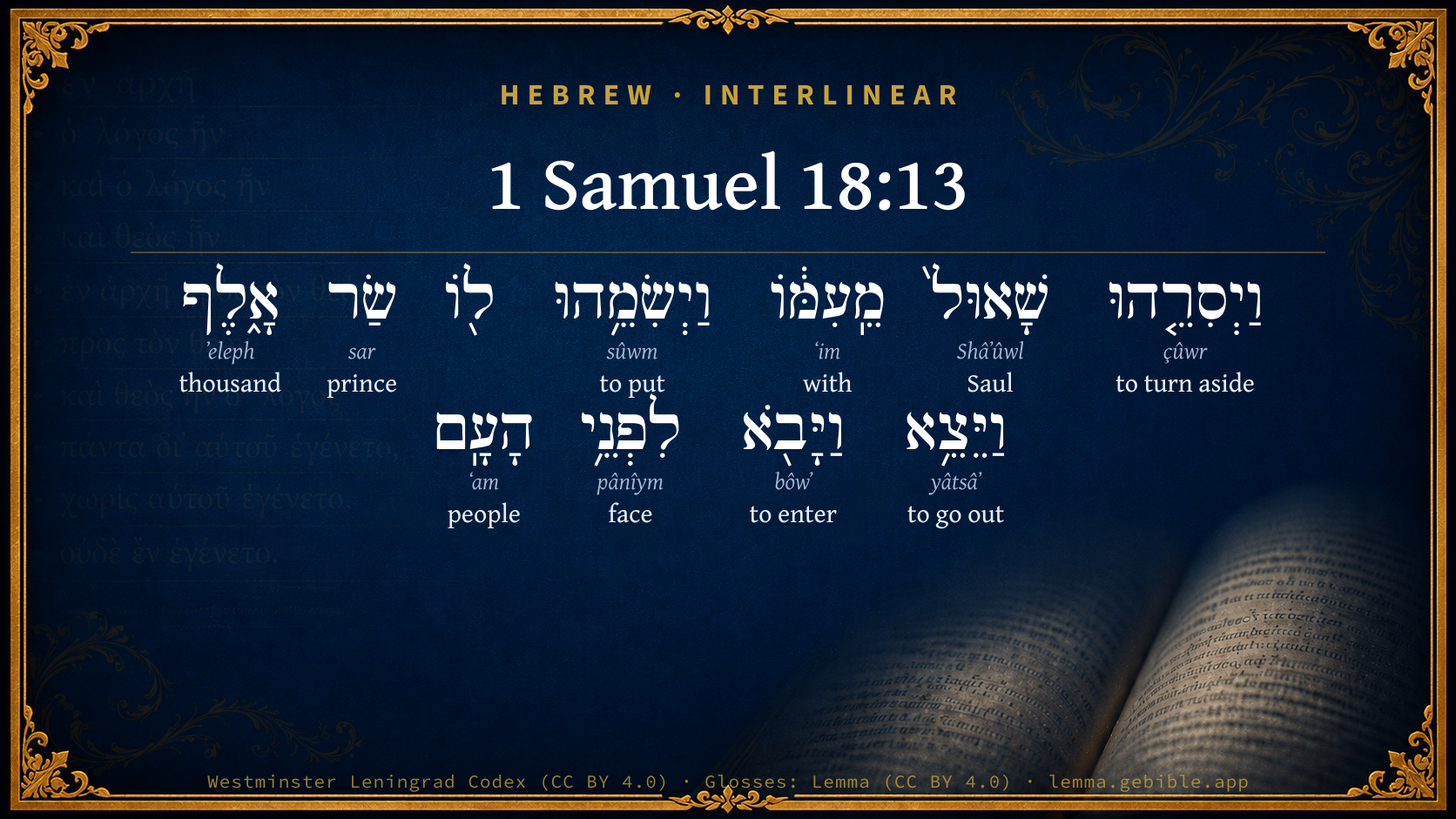
וַיְסִרֵ֤הוּ
çûwr
H5493
“and · to turn aside · him”
Conjunction + Verb, Hiphil, Sequential Imperfect, 3rd Person, Masculine, Singular + Suffix, Personal, 3rd Person, Masculine, Singular
Part of Speech
Conjunction + Verb
Stem
Hiphil
Form
Sequential Imperfect
Person
3rd Person
Gender
Masculine
Number
Singular
Full BDB Definition

Origin: a primitive root

TWOT: 1480

to turn aside, depart - (Qal) - to turn aside, turn in unto - to depart, depart from way, avoid - to be removed - to come to an end - (Polel) to turn aside - (Hiphil) - to cause to turn aside, cause to depart, remove, take away, put away, depose - to put aside, leave undone, retract, reject, abolish - (Hophal) to be taken away, be removed
  1. שָׁאוּל֙ Shâʼûwl H7586 “Saul” Noun, Proper
  2. מֵֽעִמּ֔וֹ ʻim H5973 “from · with · him” Preposition + Preposition + Suffix, Personal, 3rd Person, Masculine, Singular
  3. וַיְשִׂמֵ֥הוּ sûwm H7760 “and · to put · him” Conjunction + Verb, Qal, Sequential Imperfect, 3rd Person, Masculine, Singular + Suffix, Personal, 3rd Person, Masculine, Singular
  4. שַׂר sar H8269 “prince of” Noun, Common, Masculine, Singular, Construct
  5. אָ֑לֶף ʼeleph H505 “thousand” Adjective, Cardinal number, Both, Singular, Absolute
  6. וַיֵּצֵ֥א yâtsâʼ H3318 “and · to go out” Conjunction + Verb, Qal, Sequential Imperfect, 3rd Person, Masculine, Singular
  7. וַיָּבֹ֖א bôwʼ H935 “and · to enter” Conjunction + Verb, Qal, Sequential Imperfect, 3rd Person, Masculine, Singular
  8. לִפְנֵ֥י pânîym H6440 “to/for · face(s) of” Preposition + Noun, Common, Both, Plural, Construct
  9. הָעָֽם ʻam H5971 “the · people” Particle, Definite Article + Noun, Common, Masculine, Singular, Absolute

About this verse

These counts appear in no published source. They are computed here, from the morphology-tagged text and Lemma’s own curated glosses. What Lemma adds →

11
words
10
distinct lemmas
Historical
section

Grammatical profile

  • 4 verbs
  • 4 nouns
  • 1 adjective
  • 2 prepositions

Verb forms

  • וַיְסִרֵ֤הוּ Hiphil · Sequential Imperfect
  • וַיְשִׂמֵ֥הוּ Qal · Sequential Imperfect
  • וַיֵּצֵ֥א Qal · Sequential Imperfect
  • וַיָּבֹ֖א Qal · Sequential Imperfect

Hebrew & Septuagint length

In English translation the verse runs 24 words from the Hebrew and 26 from the Septuagint (LXX English) — closely comparable.

A rough comparison of the two English renderings, which tokenize alike — not a word-level alignment.

Word counts can differ between the Hebrew and the Greek without any difference in meaning — e.g. the Hebrew direct-object marker אֵת has no separate Greek word, and Greek often adds the article ὁ.

Cross-references

7

Topical passages linked to 1 Samuel 18:13 in the Treasury of Scripture Knowledge — connected by theme and wording, ordered by reader-vote popularity; previews shown in the World English Bible.

  • 2 Samuel 5:2 In times past, when Saul was king over us, it was you who led out and brought in Israel: and Yahweh said to you, You shall be shepherd of my people Israel, and you shall be prince over Israel.
  • Psalms 121:8 Yahweh will keep your going out and your coming in, From this time forth, and forevermore.
  • Numbers 27:16–17 Let Yahweh, the God of the spirits of all flesh, appoint a man over the congregation,
  • 1 Samuel 8:12 and he will appoint them to him for captains of thousands, and captains of fifties; and [he will set some] to plow his ground, and to reap his harvest, and to make his instruments of war, and the instruments of his chariots.
  • 1 Samuel 18:16–17 But all Israel and Judah loved David; for he went out and came in before them.
  • 1 Samuel 18:25 Saul said, Thus shall you tell David, The king desires no dowry except one hundred foreskins of the Philistines, to be avenged of the king's enemies. Now Saul thought to make David fall by the hand of the Philistines.
  • 1 Samuel 22:7 Saul said to his servants who stood about him, Hear now, you Benjamites; will the son of Jesse give everyone of you fields and vineyards, will he make you all captains of thousands and captains of hundreds,

Cross-references courtesy of OpenBible.info (CC BY 4.0).

Hebrew and Greek witnesses Masoretic Hebrew ↔ Greek Septuagint

The same verse in the two great witnesses to the Old Testament, shown verse-for-verse.

These are two independent witnesses, not word-aligned to each other, and the Septuagint is shown in lemma (dictionary) form.

Hebrew 1 Samuel 18:13 Masoretic · Westminster Leningrad Codex

וַיְסִרֵ֤הוּ שָׁאוּל֙ מֵֽעִמּ֔וֹ וַיְשִׂמֵ֥הוּ ל֖וֹ שַׂר אָ֑לֶף וַיֵּצֵ֥א וַיָּבֹ֖א לִפְנֵ֥י הָעָֽם

Therefore Saul removed him from him, and made him his captain over a thousand; and he went out and came in before the people.

World English Bible · Public Domain

Greek LXX 1 Samuel 18:13 Septuagint · lemma form

καί λαλέω ὁ παῖς σαούλ εἰς ὁ οὖς δαυίδ ὁ ῥῆμα οὗτος καί εἶπον δαυίδ εἰ κοῦφος ἐν ὀφθαλμός σύ ἐπιγαμβρεύω βασιλεύς καΐἐγώ ἀνήρ ταπεινός καί οὐ ἔνδοξος

And he removed him from him, and made him a captain of a thousand for himself; and he went out and came in before the people.

LXX2012 (modern English Septuagint) · Public Domain

Hebrew: Westminster Leningrad Codex (CC BY 4.0). Greek: Septuagint (public domain); English from LXX2012 (modern English Septuagint) (Public Domain). How the Septuagint differs from the Hebrew →

Targum (Aramaic paraphrase)

1

The Targum is the ancient Jewish Aramaic paraphrase of the Hebrew Scriptures — an interpretive translation, not the Hebrew text itself. Onkelos (literal) and Pseudo-Jonathan (expansive) render the Torah, and Jonathan the Prophets. Coverage is partial: where no permissively-licensed English translation exists for a verse, only the Aramaic is shown. This is verse-level text, not a word-by-word alignment to the Hebrew.

  1. Targum Jonathan Prophets (Joshua–Malachi)
    וְאַפְנְיֵיהּ שָׁאוּל מִלְוָתֵיהּ וּמַנְיֵיהּ לֵיה רַב אַלְפָא וּנְפַק וְעַל בְּרֵישׁ עַמָא:

    (no public-domain English translation for this verse)

    Targum Jonathan — Aramaic: “Mikraot Gedolot” (public domain). English: “Sefaria Community Translation” (CC0 1.0 (public-domain dedication)); “London "Chaldee Paraphrase," 1871” (public domain). Text via Sefaria.

Commentary

Notes on 1 Samuel 18:13 from classic Christian and Jewish commentators (each source and its license shown beneath its notes). The classic Christian expositions comment on the surrounding passage and are grouped to its opening verse, so a note may address several verses; the Jewish commentaries on the Tanakh (Rashi and others) are per-verse, so they appear only where the commentator wrote on this verse.

Lemma curates 59 commentaries, every one of them public domain or Creative Commons licensed, each selected and text-cleaned for this edition rather than reprinted as found. About our sources →

Jamieson, Fausset & Brown

Robert Jamieson, A. R. Fausset & David Brown

FEARS HIM FOR HIS GOOD SUCCESS. (Sa1 18:13-16)

Therefore Saul removed him from him--sent him away from the court, where the principal persons, including his own son, were spellbound with admiration of the young and pious warrior.

made him captain over a thousand--gave him a military commission, which was intended to be an honorable exile. But this post of duty served only to draw out before the public the extraordinary and varied qualities of his character, and to give him a stronger hold of the people's affections.

Jamieson, Fausset & Brown — Commentary Critical and Explanatory on the Whole Bible (1871) — public domain (CC PDM 1.0). Text via the HelloAO Bible API.

Trapp's Complete Commentary

John Trapp

1Sa 18:13 Therefore Saul removed him from him, and made him his captain over a thousand; and he went out and came in before the people.

Ver. 13. Therefore Saul removed him from him.] As the great Turk doth always his eldest son, whom he sendeth away into some remote provinces, lest he should practise treason. And as unto the Aga, captain of the janizaries, nothing can portend a more certain destruction than to be of them beloved; for then is he of the great sultan straightway feared or mistrusted, and occasion sought for to take him out of the way; {a} so it befell good David.

And made him his captain over a thousand.] This seeming preferment was indeed a persecution; for hereby David, being valorous and venturous, was exposed to no small danger in fighting against the enemies. Uriah lost his life by such means.

{a} Turk. Hist.

John Trapp, A Commentary or Exposition upon All the Books of the Old and New Testament (1647–1656) — public domain. Text from a community e-Sword module.

Geneva Bible (1599)

Geneva Bible translators

Meaning, he was captain over the people.

Geneva Bible (1599) marginal notes — public domain. Text via Bolls.life.

Adam Clarke's Commentary

Verse 13. Made him his captain] This was under pretence of doing him honour, when it was in effect only to rid himself of the object of his envy.

Adam Clarke's Commentary on the Bible (1810–1826) — public domain. Text from a community e-Sword/MySword module.

The Cambridge Bible for Schools and Colleges

gen. ed. J. J. S. Perowne

13. made him his captain over a thousand] What was summarily mentioned by anticipation in 1Sa_18:5 is here related with more detail in the order of time.

The Cambridge Bible for Schools and Colleges (gen. ed. J. J. S. Perowne; Cambridge University Press, 1878–1918) — public domain. Text from a community e-Sword module.

John Gill's Exposition

And David behaved himself wisely in all his ways,.... Both in the court and in the camp, in whatsoever service he was employed; or "prospered" (u), as the word also signifies; for, generally speaking, those that behave wisely succeed well; in this he was a type of Christ, Isa 52:13; the reason of it follows:

and the Lord was with him; from whom he had his wisdom and success; the Targum is,"the Word of the Lord was for his help.''

(u) "prospere admodum res gerebat", Vatablus; "secundabatur", Junius & Tremellius, Piscator; so the Targum and Jarchi.

John Gill's Exposition of the Whole Bible (1746–1763) — public domain (CC PDM 1.0). Text via the HelloAO Bible API.

Haydock's Catholic Bible Commentary

People, as their leader. Saul gave him an honourable, but dangerous office, to procure his destruction. This is frequently the manner in which men of superior talents have been treated, (Calmet) as Corbulo, Germanicus, and Agricola were by three Roman emperors. (Tacitus, Ann. ii., &c.)

George Leo Haydock (1774–1849), Haydock's Catholic Family Bible and Commentary, 1859 edition — public domain. Excludes Psalms (Douay-Rheims chapter numbering differs from Protestant) and Deuterocanonical books (Catholic canon only).

Matthew Poole's English Annotations

From him; from his presence and court; which he did, partly, because he feared lest David should watch and find an opportunity to kill him, as he had designed to kill David; partly, because he was a great eyesore, and his presence now made him more sad than ever his music had made him cheerful; and principally, that hereby he might expose him to the greatest hazards, and in some sort betray him into the hands of the Philistines.

He went out and came in; he led his soldiers forth to battle, and brought them back again with safety. Compare 2Sa 5:2. Or else the phrase of coming in and going out may be understood (as elsewhere) for conversing; or (as we use to say) going to and fro about business, as 1Sa 29:6.

Matthew Poole's English Annotations on the Holy Bible (1683–1685) — public domain. Text from a community e-Sword/MySword module.

Whedon's Commentary on the Bible

Daniel D. Whedon

13. Made him his captain over a thousand — This is probably the same appointment as that referred to in 1Sa_18:5. David was not made the leading officer over all the host, for this position Abner held, (1Sa_17:55,) but he was made captain of a regiment.

Daniel D. Whedon (gen. ed.), Commentary on the Old and New Testaments (1874–1909) — public domain. Text from a community e-Sword module.

John Wesley's Explanatory Notes

Removed him from him - From his presence and court; which he did, because he feared lest David should find an opportunity to kill him, as he had designed to kill David; because his presence now made him more sad than ever his musick made him chearful: and principally, that hereby he might expose him to the greatest hazards.

John Wesley, Explanatory Notes Upon the Whole Bible (1754–1765) — public domain. Text via the GEBible commentary corpus.

unfoldingWord translationNotes

Door43 World Missions Community

So Saul removed him from his presence

"So Saul removed David from his presence"

a commander of a thousand

Possible meanings are 1) the word "thousand" represents the exact amount of soldiers that he would lead. AT: "a commander of 1,000 soldiers" or 2) the word translated as "thousand" does not represent exact number, but is the name of a large military division. AT: "a commander of a large military division" See how you translated a similar phrase in 1 Samuel 17:18. (See: Numbers)

David went out and came in before the people

Here "the people" refers to the soldiers under David's command. The phrases "went out" and "came in" are idioms that refer to leading the people into battle and leading them home from battle. AT: "David led his soldiers into battle and led them home from battle" (See: Idiom and Assumed Knowledge and Implicit Information)

translationWords

Saul (OT)

appoint

commander

David

unfoldingWord translationNotes — © Distant Shores Media and the Door43 World Missions Community, licensed CC BY-SA 4.0. Source: git.door43.org/Door43/en_tn.

Lesson kit

Teaching starters — assembled from the data on this page, not authored interpretation. Every prompt links to the verse data it draws on. Edit before teaching.

1 Samuel, in the Historical, opens this verse with 11 words (10 distinct Hebrew lemmas). Its most distinctive word is çûwr (“to turn aside”). A historical commentator’s framing appears above. Read the whole chapter for the surrounding context.

Discussion questions

  1. What does “to turn aside” (çûwr) contribute to the verse as a whole?
  2. How does 2 Samuel 5:2, which shares this passage’s theme, read alongside this verse?
  3. These translations render this verse differently; the difference is in the English rendering, not the original. What questions does that raise?
  4. «וַיְסִרֵ֤הוּ» is a Hiphil Sequential Imperfect verb. How does that grammatical form shape the action described?
  5. Compare how Jamieson, Fausset & Brown and Trapp's Complete Commentary read this verse. Where do they agree or differ?

Things to notice

Reading settings

Reading text

Shown beneath each verse's original-language words.

Old Testament
Old Testament edition

Read the OT as the Masoretic Hebrew (MT) or the Greek Septuagint (LXX).

English shown for the Greek Septuagint (in the Hebrew ↔ Greek comparison).

Comparing translations? Open the Compare panel on any verse page to stack up to four side by side.