Judges 19:12

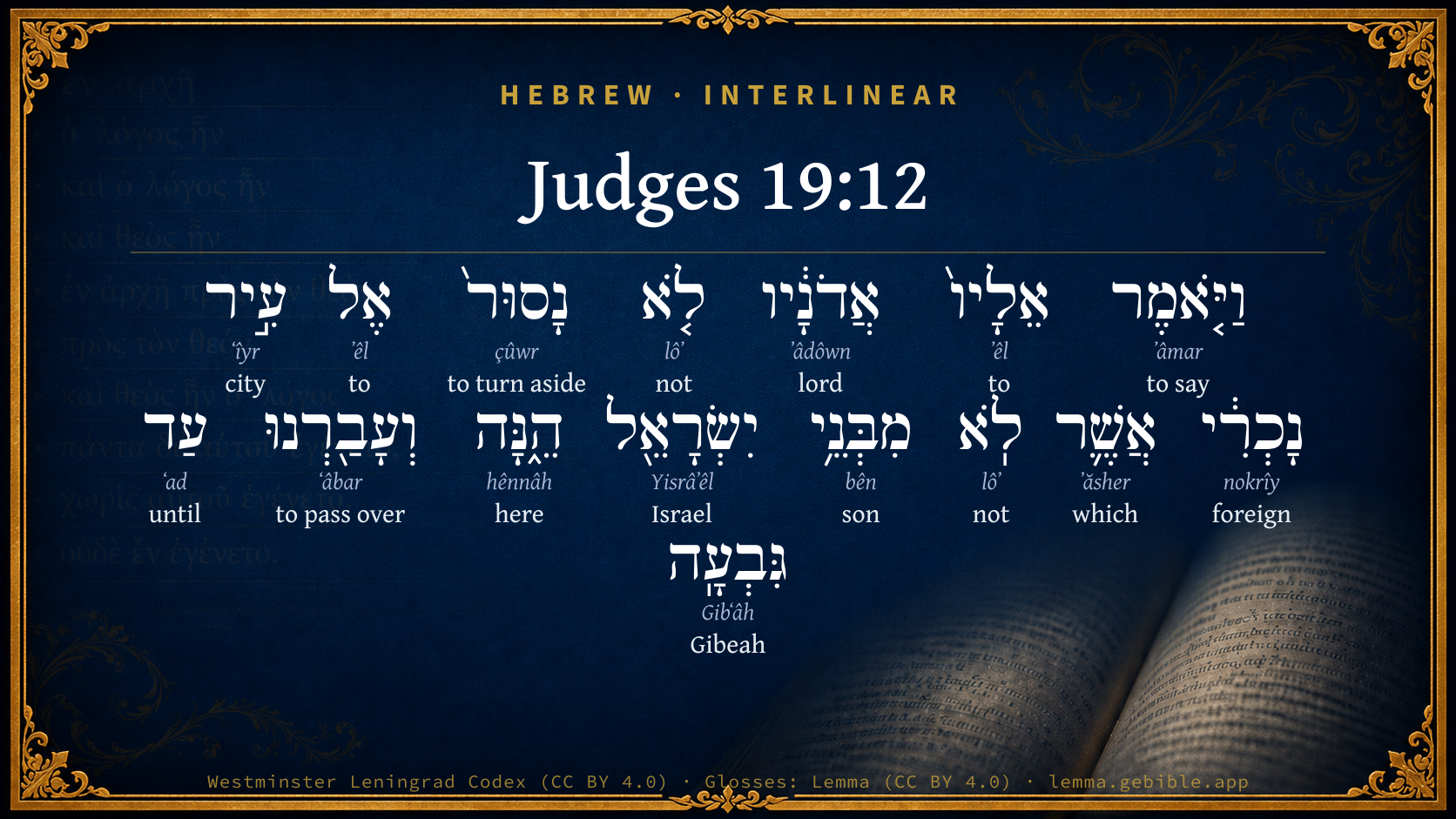
Hebrew (Westminster Leningrad Codex) Judges 19:12 appears in the Hebrew Old Testament. The text above is from the Westminster Leningrad Codex. Each word links to its Strong’s number, a concise gloss, and parsing drawn from the Open Scriptures Hebrew Bible morphology. Click any word for its full Brown-Driver-Briggs (BDB) entry.
Download image
Cite this verse

Judges 19:12 (World English Bible). Public Domain. Lemma interlinear Bible study tool, https://lemma.gebible.app/v/judges/19/12.

Show BibTeX & RIS
BibTeX
RIS
English Translation
His master said to him, We won't turn aside into the city of a foreigner, that is not of the children of Israel; but we will pass over to Gibeah.
World English Bible · Public Domain
Download a study sheet

One document with this verse’s original text, its word-by-word gloss line, the meaning frame, cross-references with their text, attributed commentary, and full source and license credits — printable, and it pastes into notes with its structure intact.

This verse Autodidact and up

Study sheet (.html) Plain text (.txt)

A passage Seminary Student

Up to 50 verses in one chapter. A passage sheet keeps up to 6 commentary sources and 12 cross-references per verse, in the order this page ranks them, and says so on the sheet whenever that leaves anything out. Ask for a single verse and you get the Autodidact verse sheet above.

Everything on this page stays free to read, with no account — the sheet is a download of what is already on screen, not access to it.

Want to remove ads? Support Godless Engineer
Compare translations 3

The same verse in 3 English versions, stacked beneath the original-language interlinear above. Click any original word for its lexicon entry.

Each is an independent rendering of the whole verse — the interlinear is not word-aligned to these translations.

Highlighted words mark where these versions differ — a whole-verse word diff, not a word-by-word alignment.

  • World English Bible Public Domain
    His master said to him, We won't turn aside into the city of a foreigner, that is not of the children of Israel; but we will pass over to Gibeah.
  • King James Version Public Domain
    And his master said unto him, We will not turn aside hither into the city of a stranger, that is not of the children of Israel; we will pass over to Gibeah.
  • unfoldingWord Literal Text CC BY-SA 4.0
    But his master said to him, “We shall not turn aside into a city of a foreigner, where none from the sons of Israel here. But we shall cross over to Gibeah.”

unfoldingWord Literal Text — © unfoldingWord, licensed CC BY-SA 4.0. Word-aligned USFM3 via Door43 (git.door43.org/unfoldingWord/en_ult).

Versions to compare (up to 4)

3 of 4 selected

Show all 18 translations

Every available English version of this verse, each an independent rendering of the whole verse.

  • World English Bible Public Domain
    His master said to him, We won't turn aside into the city of a foreigner, that is not of the children of Israel; but we will pass over to Gibeah.
  • Berean Standard Bible Public Domain
    But his master replied, “We will not turn aside to the city of foreigners, where there are no Israelites. We will go on to Gibeah.”
  • Majority Standard Bible Public Domain
    But his master replied, “We will not turn aside to the city of foreigners, where there are no Israelites. We will go on to Gibeah.”
  • King James Version Public Domain
    And his master said unto him, We will not turn aside hither into the city of a stranger, that is not of the children of Israel; we will pass over to Gibeah.
  • American Standard Version (1901) Public Domain
    And his master said unto him, We will not turn aside into the city of a foreigner, that is not of the children of Israel; but we will pass over to Gibeah.
  • Revised Version (1885) Public Domain
    And his master said unto him, We will not turn aside into the city of a stranger, that is not of the children of Israel; but we will pass over to Gibeah.
  • Geneva Bible (1599) Public Domain
    And his master answered him, We will not turne into the citie of strangers that are not of the children of Israel, but we will goe forth to Gibeah.
  • Douay-Rheims (1899) Public Domain
    His master answered him: I will not go into the town of another nation, who are not of the children of Israel, but I will pass over to Gabaa:
  • Young's Literal Translation Public Domain
    And his lord saith unto him, `Let us not turn aside unto the city of a stranger, that is not of the sons of Israel, thither, but we have passed over unto Gibeah.'
  • Literal Standard Version CC BY-SA 4.0
    And his lord says to him, “Let us not turn aside to the city of a stranger, that is not of the sons of Israel there, but we have passed over to Gibeah.”
  • Unlocked Literal Bible CC BY-SA 4.0
    His master said to him, “We will not turn aside into a city of foreigners who do not belong to the people of Israel. We will go on to Gibeah.”
  • unfoldingWord Literal Text CC BY-SA 4.0
    But his master said to him, “We shall not turn aside into a city of a foreigner, where none from the sons of Israel here. But we shall cross over to Gibeah.”
  • Darby Bible Public Domain
    And his master said to him, "We will not turn aside into the city of foreigners, who do not belong to the people of Israel; but we will pass on to Gib'e-ah."
  • World Messianic Bible Public Domain
    His master said to him, “We won’t enter into the city of a foreigner that is not of the children of Israel; but we will pass over to Gibeah.”
  • Webster's Bible Public Domain
    And his master said to him, We will not turn aside hither into the city of a stranger, that is not of the children of Israel; we will pass over to Gibeah.
  • Free Bible Version CC BY-SA 4.0
    But his master replied, “No, we're not going to stop in this town where only foreigners live and no Israelites. We'll continue on to Gibeah.”
  • Bible in Basic English Public Domain
    But his master said to him, We will not go out of our way into a strange town, whose people are not of the children of Israel; but we will go on to Gibeah.
  • JPS Tanakh (1917) Public Domain
    And his master said unto him: 'We will not turn aside into the city of a foreigner, that is not of the children of Israel; but we will pass over to Gibeah.'

Literal Standard Version (2020), Covenant Press — licensed CC BY-SA 4.0. Text via the HelloAO Bible API (eBible.org). Unlocked Literal Bible (unfoldingWord) — licensed CC BY-SA 4.0. Text via the HelloAO Bible API (eBible.org). unfoldingWord Literal Text — © unfoldingWord, licensed CC BY-SA 4.0. Word-aligned USFM3 via Door43 (git.door43.org/unfoldingWord/en_ult). Free Bible Version, Dr. Jonathan Gallagher — licensed CC BY-SA 4.0. Text via the HelloAO Bible API (eBible.org).

Word by word

More ways to search: Search by grammar → Find every occurrence → Compare this word →

Practice this passage: Drill this verse → Learn its vocabulary →

גִּבְעָֽה
Gibʻâh
H1390
“Gibeah”
Noun, Proper
Part of Speech
Noun
Type
Proper
Full BDB Definition

Origin: the same as H1389

TWOT: None

Gibeah = "hill" - a city in the mountain district of Judah - a city of Benjamin, birthplace of king Saul - a city in Kirjath-jearim of Ephraim
  1. וַיֹּ֤אמֶר ʼâmar H559 “and · to say” Conjunction + Verb, Qal, Sequential Imperfect, 3rd Person, Masculine, Singular
  2. אֵלָיו֙ ʼêl H413 “to · him” Preposition + Suffix, Personal, 3rd Person, Masculine, Singular
  3. אֲדֹנָ֔יו ʼâdôwn H113 “lords · his” Noun, Common, Masculine, Plural, Construct + Suffix, Personal, 3rd Person, Masculine, Singular
  4. לֹ֤א lôʼ H3808 “not” Particle, Negative
  5. נָסוּר֙ çûwr H5493 “to turn aside” Verb, Qal, Imperfect, 1st Person, Common, Plural
  6. אֶל ʼêl H413 “to” Preposition
  7. עִ֣יר ʻîyr H5892 “city” Noun, Common, Feminine, Singular, Absolute
  8. נָכְרִ֔י nokrîy H5237 “foreign” Adjective, Adjective, Masculine, Singular, Absolute
  9. אֲשֶׁ֛ר ʼăsher H834 “which” Particle, Relative
  10. לֹֽא lôʼ H3808 “not” Particle, Negative
  11. מִבְּנֵ֥י bên H1121 “from · sons of” Preposition + Noun, Common, Masculine, Plural, Construct
  12. יִשְׂרָאֵ֖ל Yisrâʼêl H3478 “Israel” Noun, Proper
  13. הֵ֑נָּה hênnâh H2008 “here” Pronoun, Personal, 3rd Person, Feminine, Plural
  14. וְעָבַ֖רְנוּ ʻâbar H5674 “and · to pass over” Conjunction + Verb, Qal, Sequential Perfect, 1st Person, Common, Plural
  15. עַד ʻad H5704 “until” Preposition

About this verse

These counts appear in no published source. They are computed here, from the morphology-tagged text and Lemma’s own curated glosses. What Lemma adds →

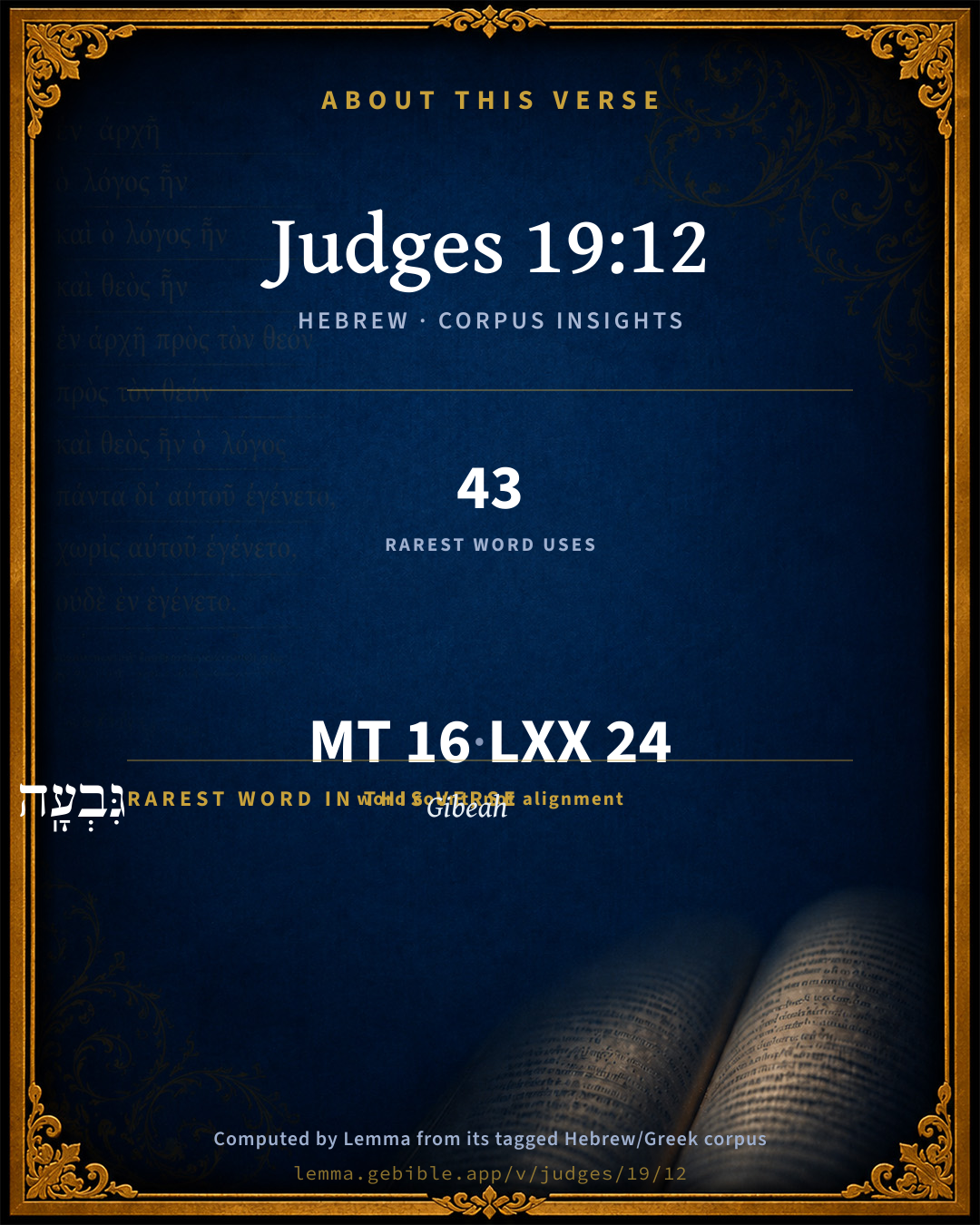
16
words
14
distinct lemmas
Historical
section

Shared distinctive vocabulary

גִּבְעָֽה Gibeah H1390 occurs in 42 verses of the Hebrew Bible. Also found in:

Grammatical profile

  • 3 verbs
  • 5 nouns
  • 1 adjective
  • 1 pronoun
  • 3 prepositions
  • 3 particles

Verb forms

  • וַיֹּ֤אמֶר Qal · Sequential Imperfect
  • נָסוּר֙ Qal · Imperfect
  • וְעָבַ֖רְנוּ Qal · Sequential Perfect

Repetition

Words recur within this verse — often emphatic in Hebrew:

  • אֵלָיו֙ to H413 ×2
  • לֹ֤א not H3808 ×2

Hebrew & Septuagint length

In English translation the verse runs 30 words from the Hebrew and 34 from the Septuagint (LXX English) — closely comparable.

A rough comparison of the two English renderings, which tokenize alike — not a word-level alignment.

Word counts can differ between the Hebrew and the Greek without any difference in meaning — e.g. the Hebrew direct-object marker אֵת has no separate Greek word, and Greek often adds the article ὁ.

In the original languages it is 16 Hebrew tokens and 24 Greek tokens — but the two are counted differently (Hebrew bundles its prefixes and suffixes into one token; the Greek is in lemma form), so that isn’t a like-for-like length.

Hebrew and Greek witnesses Masoretic Hebrew ↔ Greek Septuagint

The same verse in the two great witnesses to the Old Testament, shown verse-for-verse.

These are two independent witnesses, not word-aligned to each other, and the Septuagint is shown in lemma (dictionary) form.

Hebrew Judges 19:12 Masoretic · Westminster Leningrad Codex

וַיֹּ֤אמֶר אֵלָיו֙ אֲדֹנָ֔יו לֹ֤א נָסוּר֙ אֶל עִ֣יר נָכְרִ֔י אֲשֶׁ֛ר לֹֽא מִבְּנֵ֥י יִשְׂרָאֵ֖ל הֵ֑נָּה וְעָבַ֖רְנוּ עַד גִּבְעָֽה

His master said to him, We won't turn aside into the city of a foreigner, that is not of the children of Israel; but we will pass over to Gibeah.

World English Bible · Public Domain

Greek LXX Judges 19:12 Septuagint · lemma form

καί εἶπον πρός αὐτός ὁ κύριος αὐτός οὐ ἐκκλίνω εἰς πόλις ἀλλότριος ἐν ὅς οὐ εἰμί ἀπό υἱός ἰσραήλ ὧδε καί παραἔρχομαι ἕως γαβαα

And his master said to him, We will not turn aside to a strange city, where there is not one of the children of Israel, but we will pass on as far as Gabaa.

LXX2012 (modern English Septuagint) · Public Domain

Hebrew: Westminster Leningrad Codex (CC BY 4.0). Greek: Septuagint (public domain); English from LXX2012 (modern English Septuagint) (Public Domain). How the Septuagint differs from the Hebrew →

Targum (Aramaic paraphrase)

1

The Targum is the ancient Jewish Aramaic paraphrase of the Hebrew Scriptures — an interpretive translation, not the Hebrew text itself. Onkelos (literal) and Pseudo-Jonathan (expansive) render the Torah, and Jonathan the Prophets. Coverage is partial: where no permissively-licensed English translation exists for a verse, only the Aramaic is shown. This is verse-level text, not a word-by-word alignment to the Hebrew.

  1. Targum Jonathan Prophets (Joshua–Malachi)
    וַאֲמַר לֵיהּ רִבּוֹנֵיהּ לָא נְזוּר לְקַרְתָּא בְּנֵי עַמְמַיָא דְלָא מִבְּנֵי יִשְׂרָאֵל אִינוּן וְנִתְמְטֵי עַד גִבְעָתָא:

    (no public-domain English translation for this verse)

    Targum Jonathan — Aramaic: “Mikraot Gedolot” (public domain). English: “Sefaria Community Translation” (CC0 1.0 (public-domain dedication)); “London "Chaldee Paraphrase," 1871” (public domain). Text via Sefaria.

Commentary

Notes on Judges 19:12 from classic Christian and Jewish commentators (each source and its license shown beneath its notes). The classic Christian expositions comment on the surrounding passage and are grouped to its opening verse, so a note may address several verses; the Jewish commentaries on the Tanakh (Rashi and others) are per-verse, so they appear only where the commentator wrote on this verse.

Lemma curates 59 commentaries, every one of them public domain or Creative Commons licensed, each selected and text-cleaned for this edition rather than reprinted as found. About our sources →

Trapp's Complete Commentary

John Trapp

Jdg 19:12 And his master said unto him, We will not turn aside hither into the city of a stranger, that [is] not of the children of Israel; we will pass over to Gibeah.

Ver. 12. We will pass over to Gibeah.] But where can a man be safe from the devil and his imps? And what place but hell itself can yield a worse creature than a depraved Israelite, than a profligate professor? We used to say that an Englishman Italianate is a devil incarnate. In Mexico and other parts of America, whoredom and sodomy - those Spanish virtues - are common without reproof among the pseudo-Catholics; whereas the Indians abhor this most loathsome living; showing themselves in respect of the Spaniards, as the Scythians did in respect of the Grecians, whom they so far excelled in life and behaviour, as they were short of them in learning and knowledge.

John Trapp, A Commentary or Exposition upon All the Books of the Old and New Testament (1647–1656) — public domain. Text from a community e-Sword module.

Joseph Benson's Commentary

Jdg 19:12. The city of a stranger — That is, of a strange nation; a city which the Canaanites possess. For though Jerusalem had been taken by Caleb, (chap. 1.,) yet the strong fort of Zion was still in their hands, whence it is likely they did much molest, and afterward, by God’s permission, drive out the Israelites who dwelt there.

Joseph Benson's Commentary on the Old and New Testaments (1811–1818) — public domain. Text from a community e-Sword module.

Geneva Bible (1599)

Geneva Bible translators

Though in these days there were most horrible corruptions, yet very necessity could not compel them, to have to do with them that professed not the true God.

Geneva Bible (1599) marginal notes — public domain. Text via Bolls.life.

Ellicott's Commentary for English Readers

(12) To Gibeah.—This is the “Gibeah of Saul,” where the first king of Israel was born (1Sa_11:4). It was one of the fourteen cities of Benjamin (Jos_18:28), and is the modern Tuleil el Ful. It only involved a journey of four miles more (Jos. Antt. v. 2, § 8).

A Bible Commentary for English Readers, edited by Charles John Ellicott (1878–1897) — public domain. Text from a community e-Sword module.

The Cambridge Bible for Schools and Colleges

gen. ed. J. J. S. Perowne

12. The text is to be preferred to the marg.; but that is not should be construed with a stranger rather than with the city.

The Cambridge Bible for Schools and Colleges (gen. ed. J. J. S. Perowne; Cambridge University Press, 1878–1918) — public domain. Text from a community e-Sword module.

John Gill's Exposition

And his master said unto him, we will not turn aside hither into the city of a stranger,.... A city of the children of the Gentiles, as the Targum, as the Jebusites were, being one of the seven nations of the land of Canaan, who were to be dispossessed and destroyed; and which, one would think, he would not have so called, had it been inhabited, though but in part, by the children of Judah and Benjamin: by this it appears, that this Levite was a good man, and conscientious, and shunned all appearance of evil, and the company of wicked men, as became his character and profession: and it is added:

that is not of the children of Israel; which further confirms the above conjecture, that this city was not as yet at all in the hands of the Israelites; or if it had been, was retaken, and now in the hands of the Jebusites:

we will pass over to Gibeah; which was in the tribe of Benjamin, and inhabited by men of that tribe, and so more agreeable to this Levite, though it proved fatal to him; this was, as Josephus says (r) thirty furlongs, or near four miles from Jebus or Jerusalem; and though it was near sun setting, he chose rather to proceed on to this place, than to lodge at Jebus, and the rather it may be, as it was a Levitical city, Jos 21:17.

(r) De Bello Jud. l. 5. c. 2. sect. 1.

John Gill's Exposition of the Whole Bible (1746–1763) — public domain (CC PDM 1.0). Text via the HelloAO Bible API.

Albert Barnes' Notes on the Bible

City of a stranger - This shows how completely, even in these early days, the Jebusite population had excluded both the tribes of Judah and Benjamin.

Albert Barnes' Notes on the Bible (1834–1885) — public domain. Text from a community e-Sword/MySword module.

Matthew Poole's English Annotations

Of a stranger, i.e. of a strange nation, which the Canaanites possess; for though the city Jerusalem had been taken by Caleb, Jdg 1, yet the strong fort of Zion was still in their hands, 2Sa 5:6,7, whence it is likely they did much molest, and afterwards, by God’s permission, and for the punishment of their sin, drive out the Israelites who dwelt there.

Matthew Poole's English Annotations on the Holy Bible (1683–1685) — public domain. Text from a community e-Sword/MySword module.

The Pulpit Commentary

Gibeah (or ha-Gibeah, the hill).. In the tribe of Benjamin; (Jos_18:28) Saul"s birthplace. Its modern name is Jeba. It would be about two and a half hours" further journey from Jerusalem.

The Pulpit Commentary (1880–1919), ed. H.D.M. Spence-Jones & Joseph S. Exell — public domain. Text from a community e-Sword module.

John Wesley's Explanatory Notes

A stranger - That is, of a strange nation: which the Canaanites possess; for though the city Jerusalem had been taken by Caleb, chap. i, 8, yet the strong fort of Zion was still in their hands, whence it is likely they did much molest, and afterwards by God's permission, drive out the Israelites who dwelt there.

John Wesley, Explanatory Notes Upon the Whole Bible (1754–1765) — public domain. Text via the GEBible commentary corpus.

unfoldingWord translationNotes

Door43 World Missions Community

turn aside into

This means to take a break from their journey and stop at a place along the route. See how you translated a similar phrase in Judges 19:11. AT: "stop at" (See: Idiom)

Come, let us

This is an idiom used to make a suggestion. AT: "I suggest that we" (See: Idiom)

translationWords

lord

alien

Israel

Gibeah

Levi

Ramah

unfoldingWord translationNotes — © Distant Shores Media and the Door43 World Missions Community, licensed CC BY-SA 4.0. Source: git.door43.org/Door43/en_tn.

Rashi

Rabbi Shlomo Yitzchaki (Rashi)

To Giv'oh. Giv'oh of Binyomin.

Rashi on the Tanakh — English translations: “The Judaica Press complete Tanach with Rashi, translated by A. J. Rosenberg” (CC BY 4.0); “Pentateuch with Rashi's commentary by M. Rosenbaum and A.M. Silbermann, 1929-1934” (public domain); “The Metsudah Tanach series, Lakewood, N.J” (CC BY 4.0); and “The Book of Joshua, Metsudah Publications, 1997” (CC BY 4.0). Text via Sefaria.

Lesson kit

Teaching starters — assembled from the data on this page, not authored interpretation. Every prompt links to the verse data it draws on. Edit before teaching.

Judges, in the Historical, opens this verse with 16 words (14 distinct Hebrew lemmas). Its most distinctive word is Gibʻâh (“Gibeah”). A historical commentator’s framing appears above. Read the whole chapter for the surrounding context.

Discussion questions

  1. The word Gibʻâh carries the sense “Gibeah.” How does it shape the verse?
  2. How does Joshua 15:57, which shares the word «Gibeah», read alongside this verse?
  3. What does the repetition of “to” (2× in this one verse) do in this verse?
  4. These translations render this verse differently; the difference is in the English rendering, not the original. What questions does that raise?
  5. «וַיֹּ֤אמֶר» is a Qal Sequential Imperfect verb. How does that grammatical form shape the action described?
  6. Compare how Trapp's Complete Commentary and Joseph Benson's Commentary read this verse. Where do they agree or differ?

Things to notice

Reading settings

Reading text

Shown beneath each verse's original-language words.

Old Testament
Old Testament edition

Read the OT as the Masoretic Hebrew (MT) or the Greek Septuagint (LXX).

English shown for the Greek Septuagint (in the Hebrew ↔ Greek comparison).

Comparing translations? Open the Compare panel on any verse page to stack up to four side by side.