
Lamentations 3:11

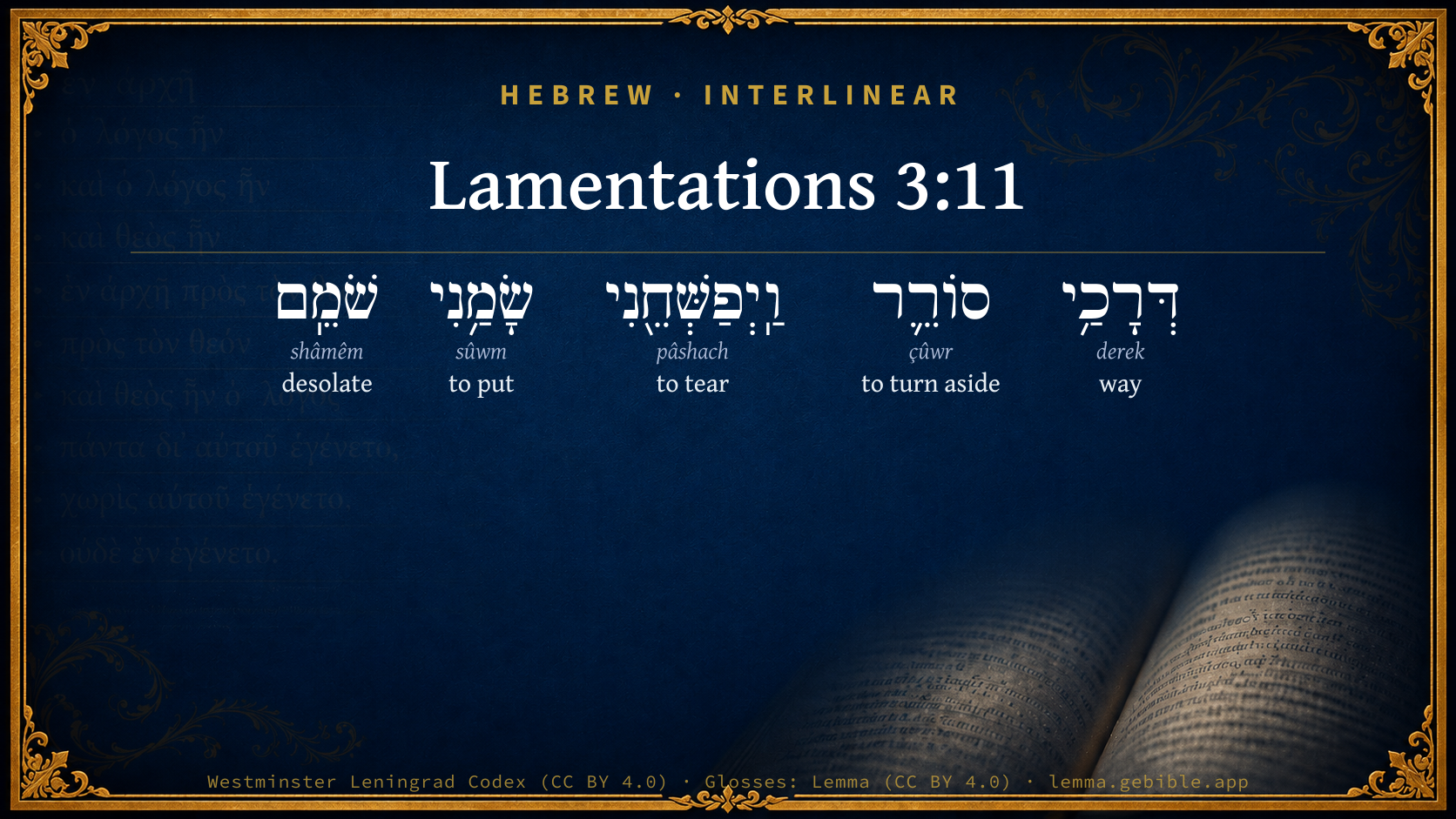
Hebrew (Westminster Leningrad Codex) Lamentations 3:11 appears in the Hebrew Old Testament. The text above is from the Westminster Leningrad Codex. Each word links to its Strong’s number, a concise gloss, and parsing drawn from the Open Scriptures Hebrew Bible morphology. Click any word for its full Brown-Driver-Briggs (BDB) entry.
Download image
Cite this verse

Lamentations 3:11 (World English Bible). Public Domain. Lemma interlinear Bible study tool, https://lemma.gebible.app/v/lamentations/3/11.

Show BibTeX & RIS
BibTeX
RIS
English Translation
He has turned aside my ways, and pulled me in pieces; he has made me desolate.
World English Bible · Public Domain
Highlights
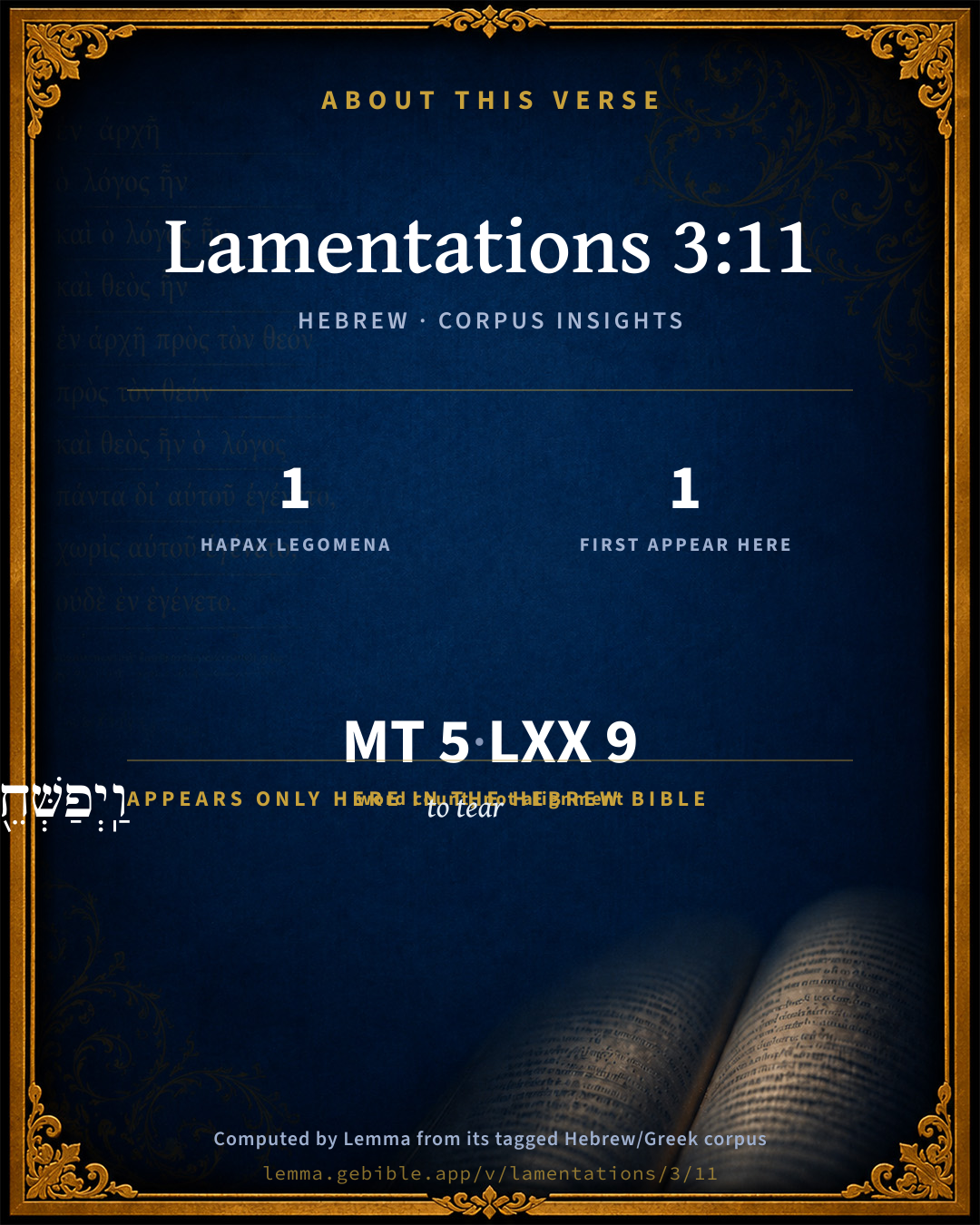
  • 1 hapax legomenon — only here in the Hebrew Bible
  • 1 first appearance in the Hebrew Bible
Full analysis ↓
Download a study sheet

One document with this verse’s original text, its word-by-word gloss line, the meaning frame, cross-references with their text, attributed commentary, and full source and license credits — printable, and it pastes into notes with its structure intact.

This verse Autodidact and up

Study sheet (.html) Plain text (.txt)

A passage Seminary Student

Up to 50 verses in one chapter. A passage sheet keeps up to 6 commentary sources and 12 cross-references per verse, in the order this page ranks them, and says so on the sheet whenever that leaves anything out. Ask for a single verse and you get the Autodidact verse sheet above.

Everything on this page stays free to read, with no account — the sheet is a download of what is already on screen, not access to it.

Want to remove ads? Support Godless Engineer
Compare translations 3

The same verse in 3 English versions, stacked beneath the original-language interlinear above. Click any original word for its lexicon entry.

Each is an independent rendering of the whole verse — the interlinear is not word-aligned to these translations.

Highlighted words mark where these versions differ — a whole-verse word diff, not a word-by-word alignment.

  • World English Bible Public Domain
    He has turned aside my ways, and pulled me in pieces; he has made me desolate.
  • King James Version Public Domain
    He hath turned aside my ways, and pulled me in pieces: he hath made me desolate.
  • unfoldingWord Literal Text CC BY-SA 4.0
    He turned aside my ways and tore me apart; he made me desolate.

unfoldingWord Literal Text — © unfoldingWord, licensed CC BY-SA 4.0. Word-aligned USFM3 via Door43 (git.door43.org/unfoldingWord/en_ult).

Versions to compare (up to 4)

3 of 4 selected

Show all 18 translations

Every available English version of this verse, each an independent rendering of the whole verse.

  • World English Bible Public Domain
    He has turned aside my ways, and pulled me in pieces; he has made me desolate.
  • Berean Standard Bible Public Domain
    He forced me off my path and tore me to pieces; He left me without help.
  • Majority Standard Bible Public Domain
    He forced me off my path and tore me to pieces; He left me without help.
  • King James Version Public Domain
    He hath turned aside my ways, and pulled me in pieces: he hath made me desolate.
  • American Standard Version (1901) Public Domain
    He hath turned aside my ways, and pulled me in pieces; he hath made me desolate.
  • Revised Version (1885) Public Domain
    He hath turned aside my ways, and pulled me in pieces; he hath made me desolate.
  • Geneva Bible (1599) Public Domain
    He hath stopped my wayes, and pulled me in pieces: he hath made me desolate.
  • Douay-Rheims (1899) Public Domain
    Daleth. He hath turned aside my paths, and hath broken me in pieces, he hath made me desolate.
  • Young's Literal Translation Public Domain
    My ways He is turning aside, and He pulleth me in pieces, He hath made me a desolation.
  • Literal Standard Version CC BY-SA 4.0
    My ways He is turning aside, and He pulls me in pieces, || He has made me a desolation.
  • Unlocked Literal Bible CC BY-SA 4.0
    he turned aside my paths, he has made me desolate.
  • unfoldingWord Literal Text CC BY-SA 4.0
    He turned aside my ways and tore me apart; he made me desolate.
  • Darby Bible Public Domain
    He hath turned aside my ways, and pulled me in pieces; he hath made me desolate.
  • World Messianic Bible Public Domain
    He has turned away my path, and pulled me in pieces. He has made me desolate.
  • Webster's Bible Public Domain
    He hath turned aside my ways, and pulled me in pieces: he hath made me desolate.
  • Free Bible Version CC BY-SA 4.0
    He dragged me from my path and ripped me to pieces, leaving me helpless.
  • Bible in Basic English Public Domain
    By him my ways have been turned on one side and I have been pulled in bits; he has made me waste.
  • JPS Tanakh (1917) Public Domain
    He hath turned aside my ways, and pulled me in pieces; He hath made me desolate.

Literal Standard Version (2020), Covenant Press — licensed CC BY-SA 4.0. Text via the HelloAO Bible API (eBible.org). Unlocked Literal Bible (unfoldingWord) — licensed CC BY-SA 4.0. Text via the HelloAO Bible API (eBible.org). unfoldingWord Literal Text — © unfoldingWord, licensed CC BY-SA 4.0. Word-aligned USFM3 via Door43 (git.door43.org/unfoldingWord/en_ult). Free Bible Version, Dr. Jonathan Gallagher — licensed CC BY-SA 4.0. Text via the HelloAO Bible API (eBible.org).

Word by word

More ways to search: Search by grammar → Find every occurrence → Compare this word →

Practice this passage: Drill this verse → Learn its vocabulary →

About this verse

These counts appear in no published source. They are computed here, from the morphology-tagged text and Lemma’s own curated glosses. What Lemma adds →

5
words
5
distinct lemmas
Prophets
section

Notable vocabulary

1 hapax legomenon — a word that appears only here in the entire Hebrew Bible:

  • וַֽיְפַשְּׁחֵ֖נִי to tear H6582

First appearance in Scripture

This word makes its first canonical appearance in the Hebrew Bible here:

  • וַֽיְפַשְּׁחֵ֖נִי to tear H6582

Shared distinctive vocabulary

שֹׁמֵֽם desolate H8076 occurs in 6 verses of the Hebrew Bible. Also found in:

Grammatical profile

  • 4 verbs
  • 1 noun

Verb forms

  • סוֹרֵ֛ר Polel · Perfect
  • וַֽיְפַשְּׁחֵ֖נִי Piel · Sequential Imperfect
  • שָׂמַ֥נִי Qal · Perfect
  • שֹׁמֵֽם Qal · Participle Active

Hebrew & Septuagint length

In English translation the verse runs 16 words from the Hebrew and 17 from the Septuagint (LXX English) — closely comparable.

A rough comparison of the two English renderings, which tokenize alike — not a word-level alignment.

Word counts can differ between the Hebrew and the Greek without any difference in meaning — e.g. the Hebrew direct-object marker אֵת has no separate Greek word, and Greek often adds the article ὁ.

In the original languages it is 5 Hebrew tokens and 9 Greek tokens — but the two are counted differently (Hebrew bundles its prefixes and suffixes into one token; the Greek is in lemma form), so that isn’t a like-for-like length.

Cross-references

17

Topical passages linked to Lamentations 3:11 in the Treasury of Scripture Knowledge — connected by theme and wording, ordered by reader-vote popularity; previews shown in the World English Bible.

  • Hosea 6:1 "Come, and let us return to Yahweh; For he has torn us to pieces, And he will heal us; He has injured us, And he will bind up our wounds.
  • Job 16:12–13 I was at ease, and he broke me apart. Yes, he has taken me by the neck, and dashed me to pieces. He has also set me up for his target.
  • Lamentations 1:13 From on high has he sent fire into my bones, and it prevails against them; He has spread a net for my feet, he has turned me back: He has made me desolate and faint all the day.
  • Job 16:7 But now, God, you have surely worn me out. You have made desolate all my company.
  • Psalms 50:22 "Now consider this, you who forget God, Lest I tear you into pieces, and there be none to deliver.
  • Isaiah 3:26 Her gates shall lament and mourn; And she shall be desolate and sit on the ground.
  • Jeremiah 5:6 Therefore a lion out of the forest shall kill them, a wolf of the evenings shall destroy them, a leopard shall watch against their cities; everyone who goes out there shall be torn in pieces; because their transgressions are many, [and] their backsliding is increased.
  • Jeremiah 6:8 Be instructed, Jerusalem, lest my soul be alienated from you; lest I make you a desolation, a land not inhabited.
  • Jeremiah 9:10–11 For the mountains will I take up a weeping and wailing, and for the pastures of the wilderness a lamentation, because they are burned up, so that none passes through; neither can men hear the voice of the cattle; both the birds of the sky and the animals are fled, they are gone.
  • Jeremiah 19:8 I will make this city an astonishment, and a hissing; everyone who passes thereby shall be astonished and hiss because of all the plagues of it.
  • Jeremiah 32:43 Fields shall be bought in this land, about which you say, It is desolate, without man or animal; it is given into the hand of the Chaldeans.
  • Jeremiah 51:20–22 You are my battle-axe and weapons of war: and with you will I break in pieces the nations; and with you will I destroy kingdoms;
  • Daniel 2:40–44 The fourth kingdom shall be strong as iron, because iron breaks in pieces and subdues all things; and as iron that crushes all these, shall it break in pieces and crush.
  • Daniel 7:23 Thus he said, The fourth animal shall be a fourth kingdom on earth, which shall be diverse from all the kingdoms, and shall devour the whole earth, and shall tread it down, and break it in pieces.
  • Micah 5:8 The remnant of Jacob will be among the nations, In the midst of many peoples, Like a lion among the animals of the forest, Like a young lion among the flocks of sheep; Who, if he goes through, treads down and tears in pieces, And there is no one to deliver.
  • Matthew 23:38 Behold, your house is left to you desolate.
  • Revelation 18:19 They cast dust on their heads, and cried, weeping and mourning, saying, 'Woe, woe, the great city, in which all who had their ships in the sea were made rich by reason of her great wealth!' For in one hour is she made desolate.

Cross-references courtesy of OpenBible.info (CC BY 4.0).

Hebrew and Greek witnesses Masoretic Hebrew ↔ Greek Septuagint

The same verse in the two great witnesses to the Old Testament, shown verse-for-verse.

These are two independent witnesses, not word-aligned to each other, and the Septuagint is shown in lemma (dictionary) form.

Hebrew Lamentations 3:11 Masoretic · Westminster Leningrad Codex

דְּרָכַ֥י סוֹרֵ֛ר וַֽיְפַשְּׁחֵ֖נִי שָׂמַ֥נִי שֹׁמֵֽם

He has turned aside my ways, and pulled me in pieces; he has made me desolate.

World English Bible · Public Domain

Greek LXX Lamentations 3:11 Septuagint · lemma form

καταδιώκω ἀποἵστημι καί καταπαύω ἐγώ τίθημι ἐγώ ἀπο ἀναἵζω

He pursued me after I departed, and brought me to a stand: he has utterly ruined me.

LXX2012 (modern English Septuagint) · Public Domain

Hebrew: Westminster Leningrad Codex (CC BY 4.0). Greek: Septuagint (public domain); English from LXX2012 (modern English Septuagint) (Public Domain). How the Septuagint differs from the Hebrew →

Commentary

Notes on Lamentations 3:11 from classic Christian and Jewish commentators (each source and its license shown beneath its notes). The classic Christian expositions comment on the surrounding passage and are grouped to its opening verse, so a note may address several verses; the Jewish commentaries on the Tanakh (Rashi and others) are per-verse, so they appear only where the commentator wrote on this verse.

Lemma curates 59 commentaries, every one of them public domain or Creative Commons licensed, each selected and text-cleaned for this edition rather than reprinted as found. About our sources →

Trapp's Complete Commentary

John Trapp

Lam 3:11 He hath turned aside my ways, and pulled me in pieces: he hath made me desolate.

Ver. 11. He hath turned aside my ways.] As Lam 3:9.

And pulled me in pieces.] As a bear or lion doth the silly sheep that falleth into their paws. Carnali quadam intemperie haec effusa sunt. The Vulgate hath it, Confregit me. He hath broken me in pieces; scil., Attempting to leap over his hedge; {Lam 3:7} his stone wall. {Lam 3:9} In the year 1590, Nicolas Frischlin, that famous poet, orator, and philosopher, attempting to escape out of prison, was so broken, a capite ad talos, a cute ad ossa. from the head to the heels, from the skin to the bones. {a}

{a} Alsted., Chron., 480.

John Trapp, A Commentary or Exposition upon All the Books of the Old and New Testament (1647–1656) — public domain. Text from a community e-Sword module.

Jamieson, Fausset & Brown

Robert Jamieson, A. R. Fausset & David Brown

turned aside--made me wander out of the right way, so as to become a prey to wild beasts.

pulled in pieces-- (Hos 6:1), as a "bear" or a "lion" (Lam 3:10).

Jamieson, Fausset & Brown — Commentary Critical and Explanatory on the Whole Bible (1871) — public domain (CC PDM 1.0). Text via the HelloAO Bible API.

John Calvin's Commentaries

In this verse also the Prophet shews how grievously the faithful are disturbed when they feel that God is adverse to them. But he uses the same figure as yesterday, though the word סורר, surer, is different: what he used yesterday was עוה, oue, but in the same sense.

He then says that his ways had been perverted; and for this reason, because he had been disappointed in his purpose; whatever he did was made void, because God by force prevented him. When we undertake to do anything, a way is open to us; but when there is no success, our way is said to be perverted. And this is done by God, who has all events, prosperous as well as adverse, in his own hand. As, then, God directs our ways when he blesses our counsels and our actions; so, on the other hand, he perverts them, when all things turn out unsuccessfully, when our purpose is not done and events do not answer our expectations.

He afterwards adds, He hath torn me or broken me. The verb פשח, peshech, means properly to cut, but here to tear or scatter. It follows lastly, he hath made me a waste In this expression he includes the other two things; for he who is reduced to desolation, does not hold on his way, nor find any exit; he is also drawn here and there, as though he was torn into several parts. We hence see that the Prophet here complains of extreme evils, for there was no hope of deliverance left. He adds, —

John Calvin's Commentaries (1540-1563) — public domain. Text from the Calvin Translation Society English edition (1840s-50s) via the Christian Classics Ethereal Library (ccel.org). Calvin's coverage is partial (roughly two-thirds of the Bible); uncommented books and verses are honest gaps, never fabricated. The 19th-century editor's footnotes and remarks are omitted so the notes are faithfully Calvin's own voice.

Ellicott's Commentary for English Readers

(11) He hath turned aside.—The terror caused by the lion turns the traveller from his path, and there is no other; and then comes the attack by which he is torn in pieces.

He hath made me desolate.—Better, made me astonied, as in Ezr_9:3. The verb (which occurs forty times in Jeremiah’s prophecies and three times in Lam.), paints the stupefaction of terror.

A Bible Commentary for English Readers, edited by Charles John Ellicott (1878–1897) — public domain. Text from a community e-Sword module.

The Cambridge Bible for Schools and Colleges

gen. ed. J. J. S. Perowne

11. He hath driven me from the path, and then sprung upon me and devoured me.

desolate] appalled, stupified. Cp. Lam_4:5; akin to the word rendered “astonishment” in Jer_5:30 (mg.), Jer_18:16.

The Cambridge Bible for Schools and Colleges (gen. ed. J. J. S. Perowne; Cambridge University Press, 1878–1918) — public domain. Text from a community e-Sword module.

John Gill's Exposition

He hath turned aside my ways,.... Or caused me to depart or go back from the way I was in, and so fall into the hand of the enemy that lay in wait, as before. Jarchi interprets the word of thorns, and of scattering the way with thorns, and hedging it up with them, so that there was no passing, Hos 2:6; the sense seems to be the same with Lam 3:9;

and pulled me in pieces: as any creature that falls into the hands of a bear or lion. Jarchi says it signifies a stopping of the feet, so that the traveller cannot go on in his way; and in the Talmudic language it is used for the breaking off of branches of trees, which being strowed in the way, hinder passengers from travelling; and this sense agrees with what goes before:

he hath made me desolate; or brought me into a desolate condition, into ruin and destruction, as the Jews were in Babylon.

John Gill's Exposition of the Whole Bible (1746–1763) — public domain (CC PDM 1.0). Text via the HelloAO Bible API.

Matthew Poole's English Annotations

The same thing is repeated in other phrases which was before said, viz. that God had pleased by his providence to frustrate all the designs and counsels of the Jews, and miserably to destroy them, as a lion or a bear (the wild beasts mentioned before) tear in pieces the beasts they prey upon.

Matthew Poole's English Annotations on the Holy Bible (1683–1685) — public domain. Text from a community e-Sword/MySword module.

Whedon's Commentary on the Bible

Daniel D. Whedon

11. Pulled… in pieces — The figure of a beast of prey still continues. He turns him from the path and tears him “in pieces.”

Daniel D. Whedon (gen. ed.), Commentary on the Old and New Testaments (1874–1909) — public domain. Text from a community e-Sword module.

The Pulpit Commentary

Hath turned aside my ways; i.e. hath caused me to go astray. Comp. Psa_146:9, "The way of the ungodly he maketh crooked," i.e. he leadeth them to destruction. Made me desolate; or, made me stunned . ("astonied," Ezr_9:3 in our Bible) So Lam_1:13, Lam_1:16.

The Pulpit Commentary (1880–1919), ed. H.D.M. Spence-Jones & Joseph S. Exell — public domain. Text from a community e-Sword module.

Rashi

Rabbi Shlomo Yitzchaki (Rashi)

He scattered thorns on my ways Heb. סוֹרֵר, an expression of סִירִים, thorns. סוֹרֵר means that He “thorned” them, He scattered thorns on my ways.

He caused me to spread my legs Heb. וַיְפַשְׁחֵנִי, an expression of spreading the legs. One who passes on roads that are not cleared must widen his stride, and there is an example of this in the language of the Gemara (M.K. 10b): “The one who pruned (דְפָשַׁח) a date palm” [meaning that he separated the branches from the trunk].

Rashi on the Tanakh — English translations: “The Judaica Press complete Tanach with Rashi, translated by A. J. Rosenberg” (CC BY 4.0); “Pentateuch with Rashi's commentary by M. Rosenbaum and A.M. Silbermann, 1929-1934” (public domain); “The Metsudah Tanach series, Lakewood, N.J” (CC BY 4.0); and “The Book of Joshua, Metsudah Publications, 1997” (CC BY 4.0). Text via Sefaria.

Lesson kit

Teaching starters — assembled from the data on this page, not authored interpretation. Every prompt links to the verse data it draws on. Edit before teaching.

Lamentations, in the Prophets, opens this verse with 5 words (5 distinct Hebrew lemmas). Its most distinctive word is pâshach (“to tear”). A historical commentator’s framing appears above. Read the whole chapter for the surrounding context.

Discussion questions

  1. What does “to tear” (pâshach) contribute to the verse as a whole?
  2. This verse holds 1 word here found nowhere else in the Hebrew Bible. What might the rare word draw attention to?
  3. The word “to tear” first appears here in Scripture. What is being introduced at this debut?
  4. 2 Samuel 13:20 shares the word «desolate» with this verse. How do the two illuminate each other?
  5. These translations render this verse differently. What is at stake in choosing one wording over another?
  6. The verb «סוֹרֵ֛ר» is Polel Perfect. How does its form color the action?
  7. Reading how Trapp's Complete Commentary and Jamieson, Fausset & Brown read this verse, where do the two commentators agree and where do they part?

Things to notice

Reading settings

Reading text

Shown beneath each verse's original-language words.

Old Testament
Old Testament edition

Read the OT as the Masoretic Hebrew (MT) or the Greek Septuagint (LXX).

English shown for the Greek Septuagint (in the Hebrew ↔ Greek comparison).

Comparing translations? Open the Compare panel on any verse page to stack up to four side by side.