2 Chronicles 14:3

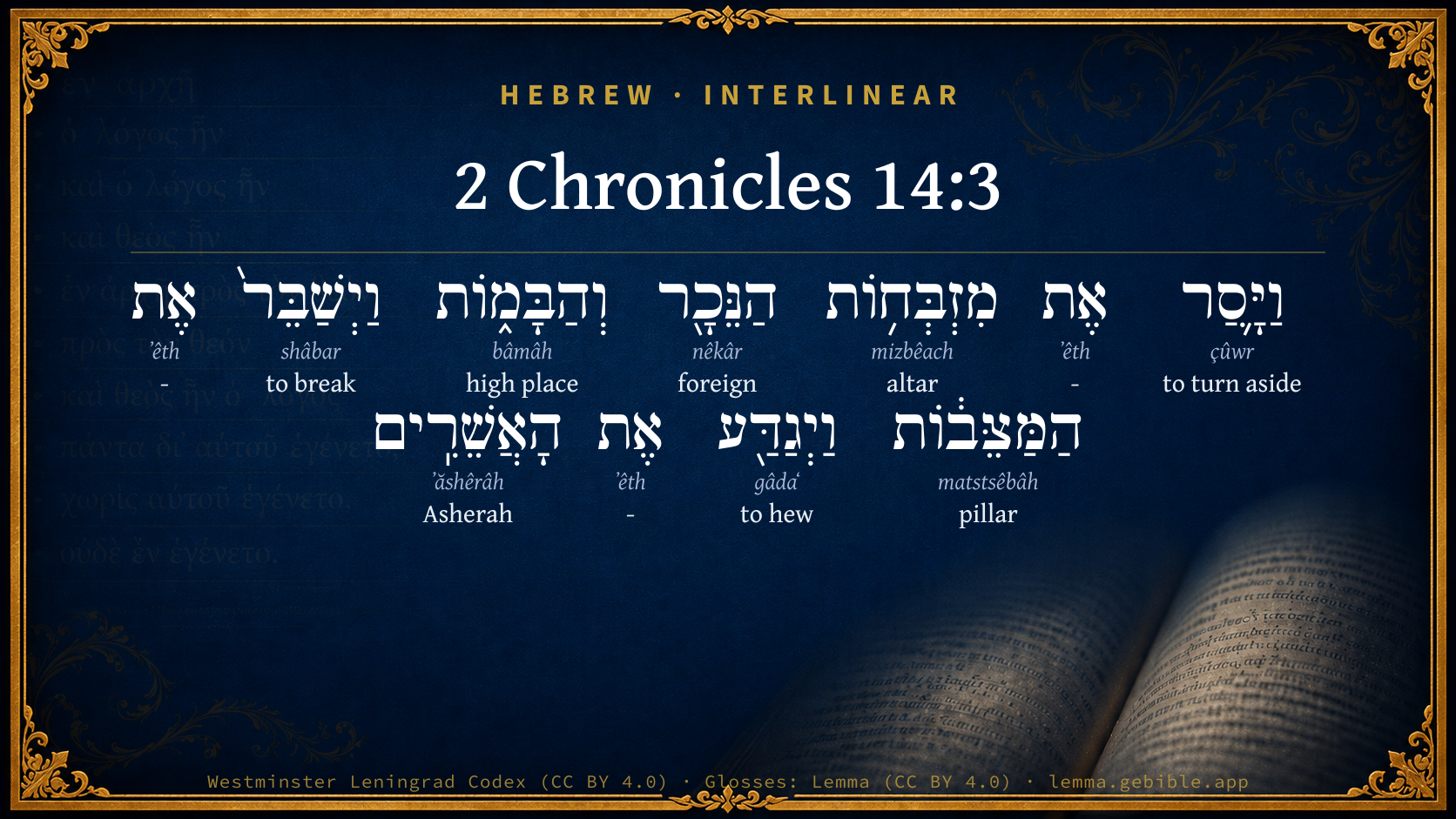
Hebrew (Westminster Leningrad Codex) 2 Chronicles 14:3 appears in the Hebrew Old Testament. The text above is from the Westminster Leningrad Codex. Each word links to its Strong’s number, a concise gloss, and parsing drawn from the Open Scriptures Hebrew Bible morphology. Click any word for its full Brown-Driver-Briggs (BDB) entry.
Download image
Cite this verse

2 Chronicles 14:3 (World English Bible). Public Domain. Lemma interlinear Bible study tool, https://lemma.gebible.app/v/2-chronicles/14/3.

Show BibTeX & RIS
BibTeX
RIS
English Translation
for he took away the foreign altars, and the high places, and broke down the pillars, and hewed down the Asherim,
World English Bible · Public Domain
Download a study sheet

One document with this verse’s original text, its word-by-word gloss line, the meaning frame, cross-references with their text, attributed commentary, and full source and license credits — printable, and it pastes into notes with its structure intact.

This verse Autodidact and up

Study sheet (.html) Plain text (.txt)

A passage Seminary Student

Up to 50 verses in one chapter. A passage sheet keeps up to 6 commentary sources and 12 cross-references per verse, in the order this page ranks them, and says so on the sheet whenever that leaves anything out. Ask for a single verse and you get the Autodidact verse sheet above.

Everything on this page stays free to read, with no account — the sheet is a download of what is already on screen, not access to it.

Want to remove ads? Support Godless Engineer
Compare translations 3

The same verse in 3 English versions, stacked beneath the original-language interlinear above. Click any original word for its lexicon entry.

Each is an independent rendering of the whole verse — the interlinear is not word-aligned to these translations.

Highlighted words mark where these versions differ — a whole-verse word diff, not a word-by-word alignment.

  • World English Bible Public Domain
    for he took away the foreign altars, and the high places, and broke down the pillars, and hewed down the Asherim,
  • King James Version Public Domain
    For he took away the altars of the strange gods, and the high places, and brake down the images, and cut down the groves:
  • unfoldingWord Literal Text CC BY-SA 4.0
    And he took away the foreign altars and the high places, and he shattered the pillars, and he cut to pieces the Asherim.

unfoldingWord Literal Text — © unfoldingWord, licensed CC BY-SA 4.0. Word-aligned USFM3 via Door43 (git.door43.org/unfoldingWord/en_ult).

Versions to compare (up to 4)

3 of 4 selected

Show all 18 translations

Every available English version of this verse, each an independent rendering of the whole verse.

  • World English Bible Public Domain
    for he took away the foreign altars, and the high places, and broke down the pillars, and hewed down the Asherim,
  • Berean Standard Bible Public Domain
    He removed the foreign altars and high places, shattered the sacred pillars, and chopped down the Asherah poles.
  • Majority Standard Bible Public Domain
    He removed the foreign altars and high places, shattered the sacred pillars, and chopped down the Asherah poles.
  • King James Version Public Domain
    For he took away the altars of the strange gods, and the high places, and brake down the images, and cut down the groves:
  • American Standard Version (1901) Public Domain
    for he took away the foreign altars, and the high places, and brake down the pillars, and hewed down the Asherim,
  • Revised Version (1885) Public Domain
    for he took away the strange altars, and the high places, and brake down the pillars, and hewed down the Asherim;
  • Geneva Bible (1599) Public Domain
    For he tooke away the altars of the strange gods and the hie places, and brake downe the images, and cut downe the groues,
  • Douay-Rheims (1899) Public Domain
    And broke the statues, and cut down the groves.
  • Young's Literal Translation Public Domain
    and turneth aside the altars of the stranger, and the high places, and breaketh the standing-pillars, and cutteth down the shrines,
  • Literal Standard Version CC BY-SA 4.0
    and turns aside the altars of the stranger, and the high places, and breaks the standing-pillars, and cuts down the Asherim,
  • Unlocked Literal Bible CC BY-SA 4.0
    for he took away the foreign altars and the high places. He broke down the stone pillars and cut down the Asherah poles.
  • unfoldingWord Literal Text CC BY-SA 4.0
    And he took away the foreign altars and the high places, and he shattered the pillars, and he cut to pieces the Asherim.
  • Darby Bible Public Domain
    and he took away the altars of the strange [gods] and the high places, and broke the columns, and cut down the Asherahs;
  • World Messianic Bible Public Domain
    for he took away the foreign altars and the high places, broke down the pillars, cut down the Asherah poles,
  • Webster's Bible Public Domain
    For he took away the altars of the strange gods, and the high places, and broke down the images, and cut down the groves:
  • Free Bible Version CC BY-SA 4.0
    He took down the foreign altars and high places, smashed their sacred pillars, and cut down the Asherah poles.
  • Bible in Basic English Public Domain
    For he took away the altars of strange gods and the high places, and had the upright stones broken and the wood pillars cut down;
  • JPS Tanakh (1917) Public Domain
    (14-2) for he took away the strange altars, and the high places, and broke down the pillars, and hewed down the Asherim;

Literal Standard Version (2020), Covenant Press — licensed CC BY-SA 4.0. Text via the HelloAO Bible API (eBible.org). Unlocked Literal Bible (unfoldingWord) — licensed CC BY-SA 4.0. Text via the HelloAO Bible API (eBible.org). unfoldingWord Literal Text — © unfoldingWord, licensed CC BY-SA 4.0. Word-aligned USFM3 via Door43 (git.door43.org/unfoldingWord/en_ult). Free Bible Version, Dr. Jonathan Gallagher — licensed CC BY-SA 4.0. Text via the HelloAO Bible API (eBible.org).

Word by word

More ways to search: Search by grammar → Find every occurrence → Compare this word →

Practice this passage: Drill this verse → Learn its vocabulary →

וַיְגַדַּ֖ע
gâdaʻ
H1438
“and · to hew”
Conjunction + Verb, Piel, Sequential Imperfect, 3rd Person, Masculine, Singular
Part of Speech
Conjunction + Verb
Stem
Piel
Form
Sequential Imperfect
Person
3rd Person
Gender
Masculine
Number
Singular
Full BDB Definition

Origin: a primitive root

TWOT: 316

to cut, hew, chop, cut down, hew down, hew off, cut off, cut in two, shave off - (Qal) to hew, chop in two - (Niphal) to be chopped off, be hewn off - (Piel) to cut off or down in two, hew off or down in two - (Pual) to chop down, hew down
  1. וַיָּ֛סַר çûwr H5493 “and · to turn aside” Conjunction + Verb, Hiphil, Sequential Imperfect, 3rd Person, Masculine, Singular
  2. אֶת ʼêth H853 “-” Particle, Direct Object
  3. מִזְבְּח֥וֹת mizbêach H4196 “altars of” Noun, Common, Masculine, Plural, Construct
  4. הַנֵּכָ֖ר nêkâr H5236 “the · foreign” Particle, Definite Article + Noun, Common, Masculine, Singular, Absolute
  5. וְהַבָּמ֑וֹת bâmâh H1116 “and · the · high places” Conjunction + Particle, Definite Article + Noun, Common, Feminine, Plural, Absolute
  6. וַיְשַׁבֵּר֙ shâbar H7665 “and · to break” Conjunction + Verb, Piel, Sequential Imperfect, 3rd Person, Masculine, Singular
  7. אֶת ʼêth H853 “-” Particle, Direct Object
  8. הַמַּצֵּב֔וֹת matstsêbâh H4676 “the · pillars” Particle, Definite Article + Noun, Common, Feminine, Plural, Absolute
  9. אֶת ʼêth H853 “-” Particle, Direct Object
  10. הָאֲשֵׁרִֽים ʼăshêrâh H842 “the · Asherah” Particle, Definite Article + Noun, Proper

About this verse

These counts appear in no published source. They are computed here, from the morphology-tagged text and Lemma’s own curated glosses. What Lemma adds →

11
words
9
distinct lemmas
Historical
section

Notable vocabulary

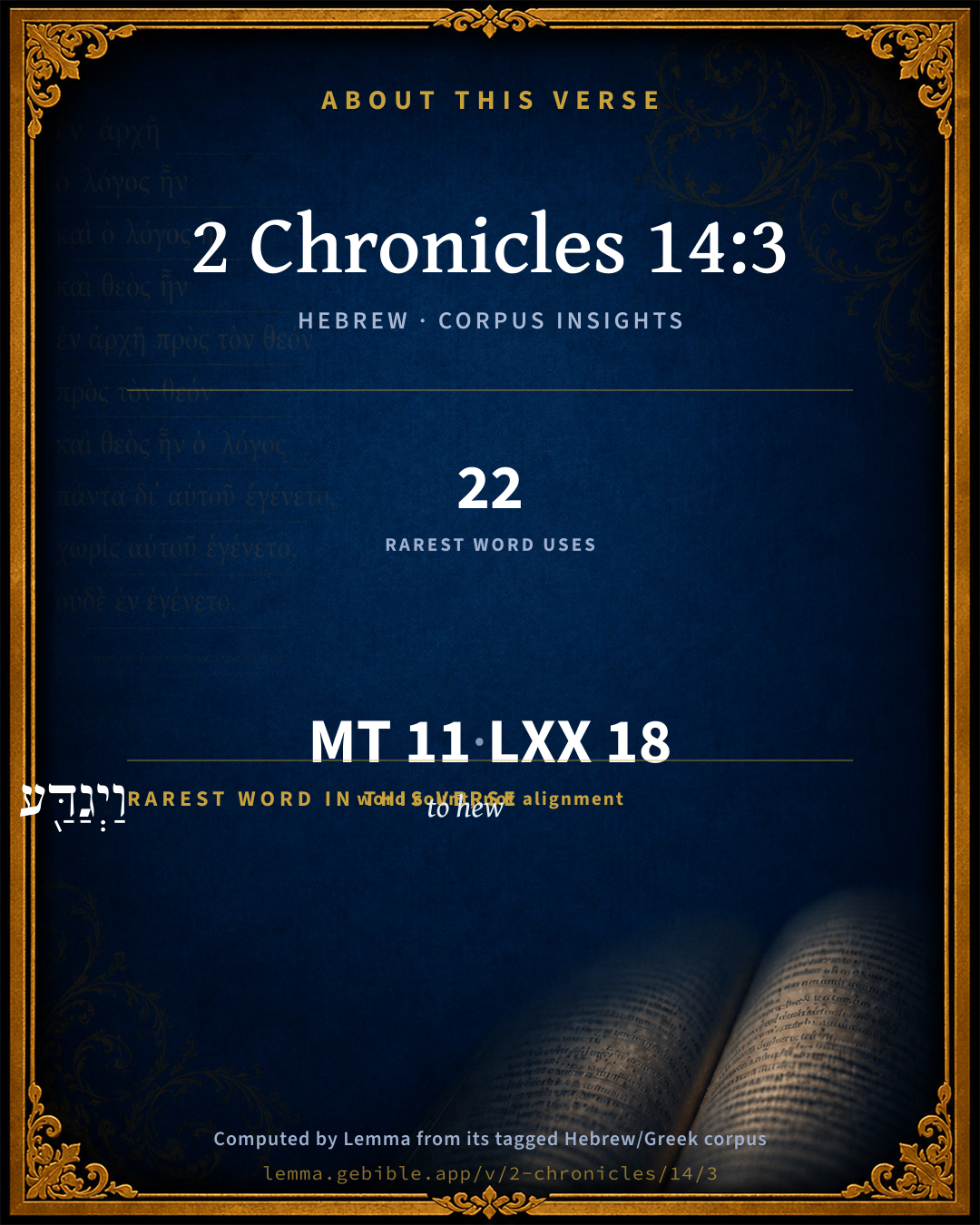
The rarest word here is וַיְגַדַּ֖ע to hew H1438 — appearing just 22 times in the whole Hebrew Bible.

Shared distinctive vocabulary

וַיְגַדַּ֖ע to hew H1438 occurs in 22 verses of the Hebrew Bible. Also found in:

Grammatical profile

  • 3 verbs
  • 5 nouns
  • 3 particles

Verb forms

  • וַיָּ֛סַר Hiphil · Sequential Imperfect
  • וַיְשַׁבֵּר֙ Piel · Sequential Imperfect
  • וַיְגַדַּ֖ע Piel · Sequential Imperfect

Hebrew & Septuagint length

In English translation the verse runs 21 words from the Hebrew and 24 from the Septuagint (LXX English) — closely comparable.

A rough comparison of the two English renderings, which tokenize alike — not a word-level alignment.

Word counts can differ between the Hebrew and the Greek without any difference in meaning — e.g. the Hebrew direct-object marker אֵת has no separate Greek word, and Greek often adds the article ὁ.

In the original languages it is 11 Hebrew tokens and 18 Greek tokens — but the two are counted differently (Hebrew bundles its prefixes and suffixes into one token; the Greek is in lemma form), so that isn’t a like-for-like length.

Cross-references

13

Topical passages linked to 2 Chronicles 14:3 in the Treasury of Scripture Knowledge — connected by theme and wording, ordered by reader-vote popularity; previews shown in the World English Bible.

  • Deuteronomy 7:5 But thus shall you deal with them: you shall break down their altars, and dash in pieces their pillars, and hew down their Asherim, and burn their engraved images with fire.
  • Exodus 34:13 but you shall break down their altars, and dash in pieces their pillars, and you shall cut down their Asherim;
  • 2 Kings 23:14 He broke in pieces the pillars, and cut down the Asherim, and filled their places with the bones of men.
  • 1 Kings 15:12–14 He put away the sodomites out of the land, and removed all the idols that his fathers had made.
  • 2 Chronicles 15:17 But the high places were not taken away out of Israel: nevertheless the heart of Asa was perfect all his days.
  • Leviticus 26:30 I will destroy your high places, and cut down your incense altars, and cast your dead bodies upon the bodies of your idols; and my soul will abhor you.
  • Deuteronomy 7:25 The engraved images of their gods shall you burn with fire: you shall not covet the silver or the gold that is on them, nor take it to you, lest you be snared therein; for it is an abomination to Yahweh your God.
  • Judges 6:25–28 It happened the same night, that Yahweh said to him, Take your father's bull, even the second bull seven years old, and throw down the altar of Baal that your father has, and cut down the Asherah that is by it;
  • 1 Kings 11:7–8 Then did Solomon build a high place for Chemosh the abomination of Moab, on the mountain that is before Jerusalem, and for Molech the abomination of the children of Ammon.
  • 1 Kings 14:22–24 Judah did that which was evil in the sight of Yahweh, and they provoked him to jealousy with their sins which they committed, above all that their fathers had done.
  • 2 Kings 18:4 He removed the high places, and broke the pillars, and cut down the Asherah: and he broke in pieces the brazen serpent that Moses had made; for to those days the children of Israel did burn incense to it; and he called it Nehushtan.
  • 2 Kings 23:6 He brought out the Asherah from the house of Yahweh, outside of Jerusalem, to the brook Kidron, and burned it at the brook Kidron, and beat it to dust, and cast the dust of it on the graves of the common people.
  • 2 Chronicles 34:4 They broke down the altars of the Baals in his presence; and the sun-images that were on high above them he hewed down; and the Asherim, and the engraved images, and the molten images, he broke in pieces, and made dust of them, and strewed it on the graves [of those] who had sacrificed to them.

Cross-references courtesy of OpenBible.info (CC BY 4.0).

Hebrew and Greek witnesses Masoretic Hebrew ↔ Greek Septuagint

The same verse in the two great witnesses to the Old Testament, shown verse-for-verse.

These are two independent witnesses, not word-aligned to each other, and the Septuagint is shown in lemma (dictionary) form.

Hebrew 2 Chronicles 14:3 Masoretic · Westminster Leningrad Codex

וַיָּ֛סַר אֶת מִזְבְּח֥וֹת הַנֵּכָ֖ר וְהַבָּמ֑וֹת וַיְשַׁבֵּר֙ אֶת הַמַּצֵּב֔וֹת וַיְגַדַּ֖ע אֶת הָאֲשֵׁרִֽים

for he took away the foreign altars, and the high places, and broke down the pillars, and hewed down the Asherim,

World English Bible · Public Domain

Greek LXX 2 Chronicles 14:3 Septuagint · lemma form

καί εἶπον ὁ ἰουδά ἐκζητέω ὁ κύριος θεός ὁ πατήρ αὐτός καί ποιέω ὁ νόμος καί ὁ ἐντολή

And he removed the altars of the strange gods, and the high places, and broke the pillars in pieces, and cut down the groves:

LXX2012 (modern English Septuagint) · Public Domain

On this verse, The Pulpit Commentary discusses the Septuagint’s reading. Read the note in Commentary ↓

Hebrew: Westminster Leningrad Codex (CC BY 4.0). Greek: Septuagint (public domain); English from LXX2012 (modern English Septuagint) (Public Domain). How the Septuagint differs from the Hebrew →

Commentary

Notes on 2 Chronicles 14:3 from classic Christian and Jewish commentators (each source and its license shown beneath its notes). The classic Christian expositions comment on the surrounding passage and are grouped to its opening verse, so a note may address several verses; the Jewish commentaries on the Tanakh (Rashi and others) are per-verse, so they appear only where the commentator wrote on this verse.

Lemma curates 59 commentaries, every one of them public domain or Creative Commons licensed, each selected and text-cleaned for this edition rather than reprinted as found. About our sources →

Trapp's Complete Commentary

John Trapp

2Ch 14:3 For he took away the altars of the strange [gods], and the high places, and brake down the images, and cut down the groves:

Ver. 3. And the high places.] Erected to idols; not the other. {1Ki 15:14}

John Trapp, A Commentary or Exposition upon All the Books of the Old and New Testament (1647–1656) — public domain. Text from a community e-Sword module.

Joseph Benson's Commentary

2Ch 14:3. He took away the altars of the strange gods — Since the time when Solomon admitted idolatry, in the latter end of his reign, it appears, nothing had been done till now to suppress it; so that it may be presumed it had gained ground. Strange gods were worshipped, and had their altars, images, and groves: and the temple-service, though kept up by the priests, was neglected by many of the people. As soon as Asa had power in his hands, he made it his business to destroy those idolatrous altars and images, they being a great provocation to the jealous God, and a great temptation to a careless and unthinking people. He hoped, by destroying the idols, to reform the idolaters, which he had in view, and not their destruction.

Joseph Benson's Commentary on the Old and New Testaments (1811–1818) — public domain. Text from a community e-Sword module.

The Pulpit Commentary

The altars of the strange (gods); Hebrew, the altars of the stranger, meaning, of course, "the altars of the gods of the stranger." This expression, "strange gods," is found in the Authorized Version about thirteen times for the Hebrew rk; ge, or rk; Geh, and would be most correctly rendered, "The gods or, "god" of the stranger," i.e. of the foreigner, as it is rendered in the solitary instance of Deu_31:16. The high places. Comp. ver. 5 and 2Ch_15:17, which says, "But the high places were not taken away out of Israel;" and 1Ki_15:14, which says, "But the high places were not removed," without limiting this non-removal to "of Israel." On the question of this apparent inconsistency and surface-contradiction, see our Introduction, pp. 16:1 and 17:2. Further, it may here be well distinctly to note how little is even the apparent discrepancy or contradiction alleged in this subject, throwing in the analogous passages in Jehoshaphat"s history, (2Ch_17:6 2Ch_20:33) in case these may reflect any light on the question. Firstly, we will remove out of our way the parallel in 1Ki_15:14, with the observation that it is evident from its immediate context that it corresponds with the last statement of our Chronicles, (2Ch_15:17) savouring of a retrospective summarizing of the compiler, not with the first statements, (2Ch_14:3, 2Ch_14:5) which set forth Asa"s prospective purpose of heart, his resolution, and, no doubt, his edicts. Secondly, we may notice that there is a plain-enough distinction made by the writer in vers. 3 and 5 respectively the one saying that Asa "took away the high places," without any further limitation; the other saying within two verses, "Also out of all the cities of Judah" (note by the way here the suggestive stress laid upon "the cities," possibly as more easily coped with than country districts) "he took away the high places." The only legitimate inference (taking into account both the words used, and the fact that the last written are found close upon the former, with the significant conjunction "also") must be that some different information was intended in the two places. Ver. 3 finds Asa as much master of "Judah" as ver. 5. Therefore the natural interpretation of ver. 3 must be that Asa at once abolished "the high places" nearest home, nearest Jerusalem, most within his own personal reach; then also" that he did and ordered the same to be done in "all the cities of Judah," and it was done at the time, if only for the time. Thirdly, include the statement of 2Ch_15:17, if we do not insist (as we might insist very fairly when pressed on a point of alleged inconsistency or contradiction) on the fact that now the high places "of Israel" arc distinctly designated, and that therein those outlying parts of Asa"s more or less acknowledged sway outside of Judah and his thoroughest control are designedly described, let us instead take the help of an exactly analogous (and analogously alleged) discrepancy 2Ch_17:7 compared with 2Ch_20:33, and we find there that the very key with which to unlock the difficulty is provided to our hand. Jehoshaphat ( (2Ch_17:6) "took away the high places;" "the people" (2Ch_20:33) did not faithfully and with a constant heart follow suit, but had failed to prepare, i.e. to turn "their hearts unto the God of their fathers." How well the juxtaposition of these very words would tell, nay, do tell, with the emphatic words of 1Ki_15:14! "Nevertheless Asa s heart was perfect with the Lord all his days;" and with 2Ch_15:17, "Nevertheless the heart of Asa was perfect all his days." In both these passages the antithesis is patent between Asa"s heart and the people s hearts, between Asa"s all his days" and the people"s uncertainty and apostasy. The fidelity of Bible history and its non-cunningly, non-fabulously devised tenor are gratefully corroborated by the inquisition made into such a supposed "discrepancy," "inconsistency," "contradiction." Notice once more the confirming indication, so far as it goes, of the one verb that commands the next verse, as there noted upon. Brake down the images; Hebrew, twObXem.) It occurs in the Authorized Version thirty-two times, and is rendered "pillar" or "pillars" twelve times; "image" or "images" nineteen times; and "garrisons" once. It appears simply to have slipped from the signification of pillar into the rendering of the word "image," by aid of the intermediate word "statue." It is used of the pillar or statue of Baal in 2Ki_3:2 2Ki_10:26, 2Ki_10:27, with his name expressed; and inhAta, 2Ch_18:4 2Ch_23:14, without that name expressed. Cut down the groves; Hebrew, Dgyw. The verb here used implies the "cutting," "cutting down," "pruning" of trees. It is undoubtedly applied also to other cutting and cutting down, as of the "breaking" of a red, (Zec_11:10) of an arm, (1Sa_2:31) of horns, (Jer_48:25) of bars or bolts. (Isa_45:2) It occurs in all twenty-three times. It is here employed to describe the destroying of what according to the Authorized Version arc called "groves" (Septuagint, alsov; Vulgate, lucus) a word which with little doubt misleads for the rendering of our Before this same word we have also another Hebrew verb for "cutting," of very frequent occurrence in its simple and metaphorically derived uses included, viz. trK; The first uses of this verb with the above word are found in Jud_1:6:25, 26, 30. That word means literally "fortune," but in its ultimate derivation "straightness," and hence supposed to designate, in Phoenician and Aramaean idolatry, Astarte or the planet Venus, who is constantly associated in such idolatry with Baal. (Jud_1:3:7) But see for the first occurrence of the word, Exo_34:13, where there is no express mention of Baal, but where the idolatries of the Amorite, Canaanite, Hittite, Hivite, Perizzite, and Jebusite are being spoken of. When we take into consideration the probable ultimate derivation of the word, the fact of the verbs that speak of "cutting" being uniformly applied to what it represents, the "burning" to which this was condemned (Jud_1:6:26) when cut down, and a series of statements that represent it as "set up under every green tree". (1Ki_14:23; 2Ki_17:10; see also 1Ki_15:13; 2Ki_21:7 2Ki_23:6; 2Ch_15:16) it not only becomes perfectly certain that "grove" and "groves" cannot rightly render the word, but directs us with the light of those passages that speak of it coupled with Baal as an object of worship, and that speak of prophet and priest called by its name (Jud_1:3:7 compared with Jud_1:2:13 10:6; 1Sa_7:4; 1Ki_18:19; 2Ki_21:3 2Ki_23:4) to the strong conviction that it should be at once written with a capital letter, and rendered as a proper name; that it may possibly be a synonym with Ashtoreth, 1. q. Astarte, or a representation in wooden pillar, stock or trunk fashion, of some supposed aspect of her passion or dominion, very likely in the voluptuous or sensual direction (see the nevertheless very doubtful Septuagint and Vulgate, (2Ch_15:16; and Vulgate,. (Jud_1:3:7) Conder, in "Handbook to the Bible," p. 187, 2nd edit., speaks of "Baal-peor (Num_25:3) as identified by St. Jerome with the classical Priapus;" and adds "the Asherah (rendered "grove" in our version) was also apparently a similar emblem". (2Ki_23:7) The analogy of the sacred tree of the Assyrians sculptured on the monuments of Nineveh ("Nineveh and Persepolis," p. 299, Fergusson), which was probably a straight trunk or stock garlanded at certain times with ribbons and flowers, has been opportunely pointed to (see also Professor Dr. Murphy"s "Handbook: Chronicles," p. 115).

The Pulpit Commentary (1880–1919), ed. H.D.M. Spence-Jones & Joseph S. Exell — public domain. Text from a community e-Sword module.

Geneva Bible (1599)

Geneva Bible translators

Which were planted contrary to the Law, Deut. 16:21.

Geneva Bible (1599) marginal notes — public domain. Text via Bolls.life.

Jamieson, Fausset & Brown

Robert Jamieson, A. R. Fausset & David Brown

brake down the images--of Baal (see on Ch2 34:4; Lev 26:30).

cut down the groves--rather, "Asherim."

Jamieson, Fausset & Brown — Commentary Critical and Explanatory on the Whole Bible (1871) — public domain (CC PDM 1.0). Text via the HelloAO Bible API.

The Cambridge Bible for Schools and Colleges

gen. ed. J. J. S. Perowne

3. the altars of the strange gods] R.V. the strange altars.

the images] R.V. the pillars, LXX. τὰς στήλας. The “pillar” or “obelisk,” Heb. Maçççbâh, was a monolith standing by an altar as a symbol of the god worshipped at the altar. In later days an image took the place of the pillar, i.e. the mere symbol was succeeded by the likeness of the god. (W. R. Smith, Religion of the Semites, p. 203 ff.)

and cut down the groves] R.V. and hewed down the Asherim. An Ashêrah (pl. Ashêrim and Ashêroth) was probably a wooden pole which was planted beside an altar as the symbol of a deity. It appears to have been a survival of tree-worship, as the Maçççbâh was a survival of stone-worship. The ashêrah of itself did not represent any particular deity, but it could be carved to bear the symbol of any special god or goddess, e.g. of Astarte. (W. R. Smith, Religion of the Semites, p. 186 ff.)

The Cambridge Bible for Schools and Colleges (gen. ed. J. J. S. Perowne; Cambridge University Press, 1878–1918) — public domain. Text from a community e-Sword module.

John Gill's Exposition

And commanded Judah to seek the Lord God of their fathers,.... To pray to him, and him only, and attend his worship and service; this he did by a public edict:

and to do the law and the commandment: to observe all the laws of God, moral, ceremonial, and civil.

John Gill's Exposition of the Whole Bible (1746–1763) — public domain (CC PDM 1.0). Text via the HelloAO Bible API.

Whedon's Commentary on the Bible

Daniel D. Whedon

3. Took away… the high places — This statement, repeated in 2Ch_14:5, seems to be contradicted in 2Ch_15:17, where it is said “the high places were not taken away out of Israel.” This apparent discrepancy is explicable in several ways. Some think that the high places here referred to were those of the strange gods; a possible explanation, though scarcely satisfactory, since no mention of strange gods occurs in 2Ch_14:5, or 2Ch_15:17. We may suppose that Asa succeeded, at one period of his reign, in abolishing all the high places, but that they subsequently appeared again, and he died without seeing his kingdom entirely rid of them. But perhaps the best explanation is, that Asa made the greatest effort to remove the high places from his kingdom, and was largely successful, but, notwithstanding all his efforts, he failed of complete success. The writer does not say that he took away all the high places. Either of these explanations is more rational than to suppose that the writer contradicted himself in the space of a chapter.

Daniel D. Whedon (gen. ed.), Commentary on the Old and New Testaments (1874–1909) — public domain. Text from a community e-Sword module.

Scofield Reference Notes

C. I. Scofield

places Cf. (See Scofield "1Ki 3:2") See Scofield "1Ki 15:14".

groves (See Scofield "Deu 16:21") See Scofield "Jdg 3:7".

The Scofield Reference Bible (1917 edition), notes by C. I. Scofield — public domain. Text from a community e-Sword module.

Rashi

Rabbi Shlomo Yitzchaki (Rashi)

And he commanded Judah to seek unlike the Ten Tribes, who sought other, new Gods, which came up of late, and did not seek the God of their fathers.

Rashi on the Tanakh — English translations: “The Judaica Press complete Tanach with Rashi, translated by A. J. Rosenberg” (CC BY 4.0); “Pentateuch with Rashi's commentary by M. Rosenbaum and A.M. Silbermann, 1929-1934” (public domain); “The Metsudah Tanach series, Lakewood, N.J” (CC BY 4.0); and “The Book of Joshua, Metsudah Publications, 1997” (CC BY 4.0). Text via Sefaria.

Lesson kit

Teaching starters — assembled from the data on this page, not authored interpretation. Every prompt links to the verse data it draws on. Edit before teaching.

2 Chronicles, in the Historical, opens this verse with 11 words (9 distinct Hebrew lemmas). Its most distinctive word is gâdaʻ (“to hew”). A historical commentator’s framing appears above. Read the whole chapter for the surrounding context.

Discussion questions

  1. How does “to hew” (gâdaʻ) shape what this verse is saying?
  2. Deuteronomy 7:5 shares the word «to hew» with this verse. How do the two illuminate each other?
  3. These translations render this verse differently. What is at stake in choosing one wording over another?
  4. The verb «וַיָּ֛סַר» is Hiphil Sequential Imperfect. How does its form color the action?
  5. Reading how Trapp's Complete Commentary and Joseph Benson's Commentary read this verse, where do the two commentators agree and where do they part?

Things to notice

Reading settings

Reading text

Shown beneath each verse's original-language words.

Old Testament
Old Testament edition

Read the OT as the Masoretic Hebrew (MT) or the Greek Septuagint (LXX).

English shown for the Greek Septuagint (in the Hebrew ↔ Greek comparison).

Comparing translations? Open the Compare panel on any verse page to stack up to four side by side.