
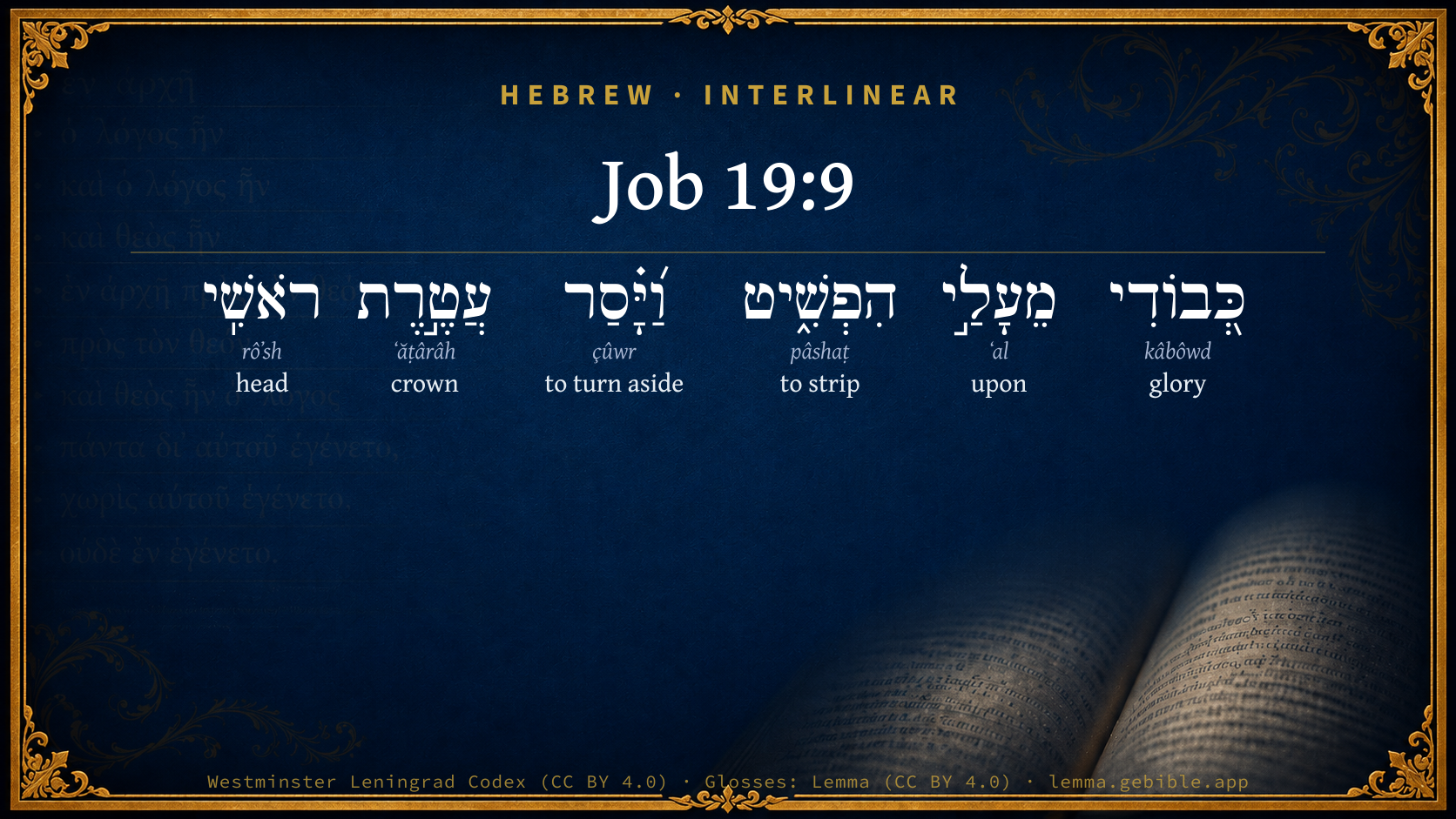
Job 19:9

Hebrew (Westminster Leningrad Codex) Job 19:9 appears in the Hebrew Old Testament. The text above is from the Westminster Leningrad Codex. Each word links to its Strong’s number, a concise gloss, and parsing drawn from the Open Scriptures Hebrew Bible morphology. Click any word for its full Brown-Driver-Briggs (BDB) entry.
Download image
Cite this verse

Job 19:9 (World English Bible). Public Domain. Lemma interlinear Bible study tool, https://lemma.gebible.app/v/job/19/9.

Show BibTeX & RIS
BibTeX
RIS
English Translation
He has stripped me of my glory, And taken the crown from my head.
World English Bible · Public Domain
Download a study sheet

One document with this verse’s original text, its word-by-word gloss line, the meaning frame, cross-references with their text, attributed commentary, and full source and license credits — printable, and it pastes into notes with its structure intact.

This verse Autodidact and up

Study sheet (.html) Plain text (.txt)

A passage Seminary Student

Up to 50 verses in one chapter. A passage sheet keeps up to 6 commentary sources and 12 cross-references per verse, in the order this page ranks them, and says so on the sheet whenever that leaves anything out. Ask for a single verse and you get the Autodidact verse sheet above.

Everything on this page stays free to read, with no account — the sheet is a download of what is already on screen, not access to it.

Want to remove ads? Support Godless Engineer
Compare translations 3

The same verse in 3 English versions, stacked beneath the original-language interlinear above. Click any original word for its lexicon entry.

Each is an independent rendering of the whole verse — the interlinear is not word-aligned to these translations.

Highlighted words mark where these versions differ — a whole-verse word diff, not a word-by-word alignment.

  • World English Bible Public Domain
    He has stripped me of my glory, And taken the crown from my head.
  • King James Version Public Domain
    He hath stripped me of my glory, and taken the crown from my head.
  • unfoldingWord Literal Text CC BY-SA 4.0
    He has stripped my glory from upon me, and he has removed the crown of my head.

unfoldingWord Literal Text — © unfoldingWord, licensed CC BY-SA 4.0. Word-aligned USFM3 via Door43 (git.door43.org/unfoldingWord/en_ult).

Versions to compare (up to 4)

3 of 4 selected

Show all 18 translations

Every available English version of this verse, each an independent rendering of the whole verse.

  • World English Bible Public Domain
    He has stripped me of my glory, And taken the crown from my head.
  • Berean Standard Bible Public Domain
    He has stripped me of my honor and removed the crown from my head.
  • Majority Standard Bible Public Domain
    He has stripped me of my honor and removed the crown from my head.
  • King James Version Public Domain
    He hath stripped me of my glory, and taken the crown from my head.
  • American Standard Version (1901) Public Domain
    He hath stripped me of my glory, And taken the crown from my head.
  • Revised Version (1885) Public Domain
    He hath stripped me of my glory, and taken the crown from my head.
  • Geneva Bible (1599) Public Domain
    Hee hath spoyled mee of mine honour, and taken the crowne away from mine head.
  • Douay-Rheims (1899) Public Domain
    He hath stripped me of my glory, and hath taken the crown from my head.
  • Young's Literal Translation Public Domain
    Mine honour from off me He hath stripped, And He turneth the crown from my head.
  • Literal Standard Version CC BY-SA 4.0
    He has stripped my honor from off me, || And He turns the crown from my head.
  • Unlocked Literal Bible CC BY-SA 4.0
    He has stripped me of my glory, and he has taken the crown from my head.
  • unfoldingWord Literal Text CC BY-SA 4.0
    He has stripped my glory from upon me, and he has removed the crown of my head.
  • Darby Bible Public Domain
    He hath stripped me of my glory, and taken the crown from my head.
  • World Messianic Bible Public Domain
    He has stripped me of my glory, and taken the crown from my head.
  • Webster's Bible Public Domain
    He hath stripped me of my glory, and taken the crown from my head.
  • Free Bible Version CC BY-SA 4.0
    He has stripped my honor from me; he has taken away my reputation.
  • Bible in Basic English Public Domain
    He has put off my glory from me, and taken the crown from my head.
  • JPS Tanakh (1917) Public Domain
    He hath stripped me of my glory, and taken the crown from my head.

Literal Standard Version (2020), Covenant Press — licensed CC BY-SA 4.0. Text via the HelloAO Bible API (eBible.org). Unlocked Literal Bible (unfoldingWord) — licensed CC BY-SA 4.0. Text via the HelloAO Bible API (eBible.org). unfoldingWord Literal Text — © unfoldingWord, licensed CC BY-SA 4.0. Word-aligned USFM3 via Door43 (git.door43.org/unfoldingWord/en_ult). Free Bible Version, Dr. Jonathan Gallagher — licensed CC BY-SA 4.0. Text via the HelloAO Bible API (eBible.org).

Word by word

More ways to search: Search by grammar → Find every occurrence → Compare this word →

Practice this passage: Drill this verse → Learn its vocabulary →

About this verse

These counts appear in no published source. They are computed here, from the morphology-tagged text and Lemma’s own curated glosses. What Lemma adds →

6
words
6
distinct lemmas
Wisdom
section

Notable vocabulary

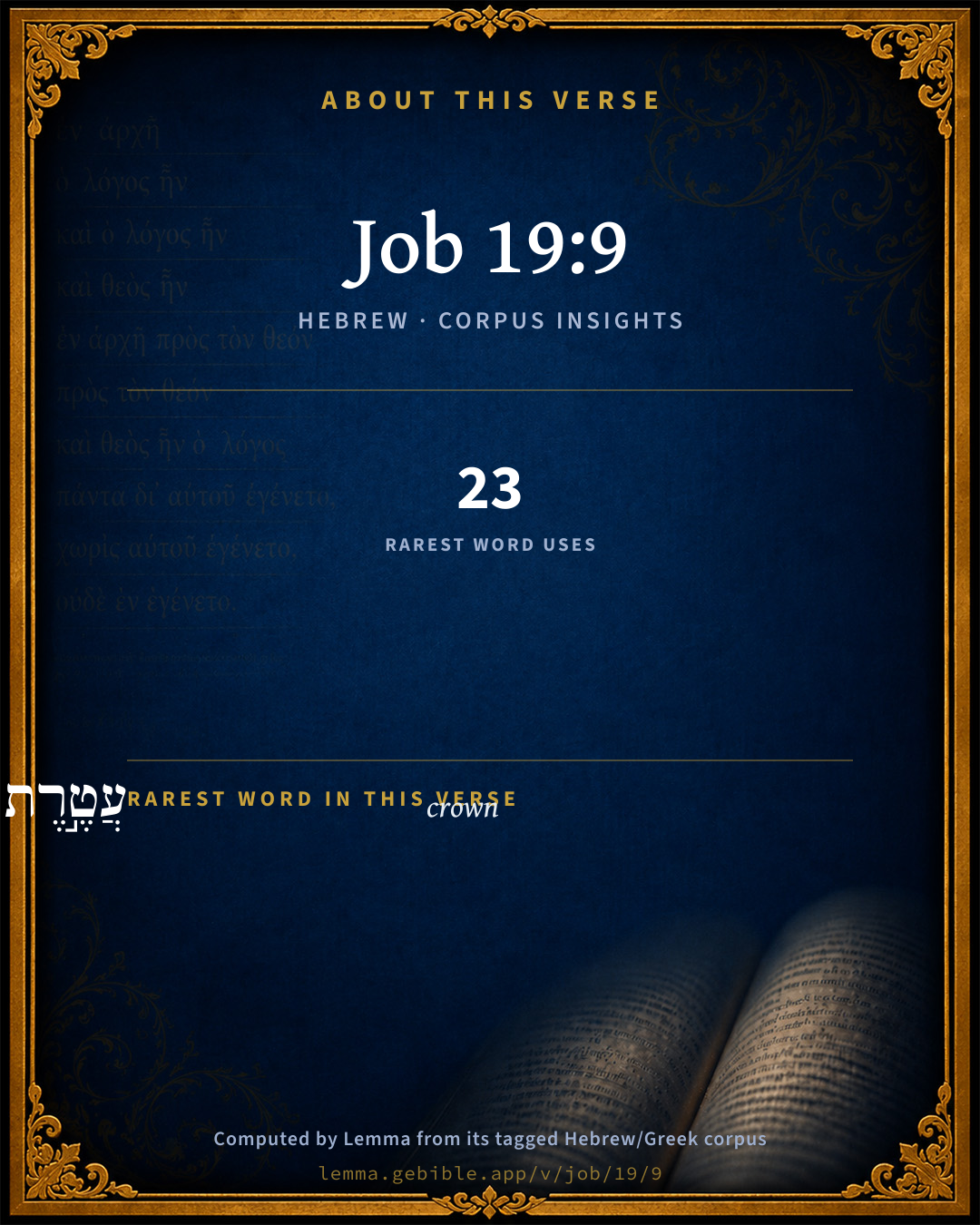
The rarest word here is עֲטֶ֣רֶת crown H5850 — appearing just 23 times in the whole Hebrew Bible.

Shared distinctive vocabulary

עֲטֶ֣רֶת crown H5850 occurs in 23 verses of the Hebrew Bible. Also found in:

Grammatical profile

  • 2 verbs
  • 3 nouns
  • 1 preposition

Verb forms

  • הִפְשִׁ֑יט Hiphil · Perfect
  • וַ֝יָּ֗סַר Hiphil · Sequential Imperfect

Hebrew & Septuagint length

In English translation the verse runs 14 words from the Hebrew and 16 from the Septuagint (LXX English) — closely comparable.

A rough comparison of the two English renderings, which tokenize alike — not a word-level alignment.

Word counts can differ between the Hebrew and the Greek without any difference in meaning — e.g. the Hebrew direct-object marker אֵת has no separate Greek word, and Greek often adds the article ὁ.

Cross-references

10

Topical passages linked to Job 19:9 in the Treasury of Scripture Knowledge — connected by theme and wording, ordered by reader-vote popularity; previews shown in the World English Bible.

  • Psalms 89:44 You have ended his splendor, And thrown his throne down to the ground.
  • Job 29:7–14 When I went forth to the city gate, When I prepared my seat in the street,
  • Job 12:17 He leads counselors away stripped. He makes judges fools.
  • Job 30:1 "But now those who are younger than I, have me in derision, Whose fathers I would have disdained to put with my sheep dogs.
  • Psalms 89:39 You have renounced the covenant of your servant. You have defiled his crown in the dust.
  • Lamentations 5:16 The crown is fallen from our head: Woe to us! for we have sinned.
  • Job 29:20–21 My glory is fresh in me, My bow is renewed in my hand.'
  • Psalms 49:16–17 Don't be afraid when a man is made rich, When the glory of his house is increased.
  • Isaiah 61:6 But you shall be named the priests of Yahweh; men shall call you the ministers of our God: you shall eat the wealth of the nations, and in their glory shall you boast yourselves.
  • Hosea 9:11 As for Ephraim, their glory will fly away like a bird. There will be no birth, none with child, and no conception.

Cross-references courtesy of OpenBible.info (CC BY 4.0).

Hebrew and Greek witnesses Masoretic Hebrew ↔ Greek Septuagint

The same verse in the two great witnesses to the Old Testament, shown verse-for-verse.

These are two independent witnesses, not word-aligned to each other, and the Septuagint is shown in lemma (dictionary) form.

Hebrew Job 19:9 Masoretic · Westminster Leningrad Codex

כְּ֭בוֹדִי מֵעָלַ֣י הִפְשִׁ֑יט וַ֝יָּ֗סַר עֲטֶ֣רֶת רֹאשִֽׁי

He has stripped me of my glory, And taken the crown from my head.

World English Bible · Public Domain

Greek LXX Job 19:9 Septuagint · lemma form

ὁ δέ δόξα ἀπό ἐγώ ἐκδύω ἀποαἱρέω δέ στέφανος ἀπό κεφαλή ἐγώ

And he has stripped me of my glory, and has taken the crown from my head.

LXX2012 (modern English Septuagint) · Public Domain

Hebrew: Westminster Leningrad Codex (CC BY 4.0). Greek: Septuagint (public domain); English from LXX2012 (modern English Septuagint) (Public Domain). How the Septuagint differs from the Hebrew →

Commentary

Notes on Job 19:9 from classic Christian and Jewish commentators (each source and its license shown beneath its notes). The classic Christian expositions comment on the surrounding passage and are grouped to its opening verse, so a note may address several verses; the Jewish commentaries on the Tanakh (Rashi and others) are per-verse, so they appear only where the commentator wrote on this verse.

Lemma curates 59 commentaries, every one of them public domain or Creative Commons licensed, each selected and text-cleaned for this edition rather than reprinted as found. About our sources →

Trapp's Complete Commentary

John Trapp

Job 19:9 He hath stripped me of my glory, and taken the crown [from] my head.

Ver. 9. He hath stripped me of my glory] This is the second comparison, ab externo corporis cultu et habitu, saith Merlin; from the outward habiliments and habits of the body, Gen 37:23. Our King Richard II, when he was to be deposed, was brought forth gorgeously attired in his royal robes, with a crown upon his head, a sceptre in his hand, &c., but soon after despoiled of all, and unkinged. So it fared with poor Job, stripped and bereft of all that he formerly gloried in, and was respected for, as a man robbed hath all his clothes taken off, and is left naked. In him it appeared that mortality was but the stage of mutability, as one saith of our Henry VI, who of a most potent monarch was, when deposed, not the master of a molehill, nor owner of his own liberty (Daniel’s Hist.).

And hath taken the crown from off my head] Hence some infer that Job was a king, the same with Jobab, king of Edom, mentioned Gen 36:34. But this is uncertain, since crown is often in Scripture taken allegorically, for riches, authority, dignity, and other ornaments. These were taken from Job, yea, from off his head. See Lam 5:16. But he had a better crown, quae nec eripi nec surripi potuit, which could not be taken away; viz. that crown of twelve stars, or celestial graces, Rev 12:1, together with that crown of glory (the fruit of the former) that is "incorruptible and fadeth not away," 1Pe 1:4. Happy Job in such a crown; and that he was in the number of those few heads destined to such a diadem. David had (whatever Job had) a crown of pure gold set upon his head, Psal. xxi. 1; this was a great mercy to so mean a man, since beyond a crown the wishes of mortal man extend not. But David blesseth God for a better crown, Psa 103:4, "Who crowneth thee with loving kindness and tender mercies." And how was this set on his head? "Who forgiveth all thy iniquities," &c., Psa 103:3. Neither can any take away this crown, because we are kept (Greek, φρουρουμενοι, guarded or garrisoned as in a tower of brass, or town of war, that is well fenced with walls and works, and so it is made impregnable) by the power of God through faith unto salvation, 1Pe 1:5.

John Trapp, A Commentary or Exposition upon All the Books of the Old and New Testament (1647–1656) — public domain. Text from a community e-Sword module.

Tyndale Open Study Notes

Tyndale Open Resources

19:9 stripped me of my honor: See 12:17-19; 29:7-14, 20.

Tyndale Open Study Notes — © Tyndale Open Resources, licensed CC BY-SA 4.0. Text via the HelloAO Bible API.

Geneva Bible (1599)

Geneva Bible translators

Meaning, his children, and whatsoever was dear unto him in this world.

Geneva Bible (1599) marginal notes — public domain. Text via Bolls.life.

Jamieson, Fausset & Brown

Robert Jamieson, A. R. Fausset & David Brown

stripped . . . crown--image from a deposed king, deprived of his robes and crown; appropriate to Job, once an emir with all but royal dignity (Lam 5:16; Psa 89:39).

Jamieson, Fausset & Brown — Commentary Critical and Explanatory on the Whole Bible (1871) — public domain (CC PDM 1.0). Text via the HelloAO Bible API.

Adam Clarke's Commentary

Verse 9. He hath stripped me of my glory] I am reduced to such circumstances, that I have lost all my honour and respect.

Adam Clarke's Commentary on the Bible (1810–1826) — public domain. Text from a community e-Sword/MySword module.

The Cambridge Bible for Schools and Colleges

gen. ed. J. J. S. Perowne

9. Then came the consciousness of the meaning of his calamities—they were evidence that he was a transgressor. God took thus his crown of righteousness from his head, and stripped the glory of godliness from him, cf. ch. Job_29:14.

The Cambridge Bible for Schools and Colleges (gen. ed. J. J. S. Perowne; Cambridge University Press, 1878–1918) — public domain. Text from a community e-Sword module.

John Gill's Exposition

He hath destroyed me on every side,.... To be "troubled on every side" is much, as the apostles were, Co2 4:8; but to be destroyed on every side, and all around, is more, and denotes utter destruction; it may have respect to the rein of his substance and family, which were all demolished at once; his oxen and asses, which were on one side, his camels on other, his sheep on another, and his children on another, and all destroyed in one day, and perhaps in a few hours; and also to his body, which God had made, and had fashioned together round about; but now he had suffered it to be smitten with ulcers from the crown of his head to the sole of his feet; and this earthly tabernacle of his was demolishing on every side, and just falling down; for the allusion is either to the demolition of a building, or to the rooting up of a tree, and so continued in the next clause; comparing himself to a tree, that is dug about on all sides, and its roots laid bare, and these and all their fibres cut off, so that it is utterly destroyed from growing any more, but becomes dead; and this Job thought to be his case:

and I am gone; or am a dead man, just going out of the world, the way of all flesh; and because of the certainty of it, and of its being very quickly, in a few minutes, as it were, he speaks of it as if it already was: wherefore it follows,

and my hope he hath removed like a tree; not like a tree that is cut down to its roots, which remain in the ground, and may sprout out again, Job 14:7; nor like a tree that is taken up with its roots, and removed to another place, and planted in another soil, where it may grow as well or better; but like a tree cut off from its roots, or pulled up by the roots, and laid upon the ground, when there can be no hope of its ever growing again; and so the hope of Job was like that; not his hope of salvation, of the resurrection of the dead, and of eternal life, which was strong and firm, Job 13:15; nor can a good and well grounded hope be removed; not the grace of hope, which is an abiding one; nor the ground of hope, which is Christ and his righteousness, upon which hope, as an anchor, being cast, is sure and steadfast; nor the object of hope, eternal glory and happiness laid up in heaven: but this is to be interpreted of Job's hope of a restoration to outward happiness, which his friends would have had him entertain, in case of repentance and reformation; but Job, as he was not sensible of his need of the one, as his friends understood it, he had no hope of the other, see Job 6:11.

John Gill's Exposition of the Whole Bible (1746–1763) — public domain (CC PDM 1.0). Text via the HelloAO Bible API.

Albert Barnes' Notes on the Bible

He hath stripped me of my glory - Everything which I had that contributed to my respectability and honor, he has taken away. My property, my health, my family, the esteem of my friend - all is gone.

And taken the crown from my head - The crown is an emblem of honor and dignity - and Job says that God had removed all that contributed to his - and Job says that God had removed all that contributed to his former dignity; compare Pro 4:9; Pro 17:6; Eze 16:12; Lam 5:16.

Albert Barnes' Notes on the Bible (1834–1885) — public domain. Text from a community e-Sword/MySword module.

Matthew Poole's English Annotations

Of my glory, i.e. of my estate, and children, and authority, and all my comforts.

The crown, i.e. all my ornaments.

Matthew Poole's English Annotations on the Holy Bible (1683–1685) — public domain. Text from a community e-Sword/MySword module.

Whedon's Commentary on the Bible

Daniel D. Whedon

9. The crown — Though not a king, Job’s former state was truly regal.

Daniel D. Whedon (gen. ed.), Commentary on the Old and New Testaments (1874–1909) — public domain. Text from a community e-Sword module.

The Pulpit Commentary

He hath stripped me of my glory. The glory which he had in his prosperity; not exactly that of a king, but that of a great sheikh or emir of one who was on a par with the noblest of those about him. (see Job_1:3) And taken the crown from my head. Not an actual crown, which sheikhs do not wear, but a metaphor for dignity or honour.

The Pulpit Commentary (1880–1919), ed. H.D.M. Spence-Jones & Joseph S. Exell — public domain. Text from a community e-Sword module.

John Wesley's Explanatory Notes

Glory - Of my estate, children, authority, and all my comforts. Crown - All my power, and laid my honour in the dust.

John Wesley, Explanatory Notes Upon the Whole Bible (1754–1765) — public domain. Text via the GEBible commentary corpus.

Lesson kit

Teaching starters — assembled from the data on this page, not authored interpretation. Every prompt links to the verse data it draws on. Edit before teaching.

Job, in the Wisdom, opens this verse with 6 words (6 distinct Hebrew lemmas). Its most distinctive word is ʻăṭârâh (“crown”). A historical commentator’s framing appears above. Read the whole chapter for the surrounding context.

Discussion questions

  1. The word ʻăṭârâh carries the sense “crown.” How does it shape the verse?
  2. 2 Samuel 12:30 shares the word «crown» with this verse. How do the two illuminate each other?
  3. The translations on this page render this verse differently — a whole-verse word diff, not a word-by-word alignment. What might account for the different wordings?
  4. The verb «הִפְשִׁ֑יט» is Hiphil Perfect. How does its form color the action?
  5. Reading how Trapp's Complete Commentary and Tyndale Open Study Notes read this verse, where do the two commentators agree and where do they part?

Things to notice

Reading settings

Reading text

Shown beneath each verse's original-language words.

Old Testament
Old Testament edition

Read the OT as the Masoretic Hebrew (MT) or the Greek Septuagint (LXX).

English shown for the Greek Septuagint (in the Hebrew ↔ Greek comparison).

Comparing translations? Open the Compare panel on any verse page to stack up to four side by side.