
Isaiah 7:17

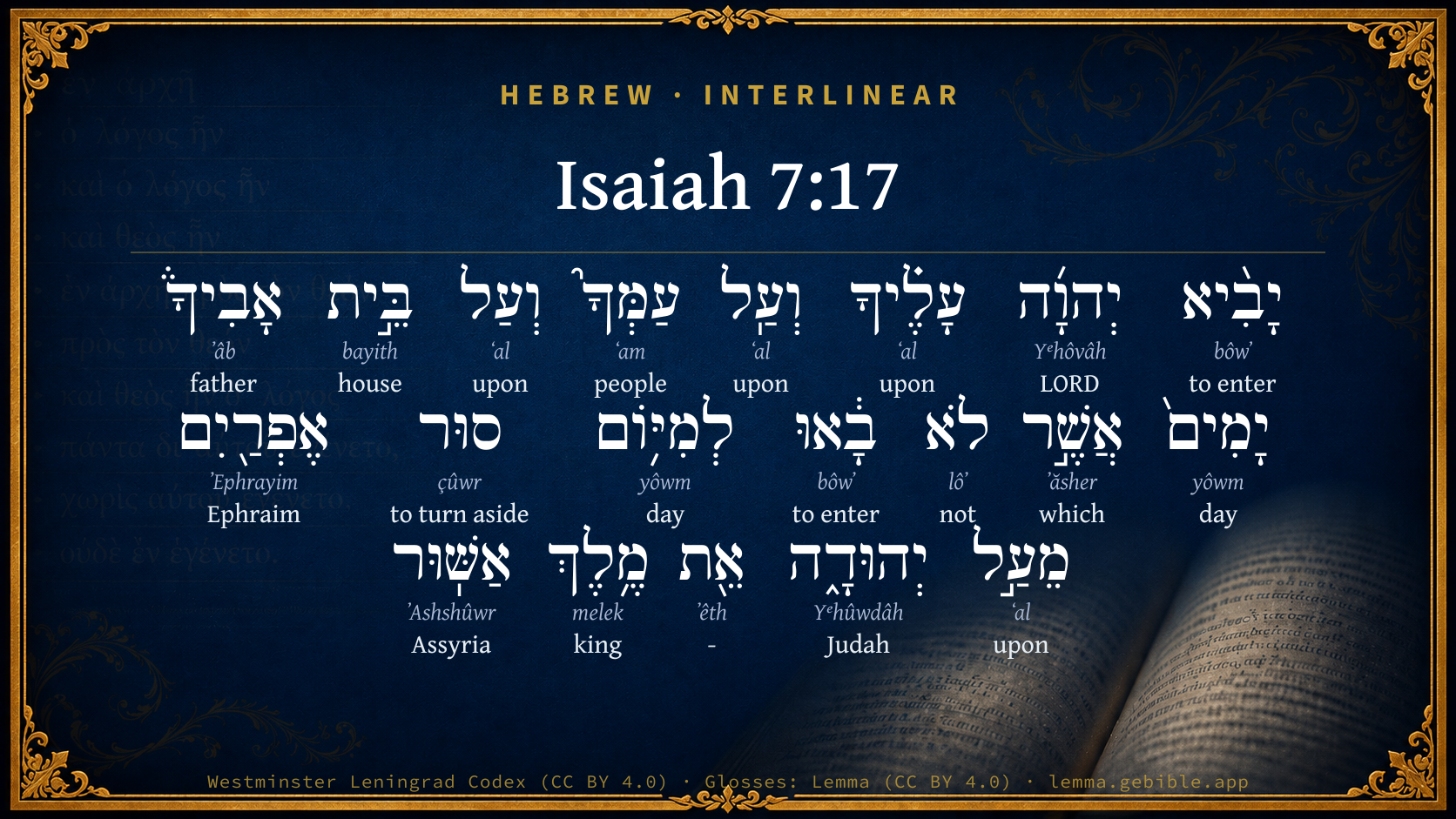
Hebrew (Westminster Leningrad Codex) Isaiah 7:17 appears in the Hebrew Old Testament. The text above is from the Westminster Leningrad Codex. Each word links to its Strong’s number, a concise gloss, and parsing drawn from the Open Scriptures Hebrew Bible morphology. Click any word for its full Brown-Driver-Briggs (BDB) entry.
Download image
Cite this verse

Isaiah 7:17 (World English Bible). Public Domain. Lemma interlinear Bible study tool, https://lemma.gebible.app/v/isaiah/7/17.

Show BibTeX & RIS
BibTeX
RIS
English Translation
Yahweh will bring on you, on your people, and on your father's house, days that have not come, from the day that Ephraim departed from Judah; even the king of Assyria.
World English Bible · Public Domain
Download a study sheet

One document with this verse’s original text, its word-by-word gloss line, the meaning frame, cross-references with their text, attributed commentary, and full source and license credits — printable, and it pastes into notes with its structure intact.

This verse Autodidact and up

Study sheet (.html) Plain text (.txt)

A passage Seminary Student

Up to 50 verses in one chapter. A passage sheet keeps up to 6 commentary sources and 12 cross-references per verse, in the order this page ranks them, and says so on the sheet whenever that leaves anything out. Ask for a single verse and you get the Autodidact verse sheet above.

Everything on this page stays free to read, with no account — the sheet is a download of what is already on screen, not access to it.

Want to remove ads? Support Godless Engineer
Compare translations 3

The same verse in 3 English versions, stacked beneath the original-language interlinear above. Click any original word for its lexicon entry.

Each is an independent rendering of the whole verse — the interlinear is not word-aligned to these translations.

Highlighted words mark where these versions differ — a whole-verse word diff, not a word-by-word alignment.

  • World English Bible Public Domain
    Yahweh will bring on you, on your people, and on your father's house, days that have not come, from the day that Ephraim departed from Judah; even the king of Assyria.
  • King James Version Public Domain
    The LORD shall bring upon thee, and upon thy people, and upon thy father's house, days that have not come, from the day that Ephraim departed from Judah; even the king of Assyria.
  • unfoldingWord Literal Text CC BY-SA 4.0
    Yahweh will bring upon you and upon your people and upon the house of your father days that have not come since the day of the turning of Ephraim away from Judah—the king of Assyria.”

unfoldingWord Literal Text — © unfoldingWord, licensed CC BY-SA 4.0. Word-aligned USFM3 via Door43 (git.door43.org/unfoldingWord/en_ult).

Versions to compare (up to 4)

3 of 4 selected

Show all 18 translations

Every available English version of this verse, each an independent rendering of the whole verse.

  • World English Bible Public Domain
    Yahweh will bring on you, on your people, and on your father's house, days that have not come, from the day that Ephraim departed from Judah; even the king of Assyria.
  • Berean Standard Bible Public Domain
    The LORD will bring on you and on your people and on the house of your father a time unlike any since the day Ephraim separated from Judah—He will bring the king of Assyria.”
  • Majority Standard Bible Public Domain
    The LORD will bring on you and on your people and on the house of your father a time unlike any since the day Ephraim separated from Judah—He will bring the king of Assyria.”
  • King James Version Public Domain
    The LORD shall bring upon thee, and upon thy people, and upon thy father's house, days that have not come, from the day that Ephraim departed from Judah; even the king of Assyria.
  • American Standard Version (1901) Public Domain
    Jehovah will bring upon thee, and upon thy people, and upon thy father's house, days that have not come, from the day that Ephraim departed from Judah-`even' the king of Assyria.
  • Revised Version (1885) Public Domain
    The LORD shall bring upon thee, and upon thy people, and upon thy father’s house, days that have not come, from the day that Ephraim departed from Judah; even the king of Assyria.
  • Geneva Bible (1599) Public Domain
    The Lord shall bring vpon thee, and vpon thy people, and vpon thy fathers house (the dayes that haue not come from the day that Ephraim departed from Iudah) euen the King of Asshur.
  • Douay-Rheims (1899) Public Domain
    The Lord shall bring upon thee, and upon thy people, and upon the house of thy father, days that have not come since the time of the separation of Ephraim from Juda with the king of the Assyrians.
  • Young's Literal Translation Public Domain
    Jehovah bringeth on thee, and on thy people, And on the house of thy father, Days that have not come, Even from the day of the turning aside of Ephraim from Judah, By the king of Asshur.
  • Literal Standard Version CC BY-SA 4.0
    YHWH brings on you, and on your people, || And on the house of your father, || Days that have not come, || Even from the day of the turning aside of Ephraim from Judah, || By the king of Asshur.”
  • Unlocked Literal Bible CC BY-SA 4.0
    Yahweh will bring on you, on your people, and on your father's house days unlike any since Ephraim seceded from Judah—he will bring on you the king of Assyria.”
  • unfoldingWord Literal Text CC BY-SA 4.0
    Yahweh will bring upon you and upon your people and upon the house of your father days that have not come since the day of the turning of Ephraim away from Judah—the king of Assyria.”
  • Darby Bible Public Domain
    Jehovah will bring upon thee, and upon thy people, and upon thy father's house, days which have not come since the day when Ephraim turned away from Judah -- [even] the king of Assyria.
  • World Messianic Bible Public Domain
    The LORD will bring on you, on your people, and on your father’s house days that have not come, from the day that Ephraim departed from Judah, even the king of Assyria.
  • Webster's Bible Public Domain
    The LORD will bring upon thee, and upon thy people, and upon thy father's house, days that have not come, from the day that Ephraim departed from Judah; even the king of Assyria.
  • Free Bible Version CC BY-SA 4.0
    The Lord will make you, your people, and the royal family experience a time unlike anything since the day Ephraim split from Judah. He will bring the king of Assyria to attack you!”
  • Bible in Basic English Public Domain
    The Lord is about to send on you, and on your people, and on your father's house, such a time of trouble as there has not been from the days of the separating of Ephraim from Judah; even the coming of the king of Assyria.
  • JPS Tanakh (1917) Public Domain
    The LORD shall bring upon thee, and upon thy people, and upon thy father's house, days that have not come, from the day that Ephraim departed from Judah; even the king of Assyria.'

Literal Standard Version (2020), Covenant Press — licensed CC BY-SA 4.0. Text via the HelloAO Bible API (eBible.org). Unlocked Literal Bible (unfoldingWord) — licensed CC BY-SA 4.0. Text via the HelloAO Bible API (eBible.org). unfoldingWord Literal Text — © unfoldingWord, licensed CC BY-SA 4.0. Word-aligned USFM3 via Door43 (git.door43.org/unfoldingWord/en_ult). Free Bible Version, Dr. Jonathan Gallagher — licensed CC BY-SA 4.0. Text via the HelloAO Bible API (eBible.org).

Word by word

More ways to search: Search by grammar → Find every occurrence → Compare this word →

Practice this passage: Drill this verse → Learn its vocabulary →

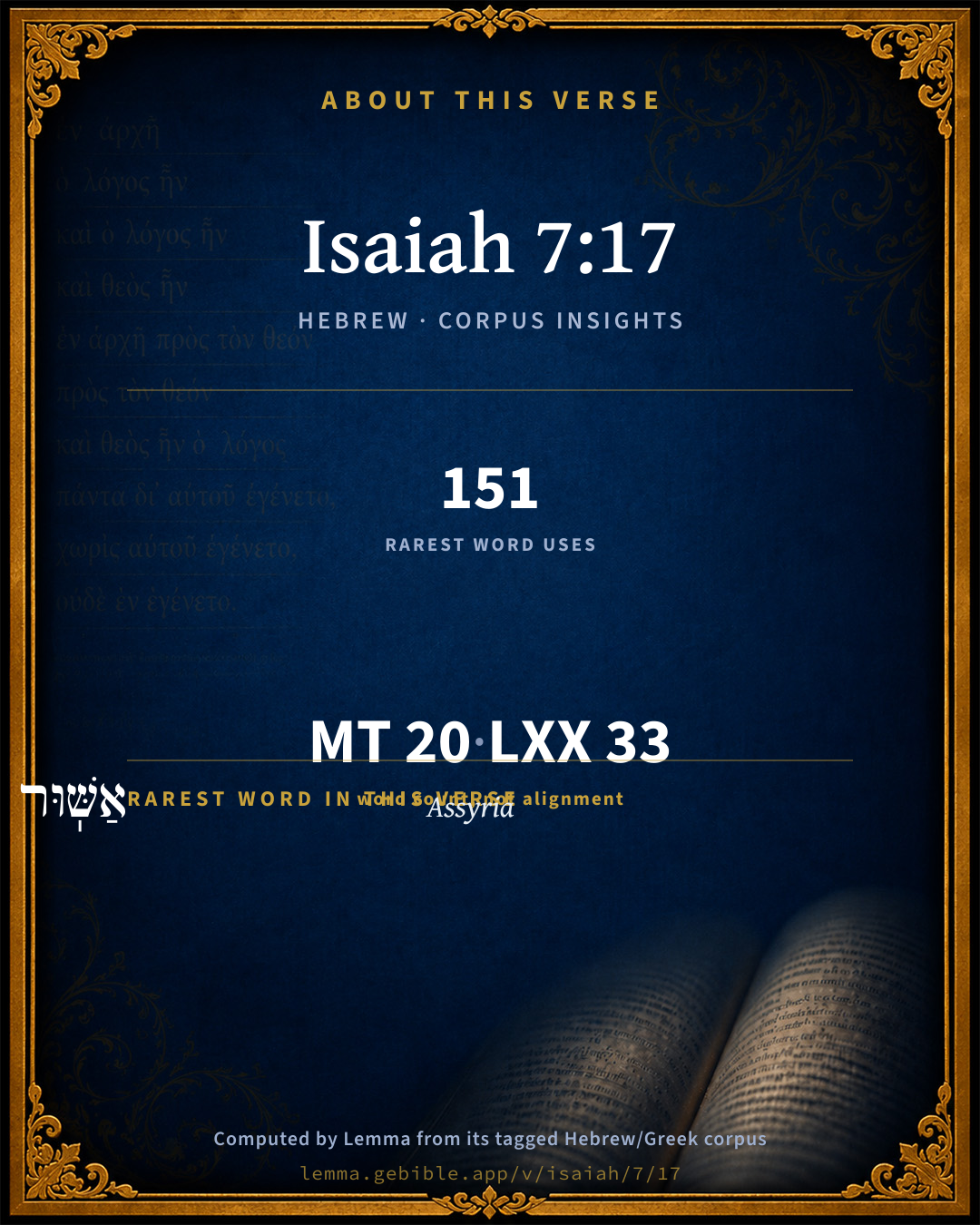
אַשּֽׁוּר
ʼAshshûwr
H804
“Assyria”
Noun, Proper
Part of Speech
Noun
Type
Proper
Full BDB Definition

Origin: apparently from H833 (in the sense of successful)

TWOT: 176

Asshur or Assyria = "a step" - the second son of Shem, eponymous ancestor of the Assyrians (noun proper masculine) - the people of Assyria (noun proper masculine) - the nation, Assyria (noun proper locative) - the land, Assyria or Asshur (noun proper locative)
  1. יָבִ֨יא bôwʼ H935 “to enter” Verb, Hiphil, Imperfect, 3rd Person, Masculine, Singular
  2. יְהוָ֜ה Yᵉhôvâh H3068 “LORD” Noun, Proper
  3. עָלֶ֗יךָ ʻal H5921 “upon · you” Preposition + Suffix, Personal, 2nd Person, Masculine, Singular
  4. וְעַֽל ʻal H5921 “and · upon” Conjunction + Preposition
  5. עַמְּךָ֮ ʻam H5971 “people · your” Noun, Common, Masculine, Singular, Construct + Suffix, Personal, 2nd Person, Masculine, Singular
  6. וְעַל ʻal H5921 “and · upon” Conjunction + Preposition
  7. בֵּ֣ית bayith H1004 “house of” Noun, Common, Masculine, Singular, Construct
  8. אָבִיךָ֒ ʼâb H1 “father · your” Noun, Common, Masculine, Singular, Construct + Suffix, Personal, 2nd Person, Masculine, Singular
  9. יָמִים֙ yôwm H3117 “days” Noun, Common, Masculine, Plural, Absolute
  10. אֲשֶׁ֣ר ʼăsher H834 “which” Particle, Relative
  11. לֹא lôʼ H3808 “not” Particle, Negative
  12. בָ֔אוּ bôwʼ H935 “to enter” Verb, Qal, Perfect, 3rd Person, Common, Plural
  13. לְמִיּ֥וֹם yôwm H3117 “to/for · from · day of” Preposition + Preposition + Noun, Common, Masculine, Singular, Construct
  14. סוּר çûwr H5493 “to turn aside” Verb, Qal, Infinitive Construct
  15. אֶפְרַ֖יִם ʼEphrayim H669 “Ephraim” Noun, Proper
  16. מֵעַ֣ל ʻal H5921 “from · upon” Preposition + Preposition
  17. יְהוּדָ֑ה Yᵉhûwdâh H3063 “Judah” Noun, Proper
  18. אֵ֖ת ʼêth H853 “-” Particle, Direct Object
  19. מֶ֥לֶךְ melek H4428 “king of” Noun, Common, Masculine, Singular, Construct

About this verse

These counts appear in no published source. They are computed here, from the morphology-tagged text and Lemma’s own curated glosses. What Lemma adds →

20
words
15
distinct lemmas
Prophets
section

Grammatical profile

  • 3 verbs
  • 10 nouns
  • 4 prepositions
  • 3 particles

Verb forms

  • יָבִ֨יא Hiphil · Imperfect
  • בָ֔אוּ Qal · Perfect
  • סוּר Qal · Infinitive Construct

Repetition

Words recur within this verse — often emphatic in Hebrew:

  • עָלֶ֗יךָ upon H5921 ×4
  • יָבִ֨יא to enter H935 ×2
  • יָמִים֙ day H3117 ×2

Hebrew & Septuagint length

In English translation the verse runs 31 words from the Hebrew and 36 from the Septuagint (LXX English) — closely comparable.

A rough comparison of the two English renderings, which tokenize alike — not a word-level alignment.

Word counts can differ between the Hebrew and the Greek without any difference in meaning — e.g. the Hebrew direct-object marker אֵת has no separate Greek word, and Greek often adds the article ὁ.

In the original languages it is 20 Hebrew tokens and 33 Greek tokens — but the two are counted differently (Hebrew bundles its prefixes and suffixes into one token; the Greek is in lemma form), so that isn’t a like-for-like length.

Cross-references

11

Topical passages linked to Isaiah 7:17 in the Treasury of Scripture Knowledge — connected by theme and wording, ordered by reader-vote popularity; previews shown in the World English Bible.

  • Isaiah 8:7–8 now therefore, behold, the Lord brings up on them the waters of the River, strong and many, [even] the king of Assyria and all his glory: and it shall come up over all its channels, and go over all its banks;
  • Isaiah 10:5–6 Ho Assyrian, the rod of my anger, the staff in whose hand is my indignation!
  • 1 Kings 12:16–19 When all Israel saw that the king didn't listen to them, the people answered the king, saying, What portion have we in David? neither have we inheritance in the son of Jesse: to your tents, Israel: now see to your own house, David. So Israel departed to their tents.
  • 2 Kings 18:1–19 Now it happened in the third year of Hoshea son of Elah king of Israel, that Hezekiah the son of Ahaz king of Judah began to reign.
  • 2 Chronicles 10:16–19 When all Israel saw that the king didn't listen to them, the people answered the king, saying, What portion have we in David? neither have we inheritance in the son of Jesse: every man to your tents, Israel: now see to your own house, David. So all Israel departed to their tents.
  • 2 Chronicles 28:19–21 For Yahweh brought Judah low because of Ahaz king of Israel; for he had dealt wantonly in Judah, and trespassed severely against Yahweh.
  • 2 Chronicles 32:1–33 After these things, and this faithfulness, Sennacherib king of Assyria came, and entered into Judah, and encamped against the fortified cities, and thought to win them for himself.
  • 2 Chronicles 33:11 Therefore Yahweh brought on them the captains of the host of the king of Assyria, who took Manasseh in chains, and bound him with fetters, and carried him to Babylon.
  • 2 Chronicles 36:6–20 Against him came up Nebuchadnezzar king of Babylon, and bound him in fetters, to carry him to Babylon.
  • Nehemiah 9:32 Now therefore, our God, the great, the mighty, and the awesome God, who keep covenant and loving kindness, don't let all the travail seem little before you, that has come on us, on our kings, on our princes, and on our priests, and on our prophets, and on our fathers, and on all your people, since the time of the kings of Assyria to this day.
  • Isaiah 36:1–22 Now it happened in the fourteenth year of king Hezekiah, that Sennacherib king of Assyria came up against all the fortified cities of Judah, and took them.

Cross-references courtesy of OpenBible.info (CC BY 4.0).

Hebrew and Greek witnesses Masoretic Hebrew ↔ Greek Septuagint

The same verse in the two great witnesses to the Old Testament, shown verse-for-verse.

These are two independent witnesses, not word-aligned to each other, and the Septuagint is shown in lemma (dictionary) form.

Hebrew Isaiah 7:17 Masoretic · Westminster Leningrad Codex

יָבִ֨יא יְהוָ֜ה עָלֶ֗יךָ וְעַֽל עַמְּךָ֮ וְעַל בֵּ֣ית אָבִיךָ֒ יָמִים֙ אֲשֶׁ֣ר לֹא בָ֔אוּ לְמִיּ֥וֹם סוּר אֶפְרַ֖יִם מֵעַ֣ל יְהוּדָ֑ה אֵ֖ת מֶ֥לֶךְ אַשּֽׁוּר

Yahweh will bring on you, on your people, and on your father's house, days that have not come, from the day that Ephraim departed from Judah; even the king of Assyria.

World English Bible · Public Domain

Greek LXX Isaiah 7:17 Septuagint · lemma form

ἀλλά ἐπιἄγω ὁ θεός ἐπί σύ καί ἐπί ὁ λαός σύ καί ἐπί ὁ οἶκος ὁ πατήρ σύ ἡμέρα ὅς οὔπω ἥκω ἀπό ὅς ἡμέρα ἀποαἱρέω ἐφράιμ ἀπό ιουδα ὁ βασιλεύς ὁ ἀσσύριος

But God shall bring upon you, and upon your people, and upon the house of your father, days which have never come, from the day that Ephraim took away from Juda the king of the Assyrians.

LXX2012 (modern English Septuagint) · Public Domain

On this verse, Adam Clarke's Commentary discusses the Septuagint’s reading. Read the note in Commentary ↓

Hebrew: Westminster Leningrad Codex (CC BY 4.0). Greek: Septuagint (public domain); English from LXX2012 (modern English Septuagint) (Public Domain). How the Septuagint differs from the Hebrew →

Targum (Aramaic paraphrase)

1

The Targum is the ancient Jewish Aramaic paraphrase of the Hebrew Scriptures — an interpretive translation, not the Hebrew text itself. Onkelos (literal) and Pseudo-Jonathan (expansive) render the Torah, and Jonathan the Prophets. Coverage is partial: where no permissively-licensed English translation exists for a verse, only the Aramaic is shown. This is verse-level text, not a word-by-word alignment to the Hebrew.

  1. Targum Jonathan Prophets (Joshua–Malachi)
    יֵיתֵי יְיָ עֲלָךְ וְעַל עַמָךְ וְעַל בֵּית אֲבוּךְ יוֹמִין דְלָא אֲתוֹ לְמִיוֹמָא דְאִתְפְּלִיגוּ בֵית יִשְׂרָאֵל עַל דְבֵית יְהוּדָה יַת מַלְכָּא דְאַתּוּר:

    The Lord shall bring upon thee, and upon thy people, and upon thy father's house, days that have not come from the day of the separation of the house of Ephraim from the house of Judah; even the king of Assyria.

    Targum Jonathan — Aramaic: “Mikraot Gedolot” (public domain). English: “Sefaria Community Translation” (CC0 1.0 (public-domain dedication)); “London "Chaldee Paraphrase," 1871” (public domain). Text via Sefaria.

Commentary

Notes on Isaiah 7:17 from classic Christian and Jewish commentators (each source and its license shown beneath its notes). The classic Christian expositions comment on the surrounding passage and are grouped to its opening verse, so a note may address several verses; the Jewish commentaries on the Tanakh (Rashi and others) are per-verse, so they appear only where the commentator wrote on this verse.

Lemma curates 59 commentaries, every one of them public domain or Creative Commons licensed, each selected and text-cleaned for this edition rather than reprinted as found. About our sources →

Matthew Henry's Commentary

After the comfortable promises made to Ahaz as a branch of the house of David, here follow terrible threatenings against him, as a degenerate branch of that house; for though the loving-kindness of God shall not be utterly taken away, for the sake of David and the covenant made with him, yet his iniquity shall be chastened with the rod, and his sin with stripes. Let those that will not mix faith with the promises of God expect to hear the alarms of his threatenings.

I. The judgment threatened is very great, Isa 7:17. It is very great, for it is general; it shall be brought upon the prince himself (high as he is, he shall not be out of the reach of it), and upon the people, the whole body of the nation, and upon the royal family, upon all thy father's house; it shall be a judgment entailed on posterity, and shall go along with the royal blood. It is very great, for it shall be unprecedented - days that have not come; so dark, so gloomy, so melancholy, as never were the like since the revolt of the ten tribes, when Ephraim departed from Judah, which was indeed a sad time to the house of David. Note, The longer men continue in sin the sorer punishments they have reason to expect. It is the Lord that will bring these days upon them, for our times are in his hand, and who can resist or escape the judgments he brings?

II. The enemy that should be employed as the instrument of this judgment is the king of Assyria. Ahaz reposed great confidence in that prince for help against the confederate powers of Israel and Syria, and minded the less what God said to him by his prophet for his encouragement because he built much upon his interest in the king of Assyria, and had meanly promised to be his servant if he would send him some succours; he had also, made him a present of gold and silver, for which he drained the treasures both of church and state, Kg2 16:7, Kg2 16:8. Now God threatens that that king of Assyria whom he made his stay instead of God should become a scourge to him. He was so speedily; for, when he came to him, he distressed him, but strengthened him not (Ch2 28:20), the reed not only broke under him, but ran into his hand, and pierced it, and thenceforward the kings of Assyria were, for a long time, grieving thorns to Judah, and gave them a great deal of trouble. Note, The creature that we make our hope commonly proves our hurt. The king of Assyria, not long after this, made himself master of the ten tribes, carried them captive, and laid their country waste, so as fully to answer the prediction here; and perhaps it may refer to that, as an explication of Isa 7:8, where it is foretold that Ephraim shall be broken, that it shall not be a people; and it is easy to suppose that the prophet (at Isa 7:17) turns his speech to the king of Israel, denouncing God's judgments against him for invading Judah. But the expositors universally understand it of Ahaz and his kingdom. Now observe, 1. Summons given to the invaders (Isa 7:18): The Lord shall whistle for the fly and the bee. See Isa 5:26. Enemies that seem as contemptible as a fly or a bee, and are as easily crushed, shall yet, when God pleases, do his work as effectually as lions and young lions. Though they are as far distant from one another as the rivers of Egypt and the land of Assyria, yet they shall punctually meet to join in this work when God commands their attendance; for, when God has work to do, he will not be at a loss for instruments to do it with. 2. Possession taken by them, Isa 7:19. It should seem as if the country were in no condition to make resistance. They find no difficulties in forcing their way, but come and rest all of them in the desolate valleys, which the inhabitants had deserted upon the first alarm, and left them a cheap and easy prey to the invaders. They shall come and rest in the low grounds like swarms of flies and bees, and shall render themselves impregnable by taking shelter in the holes of the rocks, as bees often do, and showing themselves formidable by appearing openly upon all thorns and all bushes; so generally shall the land be overspread with them. These bees shall knit upon the thorns and bushes, and there rest undisturbed. 3. Great desolations made, and the country generally depopulated (Isa 7:20): The Lord shall shave the hair of the head, and beard, and feet; he shall sweep all away, as the leper, when he was cleansed, shaved off all his hair, Lev 14:8, Lev 14:9. This is done with a razor which is hired, either which God has hired (as if he had none of his own; but what he hires, and whom he employs in any service for him, he will pay for. See Eze 29:18, Eze 29:19), or which Ahaz has hired for his assistance. God will make that to be an instrument of his destruction which he hired into his service. Note, Many are beaten with that arm of flesh which they trusted to rather than to the arm of the Lord, and which they were at a great expense upon, when by faith and prayer they might have found cheap and easy succour in God. 4. The consequences of this general depopulation. (1.) The flocks of cattle shall be all destroyed, so that a man who had herds and flocks in abundance shall be stripped of them all by the enemy, and shall with much ado save for his own use a young cow and two sheep - a poor stock (Isa 7:21), yet he shall think himself happy in having any left. (2.) The few cattle that are left shall have such a large compass of ground to feed in that they shall give abundance of milk, and very good milk, such as shall produce butter enough, Isa 7:22. There shall also be such want of men that the milk of one cow and two sheep shall serve a whole family, which used to keep abundance of servants and consume a great deal, but is now reduced. (3.) The breed of cattle shall be destroyed; so that those who used to eat flesh ( as the Jews commonly did) shall be necessitated to confine themselves to butter and honey, for there shall be no flesh for them; and the country shall be so depopulated that there shall be butter and honey enough for the few that are left in it. (4.) Good land, that used to be let well, shall be all overrun with briers and thorns (Isa 7:23); where there used to be a thousand vines planted, for which the tenants used to pay a thousand shekels, or pieces of silver, yearly rent, there shall be nothing now but briers and thorns, no profit either for landlord or tenant, all being laid waste by the army of the invaders. Note, God can soon turn a fruitful land into barrenness; and it is just with him to turn vines into briers if we, instead of bringing forth grapes to him, bring forth wild grapes, Isa 5:4. (5.) The implements of husbandry shall be turned into instruments of war, Isa 7:24. The whole land having become briers and thorns, the grounds that men used to come to with sickles and pruning-hooks to gather in the fruits they shall now come to with arrows and bows, to hunt for wild beasts in the thickets, or to defend themselves from the robbers that lurk in the bushes, seeking for prey, or to kill the serpents and venomous beasts that are hid there. This denotes a very sad change of the face of that pleasant land. But what melancholy change is there which sin will not make with a people? (6.) Where briers and thorns were wont to be of use and to do good service, even in the hedges, for the defence of the enclosed grounds, they shall be plucked up, and all laid in common. There shall be briers and thorns in abundance where they should not be, but none where they should be, Isa 7:25. The hills that shall be digged with the mattock, for special use, from which the cattle used to be kept off with the fear of briers and thorns, shall now be thrown open, the hedges broken down for the boar out of the wood to waste it, Psa 80:12, Psa 80:13. It shall be left at large for oxen to run in and less cattle. See the effect of sin and the curse; it has made the earth a forest of thorns and thistles, except as it is forced into some order by the constant care and labour of man. And see what folly it is to set our hearts upon possessions of lands, be they every so fruitful, ever so pleasant; if they lie ever so little neglected and uncultivated, or if they be abused by a wasteful careless heir or tenant, or the country be laid waste by war, they will soon become frightful deserts. Heaven is a paradise not subject to such changes.

Matthew Henry's Commentary on the Whole Bible (1708–1710) — public domain (CC PDM 1.0). Text via the HelloAO Bible API.

Trapp's Complete Commentary

John Trapp

Isa 7:17 The LORD shall bring upon thee, and upon thy people, and upon thy father’s house, days that have not come, from the day that Ephraim departed from Judah; [even] the king of Assyria.

Ver. 17. The Lord shall bring upon thee, &c., ] sc., In case thou believe not. Thou and thine shall perish, notwithstanding this present deliverance. The Lord will "destroy thee after that he hath done thee good." {as Jos 24:20} Et cuius verbis credere noluisti, eius verberibus fidem habebis. Thou shalt soon have enough of the Assyrian, in whom thou wilt needs trust, and not in me. Him thou shalt call in for help against others; but he, having taken a taste of so fertile a soil and wealthy a state, shall at length overrun all, like as afterwards also the old Gauls did Italy, and the Saracens the Greek empire.

John Trapp, A Commentary or Exposition upon All the Books of the Old and New Testament (1647–1656) — public domain. Text from a community e-Sword module.

The Biblical Illustrator

Joseph S. Exell

Isa_7:17-25

The Lord shall bring upon thee . . . even the king of Assyria

The prophecy fulfilled

The calling in of Assur laid the foundation for the overthrow of the kingdom of Judah not less than for that of the kingdom of Israel Ahaz thereby became a tributary vassal of the Assyrian king, and although Hezekiah again became free from Assyria through the miraculous help of Jehovah, nevertheless what Nebuchadnezzar did was only the accomplishment of the frustrated undertaking of Sennacherib.

(F. Delitzsch.)

Assyria and the Jews

If Isaiah here, in chaps, 7-12, looks upon Assyria absolutely as the universal empire (2Ki_23:29; Ezr_6:22), this is so far true, seeing that the four empires from the Babylonian to the Roman are really only the unfolding of the beginning which had its beginning in Assyria. And if, here in chap. 7, he thinks of the son of the virgin as growing up under the Assyrian oppressions, this is also so far true, since Jesus was actually born in a time in which the Holy Land, deprived of its earliest fulness of blessing, found itself under the supremacy of the universal empire, and in a condition which went back to the unbelief of Ahaz as its ultimate cause. Besides He, who in the fulness of time became flesh, does truly lead an ideal life in the Old Testament history. The fact that the house and people of David did not perish in the Assyrian calamities is really, as chap. 8 presupposes, to be ascribed to His presence, which, although not yet in bodily form, was nevertheless active. Thus is solved the contradiction between the prophecy and the history of its fulfilment. (F. Delitzsch.)

Judahs loss of national independence

From this application of Ahaz to Tiglath-Pileser was to date the transition of Judah to a servile state from which it was never permanently freed, the domination of Assyria being soon succeeded by that of Egypt, and this by that of Babylon, Persia, Syria, and Rome, the last ending only in the downfall of the State, and that general dispersion which continues to this day. The revolt of Hezekiah, and even longer intervals of liberty in later times, are mere interruptions of the customary and prevailing bondage. (J. A. Alexander.)

The perspective of prophecy

God makes what was announced by prophecy separate itself in reality into different stages. (E. Konig.)

History and prophecy

Prophecy never seems to forsake the ground of history. However extended the vista which stretches before him, that vista begins at the prophets feet. (Bishop Perowne.)

Bees and flies

Bees and swarms of flies are used as a Homeric image for swarms of peoples (Il. 2.87)

. Here the images are likewise emblematic. The Egyptian people, being unusually numerous, is compared to the swarming fly; and the Assyrian people, being warlike and eager for conquest, is compared to the stinging bee, which is so difficult to turn sway Deu_1:44; Psa_118:12). The emblems also correspond to the nature of the two countries; the fly to slimy Egypt, which, from being such, abounds in insects (chap. 18:1), and the bee to the more mountainous and woody Assyria, where bee-culture still constitutes one of the principal branches of trade in the present day. (F. Delitzsch.)

Hissing for the fly and the bee

To hiss for them, is to call or summon them, derived from the practice of the bee keepers, who, with a whistle, summoned them from the hives to the open fields, and, by the same means, conducted them home again We are assured by St. Cyril that [the practice] subsisted in Asia down to the fourth and fifth centuries. (J. Kitto, D. D.)

A sentence of doom

I. GOD IS SOVEREIGN IN THE WHOLE EARTH. All governments are but instruments which He uses when and as He pleases (Isa_7:17-21). A thought full of comfort for the righteous, of horror for the unrighteous.

II. THE CONSEQUENT INSECURITY OF ALL PROSPERITY THAT IS NOT BASED UPON, AND PROMOTIVE OF, RIGHTEOUSNESS (Isa_7:23). Britain will be Great Britain only so long as God pleases.

III. WHATEVER CHASTISEMENTS GOD MAY HAVE INFLICTED, HE HAS ALWAYS A MORE TERRIBLE ONE BEHIND (Isa_7:17).

IV. Seeing that all these things were threatened against and inflicted upon Gods chosen people, learn that NO MERCY THAT GOD HAS SHOWN US WILL FURNISH ANY IMMUNITY FOR US, IF NOTWITHSTANDING THAT MERCY, WE SIN AGAINST HIM. There is a tendency in our evil hearts to think that because God has been specially good to us, we may sin with less risk than others; but the teaching of the Bible is, that those who turn the grace of God into lasciviousness shall be visited with a sorer doom than others. (R. A. Bertram.)

The Biblical Illustrator, edited by Joseph S. Exell (c. 1880s–1900s) — public domain. Text from a community e-Sword module.

Joseph Benson's Commentary

Isa 7:17. The Lord shall bring upon thee — But although God will deliver you at this time, for his own name’s sake, yet he will remember and requite your wickedness, and hath a dreadful judgment in store for you. And upon thy people, and thy father’s house — Upon thy subjects, and upon thy sons and successors, the kings of Judah: the accomplishment of which threatening is recorded in their history. Part of the Assyrian storm fell in Ahaz’s reign, 2Ch 28:20; and he began to reap the bitter fruit of his confiding in the king of Assyria, rather than in the Lord of hosts. Days that have not come — Namely, evil days, or calamities; from the day that Ephraim departed, &c. — When the ten tribes revolted from thy father’s house, and set up another opposite kingdom. The king of Assyria might well be called their plague or calamity, as he is called the rod of God’s anger, Isa 10:5.

Joseph Benson's Commentary on the Old and New Testaments (1811–1818) — public domain. Text from a community e-Sword module.

The Preacher's Complete Homiletical Commentary

Joseph S. Exell (gen. ed.)

A SENTENCE OF DOOM

Isa_7:17-25. The Lord shall bring upon thee, and upon thy people, &c.

I. God is sovereign in the whole earth. He is the great controller of all nations. All governments are but instruments which He uses when and as He pleases (Isa_7:17-21). A thought full of comfort for the righteous, of terror for the unrighteous.

II. The consequent insecurity of all prosperity that is not based upon, and promotive of, righteousness (Isa_7:23). True of nations: Britain will be “Great Britain” only so long as God pleases. True of individuals: (H. E. I. 3991, 4403–4406).

III. Whatever chastisements God may have inflicted, He has always a more terrible one behind (Isa_7:17).

IV. Seeing that all these things were threatened against and inflicted upon God’s chosen people, learn that no mercy that God has shown us will furnish any immunity for us, if, notwithstanding that mercy, we sin against Him. There is a tendency in our evil hearts to think, that because God has been specially good to us, we may sin with less risk than others; but the teaching of the Bible is, that those who “turn the grace of God into lasciviousness” shall be visited with a sorer doom than others (H. E. I. 4564, 4568, 4570).

The Preacher's Complete Homiletical Commentary (gen. ed. Joseph S. Exell; Funk & Wagnalls, c. 1892) — public domain (pre-1929). A full-Bible homiletical/sermon-outline anthology covering 65 of 66 books (2 John is absent from the source module). Text from a community e-Sword module.

Tyndale Open Study Notes

Tyndale Open Resources

7:17 Israel broke away from Judah in 931 BC (see 1 Kgs 12:19-20). • will bring the king of Assyria upon you: Ahaz called Assyria in to help (2 Kgs 16:8-9), but Assyria turned against him and made Judah a vassal state.

Tyndale Open Study Notes — © Tyndale Open Resources, licensed CC BY-SA 4.0. Text via the HelloAO Bible API.

Geneva Bible (1599)

Geneva Bible translators

Since the time that the twelve Tribes rebelled under Rehoboam.

In whom thou hast put thy trust.

Geneva Bible (1599) marginal notes — public domain. Text via Bolls.life.

Adam Clarke's Commentary

Verse 17. The Lord shall bring - "But JEHOVAH will bring"] Houbigant reads וביא vaiyabi, from the Septuagint, αλλα επαξει ὁ Θεος, to mark the transition to a new subject.

Even the king of Assyria.] Houbigant supposes these words to have been a marginal gloss, brought into the text by mistake; and so likewise Archbishop Secker. Besides their having no force or effect here, they do not join well in construction with the words preceding, as may be seen by the strange manner in which the ancient interpreters have taken them; and they very inelegantly forestall the mention of the king of Assyria, which comes in with great propriety in the 20th verse. I have therefore taken the liberty of omitting them in the translation.

Adam Clarke's Commentary on the Bible (1810–1826) — public domain. Text from a community e-Sword/MySword module.

Ellicott's Commentary for English Readers

(17) The Lord shall bring upon thee . . .—The prophet’s language shows that he reads the secret thoughts of the king’s heart. He was bent on calling in the help of the king of Assyria. Isaiah warns him (reserving the name of the king, with all the emphasis of suddenness, for the close of his sentence) that by so doing he is bringing on himself a more formidable invasion than that of Syria and Ephraim, worse than any that had been known since the separation of the two kingdoms (we note the use of the event as a chronological era), than that of Shishak under Rehoboam (2Ch_12:2), or Zerah (2Ch_14:9), or of Baasha under Asa (2Ch_16:1), or of the Moabites and Ammonites under Jehoshaphat (2Ch_20:1), or of the Philistines and Arabians under Jehoram (2Ch_21:16). So in 2Ch_28:19-20, we read that “the Lord brought Judah low and made it naked,” that “Tilgath-pilneser, king of Assyria, came unto Ahaz and distressed him,” and this was but the precursor of the great invasions under Sargon and Sennacherib.

A Bible Commentary for English Readers, edited by Charles John Ellicott (1878–1897) — public domain. Text from a community e-Sword module.

John Gill's Exposition

The Lord shall bring upon thee,.... These words are directed to Ahaz; and show, that though he and his kingdom would be safe from the two kings that conspired against him, yet evils should come upon him from another quarter, even from the Assyrians he sent to for help, and in whom he trusted; in which the Lord himself would have a hand, and permit them in his providence, in order to chastise him for his unbelief, stubbornness, and ingratitude in refusing the sign offered him, and for his other sins; and the calamities threatened began in his time; and therefore it is said, "upon thee"; for Tilgathpilneser, king of Assyria, to whom he sent for help, instead of helping and strengthening him, distressed him, Ch2 28:20,

and upon thy people, and upon thy father's house; so in the reign of his son Hezekiah, Sennacherib, king of Assyria, invaded the land of Judah, took all its fenced cities, excepting Jerusalem, and came up even to that, Kg2 18:13 and in the times of Zedekiah, Nebuchadnezzar, king of Babylon, came up against Jerusalem, and destroyed it, and carried the people of Judah captive, Kg2 25:1 and these are the evil days, the days of affliction and adversity, here threatened:

days that have not come, from the day that Ephraim departed from Judah: meaning the revolt of the ten tribes from the house of David, in the times of Rehoboam, Kg1 12:16 which was a day of great adversity, a great affliction to the house of Judah; and there had been several evil days since, and that very lately; as when the king of Syria came into the land, and carried away great multitudes captives to Damascus; and when Pekah, king of Israel, slew in Judah, on one day, a hundred and twenty thousand valiant men, and carried captive two hundred thousand women, sons and daughters, with a great spoil, Ch2 28:5 and yet these were not to be compared with the calamitous times yet to come:

even the king of Assyria; or "with the king of Assyria", as the Vulgate Latin version renders it; rather the meaning is, that those days of trouble should come by the king of Assyria (i), as they did. The Septuagint version renders it, "from the day that Ephraim took away from Judah the king of the Assyrians"; and the Syriac and Arabic versions, just the reverse, "from the day that the king of the Assyrians", or "Assyria, carried away Ephraim from Judea"; neither of them right.

(i) "per regem Assyriae", Junius & Tremellius, Piscator; and which is preferred by Noldius, Ebr. Concord. Part. p. 120, No. 616.

John Gill's Exposition of the Whole Bible (1746–1763) — public domain (CC PDM 1.0). Text via the HelloAO Bible API.

Albert Barnes' Notes on the Bible

The Lord shall bring ... - The prophet having assured Ahaz that his kingdom should be free from the invasion that then threatened it, proceeds, however, to state to him that it would be endangered from another source.

Thy father’s house - The royal family - the princes and nobles.

Days that have not come - Times of calamity that have not been equalled.

From the day that Ephraim departed from Judah - From the time of the separation of the ten tribes from the tribes of Judah and Benjamin.

Even the king of Assyria - This was done in the following manner. Though the siege which Rezin and Pekah had undertaken was not at this time successful, yet they returned the year after with stronger forces, and with counsels better concerted, and again besieged the city. This was in consequence of the continued and increasing wickedness of Ahaz; 2Ch 28:1-5. In this expedition, a great multitude were taken captives, and carried to Damascus; 2Ch 28:5. Pekah at this time also killed 120,000 of the Jews in one day 2Ch 28:6; and Zichri, a valiant man of Ephraim, killed Maaseiah the son of Ahaz. At this time, also, Pekah took no less than 200,000 of the kingdom of Judah, proposing to take them to Samaria, but was prevented by the influence of the prophet Oded; 2Ch 28:8-15. In this calamity, Ahaz stripped the temple of its treasures and ornaments, and sent them to Tiglath-pileser, king of Assyria, to induce him to come and defend him from the united arms of Syria and Ephraim. The consequence was, as might have been foreseen, that the king of Assyria took occasion, from this, to bring increasing calamities upon the kingdom of Ahaz. He first, indeed, killed Rezin, and took Damascus; 2Ki 16:7.

Having subdued the kingdoms of Damascus and Ephraim, Tiglath-pileser became a more formidable enemy to Ahaz than both of them. His object was not to aid Ahaz, but to distress him 2Ch 28:20; and his coming professedly and at the request of Ahaz, to his help, was a more formidable calamity than the threatened invasion of both Rezin and Pekah. God has power to punish a wicked nation in his own way. When they seek human aid, he can make this a scourge. He has kings and nations under his control; and though a wicked prince may seek earthly alliance, yet it is easy for God to allow such allies to indulge their ambition and love of rapine, and make them the very instruments of punishing the nation which they were called to defend. It should be observed that this phrase, ‘even the king of Assyria,’ is by many critics thought to be spurious, or a marginal reading, or gloss, that has by some means crept into the text. The ground of this opinion is, that it does not harmonize entirely with the following verse, where “Egypt” is mentioned as well as Assyria, and that it does not agree with the poetical form of the passage.

Albert Barnes' Notes on the Bible (1834–1885) — public domain. Text from a community e-Sword/MySword module.

Haydock's Catholic Bible Commentary

Assyrians. His aid shall prove the greatest scourge, (2 Paralipomenon xxviii. 20.) while the Idumeans and Philistines shall also ravage the country. (2 Paralipomenon xxviii. 17.) Achaz has vainly trusted in man.

George Leo Haydock (1774–1849), Haydock's Catholic Family Bible and Commentary, 1859 edition — public domain. Excludes Psalms (Douay-Rheims chapter numbering differs from Protestant) and Deuterocanonical books (Catholic canon only).

Matthew Poole's English Annotations

The Lord shall bring; but although God will deliver you at this time for his own name’s sake, yet he will remember and requite all your present and following wickedness, and hath a dreadful judgment in store for you.

Upon thee; for part of this Assyrian storm fell in Ahaz’s reign, 2Ch 28:20.

Upon thy father’s house; upon thy sons and successors, the kings of Judah; the accomplishment whereof is recorded in their history.

Days, to wit, evil days, by a synecdoche; or calamities; for days are oft put for the events which happen in them, and especially for judgments or tribulations, as Job 18:20; Psa 137:7; Isa 9:4; Oba 1:12.

The day that Ephraim departed from Judah; when ten tribes revolted from thy father’s house, and set up another opposite kingdom.

Even the king of Assyria; who may well be called their plague or calamity, as he is called the rod of God’s anger, Isa 10:5. Or, with (as this Hebrew particle oft signifies) the king, &c.; or, by the king, &c. And king is here put for kings, as Dan 2:37; 8:21.

Matthew Poole's English Annotations on the Holy Bible (1683–1685) — public domain. Text from a community e-Sword/MySword module.

Whedon's Commentary on the Bible

Daniel D. Whedon

17. The Lord shall bring upon thee — That is, upon the population of Judah.

And upon thy father’s house — The royal family.

Days… not come — Afflictions, the like of which have never yet come.

From the day… Ephraim — Since the ten tribes of Israel, under Jeroboam, revolted. See 1Ki_12:16. After Tiglath-pileser, the king of Assyria — probably within two years from the time his aid was sought by Ahaz — had overthrown Rezin and Pekah in their second attempt upon Judah and Jerusalem, he turned to subdue some small kingdoms in the north, but came again to harass Egypt on the south, and made Judah subject to a worse vassalage than before, causing the whole country to become the battle-field of Assyria and Egypt. For some time agriculture was ruined. A pasturage of shrubs, thorns, and briers covered nearly the whole territory of Judah. Then, as against Assyria, Judah, in process of time, seeks relief from Egypt, which in turn also becomes a fatal ally. During many years afterward deterioration went on, until all things became true which Isaiah had predicted. Finally, Israel first, then Judah, was desolated of people, nationality, and government altogether. The Assyrian annals give us two kings by the name of Tiglath-pileser. The one mentioned in transactions here was the second. He invaded Israel twice; the second invasion is the one here given. See Rawlinson’s Herodotus, vol. i, p. 377.

Daniel D. Whedon (gen. ed.), Commentary on the Old and New Testaments (1874–1909) — public domain. Text from a community e-Sword module.

The Pulpit Commentary

Vers. 17-25. THE DANGER TO JUDAH FROM ASSYRIA. The perversity of Ahaz, already rebuked in ver. 13, is further punished by a threat, that upon him, and upon his people, and upon his father"s house, shall come shortly a dire calamity. The very power whose aid he is himself bent on invoking shall be the scourge to chastise both king and people (vers. 17-20). The land shall be made bare as by a razor (ver. 20). Cultivation shall cease; its scant inhabitants will support themselves by keeping a few cows and sheep (ver. 21), and will nourish themselves on dairy produce, and the honey that the wild bees produce (ver. 22). Briers and thorns will come up everywhere; wild beasts will increase; cattle will browse on the hills that were once carefully cultivated to their summits (vers. 23-25).

The Lord shall bring upon thee, etc. The transition from promises to threatenings is abrupt, and calculated to impress any one who was to any extent impressible. But Ahaz seems not to have had "ears to hear." From the day that Ephraim departed from Judah; i.e. from the time of the revolt under Jeroboam (1Ki_12:16-24) an evil day, which rankled in the mind of all true Judaeans. Even the King of Assyria. The construction is awkward, since "the King of Assyria" cannot well stand in apposition with "days." Hence many take the words for a gloss that has been accidentally intruded into the text (Lowth, Gesenius, Hitzig, Knobel, Cheyne). Others, however, see in the grammatical anomaly a grace of composition.

Vers. 17-20. Our pleasant vices whips for our own backs.

Ahaz has made up his mind to "hire" the keen razor that lies beyond the far waters of the Euphrates, in Mesopotamia and Assyria Proper. He means to meet the danger which he sees to be impending, by his own wisdom and in his own strength. His ally, Tigiath-Pileser, "the great king, the King of Assyria", (2Ki_18:28) shall crush the hosts of Pekah and Rezin, save Judah and Jerusalem from harm, nay, perhaps exalt Judah to the position which was his before Israel revolted under Jeroboam. But God has decreed otherwise. He will endorse Abaz"s scheme to a certain extent; he will employ the sword of Tiglath-Pileser to destroy Rezin (2Ki_16:9) and chastise Pekah ("Records of the Past," vol. 5. p. 52); but he will then make him a scourge to chastise Ahaz himself. The razor hired by Ahaz shall shave Judaea as clean as Samaria, exhausting the land utterly, and leaving it with comparatively few inhabitants. Ahaz shall find that he is not really helped" by his ally, but only "distressed" and injured. (2Ch_28:20, 2Ch_28:21) In all this we have a specimen of one of the ordinary modes in which God works out his will. He "hoists us with our own petard," scourges us with the whip which we have ourselves made for another purpose. Ambition brings men into places where they are fain to cry, "Uneasy lies the head that wears a crown." Avarice indulged makes them grudge themselves the slightest enjoyment. Successful plotting deprives them of all feeling of security, putting their lives and liberties into the power of those who may at any time betray them. The attainment of the highest position at which they have ever aimed leaves them a prey to ennui and disappointment. Rebekah"s plan for the advancement of her favorite son succeeds; but it deprives her of her son"s society for a great part of her life. Absalom"s rebellion against David raises him to the throne, but brings him to an untimely end within a few months. Judas carries out his scheme of betrayal with complete success, and in consequence of his success hangs himself, In our youth we forge those fetters of habit which make us miserable in our old age. We plan, and scheme, and build castles, and laboriously achieve the accomplishment of our plans to a certain extent, with the result that we are Utterly dissatisfied, and would like to pull all down and begin again. "Our mischief falls on our own head, and our wickedness on our own pate". (Psa_7:16) God turns our wisdom into foolishness, and crushes us beneath the structures that our own hands have erected.

Vers. 17-25. Divine retribution.

The reference of these verses is clearly national; nevertheless they may be pointed so as to bear upon individual men; for we may be sure that it is on the same principles on which God governs communities that he rules the heart and life of each one of his subjects. We gather concerning Divine retribution

I THAT IT MAY BE WROUGHT BY VARIOUS INSTRUMENTALITIES.

1. Sometimes by unconscious instruments.

(1) It may be, as here, by men acting blindly. Egypt and Assyria would be wholly unaware that they were employed by God to do his punitive work. It often happens that men suppose themselves to be simply seeking their own ends when they are really fulfilling the purpose of the Most High.

(2) Or it more frequently is by the regular action of physical or social laws.

2. Sometimes by conscious agents. As when the parent utters his strong displeasure in the Name of the heavenly Father, or the Church passes its sentence of reproach or exclusion in the Name of the Divine Master.

II THAT IT MAY TAKE ONE OR MORE OF VARIOUS FORMS. Retribution may assume the form of:

1. Diminution. (Vers. 21-23.) All diminution is not directly caused by sin, but sin always tends to despoil and to diminish. The result of doing wrong is to come down from the higher estate to the lower, from power to feebleness, from eminence to obscurity, from influence to nothingness.

2. Dishonor. "It shall also consume the beard" (ver. 20). When men have long persisted in folly and in transgression they become the mark of general dishonor. From qualified respect down, through all stages of ill opinion, to absolute aversion and contempt, does sin conduct its victims. Sin may start in lofty defiance, but it ends in lowest shame.

3. Degradation. (Vers. 24, 25.) The country that was once cultivated by the hand of skilful diligence is left to yield the wretched and useless crop of "briers and thorns." The mind that once produced noble thoughts now yields guilty imaginations; the heart that was once full of holy love is now crowded with unworthy passions; the spirit that once soared heavenward with lofty hopes now circles round ignoble aims and ambitions that are of earth and sense; the life which once brought forth all honorable and admirable activities has nothing to offer now but selfish schemes or even deeds of darkness. C.

The Pulpit Commentary (1880–1919), ed. H.D.M. Spence-Jones & Joseph S. Exell — public domain. Text from a community e-Sword module.

John Wesley's Explanatory Notes

Shall bring - But altho' God will deliver you at this time, yet he will requite all your wickedness. Thee - For part of this Assyrian storm fell in Ahaz's reign. And - Upon thy sons and successors, the kings of Judah. Days - Calamities. Departed - When ten tribes revolted from thy father's house. The king - Who may well be called their plague or calamity, as he is called the rod of God's anger, chap. x, 5.

John Wesley, Explanatory Notes Upon the Whole Bible (1754–1765) — public domain. Text via the GEBible commentary corpus.

J. A. Alexander on Isaiah

Joseph Addison Alexander

Again addressing Ahaz, he assures him that although he shall escape the present danger, God will inflict worse evils on himself and his successors, by means of those very allies whose assistance he is now seeking. “Jehovah will bring upon thee (not merely as an individual, but as a king) and on thy people, and on thy father’s house (or family, the royal line of Judah) days which have not come since the departure of Ephraim from Judah, to wit, the king of Assyria.”

All versions and interpreters understand the verse as declaring the days threatened to be worse than any which had come upon Judah since the revolt of the ten tribes, here called Ephraim, from the largest and most powerful tribe, that to which Jeroboam belonged, and within which the chief towns of the kingdom were situated. This declaration seems at first sight inconsistent with the fact, demonstrable from sacred history, that the injuries sustained by Judah, during the interval here specified, from other foreign powers, as for example from the Egyptians in the reign of Rehoboam (2Ch 12:2-9), from the Philistines and Arabians in the reign of Jehoram (2Ch 21:16-17), from the Syrians in the reign of Joash (2Ch 24:23-24), not to mention the less successful attacks of the Ethiopians in the reign of Asa (2Ch 14:8-15), and of Moab and Ammon in the reign of Jehoshaphat (2Ch 20:1-30) or the frequent incursions of the ten tribes, must have greatly overbalanced the invasion of Sennacherib, by far the most alarming visitation of Judah by the armies of Assyria.

But let it be observed that the days here threatened were to be worse, not simply with respect to individual suffering or temporary difficulties of the state itself, but to the loss of its independence, its transition to a servile state, from which it was never permanently freed, the domination of Assyria being soon succeeded by that of Egypt: and this by that of Babylon, Persia, Syria, and Rome, the last ending only in the downfall of the state; and that general dispersion of the people which continues to this day. The revolt of Hezekiah and even longer intervals of liberty in later times, are mere interruptions of the customary and prevailing bondage. Of this critical change it surely might be said, even though it were to cost not a single drop of blood, nor the personal freedom of a single captive, that the Lord was about to bring upon Judah days which had not been witnessed from the time of Ephraim’s apostasy, or according to another construction of the text, at any time whatever; since none of the evils suffered, from Solomon to Ahaz, had destroyed the independence of Judah, not even the Egyptian domination in the reign of Rehoboam, which only lasted long enough to teach the Jews the difference between God’s service and the service of the kingdoms of the countries (2Ch 12:8).

This view of the matter is abundantly sufficient to reconcile the prophecy with history, whether Assyria be understood to mean the kingdom properly so called, or to include the empires which succeeded it; and whether the threatening be referred exclusively to Ahaz and his times, or to him and his successors jointly, which appears to be the true sense of thy people and thy father’s house, as distinguished from himself and his own house; - but even on the other supposition, as the change of times, (i.e., the transition from an independent to a servile state), took place before the death of Ahaz, the expressions used are perfectly consistent with the facts.

It is implied, of course, in this interpretation, that Sennacherib’s invasion was not the beginning of the days here threatened, which is rather to be sought in the alliance between Ahaz and Tiglath-pileser, who came unto him, and distressed him, and strengthened him not (2Ch 28:19-20), but exacted repeated contributions from him as a vassal; which degrading and oppressive intercourse continued till his death, as appears from the statement (2Ki 18:7) that Hezekiah ‘rebelled against the king of Assyria, and served him not,’ clearly implying that he did at first, as he offered to do afterwards, on Sennacherib’s approach, with confession of his fault, a renewal of his tribute, and a repetition of his father’s sacrilege (2Ki 18:13-16). That during the whole term of this foreign ascendancy, Judah was infested by Assyrian intruders, and by frequent visitations for the purpose of extorting their unwilling tribute, till at last the revolt of Hezekiah, no longer able to endure the burden, led to a formal occupation of the country, is not only probable in itself, but seems to be implied in the subsequent context (vs. 18-20).

Joseph Addison Alexander, The Prophecies of Isaiah (1846–1847; New York: Scribner, 1870–1878) — public domain. Text from a community e-Sword module.

Rashi

Rabbi Shlomo Yitzchaki (Rashi)

The Lord shall bring upon you and upon your people “And yet greater that this, the Lord shall bring upon you and upon your people [ms]. Upon Hezekiah your son, who will reign after you,” but since he was righteous, he did not call him his son.

days which have not come since the day the kingdom of the House of David was divided, and Ephraim seceded from Judah. And what are the days? The days of the army of the king of Assyria, and even then [lit. in them], a miracle shall be performed for Judah, and so we find in II Chron. (28:20) that he came first upon Ahaz, for it is written: “And Tilgath-Pilnesser [not as in printed editions] came upon him and distressed him, but did not strengthen him.” And in the days of Hezekiah his son, the miracle was performed.

Rashi on the Tanakh — English translations: “The Judaica Press complete Tanach with Rashi, translated by A. J. Rosenberg” (CC BY 4.0); “Pentateuch with Rashi's commentary by M. Rosenbaum and A.M. Silbermann, 1929-1934” (public domain); “The Metsudah Tanach series, Lakewood, N.J” (CC BY 4.0); and “The Book of Joshua, Metsudah Publications, 1997” (CC BY 4.0). Text via Sefaria.

Ibn Ezra

Rabbi Abraham ibn Ezra

The Lord shall bring unto thee, etc. When Samaria and Damascus will be exiled, then Sennacherib shall come against Judah.

Ibn Ezra on the Tanakh — English translations: “Sefaria Community Translation” (CC0 1.0 (public-domain dedication)); “Yalkut, Sifsei Chachomim Chumash, Metsudah Publications, 2009” (CC BY 4.0); and “Commentary of Ibn Ezra on Isaiah - trans. by M. Friedlander, 1873” (public domain). Text via Sefaria.

Lesson kit

Teaching starters — assembled from the data on this page, not authored interpretation. Every prompt links to the verse data it draws on. Edit before teaching.

Isaiah, in the Prophets, opens this verse with 20 words (15 distinct Hebrew lemmas). Its most distinctive word is ʼAshshûwr (“Assyria”). A historical commentator’s framing appears above. Read the whole chapter for the surrounding context.

Discussion questions

  1. The word ʼAshshûwr carries the sense “Assyria.” How does it shape the verse?
  2. Isaiah 8:7–8 shares this passage’s theme. How do the two illuminate each other?
  3. “upon” occurs 4× in this one verse. What is the effect of the repetition?
  4. These translations render this verse differently. What is at stake in choosing one wording over another?
  5. The verb «יָבִ֨יא» is Hiphil Imperfect. How does its form color the action?
  6. Reading how Matthew Henry's Commentary and Trapp's Complete Commentary read this verse, where do the two commentators agree and where do they part?

Things to notice

Reading settings

Reading text

Shown beneath each verse's original-language words.

Old Testament
Old Testament edition

Read the OT as the Masoretic Hebrew (MT) or the Greek Septuagint (LXX).

English shown for the Greek Septuagint (in the Hebrew ↔ Greek comparison).

Comparing translations? Open the Compare panel on any verse page to stack up to four side by side.