Deuteronomy 11:16

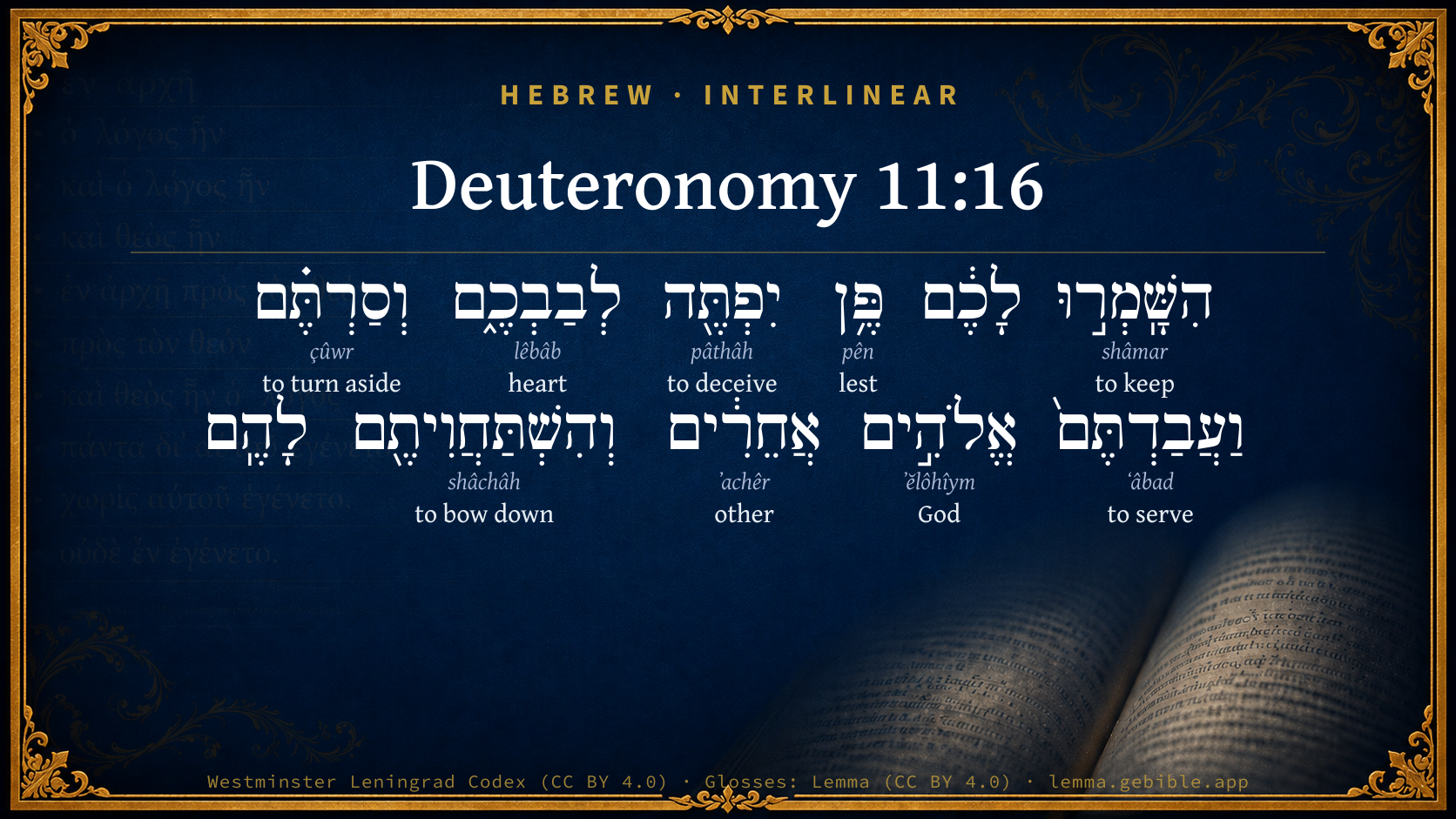
Hebrew (Westminster Leningrad Codex) Deuteronomy 11:16 appears in the Hebrew Old Testament. The text above is from the Westminster Leningrad Codex. Each word links to its Strong’s number, a concise gloss, and parsing drawn from the Open Scriptures Hebrew Bible morphology. Click any word for its full Brown-Driver-Briggs (BDB) entry.
Download image
Cite this verse

Deuteronomy 11:16 (World English Bible). Public Domain. Lemma interlinear Bible study tool, https://lemma.gebible.app/v/deuteronomy/11/16.

Show BibTeX & RIS
BibTeX
RIS
English Translation
Take heed to yourselves, lest your heart be deceived, and you turn aside, and serve other gods, and worship them;
World English Bible · Public Domain
Download a study sheet

One document with this verse’s original text, its word-by-word gloss line, the meaning frame, cross-references with their text, attributed commentary, and full source and license credits — printable, and it pastes into notes with its structure intact.

This verse Autodidact and up

Study sheet (.html) Plain text (.txt)

A passage Seminary Student

Up to 50 verses in one chapter. A passage sheet keeps up to 6 commentary sources and 12 cross-references per verse, in the order this page ranks them, and says so on the sheet whenever that leaves anything out. Ask for a single verse and you get the Autodidact verse sheet above.

Everything on this page stays free to read, with no account — the sheet is a download of what is already on screen, not access to it.

Want to remove ads? Support Godless Engineer
Compare translations 3

The same verse in 3 English versions, stacked beneath the original-language interlinear above. Click any original word for its lexicon entry.

Each is an independent rendering of the whole verse — the interlinear is not word-aligned to these translations.

Highlighted words mark where these versions differ — a whole-verse word diff, not a word-by-word alignment.

  • World English Bible Public Domain
    Take heed to yourselves, lest your heart be deceived, and you turn aside, and serve other gods, and worship them;
  • King James Version Public Domain
    Take heed to yourselves, that your heart be not deceived, and ye turn aside, and serve other gods, and worship them;
  • unfoldingWord Literal Text CC BY-SA 4.0
    Guard yourselves, lest your heart be deceived, and you turn aside and serve other gods and bow down to them.

unfoldingWord Literal Text — © unfoldingWord, licensed CC BY-SA 4.0. Word-aligned USFM3 via Door43 (git.door43.org/unfoldingWord/en_ult).

Versions to compare (up to 4)

3 of 4 selected

Show all 18 translations

Every available English version of this verse, each an independent rendering of the whole verse.

  • World English Bible Public Domain
    Take heed to yourselves, lest your heart be deceived, and you turn aside, and serve other gods, and worship them;
  • Berean Standard Bible Public Domain
    But be careful that you are not enticed to turn aside to worship and bow down to other gods,
  • Majority Standard Bible Public Domain
    But be careful that you are not enticed to turn aside to worship and bow down to other gods,
  • King James Version Public Domain
    Take heed to yourselves, that your heart be not deceived, and ye turn aside, and serve other gods, and worship them;
  • American Standard Version (1901) Public Domain
    Take heed to yourselves, lest your heart be deceived, and ye turn aside, and serve other gods, and worship them;
  • Revised Version (1885) Public Domain
    Take heed to yourselves, lest your heart be deceived, and ye turn aside, and serve other gods, and worship them;
  • Geneva Bible (1599) Public Domain
    But beware lest your heart deceiue you, and lest yee turne aside, and serue other gods, and worship them,
  • Douay-Rheims (1899) Public Domain
    And your hay out of the fields to feed your cattle, and that you may eat and be filled.
  • Young's Literal Translation Public Domain
    `Take heed to yourselves, lest your heart be enticed, and ye have turned aside, and served other gods, and bowed yourselves to them,
  • Literal Standard Version CC BY-SA 4.0
    Take heed to yourselves lest your heart be enticed, and you have turned aside, and served other gods, and bowed yourselves to them,
  • Unlocked Literal Bible CC BY-SA 4.0
    Pay attention to yourselves so that your heart is not deceived, and you turn aside and worship other gods and bow down to them;
  • unfoldingWord Literal Text CC BY-SA 4.0
    Guard yourselves, lest your heart be deceived, and you turn aside and serve other gods and bow down to them.
  • Darby Bible Public Domain
    Take heed to yourselves, that your heart be not deceived, and ye turn aside and serve other gods, and bow down to them,
  • World Messianic Bible Public Domain
    Be careful, lest your heart be deceived, and you turn away to serve other gods and worship them;
  • Webster's Bible Public Domain
    Take heed to yourselves, that your heart be not deceived, and ye turn aside, and serve other gods, and worship them;
  • Free Bible Version CC BY-SA 4.0
    But make sure that you're not fooled into worshiping and bowing down to other gods,
  • Bible in Basic English Public Domain
    But take care that your hearts are not turned to false ways so that you become servants and worshippers of other gods;
  • JPS Tanakh (1917) Public Domain
    Take heed to yourselves, lest your heart be deceived, and ye turn aside, and serve other gods, and worship them;

Literal Standard Version (2020), Covenant Press — licensed CC BY-SA 4.0. Text via the HelloAO Bible API (eBible.org). Unlocked Literal Bible (unfoldingWord) — licensed CC BY-SA 4.0. Text via the HelloAO Bible API (eBible.org). unfoldingWord Literal Text — © unfoldingWord, licensed CC BY-SA 4.0. Word-aligned USFM3 via Door43 (git.door43.org/unfoldingWord/en_ult). Free Bible Version, Dr. Jonathan Gallagher — licensed CC BY-SA 4.0. Text via the HelloAO Bible API (eBible.org).

Word by word

More ways to search: Search by grammar → Find every occurrence → Compare this word →

Practice this passage: Drill this verse → Learn its vocabulary →

יִפְתֶּ֖ה
pâthâh
H6601
“to deceive”
Verb, Qal, Imperfect, 3rd Person, Masculine, Singular
Part of Speech
Verb
Stem
Qal
Form
Imperfect
Person
3rd Person
Gender
Masculine
Number
Singular
Full BDB Definition

Origin: a primitive root

TWOT: 1853

to be spacious, be open, be wide - (Qal) to be spacious or open or wide - (Hiphil) to make spacious, make open - to be simple, entice, deceive, persuade - (Qal) - to be open-minded, be simple, be naive - to be enticed, be deceived - (Niphal) to be deceived, be gullible - (Piel) - to persuade, seduce - to deceive - (Pual) - to be persuaded - to be deceived
  1. הִשָּֽׁמְר֣וּ shâmar H8104 “keep” Verb, Niphal, Imperative, 2nd Person, Masculine, Plural
  2. פֶּ֥ן pên H6435 “lest” Conjunction
  3. לְבַבְכֶ֑ם lêbâb H3824 “heart · your” Noun, Common, Masculine, Singular, Construct + Suffix, Personal, 2nd Person, Masculine, Plural
  4. וְסַרְתֶּ֗ם çûwr H5493 “and · to turn aside” Conjunction + Verb, Qal, Sequential Perfect, 2nd Person, Masculine, Plural
  5. וַעֲבַדְתֶּם֙ ʻâbad H5647 “and · to serve” Conjunction + Verb, Qal, Sequential Perfect, 2nd Person, Masculine, Plural
  6. אֱלֹהִ֣ים ʼĕlôhîym H430 “God(s)” Noun, Common, Masculine, Plural, Absolute
  7. אֲחֵרִ֔ים ʼachêr H312 “other” Adjective, Adjective, Masculine, Plural, Absolute
  8. וְהִשְׁתַּחֲוִיתֶ֖ם shâchâh H7812 “and · to bow down” Conjunction + Verb, Hishtaphel, Sequential Perfect, 2nd Person, Masculine, Plural

About this verse

These counts appear in no published source. They are computed here, from the morphology-tagged text and Lemma’s own curated glosses. What Lemma adds →

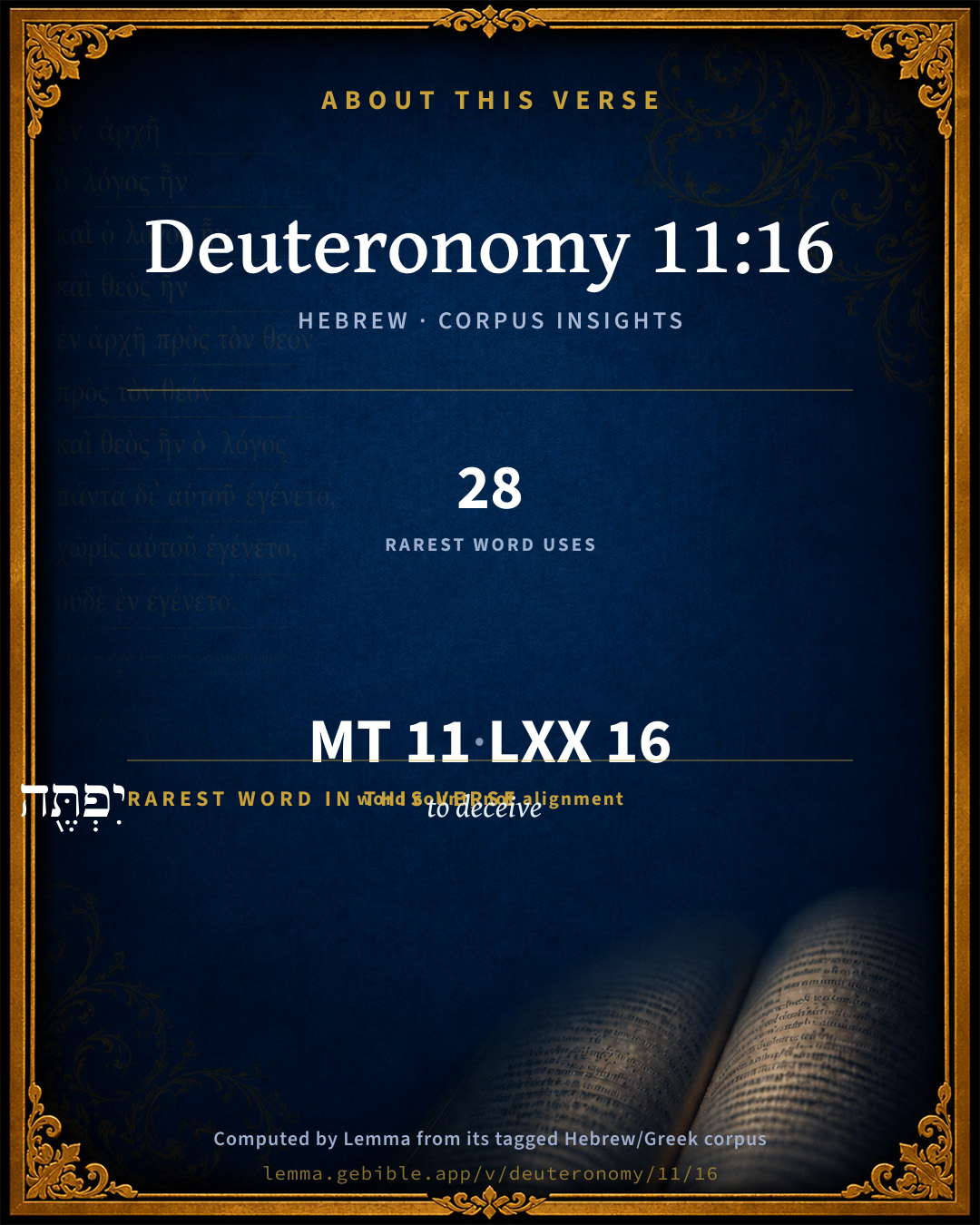
11
words
9
distinct lemmas
Pentateuch
section

Shared distinctive vocabulary

יִפְתֶּ֖ה to deceive H6601 occurs in 26 verses of the Hebrew Bible. Also found in:

Grammatical profile

  • 5 verbs
  • 2 nouns
  • 1 adjective
  • 2 prepositions
  • 1 conjunction

Verb forms

  • הִשָּֽׁמְר֣וּ Niphal · Imperative
  • יִפְתֶּ֖ה Qal · Imperfect
  • וְסַרְתֶּ֗ם Qal · Sequential Perfect
  • וַעֲבַדְתֶּם֙ Qal · Sequential Perfect
  • וְהִשְׁתַּחֲוִיתֶ֖ם Hishtaphel · Sequential Perfect

Hebrew & Septuagint length

In English translation the verse runs 20 words from the Hebrew and 21 from the Septuagint (LXX English) — closely comparable.

A rough comparison of the two English renderings, which tokenize alike — not a word-level alignment.

Word counts can differ between the Hebrew and the Greek without any difference in meaning — e.g. the Hebrew direct-object marker אֵת has no separate Greek word, and Greek often adds the article ὁ.

In the original languages it is 11 Hebrew tokens and 16 Greek tokens — but the two are counted differently (Hebrew bundles its prefixes and suffixes into one token; the Greek is in lemma form), so that isn’t a like-for-like length.

Cross-references

20

Topical passages linked to Deuteronomy 11:16 in the Treasury of Scripture Knowledge — connected by theme and wording, ordered by reader-vote popularity; previews shown in the World English Bible.

  • Job 31:27 And my heart has been secretly enticed, My hand threw a kiss from my mouth:
  • Hebrews 3:12 Beware, brothers, lest perhaps there be in any one of you an evil heart of unbelief, in falling away from the living God;
  • Hebrews 2:1 Therefore we ought to pay greater attention to the things that were heard, lest perhaps we drift away.
  • Deuteronomy 29:18 lest there should be among you man, or woman, or family, or tribe, whose heart turns away this day from Yahweh our God, to go to serve the gods of those nations; lest there should be among you a root that bears gall and wormwood;
  • James 1:26 If anyone among you thinks himself to be religious while he doesn't bridle his tongue, but deceives his heart, this man's religion is worthless.
  • Deuteronomy 4:23 Take heed to yourselves, lest you forget the covenant of Yahweh your God, which he made with you, and make you an engraved image in the form of anything which Yahweh your God has forbidden you.
  • Deuteronomy 8:19 It shall be, if you shall forget Yahweh your God, and walk after other gods, and serve them, and worship them, I testify against you this day that you shall surely perish.
  • Deuteronomy 30:17 But if your heart turn away, and you will not hear, but shall be drawn away, and worship other gods, and serve them;
  • Isaiah 44:20 He feeds on ashes; a deceived heart has turned him aside; and he can't deliver his soul, nor say, Is there not a lie in my right hand?
  • Luke 21:34 "So be careful, or your hearts will be loaded down with carousing, drunkenness, and cares of this life, and that day will come on you suddenly.
  • 1 John 5:21 Little children, keep yourselves from idols.
  • Deuteronomy 4:9 Only take heed to yourself, and keep your soul diligently, lest you forget the things which your eyes saw, and lest they depart from your heart all the days of your life; but make them known to your children and your children's children;
  • Deuteronomy 13:3 you shall not listen to the words of that prophet, or to that dreamer of dreams: for Yahweh your God proves you, to know whether you love Yahweh your God with all your heart and with all your soul.
  • Luke 21:8 He said, "Watch out that you don't get led astray, for many will come in my name, saying, 'I AM,' and, 'The time is at hand.' Therefore don't follow them.
  • Luke 21:36 Therefore be watchful all the time, asking that you may be counted worthy to escape all these things that will happen, and to stand before the Son of Man."
  • Hebrews 4:1 Let us fear therefore, lest perhaps a promise being left of entering into his rest, anyone of you should seem to have come short of it.
  • Hebrews 12:15 looking carefully lest there be any man who falls short of the grace of God; lest any root of bitterness springing up trouble you, and thereby the many be defiled;
  • Revelation 12:9 The great dragon was thrown down, the old serpent, he who is called the devil and Satan, the deceiver of the whole world. He was thrown down to the earth, and his angels were thrown down with him.
  • Revelation 13:14 He deceives my own people who dwell on the earth because of the signs he was granted to do in front of the beast; saying to those who dwell on the earth, that they should make an image to the beast who had the sword wound and lived.
  • Revelation 20:4 I saw thrones, and they sat on them, and judgment was given to them. I saw the souls of those who had been beheaded for the testimony of Jesus, and for the word of God, and such as didn't worship the beast nor his image, and didn't receive the mark on their forehead and on their hand. They lived, and reigned with Christ for the thousand years.

Cross-references courtesy of OpenBible.info (CC BY 4.0).

Hebrew and Greek witnesses Masoretic Hebrew ↔ Greek Septuagint

The same verse in the two great witnesses to the Old Testament, shown verse-for-verse.

These are two independent witnesses, not word-aligned to each other, and the Septuagint is shown in lemma (dictionary) form.

Hebrew Deuteronomy 11:16 Masoretic · Westminster Leningrad Codex

הִשָּֽׁמְר֣וּ לָכֶ֔ם פֶּ֥ן יִפְתֶּ֖ה לְבַבְכֶ֑ם וְסַרְתֶּ֗ם וַעֲבַדְתֶּם֙ אֱלֹהִ֣ים אֲחֵרִ֔ים וְהִשְׁתַּחֲוִיתֶ֖ם לָהֶֽם

Take heed to yourselves, lest your heart be deceived, and you turn aside, and serve other gods, and worship them;

World English Bible · Public Domain

Greek LXX Deuteronomy 11:16 Septuagint · lemma form

προςἔχω σεαυτοῦ μή πλατύνω ὁ καρδία σύ καί παραβαίνω καί λατρεύω θεός ἕτερος καί προςκυνέω αὐτός

take heed to yourself that your heart be not puffed up, and you⌃ transgress, and serve other gods, and worship them:

LXX2012 (modern English Septuagint) · Public Domain

Hebrew: Westminster Leningrad Codex (CC BY 4.0). Greek: Septuagint (public domain); English from LXX2012 (modern English Septuagint) (Public Domain). How the Septuagint differs from the Hebrew →

Targum (Aramaic paraphrase)

2

The Targum is the ancient Jewish Aramaic paraphrase of the Hebrew Scriptures — an interpretive translation, not the Hebrew text itself. Onkelos (literal) and Pseudo-Jonathan (expansive) render the Torah, and Jonathan the Prophets. Coverage is partial: where no permissively-licensed English translation exists for a verse, only the Aramaic is shown. This is verse-level text, not a word-by-word alignment to the Hebrew.

  1. Targum Onkelos Torah (Genesis–Deuteronomy)
    אִסְתַּמָרוּ לְכוֹן דִילְמָא יִטְעוּן לִבְּכוֹן וְתִסְטוּן וְתִפְלְחוּן לְטַעֲוַת עַמְמַיָא וְתִסְגְדוּן לְהוֹן

    Beware for yourselves lest your hearts wander and you deviate and you worship the idols of the nations and you will bow to them.

    Targum Onkelos — Aramaic: “Onkelos Genesis” (public domain); “Onkelos Exodus” (public domain); “Onkelos Leviticus” (public domain); “Onkelos Numbers” (public domain); “Onkelos Deuteronomy” (public domain). English: “Sefaria Community Translation” (CC0 1.0 (public-domain dedication)); “J.W. Etheridge. The Targums of Onkelos and Jonathan Ben Uzziel on the Pentateuch. London: Longmans, Green, 1862” (public domain). Text via Sefaria.

  2. Targum Pseudo-Jonathan Torah (Genesis–Deuteronomy)
    אִסְתַּמָּרוּ לְכוֹן דִּילְמָא יִטְעֵי יִצְרָא דְלִבְּכוֹן וְתִסְטוּן וְתִפְלְחוּן לְטַעֲוַות עַמְמַיָא וְתִסְגְּדוּן לְהוֹן

    Take heed to yourselves, lest you be led away by the imagination of your heart, and turn aside to serve the idols of the Gentiles, and worship them,

    Targum Pseudo-Jonathan — Aramaic: “Targum Jonathan on Genesis” (public domain); “Targum Jonathan on Exodus” (public domain); “Targum Jonathan on Leviticus” (public domain); “Targum Jonathan on Numbers” (public domain); “Targum Jonathan on Deuteronomy” (public domain). English: “The Targum of Jonathan ben Uzziel, trans. J. W. Etheridge, London, 1862” (public domain). Text via Sefaria.

Commentary

Notes on Deuteronomy 11:16 from classic Christian and Jewish commentators (each source and its license shown beneath its notes). The classic Christian expositions comment on the surrounding passage and are grouped to its opening verse, so a note may address several verses; the Jewish commentaries on the Tanakh (Rashi and others) are per-verse, so they appear only where the commentator wrote on this verse.

Lemma curates 59 commentaries, every one of them public domain or Creative Commons licensed, each selected and text-cleaned for this edition rather than reprinted as found. About our sources →

Trapp's Complete Commentary

John Trapp

Deu 11:16 Take heed to yourselves, that your heart be not deceived, and ye turn aside, and serve other gods, and worship them;

Ver. 16. That your heart be not deceived.] Having first deceived itself; for "the heart is deceitful above all things," {Jer 17:9} and may say to many, as the heart of Apollonius the tyrant seemed to say to him, who dreamed one night, that he was flayed by the Scythians, and boiled in a caldron, and that his heart spake to him out of the kettle and said, Eγω σοι τουτων αιτια, It is I that have drawn thee to all this. {a} Those in hell cry so.

{a} Plut.

John Trapp, A Commentary or Exposition upon All the Books of the Old and New Testament (1647–1656) — public domain. Text from a community e-Sword module.

The Biblical Illustrator

Joseph S. Exell

Deu_11:16-17

Take heed . . . that your heart be not deceived.

Religion no humbug

I. Let us not be deceived in our ideas about God.

1. Let us not be deceived in thinking that our heavenly Father is partly good and partly bad.

2. Let not your heart be deceived in thinking that God cannot pardon the one who supposes himself or herself to be the worst. We all do wrong, in some sense or another; and when the thought of our sin weighs down our hearts, let us feel persuaded that God can forgive us. But do not mistake His pardon by thinking that when He forgives us, there is an end of it. Here is a careless weaver at work, throwing the shuttle containing the weft. When she has got half through the warp, she finds she has made an error in the pattern, and when the overlooker unwinds the piece he discovers the flaw running through the whole. Well, what is to be done? She says, O, do forgive me! He replies, Certainly I will; but you know it must be undone. It is weary work undoing a web of long threads; but nobody would buy that piece as it is. So the weaver begins with the last thread and pulls it out from side to side and begins again. Likewise, though the Lord forgives us, we must undo the bad life. As the kindly overlooker stands beside the weaver, saying, Let me help you, so the Lord stands by us to help us to amend the tangled web of our life. While God forgives us and inspires our heart, the rectification of what is wrong must, however, be our own act. We must undo our bad life by beginning afresh.

II. Do not be deceived in your views concerning religion. Religion is not a theory; it is the living spirit of usefulness. Religion that does not inspire us to be pure ourselves and useful to others is not the true Christian religion; it is a humbug. Religion will comfort your own heart and make you a blessing wherever you go. While it teaches you to fight against your evil propensities, it trains you to be kind-hearted at home and peaceable-minded abroad. In leading you down the steps of true humility, it exalts you to the noblest manhood; and while constraining you to surrender your will to the Christ-spirit, it gives you the glorious power of God-likeness. A minister was on one occasion preaching on peaceableness, having special reference to Messrs. Pincher and Stiggins, two of his deacons who had long been at daggers point. Such was his faithful earnestness that the whole congregation was moved, and when the benediction was pronounced, Mr. Pincher went across the chapel to the other, and with tears in his eyes, remarked, Brother Stiggins, after such a sermon there must be peace between us. Now, I cant give in, so you must! The other replied, Well, Brother Pincher, if you wont give in, Im blessed if I will! You see, they were religious in theory but not in practical life.

III. We should not be deceived in our thoughts about the invisible world called heaven and hell. If you have good things in this world, and do not care for the destitute, you cannot have good things in the other world. (W. Birch.)

A caution against deception

I. An evil anticipated. That of having the heart deceived.

1. The scantiness and imperfection of human knowledge.

2. The deceitfulness of the heart.

3. The deceitfulness of sin.

4. The deceitfulness of the world.

5. The deceitfulness of the devil.

Such are the reasons we have for believing that our hearts may be deceived. But the text assumes that this deception is an evil pregnant with very pernicious consequences. And this appears from the consideration, that those whose hearts are deceived are involved in a state of the most palpable error. What tradesman would wish to make errors in his accounts? What scholar would not guard against error in his sums? But these errors are trivial, when compared to the grievous error in which those are involved whose hearts are deceived concerning their salvation and their God. Nor is this all; those whose hearts are deceived, are exposed to extreme danger.

II. The caution urged against this deception. Take heed to yourselves, etc.

1. Be alive to a sense of your extreme danger. Let us consider what we are--how deeply fallen! Let us weigh well our circumstances, dangers, and enemies; this will lay the foundation for caution and circumspection.

2. Seek for the illuminating and sanctifying influences of the Holy Spirit; O, seek His influence by fervent, importunate prayer. Take heed to yourselves.

3. By the constant practice of self-examination.

4. By watching over yourselves. Watch and pray. Be ye therefore sober, and watch unto prayer. Watch thou in all things. Watchfulness will lead you to keep a strict guard over your thoughts, words, actions. (Sketches of Four Hundred Sermons.)

The Biblical Illustrator, edited by Joseph S. Exell (c. 1880s–1900s) — public domain. Text from a community e-Sword module.

Joseph Benson's Commentary

Deu 11:16-17. That your heart be not deceived — By the specious pretence of idolaters, persuading you that they enjoy fruitful seasons, and other temporal blessings, as a reward for their worship. And he shut up the heaven — Withhold rain from you, which will be a sore judgment, quickly bringing a famine, whereby you will be wasted and consumed. Here, and elsewhere, heaven is compared to a great store-house, wherein God lays up his treasures of dew and rain, (Job 38:22,) the doors whereof God is said to open when he gives rain, and to shut when he withholds it.

Joseph Benson's Commentary on the Old and New Testaments (1811–1818) — public domain. Text from a community e-Sword module.

Geneva Bible (1599)

Geneva Bible translators

By devising to yourselves foolish devotions according to your own fantasies.

Geneva Bible (1599) marginal notes — public domain. Text via Bolls.life.

Ellicott's Commentary for English Readers

(16) Take heed to yourselves—i.e., when you are satisfied. (Comp. Deu_8:10-11.)

A Bible Commentary for English Readers, edited by Charles John Ellicott (1878–1897) — public domain. Text from a community e-Sword module.

The Cambridge Bible for Schools and Colleges

gen. ed. J. J. S. Perowne

16, 17. The enjoyment of so much blessing in the land suggests, as usual (cp. Deu_6:14 f., Deu_8:19 f.), a warning against being deceived into attributing it to other gods, i.e. the Baalim, already regarded in the land as the authors of its fertility, and worshipping them. Whether this warning is from the same hand as the preceding vv. is difficult to determine. The fact that it is in the Pl. while they are in the Sg., and that it is not so necessary to their argument as it is to the context in Deu_6:14 f. and Deu_8:19 f., suggests here another hand. At the same time it is relevant to what precedes, and in Deu_11:17 directly attaches itself to that. Nor is it all compiled of formulas.

16. Take heed to yourselves] See on Deu_4:9; only here and Deu_4:23 with Pl.

lest your heart be deceived] So Job_31:27.

and ye turn aside] With both Sg. and Pl., see on Deu_13:5.

17. the anger of the Lord, etc.] See Deu_6:14 f., Deu_7:4.

and he shut up the heaven … fruit] These clauses found in D only here (but cp. Deu_28:23 f. and the deuteronomic 1Ki_8:35). Fruit, rather produce, yebûl, found, save for Jdg_6:4, only in the later O.T. writings from Ezekiel (Eze_34:27) and D onwards, cp. Deu_32:22. Thus not only in the climate of Palestine, blessed directly from heaven, but in its interruptions also Israel are to see the personal Providence of their God.

and ye perish quickly, etc.] So, with slight variations, Deu_4:26.

the good land] Deu_1:35.

The Cambridge Bible for Schools and Colleges (gen. ed. J. J. S. Perowne; Cambridge University Press, 1878–1918) — public domain. Text from a community e-Sword module.

John Gill's Exposition

That your days may be multiplied,.... Long life being a very desirable blessing, and which is promised to those that obey and keep the law; see Deu 30:19.

and the days of your children; which are dear to parents, and the continuance of whose lives, next to their own, is most desirable, yea, as desirable as their own; and especially it is desirable that they might have a posterity descending from them, to enjoy for ever their estates and possessions; as it was to the people of Israel, that they might have a seed always to dwell

in the land which the Lord sware unto your fathers to give them; the land of Canaan, so often spoken of as the promise, oath, and gift of God:

as the days of heaven upon the earth; that is, as long as the heavens and the earth shall be, and the one shall be over the other, as they will be to the end of time.

John Gill's Exposition of the Whole Bible (1746–1763) — public domain (CC PDM 1.0). Text via the HelloAO Bible API.

Matthew Poole's English Annotations

That your heart be not deceived by the specious pretenses of idolaters, who will plead the general consent of all nations, except yours, in the worship of creatures, and that they worship the creatures only for God’s sake, and as they are glorious works of God, whom they worship in and by them; which, and the like arguments, being commonly alleged by heathens for their idolatries, as their own writers declare, might possibly seduce an unwary Israelite; and therefore they are here cautioned against such deceit, and withal it is implied, that if a man’s mind be corrupted and deceived, so as he believes idolatry to be lawful, this will not excuse him in the sight of God.

Matthew Poole's English Annotations on the Holy Bible (1683–1685) — public domain. Text from a community e-Sword/MySword module.

The Pulpit Commentary

That your heart be not deceived; literally, lest your heart be enticed or seduced (ht; pyi). The verb means primarily to be open, and as a mind open to impressions from without is easily persuaded, moved either to good or evil, the word came to signify to induce in a good sense, or to seduce in a bad sense. Here the people are cautioned against allowing themselves to be enticed so as to be led astray by seductive representations. (Job_31:27; Pro_20:19 "flattereth (Job_5:2 "silly Hos_7:11)

The Pulpit Commentary (1880–1919), ed. H.D.M. Spence-Jones & Joseph S. Exell — public domain. Text from a community e-Sword module.

unfoldingWord translationNotes

Door43 World Missions Community

General Information:

Moses continues speaking to the people of Israel.

Pay attention to yourselves

"Be careful" or "Beware"

so that your heart is not deceived

Here "heart" represents a person's desires or thoughts. This can be stated in active form. AT: "so that your desires do not deceive you" or "so that you do not deceive yourself" (See: Metonymy and Active or Passive)

you turn aside and worship other gods

Rejecting Yahweh and worshiping other gods is spoken of as if the person would physically turn and go in a different direction away from Yahweh. AT: "you start worshiping other gods" (See: Metaphor)

so that the anger of Yahweh is not kindled against you

God becoming angry is spoken of as if it were a fire that were starting. This can be stated in active form. AT: "so that Yahweh does not become angry with you" (See: Metaphor and Active or Passive)

so that he does not shut up the heavens so that there will be no rain, and the land will not yield its fruit

God causing no rain to fall from the sky is spoken of as if he were closing the sky. AT: "so that he does not cause the rain to stop falling from the sky so that crops will not grow in the land" (See: Metaphor)

translationWords

heart

deceive

turn

worship

false god

bow

anger

Yahweh

heaven

fruit

perish

unfoldingWord translationNotes — © Distant Shores Media and the Door43 World Missions Community, licensed CC BY-SA 4.0. Source: git.door43.org/Door43/en_tn.

Rashi

Rabbi Shlomo Yitzchaki (Rashi)

TAKE HEED [THAT YOUR HEART MISLEAD YOU NOT] — when you have eaten and are full, take heed to yourselves that you kick not against God; for usually no man rebels against the Holy One, blessed be He, except out of satiety, as it is said, (Deuteronomy 8:12—14) “Lest thou eat and art full … and thy herds and flocks increase”. What is stated after this? “And thy heart be lifted up and thou forget [the Lord thy God]” (Sifrei Devarim 43:7).

וסרתם AND YE TURN ASIDE, to depart from the Torah, and through this, ועבדתם אלהים אחרים YE WILL SERVE OTHER GODS, for so soon as a man departs from the Torah he goes and clings to idol-worship. Similarly did David say, (I Samuel 26:19) “For they have driven me out this day, that I should not cleave to the inheritance of the Lord (the Torah) saying, Go, serve other gods”. But who had really said thus to him?! But he meant: Since I am driven out so that I can no longer occupy myself with the Torah, I am nearly exposed to the danger of serving other gods (Sifrei Devarim 43:14).

אלהים אחרים OTHER GODS — i.e. gods that are other (alien) to those who worship them: one calls to it, and it does not answer him; consequently it becomes to him like a stranger (Sifrei Devarim 43:17).

Rashi on the Tanakh — English translations: “The Judaica Press complete Tanach with Rashi, translated by A. J. Rosenberg” (CC BY 4.0); “Pentateuch with Rashi's commentary by M. Rosenbaum and A.M. Silbermann, 1929-1934” (public domain); “The Metsudah Tanach series, Lakewood, N.J” (CC BY 4.0); and “The Book of Joshua, Metsudah Publications, 1997” (CC BY 4.0). Text via Sefaria.

Lesson kit

Teaching starters — assembled from the data on this page, not authored interpretation. Every prompt links to the verse data it draws on. Edit before teaching.

Deuteronomy, in the Pentateuch, opens this verse with 11 words (9 distinct Hebrew lemmas). Its most distinctive word is pâthâh (“to deceive”). A historical commentator’s framing appears above. Read the whole chapter for the surrounding context.

Discussion questions

  1. What does “to deceive” (pâthâh) contribute to the verse as a whole?
  2. Genesis 9:27 shares the word «to deceive» with this verse. How do the two illuminate each other?
  3. These translations render this verse differently. What is at stake in choosing one wording over another?
  4. The verb «הִשָּֽׁמְר֣וּ» is Niphal Imperative. How does its form color the action?
  5. Reading how Trapp's Complete Commentary and The Biblical Illustrator read this verse, where do the two commentators agree and where do they part?

Things to notice

Reading settings

Reading text

Shown beneath each verse's original-language words.

Old Testament
Old Testament edition

Read the OT as the Masoretic Hebrew (MT) or the Greek Septuagint (LXX).

English shown for the Greek Septuagint (in the Hebrew ↔ Greek comparison).

Comparing translations? Open the Compare panel on any verse page to stack up to four side by side.