Job 34:20

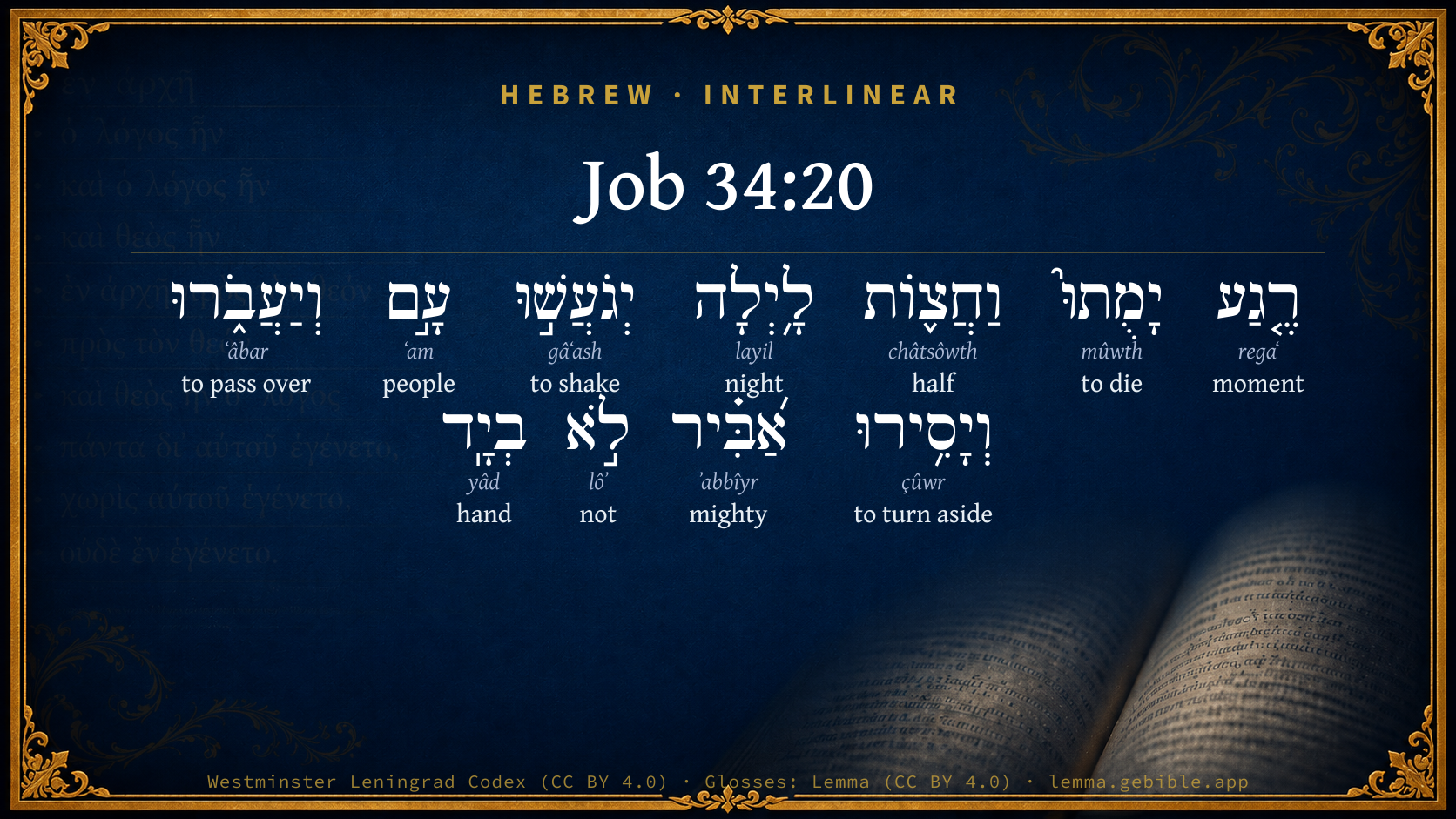
Hebrew (Westminster Leningrad Codex) Job 34:20 appears in the Hebrew Old Testament. The text above is from the Westminster Leningrad Codex. Each word links to its Strong’s number, a concise gloss, and parsing drawn from the Open Scriptures Hebrew Bible morphology. Click any word for its full Brown-Driver-Briggs (BDB) entry.
Download image
Cite this verse

Job 34:20 (World English Bible). Public Domain. Lemma interlinear Bible study tool, https://lemma.gebible.app/v/job/34/20.

Show BibTeX & RIS
BibTeX
RIS
English Translation
In a moment they die, even at midnight; The people are shaken and pass away, The mighty are taken away without hand.
World English Bible · Public Domain
Download a study sheet

One document with this verse’s original text, its word-by-word gloss line, the meaning frame, cross-references with their text, attributed commentary, and full source and license credits — printable, and it pastes into notes with its structure intact.

This verse Autodidact and up

Study sheet (.html) Plain text (.txt)

A passage Seminary Student

Up to 50 verses in one chapter. A passage sheet keeps up to 6 commentary sources and 12 cross-references per verse, in the order this page ranks them, and says so on the sheet whenever that leaves anything out. Ask for a single verse and you get the Autodidact verse sheet above.

Everything on this page stays free to read, with no account — the sheet is a download of what is already on screen, not access to it.

Want to remove ads? Support Godless Engineer
Compare translations 3

The same verse in 3 English versions, stacked beneath the original-language interlinear above. Click any original word for its lexicon entry.

Each is an independent rendering of the whole verse — the interlinear is not word-aligned to these translations.

Highlighted words mark where these versions differ — a whole-verse word diff, not a word-by-word alignment.

  • World English Bible Public Domain
    In a moment they die, even at midnight; The people are shaken and pass away, The mighty are taken away without hand.
  • King James Version Public Domain
    In a moment shall they die, and the people shall be troubled at midnight, and pass away: and the mighty shall be taken away without hand.
  • unfoldingWord Literal Text CC BY-SA 4.0
    a moment they die, and the middle of the night people are shaken and they pass, and they take away the mighty, not by a hand.

unfoldingWord Literal Text — © unfoldingWord, licensed CC BY-SA 4.0. Word-aligned USFM3 via Door43 (git.door43.org/unfoldingWord/en_ult).

Versions to compare (up to 4)

3 of 4 selected

Show all 18 translations

Every available English version of this verse, each an independent rendering of the whole verse.

  • World English Bible Public Domain
    In a moment they die, even at midnight; The people are shaken and pass away, The mighty are taken away without hand.
  • Berean Standard Bible Public Domain
    They die in an instant, in the middle of the night. The people convulse and pass away; the mighty are removed without human hand.
  • Majority Standard Bible Public Domain
    They die in an instant, in the middle of the night. The people convulse and pass away; the mighty are removed without human hand.
  • King James Version Public Domain
    In a moment shall they die, and the people shall be troubled at midnight, and pass away: and the mighty shall be taken away without hand.
  • American Standard Version (1901) Public Domain
    In a moment they die, even at midnight; The people are shaken and pass away, And the mighty are taken away without hand.
  • Revised Version (1885) Public Domain
    In a moment they die, even at midnight; the people are shaken and pass away, and the mighty are taken away without hand.
  • Geneva Bible (1599) Public Domain
    They shall die suddenly, and the people shalbe troubled at midnight, and they shall passe foorth and take away the mightie without hand.
  • Douay-Rheims (1899) Public Domain
    They shall suddenly die, and the people shall be troubled at midnight, and they shall pass, and take away the violent without hand.
  • Young's Literal Translation Public Domain
    `In' a moment they die, and at midnight Shake do people, and they pass away, And they remove the mighty without hand.
  • Literal Standard Version CC BY-SA 4.0
    [In] a moment they die, || And at midnight people shake, || And they pass away, || And they remove the mighty without hand.
  • Unlocked Literal Bible CC BY-SA 4.0
    In a moment they will die; at midnight people will be shaken and will pass away; mighty people will be taken away, but not by human hands.
  • unfoldingWord Literal Text CC BY-SA 4.0
    a moment they die, and the middle of the night people are shaken and they pass, and they take away the mighty, not by a hand.
  • Darby Bible Public Domain
    In a moment they die, even at midnight the people are convulsed and pass away; and the strong are taken away without hand.
  • World Messianic Bible Public Domain
    In a moment they die, even at midnight. The people are shaken and pass away. The mighty are taken away without a hand.
  • Webster's Bible Public Domain
    In a moment they shall die, and the people shall be troubled at midnight, and pass away: and the mighty shall be taken away without hand.
  • Free Bible Version CC BY-SA 4.0
    They die in a moment; at midnight they shudder and pass away; the mighty are gone without effort.
  • Bible in Basic English Public Domain
    Suddenly they come to an end, even in the middle of the night: the blow comes on the men of wealth, and they are gone, and the strong are taken away without the hand of man.
  • JPS Tanakh (1917) Public Domain
    In a moment they die, even at midnight; the people are shaken and pass away, and the mighty are taken away without hand.

Literal Standard Version (2020), Covenant Press — licensed CC BY-SA 4.0. Text via the HelloAO Bible API (eBible.org). Unlocked Literal Bible (unfoldingWord) — licensed CC BY-SA 4.0. Text via the HelloAO Bible API (eBible.org). unfoldingWord Literal Text — © unfoldingWord, licensed CC BY-SA 4.0. Word-aligned USFM3 via Door43 (git.door43.org/unfoldingWord/en_ult). Free Bible Version, Dr. Jonathan Gallagher — licensed CC BY-SA 4.0. Text via the HelloAO Bible API (eBible.org).

Word by word

More ways to search: Search by grammar → Find every occurrence → Compare this word →

Practice this passage: Drill this verse → Learn its vocabulary →

וַחֲצ֪וֹת
châtsôwth
H2676
“and · half of”
Conjunction + Noun, Common, Feminine, Singular, Construct
Part of Speech
Conjunction + Noun
Type
Common
Gender
Feminine
Number
Singular
State
Construct
Full BDB Definition

Origin: from H2673

TWOT: 719a

middle, mid-, half, division
  1. רֶ֤גַע regaʻ H7281 “moment” Noun, Common, Masculine, Singular, Absolute
  2. יָמֻתוּ֮ mûwth H4191 “to die” Verb, Qal, Imperfect, 3rd Person, Masculine, Plural
  3. לָ֥יְלָה layil H3915 “night” Noun, Common, Masculine, Singular, Absolute
  4. יְגֹעֲשׁ֣וּ gâʻash H1607 “to shake” Verb, Pual, Imperfect, 3rd Person, Masculine, Plural
  5. עָ֣ם ʻam H5971 “people” Noun, Common, Masculine, Singular, Absolute
  6. וְיַעֲבֹ֑רוּ ʻâbar H5674 “and · to pass over” Conjunction + Verb, Qal, Imperfect, 3rd Person, Masculine, Plural
  7. וְיָסִ֥ירוּ çûwr H5493 “and · to turn aside” Conjunction + Verb, Hiphil, Imperfect, 3rd Person, Masculine, Plural
  8. אַ֝בִּ֗יר ʼabbîyr H47 “mighty” Adjective, Adjective, Masculine, Singular, Absolute
  9. לֹ֣א lôʼ H3808 “not” Particle, Negative
  10. בְיָֽד yâd H3027 “in/at · hand” Preposition + Noun, Common, Both, Singular, Absolute

About this verse

These counts appear in no published source. They are computed here, from the morphology-tagged text and Lemma’s own curated glosses. What Lemma adds →

11
words
11
distinct lemmas
Wisdom
section

Notable vocabulary

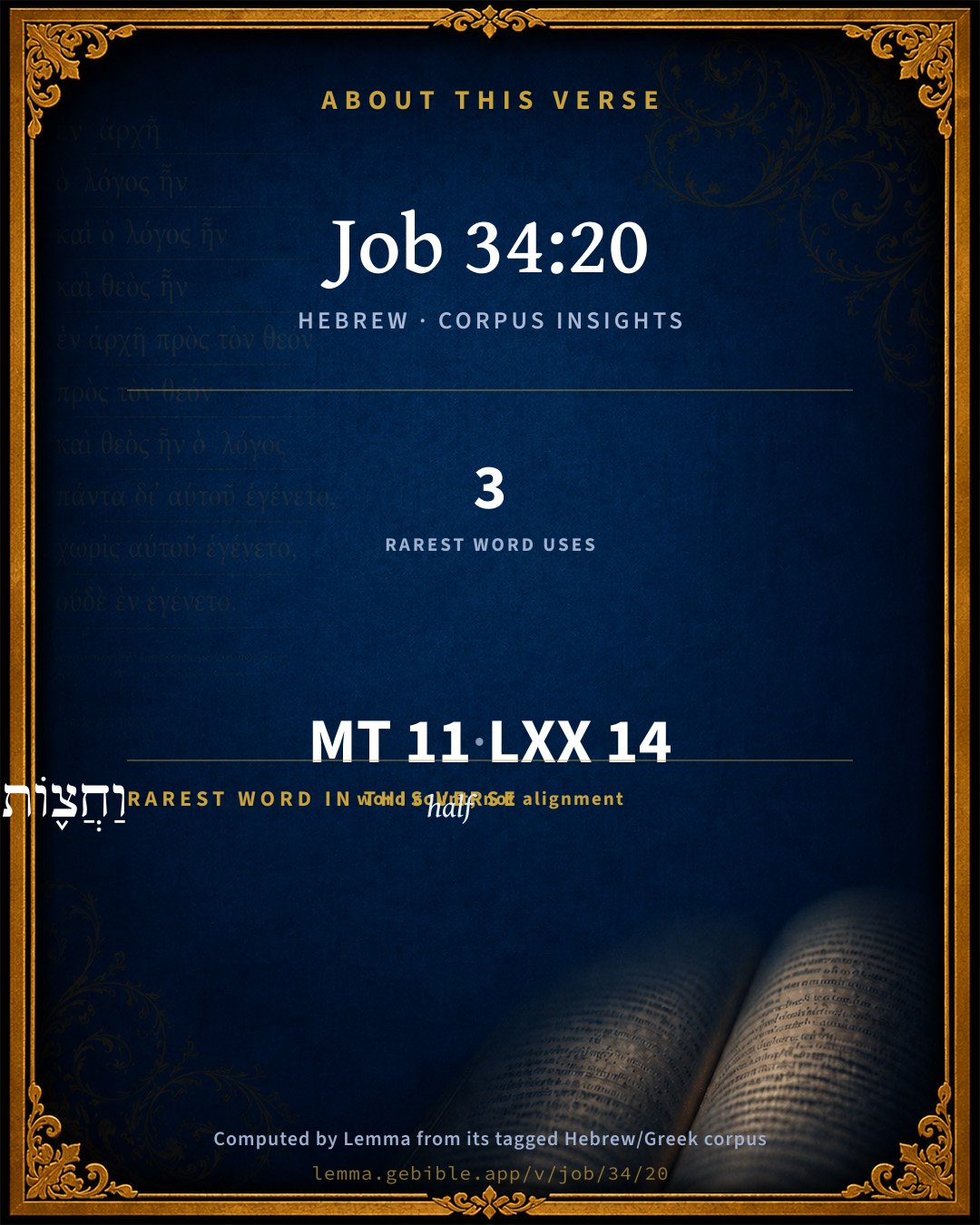
The rarest word here is וַחֲצ֪וֹת half H2676 — appearing just 3 times in the whole Hebrew Bible.

Shared distinctive vocabulary

וַחֲצ֪וֹת half H2676 occurs in 3 verses of the Hebrew Bible. Also found in:

Grammatical profile

  • 4 verbs
  • 5 nouns
  • 1 adjective
  • 1 particle

Verb forms

  • יָמֻתוּ֮ Qal · Imperfect
  • יְגֹעֲשׁ֣וּ Pual · Imperfect
  • וְיַעֲבֹ֑רוּ Qal · Imperfect
  • וְיָסִ֥ירוּ Hiphil · Imperfect

Hebrew & Septuagint length

In English translation the verse runs 22 words from the Hebrew and 26 from the Septuagint (LXX English) — closely comparable.

A rough comparison of the two English renderings, which tokenize alike — not a word-level alignment.

Word counts can differ between the Hebrew and the Greek without any difference in meaning — e.g. the Hebrew direct-object marker אֵת has no separate Greek word, and Greek often adds the article ὁ.

In the original languages it is 11 Hebrew tokens and 14 Greek tokens — but the two are counted differently (Hebrew bundles its prefixes and suffixes into one token; the Greek is in lemma form), so that isn’t a like-for-like length.

Cross-references

21

Topical passages linked to Job 34:20 in the Treasury of Scripture Knowledge — connected by theme and wording, ordered by reader-vote popularity; previews shown in the World English Bible.

  • Psalms 73:19 How they are suddenly destroyed! They are completely swept away with terrors.
  • 1 Samuel 25:37–39 It happened in the morning, when the wine was gone out of Nabal, that his wife told him these things, and his heart died within him, and he became as a stone.
  • 1 Samuel 26:10 David said, As Yahweh lives, Yahweh will strike him; or his day shall come to die; or he shall go down into battle and perish.
  • Job 12:19 He leads priests away stripped, And overthrows the mighty.
  • Job 36:20 Don't desire the night, When people are cut off in their place.
  • Isaiah 10:16–19 Therefore will the Lord, Yahweh of Hosts, send among his fat ones leanness; and under his glory there shall be kindled a burning like the burning of fire.
  • Isaiah 30:13 therefore this iniquity shall be to you as a breach ready to fall, swelling out in a high wall, whose breaking comes suddenly in an instant.
  • Isaiah 30:30–33 Yahweh will cause his glorious voice to be heard, and will show the lighting down of his arm, with the indignation of [his] anger, and the flame of a devouring fire, with a blast, and tempest, and hailstones.
  • Isaiah 37:36 The angel of Yahweh went forth, and struck in the camp of the Assyrians one hundred and eighty-five thousand; and when men arose early in the morning, behold, these were all dead bodies.
  • Isaiah 37:38 It happened, as he was worshipping in the house of Nisroch his god, that Adrammelech and Sharezer his sons struck him with the sword; and they escaped into the land of Ararat. Esar Haddon his son reigned in his place.
  • Daniel 2:34 You saw until a stone was cut out without hands, which struck the image on its feet that were of iron and clay, and broke them in pieces.
  • Daniel 5:30 In that night Belshazzar the Chaldean King was slain.
  • Luke 12:20 "But God said to him, 'You foolish one, tonight your soul is required of you. The things which you have prepared--whose will they be?'
  • Luke 17:26–29 As it happened in the days of Noah, even so will it be also in the days of the Son of Man.
  • Acts 12:23 Immediately an angel of the Lord struck him, because he didn't give God the glory, and he was eaten by worms and died.
  • 1 Thessalonians 5:2 For you yourselves know well that the day of the Lord comes like a thief in the night.
  • 2 Peter 2:3 In covetousness they will exploit you with deceptive words: whose sentence now from of old doesn't linger, and their destruction will not slumber.
  • Exodus 12:29–30 It happened at midnight, that Yahweh struck all the firstborn in the land of Egypt, from the firstborn of Pharaoh who sat on his throne to the firstborn of the captive who was in the dungeon; and all the firstborn of cattle.
  • Daniel 2:44–45 In the days of those kings shall the God of heaven set up a kingdom which shall never be destroyed, nor shall the sovereignty of it be left to another people; but it shall break in pieces and consume all these kingdoms, and it shall stand forever.
  • Zechariah 4:6 Then he answered and spoke to me, saying, "This is the word of Yahweh to Zerubbabel, saying, 'Not by might, nor by power, but by my Spirit,' says Yahweh of Hosts.
  • Matthew 25:6 But at midnight there was a cry, 'Behold! The bridegroom is coming! Come out to meet him!'

Cross-references courtesy of OpenBible.info (CC BY 4.0).

Hebrew and Greek witnesses Masoretic Hebrew ↔ Greek Septuagint

The same verse in the two great witnesses to the Old Testament, shown verse-for-verse.

These are two independent witnesses, not word-aligned to each other, and the Septuagint is shown in lemma (dictionary) form.

Hebrew Job 34:20 Masoretic · Westminster Leningrad Codex

רֶ֤גַע יָמֻתוּ֮ וַחֲצ֪וֹת לָ֥יְלָה יְגֹעֲשׁ֣וּ עָ֣ם וְיַעֲבֹ֑רוּ וְיָסִ֥ירוּ אַ֝בִּ֗יר לֹ֣א בְיָֽד

In a moment they die, even at midnight; The people are shaken and pass away, The mighty are taken away without hand.

World English Bible · Public Domain

Greek LXX Job 34:20 Septuagint · lemma form

κενός δέ αὐτός ἀποβαίνω ὁ κράζω καί δέω ἀνήρ χράω γάρ παρανόμως ἐκκλίνω ἀδύνατος

But it shall turn out vanity to them, to cry and beseech a man; for they dealt unlawfully, the poor being turned aside from their right.

LXX2012 (modern English Septuagint) · Public Domain

Hebrew: Westminster Leningrad Codex (CC BY 4.0). Greek: Septuagint (public domain); English from LXX2012 (modern English Septuagint) (Public Domain). How the Septuagint differs from the Hebrew →

Commentary

Notes on Job 34:20 from classic Christian and Jewish commentators (each source and its license shown beneath its notes). The classic Christian expositions comment on the surrounding passage and are grouped to its opening verse, so a note may address several verses; the Jewish commentaries on the Tanakh (Rashi and others) are per-verse, so they appear only where the commentator wrote on this verse.

Lemma curates 59 commentaries, every one of them public domain or Creative Commons licensed, each selected and text-cleaned for this edition rather than reprinted as found. About our sources →

Trapp's Complete Commentary

John Trapp

Job 34:20 In a moment shall they die, and the people shall be troubled at midnight, and pass away: and the mighty shall be taken away without hand.

Ver. 20. In a moment shall they die] Be they mean or mighty, they are, when God pleaseth, suddenly swept away by the hand of death; as chess men are into the bag, without distinction of kings, dukes, bishops, or common people.

And the people shall be troubled at midnight] As were the Egyptians, when their firstborn were slain in their dead sleep, Exo 12:29, not without much terror and tumult; and as were the army of Sennacherib, 2Ki 19:35, and Belshazzar with his Babylon, Dan 5:30-31. "The people shall be troubled," they shall be shaken as leaves in a great wind, or be carried away as by a mighty torrent; when they were most secure, and dreamed of no such danger. Neither in all these alterations and various occurrences is God unrighteous, since he is debtor to none, neither doth he anything without reason and right.

And pass away] Praeteribunt, id est, peribunt; they shall pass into the grave, as Ecc 1:4, "One generation passeth, and another cometh"; or they shall perish, as when it is said, "Heaven and earth shall pass away." The Vulgate hath it, Pertransibunt. It is not transibunt, they shall pass, saith Gregory; but pertransibunt, they shall pass through, because the wicked are always passing on to perdition throughout all their lives.

And the mighty shall be taken away without hand] That is, without seeing the hand that smiteth them; which is, saith one, a Divine force, invisibly cutting asunder the thread of their lives in a moment: Psa 76:12, The Lord cutteth off the spirit of princes. The Hebrew importeth, that he slips them off, as ono should slip off a flower between his finger; or as one should slip off a bunch of grapes, &c. The original here is, They shall take away the mighty, that is, the angels shall {as Luk 12:20} hurry them out of the world without hand, that is, without man’s help, without human violence.

John Trapp, A Commentary or Exposition upon All the Books of the Old and New Testament (1647–1656) — public domain. Text from a community e-Sword module.

The Biblical Illustrator

Joseph S. Exell

Job_34:20

And the mighty shall be taken away without hand.

Gods sovereignty viewed in relation to the death of His people

The text is part of the argument employed by Elihu to establish the principle of the Divine equity in the government of the universe. He insinuates that the suffering patriarch had at least implied certain reflections on the character of the Deity, and he remonstrates with him to show that the governor of the universe could not be unjust.

I. The sovereignty and impartiality of God. Sovereignty in the highest and most proper sense belongs exclusively to Jehovah. No bounds are set to His influence, and no department is free from His control. The originating cause of death is not Divine sovereignty, but our sin. In salvation we see Gods sovereignty as the originating cause; but in death mans guilt. Though death has not originated in sovereignty, yet all the circumstances of death are controlled by it. Death stands as a willing messenger at the footstool of Omnipotence.

1. God determines the hour of dissolution. The casualties which we sometimes speak of are casualties to us, but not to God. They are necessary parts of the general system which His wisdom regulates and His power controls. There is no confusion in what God does or permits to be done.

2. God determines or controls the instruments by which life shall be ended. Whether by long, lingering sickness, or by a sudden stroke. There are only two cases of (apparent) exemption--Enoch and Elijah.

3. God is uninfluenced by the consideration of merely present consequences. They are all foreseen by Him. Death is a penalty that must be universally rendered. While administering equitable government, that which is particular must not be permitted to impede the universal good.

II. The weakness and dependence of man. The contrast is tremendous between the feebleness of the creature and the majesty of the Creator. Man dieth and wasteth away. He cometh forth like a flower and is cut down. We ask the question, Where is he? Nature gives no answer. Philosophy gives no answer. Only revelation can. It flings its light upon the future, and as in one word utters eternity! (George Wilkins.)

The Biblical Illustrator, edited by Joseph S. Exell (c. 1880s–1900s) — public domain. Text from a community e-Sword module.

Joseph Benson's Commentary

Job 34:20-21. In a moment shall they die — Whensoever God doth but give the word, and send his summons for them. The rich and the prince, no less than the poor, must submit to the law of death, which God hath imposed upon all men without exception. And the people shall be troubled — Hebrew, יגעשׁו, jegognashu, concutientur, tremiscent, shall be shaken, shall tremble, at the approach of death, or through the calamities which God will bring upon them. Whole nations, or people, are no less subject to God’s power than any particular persons: their number cannot secure them from his hand. At midnight — Suddenly or unexpectedly, when they are most secure. And the mighty shall be taken away — From their place or power, or out of this life; without hand — Without any hand or instrumentality of man; by some secret act or judgment of God, which he often inflicts upon those who are out of the reach of men. For his eyes are upon the ways of man — “There is no one passage of man’s life but God is acquainted with it, and therefore cannot be suspected, through ignorance of their actions, (any more than through fear of their persons,) to overlook their crimes, or to do them any injustice.” — Patrick. God doth not destroy either prince or people unjustly, no, nor out of his mere pleasure, but for their sins, which he sees exactly, although they use all possible arts to hide them.

Joseph Benson's Commentary on the Old and New Testaments (1811–1818) — public domain. Text from a community e-Sword module.

Geneva Bible (1599)

Geneva Bible translators

The messengers of visitation that God shall send.

When they look not for it.

Geneva Bible (1599) marginal notes — public domain. Text via Bolls.life.

Jamieson, Fausset & Brown

Robert Jamieson, A. R. Fausset & David Brown

they--"the rich" and "princes" who offend God.

the people--namely, of the guilty princes: guilty also themselves.

at midnight--image from a night attack of an enemy on a camp, which becomes an easy prey (Exo 12:29-30).

without hand--without visible agency, by the mere word of God (so Job 20:26; Zac 4:6; Dan 2:34).

Jamieson, Fausset & Brown — Commentary Critical and Explanatory on the Whole Bible (1871) — public domain (CC PDM 1.0). Text via the HelloAO Bible API.

Adam Clarke's Commentary

Verse 20. In a moment shall they die] Both are equally dependent on the Almighty for their breath and being; the mighty as well as the poor. If the great men of the earth have abused their power, he sometimes cuts them off by the most sudden and unexpected death; and even at midnight, when in security, and least capable of defence, they are cut off by the people whom they have oppressed, or by the invisible hand of the angel of death. This appears to be spoken in reference to Eastern tyrants, who seldom die a natural death.

Adam Clarke's Commentary on the Bible (1810–1826) — public domain. Text from a community e-Sword/MySword module.

Ellicott's Commentary for English Readers

(20) In a moment shall they die—i.e., “they all alike die, rich and poor together; the hour of death is not hastened for the poor nor delayed for the rich. They all alike die.”

Even at midnight the people are troubled. . . .—It is hard to think that the writer did not know of Exo_12:29. It is better to read these statements as habitual presents and not as futures: “In a moment they die, even at midnight—the people are shaken and pass away,” &c.

A Bible Commentary for English Readers, edited by Charles John Ellicott (1878–1897) — public domain. Text from a community e-Sword module.

The Cambridge Bible for Schools and Colleges

gen. ed. J. J. S. Perowne

20. Display of God’s just rule over people and princes. According to the punctuation the verse is thus divided,

In a moment they die and at midnight;

The people are shaken and pass away,

And the mighty are taken away without hand.

The phrase at midnight means suddenly and without anticipation, comp. Job_34:25; Psa_119:62. Without hand, i. e. through no human agency, by an unseen power, the ruling hand of God; comp. ch. Job_20:26; Dan_2:34-35; Zec_4:6. The mighty are the princes, opposed to “the people” in the second clause.

20–28. God’s strict justice may be seen in His government of the peoples and their princes alike. His justice is unerring, for it is guided by omniscient insight. Punishing oppression, it avenges the cause of the poor and afflicted.

The Cambridge Bible for Schools and Colleges (gen. ed. J. J. S. Perowne; Cambridge University Press, 1878–1918) — public domain. Text from a community e-Sword module.

John Gill's Exposition

For his eyes are upon the ways of man,.... Which denotes the omniscience of God, which reaches to every man, to every individual, and to all men in general; and to their ways, to every step taken by them, to the whole of their lives and conversations, and every action of them; to all their internal and external ways and goings; perhaps the former may be meant in this, and the latter in the following clause. This may denote all their inward thoughts, the workings of their mind, the imaginations of their heart; all their secret purposes, designs, and schemes; and all the desires and affections of their soul; and all these, whether good or bad:

and he seeth all his goings; the whole of his walk and conversation, conduct and behaviour; all his external ways, works, and actions; and these whether of good or bad men, see Psa 139:1.

John Gill's Exposition of the Whole Bible (1746–1763) — public domain (CC PDM 1.0). Text via the HelloAO Bible API.

Albert Barnes' Notes on the Bible

In a moment shall they die - That is, the rich and the great. They pass suddenly off the stage of action. They have no power to compel God to favor them, and they have no permanency of existence here which can constitute a claim on his special favor. Soon they will lie undistinguished in the dust. All are in his hand; and when he wills it, they must lie down in the dust together. He exempts none from death; spares none on account of beauty, rank, wealth, talent, or learning, but consigns all indiscriminately to the grave-showing that he is disposed to treat them all alike. This is urged by Elihu as a proof that God has no partiality, but treats all people as being on the same level - and there is no more striking illustration of this than is furnished by death. All die. None are spared on account of title, wealth, rank, beauty, age, or wisdom. All die in a manner that shows that he has no favoritism. The rich man may die with a malady as painful and protracted as the poor man; the beautiful and accomplished with a disease as foul and loathsome as the beggar. The sad change that the body undergoes in the tomb is as repulsive in the one case as in the other; and amidst all the splendor of rank, and the magnificence of dress and equipage, God intends to keep the great truth before the minds of people, that they are really on a level, and that all must share at his hand alike.

And the people shall be troubled - They shall be shaken, agitated, alarmed. They dread impending danger, or the prospect of sudden destruction.

At midnight - The image here is probably taken from an earthquake, or from a sudden onset made by a band of robbers on a village at night. The essential thought is that of the suddenness with which God can take away the mighty and the mean together. Nothing can resist him, and as he has this absolute control over people, and deals with all alike, there is great impropriety in complaining of his government.

And the mighty - Margin, “They shall take away the mighty.” The idea is, that the great shall be removed - to wit, by sudden death or by overwhelming calamiiy. The argueat of Elihu in this passage Job 34:18-20 is, that it would be esteemed great presumption to arraign the conduct of a prince or king, and it must be much more so to call in question the doings of him who is so superior to princes and kings that he shows them no partiality on account of their rank, but sweeps them away by sudden calamity as he does the most humble of mankind.

Without hand - That is, without any human instrumentality, or without the use of any visible means. It is by a word - by an expression of his will - by power where the agency is not seen. The design is, to show that God can do it with infinite ease.

Albert Barnes' Notes on the Bible (1834–1885) — public domain. Text from a community e-Sword/MySword module.

Haydock's Catholic Bible Commentary

They, the wicked, whatever may be their station in life. (Haydock) --- God takes off the tyrant (Calmet) when he least expects it, as well as the poor. (Haydock) --- Troubled, or make an insurrection. (Calmet) --- This often proves the ruin of tyrants. (Haydock) --- Hand, by the destroying angel. (Calmet)

George Leo Haydock (1774–1849), Haydock's Catholic Family Bible and Commentary, 1859 edition — public domain. Excludes Psalms (Douay-Rheims chapter numbering differs from Protestant) and Deuterocanonical books (Catholic canon only).

Matthew Poole's English Annotations

In a moment; whensoever God doth but give the word, and send his summons for them.

Shall they, i. e. the rich and the prince, no less than the poor, must submit to the law of death, which God hath imposed upon all men, without exception, and they cannot charge God with injury therein.

The people; whole nations or people are no less subject to God’s power than any particular persons; their numbers cannot secure them from God’s hand.

Troubled, i.e. disturbed and terrified with those calamities which God shall bring upon them.

At midnight; suddenly, and when they are most secure.

Pass away; either,

1. Go into captivity, or run or flee away they know not whither for their lives. Or,

2. Perish or die, as he said before, and as this word is oft used, as Job 14:20; Psa 37:36; Ecc 1:4. So the same thing is said of the people, which in the first branch of the verse was said of the princes.

Taken away; either from their place or power, or out of this life.

Without hand; without any hand or help of man, by some secret and stupendous work and judgment of God; which he oft inflicts upon those who are out of the reach of men.

Matthew Poole's English Annotations on the Holy Bible (1683–1685) — public domain. Text from a community e-Sword/MySword module.

Whedon's Commentary on the Bible

Daniel D. Whedon

20. Shall they die — Rather, they die.

Shall be troubled — Literally, Are shaken, as by an earthquake, or smitten, as by the nocturnal attack of an enemy. Hengstenberg sees here an allusion to the destruction of the Egyptians at midnight, (Exo_11:5,) which also is the view of the Targum.

The mighty shall be taken away — Literally, they take away the mighty — they, the mysterious agents so often introduced in this book — invisible and silent.

Without hand — Literally, “not by hand;” as in Lam_4:6, “no hands attacked her,” that is, Sodom. (See note Job_7:3.) Compare Dan_8:25.

Daniel D. Whedon (gen. ed.), Commentary on the Old and New Testaments (1874–1909) — public domain. Text from a community e-Sword module.

The Pulpit Commentary

-In a moment shall they die. All lie under the same law of death"Pallida Mors aequo pulsat pede pauperum tabernas Regumque turres. (Horace,"Od.," 1:4, 11. 13, 14.) "In a moment," whenever God wills, they pass from life and disappear, the rich equally with the needy, the powerful prince as much as the outcast and the beggar. And the people shall be troubled at midnight, and pass away. (comp. Exo_12:29 2Ki_19:35) Such sudden catastrophes are infrequent; but it is within the power of God to produce them at any time. When they occur, they strikingly exemplify the equality of his dealings with all classes of men, since none escape. (Exo_11:5 Exo_12:29) And the mighty shall be taken away without hand; i.e. without human agency. (comp. Dan_2:34)

The Pulpit Commentary (1880–1919), ed. H.D.M. Spence-Jones & Joseph S. Exell — public domain. Text from a community e-Sword module.

Rashi

Rabbi Shlomo Yitzchaki (Rashi)

In a moment, they die when He wishes.

and at midnight as He did to the Egyptians,

an [entire] people quakes in a moment and passes away.

it is not in their hands it is not in their hands, and they have no strength.

Rashi on the Tanakh — English translations: “The Judaica Press complete Tanach with Rashi, translated by A. J. Rosenberg” (CC BY 4.0); “Pentateuch with Rashi's commentary by M. Rosenbaum and A.M. Silbermann, 1929-1934” (public domain); “The Metsudah Tanach series, Lakewood, N.J” (CC BY 4.0); and “The Book of Joshua, Metsudah Publications, 1997” (CC BY 4.0). Text via Sefaria.

Lesson kit

Teaching starters — assembled from the data on this page, not authored interpretation. Every prompt links to the verse data it draws on. Edit before teaching.

Job, in the Wisdom, opens this verse with 11 words (11 distinct Hebrew lemmas). Its most distinctive word is châtsôwth (“half”). A historical commentator’s framing appears above. Read the whole chapter for the surrounding context.

Discussion questions

  1. How does “half” (châtsôwth) shape what this verse is saying?
  2. Exodus 11:4 shares the word «half» with this verse. How do the two illuminate each other?
  3. These translations render this verse differently; the difference is in the English rendering, not the original. What questions does that raise?
  4. The verb «יָמֻתוּ֮» is Qal Imperfect. How does its form color the action?
  5. Reading how Trapp's Complete Commentary and The Biblical Illustrator read this verse, where do the two commentators agree and where do they part?

Things to notice

Reading settings

Reading text

Shown beneath each verse's original-language words.

Old Testament
Old Testament edition

Read the OT as the Masoretic Hebrew (MT) or the Greek Septuagint (LXX).

English shown for the Greek Septuagint (in the Hebrew ↔ Greek comparison).

Comparing translations? Open the Compare panel on any verse page to stack up to four side by side.