
Deuteronomy 19:16

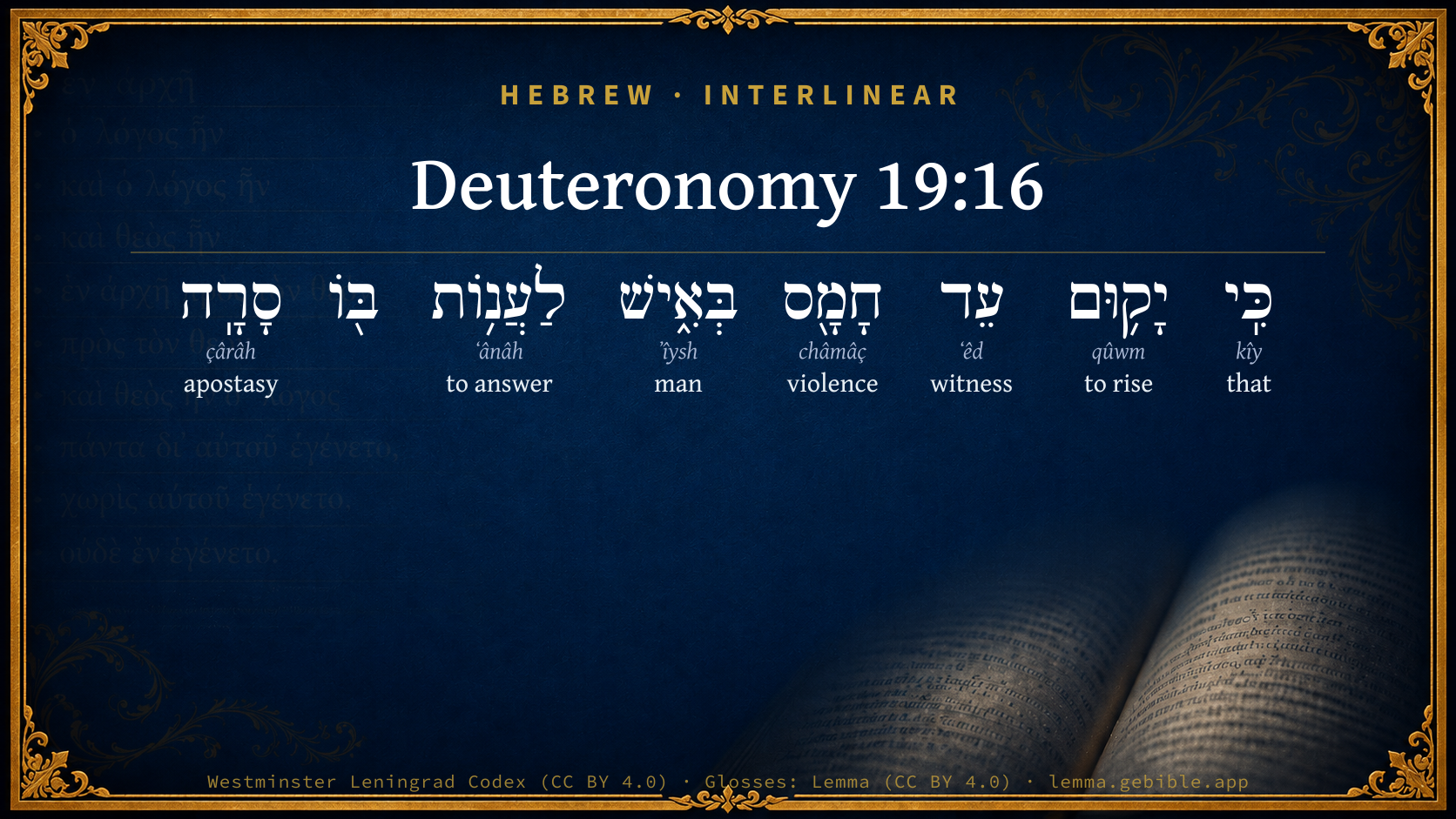
Hebrew (Westminster Leningrad Codex) Deuteronomy 19:16 appears in the Hebrew Old Testament. The text above is from the Westminster Leningrad Codex. Each word links to its Strong’s number, a concise gloss, and parsing drawn from the Open Scriptures Hebrew Bible morphology. Click any word for its full Brown-Driver-Briggs (BDB) entry.
Download image
Cite this verse

Deuteronomy 19:16 (World English Bible). Public Domain. Lemma interlinear Bible study tool, https://lemma.gebible.app/v/deuteronomy/19/16.

Show BibTeX & RIS
BibTeX
RIS
English Translation
If an unrighteous witness rise up against any man to testify against him of wrong-doing,
World English Bible · Public Domain
Download a study sheet

One document with this verse’s original text, its word-by-word gloss line, the meaning frame, cross-references with their text, attributed commentary, and full source and license credits — printable, and it pastes into notes with its structure intact.

This verse Autodidact and up

Study sheet (.html) Plain text (.txt)

A passage Seminary Student

Up to 50 verses in one chapter. A passage sheet keeps up to 6 commentary sources and 12 cross-references per verse, in the order this page ranks them, and says so on the sheet whenever that leaves anything out. Ask for a single verse and you get the Autodidact verse sheet above.

Everything on this page stays free to read, with no account — the sheet is a download of what is already on screen, not access to it.

Want to remove ads? Support Godless Engineer
Compare translations 3

The same verse in 3 English versions, stacked beneath the original-language interlinear above. Click any original word for its lexicon entry.

Each is an independent rendering of the whole verse — the interlinear is not word-aligned to these translations.

Highlighted words mark where these versions differ — a whole-verse word diff, not a word-by-word alignment.

  • World English Bible Public Domain
    If an unrighteous witness rise up against any man to testify against him of wrong-doing,
  • King James Version Public Domain
    If a false witness rise up against any man to testify against him that which is wrong;
  • unfoldingWord Literal Text CC BY-SA 4.0
    If a false witness rises up against a man to testify falsehood against him,

unfoldingWord Literal Text — © unfoldingWord, licensed CC BY-SA 4.0. Word-aligned USFM3 via Door43 (git.door43.org/unfoldingWord/en_ult).

Versions to compare (up to 4)

3 of 4 selected

Show all 18 translations

Every available English version of this verse, each an independent rendering of the whole verse.

  • World English Bible Public Domain
    If an unrighteous witness rise up against any man to testify against him of wrong-doing,
  • Berean Standard Bible Public Domain
    If a false witness testifies against someone, accusing him of a crime,
  • Majority Standard Bible Public Domain
    If a false witness testifies against someone, accusing him of a crime,
  • King James Version Public Domain
    If a false witness rise up against any man to testify against him that which is wrong;
  • American Standard Version (1901) Public Domain
    If an unrighteous witness rise up against any man to testify against him of wrong-doing,
  • Revised Version (1885) Public Domain
    If an unrighteous witness rise up against any man to testify against him of wrong-doing;
  • Geneva Bible (1599) Public Domain
    If a false witnesse rise vp against a man to accuse him of trespasse,
  • Douay-Rheims (1899) Public Domain
    If a lying witness stand against a man, accusing him of transgression,
  • Young's Literal Translation Public Domain
    `When a violent witness doth rise against a man, to testify against him apostacy,
  • Literal Standard Version CC BY-SA 4.0
    When a violent witness rises against a man to testify against him apostasy,
  • Unlocked Literal Bible CC BY-SA 4.0
    Suppose that an unrighteous witness rises up against any man to testify against him of wrongdoing.
  • unfoldingWord Literal Text CC BY-SA 4.0
    If a false witness rises up against a man to testify falsehood against him,
  • Darby Bible Public Domain
    If an unrighteous witness rise up against any man to testify against him of an offence;
  • World Messianic Bible Public Domain
    If an unrighteous witness rises up against any man to testify against him of wrongdoing,
  • Webster's Bible Public Domain
    If a false witness shall rise up against any man to testify against him that which is wrong;
  • Free Bible Version CC BY-SA 4.0
    If someone falsely accuses another person of a crime,
  • Bible in Basic English Public Domain
    If a false witness makes a statement against a man, saying that he has done wrong,
  • JPS Tanakh (1917) Public Domain
    If an unrighteous witness rise up against any man to bear perverted witness against him;

Literal Standard Version (2020), Covenant Press — licensed CC BY-SA 4.0. Text via the HelloAO Bible API (eBible.org). Unlocked Literal Bible (unfoldingWord) — licensed CC BY-SA 4.0. Text via the HelloAO Bible API (eBible.org). unfoldingWord Literal Text — © unfoldingWord, licensed CC BY-SA 4.0. Word-aligned USFM3 via Door43 (git.door43.org/unfoldingWord/en_ult). Free Bible Version, Dr. Jonathan Gallagher — licensed CC BY-SA 4.0. Text via the HelloAO Bible API (eBible.org).

Word by word

More ways to search: Search by grammar → Find every occurrence → Compare this word →

Practice this passage: Drill this verse → Learn its vocabulary →

About this verse

These counts appear in no published source. They are computed here, from the morphology-tagged text and Lemma’s own curated glosses. What Lemma adds →

8
words
7
distinct lemmas
Pentateuch
section

Notable vocabulary

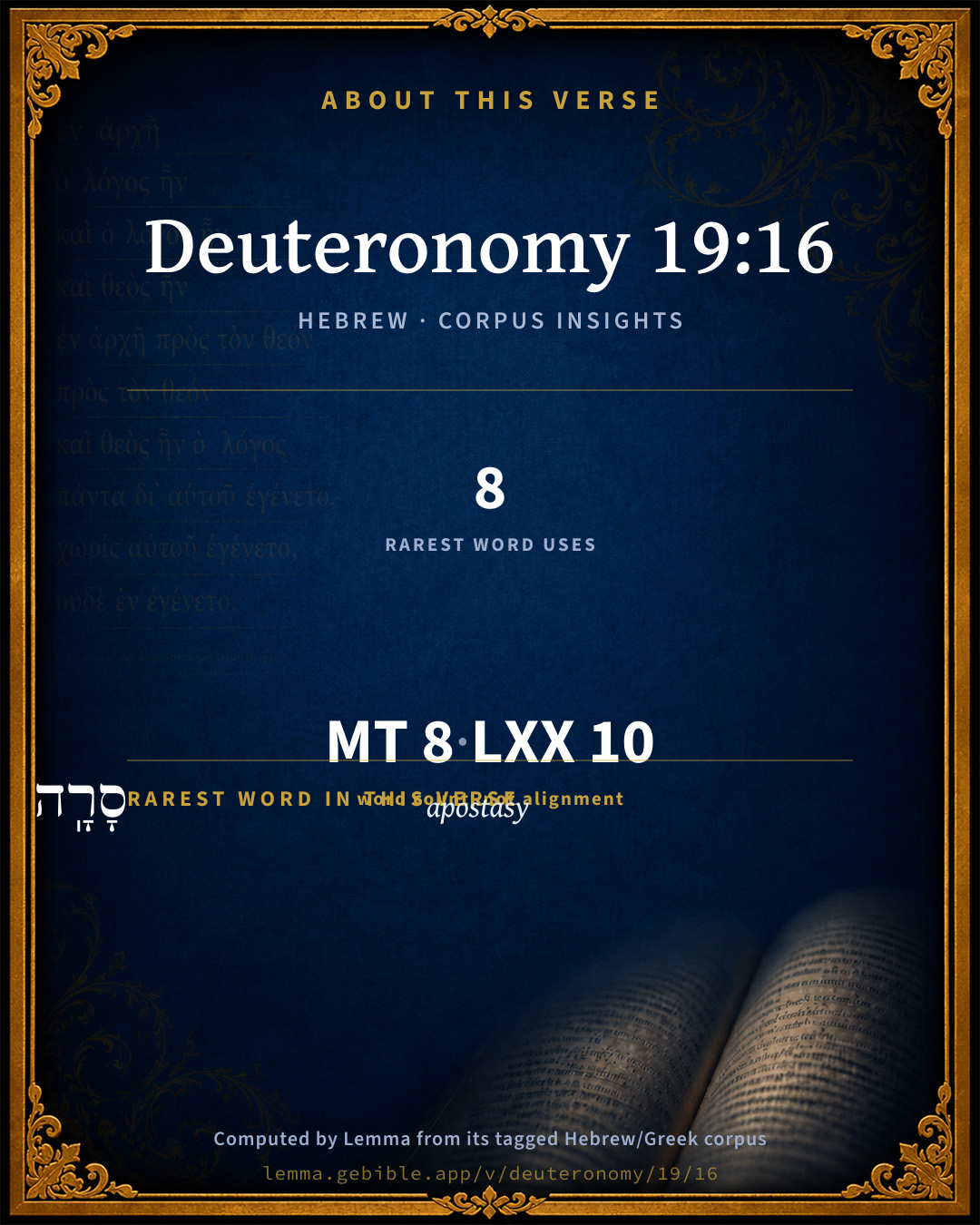
The rarest word here is סָרָֽה apostasy H5627 — appearing just 8 times in the whole Hebrew Bible.

Shared distinctive vocabulary

סָרָֽה apostasy H5627 occurs in 8 verses of the Hebrew Bible. Also found in:

Grammatical profile

  • 2 verbs
  • 4 nouns
  • 1 preposition
  • 1 conjunction

Verb forms

  • יָק֥וּם Qal · Imperfect
  • לַעֲנ֥וֹת Qal · Infinitive Construct

Hebrew & Septuagint length

In English translation the verse runs 15 words from the Hebrew and 14 from the Septuagint (LXX English) — closely comparable.

A rough comparison of the two English renderings, which tokenize alike — not a word-level alignment.

Word counts can differ between the Hebrew and the Greek without any difference in meaning — e.g. the Hebrew direct-object marker אֵת has no separate Greek word, and Greek often adds the article ὁ.

In the original languages it is 8 Hebrew tokens and 10 Greek tokens — but the two are counted differently (Hebrew bundles its prefixes and suffixes into one token; the Greek is in lemma form), so that isn’t a like-for-like length.

Cross-references

6

Topical passages linked to Deuteronomy 19:16 in the Treasury of Scripture Knowledge — connected by theme and wording, ordered by reader-vote popularity; previews shown in the World English Bible.

  • Psalms 27:12 Don't deliver me over to the desire of my adversaries, For false witnesses have risen up against me, Such as breathe out cruelty.
  • Psalms 35:11 Unrighteous witnesses rise up. They ask me about things that I don't know about.
  • Exodus 23:1–7 "You shall not spread a false report. Don't join your hand with the wicked to be a malicious witness.
  • 1 Kings 21:10–13 and set two men, base fellows, before him, and let them testify against him, saying, You did curse God and the king. Then carry him out, and stone him to death.
  • Mark 14:55–59 Now the chief priests and the whole council sought witnesses against Jesus to put him to death, and found none.
  • Acts 6:13 and set up false witnesses who said, "This man never stops speaking blasphemous words against this holy place and the law.

Cross-references courtesy of OpenBible.info (CC BY 4.0).

Hebrew and Greek witnesses Masoretic Hebrew ↔ Greek Septuagint

The same verse in the two great witnesses to the Old Testament, shown verse-for-verse.

These are two independent witnesses, not word-aligned to each other, and the Septuagint is shown in lemma (dictionary) form.

Hebrew Deuteronomy 19:16 Masoretic · Westminster Leningrad Codex

כִּֽי יָק֥וּם עֵד חָמָ֖ס בְּאִ֑ישׁ לַעֲנ֥וֹת בּ֖וֹ סָרָֽה

If an unrighteous witness rise up against any man to testify against him of wrong-doing,

World English Bible · Public Domain

Greek LXX Deuteronomy 19:16 Septuagint · lemma form

ἐάν δέ καταἵστημι μάρτυς ἄδικος κατά ἄνθρωπος καταλέγω αὐτός ἀσέβεια

And if an unjust witness rise up against a man, alleging iniquity against him;

LXX2012 (modern English Septuagint) · Public Domain

On this verse, The Cambridge Bible for Schools and Colleges discusses the Septuagint’s reading. Read the note in Commentary ↓

Hebrew: Westminster Leningrad Codex (CC BY 4.0). Greek: Septuagint (public domain); English from LXX2012 (modern English Septuagint) (Public Domain). How the Septuagint differs from the Hebrew →

Targum (Aramaic paraphrase)

2

The Targum is the ancient Jewish Aramaic paraphrase of the Hebrew Scriptures — an interpretive translation, not the Hebrew text itself. Onkelos (literal) and Pseudo-Jonathan (expansive) render the Torah, and Jonathan the Prophets. Coverage is partial: where no permissively-licensed English translation exists for a verse, only the Aramaic is shown. This is verse-level text, not a word-by-word alignment to the Hebrew.

  1. Targum Onkelos Torah (Genesis–Deuteronomy)
    אֲרֵי יְקוּם סָהִיד שְׁקַר בִּגְבָר לְאַסְהָדָא בֵהּ סַטְּיָא

    (no public-domain English translation for this verse)

    Targum Onkelos — Aramaic: “Onkelos Genesis” (public domain); “Onkelos Exodus” (public domain); “Onkelos Leviticus” (public domain); “Onkelos Numbers” (public domain); “Onkelos Deuteronomy” (public domain). English: “Sefaria Community Translation” (CC0 1.0 (public-domain dedication)); “J.W. Etheridge. The Targums of Onkelos and Jonathan Ben Uzziel on the Pentateuch. London: Longmans, Green, 1862” (public domain). Text via Sefaria.

  2. Targum Pseudo-Jonathan Torah (Genesis–Deuteronomy)
    אֲרוּם יְקוּמוּן סַהֲדִין שִׁיקְרִין בְּבַר נַשׁ לְאַסְהָדָא בֵּיהּ סַטְיָא

    When false witnesses stand up against a man to testify wrong things against him,

    Targum Pseudo-Jonathan — Aramaic: “Targum Jonathan on Genesis” (public domain); “Targum Jonathan on Exodus” (public domain); “Targum Jonathan on Leviticus” (public domain); “Targum Jonathan on Numbers” (public domain); “Targum Jonathan on Deuteronomy” (public domain). English: “The Targum of Jonathan ben Uzziel, trans. J. W. Etheridge, London, 1862” (public domain). Text via Sefaria.

Commentary

Notes on Deuteronomy 19:16 from classic Christian and Jewish commentators (each source and its license shown beneath its notes). The classic Christian expositions comment on the surrounding passage and are grouped to its opening verse, so a note may address several verses; the Jewish commentaries on the Tanakh (Rashi and others) are per-verse, so they appear only where the commentator wrote on this verse.

Lemma curates 59 commentaries, every one of them public domain or Creative Commons licensed, each selected and text-cleaned for this edition rather than reprinted as found. About our sources →

Jamieson, Fausset & Brown

Robert Jamieson, A. R. Fausset & David Brown

PUNISHMENT OF A FALSE WITNESS. (Deu 19:16-21)

But if convicted of perjury, it will be sufficient for his own condemnation, and his punishment shall be exactly the same as would have overtaken the object of his malignant prosecution. (See on Exo 21:23; see also Lev 24:20).

Next: Deuteronomy Chapter 20

Jamieson, Fausset & Brown — Commentary Critical and Explanatory on the Whole Bible (1871) — public domain (CC PDM 1.0). Text via the HelloAO Bible API.

The Cambridge Bible for Schools and Colleges

gen. ed. J. J. S. Perowne

16. But if] So Sam. LXX.

unrighteous witness] Heb. witness of violence. So E, Exo_23:1, and Psa_35:11, apparently one who forces his evidence, does violence to the truth or intends violence to his neighbour. Driver renders malicious, ‘meditates some covert violence himself or assists by false testimony the high-handed wrong doer.’ Marti ‘with whom might goes before right.’ In any case the description is proleptic, his character is not decided till he is taken before the judges.

rise up] See on previous v. In this simpler sense in other Sg. passages; see on Deu_13:1.

to testify against him] Same vb as in Deu_5:20 (17).

wrong doing] Heb. sarah same as rebellion, Deu_13:5 (6) R.V. (cp. Deu_17:17), but while there it means apostacy from Jehovah here it is wider, any delinquency or defection from the law.

The Cambridge Bible for Schools and Colleges (gen. ed. J. J. S. Perowne; Cambridge University Press, 1878–1918) — public domain. Text from a community e-Sword module.

John Gill's Exposition

Then both the men between whom the controversy is,.... The man that bears the false witness, and the man against whom it is borne:

shall stand before the Lord; as in the presence of him, the omniscient God, and as represented by judges and civil magistrates, whose vicegerents they are; so it seems to be explained in the next words, which are exegetical of these:

before the priests and the judges which shall be in those days; which shall compose the sanhedrim, or court of judicature; and this seems to confirm it, that by priest and judge, in Deu 17:9 are meant priests and judges; Jarchi says, this Scripture speaks of witnesses, that is, of the false witness that testifies wrong against a man, and another that contradicts his testimony, and teaches that there is no witness by women; and so it is elsewhere said (a), an oath of witness is made by men, and not by women; on which it is observed (b) that a woman is not fit to bear witness, as it is written:

then both the men,.... men and not women; and the above writer remarks further, that it teaches that they ought to bear testimony standing.

(a) Misn. Shebuot, c. 4. sect. 1. (b) Bartenora in ib.

John Gill's Exposition of the Whole Bible (1746–1763) — public domain (CC PDM 1.0). Text via the HelloAO Bible API.

Albert Barnes' Notes on the Bible

Testify against him that which is wrong - Margin, more literally, “a falling away.” The word is used Deu 13:5 to signify apostasy or revolt; here it is no doubt to be understood in the wider sense of any departure from the Law.

Albert Barnes' Notes on the Bible (1834–1885) — public domain. Text from a community e-Sword/MySword module.

Haydock's Catholic Bible Commentary

Transgression against the law, by apostacy or by idolatry, (Junius) or by any other grievous crime. The person accused might, in this case, be examined, but he could not be condemned unless another witness appeared. Demosthenes (contra Aristocrat.) informs us how (Calmet) the Athenians (Haydock) required the witness in criminal matters, to swear on the flesh of a wild boar, ram, and bull, that he spoke the truth, and to utter horrible imprecations against himself and family, if he did otherwise. (Calmet)

George Leo Haydock (1774–1849), Haydock's Catholic Family Bible and Commentary, 1859 edition — public domain. Excludes Psalms (Douay-Rheims chapter numbering differs from Protestant) and Deuterocanonical books (Catholic canon only).

Matthew Poole's English Annotations

A single witness, though he speak truth, is not to be accepted for the condemnation of another man; but if he be convicted of false witness, this is sufficient for his own condemnation.

Matthew Poole's English Annotations on the Holy Bible (1683–1685) — public domain. Text from a community e-Sword/MySword module.

Whedon's Commentary on the Bible

Daniel D. Whedon

16. A false witness — The general treatment of the subject of bearing false witness is found in the earlier legislation. See Exodus xxiii, 1-3; Lev_19:15-18. But no penalties are assigned to particular cases. Here Moses allows the lex talionis — the law of retaliation — to be applied to those who through malice endeavour to wrong the innocent.

To testify… that which is wrong — The Hebrew word which is here rendered wrong is sometimes used with the significance of apostasy. It is here used in a more extended sense for any violation of law. We might translate the expression to testify against his departure — that is, from the law of Jehovah.

Daniel D. Whedon (gen. ed.), Commentary on the Old and New Testaments (1874–1909) — public domain. Text from a community e-Sword module.

The Pulpit Commentary

To testify against him that which is wrong; literally, to testify against him defection, i.e. from the Law of God. The speaker has apparently in view here all such defections from the Law as would entail punishment on the convicted offender in Deu_13:5, indeed, the crime described here as "that which is wrong" (margin, "falling away") is specially the crime of apostasy to idolatry; but the word (hrs), though usually expressing apostasy from Jehovah, has properly the general sense of a deflection from a prescribed course (from rWs, to go off, to go aside), and so may describe any departure from what is constituted right.

Vers. 16-21. False witness.

God"s brand is here placed upon the crime of false witness. It was to be severely punished. Every one is interested in the suppression of such a crime-the parties whose interests are involved, society at large, the Church, the magistracy, God himself, of one of whose commandments (the ninth) it is the daring violation. The rules here apply primarily to false witness given in courts of justice, but the principles involved may be extended to all forms of the sin.

I FALSE WITNESS IS IN GOD"S SIGHT A GREAT EVIL.

1. It indicates great malevolence.

2. It is grievously unjust and injurious to the person wrongfully accused.

3. It is certain to be taken up and industriously propagated.

A calumny is never wholly wiped out. There are always found some evil-speaking persons disposed to believe and repeat it. It affixes a mark on the injured party which remains on him through life.

II FALSE WITNESS ASSUMES MANY FORMS. It is not confined to law courts, but pervades private life, and appears in the way in which partisans deal with public men and public events. Persons of a malicious and envious disposition, given to detraction, can scarcely avoid it indeed, live in the element of it. Forms of this vice:

1. Deliberate invention and circulation of falsehoods.

2. Innuendo, or suggestio falsi.

3. Suppression of essential circumstancessuppressio veri.

4. The distortion or deceitful coloring of actual facts.

A lie is never so successful as when it can attach itself to a grain of truth

A lie that is all a lie may be met and fought with outright; But a lie that is part of a truth is a harder matter to fight.

III THE FALSE WITNESS BORNE BY ONE AGAINST ANOTHER WILL BE EXPOSED AT GOD"S JUDGMENT SEAT. The two parties he who was accused of bearing false witness and he who alleged himselfto be injured by it were required to appear before the Lord, and to submit their cause to the priests and judges, who acted as his deputies (ver. 17). It was their part to make diligent inquisition, and, if the crime was proved, to award punishment (vers. 18, 19). The punishment was to be on the principle of the lex talionis (vers. 19-21). So, at Christ"s judgment seat, the person who has long lain under an undeserved stigma through the false witness of another may depend on being cleared from wrong, and the wrong-doer will be punished. (Col_3:25) Meanwhile, it is the duty of every one to see to the punishment of this crime, not only in cases of actual perjury, But in every form of it, and not only by legal penalties, but which is the only means that can reach every case by the emphatic reprobation of society, and, where that is possible, by Church censures. J.O.

The Pulpit Commentary (1880–1919), ed. H.D.M. Spence-Jones & Joseph S. Exell — public domain. Text from a community e-Sword module.

John Wesley's Explanatory Notes

A safe witness - A single witness, though he speak truth, is not to be accepted for the condemnation of another man, but if he be convicted of false witness, this is sufficient for his own condemnation.

John Wesley, Explanatory Notes Upon the Whole Bible (1754–1765) — public domain. Text via the GEBible commentary corpus.

Rashi

Rabbi Shlomo Yitzchaki (Rashi)

לענות בו סרה [IF A WITNESS FOR VIOLENCE RISE UP AGAINST A MAN] TO TESTIFY AGAINST HIM סרה — i.e. a thing which does not exist at all; this term is used because this witness is far removed (הוסר) from having anything to do with this testimony. How is this? (Give an example of such a case)?! That two other witnesses say, “But were you not with us on that day (when you say you saw the defendant committing this crime) in such and such a place (different from that where the alleged crime, according to you, has taken place)?!” (Makkot 5a).

Rashi on the Tanakh — English translations: “The Judaica Press complete Tanach with Rashi, translated by A. J. Rosenberg” (CC BY 4.0); “Pentateuch with Rashi's commentary by M. Rosenbaum and A.M. Silbermann, 1929-1934” (public domain); “The Metsudah Tanach series, Lakewood, N.J” (CC BY 4.0); and “The Book of Joshua, Metsudah Publications, 1997” (CC BY 4.0). Text via Sefaria.

Lesson kit

Teaching starters — assembled from the data on this page, not authored interpretation. Every prompt links to the verse data it draws on. Edit before teaching.

Deuteronomy, in the Pentateuch, opens this verse with 8 words (7 distinct Hebrew lemmas). Its most distinctive word is çârâh (“apostasy”). A historical commentator’s framing appears above. Read the whole chapter for the surrounding context.

Discussion questions

  1. How does “apostasy” (çârâh) shape what this verse is saying?
  2. Deuteronomy 13:5 shares the word «apostasy» with this verse. How do the two illuminate each other?
  3. These translations render this verse differently. What is at stake in choosing one wording over another?
  4. The verb «יָק֥וּם» is Qal Imperfect. How does its form color the action?
  5. Reading how Jamieson, Fausset & Brown and The Cambridge Bible for Schools and Colleges read this verse, where do the two commentators agree and where do they part?

Things to notice

Reading settings

Reading text

Shown beneath each verse's original-language words.

Old Testament
Old Testament edition

Read the OT as the Masoretic Hebrew (MT) or the Greek Septuagint (LXX).

English shown for the Greek Septuagint (in the Hebrew ↔ Greek comparison).

Comparing translations? Open the Compare panel on any verse page to stack up to four side by side.