
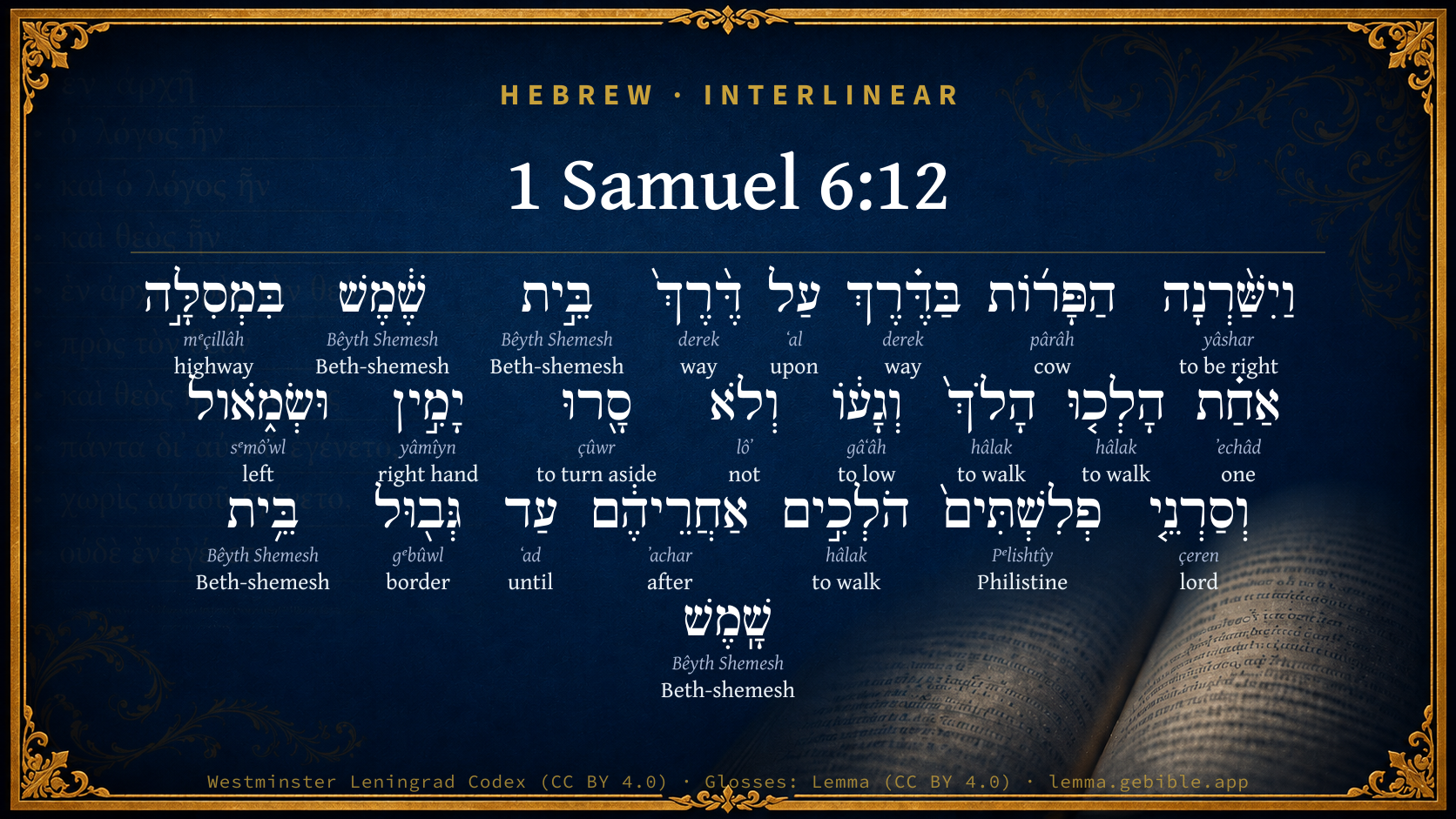
1 Samuel 6:12

Hebrew (Westminster Leningrad Codex) 1 Samuel 6:12 appears in the Hebrew Old Testament. The text above is from the Westminster Leningrad Codex. Each word links to its Strong’s number, a concise gloss, and parsing drawn from the Open Scriptures Hebrew Bible morphology. Click any word for its full Brown-Driver-Briggs (BDB) entry.
Download image
Cite this verse

1 Samuel 6:12 (World English Bible). Public Domain. Lemma interlinear Bible study tool, https://lemma.gebible.app/v/1-samuel/6/12.

Show BibTeX & RIS
BibTeX
RIS
English Translation
The cattle took the straight way by the way to Beth-shemesh; they went along the highway, lowing as they went, and didn't turn aside to the right hand or to the left; and the lords of the Philistines went after them to the border of Beth-shemesh.
World English Bible · Public Domain
Highlights
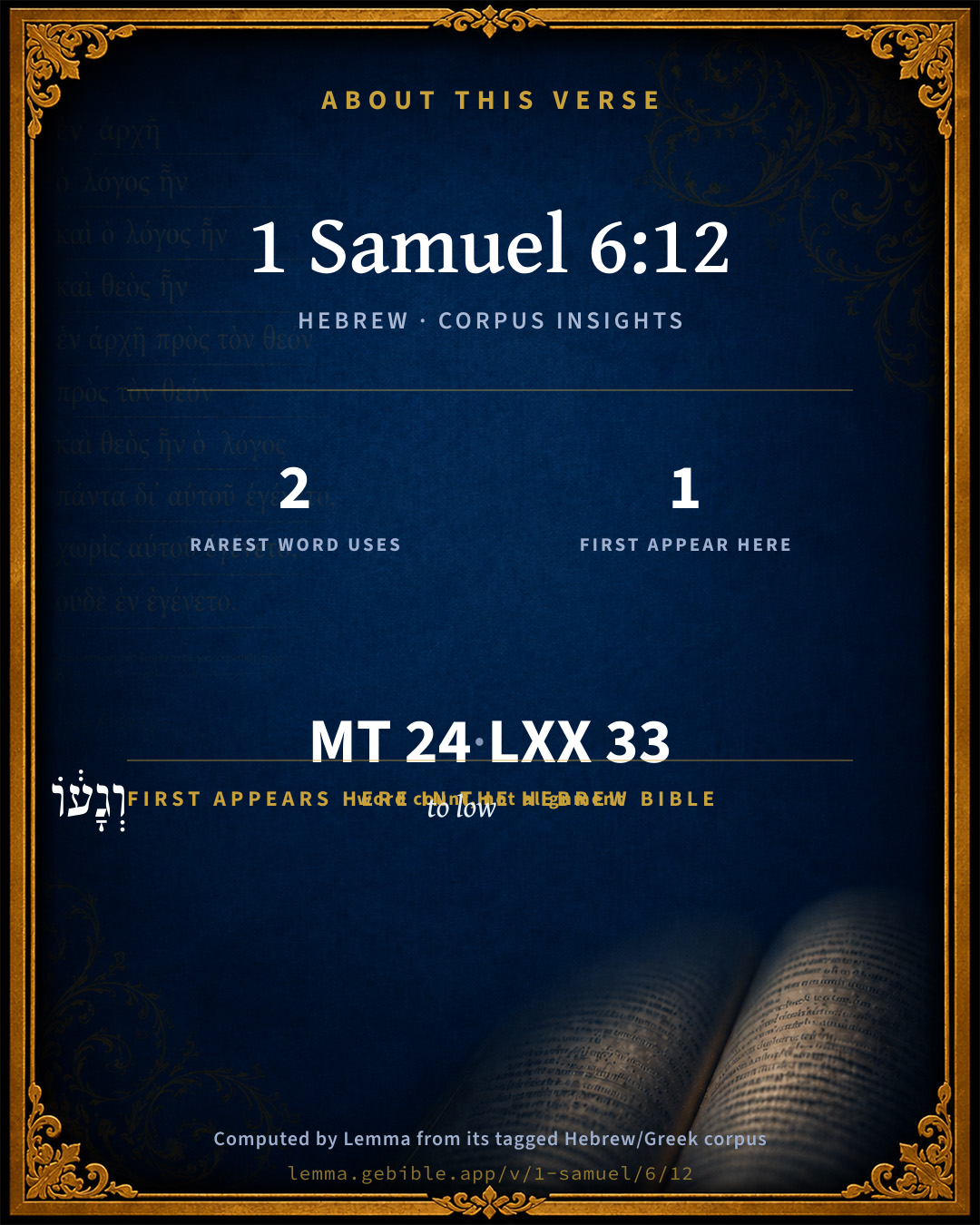
  • 1 first appearance in the Hebrew Bible
Full analysis ↓
Download a study sheet

One document with this verse’s original text, its word-by-word gloss line, the meaning frame, cross-references with their text, attributed commentary, and full source and license credits — printable, and it pastes into notes with its structure intact.

This verse Autodidact and up

Study sheet (.html) Plain text (.txt)

A passage Seminary Student

Up to 50 verses in one chapter. A passage sheet keeps up to 6 commentary sources and 12 cross-references per verse, in the order this page ranks them, and says so on the sheet whenever that leaves anything out. Ask for a single verse and you get the Autodidact verse sheet above.

Everything on this page stays free to read, with no account — the sheet is a download of what is already on screen, not access to it.

Want to remove ads? Support Godless Engineer
Compare translations 3

The same verse in 3 English versions, stacked beneath the original-language interlinear above. Click any original word for its lexicon entry.

Each is an independent rendering of the whole verse — the interlinear is not word-aligned to these translations.

Highlighted words mark where these versions differ — a whole-verse word diff, not a word-by-word alignment.

  • World English Bible Public Domain
    The cattle took the straight way by the way to Beth-shemesh; they went along the highway, lowing as they went, and didn't turn aside to the right hand or to the left; and the lords of the Philistines went after them to the border of Beth-shemesh.
  • King James Version Public Domain
    And the kine took the straight way to the way of Bethshemesh, and went along the highway, lowing as they went, and turned not aside to the right hand or to the left; and the lords of the Philistines went after them unto the border of Bethshemesh.
  • unfoldingWord Literal Text CC BY-SA 4.0
    And the cows went straight in the way on the way of Beth Shemesh. They went in one path, going and lowing, and they did not turn the right or the left. And the lords of the Philistines were going after them unto the border of Beth Shemesh.

unfoldingWord Literal Text — © unfoldingWord, licensed CC BY-SA 4.0. Word-aligned USFM3 via Door43 (git.door43.org/unfoldingWord/en_ult).

Versions to compare (up to 4)

3 of 4 selected

Show all 18 translations

Every available English version of this verse, each an independent rendering of the whole verse.

  • World English Bible Public Domain
    The cattle took the straight way by the way to Beth-shemesh; they went along the highway, lowing as they went, and didn't turn aside to the right hand or to the left; and the lords of the Philistines went after them to the border of Beth-shemesh.
  • Berean Standard Bible Public Domain
    And the cows headed straight up the road toward Beth-shemesh, staying on that one highway and lowing as they went, never straying to the right or to the left. The rulers of the Philistines followed behind them to the border of Beth-shemesh.
  • Majority Standard Bible Public Domain
    And the cows headed straight up the road toward Beth-shemesh, staying on that one highway and lowing as they went, never straying to the right or to the left. The rulers of the Philistines followed behind them to the border of Beth-shemesh.
  • King James Version Public Domain
    And the kine took the straight way to the way of Bethshemesh, and went along the highway, lowing as they went, and turned not aside to the right hand or to the left; and the lords of the Philistines went after them unto the border of Bethshemesh.
  • American Standard Version (1901) Public Domain
    And the kine took the straight way by the way to Beth-shemesh; they went along the highway, lowing as they went, and turned not aside to the right hand or to the left; and the lords of the Philistines went after them unto the border of Beth-shemesh.
  • Revised Version (1885) Public Domain
    And the kine took the straight way by the way to Beth-shemesh; they went along the highway, lowing as they went, and turned not aside to the right hand or to the left; and the lords of the Philistines went after them unto the border of Beth-shemesh.
  • Geneva Bible (1599) Public Domain
    And the kine went the streight way to Beth-shemesh, and kept one path and lowed as they went, and turned neither to the right hand nor to the left: also the Princes of the Philistims went after them, vnto the borders of Beth-shemesh.
  • Douay-Rheims (1899) Public Domain
    And the kine took the straight way that leadeth to Bethsames, and they went along the way, lowing as they went: and turned not aside neither to the right hand nor to the left: and the lords of the Philistines followed them as far as the borders of Bethsames.
  • Young's Literal Translation Public Domain
    And the kine go straight in the way, on the way to Beth-Shemesh, in one highway they have gone, going and lowing, and have not turned aside right or left; and the princes of the Philistines are going after them unto the border of Beth-Shemesh.
  • Literal Standard Version CC BY-SA 4.0
    And the cows go straight in the way, on the way to Beth-Shemesh, they have gone in one highway, going and lowing, and have not turned aside right or left; and the princes of the Philistines are going after them to the border of Beth-Shemesh.
  • Unlocked Literal Bible CC BY-SA 4.0
    The cows went straight in the direction of Beth Shemesh. They went along one highway, lowing as they went, and they did not turn aside either to the right or to the left. The rulers of the Philistines followed after them to the border of Beth Shemesh.
  • unfoldingWord Literal Text CC BY-SA 4.0
    And the cows went straight in the way on the way of Beth Shemesh. They went in one path, going and lowing, and they did not turn the right or the left. And the lords of the Philistines were going after them unto the border of Beth Shemesh.
  • Darby Bible Public Domain
    And the kine went straight forward on the way to Beth-shemesh; they went by the one high way, lowing as they went; and they turned not aside to the right hand or to the left; and the lords of the Philistines went after them as far as the border of Beth-shemesh.
  • World Messianic Bible Public Domain
    The cows took the straight way by the way to Beth Shemesh. They went along the highway, lowing as they went, and didn’t turn away to the right hand or to the left; and the lords of the Philistines went after them to the border of Beth Shemesh.
  • Webster's Bible Public Domain
    And the cows took the straight way to the way of Beth-shemesh, and went along the highway, lowing as they went, and turned not aside to the right hand or to the left; and the lords of the Philistines went after them to the border of Beth-shemesh.
  • Free Bible Version CC BY-SA 4.0
    The cows went straight up the road to Beth-shemesh, lowing as they went, going directly on the main road and not turning either left or right. The Philistine rulers followed them all the way to the border of Beth-shemesh.
  • Bible in Basic English Public Domain
    And the cows took the straight way, by the road to Beth-shemesh; they went by the highway, not turning to the right or to the left, and the sound of their voices was clear on the road; and the lords of the Philistines went after them as far as the edge of Beth-shemesh.
  • JPS Tanakh (1917) Public Domain
    And the kine took the straight way by the way to Beth-shemesh; they went along the highway, lowing as they went, and turned not aside to the right hand or to the left; and the lords of the Philistines went after them unto the border of Beth-shemesh.

Literal Standard Version (2020), Covenant Press — licensed CC BY-SA 4.0. Text via the HelloAO Bible API (eBible.org). Unlocked Literal Bible (unfoldingWord) — licensed CC BY-SA 4.0. Text via the HelloAO Bible API (eBible.org). unfoldingWord Literal Text — © unfoldingWord, licensed CC BY-SA 4.0. Word-aligned USFM3 via Door43 (git.door43.org/unfoldingWord/en_ult). Free Bible Version, Dr. Jonathan Gallagher — licensed CC BY-SA 4.0. Text via the HelloAO Bible API (eBible.org).

Word by word

More ways to search: Search by grammar → Find every occurrence → Compare this word →

Practice this passage: Drill this verse → Learn its vocabulary →

וְגָע֔וֹ
gâʻâh
H1600
“and · to low”
Conjunction + Verb, Qal, Infinitive Absolute
Part of Speech
Conjunction + Verb
Stem
Qal
Form
Infinitive Absolute
Full BDB Definition

Origin: a primitive root

TWOT: 368

(Qal) to low, bellow (of cattle)
  1. וַיִשַּׁ֨רְנָה yâshar H3474 “and · to be right” Conjunction + Verb, Qal, Sequential Imperfect, 3rd Person, Feminine, Plural
  2. הַפָּר֜וֹת pârâh H6510 “the · cows” Particle, Definite Article + Noun, Common, Feminine, Plural, Absolute
  3. בַּדֶּ֗רֶךְ derek H1870 “in/at the · way” Preposition, Determined + Noun, Common, Both, Singular, Absolute
  4. עַל ʻal H5921 “upon” Preposition
  5. דֶּ֨רֶךְ֙ derek H1870 “way of” Noun, Common, Both, Singular, Construct
  6. בֵּ֣ית Bêyth Shemesh H1053 “Beth-shemesh” Noun, Proper
  7. שֶׁ֔מֶשׁ Bêyth Shemesh H1053 “Beth-shemesh” Noun, Proper
  8. בִּמְסִלָּ֣ה mᵉçillâh H4546 “in/at · highway” Preposition + Noun, Common, Feminine, Singular, Absolute
  9. אַחַ֗ת ʼechâd H259 “one” Adjective, Cardinal number, Feminine, Singular, Absolute
  10. הָלְכ֤וּ hâlak H1980 “to walk” Verb, Qal, Perfect, 3rd Person, Common, Plural
  11. הָלֹךְ֙ hâlak H1980 “to walk” Verb, Qal, Infinitive Absolute
  12. וְלֹא lôʼ H3808 “and · not” Conjunction + Particle, Negative
  13. סָ֖רוּ çûwr H5493 “to turn aside” Verb, Qal, Perfect, 3rd Person, Common, Plural
  14. יָמִ֣ין yâmîyn H3225 “right hand” Noun, Common, Feminine, Singular, Absolute
  15. וּשְׂמֹ֑אול sᵉmôʼwl H8040 “and · left” Conjunction + Noun, Common, Masculine, Singular, Absolute
  16. וְסַרְנֵ֤י çeren H5633 “and · lords of” Conjunction + Noun, Common, Masculine, Plural, Construct
  17. פְלִשְׁתִּים֙ Pᵉlishtîy H6430 “Philistines” Noun, Gentilic, Masculine, Plural, Absolute
  18. הֹלְכִ֣ים hâlak H1980 “walking” Verb, Qal, Participle Active, Masculine, Plural, Absolute
  19. אַחֲרֵיהֶ֔ם ʼachar H310 “after · them” Preposition + Suffix, Personal, 3rd Person, Masculine, Plural
  20. עַד ʻad H5704 “until” Preposition
  21. גְּב֖וּל gᵉbûwl H1366 “border of” Noun, Common, Masculine, Singular, Construct
  22. בֵּ֥ית Bêyth Shemesh H1053 “Beth-shemesh” Noun, Proper
  23. שָֽׁמֶשׁ Bêyth Shemesh H1053 “Beth-shemesh” Noun, Proper

About this verse

These counts appear in no published source. They are computed here, from the morphology-tagged text and Lemma’s own curated glosses. What Lemma adds →

24
words
18
distinct lemmas
Historical
section

Notable vocabulary

The rarest word here is וְגָע֔וֹ to low H1600 — appearing just 2 times in the whole Hebrew Bible.

First appearance in Scripture

This word makes its first canonical appearance in the Hebrew Bible here:

  • וְגָע֔וֹ to low H1600

Shared distinctive vocabulary

וְגָע֔וֹ to low H1600 occurs in 2 verses of the Hebrew Bible. Also found in:

Grammatical profile

  • 6 verbs
  • 13 nouns
  • 1 adjective
  • 3 prepositions
  • 1 particle

Verb forms

  • וַיִשַּׁ֨רְנָה Qal · Sequential Imperfect
  • הָלְכ֤וּ Qal · Perfect
  • הָלֹךְ֙ Qal · Infinitive Absolute
  • וְגָע֔וֹ Qal · Infinitive Absolute
  • סָ֖רוּ Qal · Perfect
  • הֹלְכִ֣ים Qal · Participle Active

Repetition

Words recur within this verse — often emphatic in Hebrew:

  • בֵּ֣ית Beth-shemesh H1053 ×4
  • הָלְכ֤וּ to walk H1980 ×3
  • בַּדֶּ֗רֶךְ way H1870 ×2

Hebrew & Septuagint length

In English translation the verse runs 46 words from the Hebrew and 48 from the Septuagint (LXX English) — closely comparable.

A rough comparison of the two English renderings, which tokenize alike — not a word-level alignment.

Word counts can differ between the Hebrew and the Greek without any difference in meaning — e.g. the Hebrew direct-object marker אֵת has no separate Greek word, and Greek often adds the article ὁ.

In the original languages it is 24 Hebrew tokens and 33 Greek tokens — but the two are counted differently (Hebrew bundles its prefixes and suffixes into one token; the Greek is in lemma form), so that isn’t a like-for-like length.

Cross-references

1

Topical passages linked to 1 Samuel 6:12 in the Treasury of Scripture Knowledge — connected by theme and wording, ordered by reader-vote popularity; previews shown in the World English Bible.

  • Numbers 20:19 The children of Israel said to him, We will go up by the highway; and if we drink of your water, I and my cattle, then will I give the price of it: let me only, without [doing] anything [else], pass through on my feet.

Cross-references courtesy of OpenBible.info (CC BY 4.0).

Hebrew and Greek witnesses Masoretic Hebrew ↔ Greek Septuagint

The same verse in the two great witnesses to the Old Testament, shown verse-for-verse.

These are two independent witnesses, not word-aligned to each other, and the Septuagint is shown in lemma (dictionary) form.

Hebrew 1 Samuel 6:12 Masoretic · Westminster Leningrad Codex

וַיִשַּׁ֨רְנָה הַפָּר֜וֹת בַּדֶּ֗רֶךְ עַל דֶּ֨רֶךְ֙ בֵּ֣ית שֶׁ֔מֶשׁ בִּמְסִלָּ֣ה אַחַ֗ת הָלְכ֤וּ הָלֹךְ֙ וְגָע֔וֹ וְלֹא סָ֖רוּ יָמִ֣ין וּשְׂמֹ֑אול וְסַרְנֵ֤י פְלִשְׁתִּים֙ הֹלְכִ֣ים אַחֲרֵיהֶ֔ם עַד גְּב֖וּל בֵּ֥ית שָֽׁמֶשׁ

The cattle took the straight way by the way to Beth-shemesh; they went along the highway, lowing as they went, and didn't turn aside to the right hand or to the left; and the lords of the Philistines went after them to the border of Beth-shemesh.

World English Bible · Public Domain

Greek LXX 1 Samuel 6:12 Septuagint · lemma form

καί καταεὐθύνω ὁ βοῦς ἐν ὁ ὁδός εἰς ὁδός βαιθσαμυς ἐν τρίβος εἷς πορεύομαι καί κοπιάω καί οὐ μεταἵστημι δεξιός οὐδέ ἀριστερός καί ὁ σατράπης ὁ ἀλλόφυλος πορεύομαι ὀπίσω αὐτός ἕως ὅριον βαιθσαμυς

And the cows went straight on the way to the way of Baethsamys, they went along one track; and laboured, and turned not aside to the right hand or to the left, and the lords of the Philistines went after it as far as the coasts of Baethsamys.

LXX2012 (modern English Septuagint) · Public Domain

Hebrew: Westminster Leningrad Codex (CC BY 4.0). Greek: Septuagint (public domain); English from LXX2012 (modern English Septuagint) (Public Domain). How the Septuagint differs from the Hebrew →

Targum (Aramaic paraphrase)

1

The Targum is the ancient Jewish Aramaic paraphrase of the Hebrew Scriptures — an interpretive translation, not the Hebrew text itself. Onkelos (literal) and Pseudo-Jonathan (expansive) render the Torah, and Jonathan the Prophets. Coverage is partial: where no permissively-licensed English translation exists for a verse, only the Aramaic is shown. This is verse-level text, not a word-by-word alignment to the Hebrew.

  1. Targum Jonathan Prophets (Joshua–Malachi)
    וְאַכְוֵינָא תּוֹרָתָא בְּאָרְחָא עַל אוֹרַח בֵּית שֶׁמֶשׁ בִּכְבִישָׁא חֲדָא אָזְלִין מֵיזַל וְנָעַיָן וְלָא סְטָאָה לְיַמִינָא וְלִסְמְאָלָא וְטוּרְנֵי פְלִשְׁתָּאֵי אָזְלִין בַּתְרֵיהוֹן עַד תְּחוּם בֵּית שֶׁמֶשׁ:

    (no public-domain English translation for this verse)

    Targum Jonathan — Aramaic: “Mikraot Gedolot” (public domain). English: “Sefaria Community Translation” (CC0 1.0 (public-domain dedication)); “London "Chaldee Paraphrase," 1871” (public domain). Text via Sefaria.

Commentary

Notes on 1 Samuel 6:12 from classic Christian and Jewish commentators (each source and its license shown beneath its notes). The classic Christian expositions comment on the surrounding passage and are grouped to its opening verse, so a note may address several verses; the Jewish commentaries on the Tanakh (Rashi and others) are per-verse, so they appear only where the commentator wrote on this verse.

Lemma curates 59 commentaries, every one of them public domain or Creative Commons licensed, each selected and text-cleaned for this edition rather than reprinted as found. About our sources →

Trapp's Complete Commentary

John Trapp

1Sa 6:12 And the kine took the straight way to the way of Bethshemesh, [and] went along the highway, lowing as they went, and turned not aside [to] the right hand or [to] the left; and the lords of the Philistines went after them unto the border of Bethshemesh.

Ver. 12. And the kine took the straight way.] So far did God, as it were, gratify these idolaters in a thing that so much concerned his own glory, and the comfort of his poor people, who now looked upon themselves as forlorn and forsaken of him.

Lowing as they went.] In token of grief for leaving their young ones: but all creatures "continue according to thine ordinance," saith David, "for they all are thy servants." {Psa 119:91} Let not us draw God’s ark, bear Christ’s yoke, lowing and lamenting, but lively and cheerful, "ready to every good work." {Tit 3:1} Melior est sancta laetitia quam querula quasi tristitia, saith an ancient.

And the lords of the Philistines went after them.] And so, as servants and pages they attend upon the ark, which erst as conquerors they carried captive. This was the Lord’s own work, and should have been marvellous in their eyes.

John Trapp, A Commentary or Exposition upon All the Books of the Old and New Testament (1647–1656) — public domain. Text from a community e-Sword module.

The Biblical Illustrator

Joseph S. Exell

1Sa_6:12

Lowing as they went.

The heart going toward heaven

How many, many times have men gone by their tears to the gate of heaven who never could have been drawn there by the mere presentation of truth. As the kine went lowing with the ark, so the heart goes lowing toward heaven, seeking its own, and finding them, in hope, in imagination, and resting only when by faith it is brought again consciously near to them in the kingdom of the Eternal Father. (H. W. Beecher.)

The Biblical Illustrator, edited by Joseph S. Exell (c. 1880s–1900s) — public domain. Text from a community e-Sword module.

Joseph Benson's Commentary

1Sa 6:12. The kine took the straight way to Beth-shemesh — Though they had no driver, nor visible director, and had such strong attractives to draw them back, and there were so many other ways in which they might have gone. Lowing as they went — After their calves, which had been taken from them; and hereby evidencing at once both their natural and vehement inclination to their calves, and the supernatural power which overruled them to a contrary course. The lords went — To prevent all imposture, and to get assurance of the truth of the event. All which circumstances tended to the greater illustration of God’s glory.

Joseph Benson's Commentary on the Old and New Testaments (1811–1818) — public domain. Text from a community e-Sword module.

Geneva Bible (1599)

Geneva Bible translators

For the trial of the matter.

Geneva Bible (1599) marginal notes — public domain. Text via Bolls.life.

Jamieson, Fausset & Brown

Robert Jamieson, A. R. Fausset & David Brown

the lords of the Philistines went after them--to give their tribute of homage, to prevent imposture, and to obtain the most reliable evidence of the truth. The result of this journey tended to their own deeper humiliation, and the greater illustration of God's glory.

Jamieson, Fausset & Brown — Commentary Critical and Explanatory on the Whole Bible (1871) — public domain (CC PDM 1.0). Text via the HelloAO Bible API.

Adam Clarke's Commentary

Verse 12. Lowing as they went] Calling for their calves.

To the right hand or to the left] Some think they were placed where two roads met; one going to Ekron, the other to Beth-shemesh. It is possible that they were put in such circumstances as these for the greater certainty of the affair: to have turned from their own homes, from their calves and known pasture, and to have taken the road to a strange country, must argue supernatural influence.

The lords of the Philistines went after] They were so jealous in this business that they would trust no eyes but their own. All this was wisely ordered, that there might be the fullest conviction of the being and interposition of God.

Adam Clarke's Commentary on the Bible (1810–1826) — public domain. Text from a community e-Sword/MySword module.

Ellicott's Commentary for English Readers

(12) Went along the highway, lowing.—But the dumb beasts did what the idol priests and diviners scarcely considered possible, for God’s hand drove them. The narrative here throughout is evidently unadorned, very easy and natural, and speaks of primitive customs, telling its story of the Divine interference of the “Glorious Arm” with exquisite simplicity and truth.

The dumb beasts went on their strange way with their golden burden, the princes of the Philistines following them, awe-struck, at a distance.

A Bible Commentary for English Readers, edited by Charles John Ellicott (1878–1897) — public domain. Text from a community e-Sword module.

The Cambridge Bible for Schools and Colleges

gen. ed. J. J. S. Perowne

10–18. The plan carried out and the Ark restored to Israel

12. took the straight way to the way of Beth-skemesh] Better, went straight forward on the road to Beth-shemesh.

lowing as they went] For their lost calves.

The Cambridge Bible for Schools and Colleges (gen. ed. J. J. S. Perowne; Cambridge University Press, 1878–1918) — public domain. Text from a community e-Sword module.

John Gill's Exposition

And the kine took the straight way to the way of Bethshemesh,.... Though they had none to drive, lead, or guide them, yet they steered their course to the road that led to Bethshemesh, though there were other ways they might have taken; which shows they were under the direction of God himself:

and went along the highway; or, "in one highway", or "post" (t); though they had never been used to a yoke, they drew together in one path; and did not draw one way, and another another, as oxen unaccustomed to a yoke do:

lowing as they went; on account of their calves, which showed their sense of them, and their natural affection for them; and yet went on, did not attempt to go back to them; by which it was plain they were under a supernatural influence:

and turned not aside to the right or to the left; when other ways presented, on the right hand or on the left; they kept going straight on in the road that led to the place they were destined for; all which can be reckoned nothing less than a miracle:

and the lords of the Philistines went after them unto the border of Bethshemesh; not before them to guide them, or on the side of the ark to take care of it, but behind: and not at all out of respect and reverence to it, but to see what would be the issue of things, whether it would turn out an imposture or not; and that they might be able to make a true judgment of what had befallen them, as their priests and diviners had directed them to; they followed it until it was out of their territories, and in the hands of the Israelites. This place Bethshemesh is thought by some, as R. Isaiah observes, to be the same with Timnathheres, where Joshua was buried, in Jdg 2:9, which signifies the figure of the sun, as this does the house of the sun; and where, perhaps, when inhabited by the Canaanites, was a temple of the sun; and it was, according to Bunting (u), twelve miles from Ekron, from whence the ark came; and so far it was followed by the Philistines. This was a city given to the Levites, and so a proper place for the ark to come to be taken care of; hence mention is made of Levites that took it down from the cart, Sa1 6:15; see Gill on Jos 21:16.

(t) "in via elata una", Montanus; "eadem semita", Tigurine version; so Junius & Tremellius, Piscator. (u) Travels of the Patriarchs, &c. p. 123.

John Gill's Exposition of the Whole Bible (1746–1763) — public domain (CC PDM 1.0). Text via the HelloAO Bible API.

Albert Barnes' Notes on the Bible

Lowing as they went - Milking cows had been chosen on purpose to make the sign more significant. Nature would obviously dispose the cows to go toward their calves; their going in an opposite direction was therefore plainly a divine impulse overruling their natural inclination. And this is brought out more distinctly by the mention of their lowing, which was caused by their remembering their calves.

And the lords ... - This circumstance of the five satraps of the Philistines accompanying the ark in person both made it impossible for the Israelites to practice any deceit (compare Mat 27:63-66), and is also a striking testimony to the agitation caused among the Philistines by the plagues inflicted on them since the ark had been in their country.

Albert Barnes' Notes on the Bible (1834–1885) — public domain. Text from a community e-Sword/MySword module.

Haydock's Catholic Bible Commentary

CHAPTER VI.

George Leo Haydock (1774–1849), Haydock's Catholic Family Bible and Commentary, 1859 edition — public domain. Excludes Psalms (Douay-Rheims chapter numbering differs from Protestant) and Deuterocanonical books (Catholic canon only).

Matthew Poole's English Annotations

To the way of Beth-shemesh, i.e. leading to Beth-shemesh, a city of the priests, Jos 21:16, who were by office to take care of it.

Lowing as they went; testifying at once both their natural and vehement inclination to their calves, and the supernatural and Divine power which overruled them to a contrary course.

The lords of the Philistines went after them, under pretence of an honourable dismission of it; but in truth, to prevent all imposture, and to get assurance of the truth of the event; all which circumstances tended to their greater confusion, and illustration of God’s glory.

Matthew Poole's English Annotations on the Holy Bible (1683–1685) — public domain. Text from a community e-Sword/MySword module.

Whedon's Commentary on the Bible

Daniel D. Whedon

12. The kine took the straight way — Literally, were straight in the way on the way of Beth-shemesh, in a highway they continued going and lowing. This wondrous sign was evidence, beyond all possibility of doubt, that it was Jehovah’s hand that had smitten Philistia, her people, and her gods.

The lords of the Philistines went after them — Their eyes had never witnessed a sight like this before, and they were anxious to see it to the end.

Daniel D. Whedon (gen. ed.), Commentary on the Old and New Testaments (1874–1909) — public domain. Text from a community e-Sword module.

The Pulpit Commentary

The kine took the straight way. The Hebrew brings out the directness with which the heifers took the route to Beth-shemesh very forcibly. It says, "And the kine went straight in the way upon the way to Beth-shemesh; they went along one highway, lowing as they went," i.e. they went in one direct course, without deviating from it. Nevertheless, their continual lowing showed the great stress that was laid upon their nature in being thus compelled to separate themselves from their calves. And the lords of the Philistines went after them. Ie. behind them, leaving the kine free to go where they chose. The usual position of the driver of an ox cart in the East is in front. Conder ("Tent Work," 1:274) describes the view up the great corn valley of Sorek to the high and rugged hills above as extremely picturesque, and this it is, he adds, which was spread before the eyes of the five lords of the Philistines as they followed the lowing oxen which bore the ark on the "straight way" from Ekron to Beth-shemesh. The ruins of the latter place, he says, lie on a knoll surrounded by olive trees, near the junction of the valley of Sorek with the great gorge which bounded Judah on the north.

The Pulpit Commentary (1880–1919), ed. H.D.M. Spence-Jones & Joseph S. Exell — public domain. Text from a community e-Sword module.

John Wesley's Explanatory Notes

Beth-shemesh - A city of the priests, who were by office to take care of it. Loving - Testifying at once both their natural and vehement inclination to their calves, and the supernatural power which over-ruled them to a contrary course. The lords went - To prevent all imposture, and to get assurance of the truth of the event. All which circumstances tended to the greater illustration of God's glory.

John Wesley, Explanatory Notes Upon the Whole Bible (1754–1765) — public domain. Text via the GEBible commentary corpus.

Rashi

Rabbi Shlomo Yitzchaki (Rashi)

Set on a straight course. This word is a grammatical hermaphrodite. This teaches us that even the young recited a song, "Sing aloud, sing aloud, O Ark of acacia wood! Exalt yourself…" as stated in Maseches Avodah Zorah. According to its simple meaning, 'וַיִשַּׁרְנָה' is an expression meaning 'straight,' i.e. they followed a straight path.

Lowing as they walked. This is an expression of the cry [גְּעִיָה] of cattle.

Beis Shemesh. Yisroel was there.

Rashi on the Tanakh — English translations: “The Judaica Press complete Tanach with Rashi, translated by A. J. Rosenberg” (CC BY 4.0); “Pentateuch with Rashi's commentary by M. Rosenbaum and A.M. Silbermann, 1929-1934” (public domain); “The Metsudah Tanach series, Lakewood, N.J” (CC BY 4.0); and “The Book of Joshua, Metsudah Publications, 1997” (CC BY 4.0). Text via Sefaria.

Lesson kit

Teaching starters — assembled from the data on this page, not authored interpretation. Every prompt links to the verse data it draws on. Edit before teaching.

1 Samuel, in the Historical, opens this verse with 24 words (18 distinct Hebrew lemmas). Its most distinctive word is gâʻâh (“to low”). A historical commentator’s framing appears above. Read the whole chapter for the surrounding context.

Discussion questions

  1. The word gâʻâh carries the sense “to low.” How does it shape the verse?
  2. This is the first place “to low” appears in Scripture (first appears here). What does its debut here establish?
  3. How does Job 6:5, which shares the word «to low», read alongside this verse?
  4. What does the repetition of “Beth-shemesh” (4× in this one verse) do in this verse?
  5. The translations on this page render this verse differently — a whole-verse word diff, not a word-by-word alignment. What might account for the different wordings?
  6. «וַיִשַּׁ֨רְנָה» is a Qal Sequential Imperfect verb. How does that grammatical form shape the action described?
  7. Compare how Trapp's Complete Commentary and The Biblical Illustrator read this verse. Where do they agree or differ?

Things to notice

Reading settings

Reading text

Shown beneath each verse's original-language words.

Old Testament
Old Testament edition

Read the OT as the Masoretic Hebrew (MT) or the Greek Septuagint (LXX).

English shown for the Greek Septuagint (in the Hebrew ↔ Greek comparison).

Comparing translations? Open the Compare panel on any verse page to stack up to four side by side.