Judges 9:29

Hebrew (Westminster Leningrad Codex) Judges 9:29 appears in the Hebrew Old Testament. The text above is from the Westminster Leningrad Codex. Each word links to its Strong’s number, a concise gloss, and parsing drawn from the Open Scriptures Hebrew Bible morphology. Click any word for its full Brown-Driver-Briggs (BDB) entry.
Download image
Cite this verse

Judges 9:29 (World English Bible). Public Domain. Lemma interlinear Bible study tool, https://lemma.gebible.app/v/judges/9/29.

Show BibTeX & RIS
BibTeX
RIS
English Translation
Would that this people were under my hand! then would I remove Abimelech. He said to Abimelech, Increase your army, and come out.
World English Bible · Public Domain
Download a study sheet

One document with this verse’s original text, its word-by-word gloss line, the meaning frame, cross-references with their text, attributed commentary, and full source and license credits — printable, and it pastes into notes with its structure intact.

This verse Autodidact and up

Study sheet (.html) Plain text (.txt)

A passage Seminary Student

Up to 50 verses in one chapter. A passage sheet keeps up to 6 commentary sources and 12 cross-references per verse, in the order this page ranks them, and says so on the sheet whenever that leaves anything out. Ask for a single verse and you get the Autodidact verse sheet above.

Everything on this page stays free to read, with no account — the sheet is a download of what is already on screen, not access to it.

Want to remove ads? Support Godless Engineer
Compare translations 3

The same verse in 3 English versions, stacked beneath the original-language interlinear above. Click any original word for its lexicon entry.

Each is an independent rendering of the whole verse — the interlinear is not word-aligned to these translations.

Highlighted words mark where these versions differ — a whole-verse word diff, not a word-by-word alignment.

  • World English Bible Public Domain
    Would that this people were under my hand! then would I remove Abimelech. He said to Abimelech, Increase your army, and come out.
  • King James Version Public Domain
    And would to God this people were under my hand! then would I remove Abimelech. And he said to Abimelech, Increase thine army, and come out.
  • unfoldingWord Literal Text CC BY-SA 4.0
    Now who will give this people into my hand? Then I would remove Abimelech.” And he said to Abimelech, “Increase your army and come out.”

unfoldingWord Literal Text — © unfoldingWord, licensed CC BY-SA 4.0. Word-aligned USFM3 via Door43 (git.door43.org/unfoldingWord/en_ult).

Versions to compare (up to 4)

3 of 4 selected

Show all 18 translations

Every available English version of this verse, each an independent rendering of the whole verse.

  • World English Bible Public Domain
    Would that this people were under my hand! then would I remove Abimelech. He said to Abimelech, Increase your army, and come out.
  • Berean Standard Bible Public Domain
    If only this people were under my authority, I would remove Abimelech; I would say to him, ‘Muster your army and come out!’”
  • Majority Standard Bible Public Domain
    If only this people were under my authority, I would remove Abimelech; I would say to him, ‘Muster your army and come out!’”
  • King James Version Public Domain
    And would to God this people were under my hand! then would I remove Abimelech. And he said to Abimelech, Increase thine army, and come out.
  • American Standard Version (1901) Public Domain
    And would that this people were under my hand! then would I remove Abimelech. And he said to Abimelech, Increase thine army, and come out.
  • Revised Version (1885) Public Domain
    And would to God this people were under my hand! then would I remove Abimelech. And he said to Abimelech, Increase thine army, and come out.
  • Geneva Bible (1599) Public Domain
    Now would God this people were vnder mine hand: then would I put away Abimelech. And he said to Abimelech, Increase thine army, and come out.
  • Douay-Rheims (1899) Public Domain
    Would to God that some man would put this people under my hand, that I might remove Abimelech out of the way. And it was said to Abimelech: Gather together the multitude of an army, and come.
  • Young's Literal Translation Public Domain
    and oh that this people were in my hand -- then I turn Abimelech aside;' and he saith to Abimelech, `Increase thy host, and come out.'
  • Literal Standard Version CC BY-SA 4.0
    And oh that this people were in my hand—then I turn Abimelech aside”; and he says to Abimelech, “Increase your host, and come out.”
  • Unlocked Literal Bible CC BY-SA 4.0
    I wish that this people were under my command! Then would I remove Abimelech. I would say to Abimelech, 'Call out all your army.'”
  • unfoldingWord Literal Text CC BY-SA 4.0
    Now who will give this people into my hand? Then I would remove Abimelech.” And he said to Abimelech, “Increase your army and come out.”
  • Darby Bible Public Domain
    Would that this people were under my hand! then I would remove Abim'elech. I would say to Abim'elech, 'Increase your army, and come out.'"
  • World Messianic Bible Public Domain
    I wish that this people were under my hand! Then I would remove Abimelech.” He said to Abimelech, “Increase your army and come out!”
  • Webster's Bible Public Domain
    And would that this people were under my hand! then would I remove Abimelech. And he said to Abimelech, Increase thy army, and come out.
  • Free Bible Version CC BY-SA 4.0
    If I was the one in charge of you people, I would dispose of Abimelech! I would tell him, ‘Get your army together, and come and fight!’”
  • Bible in Basic English Public Domain
    If only I had authority over this people! I would put Abimelech out of the way, and I would say to Abimelech, Make your army strong, and come out.
  • JPS Tanakh (1917) Public Domain
    And would that this people were under my hand! then would I remove Abimelech.' And he said to Abimelech: 'Increase thine army, and come out.'

Literal Standard Version (2020), Covenant Press — licensed CC BY-SA 4.0. Text via the HelloAO Bible API (eBible.org). Unlocked Literal Bible (unfoldingWord) — licensed CC BY-SA 4.0. Text via the HelloAO Bible API (eBible.org). unfoldingWord Literal Text — © unfoldingWord, licensed CC BY-SA 4.0. Word-aligned USFM3 via Door43 (git.door43.org/unfoldingWord/en_ult). Free Bible Version, Dr. Jonathan Gallagher — licensed CC BY-SA 4.0. Text via the HelloAO Bible API (eBible.org).

Word by word

More ways to search: Search by grammar → Find every occurrence → Compare this word →

Practice this passage: Drill this verse → Learn its vocabulary →

אֲבִימֶ֑לֶךְ
ʼĂbîymelek
H40
“Abimelech”
Noun, Proper
Part of Speech
Noun
Type
Proper
Full BDB Definition

Origin: from H1 and H4428

TWOT: None

Abimelech = "Melek is father" or " my father is king" - king of Gerar in Abraham's time - king of Gath in David's time; maybe title of Philistine kings - son of Gideon by a concubine - priest, son of Abiathar
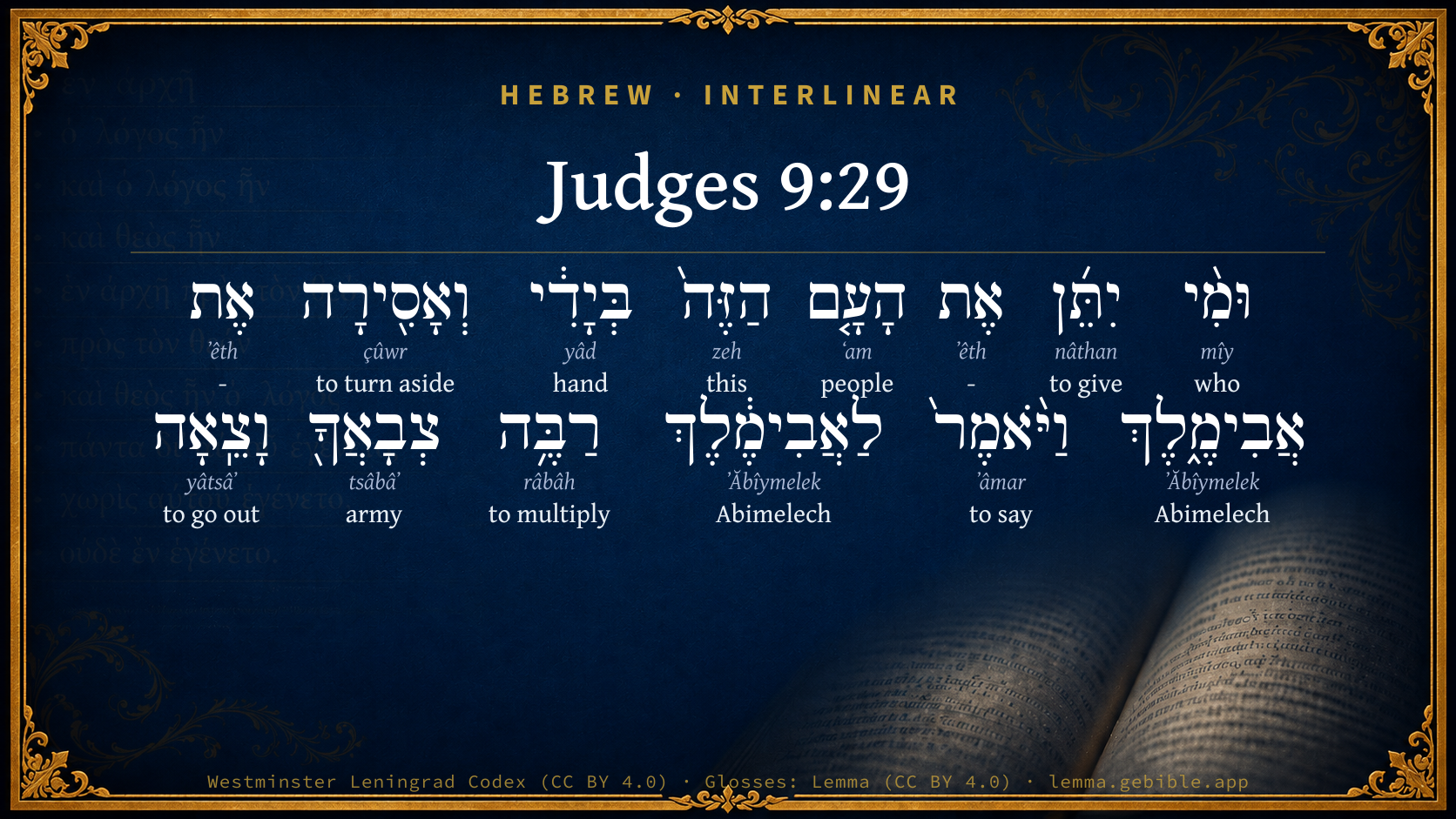
  1. וּמִ֨י mîy H4310 “and · who” Conjunction + Particle, Interrogative
  2. יִתֵּ֜ן nâthan H5414 “to give” Verb, Qal, Imperfect, 3rd Person, Masculine, Singular
  3. אֶת ʼêth H853 “-” Particle, Direct Object
  4. הָעָ֤ם ʻam H5971 “the · people” Particle, Definite Article + Noun, Common, Masculine, Singular, Absolute
  5. הַזֶּה֙ zeh H2088 “the · this” Particle, Definite Article + Pronoun, Demonstrative, Masculine, Singular
  6. בְּיָדִ֔י yâd H3027 “in/at · hand · my” Preposition + Noun, Common, Both, Singular, Construct + Suffix, Personal, 1st Person, Common, Singular
  7. וְאָסִ֖ירָה çûwr H5493 “and · to turn aside” Conjunction + Verb, Hiphil, Imperfect, 1st Person, Common, Singular
  8. אֶת ʼêth H853 “-” Particle, Direct Object
  9. וַיֹּ֨אמֶר֙ ʼâmar H559 “and · to say” Conjunction + Verb, Qal, Sequential Imperfect, 3rd Person, Masculine, Singular
  10. לַאֲבִימֶ֔לֶךְ ʼĂbîymelek H40 “to/for · Abimelech” Preposition + Noun, Proper
  11. רַבֶּ֥ה râbâh H7235 “multiply” Verb, Piel, Imperative, 2nd Person, Masculine, Singular
  12. צְבָאֲךָ֖ tsâbâʼ H6635 “army · your” Noun, Common, Both, Singular, Construct + Suffix, Personal, 2nd Person, Masculine, Singular
  13. וָצֵֽאָה yâtsâʼ H3318 “and · go out” Conjunction + Verb, Qal, Imperative, 2nd Person, Masculine, Singular + Suffix, h

About this verse

These counts appear in no published source. They are computed here, from the morphology-tagged text and Lemma’s own curated glosses. What Lemma adds →

14
words
12
distinct lemmas
Historical
section

Grammatical profile

  • 5 verbs
  • 5 nouns
  • 1 pronoun
  • 3 particles

Verb forms

  • יִתֵּ֜ן Qal · Imperfect
  • וְאָסִ֖ירָה Hiphil · Imperfect
  • וַיֹּ֨אמֶר֙ Qal · Sequential Imperfect
  • רַבֶּ֥ה Piel · Imperative
  • וָצֵֽאָה Qal · Imperative

Repetition

A word recurs within this verse — often emphatic in Hebrew:

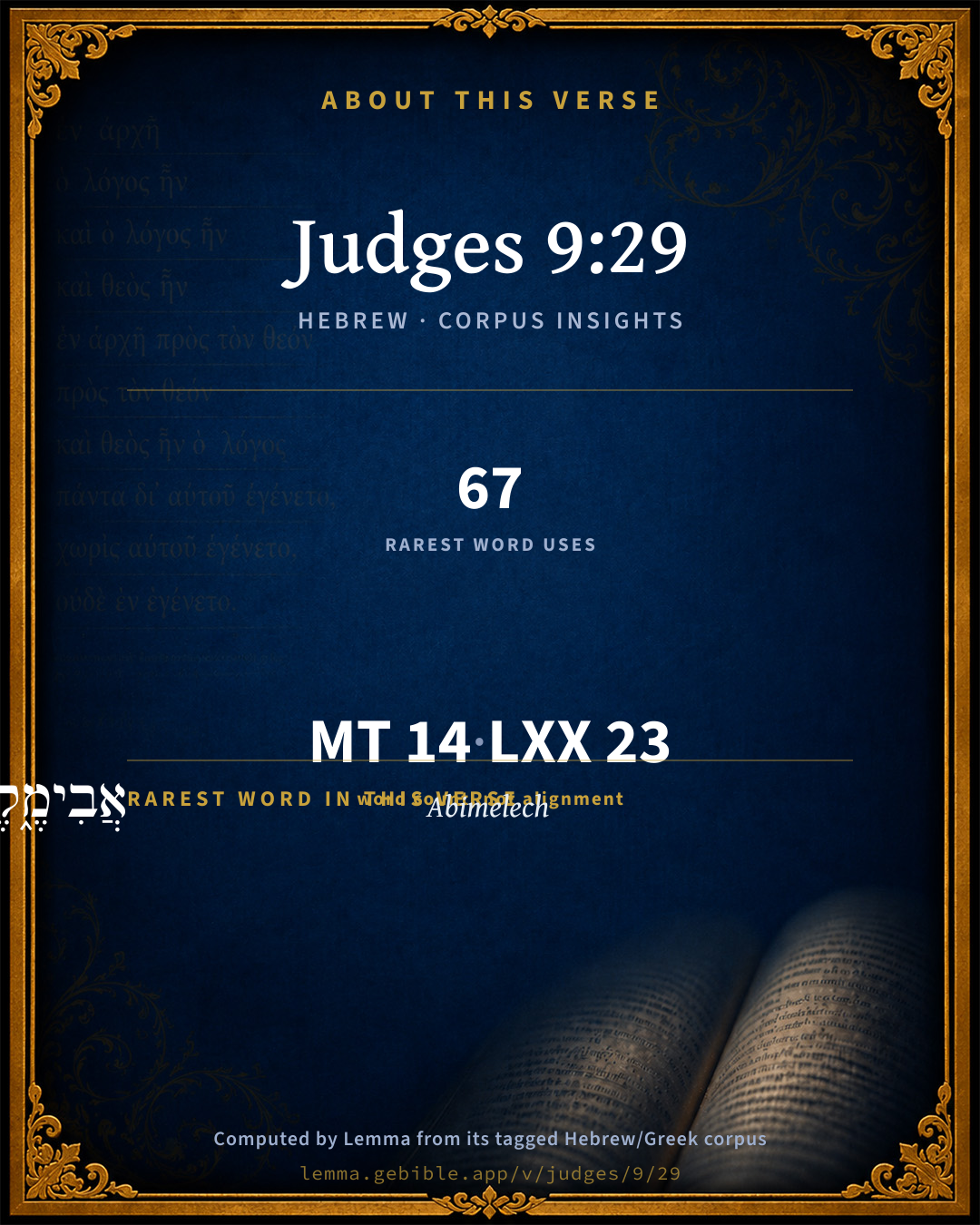
  • אֲבִימֶ֑לֶךְ Abimelech H40 ×2

Hebrew & Septuagint length

In English translation the verse runs 23 words from the Hebrew and 26 from the Septuagint (LXX English) — closely comparable.

A rough comparison of the two English renderings, which tokenize alike — not a word-level alignment.

Word counts can differ between the Hebrew and the Greek without any difference in meaning — e.g. the Hebrew direct-object marker אֵת has no separate Greek word, and Greek often adds the article ὁ.

In the original languages it is 14 Hebrew tokens and 23 Greek tokens — but the two are counted differently (Hebrew bundles its prefixes and suffixes into one token; the Greek is in lemma form), so that isn’t a like-for-like length.

Cross-references

8

Topical passages linked to Judges 9:29 in the Treasury of Scripture Knowledge — connected by theme and wording, ordered by reader-vote popularity; previews shown in the World English Bible.

  • 2 Samuel 15:4 Absalom said moreover, Oh that I were made judge in the land, that every man who has any suit or cause might come to me, and I would do him justice!
  • 2 Samuel 2:14–17 Abner said to Joab, Please let the young men arise and play before us. Joab said, Let them arise.
  • 1 Kings 20:11 The king of Israel answered, Tell him, Don't let him who girds on [his armor] boast himself as he who puts it off.
  • 2 Kings 14:8 Then Amaziah sent messengers to Jehoash, the son of Jehoahaz son of Jehu, king of Israel, saying, Come, let us look one another in the face.
  • 2 Kings 18:23 Now therefore, Please give pledges to my master the king of Assyria, and I will give you two thousand horses, if you are able on your part to set riders on them.
  • Psalms 10:3 For the wicked boasts of his heart's cravings, He blesses the greedy, and condemns Yahweh.
  • Isaiah 36:8–9 Now therefore, please give pledges to my master the king of Assyria, and I will give you two thousand horses, if you are able on your part to set riders on them.
  • Romans 1:30–31 backbiters, hateful to God, insolent, haughty, boastful, inventors of evil things, disobedient to parents,

Cross-references courtesy of OpenBible.info (CC BY 4.0).

Hebrew and Greek witnesses Masoretic Hebrew ↔ Greek Septuagint

The same verse in the two great witnesses to the Old Testament, shown verse-for-verse.

These are two independent witnesses, not word-aligned to each other, and the Septuagint is shown in lemma (dictionary) form.

Hebrew Judges 9:29 Masoretic · Westminster Leningrad Codex

וּמִ֨י יִתֵּ֜ן אֶת הָעָ֤ם הַזֶּה֙ בְּיָדִ֔י וְאָסִ֖ירָה אֶת אֲבִימֶ֑לֶךְ וַיֹּ֨אמֶר֙ לַאֲבִימֶ֔לֶךְ רַבֶּ֥ה צְבָאֲךָ֖ וָצֵֽאָה

Would that this people were under my hand! then would I remove Abimelech. He said to Abimelech, Increase your army, and come out.

World English Bible · Public Domain

Greek LXX Judges 9:29 Septuagint · lemma form

καί τίς δίδωμι ὁ λαός οὗτος ἐν χείρ ἐγώ καί μεταἵστημι ὁ αβιμελεχ καί εἶπον πρός αὐτός πληθύνω ὁ δύναμις σύ καί ἐκἔρχομαι

And would that this people were under my hand! then would I remove Abimelech, and I would say to him, Multiply your host, and come out.

LXX2012 (modern English Septuagint) · Public Domain

On this verse, The Cambridge Bible for Schools and Colleges discusses the Septuagint’s reading. Read the note in Commentary ↓

Hebrew: Westminster Leningrad Codex (CC BY 4.0). Greek: Septuagint (public domain); English from LXX2012 (modern English Septuagint) (Public Domain). How the Septuagint differs from the Hebrew →

Targum (Aramaic paraphrase)

1

The Targum is the ancient Jewish Aramaic paraphrase of the Hebrew Scriptures — an interpretive translation, not the Hebrew text itself. Onkelos (literal) and Pseudo-Jonathan (expansive) render the Torah, and Jonathan the Prophets. Coverage is partial: where no permissively-licensed English translation exists for a verse, only the Aramaic is shown. This is verse-level text, not a word-by-word alignment to the Hebrew.

  1. Targum Jonathan Prophets (Joshua–Malachi)
    וּמַן יִמְסַר יַת עַמָא הָדֵין בִּידִי וְאַעֲדִי יַת אֲבִימֶלֶךְ וַאֲמַר לַאֲבִימֶלֶךְ טַקֵיס יַת מַשִׁרְיָתָךְ וּפוּק:

    (no public-domain English translation for this verse)

    Targum Jonathan — Aramaic: “Mikraot Gedolot” (public domain). English: “Sefaria Community Translation” (CC0 1.0 (public-domain dedication)); “London "Chaldee Paraphrase," 1871” (public domain). Text via Sefaria.

Commentary

Notes on Judges 9:29 from classic Christian and Jewish commentators (each source and its license shown beneath its notes). The classic Christian expositions comment on the surrounding passage and are grouped to its opening verse, so a note may address several verses; the Jewish commentaries on the Tanakh (Rashi and others) are per-verse, so they appear only where the commentator wrote on this verse.

Lemma curates 59 commentaries, every one of them public domain or Creative Commons licensed, each selected and text-cleaned for this edition rather than reprinted as found. About our sources →

Trapp's Complete Commentary

John Trapp

Jdg 9:29 And would to God this people were under my hand! then would I remove Abimelech. And he said to Abimelech, Increase thine army, and come out.

Ver. 29. And would to God this people, &c.] This is the very voice of these quorum bibulas animas ambitionis possidet salsugo; witness Absalom, Julius Caesar, Phocas, &c.

And he said to Abimelech.] Who perhaps heard him not, or else he sent him a challenge. We have those that in their mad mood dare say as much to death: who yet when death comes indeed, cannot look him in the face with blood in their cheeks.

John Trapp, A Commentary or Exposition upon All the Books of the Old and New Testament (1647–1656) — public domain. Text from a community e-Sword module.

Joseph Benson's Commentary

Jdg 9:29. Under my hand — That is, under my command; I wish you would unanimously submit to me, as your captain and governor; for he found them divided; and some of them inclining toward Abimelech, whom they had lately rejected, according to the levity of the popular humour. I would remove — As you have driven him out of your city, I would drive him out of your country. He said — He sent this message or challenge to him. Increase thine army — I desire not to surprise thee at any disadvantage; strengthen thyself as much as thou canst, and come out into the open field, that thou and I may decide it by our arms.

Joseph Benson's Commentary on the Old and New Testaments (1811–1818) — public domain. Text from a community e-Sword module.

Geneva Bible (1599)

Geneva Bible translators

Braggingly, as though he had been present, or to his captain Zebul.

Geneva Bible (1599) marginal notes — public domain. Text via Bolls.life.

Adam Clarke's Commentary

Verse 29. Would to God this people were under my hand] The very words and conduct of a sly, hypocritical demagogue.

Increase thine army, and come out.] When he found his party strong, and the public feeling warped to his side, then he appears to have sent a challenge to Abimelech, to come out and fight him.

Adam Clarke's Commentary on the Bible (1810–1826) — public domain. Text from a community e-Sword/MySword module.

Ellicott's Commentary for English Readers

(29) Would to God this people were under my hand !—Comp. 2Sa_15:4.

And he said to Abimelech.—The “he said” may be the impersonal idiom (comp. Jos_7:26, &c.), meaning “it was told” (Vulg., Dictum est). It is less likely that “he” means Zebul, or that it is Gaal’s drunken vaunt to the absent Abimelech. Another reading is, “And I would say to Abimelech,” &c.

A Bible Commentary for English Readers, edited by Charles John Ellicott (1878–1897) — public domain. Text from a community e-Sword module.

The Cambridge Bible for Schools and Colleges

gen. ed. J. J. S. Perowne

29. And he said] Read with a slight change and I would say, so LXX; cf. Jdg_9:38.

The Cambridge Bible for Schools and Colleges (gen. ed. J. J. S. Perowne; Cambridge University Press, 1878–1918) — public domain. Text from a community e-Sword module.

John Gill's Exposition

And when Zebul the ruler of the city,.... Whom Abimelech had placed there under him: heard

the words of Gaal the son of Ebed, his anger was kindled; because he spoke slightly of him, and wished to have his place; perhaps before Zebul was inclined to be on the side of the Shechemites against Abimelech, or at least dissembled that he was; but now, being incensed at the words of Gaal, determined to take the side of Abimelech, and let him know how things were carrying on against him.

John Gill's Exposition of the Whole Bible (1746–1763) — public domain (CC PDM 1.0). Text via the HelloAO Bible API.

Matthew Poole's English Annotations

Under my hand, i.e. under my command; I wish you would unanimously submit to me, as your captain and governor; for he found them divided, and some of them hearkening after Abimelech, whom they had lately rejected, according to the levity of the popular humour.

Then would I remove Abimelech; as you have driven him out of your city, I would drive him out of your country.

He said to Abimelech; he sent this message or challenge to him, I desire not to surprise thee at any disadvantage; strengthen thyself as much as thou canst, and come out into the open field, that thou and I may decide it by our arms.

Matthew Poole's English Annotations on the Holy Bible (1683–1685) — public domain. Text from a community e-Sword/MySword module.

Whedon's Commentary on the Bible

Daniel D. Whedon

29. Under my hand — The boastful language of one who yearns for political power. Compare 2Sa_15:4.

Increase thine army — The noisy swaggerer, heated with wine, and still more intoxicated with the thirst for power, boldly challenges Abimelech to battle.

Daniel D. Whedon (gen. ed.), Commentary on the Old and New Testaments (1874–1909) — public domain. Text from a community e-Sword module.

The Pulpit Commentary

And would to God, etc., i.e. "If you will only trust me as your leader, I will soon remove Abimelech, and then you can have a national government." It seems that the people at once closed with his offer, and, thus emboldened, he sent a challenge to Abimelech to come out and fight him.

The Pulpit Commentary (1880–1919), ed. H.D.M. Spence-Jones & Joseph S. Exell — public domain. Text from a community e-Sword module.

John Wesley's Explanatory Notes

My hand - That is, under my command; I wish you would unanimously submit to me, as your captain and governor; for he found them divided; and some of them hearkening after Abimelech, whom they had lately rejected, according to the levity of the popular humour. I would remove - As you have driven him out of your city, I would drive him out of your country. He said - He sent this message or challenge to him. Increase thine army - I desire not to surprise thee at any disadvantage; strengthen thyself as much as thou canst, and come out into the open field, that thou and I may decide it by our arms.

John Wesley, Explanatory Notes Upon the Whole Bible (1754–1765) — public domain. Text via the GEBible commentary corpus.

Rashi

Rabbi Shlomo Yitzchaki (Rashi)

He said: For Avimelech. Ga'al declared in the presence of Zevul, "Tell Avimelech."

Beef up your army and come on out from your place, and let us see how grand you are!

Rashi on the Tanakh — English translations: “The Judaica Press complete Tanach with Rashi, translated by A. J. Rosenberg” (CC BY 4.0); “Pentateuch with Rashi's commentary by M. Rosenbaum and A.M. Silbermann, 1929-1934” (public domain); “The Metsudah Tanach series, Lakewood, N.J” (CC BY 4.0); and “The Book of Joshua, Metsudah Publications, 1997” (CC BY 4.0). Text via Sefaria.

Lesson kit

Teaching starters — assembled from the data on this page, not authored interpretation. Every prompt links to the verse data it draws on. Edit before teaching.

Judges, in the Historical, opens this verse with 14 words (12 distinct Hebrew lemmas). Its most distinctive word is ʼĂbîymelek (“Abimelech”). A historical commentator’s framing appears above. Read the whole chapter for the surrounding context.

Discussion questions

  1. How does “Abimelech” (ʼĂbîymelek) shape what this verse is saying?
  2. 2 Samuel 15:4 shares this passage’s theme. How do the two illuminate each other?
  3. “Abimelech” occurs 2× in this one verse. What is the effect of the repetition?
  4. The translations on this page render this verse differently — a whole-verse word diff, not a word-by-word alignment. What might account for the different wordings?
  5. The verb «יִתֵּ֜ן» is Qal Imperfect. How does its form color the action?
  6. Reading how Trapp's Complete Commentary and Joseph Benson's Commentary read this verse, where do the two commentators agree and where do they part?

Things to notice

Reading settings

Reading text

Shown beneath each verse's original-language words.

Old Testament
Old Testament edition

Read the OT as the Masoretic Hebrew (MT) or the Greek Septuagint (LXX).

English shown for the Greek Septuagint (in the Hebrew ↔ Greek comparison).

Comparing translations? Open the Compare panel on any verse page to stack up to four side by side.