2 Samuel 7:15

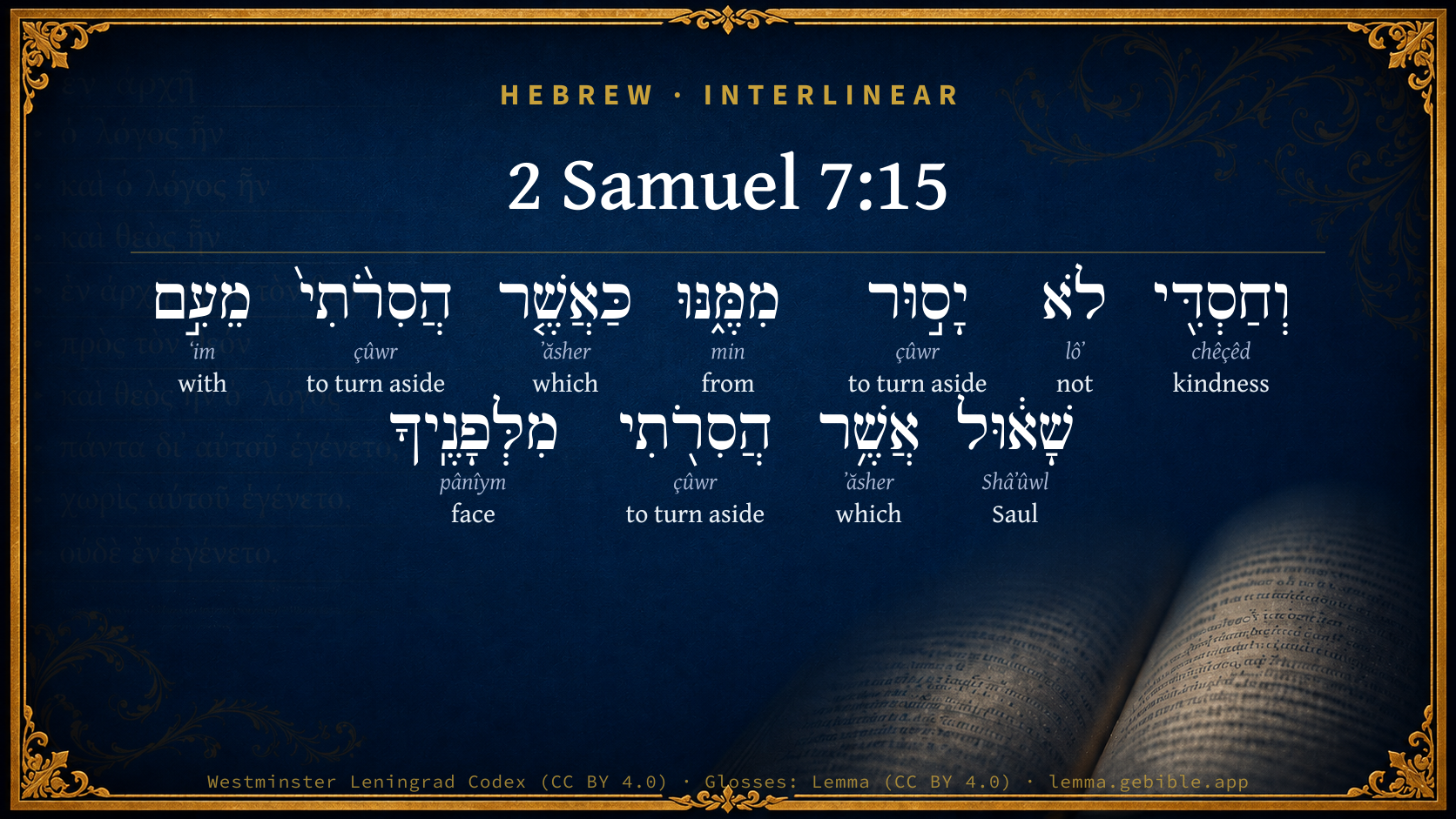
Hebrew (Westminster Leningrad Codex) 2 Samuel 7:15 appears in the Hebrew Old Testament. The text above is from the Westminster Leningrad Codex. Each word links to its Strong’s number, a concise gloss, and parsing drawn from the Open Scriptures Hebrew Bible morphology. Click any word for its full Brown-Driver-Briggs (BDB) entry.
Download image
Cite this verse

2 Samuel 7:15 (World English Bible). Public Domain. Lemma interlinear Bible study tool, https://lemma.gebible.app/v/2-samuel/7/15.

Show BibTeX & RIS
BibTeX
RIS
English Translation
but my loving kindness shall not depart from him, as I took it from Saul, whom I put away before you.
World English Bible · Public Domain
Download a study sheet

One document with this verse’s original text, its word-by-word gloss line, the meaning frame, cross-references with their text, attributed commentary, and full source and license credits — printable, and it pastes into notes with its structure intact.

This verse Autodidact and up

Study sheet (.html) Plain text (.txt)

A passage Seminary Student

Up to 50 verses in one chapter. A passage sheet keeps up to 6 commentary sources and 12 cross-references per verse, in the order this page ranks them, and says so on the sheet whenever that leaves anything out. Ask for a single verse and you get the Autodidact verse sheet above.

Everything on this page stays free to read, with no account — the sheet is a download of what is already on screen, not access to it.

Want to remove ads? Support Godless Engineer
Compare translations 3

The same verse in 3 English versions, stacked beneath the original-language interlinear above. Click any original word for its lexicon entry.

Each is an independent rendering of the whole verse — the interlinear is not word-aligned to these translations.

Highlighted words mark where these versions differ — a whole-verse word diff, not a word-by-word alignment.

  • World English Bible Public Domain
    but my loving kindness shall not depart from him, as I took it from Saul, whom I put away before you.
  • King James Version Public Domain
    But my mercy shall not depart away from him, as I took it from Saul, whom I put away before thee.
  • unfoldingWord Literal Text CC BY-SA 4.0
    But my covenant faithfulness will not turn away from you as I turned it away from with Saul, whom I turned away from your face.

unfoldingWord Literal Text — © unfoldingWord, licensed CC BY-SA 4.0. Word-aligned USFM3 via Door43 (git.door43.org/unfoldingWord/en_ult).

Versions to compare (up to 4)

3 of 4 selected

Show all 18 translations

Every available English version of this verse, each an independent rendering of the whole verse.

  • World English Bible Public Domain
    but my loving kindness shall not depart from him, as I took it from Saul, whom I put away before you.
  • Berean Standard Bible Public Domain
    But My loving devotion will never be removed from him as I removed it from Saul, whom I moved out of your way.
  • Majority Standard Bible Public Domain
    But My loving devotion will never be removed from him as I removed it from Saul, whom I removed from before you.
  • King James Version Public Domain
    But my mercy shall not depart away from him, as I took it from Saul, whom I put away before thee.
  • American Standard Version (1901) Public Domain
    but my lovingkindness shall not depart from him, as I took it from Saul, whom I put away before thee.
  • Revised Version (1885) Public Domain
    but my mercy shall not depart from him, as I took it from Saul, whom I put away before thee.
  • Geneva Bible (1599) Public Domain
    But my mercy shall not depart away from him, as I tooke it from Saul whome I haue put away before thee.
  • Douay-Rheims (1899) Public Domain
    But my mercy I will not take away from him, as I took it from Saul, whom I removed from before my face.
  • Young's Literal Translation Public Domain
    and My kindness doth not turn aside from him, as I turned it aside from Saul, whom I turned aside from before thee,
  • Literal Standard Version CC BY-SA 4.0
    and My kindness does not turn aside from him, as I turned it aside from Saul, whom I turned aside from before you,
  • Unlocked Literal Bible CC BY-SA 4.0
    But my covenant faithfulness will not leave him, as I took it from Saul, whom I removed from before you.
  • unfoldingWord Literal Text CC BY-SA 4.0
    But my covenant faithfulness will not turn away from you as I turned it away from with Saul, whom I turned away from your face.
  • Darby Bible Public Domain
    but my mercy shall not depart away from him, as I took it from Saul, whom I put away from before thee.
  • World Messianic Bible Public Domain
    but my loving kindness will not depart from him, as I took it from Saul, whom I put away before you.
  • Webster's Bible Public Domain
    But my mercy shall not depart from him, as I took it from Saul, whom I put away before thee.
  • Free Bible Version CC BY-SA 4.0
    But I will never take away my kindness and love from him, as I did in the case of Saul whom I removed before you.
  • Bible in Basic English Public Domain
    But my mercy will not be taken away from him, as I took it from him who was before you.
  • JPS Tanakh (1917) Public Domain
    but My mercy shall not depart from him, as I took it from Saul, whom I put away before thee.

Literal Standard Version (2020), Covenant Press — licensed CC BY-SA 4.0. Text via the HelloAO Bible API (eBible.org). Unlocked Literal Bible (unfoldingWord) — licensed CC BY-SA 4.0. Text via the HelloAO Bible API (eBible.org). unfoldingWord Literal Text — © unfoldingWord, licensed CC BY-SA 4.0. Word-aligned USFM3 via Door43 (git.door43.org/unfoldingWord/en_ult). Free Bible Version, Dr. Jonathan Gallagher — licensed CC BY-SA 4.0. Text via the HelloAO Bible API (eBible.org).

Word by word

More ways to search: Search by grammar → Find every occurrence → Compare this word →

Practice this passage: Drill this verse → Learn its vocabulary →

וְחַסְדִּ֖י
chêçêd
H2617
“and · kindness · my”
Conjunction + Noun, Common, Masculine, Singular, Construct + Suffix, Personal, 1st Person, Common, Singular
Part of Speech
Conjunction + Noun
Type
Common
Gender
Masculine
Number
Singular
State
Construct
Full BDB Definition

Origin: from H2616

TWOT: 698a , 699a

goodness, kindness, faithfulness - a reproach, shame
  1. לֹא lôʼ H3808 “not” Particle, Negative
  2. יָס֣וּר çûwr H5493 “to turn aside” Verb, Qal, Imperfect, 3rd Person, Masculine, Singular
  3. מִמֶּ֑נּוּ min H4480 “from · us” Preposition + Suffix, Personal, 1st Person, Common, Plural
  4. כַּאֲשֶׁ֤ר ʼăsher H834 “like/as · which” Preposition + Particle, Relative
  5. הֲסִרֹ֨תִי֙ çûwr H5493 “to turn aside” Verb, Hiphil, Perfect, 1st Person, Common, Singular
  6. מֵעִ֣ם ʻim H5973 “from · with” Preposition + Preposition
  7. שָׁא֔וּל Shâʼûwl H7586 “Saul” Noun, Proper
  8. אֲשֶׁ֥ר ʼăsher H834 “which” Particle, Relative
  9. הֲסִרֹ֖תִי çûwr H5493 “to turn aside” Verb, Hiphil, Perfect, 1st Person, Common, Singular
  10. מִלְּפָנֶֽיךָ pânîym H6440 “from · to/for · face(s) · your” Preposition + Preposition + Noun, Common, Both, Plural, Construct + Suffix, Personal, 2nd Person, Masculine, Singular

About this verse

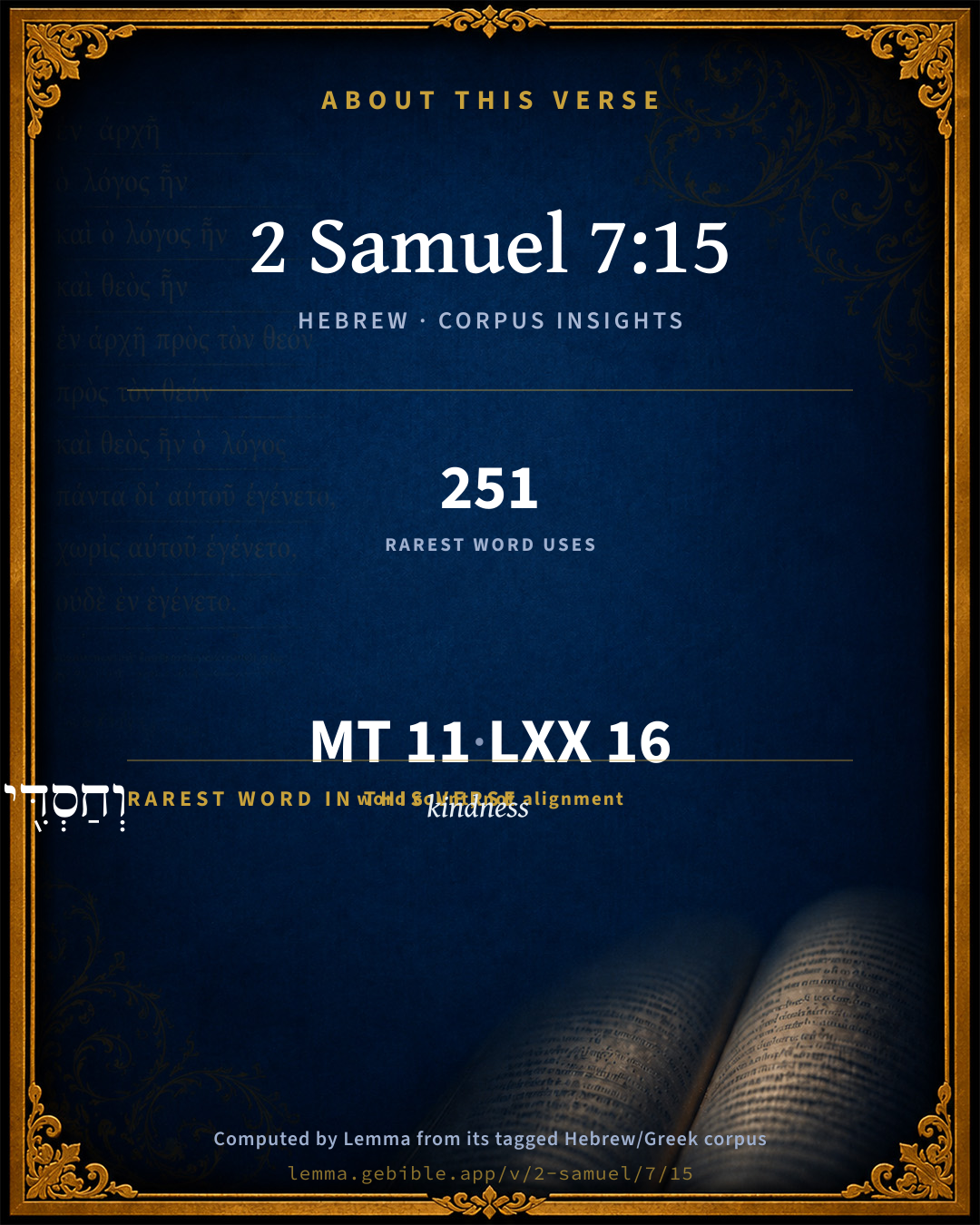
These counts appear in no published source. They are computed here, from the morphology-tagged text and Lemma’s own curated glosses. What Lemma adds →

11
words
8
distinct lemmas
Historical
section

Grammatical profile

  • 3 verbs
  • 3 nouns
  • 2 prepositions
  • 3 particles

Verb forms

  • יָס֣וּר Qal · Imperfect
  • הֲסִרֹ֨תִי֙ Hiphil · Perfect
  • הֲסִרֹ֖תִי Hiphil · Perfect

Repetition

Words recur within this verse — often emphatic in Hebrew:

  • יָס֣וּר to turn aside H5493 ×3
  • כַּאֲשֶׁ֤ר which H834 ×2

Hebrew & Septuagint length

In English translation the verse runs 21 words from the Hebrew and 21 from the Septuagint (LXX English) — the same length.

A rough comparison of the two English renderings, which tokenize alike — not a word-level alignment.

Word counts can differ between the Hebrew and the Greek without any difference in meaning — e.g. the Hebrew direct-object marker אֵת has no separate Greek word, and Greek often adds the article ὁ.

In the original languages it is 11 Hebrew tokens and 16 Greek tokens — but the two are counted differently (Hebrew bundles its prefixes and suffixes into one token; the Greek is in lemma form), so that isn’t a like-for-like length.

Cross-references

14

Topical passages linked to 2 Samuel 7:15 in the Treasury of Scripture Knowledge — connected by theme and wording, ordered by reader-vote popularity; previews shown in the World English Bible.

  • 1 Samuel 15:23 For rebellion is as the sin of witchcraft, and stubbornness is as idolatry and teraphim. Because you have rejected the word of Yahweh, he has also rejected you from being king.
  • 1 Samuel 15:28 Samuel said to him, Yahweh has torn the kingdom of Israel from you this day, and has given it to a neighbor of yours who is better than you.
  • Psalms 89:28 I will keep my loving kindness for him forevermore. My covenant will stand firm with him.
  • 1 Samuel 16:14 Now the Spirit of Yahweh departed from Saul, and an evil spirit from Yahweh troubled him.
  • 2 Samuel 7:14 I will be his father, and he shall be my son: if he commit iniquity, I will chasten him with the rod of men, and with the stripes of the children of men;
  • 1 Kings 11:13 However I will not tear away all the kingdom; but I will give one tribe to your son, for David my servant's sake, and for Jerusalem's sake which I have chosen.
  • Isaiah 9:7 Of the increase of his government and of peace there shall be no end, on the throne of David, and on his kingdom, to establish it, and to uphold it with justice and with righteousness from henceforth even forever. The zeal of Yahweh of Hosts will perform this.
  • 2 Samuel 7:16 Your house and your kingdom shall be made sure for ever before you: your throne shall be established forever.
  • Psalms 89:34 I will not break my covenant, Nor alter what my lips have uttered.
  • Isaiah 37:35 For I will defend this city to save it, for my own sake, and for my servant David's sake.
  • Acts 13:34–37 "Concerning that he raised him up from the dead, now no more to return to corruption, he has spoken thus: 'I will give you the holy and sure blessings of David.'
  • 1 Samuel 19:24 He also stripped off his clothes, and he also prophesied before Samuel, and lay down naked all that day and all that night. Therefore they say, "Is Saul also among the prophets?"
  • 1 Kings 11:34–36 However I will not take the whole kingdom out of his hand; but I will make him prince all the days of his life, for David my servant's sake whom I chose, who kept my commandments and my statutes;
  • Isaiah 55:3 Turn your ear, and come to me; hear, and your soul shall live: and I will make an everlasting covenant with you, even the sure mercies of David.

Cross-references courtesy of OpenBible.info (CC BY 4.0).

Hebrew and Greek witnesses Masoretic Hebrew ↔ Greek Septuagint

The same verse in the two great witnesses to the Old Testament, shown verse-for-verse.

These are two independent witnesses, not word-aligned to each other, and the Septuagint is shown in lemma (dictionary) form.

Hebrew 2 Samuel 7:15 Masoretic · Westminster Leningrad Codex

וְחַסְדִּ֖י לֹא יָס֣וּר מִמֶּ֑נּוּ כַּאֲשֶׁ֤ר הֲסִרֹ֨תִי֙ מֵעִ֣ם שָׁא֔וּל אֲשֶׁ֥ר הֲסִרֹ֖תִי מִלְּפָנֶֽיךָ

but my loving kindness shall not depart from him, as I took it from Saul, whom I put away before you.

World English Bible · Public Domain

Greek LXX 2 Samuel 7:15 Septuagint · lemma form

ὁ δέ ἔλεος ἐγώ οὐ ἀποἵστημι ἀπό αὐτός καθώς ἀποἵστημι ἀπό ὅς ἀποἵστημι ἐκ πρόσωπον ἐγώ

But my mercy I will not take from him, as I took it from those whom I removed from my presence.

LXX2012 (modern English Septuagint) · Public Domain

Hebrew: Westminster Leningrad Codex (CC BY 4.0). Greek: Septuagint (public domain); English from LXX2012 (modern English Septuagint) (Public Domain). How the Septuagint differs from the Hebrew →

Targum (Aramaic paraphrase)

1

The Targum is the ancient Jewish Aramaic paraphrase of the Hebrew Scriptures — an interpretive translation, not the Hebrew text itself. Onkelos (literal) and Pseudo-Jonathan (expansive) render the Torah, and Jonathan the Prophets. Coverage is partial: where no permissively-licensed English translation exists for a verse, only the Aramaic is shown. This is verse-level text, not a word-by-word alignment to the Hebrew.

  1. Targum Jonathan Prophets (Joshua–Malachi)
    וְטוּבִי לָא יַעְדִי מִנֵיהּ כְּמָא דְאַעְדֵיתִי מִן שָׁאוּל דִי אַעְדֵיתִי מִן קֳדָמָךְ:

    (no public-domain English translation for this verse)

    Targum Jonathan — Aramaic: “Mikraot Gedolot” (public domain). English: “Sefaria Community Translation” (CC0 1.0 (public-domain dedication)); “London "Chaldee Paraphrase," 1871” (public domain). Text via Sefaria.

Commentary

Notes on 2 Samuel 7:15 from classic Christian and Jewish commentators (each source and its license shown beneath its notes). The classic Christian expositions comment on the surrounding passage and are grouped to its opening verse, so a note may address several verses; the Jewish commentaries on the Tanakh (Rashi and others) are per-verse, so they appear only where the commentator wrote on this verse.

Lemma curates 59 commentaries, every one of them public domain or Creative Commons licensed, each selected and text-cleaned for this edition rather than reprinted as found. About our sources →

Trapp's Complete Commentary

John Trapp

2Sa 7:15 But my mercy shall not depart away from him, as I took [it] from Saul, whom I put away before thee.

Ver. 15. But my mercy shall not depart away from him.] Why then Feri, Domine, feri, saith Luther. Strike while thou wilt, Lord; my sins are pardoned. I thank thee, O Lord, for all my pain, as another said. And, Not so much case, as the use, Lord, said a third.

John Trapp, A Commentary or Exposition upon All the Books of the Old and New Testament (1647–1656) — public domain. Text from a community e-Sword module.

Albert Barnes' Notes on the Bible

My mercy shall not depart ... - Hence, Isaiah’s saying, the sure mercies of David Isa 55:3, i. e. unfailing, lasting mercies: mercies which are like streams of water that never dry up Isa 33:16; Jer 15:18. This is explained in 2Sa 7:16, where the word established is the same word as is rendered sure in Isaiah.

Before thee - Before Me is probably the true reading in 2Sa 7:15-16 (if the rest of the text be sound), according to the analogy of Jer 35:19; 1Sa 2:30, 1Sa 2:35; and many other places; whereas the idea contained in the reading, before thee, is unparalleled. But the reading in 1Ch 17:13 is quite different: “As I took it from him that was before thee,” meaning Saul, which gives a very good sense, and suggests that the text here may have been corrupted.

Albert Barnes' Notes on the Bible (1834–1885) — public domain. Text from a community e-Sword/MySword module.

The Biblical Illustrator

Joseph S. Exell

2Sa_7:15

But my mercy shall not depart away from him.

But One forsaken and He victorious

At Mildmay, Mr. Spurgeon related the story of an aged saint, who, depressed much with bodily infirmity, asked a friend if he ever knew anyone forsaken of God, for that was his condition. Only one, was the reply, but He to-day is sitting on His Fathers throne. (Newton Jones.)

The Biblical Illustrator, edited by Joseph S. Exell (c. 1880s–1900s) — public domain. Text from a community e-Sword module.

Joseph Benson's Commentary

2Sa 7:15-16. My mercy shall not depart from him — Or, my kindness, as the Hebrew word חסדי, chasdi, rather means. That is, the kingdom which I have mercifully and kindly promised to thee and thine. As I took it from Saul — In regard of his posterity, for the kingdom was continued to Saul himself during his life. Thy kingdom shall be established for ever before thee — Thine eyes, in some sort, beholding it; for he lived to see his wise son Solomon actually placed on the throne with reputation and general applause, which was in itself a good presage of the continuance of the kingdom in his family; and, when considered in connection with God’s infallible promises made to him and his descendants, must have given him assurance thereof. David, however, had his eyes and thoughts on the Messiah, Psa 110:1; whose day he saw by faith, as Abraham had done; whom he knew God would raise up of the fruit of his loins to sit on his throne, Act 2:30, and the eternity of whose kingdom might well be said to be before him. Thy throne shall be established for ever — The kingdom shall be continued for a long time, even for many ages, in thy family, and in the Messiah, who is to be thy seed, to all eternity. Thus the angel, applying this promise to Jesus, says to Mary, The Lord God shall give unto him the throne of HIS FATHER DAVID. And he shall reign over the house of Jacob FOR EVER, and of HIS KINGDOM there shall be NO END.

Joseph Benson's Commentary on the Old and New Testaments (1811–1818) — public domain. Text from a community e-Sword module.

Adam Clarke's Commentary

Verse 15. But my mercy shall not depart away from him, as I took it from Saul] His house shall be a lasting house, and he shall die in the throne of Israel, his children succeeding him; and the spiritual seed, Christ, possessing and ruling in that throne to the end of time.

The family of Saul became totally extinct; the family of David remained till the incarnation. Joseph and Mary were both of that family; Jesus was the only heir to the kingdom of Israel; he did not choose to sit on the secular throne, he ascended the spiritual throne, and now he is exalted to the right hand of God, a PRINCE and a Saviour, to give repentance and remission of sins. See the observations at the end of the chapter. 2Sa 7:25.

Many have applied these verses and their parallels to support the doctrine of unconditional final perseverance; but with it the text has nothing to do; and were we to press it, because of the antitype, Solomon, the doctrine would most evidently be ruined, for there is neither proof nor evidence of Solomon's salvation.

Adam Clarke's Commentary on the Bible (1810–1826) — public domain. Text from a community e-Sword/MySword module.

Ellicott's Commentary for English Readers

(15) As I took it from Saul.—He and his house were utterly and permanently set aside; David’s descendants will be punished for their sins, yet shall never be forgotten, and shall, ultimately issue in one who shall conquer sin and death for ever.

A Bible Commentary for English Readers, edited by Charles John Ellicott (1878–1897) — public domain. Text from a community e-Sword module.

The Cambridge Bible for Schools and Colleges

gen. ed. J. J. S. Perowne

15. shall not depart, &c.] Lit, shall not be taken away from him, as I took it away from Saul, whom I took away from before thee. The three verbs belong to the same root. But there is perhaps some error in the text. 1Ch_17:13 reads, “my mercy will I not take away from him, as I took it away from him who was before thee;” and the Sept. here has, “My mercy will I not take away from him, as I took it away from them that I took away from before me.”

The Cambridge Bible for Schools and Colleges (gen. ed. J. J. S. Perowne; Cambridge University Press, 1878–1918) — public domain. Text from a community e-Sword module.

John Gill's Exposition

But my mercy shall not depart away from him,.... Which is not to be understood of special mercy and grace, though it is true of these with respect to Solomon, and so to all the adopted children of God, see Psa 89:32; but then this here designs such mercy as may be taken away from another, and as it was from Saul, as it follows:

as I took it from Saul, whom I put away before thee; and therefore must be understood of his mercy and kindness, in giving him a kingdom, and setting him on the throne; this should not be taken away from him, as it was from Saul, whom God rejected from being king; not him personally, but his posterity; but so the Lord would not do, nor did he, to Solomon, in whose posterity the kingdom of Judah continued to the Babylonish captivity.

John Gill's Exposition of the Whole Bible (1746–1763) — public domain (CC PDM 1.0). Text via the HelloAO Bible API.

Matthew Poole's English Annotations

My mercy, or my kindness, i. e. the kingdom which l have mercifully an kindly promised to thee and thine.

As I took it from Saul; in regard of his posterity, for the kingdom was continued to his person during life.

Matthew Poole's English Annotations on the Holy Bible (1683–1685) — public domain. Text from a community e-Sword/MySword module.

Whedon's Commentary on the Bible

Daniel D. Whedon

15. But my mercy shall not depart — Even though the royal seed commit iniquity, yet for David and Jerusalem’s sake the prophecy and promise of this Scripture shall not fail. “The family of Saul became totally extinct. The family of David remained till the incarnation. Joseph and Mary were both of that family; Jesus was the only heir to the kingdom of Israel, But he did not choose to sit on the secular throne, he ascended the spiritual throne, and now he is exalted to the right hand of God, a Prince and a Saviour, to give repentance and remission of sins.” — Clarke.

Daniel D. Whedon (gen. ed.), Commentary on the Old and New Testaments (1874–1909) — public domain. Text from a community e-Sword module.

The Pulpit Commentary

Vers. 15, 16. Before thee. This does not refer to time, but means "in thy presence," or "before thy face," that is, "as thou hast thyself been witness." There is a strong contrast between the fate of Saul"s house and this eternal endurance promised to that of David. The lineage of Saul might have made a new start in Jonathan, and even when he died at Gilboa, he left a son behind him. Still, no one ever locked upon Mephibosheth as having any title to the throne; and though Shimei (2Sa_16:5) may have conceived the hope that, if David were overthrown, the kingdom might return to Saul"s family, yet, as a matter of fact, among the many vicissitudes of the ten tribes, the attempt never was made to search for a descendant of Saul to be Israel"s king. Saul"s was a royalty for one generation; David"s throne was to be established forever. Not because David was sinless. His character is sullied by crimes of the darkest hue. But he never sank into a mere tyrant, such as Saul was towards David and towards the priests at Nob. Nor did David ever become an irreligious man, (1Sa_22:18, 19 28:15) though there is in him a strange and painful mixture of great good and great evil. The salt that preserves his character is his genuine sincerity and earnestness both towards God and man; and these qualities make him not unworthy of the high place he holds among God s people. Still, the premise was not because of David"s deserts, but because from him was to come the Christ, who is blessed. forevermore.

The Pulpit Commentary (1880–1919), ed. H.D.M. Spence-Jones & Joseph S. Exell — public domain. Text from a community e-Sword module.

John Wesley's Explanatory Notes

My mercy - That is, Or, my kindness, that is, the kingdom which I have mercifully promised to thee and thine. From Saul - In regard of his posterity, for the kingdom was continued to his person during life.

John Wesley, Explanatory Notes Upon the Whole Bible (1754–1765) — public domain. Text via the GEBible commentary corpus.

Scofield Reference Notes

C. I. Scofield

mercy

2Sa 7:14-15 state the principle of judgment within the family of God. (See Scofield "1Co 11:31"). It is always remedial, not penal Heb 12:5-11.

Judgment of the wicked is penal, not remedial.

The Scofield Reference Bible (1917 edition), notes by C. I. Scofield — public domain. Text from a community e-Sword module.

unfoldingWord translationNotes

Door43 World Missions Community

General Information:

Yahweh finishes describing his promises to King David through the prophet Nathan.

But my covenant faithfulness will not leave him, as I took it from Saul

The word "faithfulness" is an abstract noun that can be stated as "faithfully loving." AT: "I will never stop faithfully loving him as I stopped loving Saul" (See: Abstract Nouns)

from before you. Your house ... before you. Your throne

If in 2 Samuel 7:8-9 you translated the direct quotations as indirect quotation, then here you may need to translate "you" as "David" or "him" or "his" as in the UDB. AT: "from before David. David's house ... before him. His throne" (See: Direct and Indirect Quotations)

Your house and kingdom will be confirmed forever before you. Your throne will be established forever.

These two sentences have similar meanings and emphasize that David's dynasty will last forever. (See: Parallelism)

Your house and kingdom will be confirmed forever before you

Here the word "house" represents David's descendants, who will rule as kings. Here "kingdom" means about the same thing as "house." This can also be stated in active form. AT: "You will live to see me establish your family and their rule over the people of Israel forever" (See: Doublet and Active or Passive)

Your throne will be established forever

Here "throne" represents the power to rule as king. AT: "I will cause your descendants to rule over Israel forever" (See: Active or Passive)

all these words

"all these things." This refers to what Yahweh had said.

he told him about the entire vision

"he told him about everything Yahweh revealed to him"

translationWords

covenant faithfulness

Saul (OT)

confirm

Nathan

report

word

vision

unfoldingWord translationNotes — © Distant Shores Media and the Door43 World Missions Community, licensed CC BY-SA 4.0. Source: git.door43.org/Door43/en_tn.

Lesson kit

Teaching starters — assembled from the data on this page, not authored interpretation. Every prompt links to the verse data it draws on. Edit before teaching.

2 Samuel, in the Historical, opens this verse with 11 words (8 distinct Hebrew lemmas). Its most distinctive word is chêçêd (“kindness”). A historical commentator’s framing appears above. Read the whole chapter for the surrounding context.

Discussion questions

  1. What does “kindness” (chêçêd) contribute to the verse as a whole?
  2. 1 Samuel 15:23 shares this passage’s theme. How do the two illuminate each other?
  3. “to turn aside” occurs 3× in this one verse. What is the effect of the repetition?
  4. These translations render this verse differently. What is at stake in choosing one wording over another?
  5. The verb «יָס֣וּר» is Qal Imperfect. How does its form color the action?
  6. Reading how Trapp's Complete Commentary and Albert Barnes' Notes on the Bible read this verse, where do the two commentators agree and where do they part?

Things to notice

Reading settings

Reading text

Shown beneath each verse's original-language words.

Old Testament
Old Testament edition

Read the OT as the Masoretic Hebrew (MT) or the Greek Septuagint (LXX).

English shown for the Greek Septuagint (in the Hebrew ↔ Greek comparison).

Comparing translations? Open the Compare panel on any verse page to stack up to four side by side.