
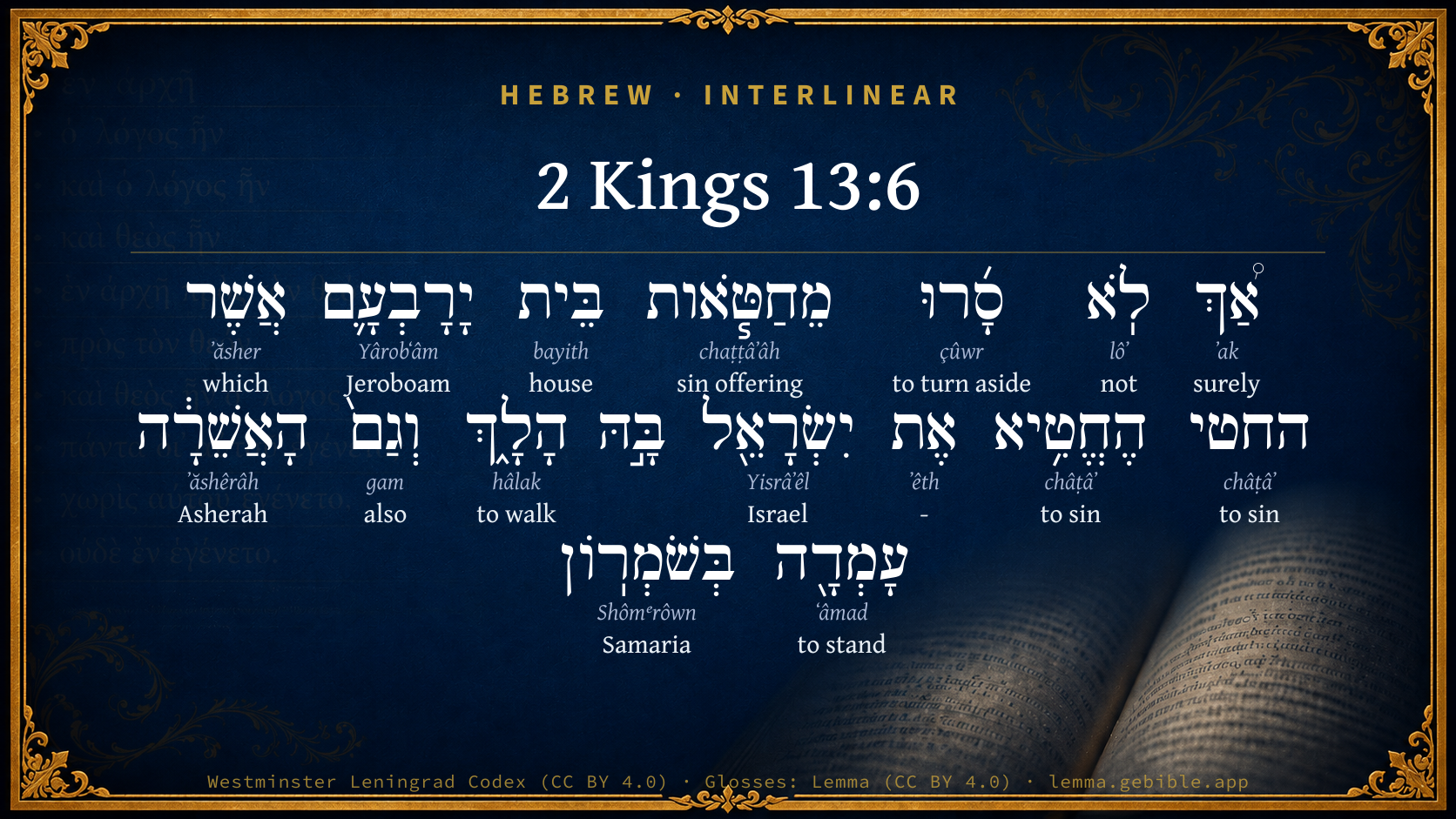
2 Kings 13:6

Hebrew (Westminster Leningrad Codex) 2 Kings 13:6 appears in the Hebrew Old Testament. The text above is from the Westminster Leningrad Codex. Each word links to its Strong’s number, a concise gloss, and parsing drawn from the Open Scriptures Hebrew Bible morphology. Click any word for its full Brown-Driver-Briggs (BDB) entry.
Download image
Cite this verse

2 Kings 13:6 (World English Bible). Public Domain. Lemma interlinear Bible study tool, https://lemma.gebible.app/v/2-kings/13/6.

Show BibTeX & RIS
BibTeX
RIS
English Translation
Nevertheless they didn't depart from the sins of the house of Jeroboam, with which he made Israel to sin, but walked therein: and there remained the Asherah also in Samaria.)
World English Bible · Public Domain
Download a study sheet

One document with this verse’s original text, its word-by-word gloss line, the meaning frame, cross-references with their text, attributed commentary, and full source and license credits — printable, and it pastes into notes with its structure intact.

This verse Autodidact and up

Study sheet (.html) Plain text (.txt)

A passage Seminary Student

Up to 50 verses in one chapter. A passage sheet keeps up to 6 commentary sources and 12 cross-references per verse, in the order this page ranks them, and says so on the sheet whenever that leaves anything out. Ask for a single verse and you get the Autodidact verse sheet above.

Everything on this page stays free to read, with no account — the sheet is a download of what is already on screen, not access to it.

Want to remove ads? Support Godless Engineer
Compare translations 3

The same verse in 3 English versions, stacked beneath the original-language interlinear above. Click any original word for its lexicon entry.

Each is an independent rendering of the whole verse — the interlinear is not word-aligned to these translations.

Highlighted words mark where these versions differ — a whole-verse word diff, not a word-by-word alignment.

  • World English Bible Public Domain
    Nevertheless they didn't depart from the sins of the house of Jeroboam, with which he made Israel to sin, but walked therein: and there remained the Asherah also in Samaria.)
  • King James Version Public Domain
    Nevertheless they departed not from the sins of the house of Jeroboam, who made Israel sin, but walked therein: and there remained the grove also in Samaria.)
  • unfoldingWord Literal Text CC BY-SA 4.0
    Nevertheless, they did not turn aside from the sins of the house of Jeroboam, who caused Israel to sin. He walked in it, and also the Asherah stood in Samaria.

unfoldingWord Literal Text — © unfoldingWord, licensed CC BY-SA 4.0. Word-aligned USFM3 via Door43 (git.door43.org/unfoldingWord/en_ult).

Versions to compare (up to 4)

3 of 4 selected

Show all 18 translations

Every available English version of this verse, each an independent rendering of the whole verse.

  • World English Bible Public Domain
    Nevertheless they didn't depart from the sins of the house of Jeroboam, with which he made Israel to sin, but walked therein: and there remained the Asherah also in Samaria.)
  • Berean Standard Bible Public Domain
    Nevertheless, they did not turn away from the sins that the house of Jeroboam had caused Israel to commit, but they continued to walk in them. The Asherah pole even remained standing in Samaria.
  • Majority Standard Bible Public Domain
    Nevertheless, they did not turn away from the sins that the house of Jeroboam had caused Israel to commit, but they continued to walk in them. The Asherah pole even remained standing in Samaria.
  • King James Version Public Domain
    Nevertheless they departed not from the sins of the house of Jeroboam, who made Israel sin, but walked therein: and there remained the grove also in Samaria.)
  • American Standard Version (1901) Public Domain
    Nevertheless they departed not from the sins of the house of Jeroboam, wherewith he made Israel to sin, but walked therein: and there remained the Asherah also in Samaria.)
  • Revised Version (1885) Public Domain
    Nevertheless they departed not from the sins of the house of Jeroboam, wherewith he made Israel to sin, but walked therein: and there remained the Asherah also in Samaria.)
  • Geneva Bible (1599) Public Domain
    Neuerthelesse they departed not from the sinnes of the house of Ieroboam which made Israel sinne, but walked in them. euen the groue also remayned still in Samaria)
  • Douay-Rheims (1899) Public Domain
    But yet they departed not from the sins of Jeroboam, who made Israel to sin, but walked in them: and there still remained a grove also in Samaria.
  • Young's Literal Translation Public Domain
    only, they have not turned aside from the sins of the house of Jeroboam, that he caused Israel to sin, therein they walked, and also, the shrine hath remained in Samaria, --
  • Literal Standard Version CC BY-SA 4.0
    only, they have not turned aside from the sins of the house of Jeroboam that he caused Israel to sin, therein they walked, and also, the Asherah has remained in Samaria—
  • Unlocked Literal Bible CC BY-SA 4.0
    Nevertheless, they did not depart from the sins of the house of Jeroboam, who caused Israel to sin, and they continued in them; and the Asherah pole remained in Samaria.
  • unfoldingWord Literal Text CC BY-SA 4.0
    Nevertheless, they did not turn aside from the sins of the house of Jeroboam, who caused Israel to sin. He walked in it, and also the Asherah stood in Samaria.
  • Darby Bible Public Domain
    Nevertheless they departed not from the sins of the house of Jeroboam, who made Israel to sin: they walked therein; and there remained also the Asherah in Samaria.)
  • World Messianic Bible Public Domain
    Nevertheless they didn’t depart from the sins of the house of Jeroboam, with which he made Israel to sin, but walked in them; and the Asherah also remained in Samaria.)
  • Webster's Bible Public Domain
    Nevertheless they departed not from the sins of the house of Jeroboam, who made Israel sin, but walked in them: and there remained the grove also in Samaria.)
  • Free Bible Version CC BY-SA 4.0
    Even so they did not end the sins that the house of Jeroboam had made Israel commit—they continued to follow them. The Asherah idol still stood in Samaria.
  • Bible in Basic English Public Domain
    But still they did not give up the sin of Jeroboam, which he made Israel do, but went on with it; and there was an image of Asherah in Samaria.)
  • JPS Tanakh (1917) Public Domain
    Nevertheless they departed not from the sins of the house of Jeroboam, wherewith he made Israel to sin, but walked therein; and there remained the Asherah also in Samaria. —

Literal Standard Version (2020), Covenant Press — licensed CC BY-SA 4.0. Text via the HelloAO Bible API (eBible.org). Unlocked Literal Bible (unfoldingWord) — licensed CC BY-SA 4.0. Text via the HelloAO Bible API (eBible.org). unfoldingWord Literal Text — © unfoldingWord, licensed CC BY-SA 4.0. Word-aligned USFM3 via Door43 (git.door43.org/unfoldingWord/en_ult). Free Bible Version, Dr. Jonathan Gallagher — licensed CC BY-SA 4.0. Text via the HelloAO Bible API (eBible.org).

Word by word

More ways to search: Search by grammar → Find every occurrence → Compare this word →

Practice this passage: Drill this verse → Learn its vocabulary →

הָאֲשֵׁרָ֔ה
ʼăshêrâh
H842
“the · Asherah”
Particle, Definite Article + Noun, Proper
Part of Speech
Particle + Noun
Type
Proper
Full BDB Definition

Origin: from H833

TWOT: 183h

Ashera(h) = "groves (for idol worship)" - a Babylonian (Astarte)-Canaanite goddess (of fortune and happiness), the supposed consort of Baal, her images - the goddess, goddesses - her images - sacred trees or poles set up near an altar
  1. אַ֠ךְ ʼak H389 “surely” Particle, Accusative
  2. לֹֽא lôʼ H3808 “not” Particle, Negative
  3. סָ֜רוּ çûwr H5493 “to turn aside” Verb, Qal, Perfect, 3rd Person, Common, Plural
  4. מֵחַטֹּ֧אות chaṭṭâʼâh H2403 “from · sin offerings of” Preposition + Noun, Common, Feminine, Plural, Construct
  5. בֵּית bayith H1004 “house of” Noun, Common, Masculine, Singular, Construct
  6. יָרָבְעָ֛ם Yârobʻâm H3379 “Jeroboam” Noun, Proper
  7. אֲשֶׁר ʼăsher H834 “which” Particle, Relative
  8. החטי châṭâʼ H2398 “to sin” Verb, Hiphil, Perfect, 3rd Person, Masculine, Singular
  9. הֶחֱטִ֥יא châṭâʼ H2398 “to sin” Verb, Hiphil, Perfect, 3rd Person, Masculine, Singular
  10. אֶת ʼêth H853 “-” Particle, Direct Object
  11. יִשְׂרָאֵ֖ל Yisrâʼêl H3478 “Israel” Noun, Proper
  12. הָלָ֑ךְ hâlak H1980 “to walk” Verb, Qal, Perfect, 3rd Person, Masculine, Singular
  13. וְגַם֙ gam H1571 “and · also” Conjunction + Particle, Accusative
  14. עָמְדָ֖ה ʻâmad H5975 “to stand” Verb, Qal, Perfect, 3rd Person, Feminine, Singular
  15. בְּשֹׁמְרֽוֹן Shômᵉrôwn H8111 “in/at · Samaria” Preposition + Noun, Proper

About this verse

These counts appear in no published source. They are computed here, from the morphology-tagged text and Lemma’s own curated glosses. What Lemma adds →

17
words
15
distinct lemmas
Historical
section

Shared distinctive vocabulary

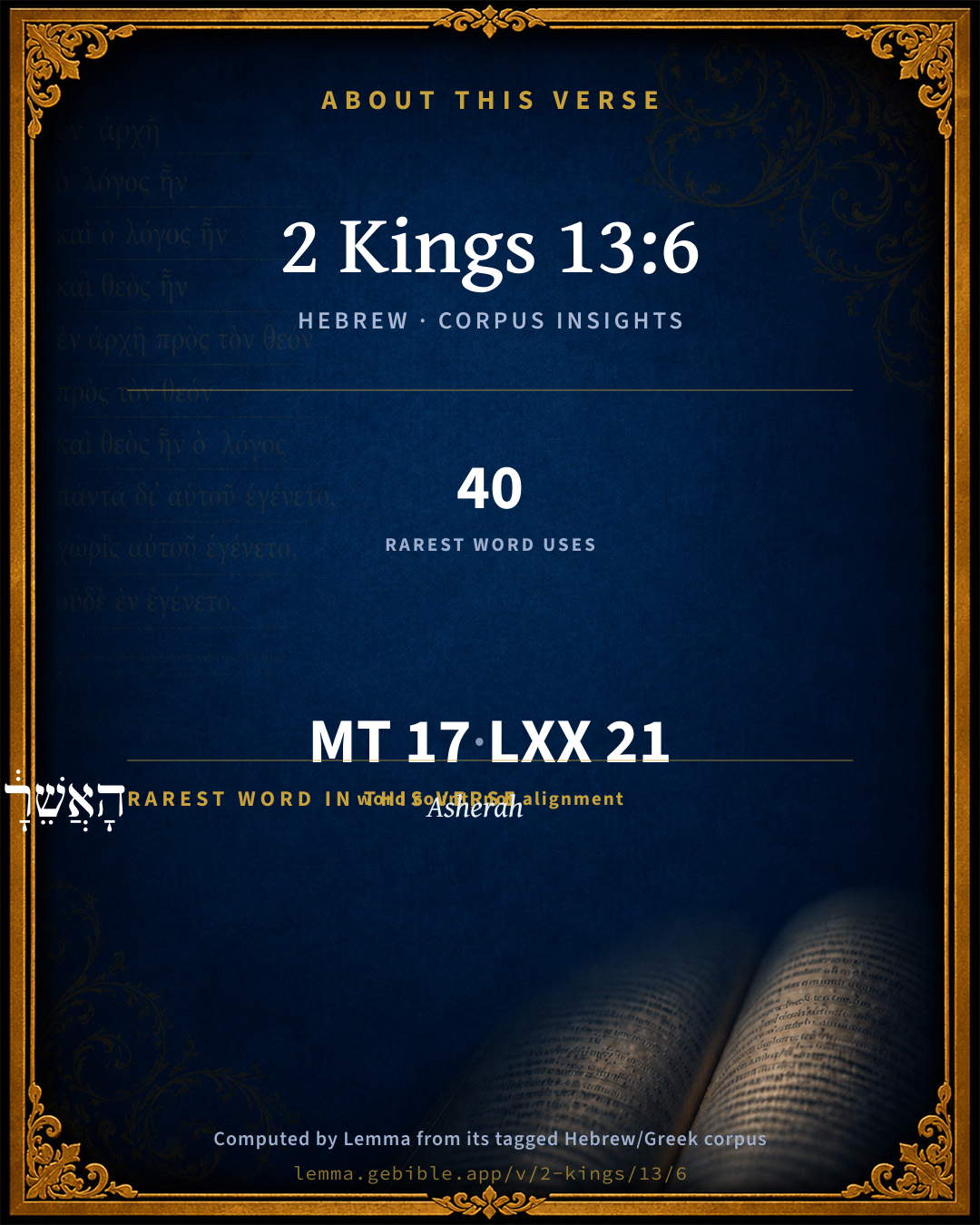
הָאֲשֵׁרָ֔ה Asherah H842 occurs in 40 verses of the Hebrew Bible. Also found in:

Grammatical profile

  • 5 verbs
  • 6 nouns
  • 1 preposition
  • 5 particles

Verb forms

  • סָ֜רוּ Qal · Perfect
  • החטי Hiphil · Perfect
  • הֶחֱטִ֥יא Hiphil · Perfect
  • הָלָ֑ךְ Qal · Perfect
  • עָמְדָ֖ה Qal · Perfect

Repetition

A word recurs within this verse — often emphatic in Hebrew:

  • החטי to sin H2398 ×2

Hebrew & Septuagint length

In English translation the verse runs 30 words from the Hebrew and 27 from the Septuagint (LXX English) — closely comparable.

A rough comparison of the two English renderings, which tokenize alike — not a word-level alignment.

Word counts can differ between the Hebrew and the Greek without any difference in meaning — e.g. the Hebrew direct-object marker אֵת has no separate Greek word, and Greek often adds the article ὁ.

In the original languages it is 17 Hebrew tokens and 21 Greek tokens — but the two are counted differently (Hebrew bundles its prefixes and suffixes into one token; the Greek is in lemma form), so that isn’t a like-for-like length.

Cross-references

11

Topical passages linked to 2 Kings 13:6 in the Treasury of Scripture Knowledge — connected by theme and wording, ordered by reader-vote popularity; previews shown in the World English Bible.

  • 1 Kings 16:33 Ahab made the Asherah; and Ahab did yet more to provoke Yahweh, the God of Israel, to anger than all the kings of Israel who were before him.
  • 2 Kings 13:2 He did that which was evil in the sight of Yahweh, and followed the sins of Jeroboam the son of Nebat, with which he made Israel to sin; he didn't depart from it.
  • Deuteronomy 7:5 But thus shall you deal with them: you shall break down their altars, and dash in pieces their pillars, and hew down their Asherim, and burn their engraved images with fire.
  • Deuteronomy 32:15–18 But Jeshurun grew fat, and kicked: You have grown fat, you are grown thick, you are become sleek; Then he forsook God who made him, Lightly esteemed the Rock of his salvation.
  • 1 Kings 15:3 He walked in all the sins of his father, which he had done before him; and his heart was not perfect with Yahweh his God, as the heart of David his father.
  • 1 Kings 16:26 For he walked in all the way of Jeroboam the son of Nebat, and in his sins with which he made Israel to sin, to provoke Yahweh, the God of Israel, to anger with their vanities.
  • 2 Kings 10:29 However from the sins of Jeroboam the son of Nebat, with which he made Israel to sin, Jehu didn't depart from after them, [to wit], the golden calves that were in Bethel, and that were in Dan.
  • 2 Kings 17:16 They forsook all the commandments of Yahweh their God, and made them molten images, even two calves, and made an Asherah, and worshiped all the host of the sky, and served Baal.
  • 2 Kings 17:20–23 Yahweh rejected all the seed of Israel, and afflicted them, and delivered them into the hand of spoilers, until he had cast them out of his sight.
  • 2 Kings 18:4 He removed the high places, and broke the pillars, and cut down the Asherah: and he broke in pieces the brazen serpent that Moses had made; for to those days the children of Israel did burn incense to it; and he called it Nehushtan.
  • 2 Kings 23:4 The king commanded Hilkiah the high priest, and the priests of the second order, and the keepers of the threshold, to bring forth out of the temple of Yahweh all the vessels that were made for Baal, and for the Asherah, and for all the host of the sky, and he burned them outside of Jerusalem in the fields of the Kidron, and carried the ashes of them to Bethel.

Cross-references courtesy of OpenBible.info (CC BY 4.0).

Hebrew and Greek witnesses Masoretic Hebrew ↔ Greek Septuagint

The same verse in the two great witnesses to the Old Testament, shown verse-for-verse.

These are two independent witnesses, not word-aligned to each other, and the Septuagint is shown in lemma (dictionary) form.

Hebrew 2 Kings 13:6 Masoretic · Westminster Leningrad Codex

אַ֠ךְ לֹֽא סָ֜רוּ מֵחַטֹּ֧אות בֵּית יָרָבְעָ֛ם אֲשֶׁר החטי הֶחֱטִ֥יא אֶת יִשְׂרָאֵ֖ל בָּ֣הּ הָלָ֑ךְ וְגַם֙ הָאֲשֵׁרָ֔ה עָמְדָ֖ה בְּשֹׁמְרֽוֹן

Nevertheless they didn't depart from the sins of the house of Jeroboam, with which he made Israel to sin, but walked therein: and there remained the Asherah also in Samaria.)

World English Bible · Public Domain

Greek LXX 2 Kings 13:6 Septuagint · lemma form

πλήν οὐ ἀποἵστημι ἀπό ἁμαρτία οἶκος ιεροβοαμ ὅς ἐκἁμαρτάνω ὁ ἰσραήλ ἐν αὐτός πορεύομαι καί γέ ὁ ἄλσος ἵστημι ἐν σαμαρεία

Only they departed not from the sins of the house of Jeroboam, who led Israel to sin: they walked in them—moreover the grove also remained in Samaria.

LXX2012 (modern English Septuagint) · Public Domain

On this verse, Ellicott's Commentary for English Readers discusses the Septuagint’s reading. Read the note in Commentary ↓

Hebrew: Westminster Leningrad Codex (CC BY 4.0). Greek: Septuagint (public domain); English from LXX2012 (modern English Septuagint) (Public Domain). How the Septuagint differs from the Hebrew →

Targum (Aramaic paraphrase)

1

The Targum is the ancient Jewish Aramaic paraphrase of the Hebrew Scriptures — an interpretive translation, not the Hebrew text itself. Onkelos (literal) and Pseudo-Jonathan (expansive) render the Torah, and Jonathan the Prophets. Coverage is partial: where no permissively-licensed English translation exists for a verse, only the Aramaic is shown. This is verse-level text, not a word-by-word alignment to the Hebrew.

  1. Targum Jonathan Prophets (Joshua–Malachi)
    בְּרַם לָא סְטוּ מֵחוֹבֵּי יָרָבְעָם דְחַיֵיב יַת יִשְׂרָאֵל בְּהוֹן אֲזָלוּ וְאַף אֲשֵׁירָתָא קָמַת בְּשֹׁמְרוֹן:

    (no public-domain English translation for this verse)

    Targum Jonathan — Aramaic: “Mikraot Gedolot” (public domain). English: “Sefaria Community Translation” (CC0 1.0 (public-domain dedication)); “London "Chaldee Paraphrase," 1871” (public domain). Text via Sefaria.

Commentary

Notes on 2 Kings 13:6 from classic Christian and Jewish commentators (each source and its license shown beneath its notes). The classic Christian expositions comment on the surrounding passage and are grouped to its opening verse, so a note may address several verses; the Jewish commentaries on the Tanakh (Rashi and others) are per-verse, so they appear only where the commentator wrote on this verse.

Lemma curates 59 commentaries, every one of them public domain or Creative Commons licensed, each selected and text-cleaned for this edition rather than reprinted as found. About our sources →

Trapp's Complete Commentary

John Trapp

2Ki 13:6 Nevertheless they departed not from the sins of the house of Jeroboam, who made Israel sin, [but] walked therein: and there remained the grove also in Samaria.)

Ver. 6. Nevertheless they departed not.] Though first plagued, and then saved, yet they remained irreclaimable.

And there remained the grove.] Ahab’s grove. {1Ki 16:33} Ballism, therefore, was not utterly abolished by Jehu.

John Trapp, A Commentary or Exposition upon All the Books of the Old and New Testament (1647–1656) — public domain. Text from a community e-Sword module.

Tyndale Open Study Notes

Tyndale Open Resources

13:6 Despite God’s rescue, Israel continued to sin, eventually resulting in the fall of the northern kingdom (17:21-23; 1 Kgs 14:15-16). • This Asherah pole (a Canaanite fertility symbol erected by Ahab, 1 Kgs 16:33) had apparently been spared in Jehu’s purge of Baal worship (2 Kgs 10:26-29).

Tyndale Open Study Notes — © Tyndale Open Resources, licensed CC BY-SA 4.0. Text via the HelloAO Bible API.

Geneva Bible (1599)

Geneva Bible translators

Wherein they did commit their idolatry, and which the Lord had commanded to be destroyed, Deut. 16:21.

Geneva Bible (1599) marginal notes — public domain. Text via Bolls.life.

Jamieson, Fausset & Brown

Robert Jamieson, A. R. Fausset & David Brown

there remained the grove--Asherah--the idol set up by Ahab (Kg1 16:33), which ought to have been demolished (Deu 7:5).

Jamieson, Fausset & Brown — Commentary Critical and Explanatory on the Whole Bible (1871) — public domain (CC PDM 1.0). Text via the HelloAO Bible API.

Adam Clarke's Commentary

Verse 6. The grove also in Samaria] Asherah, or Astarte, remained in Samaria, and there was she worshipped, with all her abominable rites.

Adam Clarke's Commentary on the Bible (1810–1826) — public domain. Text from a community e-Sword/MySword module.

Ellicott's Commentary for English Readers

(6) Nevertheless they departed not.—The restoration of Divine favour did not issue in the abolition of the irregular worship introduced by Jeroboam I. as the state religion of the northern kingdom. This is written, of course, from the point of view of the Judæan editor of Kings, who lived long after the events of which he is writing in the period of the exile. It does not appear from the history of Elijah and Elisha, incorporated in his work, that either of those great prophets ever protested against the worship established at Bethel and Dan.

The house of Jeroboam—Some MSS., the Syriac, Targum, and Arabic omit “house.” But the specification of the dynasty is here very appropriate.

But walked therein.—Rather, therein they walked; the reading of the LXX. (Alex.),Vulg., and Targum being probably correct. It is the conduct of the nation that is being described.

And there remained the grove also in Samaria.—Rather, and moreover the Asherah stood (i.e., was set up) in Samaria. The Asherah was the sacred tree, so often depicted in Assyrian art. It symbolised the productive principle of nature, and was sacred to Ashtoreth. With the return of peace, and the renewal of prosperity, luxury also soon reappeared, and the idolatry that specially countenanced it lifted up its head again. (See the Note on 2Ki_17:16.)

A Bible Commentary for English Readers, edited by Charles John Ellicott (1878–1897) — public domain. Text from a community e-Sword module.

The Cambridge Bible for Schools and Colleges

gen. ed. J. J. S. Perowne

6. and there remained the grove [R.V. Ashêrah] also in Samaria] On Ashêrah, by which is probably meant a wooden image of a goddess worshipped with similar rites to those of the god Baal, see note on 1Ki_14:15. Jehu had not eliminated all that belonged to the Tyrian idolatry, and his successors were no more earnest to do so than himself.

The Cambridge Bible for Schools and Colleges (gen. ed. J. J. S. Perowne; Cambridge University Press, 1878–1918) — public domain. Text from a community e-Sword module.

John Gill's Exposition

Nevertheless, they departed not from the sins of the house of Jeroboam, who made Israel to sin, but walked therein,.... Continued to worship the calves still, which was an instance of great ingratitude; the Syriac and Arabic versions read, "he departed not"; Jehoahaz the king:

and there remained the grove in Samaria; which Ahab made there, Kg1 16:33, neither Jehu nor his son had it cut down, though Baal was destroyed.

John Gill's Exposition of the Whole Bible (1746–1763) — public domain (CC PDM 1.0). Text via the HelloAO Bible API.

Albert Barnes' Notes on the Bible

But walked therein - Rather, “he walked therein,” meaning Joash, the “saviour” of the preceding verse.

There remained the grove also in Samaria - It seems strange that Jehu had not destroyed this when he put down the worship of Baal 2Ki 10:26-28. Perhaps the “grove” or “Asherah” worship was too closely connected with the old worship in high places to be set aside with the same ease as the rites newly introduced from Phoenicia.

Albert Barnes' Notes on the Bible (1834–1885) — public domain. Text from a community e-Sword/MySword module.

Haydock's Catholic Bible Commentary

A grove, dedicated to the worship of idols. (Challoner) --- Hebrew, "and the Ascera (grove of Astarte) was standing even in Samaria." That impure worship had gained ground again, after Jehu was dead.

George Leo Haydock (1774–1849), Haydock's Catholic Family Bible and Commentary, 1859 edition — public domain. Excludes Psalms (Douay-Rheims chapter numbering differs from Protestant) and Deuterocanonical books (Catholic canon only).

Matthew Poole's English Annotations

Which Ahab had planted for the worship of Baal, 1Ki 16:32, and which should have been destroyed, Deu 7:5.

Matthew Poole's English Annotations on the Holy Bible (1683–1685) — public domain. Text from a community e-Sword/MySword module.

Whedon's Commentary on the Bible

Daniel D. Whedon

6. The grove — Rather, the Asherah, the great statue erected to this goddess in Samaria. See notes on 1Ki_14:15; 1Ki_15:13.

Daniel D. Whedon (gen. ed.), Commentary on the Old and New Testaments (1874–1909) — public domain. Text from a community e-Sword module.

The Pulpit Commentary

Nevertheless they departed not from the sins of the house of Jeroboam, who made Israel sin. "The house of Jeroboam" is an unusual expression in this connection, and is scarcely appropriate, since every "house" had acted in the same way, Some manuscripts omit the word, and it is wanting in the Chaldee, Syriac, and Arabic versions. Thenius would cancel it. But walked therein; literally, he walked. But here again a corruption may be suspected. Instead of we should read Wklj which lost its final letter in consequence of the vau that immediately followed it. And there remained the grove also in Samaria. "The grove in Samaria" was that idolatrous emblem which Ahab had set up at Jezebel"s suggestion, (1Ki_16:33) the nature of which has been much disputed. Some think that it was "an image of Astarte" (see "Homiletic Commentary" on 1 Kings, p. 374); but more probably it was a mere emblem, analogous to the Assyrian "sacred tree." Its material may sometimes have been wood, but was perhaps more usually metal. The mistranslation "grove" originated with the Septuagint translators, who uniformly rendered hrcea by alsov.

It is surprising that Jehu did not destroy the asherah together with the other idolatrous erections of Ahab in Samaria; (2Ki_10:26-28) but, for some reason or other, it seems to have been spared, and to have been still standing. So long as it stood, even if it did not attract the religious regards of any, it would be a standing dishonor to God, and would so increase the sin of the nation. Hence its mention in this passage.

The persistency of evil.

"There remained the grove." One would have thought that, in such a reformation as that of Jehu, (2Ki_10:15-28) there would have been a clean sweep, or, at any rate, that Ahab"s pot idolatries (1Ki_16:33) would have gone. But no! evil is terribly persistent. "The evil that men do lives after them," and not in men"s recollections only, but in fact. No reformation ever sweeps away at once all that it was intended to sweep away. "The grove remains." How many heathen superstitious survived the supersession of heathenism by Christianity! How many iniquitous laws continue in all countries after every attempt that is made to reform the laws! How many abuses remain after each removal of abuses I The result is partly through the fault of the reformers, who are careless about doing their work thoroughly, and cease their efforts while much still remains to be done; but it is also caused in part by the tenacity of life which the things that need to be swept away possess in themselves. And, as evil is thus persistent in communities, so is it also in the character of individuals. Naturam expellas furca, tamen usque recurret. A man makes a great effort at self-reformation, changes his rules of conduct, his habits, the whole method of his life, as he thinks; but in some corner there still lurks a remnant of the old leaven, which shortly reasserts itself, and too often leavens the whole mass with its corrupting influence. The lesson to be learnt is watchfulness and perseverance. By care, by consideration, and by constant effort, the persistency of evil may be met and counteracted. God"s Holy Spirit is always ready to assist our endeavors; and, whether in a community or in an individual, continued effort, divinely aided, will prevail at last.

The Pulpit Commentary (1880–1919), ed. H.D.M. Spence-Jones & Joseph S. Exell — public domain. Text from a community e-Sword module.

John Wesley's Explanatory Notes

The grove - Which Ahab had planted for the worship of Baal, and which should have been destroyed, Deut. vii, 5.

John Wesley, Explanatory Notes Upon the Whole Bible (1754–1765) — public domain. Text via the GEBible commentary corpus.

unfoldingWord translationNotes

Door43 World Missions Community

they did not depart from the sins of the house of Jeroboam

To stop sinning is spoken of as if they departed from the sins. This can be stated in positive form. AT: "Israel did not stop doing the same sins as Jeroboam had done" or "Israel continued to commit the same sins as Jeroboam had committed" (See: Metaphor)

house of Jeroboam

"the family of Jeroboam"

had destroyed them

"had defeated the army of Jehoahaz"

made them like the chaff at threshing time

The Aramean army had so severely defeated the army of Israel that what remained was so worthless that it is compared to wheat chaff that the laborers walk on at harvest time. AT: "had crushed them as workers crush chaff under their feet at harvest time" (See: Simile)

translationWords

Jeroboam

Asherah

horseman

chariot

chaff

thresh

unfoldingWord translationNotes — © Distant Shores Media and the Door43 World Missions Community, licensed CC BY-SA 4.0. Source: git.door43.org/Door43/en_tn.

Lesson kit

Teaching starters — assembled from the data on this page, not authored interpretation. Every prompt links to the verse data it draws on. Edit before teaching.

2 Kings, in the Historical, opens this verse with 17 words (15 distinct Hebrew lemmas). Its most distinctive word is ʼăshêrâh (“Asherah”). A historical commentator’s framing appears above. Read the whole chapter for the surrounding context.

Discussion questions

  1. What does “Asherah” (ʼăshêrâh) contribute to the verse as a whole?
  2. Exodus 34:13 shares the word «Asherah» with this verse. How do the two illuminate each other?
  3. “to sin” occurs 2× in this one verse. What is the effect of the repetition?
  4. These translations render this verse differently. What is at stake in choosing one wording over another?
  5. The verb «סָ֜רוּ» is Qal Perfect. How does its form color the action?
  6. Reading how Trapp's Complete Commentary and Tyndale Open Study Notes read this verse, where do the two commentators agree and where do they part?

Things to notice

Reading settings

Reading text

Shown beneath each verse's original-language words.

Old Testament
Old Testament edition

Read the OT as the Masoretic Hebrew (MT) or the Greek Septuagint (LXX).

English shown for the Greek Septuagint (in the Hebrew ↔ Greek comparison).

Comparing translations? Open the Compare panel on any verse page to stack up to four side by side.