
Job 34:5

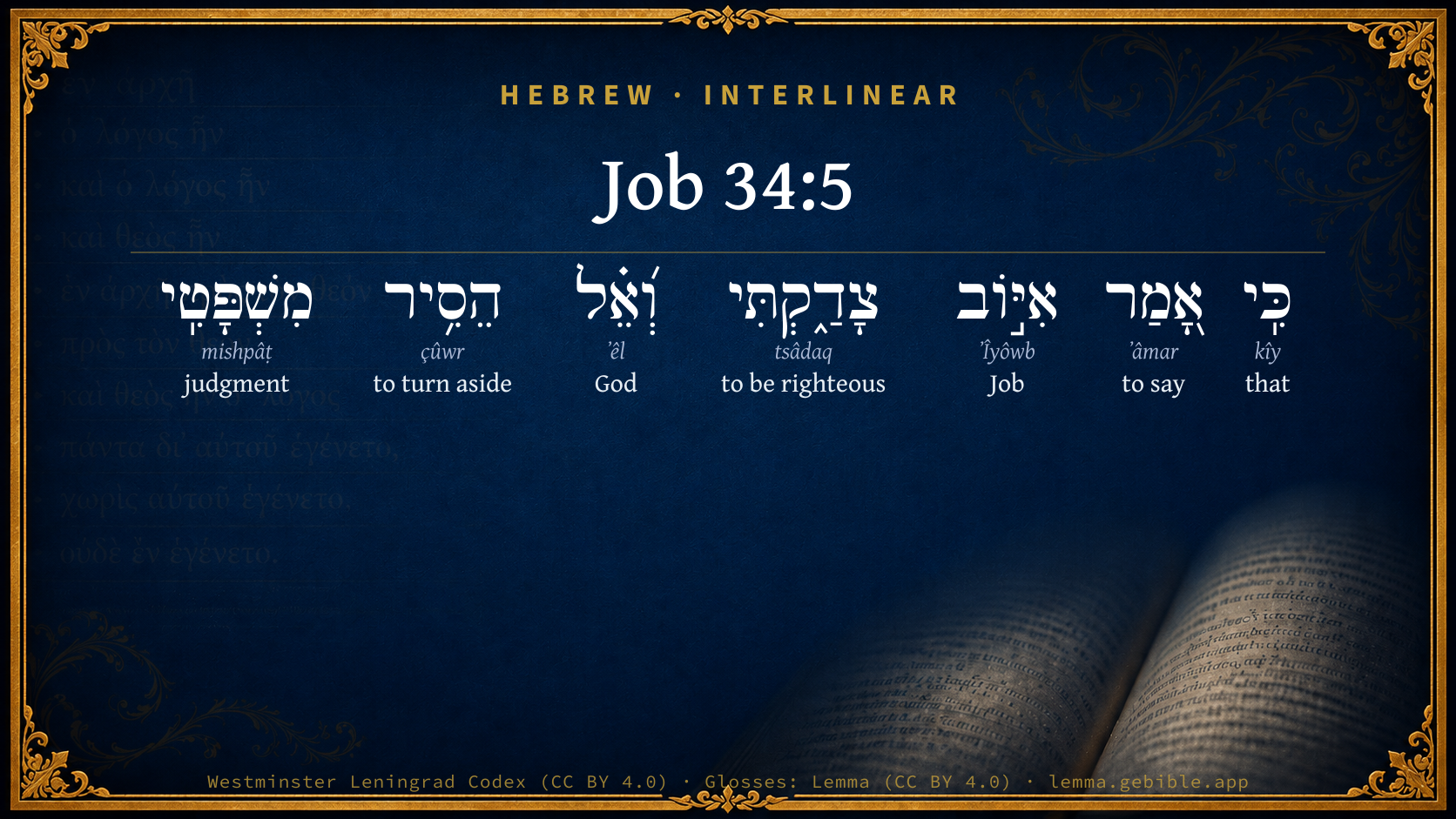
Hebrew (Westminster Leningrad Codex) Job 34:5 appears in the Hebrew Old Testament. The text above is from the Westminster Leningrad Codex. Each word links to its Strong’s number, a concise gloss, and parsing drawn from the Open Scriptures Hebrew Bible morphology. Click any word for its full Brown-Driver-Briggs (BDB) entry.
Download image
Cite this verse

Job 34:5 (World English Bible). Public Domain. Lemma interlinear Bible study tool, https://lemma.gebible.app/v/job/34/5.

Show BibTeX & RIS
BibTeX
RIS
English Translation
For Job has said, 'I am righteous, God has taken away my right:
World English Bible · Public Domain
Download a study sheet

One document with this verse’s original text, its word-by-word gloss line, the meaning frame, cross-references with their text, attributed commentary, and full source and license credits — printable, and it pastes into notes with its structure intact.

This verse Autodidact and up

Study sheet (.html) Plain text (.txt)

A passage Seminary Student

Up to 50 verses in one chapter. A passage sheet keeps up to 6 commentary sources and 12 cross-references per verse, in the order this page ranks them, and says so on the sheet whenever that leaves anything out. Ask for a single verse and you get the Autodidact verse sheet above.

Everything on this page stays free to read, with no account — the sheet is a download of what is already on screen, not access to it.

Want to remove ads? Support Godless Engineer
Compare translations 3

The same verse in 3 English versions, stacked beneath the original-language interlinear above. Click any original word for its lexicon entry.

Each is an independent rendering of the whole verse — the interlinear is not word-aligned to these translations.

Highlighted words mark where these versions differ — a whole-verse word diff, not a word-by-word alignment.

  • World English Bible Public Domain
    For Job has said, 'I am righteous, God has taken away my right:
  • King James Version Public Domain
    For Job hath said, I am righteous: and God hath taken away my judgment.
  • unfoldingWord Literal Text CC BY-SA 4.0
    For Job has said, ‘I am righteous, but God has taken away my justice.

unfoldingWord Literal Text — © unfoldingWord, licensed CC BY-SA 4.0. Word-aligned USFM3 via Door43 (git.door43.org/unfoldingWord/en_ult).

Versions to compare (up to 4)

3 of 4 selected

Show all 18 translations

Every available English version of this verse, each an independent rendering of the whole verse.

  • World English Bible Public Domain
    For Job has said, 'I am righteous, God has taken away my right:
  • Berean Standard Bible Public Domain
    For Job has declared, ‘I am righteous, yet God has deprived me of justice.
  • Majority Standard Bible Public Domain
    For Job has declared, ‘I am righteous, yet God has deprived me of justice.
  • King James Version Public Domain
    For Job hath said, I am righteous: and God hath taken away my judgment.
  • American Standard Version (1901) Public Domain
    For Job hath said, I am righteous, And God hath taken away my right:
  • Revised Version (1885) Public Domain
    For Job hath said, I am righteous, and God hath taken away my right:
  • Geneva Bible (1599) Public Domain
    For Iob hath saide, I am righteous, and God hath taken away my iudgement.
  • Douay-Rheims (1899) Public Domain
    For Job hath said: I am just, and God hath overthrown my judgment.
  • Young's Literal Translation Public Domain
    For Job hath said, `I have been righteous, And God hath turned aside my right,
  • Literal Standard Version CC BY-SA 4.0
    For Job has said, I have been righteous, || And God has turned aside my right,
  • Unlocked Literal Bible CC BY-SA 4.0
    For Job has said, 'I am righteous, but God has taken away my rights.
  • unfoldingWord Literal Text CC BY-SA 4.0
    For Job has said, ‘I am righteous, but God has taken away my justice.
  • Darby Bible Public Domain
    For Job hath said, I am righteous, and ùGod hath taken away my judgment:
  • World Messianic Bible Public Domain
    For Job has said, ‘I am righteous, God has taken away my right.
  • Webster's Bible Public Domain
    For Job hath said, I am righteous: and God hath taken away my judgment.
  • Free Bible Version CC BY-SA 4.0
    Job said, ‘I am innocent, and God has denied me justice.
  • Bible in Basic English Public Domain
    For Job has said, I am upright, and it is God who has taken away my right;
  • JPS Tanakh (1917) Public Domain
    For Job hath said: 'I am righteous, and God hath taken away my right;

Literal Standard Version (2020), Covenant Press — licensed CC BY-SA 4.0. Text via the HelloAO Bible API (eBible.org). Unlocked Literal Bible (unfoldingWord) — licensed CC BY-SA 4.0. Text via the HelloAO Bible API (eBible.org). unfoldingWord Literal Text — © unfoldingWord, licensed CC BY-SA 4.0. Word-aligned USFM3 via Door43 (git.door43.org/unfoldingWord/en_ult). Free Bible Version, Dr. Jonathan Gallagher — licensed CC BY-SA 4.0. Text via the HelloAO Bible API (eBible.org).

Word by word

More ways to search: Search by grammar → Find every occurrence → Compare this word →

Practice this passage: Drill this verse → Learn its vocabulary →

צָדַ֑קְתִּי
tsâdaq
H6663
“to be righteous”
Verb, Qal, Perfect, 1st Person, Common, Singular
Part of Speech
Verb
Stem
Qal
Form
Perfect
Person
1st Person
Gender
Common
Number
Singular
Full BDB Definition

Origin: a primitive root

TWOT: 1879

to be just, be righteous - (Qal) - to have a just cause, be in the right - to be justified - to be just (of God) - to be just, be righteous (in conduct and character) - (Niphal) to be put or made right, be justified - (Piel) justify, make to appear righteous, make someone righteous - (Hiphil) - to do or bring justice (in administering law) - to declare righteous, justify - to justify, vindicate the cause of, save - to make righteous, turn to righteousness - (Hithpael) to justify oneself
  1. כִּֽי kîy H3588 “that” Conjunction
  2. אָ֭מַר ʼâmar H559 “to say” Verb, Qal, Perfect, 3rd Person, Masculine, Singular
  3. אִיּ֣וֹב ʼÎyôwb H347 “Job” Noun, Proper
  4. וְ֝אֵ֗ל ʼêl H410 “and · God” Conjunction + Noun, Common, Masculine, Singular, Absolute
  5. הֵסִ֥יר çûwr H5493 “to turn aside” Verb, Hiphil, Perfect, 3rd Person, Masculine, Singular
  6. מִשְׁפָּטִֽי mishpâṭ H4941 “judgment · my” Noun, Common, Masculine, Singular, Construct + Suffix, Personal, 1st Person, Common, Singular

About this verse

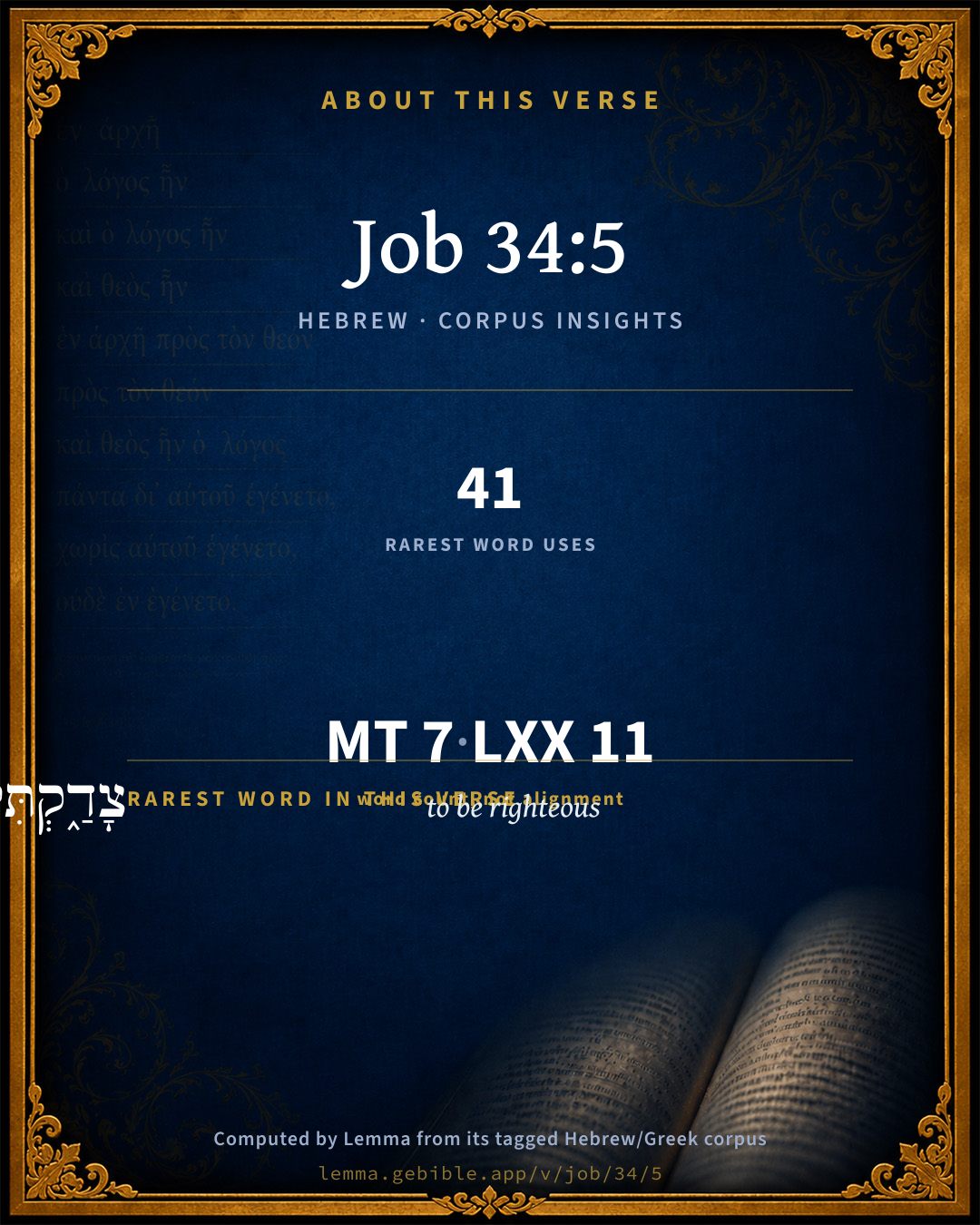
These counts appear in no published source. They are computed here, from the morphology-tagged text and Lemma’s own curated glosses. What Lemma adds →

7
words
7
distinct lemmas
Wisdom
section

Shared distinctive vocabulary

צָדַ֑קְתִּי to be righteous H6663 occurs in 40 verses of the Hebrew Bible. Also found in:

Grammatical profile

  • 3 verbs
  • 3 nouns
  • 1 conjunction

Verb forms

  • אָ֭מַר Qal · Perfect
  • צָדַ֑קְתִּי Qal · Perfect
  • הֵסִ֥יר Hiphil · Perfect

Hebrew & Septuagint length

In English translation the verse runs 13 words from the Hebrew and 13 from the Septuagint (LXX English) — the same length.

A rough comparison of the two English renderings, which tokenize alike — not a word-level alignment.

Word counts can differ between the Hebrew and the Greek without any difference in meaning — e.g. the Hebrew direct-object marker אֵת has no separate Greek word, and Greek often adds the article ὁ.

In the original languages it is 7 Hebrew tokens and 11 Greek tokens — but the two are counted differently (Hebrew bundles its prefixes and suffixes into one token; the Greek is in lemma form), so that isn’t a like-for-like length.

Cross-references

8

Topical passages linked to Job 34:5 in the Treasury of Scripture Knowledge — connected by theme and wording, ordered by reader-vote popularity; previews shown in the World English Bible.

  • Job 27:2 "As God lives, who has taken away my right, The Almighty, who has made my soul bitter.
  • Job 33:9 'I am clean, without disobedience. I am innocent, neither is there iniquity in me:
  • Job 16:17 Although there is no violence in my hands, And my prayer is pure.
  • Job 32:1 So these three men ceased to answer Job, because he was righteous in his own eyes.
  • Job 9:17 For he breaks me with a tempest, Multiplies my wounds without cause.
  • Job 10:7 Although you know that I am not wicked, There is no one who can deliver out of your hand.
  • Job 11:4 For you say, 'My doctrine is pure, I am clean in your eyes.'
  • Job 29:14 I put on righteousness, and it clothed me. My justice was as a robe and a diadem.

Cross-references courtesy of OpenBible.info (CC BY 4.0).

Hebrew and Greek witnesses Masoretic Hebrew ↔ Greek Septuagint

The same verse in the two great witnesses to the Old Testament, shown verse-for-verse.

These are two independent witnesses, not word-aligned to each other, and the Septuagint is shown in lemma (dictionary) form.

Hebrew Job 34:5 Masoretic · Westminster Leningrad Codex

כִּֽי אָ֭מַר אִיּ֣וֹב צָדַ֑קְתִּי וְ֝אֵ֗ל הֵסִ֥יר מִשְׁפָּטִֽי

For Job has said, 'I am righteous, God has taken away my right:

World English Bible · Public Domain

Greek LXX Job 34:5 Septuagint · lemma form

ὅτι εἶπον ιωβ δίκαιος εἰμί ὁ κύριος ἀποἀλλάσσω ἐγώ ὁ κρίμα

For Job has said, I am righteous: the Lord has removed my judgment.

LXX2012 (modern English Septuagint) · Public Domain

On this verse, Keil & Delitzsch discusses the Septuagint’s reading. Read the note in Commentary ↓

Hebrew: Westminster Leningrad Codex (CC BY 4.0). Greek: Septuagint (public domain); English from LXX2012 (modern English Septuagint) (Public Domain). How the Septuagint differs from the Hebrew →

Commentary

Notes on Job 34:5 from classic Christian and Jewish commentators (each source and its license shown beneath its notes). The classic Christian expositions comment on the surrounding passage and are grouped to its opening verse, so a note may address several verses; the Jewish commentaries on the Tanakh (Rashi and others) are per-verse, so they appear only where the commentator wrote on this verse.

Lemma curates 59 commentaries, every one of them public domain or Creative Commons licensed, each selected and text-cleaned for this edition rather than reprinted as found. About our sources →

Trapp's Complete Commentary

John Trapp

Job 34:5 For Job hath said, I am righteous: and God hath taken away my judgment.

Ver. 5. For Job hath said, I am righteous] So he was with a twofold righteousness: imputed, or the righteousness of justification; and imparted, or the righteousness of sanctification. But Elihu understood him as if he had said, I am sinless. This Job never said; only he cleared himself of foul offences wherewith his friends falsely charged him; and asserted his own integrity, whereof he seemed to be more solicitous than of giving God the glory of his justice; and therein he was to be blamed, as here he is to some purpose.

And God hath taken away my judgment] sc. By handling me like a wicked man, and not showing me why. See Job 27:3, where Job had used these very words; but not in the sense that Elihu urgeth them against him.

John Trapp, A Commentary or Exposition upon All the Books of the Old and New Testament (1647–1656) — public domain. Text from a community e-Sword module.

Joseph Benson's Commentary

Job 34:5-6. Job hath said, I am righteous — I am so far righteous that I have not deserved, nor had any reason to expect, such hard usage from God. God hath taken away my judgment — So Job had said, Job 27:2; that is, he denies me that which is just and equal, namely, to give me a fair hearing. Should I lie against my right — Thus Job had spoken in effect, Job 27:4-6. Should I falsely accuse myself of sins of which I am not guilty? Should I betray mine own cause, and deny that integrity which I am conscious I possess? My wound is incurable without transgression — Without any such crying sin as might reasonably bring down such terrible judgments upon my head.

Joseph Benson's Commentary on the Old and New Testaments (1811–1818) — public domain. Text from a community e-Sword module.

Tyndale Open Study Notes

Tyndale Open Resources

34:5-6 Job had claimed to be innocent: See 9:20-21; 13:18; 27:6.

Tyndale Open Study Notes — © Tyndale Open Resources, licensed CC BY-SA 4.0. Text via the HelloAO Bible API.

Geneva Bible (1599)

Geneva Bible translators

That is, hath afflicted me without measure.

Geneva Bible (1599) marginal notes — public domain. Text via Bolls.life.

Jamieson, Fausset & Brown

Robert Jamieson, A. R. Fausset & David Brown

judgment--my right. Job's own words (Job 13:18; Job 27:2).

Jamieson, Fausset & Brown — Commentary Critical and Explanatory on the Whole Bible (1871) — public domain (CC PDM 1.0). Text via the HelloAO Bible API.

Adam Clarke's Commentary

Verse 5. Job hath said, I am righteous] Job had certainly said the words attributed to him by Elihu, particularly in Job 27:2, c., but it was in vindication of his aspersed character that he had asserted his own righteousness, and in a different sense to that in which Elihu appears to take it up. He asserted that he was righteous quoad the charges his friends had brought against him. And he never intimated that he had at all times a pure heart, and had never transgressed the laws of his Maker. It is true also that he said, God hath taken away my judgment but he most obviously does not mean to charge God with injustice, but to show that he had dealt with him in a way wholly mysterious, and not according to the ordinary dispensations of his providence; and that he did not interpose in his behalf, while his friends were overwhelming him with obloquy and reproach.

Adam Clarke's Commentary on the Bible (1810–1826) — public domain. Text from a community e-Sword/MySword module.

Ellicott's Commentary for English Readers

(5) For Job hath said.—See Job_13:18-19; Job_27:2, especially.

A Bible Commentary for English Readers, edited by Charles John Ellicott (1878–1897) — public domain. Text from a community e-Sword module.

The Cambridge Bible for Schools and Colleges

gen. ed. J. J. S. Perowne

5. I am righteous] Or, in the right, I have right on my side.

my judgment] As before means my right, what is rightly due to me—God has dealt with me unjustly; comp. Job_9:15; Job_9:20, Job_13:18, Job_27:2; Job_27:6.

5–9. Elihu recites Job’s statement of his cause against God, expressing his abhorrence of Job’s sentiments.

The Cambridge Bible for Schools and Colleges (gen. ed. J. J. S. Perowne; Cambridge University Press, 1878–1918) — public domain. Text from a community e-Sword module.

John Gill's Exposition

Should I lie against my right?.... No; I ought not: this though Job had not said in so many words, yet this seems to be his sense in Job 27:4; that should he own and say that he was a wicked man, a hypocrite, and destitute of the grace of God, he should not only speak against himself, but, contrary to his conscience, say an untruth, and not do justice to his character. Some read the words without an interrogation, as Mr. Broughton,

"for my right I must be a liar;''

that is, for vindicating my right, seeking and endeavouring to do myself justice, and clear myself from false imputations, I am reckoned a liar. And to this purpose is the paraphrase of Aben Ezra,

"because I seek judgment, they say that I lie.''

Others render them, "there is a lie in judging me", so the Vulgate Latin version; that is,

"I am falsely accused, I am judged wrongfully:''

things I know not are laid to my charge, which has often been the case of good men: or, "I have lied in judgment"; that is, "failed", as the word is sometimes used, Isa 58:11; failed in his expectation of judgment or of justice being done him; he looked for it, but was disappointed; but the first sense seems best;

my wound is incurable without transgression; not that he thought himself without transgression, but that his wound or stroke inflicted on him, or the afflictions he was exercised with, were without cause; were not for any injustice in his hands, or wickedness that he had committed; and that he utterly despaired of being rid of them, or restored to his former health and prosperity; and to this sense he had expressed himself, Job 9:17. In the Hebrew text it is, "my arrow" (y), that is, the arrow that was in him, the arrows of the Lord that stuck fast in him; these were thrown at him and fastened in him without cause; and there was no hope of their being drawn out, or of the wounds made by them being healed; see Job 6:4. Now what Elihu was offended at in these expressions was, that Job should so rigidly insist on his innocence, and not own himself faulty in any respect; nor allow there was any cause for his afflictions, nor entertain any hope of the removal of them: whereas it became him to acknowledge his sins, which no man is free from, and that he was dealt with less than his iniquities deserved; and that, instead of indulging despair, he should rather say, "I will return" to the Lord; he hath "torn" and he will "heal", he hath "smitten" and he will "bind up", Hos 6:1.

(y) "sagitta mea", Montanus, Schultens, Michaelis.

John Gill's Exposition of the Whole Bible (1746–1763) — public domain (CC PDM 1.0). Text via the HelloAO Bible API.

Albert Barnes' Notes on the Bible

For Job hath said, I am righteous - see Job 13:18, “I know that I shall be justified;” compare Job 23:10-11, where he says, if he was tried he would come forth as gold. Elihu may have also referred to the general course of remark which he had pursued as vindicating himself.

And God hath taken away my judgment - This sentiment is found in Job 27:2; see the notes at that place.

Albert Barnes' Notes on the Bible (1834–1885) — public domain. Text from a community e-Sword/MySword module.

Haydock's Catholic Bible Commentary

Judgment. Chap. xxvii. 2. Job had used this expression, but only to intimate that strict justice did not take place, as he thought his faults had not deserved so severe a chastisement. He did not pretend that God was unjust, or that he was quite blameless; and he had so explicitly declared his sentiments, that Eliu could not well be ignorant of them. (Calmet)

George Leo Haydock (1774–1849), Haydock's Catholic Family Bible and Commentary, 1859 edition — public domain. Excludes Psalms (Douay-Rheims chapter numbering differs from Protestant) and Deuterocanonical books (Catholic canon only).

Matthew Poole's English Annotations

I am righteous; either,

1. I am perfectly righteous. But this Job did not say, but the contrary, Job 9:2,3; 14:4. Or,

2. I am a sincere person, no hypocrite, as my friends made me. But this Elihu doth not deny. Or,

3. I am so far righteous, and have been so holy and blameless in my life, that I have not deserved, nor had any reason to expect, such hard usage from God. And this Job had oft intimated, and Elihu doth justly blame him for it, that he blazoned his own righteousness with tacit reflections upon God for dealing so severely with him.

God hath taken away my judgment; for so Job had said, Job 27:2; i.e. he denies me that which is but just and equal, to give me a fair hearing, to suffer me to plead my cause with or before him, to show me the reasons of his contending with me, and what sins besides common infirmities I have been guilty of, whereby I have deserved such extraordinary judgments; which Elihu justly taxeth him with as a very irreverent and presumptuous expression.

Matthew Poole's English Annotations on the Holy Bible (1683–1685) — public domain. Text from a community e-Sword/MySword module.

Whedon's Commentary on the Bible

Daniel D. Whedon

b. Elihu proceeds to cite Job’s objectionable sayings, which he thinks contain the most dangerous sentiments of the wicked, and which reasonably give rise to suspicions as to the company and associations of Job , vv5-9.

5. For Job hath said — See outline, page 202. Job has been guilty of a twofold error; first in asserting his own righteousness, and secondly in declaring that God had not treated him according to right. Job_10:7; Job_27:6; Job_27:2. The first of these citations is but preparatory to the second, which contains the theme he is about to treat, and which is taken verbally from Job_27:2.

Daniel D. Whedon (gen. ed.), Commentary on the Old and New Testaments (1874–1909) — public domain. Text from a community e-Sword module.

The Pulpit Commentary

For Job hath said, I am righteous. Job had maintained his "righteousness" in a certain sense, i.e. his integrity, his honesty, his conviction that God would ultimately acquit him; but he had not maintained his sinlessness. (see the comment on Job_33:9) He had not even said, in so many words, "I am righteous." The nearest that he had come to saying it was when (in Job_13:18) he had exclaimed, "I know that I shall be held righteous," or "justified." And God hath taken away my judgment. Job had said this, (Job_27:2) but in the sense that God had withheld from him the judgment on his cause which he desired, not that he had perverted judgment, and wrongfully condemned him (see the "Speaker"s Commentary," vol. 4. p. 97).

The Pulpit Commentary (1880–1919), ed. H.D.M. Spence-Jones & Joseph S. Exell — public domain. Text from a community e-Sword module.

John Wesley's Explanatory Notes

Said - I am so far righteous, that I have not deserved, such hard usage from God. Had taken - So Job had said, chap. xxvii, 2, he denies me that which is just and equal, to give me a fair hearing.

John Wesley, Explanatory Notes Upon the Whole Bible (1754–1765) — public domain. Text via the GEBible commentary corpus.

Keil & Delitzsch

C. F. Keil & F. Delitzsch

5 For Job hath said: "I am guiltless,

"And God hath put aside my right.

6 "Shall I lie in spite of my right,

"Incurable is mine arrow without transgression."

7 Where is there a man like Job,

Who drinketh scorning like water,

8 And keepeth company with the workers of iniquity,

And walketh with wicked men,

9 So that he saith: "A man hath no profit

"From entering into fellowship with God"?!

That in relation to God, thinking of Him as a punishing judge, he is righteous or in the right, i.e., guiltless (צדקתּי with Pathach in pause, according to Ew. 93, c, from צדק = צדק, but perhaps, comp. Pro 24:30; Psa 102:26, because the Athnach is taken only as of the value of Zakeph), Job has said verbatim in Job 13:18, and according to meaning, Job 23:10; Job 27:7, and throughout; that He puts aside his right (the right of the guiltless, and therefore not of one coming under punishment): Job 27:2. That in spite of his right (על, to be interpreted, according to Schultens' example, just like Job 10:7; Job 16:17), i.e., although right is on his side, yet he must be accounted a liar, since his own testimony is belied by the wrathful form of his affliction, that therefore the appearance of wrong remains inalienably attached to him, we find in idea in Job 9:20 and freq. Elihu makes Job call his affliction חצּי, i.e., an arrow sticking in him, viz., the arrow of the wrath of God (on the objective suff. comp. on Job 23:2), after Job 6:4; Job 16:9; Job 19:11; and that this his arrow, i.e., the pain which it causes him, is incurably bad, desperately malignant without (בּלי as Job 8:11) פּשׁע, i.e., sins existing as the ground of it, from which he would be obliged to suppose they had thrust him out of the condition of favour, is Job's constant complaint (vid., e.g., Job 13:23.). Another utterance of Job closely connected with it has so roused Elihu's indignation, that he prefaces it with the exclamation of astonishment: Who is a man like Job, i.e., where in all the world (מי as Sa2 7:23) has this Job his equal, who ... . The attributive clause refers to Job; "to drink scorn (here: blasphemy) like water," is, according to Job 15:16, equivalent to to give one's self up to mockery with delight, and to find satisfaction in it. ארח לחברה, to go over to any one's side, looks like a poeticized prose expression. ללכת is a continuation of the ארח, according to Ew. 351, c, but not directly in the sense "and he goes," but, as in the similar examples, Jer 17:10; Jer 44:19; Ch2 7:17, and freq., in the sense of: "he is in the act of going;" comp. on Job 36:20 and Hab 1:17. The utterance runs: a man does not profit, viz., himself (on the use of סכן of persons as well as of things, vid., on Job 22:2), by his having joyous and familiar intercourse (בּרצתו, as little equivalent to בּרוּץ as in Psa 50:18) with God. Job has nowhere expressly said this, but certainly the declaration in Job 9:22, in connection with the repeated complaints concerning the anomalous distribution of human destinies (vid., especially Job 21:7, Job 24:1), are the premises for such a conclusion. That Elihu, in Job 34:7, is more harsh against Job than the friends ever were (comp. e.g., the well-measured reproach of Eliphaz, Job 15:4), and that he puts words into Job's moth which occur nowhere verbatim in his speeches, is worked up by the Latin fathers (Jer., Philippus Presbyter, Beda,

(Note: Philippus Presbyter was a disciple of Jerome. His Comm. in Iobum is extant in many forms, partly epitomized, partly interpolated (on this subject, vid., Hieronymi Opp. ed. Vallarsi, iii. 895ff.). The commentary of Beda, dedicated to a certain Nectarius (Vecterius), is fundamentally that of this Philippus.)

Gregory) in favour of their unfavourable judgment of Elihu; the Greek fathers, however, are deprived of all opportunity of understanding him by the translation of the lxx (in which μυκτηρισμόν signifies the scorn of others which Job must swallow down, comp. Pro 26:6), which here perverts everything.

Keil & Delitzsch — Biblical Commentary on the Old Testament (1861–1891) — public domain (CC PDM 1.0). Text via the HelloAO Bible API. (Old Testament only.)

Rashi

Rabbi Shlomo Yitzchaki (Rashi)

my right [my] To prove my words.

Rashi on the Tanakh — English translations: “The Judaica Press complete Tanach with Rashi, translated by A. J. Rosenberg” (CC BY 4.0); “Pentateuch with Rashi's commentary by M. Rosenbaum and A.M. Silbermann, 1929-1934” (public domain); “The Metsudah Tanach series, Lakewood, N.J” (CC BY 4.0); and “The Book of Joshua, Metsudah Publications, 1997” (CC BY 4.0). Text via Sefaria.

Lesson kit

Teaching starters — assembled from the data on this page, not authored interpretation. Every prompt links to the verse data it draws on. Edit before teaching.

Job, in the Wisdom, opens this verse with 7 words (7 distinct Hebrew lemmas). Its most distinctive word is tsâdaq (“to be righteous”). A historical commentator’s framing appears above. Read the whole chapter for the surrounding context.

Discussion questions

  1. The word tsâdaq carries the sense “to be righteous.” How does it shape the verse?
  2. How does Genesis 38:26, which shares the word «to be righteous», read alongside this verse?
  3. These translations render this verse differently. What is at stake in choosing one wording over another?
  4. «אָ֭מַר» is a Qal Perfect verb. How does that grammatical form shape the action described?
  5. Compare how Trapp's Complete Commentary and Joseph Benson's Commentary read this verse. Where do they agree or differ?

Things to notice

Reading settings

Reading text

Shown beneath each verse's original-language words.

Old Testament
Old Testament edition

Read the OT as the Masoretic Hebrew (MT) or the Greek Septuagint (LXX).

English shown for the Greek Septuagint (in the Hebrew ↔ Greek comparison).

Comparing translations? Open the Compare panel on any verse page to stack up to four side by side.