Deuteronomy 2:27

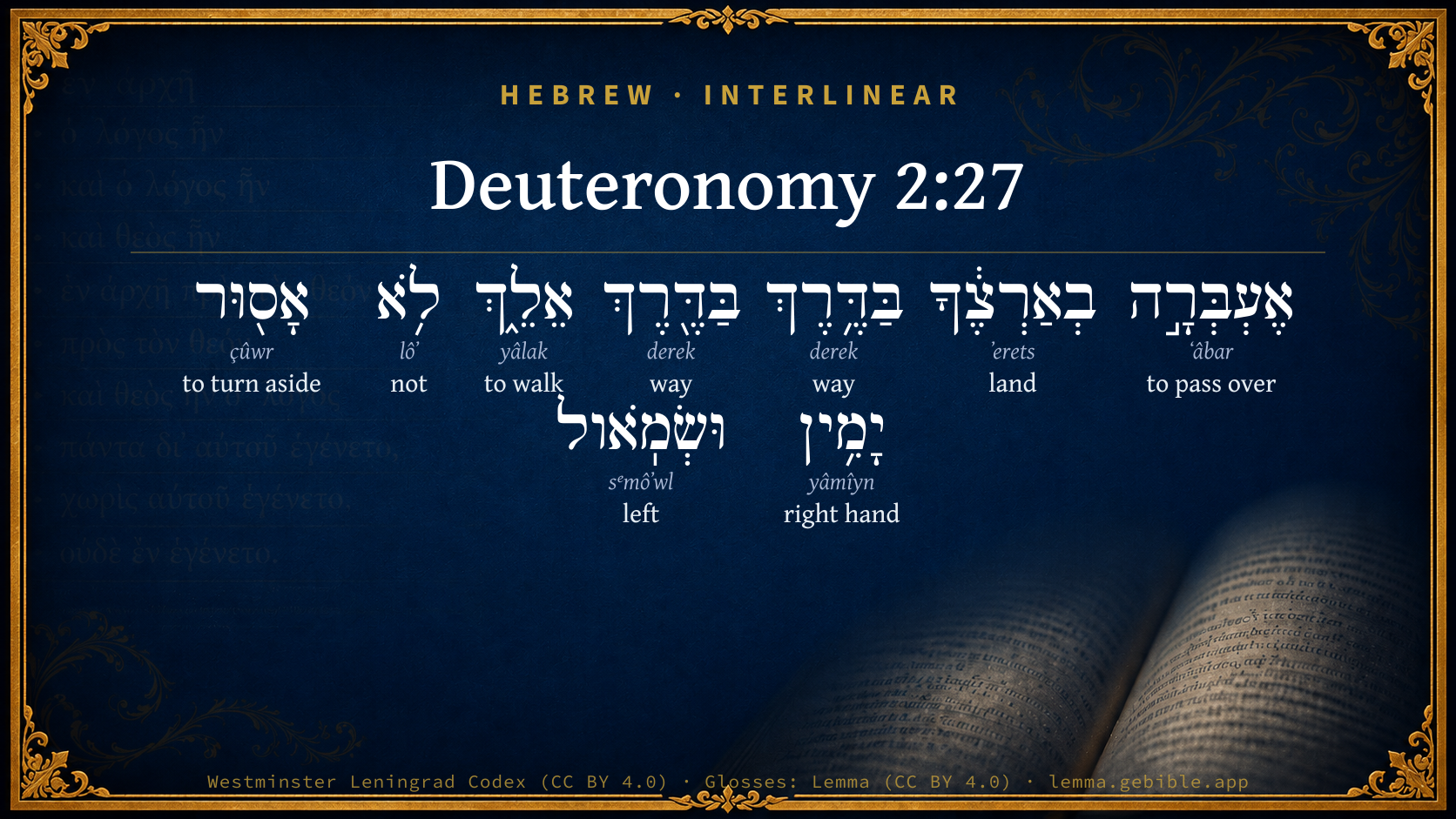
Hebrew (Westminster Leningrad Codex) Deuteronomy 2:27 appears in the Hebrew Old Testament. The text above is from the Westminster Leningrad Codex. Each word links to its Strong’s number, a concise gloss, and parsing drawn from the Open Scriptures Hebrew Bible morphology. Click any word for its full Brown-Driver-Briggs (BDB) entry.
Download image
Cite this verse

Deuteronomy 2:27 (World English Bible). Public Domain. Lemma interlinear Bible study tool, https://lemma.gebible.app/v/deuteronomy/2/27.

Show BibTeX & RIS
BibTeX
RIS
English Translation
Let me pass through your land: I will go along by the highway, I will turn neither to the right hand nor to the left.
World English Bible · Public Domain
Download a study sheet

One document with this verse’s original text, its word-by-word gloss line, the meaning frame, cross-references with their text, attributed commentary, and full source and license credits — printable, and it pastes into notes with its structure intact.

This verse Autodidact and up

Study sheet (.html) Plain text (.txt)

A passage Seminary Student

Up to 50 verses in one chapter. A passage sheet keeps up to 6 commentary sources and 12 cross-references per verse, in the order this page ranks them, and says so on the sheet whenever that leaves anything out. Ask for a single verse and you get the Autodidact verse sheet above.

Everything on this page stays free to read, with no account — the sheet is a download of what is already on screen, not access to it.

Want to remove ads? Support Godless Engineer
Compare translations 3

The same verse in 3 English versions, stacked beneath the original-language interlinear above. Click any original word for its lexicon entry.

Each is an independent rendering of the whole verse — the interlinear is not word-aligned to these translations.

Highlighted words mark where these versions differ — a whole-verse word diff, not a word-by-word alignment.

  • World English Bible Public Domain
    Let me pass through your land: I will go along by the highway, I will turn neither to the right hand nor to the left.
  • King James Version Public Domain
    Let me pass through thy land: I will go along by the high way, I will neither turn unto the right hand nor to the left.
  • unfoldingWord Literal Text CC BY-SA 4.0
    ‘I will pass through your land on the road. On the road I will go. I will not turn right or left.

unfoldingWord Literal Text — © unfoldingWord, licensed CC BY-SA 4.0. Word-aligned USFM3 via Door43 (git.door43.org/unfoldingWord/en_ult).

Versions to compare (up to 4)

3 of 4 selected

Show all 18 translations

Every available English version of this verse, each an independent rendering of the whole verse.

  • World English Bible Public Domain
    Let me pass through your land: I will go along by the highway, I will turn neither to the right hand nor to the left.
  • Berean Standard Bible Public Domain
    “Let us pass through your land; we will stay on the main road. We will not turn to the right or to the left.
  • Majority Standard Bible Public Domain
    “Let us pass through your land; we will stay on the main road. We will not turn to the right or to the left.
  • King James Version Public Domain
    Let me pass through thy land: I will go along by the high way, I will neither turn unto the right hand nor to the left.
  • American Standard Version (1901) Public Domain
    Let me pass through thy land: I will go along by the highway, I will turn neither unto the right hand nor to the left.
  • Revised Version (1885) Public Domain
    Let me pass through thy land: I will go along by the highway, I will neither turn unto the right hand nor to the left.
  • Geneva Bible (1599) Public Domain
    Let me passe through thy land: I will go by the hie way: I will neither turne vnto the right hand nor to the left.
  • Douay-Rheims (1899) Public Domain
    We will pass through thy land, we will go along by the highway: we will not turn aside neither to the right hand nor to the left.
  • Young's Literal Translation Public Domain
    Let me pass over through thy land; in the several ways I go; I turn not aside -- right or left --
  • Literal Standard Version CC BY-SA 4.0
    Let me pass over through your land; in the way—in the way I go, I do not turn aside [to the] right or left.
  • Unlocked Literal Bible CC BY-SA 4.0
    'Let me pass through your land; I will go along the highway; I will turn neither to the right hand nor to the left.
  • unfoldingWord Literal Text CC BY-SA 4.0
    ‘I will pass through your land on the road. On the road I will go. I will not turn right or left.
  • Darby Bible Public Domain
    Let me pass through thy land: by the highway alone will I go; I will neither turn to the right hand nor to the left.
  • World Messianic Bible Public Domain
    “Let me pass through your land. I will go along by the highway. I will turn neither to the right hand nor to the left.
  • Webster's Bible Public Domain
    Let me pass through thy land: I will go along by the highway, I will neither turn to the right hand nor to the left.
  • Free Bible Version CC BY-SA 4.0
    ‘Let us pass through your land. We'll stay on the main road and won't turn off either to the right or to the left.
  • Bible in Basic English Public Domain
    Let me go through your land: I will keep to the highway, not turning to the right or to the left;
  • JPS Tanakh (1917) Public Domain
    'Let me pass through thy land; I will go along by the highway, I will neither turn unto the right hand nor to the left.

Literal Standard Version (2020), Covenant Press — licensed CC BY-SA 4.0. Text via the HelloAO Bible API (eBible.org). Unlocked Literal Bible (unfoldingWord) — licensed CC BY-SA 4.0. Text via the HelloAO Bible API (eBible.org). unfoldingWord Literal Text — © unfoldingWord, licensed CC BY-SA 4.0. Word-aligned USFM3 via Door43 (git.door43.org/unfoldingWord/en_ult). Free Bible Version, Dr. Jonathan Gallagher — licensed CC BY-SA 4.0. Text via the HelloAO Bible API (eBible.org).

Word by word

More ways to search: Search by grammar → Find every occurrence → Compare this word →

Practice this passage: Drill this verse → Learn its vocabulary →

וּשְׂמֹֽאול
sᵉmôʼwl
H8040
“and · left”
Conjunction + Noun, Common, Masculine, Singular, Absolute
Part of Speech
Conjunction + Noun
Type
Common
Gender
Masculine
Number
Singular
State
Absolute
Full BDB Definition

Origin: a primitive word [rather perhaps from the same as H8071 (by insertion of the aleph) through the idea of wrapping up]

TWOT: 2267a

the left, the left hand, the left side - left - left hand - north (as one faces east)
  1. אֶעְבְּרָ֣ה ʻâbar H5674 “to pass over” Verb, Qal, Cohortative, 1st Person, Common, Singular
  2. בְאַרְצֶ֔ךָ ʼerets H776 “in/at · land · your” Preposition + Noun, Common, Both, Singular, Construct + Suffix, Personal, 2nd Person, Masculine, Singular
  3. בַּדֶּ֥רֶךְ derek H1870 “in/at the · way” Preposition, Determined + Noun, Common, Both, Singular, Absolute
  4. בַּדֶּ֖רֶךְ derek H1870 “in/at the · way” Preposition, Determined + Noun, Common, Both, Singular, Absolute
  5. אֵלֵ֑ךְ yâlak H3212 “to walk” Verb, Qal, Imperfect, 1st Person, Common, Singular
  6. לֹ֥א lôʼ H3808 “not” Particle, Negative
  7. אָס֖וּר çûwr H5493 “to turn aside” Verb, Qal, Imperfect, 1st Person, Common, Singular
  8. יָמִ֥ין yâmîyn H3225 “right hand” Noun, Common, Feminine, Singular, Absolute

About this verse

These counts appear in no published source. They are computed here, from the morphology-tagged text and Lemma’s own curated glosses. What Lemma adds →

9
words
8
distinct lemmas
Pentateuch
section

Shared distinctive vocabulary

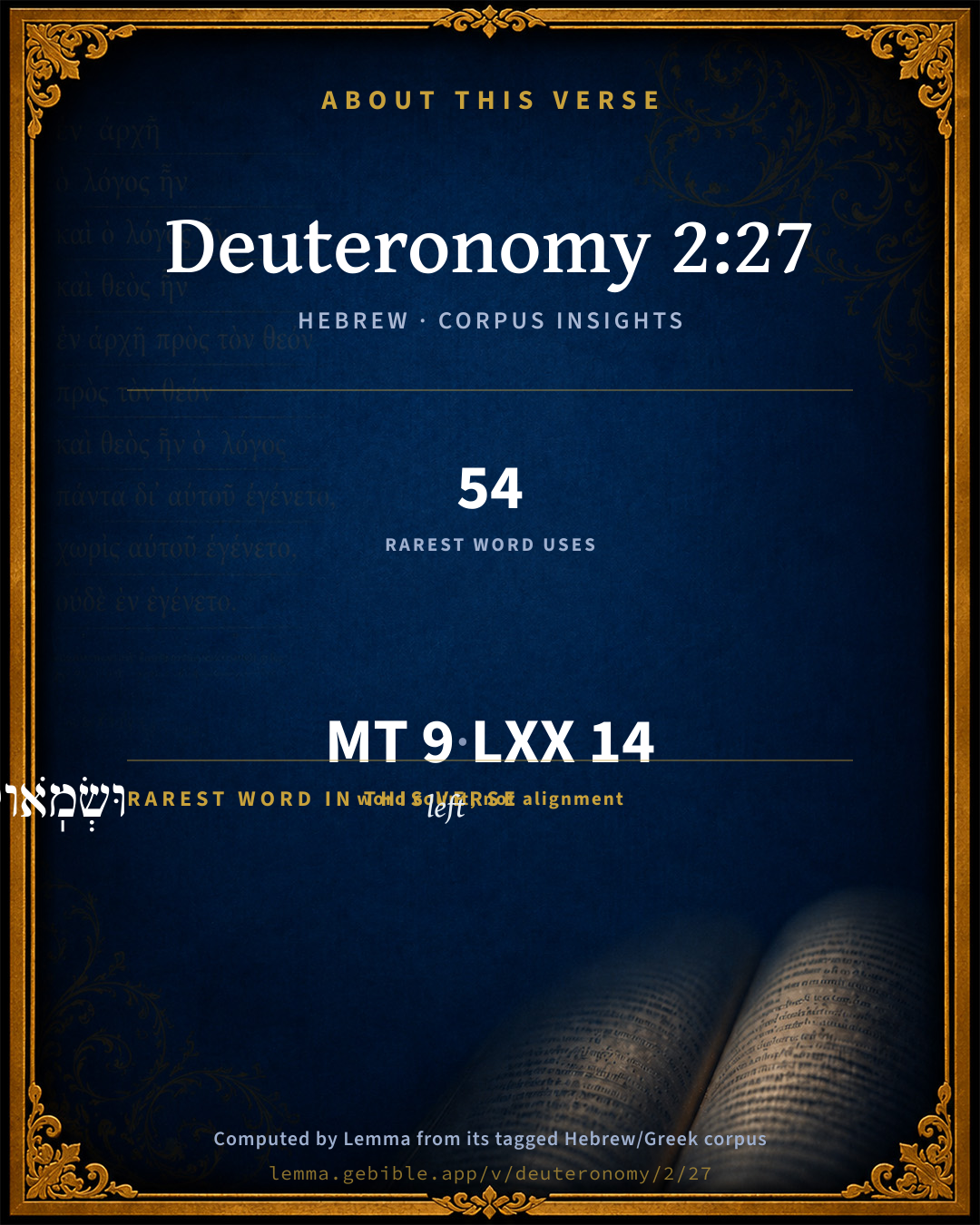
וּשְׂמֹֽאול left H8040 occurs in 53 verses of the Hebrew Bible. Also found in:

Grammatical profile

  • 3 verbs
  • 5 nouns
  • 1 particle

Verb forms

  • אֶעְבְּרָ֣ה Qal · Cohortative
  • אֵלֵ֑ךְ Qal · Imperfect
  • אָס֖וּר Qal · Imperfect

Repetition

A word recurs within this verse — often emphatic in Hebrew:

  • בַּדֶּ֥רֶךְ way H1870 ×2

Hebrew & Septuagint length

In English translation the verse runs 25 words from the Hebrew and 25 from the Septuagint (LXX English) — the same length.

A rough comparison of the two English renderings, which tokenize alike — not a word-level alignment.

Word counts can differ between the Hebrew and the Greek without any difference in meaning — e.g. the Hebrew direct-object marker אֵת has no separate Greek word, and Greek often adds the article ὁ.

In the original languages it is 9 Hebrew tokens and 14 Greek tokens — but the two are counted differently (Hebrew bundles its prefixes and suffixes into one token; the Greek is in lemma form), so that isn’t a like-for-like length.

Cross-references

3

Topical passages linked to Deuteronomy 2:27 in the Treasury of Scripture Knowledge — connected by theme and wording, ordered by reader-vote popularity; previews shown in the World English Bible.

  • Judges 11:19 Israel sent messengers to Sihon king of the Amorites, the king of Heshbon; and Israel said to him, Let us pass, we pray you, through your land to my place.
  • Numbers 21:21–23 Israel sent messengers to Sihon king of the Amorites, saying,
  • Deuteronomy 2:6 You shall purchase food of them for money, that you may eat; and you shall also buy water of them for money, that you may drink.

Cross-references courtesy of OpenBible.info (CC BY 4.0).

Hebrew and Greek witnesses Masoretic Hebrew ↔ Greek Septuagint

The same verse in the two great witnesses to the Old Testament, shown verse-for-verse.

These are two independent witnesses, not word-aligned to each other, and the Septuagint is shown in lemma (dictionary) form.

Hebrew Deuteronomy 2:27 Masoretic · Westminster Leningrad Codex

אֶעְבְּרָ֣ה בְאַרְצֶ֔ךָ בַּדֶּ֥רֶךְ בַּדֶּ֖רֶךְ אֵלֵ֑ךְ לֹ֥א אָס֖וּר יָמִ֥ין וּשְׂמֹֽאול

Let me pass through your land: I will go along by the highway, I will turn neither to the right hand nor to the left.

World English Bible · Public Domain

Greek LXX Deuteronomy 2:27 Septuagint · lemma form

παραἔρχομαι διά ὁ γῆ σύ ἐν ὁ ὁδός παραἔρχομαι οὐ ἐκκλίνω δεξιός οὐδέ ἀριστερός

I will pass through your land: I will go by the road, I will not turn aside to the right hand or to the left.

LXX2012 (modern English Septuagint) · Public Domain

On this verse, The Cambridge Bible for Schools and Colleges discusses the Septuagint’s reading. Read the note in Commentary ↓

Hebrew: Westminster Leningrad Codex (CC BY 4.0). Greek: Septuagint (public domain); English from LXX2012 (modern English Septuagint) (Public Domain). How the Septuagint differs from the Hebrew →

Targum (Aramaic paraphrase)

2

The Targum is the ancient Jewish Aramaic paraphrase of the Hebrew Scriptures — an interpretive translation, not the Hebrew text itself. Onkelos (literal) and Pseudo-Jonathan (expansive) render the Torah, and Jonathan the Prophets. Coverage is partial: where no permissively-licensed English translation exists for a verse, only the Aramaic is shown. This is verse-level text, not a word-by-word alignment to the Hebrew.

  1. Targum Onkelos Torah (Genesis–Deuteronomy)
    אֵעִבַר בְּאַרְעָךְ בְּאָרְחָא בְּאָרְחָא אֵזֵל לָא אֶסְטֵי יַמִינָא וּשְׂמָאלָא

    (no public-domain English translation for this verse)

    Targum Onkelos — Aramaic: “Onkelos Genesis” (public domain); “Onkelos Exodus” (public domain); “Onkelos Leviticus” (public domain); “Onkelos Numbers” (public domain); “Onkelos Deuteronomy” (public domain). English: “Sefaria Community Translation” (CC0 1.0 (public-domain dedication)); “J.W. Etheridge. The Targums of Onkelos and Jonathan Ben Uzziel on the Pentateuch. London: Longmans, Green, 1862” (public domain). Text via Sefaria.

  2. Targum Pseudo-Jonathan Torah (Genesis–Deuteronomy)
    אֲעִיבַר בְּאַרְעָךְ בְּאוֹרְחָא דְהִיא אוֹרַח כְּבִישָׁא אֵיזִיל לָא אַסְטֵי לְהַנְזָקוּתָךְ לְיַמִינָא וְלִשְמָאלָא

    I would pass through thy land; by the way which is the beaten road will I go; I will not turn aside to do thee harm on the right hand or the left.

    Targum Pseudo-Jonathan — Aramaic: “Targum Jonathan on Genesis” (public domain); “Targum Jonathan on Exodus” (public domain); “Targum Jonathan on Leviticus” (public domain); “Targum Jonathan on Numbers” (public domain); “Targum Jonathan on Deuteronomy” (public domain). English: “The Targum of Jonathan ben Uzziel, trans. J. W. Etheridge, London, 1862” (public domain). Text via Sefaria.

Commentary

Notes on Deuteronomy 2:27 from classic Christian and Jewish commentators (each source and its license shown beneath its notes). The classic Christian expositions comment on the surrounding passage and are grouped to its opening verse, so a note may address several verses; the Jewish commentaries on the Tanakh (Rashi and others) are per-verse, so they appear only where the commentator wrote on this verse.

Lemma curates 59 commentaries, every one of them public domain or Creative Commons licensed, each selected and text-cleaned for this edition rather than reprinted as found. About our sources →

The Cambridge Bible for Schools and Colleges

gen. ed. J. J. S. Perowne

27. Let me pass, etc.] So E, Num_21:22; LXX, we will pass.

I will go along by the highway] Heb. and Sam. here by the way by the way; E, by the king’s way, the main road, like the Ar. term Sulṭani.

I will neither turn, etc.] E, Num_21:22 : we will not turn aside into field or vineyard, nor drink the water of the wells.

The Cambridge Bible for Schools and Colleges (gen. ed. J. J. S. Perowne; Cambridge University Press, 1878–1918) — public domain. Text from a community e-Sword module.

John Gill's Exposition

Let me pass through thy land,.... See Gill on Num 21:22,

I will go along by the highway; the king's highway, as in the place referred to, the public road:

I will neither turn to the right hand nor to the left; to go into his fields and vineyards, and gather the fruit, or tread down the corn and vines, or do any manner of mischief to them; see the above place.

John Gill's Exposition of the Whole Bible (1746–1763) — public domain (CC PDM 1.0). Text via the HelloAO Bible API.

Matthew Poole's English Annotations

In my direct road to Canaan, from which I will not turn aside into thy fields, or vineyards, or houses;

Matthew Poole's English Annotations on the Holy Bible (1683–1685) — public domain. Text from a community e-Sword/MySword module.

Whedon's Commentary on the Bible

Daniel D. Whedon

27. I will go along by the high way — Hebrew, by the way. The meaning is, that the Israelites would pass directly through the land, not seeking to dispossess the inhabitants nor to despoil them. They would pay for the food that was furnished them, and pay for the privilege of digging wells for water.

Daniel D. Whedon (gen. ed.), Commentary on the Old and New Testaments (1874–1909) — public domain. Text from a community e-Sword module.

The Pulpit Commentary

Along by the high way; literally, by the way, by the way, i.e. always, continuously by the way, the public road, called in Num_20:17 and Num_21:22, "the king"s way," probably because made and kept up bythe king.

The Pulpit Commentary (1880–1919), ed. H.D.M. Spence-Jones & Joseph S. Exell — public domain. Text from a community e-Sword module.

Lesson kit

Teaching starters — assembled from the data on this page, not authored interpretation. Every prompt links to the verse data it draws on. Edit before teaching.

Deuteronomy, in the Pentateuch, opens this verse with 9 words (8 distinct Hebrew lemmas). Its most distinctive word is sᵉmôʼwl (“left”). A historical commentator’s framing appears above. Read the whole chapter for the surrounding context.

Discussion questions

  1. How does “left” (sᵉmôʼwl) shape what this verse is saying?
  2. Genesis 13:9 shares the word «left» with this verse. How do the two illuminate each other?
  3. “way” occurs 2× in this one verse. What is the effect of the repetition?
  4. These translations render this verse differently; the difference is in the English rendering, not the original. What questions does that raise?
  5. The verb «אֶעְבְּרָ֣ה» is Qal Cohortative. How does its form color the action?
  6. Reading how The Cambridge Bible for Schools and Colleges and John Gill's Exposition read this verse, where do the two commentators agree and where do they part?

Things to notice

Reading settings

Reading text

Shown beneath each verse's original-language words.

Old Testament
Old Testament edition

Read the OT as the Masoretic Hebrew (MT) or the Greek Septuagint (LXX).

English shown for the Greek Septuagint (in the Hebrew ↔ Greek comparison).

Comparing translations? Open the Compare panel on any verse page to stack up to four side by side.