
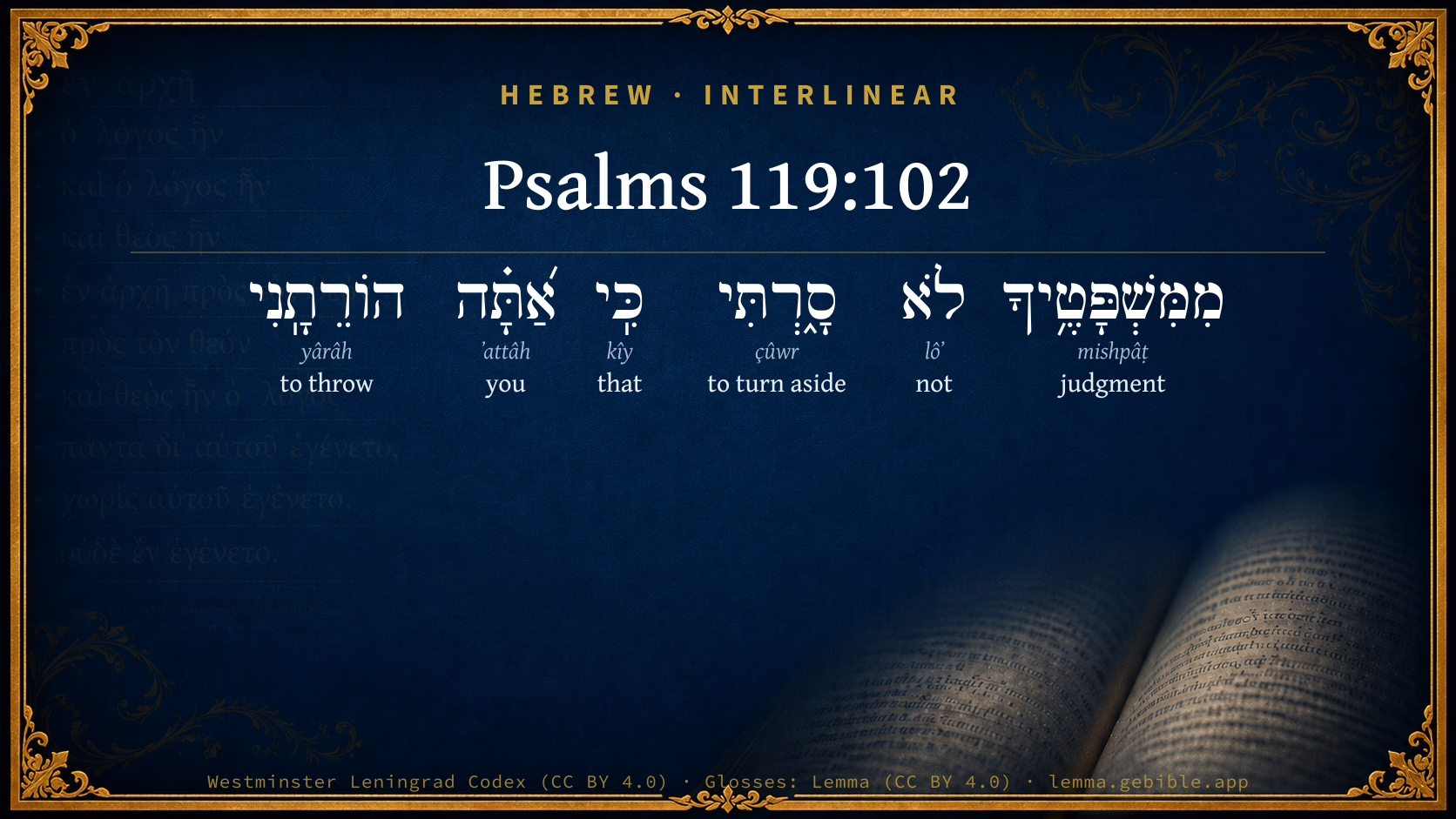
Psalms 119:102

Hebrew (Westminster Leningrad Codex) Psalms 119:102 appears in the Hebrew Old Testament. The text above is from the Westminster Leningrad Codex. Each word links to its Strong’s number, a concise gloss, and parsing drawn from the Open Scriptures Hebrew Bible morphology. Click any word for its full Brown-Driver-Briggs (BDB) entry.
Download image
Cite this verse

Psalms 119:102 (World English Bible). Public Domain. Lemma interlinear Bible study tool, https://lemma.gebible.app/v/psalms/119/102.

Show BibTeX & RIS
BibTeX
RIS
English Translation
I have not turned aside from your ordinances, For you have taught me.
World English Bible · Public Domain
Download a study sheet

One document with this verse’s original text, its word-by-word gloss line, the meaning frame, cross-references with their text, attributed commentary, and full source and license credits — printable, and it pastes into notes with its structure intact.

This verse Autodidact and up

Study sheet (.html) Plain text (.txt)

A passage Seminary Student

Up to 50 verses in one chapter. A passage sheet keeps up to 6 commentary sources and 12 cross-references per verse, in the order this page ranks them, and says so on the sheet whenever that leaves anything out. Ask for a single verse and you get the Autodidact verse sheet above.

Everything on this page stays free to read, with no account — the sheet is a download of what is already on screen, not access to it.

Want to remove ads? Support Godless Engineer
Compare translations 3

The same verse in 3 English versions, stacked beneath the original-language interlinear above. Click any original word for its lexicon entry.

Each is an independent rendering of the whole verse — the interlinear is not word-aligned to these translations.

Highlighted words mark where these versions differ — a whole-verse word diff, not a word-by-word alignment.

  • World English Bible Public Domain
    I have not turned aside from your ordinances, For you have taught me.
  • King James Version Public Domain
    I have not departed from thy judgments: for thou hast taught me.
  • unfoldingWord Literal Text CC BY-SA 4.0
    I have not turned aside from your judgments, for you, you have taught me.

unfoldingWord Literal Text — © unfoldingWord, licensed CC BY-SA 4.0. Word-aligned USFM3 via Door43 (git.door43.org/unfoldingWord/en_ult).

Versions to compare (up to 4)

3 of 4 selected

Show all 17 translations

Every available English version of this verse, each an independent rendering of the whole verse.

  • World English Bible Public Domain
    I have not turned aside from your ordinances, For you have taught me.
  • Berean Standard Bible Public Domain
    I have not departed from Your ordinances, for You Yourself have taught me.
  • Majority Standard Bible Public Domain
    I have not departed from Your ordinances, for You Yourself have taught me.
  • King James Version Public Domain
    I have not departed from thy judgments: for thou hast taught me.
  • American Standard Version (1901) Public Domain
    I have not turned aside from thine ordinances; For thou hast taught me.
  • Revised Version (1885) Public Domain
    I have not turned aside from thy judgments; for thou hast taught me.
  • Geneva Bible (1599) Public Domain
    I haue not declined from thy iudgements: for thou didest teach me.
  • Young's Literal Translation Public Domain
    From Thy judgments I turned not aside, For Thou -- Thou hast directed me.
  • Literal Standard Version CC BY-SA 4.0
    I did not turn aside from Your judgments, || For You have directed me.
  • Unlocked Literal Bible CC BY-SA 4.0
    I have not turned aside from your righteous decrees, for you have instructed me.
  • unfoldingWord Literal Text CC BY-SA 4.0
    I have not turned aside from your judgments, for you, you have taught me.
  • Darby Bible Public Domain
    I have not departed from thy judgments; for it is thou that hast taught me.
  • World Messianic Bible Public Domain
    I have not turned away from your ordinances, for you have taught me.
  • Webster's Bible Public Domain
    I have not departed from thy judgments: for thou hast taught me.
  • Free Bible Version CC BY-SA 4.0
    I have not disregarded your instructions because you yourself taught me what to do.
  • Bible in Basic English Public Domain
    My heart has not been turned away from your decisions; for you have been my teacher.
  • JPS Tanakh (1917) Public Domain
    I have not turned aside from Thine ordinances; for Thou hast instructed me.

Literal Standard Version (2020), Covenant Press — licensed CC BY-SA 4.0. Text via the HelloAO Bible API (eBible.org). Unlocked Literal Bible (unfoldingWord) — licensed CC BY-SA 4.0. Text via the HelloAO Bible API (eBible.org). unfoldingWord Literal Text — © unfoldingWord, licensed CC BY-SA 4.0. Word-aligned USFM3 via Door43 (git.door43.org/unfoldingWord/en_ult). Free Bible Version, Dr. Jonathan Gallagher — licensed CC BY-SA 4.0. Text via the HelloAO Bible API (eBible.org).

Word by word

More ways to search: Search by grammar → Find every occurrence → Compare this word →

Practice this passage: Drill this verse → Learn its vocabulary →

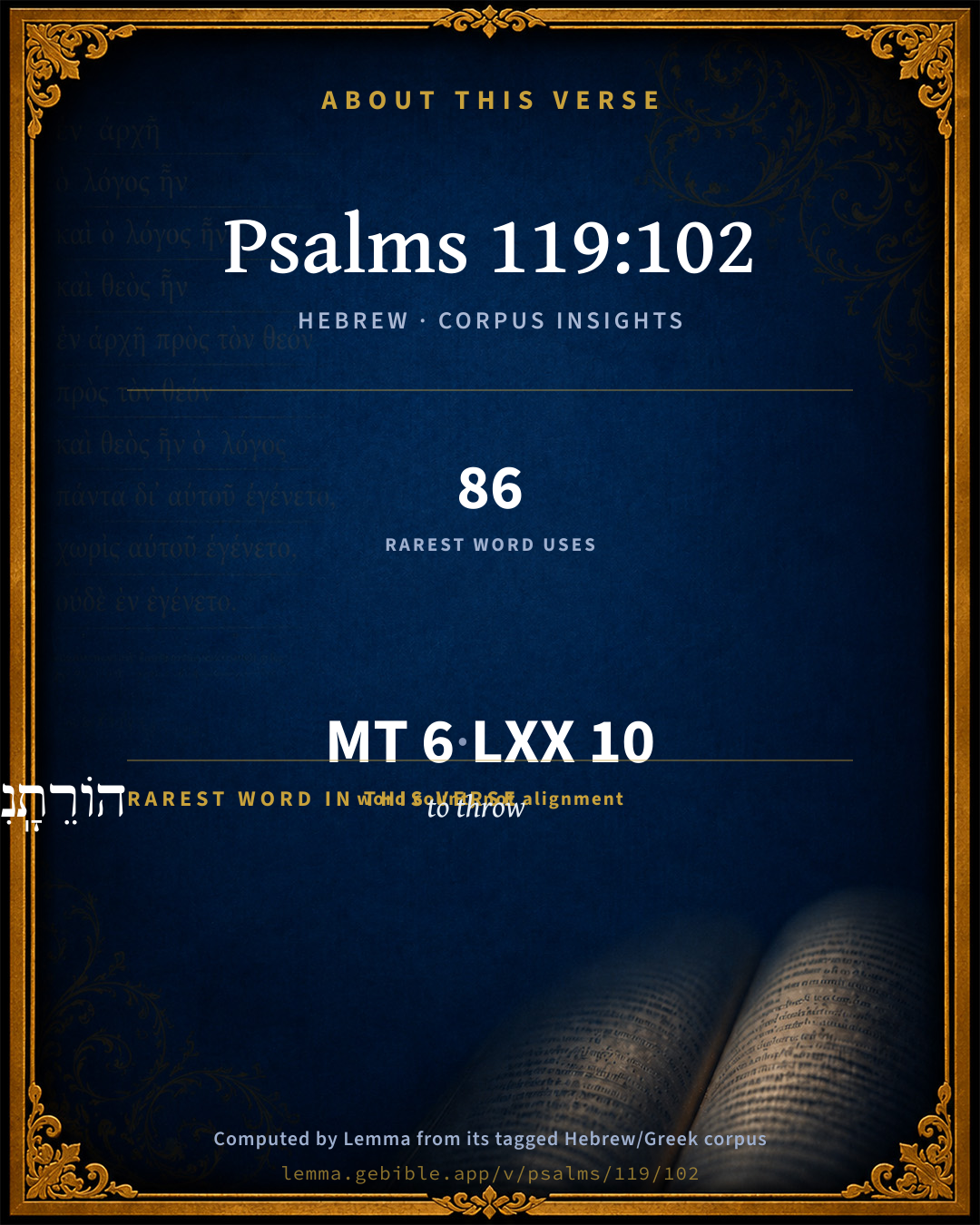
About this verse

These counts appear in no published source. They are computed here, from the morphology-tagged text and Lemma’s own curated glosses. What Lemma adds →

6
words
6
distinct lemmas
Wisdom
section

Grammatical profile

  • 2 verbs
  • 1 noun
  • 1 pronoun
  • 1 conjunction
  • 1 particle

Verb forms

  • סָ֑רְתִּי Qal · Perfect
  • הוֹרֵתָֽנִי Hiphil · Perfect

Hebrew & Septuagint length

In English translation the verse runs 13 words from the Hebrew and 12 from the Septuagint (LXX English) — closely comparable.

A rough comparison of the two English renderings, which tokenize alike — not a word-level alignment.

Word counts can differ between the Hebrew and the Greek without any difference in meaning — e.g. the Hebrew direct-object marker אֵת has no separate Greek word, and Greek often adds the article ὁ.

In the original languages it is 6 Hebrew tokens and 10 Greek tokens — but the two are counted differently (Hebrew bundles its prefixes and suffixes into one token; the Greek is in lemma form), so that isn’t a like-for-like length.

Cross-references

7

Topical passages linked to Psalms 119:102 in the Treasury of Scripture Knowledge — connected by theme and wording, ordered by reader-vote popularity; previews shown in the World English Bible.

  • 1 John 2:27 As for you, the anointing which you received from him remains in you, and you don't need for anyone to teach you. But as his anointing teaches you concerning all things, and is true, and is no lie, and even as it taught you, you will remain in him.
  • Psalms 18:21 For I have kept the ways of Yahweh, And have not wickedly departed from my God.
  • Proverbs 5:7 Now therefore, my sons, listen to me. Don't depart from the words of my mouth.
  • 1 Thessalonians 2:13 For this cause we also thank God without ceasing, that, when you received from us the word of the message of God, you accepted it not as the word of men, but, as it is in truth, the word of God, which also works in you who believe.
  • Jeremiah 32:40 and I will make an everlasting covenant with them, that I will not turn away from following them, to do them good; and I will put my fear in their hearts, that they may not depart from me.
  • Ephesians 4:20–24 But you did not learn Christ that way;
  • 1 John 2:19 They went out from us, but they didn't belong to us; for if they had belonged to us, they would have continued with us. But they left, that they might be revealed that none of them belong to us.

Cross-references courtesy of OpenBible.info (CC BY 4.0).

Hebrew and Greek witnesses Masoretic Hebrew ↔ Greek Septuagint

The same verse in the two great witnesses to the Old Testament, shown verse-for-verse.

You’re reading Greek Psalm 118 (Hebrew Psalm 119). The Septuagint counts the superscription, so verse numbers can differ from the Hebrew — chapter-level alignment, not verse-by-verse. Numbering follows Rahlfs.

These are two independent witnesses, not word-aligned to each other, and the Septuagint is shown in lemma (dictionary) form.

Hebrew Psalms 119:102 Masoretic · Westminster Leningrad Codex

מִמִּשְׁפָּטֶ֥יךָ לֹא סָ֑רְתִּי כִּֽי אַ֝תָּ֗ה הוֹרֵתָֽנִי

I have not turned aside from your ordinances, For you have taught me.

World English Bible · Public Domain

Greek LXX Greek Psalm 118:102 Septuagint · lemma form

ἀπό ὁ κρίμα σύ οὐ ἐκκλίνω ὅτι σύ νομοθετέω ἐγώ

I have not declined from your judgments; for you have instructed me.

LXX2012 (modern English Septuagint) · Public Domain

Hebrew: Westminster Leningrad Codex (CC BY 4.0). Greek: Septuagint (public domain); English from LXX2012 (modern English Septuagint) (Public Domain). How the Septuagint differs from the Hebrew →

Commentary

Notes on Psalms 119:102 from classic Christian and Jewish commentators (each source and its license shown beneath its notes). The classic Christian expositions comment on the surrounding passage and are grouped to its opening verse, so a note may address several verses; the Jewish commentaries on the Tanakh (Rashi and others) are per-verse, so they appear only where the commentator wrote on this verse.

Lemma curates 59 commentaries, every one of them public domain or Creative Commons licensed, each selected and text-cleaned for this edition rather than reprinted as found. About our sources →

Trapp's Complete Commentary

John Trapp

Psa 119:102 I have not departed from thy judgments: for thou hast taught me.

Ver. 102. I have not departed from thy judyments] i.e. From thy law, which is called judgments, because God will thereby judge the world.

For thou hast taught me] sc. To cleave close unto them with full purpose of heart; and not to be drawn aside by any either allurement or fright.

John Trapp, A Commentary or Exposition upon All the Books of the Old and New Testament (1647–1656) — public domain. Text from a community e-Sword module.

J. A. Alexander on Psalms

Joseph Addison Alexander

102. (Psa 119:102) From thy judgments I do not depart, because thou guidest me. We have here another word of comprehensive meaning, in which sometimes one phrase of the essential idea is presented prominently, sometimes another. The divine judgments, in this psalm, are always the external exhibitions of the divine righteousness, in word or deed, by precept or by punishment. Here, of course, the former are especially intended. The figure of a way, though not expressed, is still indicated by the verbs depart and guide. As to the latter, see above, on Psa 119:33. From this verse it is doubly clear that he claims nothing as belonging to himself, or as accomplished in his own strength, but ascribes all to the power and grace of God. The preterite forms, in this and the preceding verse, merely make the past more prominent than the future, as an accessory idea to the present.

Joseph Addison Alexander, The Psalms Translated and Explained (1850) — public domain. Text from a community e-Sword module.

Geneva Bible (1599)

Geneva Bible translators

So then of ourselves we can do nothing: but when God doth inwardly instruct us with his spirit, we feel his graces sweeter than honey.

Geneva Bible (1599) marginal notes — public domain. Text via Bolls.life.

Matthew Henry's Commentary

Here is, 1. David's constancy in his religion. He had not departed from God's judgments; he had not chosen any other rule than the word of God, nor had he wilfully deviated from that rule. A constant adherence to the ways of God in trying times will be a good evidence of our integrity. 2. The cause of his constancy: "For thou hast taught me; that is, they were divine instructions that I learned; I was satisfied that the doctrine was of God, and therefore I stuck to it." Or rather, "It was divine grace in my heart that enabled me to receive those instructions." All the saints are taught of God, for he it is that gives the understanding; and those, and those only, that are taught of God, will continue to the end in the things that they have learned.

Matthew Henry's Commentary on the Whole Bible (1708–1710) — public domain (CC PDM 1.0). Text via the HelloAO Bible API.

The Cambridge Bible for Schools and Colleges

gen. ed. J. J. S. Perowne

102. From thy judgements have I not turned aside;

For thou thyself hast instructed me.

God Himself has been his teacher, not men: therefore he has been enabled to keep in the path of right. Cp. Psa_86:11.

The Cambridge Bible for Schools and Colleges (gen. ed. J. J. S. Perowne; Cambridge University Press, 1878–1918) — public domain. Text from a community e-Sword module.

John Gill's Exposition

I have sworn, and I will perform it,.... Or, "I have performed it" (h). The psalmist had not only taken up a resolution in his mind, but he had openly declared with his mouth, and professed in a solemn manner, that he would serve the Lord; he had sworn allegiance to him as his King, and, through divine grace, had hitherto kept it; and hoped he ever should, and determined through grace he ever would; see Psa 119:48;

that I will keep thy righteous judgments; the precepts of the word, the ordinances of the Lord, the doctrines of grace; all which are righteous, and to be kept, observed, and held to; though they cannot be perfectly kept unless in Christ the surety.

(h) "et statui"; Musculus, Muis; "idque ratum feci et implevi", Michaelis.

John Gill's Exposition of the Whole Bible (1746–1763) — public domain (CC PDM 1.0). Text via the HelloAO Bible API.

Albert Barnes' Notes on the Bible

I have not departed from thy judgments - Thy law; thy commands. This cannot mean that he had never done this, but that as a great rule of life he had not done it. The character and aim of his life had been obedience, not disobedience. A man may honestly say this, though he may be conscious of much imperfection, and may feel that he has not perfectly carried out such an aim and purpose. No one can be a truly pious man, or have evidence of personal religion, who cannot say in sincerity that he has “not departed in this sense, “from the judgments” (the commands) of God; who cannot look back on his life and say that his course - his aim - his character - since he became a professor of religion - has been, one of obedience to God. Compare 1Jo 3:7-9.

For thou hast taught me - Not to himself was this to be traced, but to God; not to any wisdom of his own, but to that which was given him from on high.

Albert Barnes' Notes on the Bible (1834–1885) — public domain. Text from a community e-Sword/MySword module.

Matthew Poole's English Annotations

To wit, by thy blessed Spirit, illuminating my mind, and working upon my heart, which other teachers cannot do.

Matthew Poole's English Annotations on the Holy Bible (1683–1685) — public domain. Text from a community e-Sword/MySword module.

The Treasury of David

Charles H. Spurgeon

Ver. 102. I have not departed from thy judgments: for thou hast taught me. They are well taught whom God teaches. What we learn from the Lord we never forget. God's instruction has a practical effect we follow his way when he teaches us; and it has an abiding effect, we do not depart from holiness. Read this verse in connection with the preceding and you get the believer's "I have, "and his "I have not": he is good both positively and negatively. What he did, namely, "refrained his feet, "preserved him from doing that which otherwise he might have done, namely, "departed from thy judgments." He who is careful not to go an inch aside will not leave the road. He who never touches the intoxicating cup will never be drunk. He who never utters an idle word will never be profane. If we begin to depart a little we can never tell where we shall end. The Lord brings us to persevere in holiness by abstinence from the beginning of sin; but whatever be the method he is the worker of our perseverance, and to him be all the glory.

Ver. 102. By "misphallim", "judgments, "is meant God's law; for thereby he will judge the world. And the word "departed not" intimates both his exactness and constancy: his exactness, that he did not go a hair's breadth from his direction; "Ye shall observe to do therefore as the Lord your God hath commanded you: ye shall not turn aside to the right hand or to the left" (De 5:32); and his constancy is implied in it, for then we are said to depart from God and his law, when we fall off from him in judgment and practice. Jer 32:40. Thomas Manton.

Ver. 102. Thou hast taught me. God teacheth two ways: 1. By common illumination. 2. By special operation.

1. By common illumination, barely enlightening the mind to know or understand what he propounds by his messengers: so God showed it to the heathen: Ro 1:20. But then, 2. By way of special operation, effectually inclining the will to embrace and prosecute duties so known: "I will put my law in their inward parts, and write it in their hearts": Jer 31:33. This way of teaching is always effectual and persuasive. Now, in this sense they are taught of God, so that they do not only get an ear to hear, but a heart to understand, learn, and practise.

This teaching is the ground of constancy, because, (1) They that are thus taught of God see things more clearly than others do; God is the most excellent teacher. (2) They know things more surely, and with certainty of demonstration, whereas others have but dubious conjectures, and loose and wavering opinions about the things of God. (3) This teaching is so efficacious and powerful, as that the effect followeth: "Teach me thy way, O Lord; I Will walk in thy truth" (Ps 86:11). (4) God renews this teaching, and is always at hand to guide us, and give counsel to us, which is the cause of our standing. Thomas Manton.

Ver. 102. For thou hast taught me. Lest it should seem that David ascribed the praise of godliness to himself, or that it came from any goodness in him that he did refrain his feet from every evil way, he gives here all the glory to God, protesting, that because God did teach him, therefore he declined not. Wherefrom we learn, that if at any time we stand, or if when we have fallen we rise and repent, it is ever to be imputed to God that teacheth us; for there is no evil so abominable, but it would soon become plausible to us, if God should leave us to ourselves. David was taught by his ordinary teachers, and he did reverence them; but that he profited by them he ascribes unto God. Paul may plant, and Apollos water; God must give the increase. William Cowper.

Ver. 102. Divine teaching necessary to secure perseverance, and effectual to that end.

Ver. 102. Consider,

1. The path appointed for men to walk in: "Thy judgments."

(a) Right path.

(b) Clean path.

(c) Pleasant path.

(d) Safe path.

(e) The end eternal glory.

2. The persistent pursuit of it: "I have not departed."

(a) Persecution would drive from it.

(b) Pleasures would allure from it.

(c) The flesh would weary in it.

(d) But the true believer determines to hold on his way to

the end.

(e) And carefully watches his steps lest they depart.

3. The preserving power that holds the traveller to it: "For thou hast taught me."

(a) The traveller walks with God, and receives instruction

by the special illumination of the Holy Spirit.

(b) The choice property of this teaching is, not only that

it makes wise, but that it captivates the soul, strengthens

it, and holds it to a holy obedience. J.F.

Psalms 119:103*

Charles H. Spurgeon's The Treasury of David (1869–1885) — public domain. Psalms only. Text from a community e-Sword/MySword module.

The Pulpit Commentary

I have not departed from thy judgments (comp. vers. 30, 31, 51, 157, 168, etc.). For thou hast taught me. Thy teaching, thy guidance, thy help, have kept me straight.

The Pulpit Commentary (1880–1919), ed. H.D.M. Spence-Jones & Joseph S. Exell — public domain. Text from a community e-Sword module.

John Wesley's Explanatory Notes

Taught me - By thy blessed spirit, illuminating my mind, and working upon my heart.

John Wesley, Explanatory Notes Upon the Whole Bible (1754–1765) — public domain. Text via the GEBible commentary corpus.

Lesson kit

Teaching starters — assembled from the data on this page, not authored interpretation. Every prompt links to the verse data it draws on. Edit before teaching.

Psalms, in the Wisdom, opens this verse with 6 words (6 distinct Hebrew lemmas). Its most distinctive word is yârâh (“to throw”). A historical commentator’s framing appears above. Read the whole chapter for the surrounding context.

Discussion questions

  1. What does “to throw” (yârâh) contribute to the verse as a whole?
  2. 1 John 2:27 shares this passage’s theme. How do the two illuminate each other?
  3. These translations render this verse differently. What is at stake in choosing one wording over another?
  4. The verb «סָ֑רְתִּי» is Qal Perfect. How does its form color the action?
  5. Reading how Trapp's Complete Commentary and J. A. Alexander on Psalms read this verse, where do the two commentators agree and where do they part?

Things to notice

Reading settings

Reading text

Shown beneath each verse's original-language words.

Old Testament
Old Testament edition

Read the OT as the Masoretic Hebrew (MT) or the Greek Septuagint (LXX).

English shown for the Greek Septuagint (in the Hebrew ↔ Greek comparison).

Comparing translations? Open the Compare panel on any verse page to stack up to four side by side.