
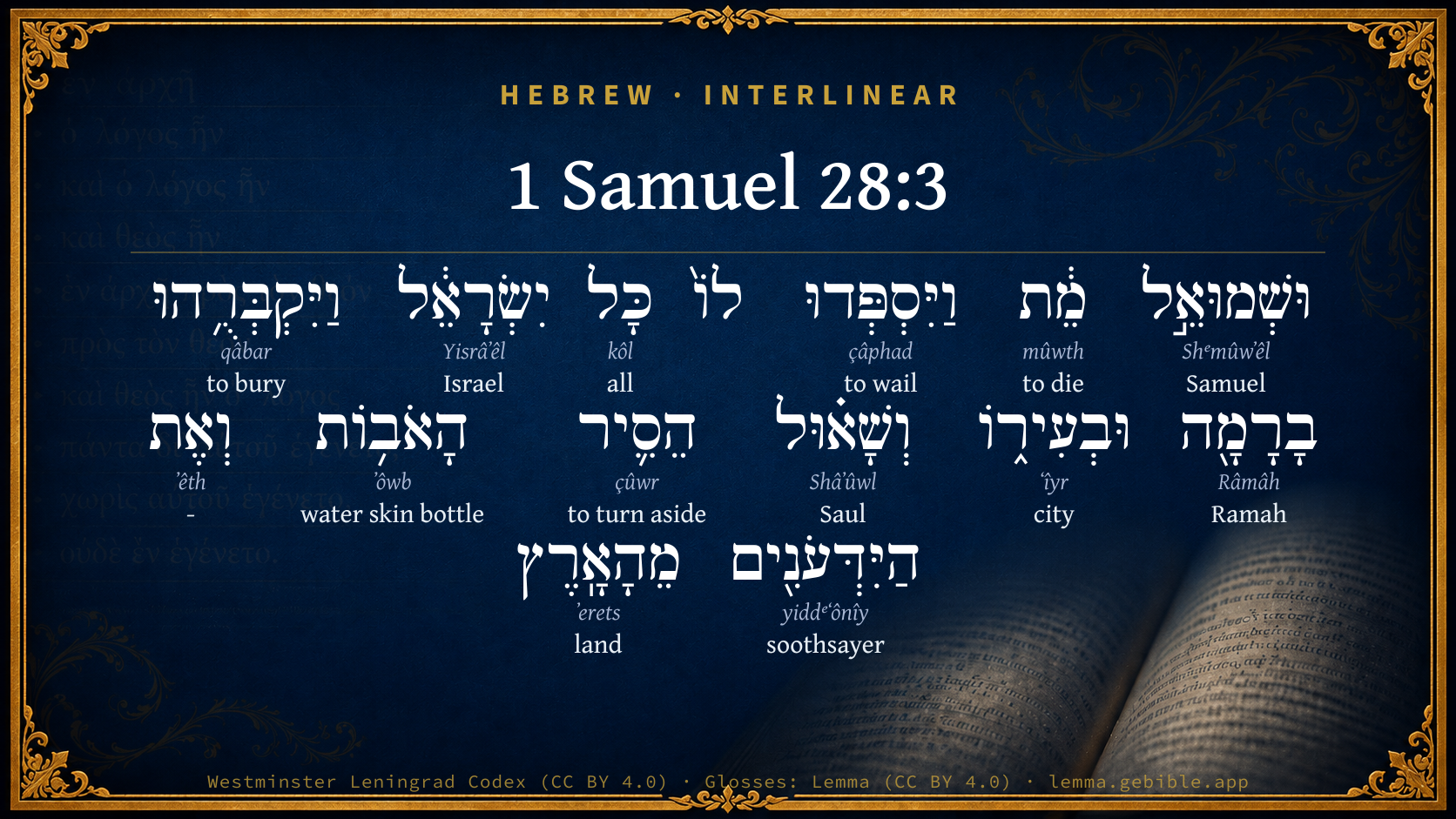
1 Samuel 28:3

Hebrew (Westminster Leningrad Codex) 1 Samuel 28:3 appears in the Hebrew Old Testament. The text above is from the Westminster Leningrad Codex. Each word links to its Strong’s number, a concise gloss, and parsing drawn from the Open Scriptures Hebrew Bible morphology. Click any word for its full Brown-Driver-Briggs (BDB) entry.
Download image
Cite this verse

1 Samuel 28:3 (World English Bible). Public Domain. Lemma interlinear Bible study tool, https://lemma.gebible.app/v/1-samuel/28/3.

Show BibTeX & RIS
BibTeX
RIS
English Translation
Now Samuel was dead, and all Israel had lamented him, and buried him in Ramah, even in his own city. Saul had put away those who had familiar spirits, and the wizards, out of the land.
World English Bible · Public Domain
Download a study sheet

One document with this verse’s original text, its word-by-word gloss line, the meaning frame, cross-references with their text, attributed commentary, and full source and license credits — printable, and it pastes into notes with its structure intact.

This verse Autodidact and up

Study sheet (.html) Plain text (.txt)

A passage Seminary Student

Up to 50 verses in one chapter. A passage sheet keeps up to 6 commentary sources and 12 cross-references per verse, in the order this page ranks them, and says so on the sheet whenever that leaves anything out. Ask for a single verse and you get the Autodidact verse sheet above.

Everything on this page stays free to read, with no account — the sheet is a download of what is already on screen, not access to it.

Want to remove ads? Support Godless Engineer
Compare translations 3

The same verse in 3 English versions, stacked beneath the original-language interlinear above. Click any original word for its lexicon entry.

Each is an independent rendering of the whole verse — the interlinear is not word-aligned to these translations.

Highlighted words mark where these versions differ — a whole-verse word diff, not a word-by-word alignment.

  • World English Bible Public Domain
    Now Samuel was dead, and all Israel had lamented him, and buried him in Ramah, even in his own city. Saul had put away those who had familiar spirits, and the wizards, out of the land.
  • King James Version Public Domain
    Now Samuel was dead, and all Israel had lamented him, and buried him in Ramah, even in his own city. And Saul had put away those that had familiar spirits, and the wizards, out of the land.
  • unfoldingWord Literal Text CC BY-SA 4.0
    Now Samuel had died, and all of Israel had mourned for him, and they had buried him in Ramah, even in his city. And Saul had removed the ritual pits and the familiar spirits from the land.

unfoldingWord Literal Text — © unfoldingWord, licensed CC BY-SA 4.0. Word-aligned USFM3 via Door43 (git.door43.org/unfoldingWord/en_ult).

Versions to compare (up to 4)

3 of 4 selected

Show all 18 translations

Every available English version of this verse, each an independent rendering of the whole verse.

  • World English Bible Public Domain
    Now Samuel was dead, and all Israel had lamented him, and buried him in Ramah, even in his own city. Saul had put away those who had familiar spirits, and the wizards, out of the land.
  • Berean Standard Bible Public Domain
    Now by this time Samuel had died, and all Israel had mourned for him and buried him in Ramah, his own city. And Saul had removed the mediums and spiritists from the land.
  • Majority Standard Bible Public Domain
    Now by this time Samuel had died, and all Israel had mourned for him and buried him in Ramah, his own city. And Saul had removed the mediums and spiritists from the land.
  • King James Version Public Domain
    Now Samuel was dead, and all Israel had lamented him, and buried him in Ramah, even in his own city. And Saul had put away those that had familiar spirits, and the wizards, out of the land.
  • American Standard Version (1901) Public Domain
    Now Samuel was dead, and all Israel had lamented him, and buried him in Ramah, even in his own city. And Saul had put away those that had familiar spirits, and the wizards, out of the land.
  • Revised Version (1885) Public Domain
    Now Samuel was dead, and all Israel had lamented him, and buried him in Ramah, even in his own city. And Saul had put away those that had familiar spirits, and the wizards, out of the land.
  • Geneva Bible (1599) Public Domain
    (Samuel was then dead, and all Israel had lamented him, and buried him in Ramah his owne citie: and Saul had put away the sorcerers, and the soothsayers out of the land)
  • Douay-Rheims (1899) Public Domain
    Now Samuel was dead, and all Israel mourned for him, and buried him in Ramatha his city. And Saul had put away all the magicians and soothsayers out of the land.
  • Young's Literal Translation Public Domain
    And Samuel hath died, and all Israel mourn for him, and bury him in Ramah, even in his city, and Saul hath turned aside those having familiar spirits, and the wizards, out of the land.
  • Literal Standard Version CC BY-SA 4.0
    And Samuel has died, and all Israel mourns for him, and buries him in Ramah, even in his city, and Saul has turned aside those having familiar spirits, and the wizards, out of the land.
  • Unlocked Literal Bible CC BY-SA 4.0
    Now Samuel had died, and all Israel had lamented him and buried him in Ramah, in his own city. Also, Saul had banned from the land those who talked with the dead or with spirits.
  • unfoldingWord Literal Text CC BY-SA 4.0
    Now Samuel had died, and all of Israel had mourned for him, and they had buried him in Ramah, even in his city. And Saul had removed the ritual pits and the familiar spirits from the land.
  • Darby Bible Public Domain
    (Now Samuel was dead, and all Israel had lamented him, and they had buried him in Ramah, even in his own city. And Saul had put away the necromancers and the soothsayers out of the land.)
  • World Messianic Bible Public Domain
    Now Samuel was dead, and all Israel had mourned for him and buried him in Ramah, even in his own city. Saul had sent away those who had familiar spirits and the wizards out of the land.
  • Webster's Bible Public Domain
    Now Samuel was dead, and all Israel had lamented him, and buried him in Ramah, even in his own city. And Saul had put away those that had familiar spirits, and the wizards, out of the land.
  • Free Bible Version CC BY-SA 4.0
    By now Samuel had died, and all of Israel had mourned for him and buried him in Ramah, his home town. Saul had got rid of mediums and spiritists from the country.
  • Bible in Basic English Public Domain
    Now Samuel was dead, and all Israel, after weeping for him, had put his body in its last resting-place in Ramah, his town. And Saul had put away from the land all those who had control of spirits and who made use of secret arts.
  • JPS Tanakh (1917) Public Domain
    Now Samuel was dead, and all Israel had lamented him, and buried him in Ramah, even in his own city. And Saul had put away those that divined by a ghost or a familiar spirit out of the land.

Literal Standard Version (2020), Covenant Press — licensed CC BY-SA 4.0. Text via the HelloAO Bible API (eBible.org). Unlocked Literal Bible (unfoldingWord) — licensed CC BY-SA 4.0. Text via the HelloAO Bible API (eBible.org). unfoldingWord Literal Text — © unfoldingWord, licensed CC BY-SA 4.0. Word-aligned USFM3 via Door43 (git.door43.org/unfoldingWord/en_ult). Free Bible Version, Dr. Jonathan Gallagher — licensed CC BY-SA 4.0. Text via the HelloAO Bible API (eBible.org).

Word by word

More ways to search: Search by grammar → Find every occurrence → Compare this word →

Practice this passage: Drill this verse → Learn its vocabulary →

הַיִּדְּעֹנִ֖ים
yiddᵉʻônîy
H3049
“the · soothsayers”
Particle, Definite Article + Noun, Common, Masculine, Plural, Absolute
Part of Speech
Particle + Noun
Type
Common
Gender
Masculine
Number
Plural
State
Absolute
Full BDB Definition

Origin: from H3045

TWOT: 848d

a knower, one who has a familiar spirit - a familiar spirit, soothsayer, necromancer (metonymy)
  1. וּשְׁמוּאֵ֣ל Shᵉmûwʼêl H8050 “and · Samuel” Conjunction + Noun, Proper
  2. מֵ֔ת mûwth H4191 “to die” Verb, Qal, Perfect, 3rd Person, Masculine, Singular
  3. וַיִּסְפְּדוּ çâphad H5594 “and · to wail” Conjunction + Verb, Qal, Sequential Imperfect, 3rd Person, Masculine, Plural
  4. כָּל kôl H3605 “all of” Noun, Common, Masculine, Singular, Construct
  5. יִשְׂרָאֵ֔ל Yisrâʼêl H3478 “Israel” Noun, Proper
  6. וַיִּקְבְּרֻ֥הוּ qâbar H6912 “and · to bury · him” Conjunction + Verb, Qal, Sequential Imperfect, 3rd Person, Masculine, Plural + Suffix, Personal, 3rd Person, Masculine, Singular
  7. בָרָמָ֖ה Râmâh H7414 “in/at the · Ramah” Preposition, Determined + Noun, Proper
  8. וּבְעִיר֑וֹ ʻîyr H5892 “and · in/at · city · his” Conjunction + Preposition + Noun, Common, Feminine, Singular, Construct + Suffix, Personal, 3rd Person, Masculine, Singular
  9. וְשָׁא֗וּל Shâʼûwl H7586 “and · Saul” Conjunction + Noun, Proper
  10. הֵסִ֛יר çûwr H5493 “to turn aside” Verb, Hiphil, Perfect, 3rd Person, Masculine, Singular
  11. הָאֹב֥וֹת ʼôwb H178 “the · water skin bottles” Particle, Definite Article + Noun, Common, Masculine, Plural, Absolute
  12. וְאֶת ʼêth H853 “and · -” Conjunction + Particle, Direct Object
  13. מֵהָאָֽרֶץ ʼerets H776 “from · the · land” Preposition + Particle, Definite Article + Noun, Common, Both, Singular, Absolute

About this verse

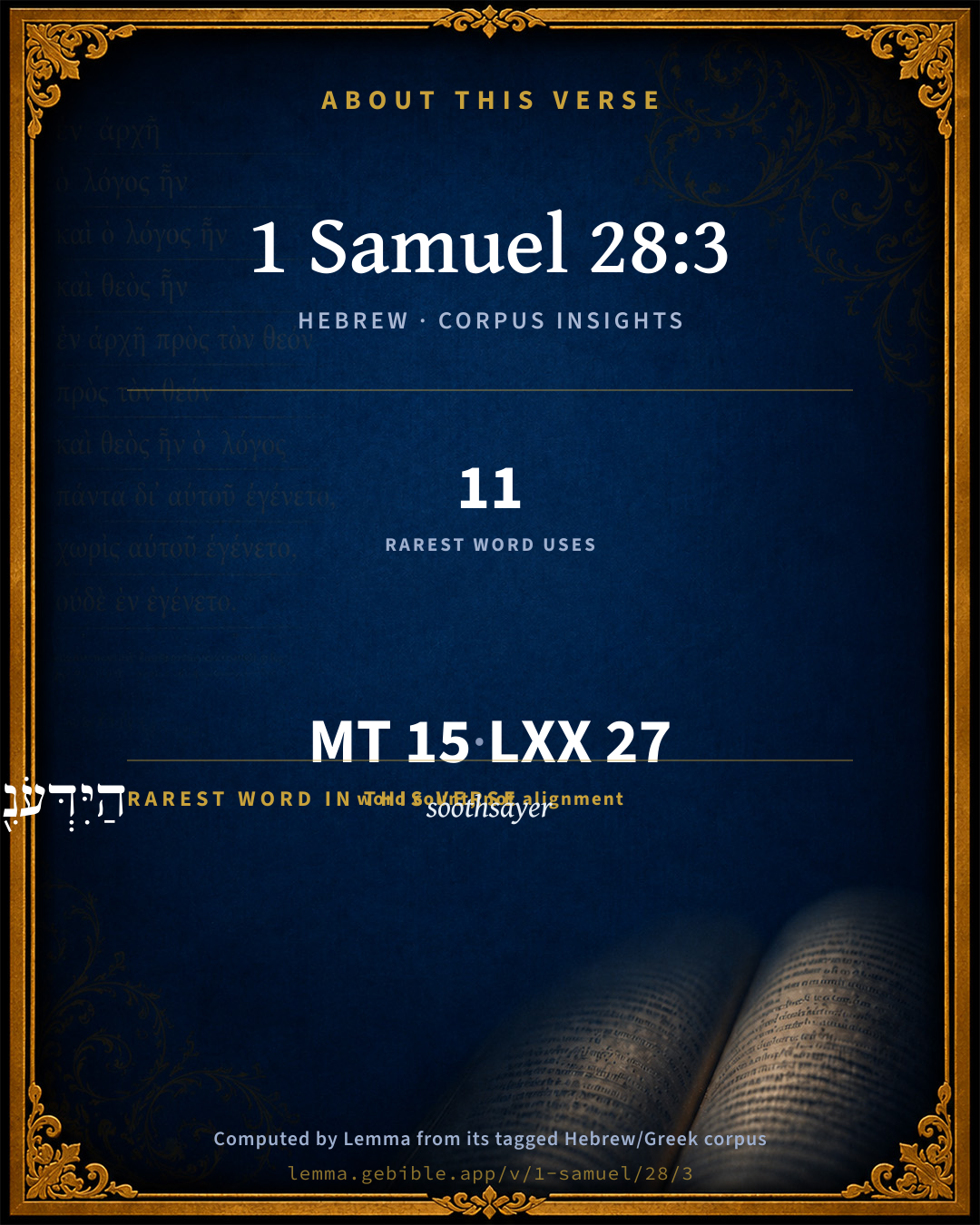
These counts appear in no published source. They are computed here, from the morphology-tagged text and Lemma’s own curated glosses. What Lemma adds →

15
words
14
distinct lemmas
Historical
section

Notable vocabulary

The rarest word here is הַיִּדְּעֹנִ֖ים soothsayer H3049 — appearing just 11 times in the whole Hebrew Bible.

Shared distinctive vocabulary

הַיִּדְּעֹנִ֖ים soothsayer H3049 occurs in 11 verses of the Hebrew Bible. Also found in:

Grammatical profile

  • 4 verbs
  • 9 nouns
  • 1 preposition
  • 1 particle

Verb forms

  • מֵ֔ת Qal · Perfect
  • וַיִּסְפְּדוּ Qal · Sequential Imperfect
  • וַיִּקְבְּרֻ֥הוּ Qal · Sequential Imperfect
  • הֵסִ֛יר Hiphil · Perfect

Hebrew & Septuagint length

In English translation the verse runs 36 words from the Hebrew and 36 from the Septuagint (LXX English) — the same length.

A rough comparison of the two English renderings, which tokenize alike — not a word-level alignment.

Word counts can differ between the Hebrew and the Greek without any difference in meaning — e.g. the Hebrew direct-object marker אֵת has no separate Greek word, and Greek often adds the article ὁ.

In the original languages it is 15 Hebrew tokens and 27 Greek tokens — but the two are counted differently (Hebrew bundles its prefixes and suffixes into one token; the Greek is in lemma form), so that isn’t a like-for-like length.

Cross-references

11

Topical passages linked to 1 Samuel 28:3 in the Treasury of Scripture Knowledge — connected by theme and wording, ordered by reader-vote popularity; previews shown in the World English Bible.

  • Leviticus 19:31 "'Don't turn to those who are mediums, nor to the wizards. Don't seek them out, to be defiled by them. I am Yahweh your God.
  • Leviticus 20:27 "'A man or a woman that is a medium, or is a wizard, shall surely be put to death: they shall stone them with stones; their blood shall be upon them.'"
  • 1 Samuel 25:1 Samuel died; and all Israel gathered themselves together, and lamented him, and buried him in his house at Ramah. David arose, and went down to the wilderness of Paran.
  • Exodus 22:18 "You shall not allow a sorceress to live.
  • Deuteronomy 18:10–11 There shall not be found with you anyone who makes his son or his daughter to pass through the fire, one who uses divination, one who practices sorcery, or an enchanter, or a sorcerer,
  • Leviticus 20:6 "'The person that turns to those who are mediums, and to the wizards, to play the prostitute after them, I will even set my face against that person, and will cut him off from among his people.
  • 1 Samuel 7:17 His return was to Ramah, for there was his house; and there he judged Israel: and he built there an altar to Yahweh.
  • 1 Samuel 15:23 For rebellion is as the sin of witchcraft, and stubbornness is as idolatry and teraphim. Because you have rejected the word of Yahweh, he has also rejected you from being king.
  • 1 Samuel 28:9 The woman said to him, Behold, you know what Saul has done, how he has cut off those who have familiar spirits, and the wizards, out of the land: why then lay you a snare for my life, to cause me to die?
  • Isaiah 57:1–2 The righteous perishes, and no man lays it to heart; and merciful men are taken away, none considering that the righteous is taken away from the evil [to come].
  • Acts 16:16–19 It happened, as we were going to prayer, that a certain girl having a spirit of divination met us, who brought her masters much gain by fortune telling.

Cross-references courtesy of OpenBible.info (CC BY 4.0).

Hebrew and Greek witnesses Masoretic Hebrew ↔ Greek Septuagint

The same verse in the two great witnesses to the Old Testament, shown verse-for-verse.

These are two independent witnesses, not word-aligned to each other, and the Septuagint is shown in lemma (dictionary) form.

Hebrew 1 Samuel 28:3 Masoretic · Westminster Leningrad Codex

וּשְׁמוּאֵ֣ל מֵ֔ת וַיִּסְפְּדוּ לוֹ֙ כָּל יִשְׂרָאֵ֔ל וַיִּקְבְּרֻ֥הוּ בָרָמָ֖ה וּבְעִיר֑וֹ וְשָׁא֗וּל הֵסִ֛יר הָאֹב֥וֹת וְאֶת הַיִּדְּעֹנִ֖ים מֵהָאָֽרֶץ

Now Samuel was dead, and all Israel had lamented him, and buried him in Ramah, even in his own city. Saul had put away those who had familiar spirits, and the wizards, out of the land.

World English Bible · Public Domain

Greek LXX 1 Samuel 28:3 Septuagint · lemma form

καί σαμουηλ ἀποθνήσκω καί κόπτω αὐτός πᾶς ἰσραήλ καί θάπτω αὐτός ἐν αρμαθαιμ ἐν πόλις αὐτός καί σαούλ περιαἱρέω ὁ ἐγγαστρίμυθος καί ὁ γνώστης ἀπό ὁ γῆ

And Samuel died, and all Israel lamented for him, and they bury him in his city, in Armathaim. And Saul had removed those who had in them divining spirits, and the wizards, out of the land.

LXX2012 (modern English Septuagint) · Public Domain

On this verse, Whedon's Commentary on the Bible discusses the Septuagint’s reading. Read the note in Commentary ↓

Hebrew: Westminster Leningrad Codex (CC BY 4.0). Greek: Septuagint (public domain); English from LXX2012 (modern English Septuagint) (Public Domain). How the Septuagint differs from the Hebrew →

Targum (Aramaic paraphrase)

1

The Targum is the ancient Jewish Aramaic paraphrase of the Hebrew Scriptures — an interpretive translation, not the Hebrew text itself. Onkelos (literal) and Pseudo-Jonathan (expansive) render the Torah, and Jonathan the Prophets. Coverage is partial: where no permissively-licensed English translation exists for a verse, only the Aramaic is shown. This is verse-level text, not a word-by-word alignment to the Hebrew.

  1. Targum Jonathan Prophets (Joshua–Malachi)
    וּשְׁמוּאֵל מִית וּסְפָדוּ עֲלוֹהִי כָּל יִשְׂרָאֵל וּקְבָרוֹהִי בְרָמָתָא וּסְפָדוּ עֲלוֹהִי אֱנָשׁ בְּקַרְתֵּיהּ וְשָׁאוּל פַּלִי יַת בִּידִין וּזְכוּרוּ מִן אַרְעָא:

    (no public-domain English translation for this verse)

    Targum Jonathan — Aramaic: “Mikraot Gedolot” (public domain). English: “Sefaria Community Translation” (CC0 1.0 (public-domain dedication)); “London "Chaldee Paraphrase," 1871” (public domain). Text via Sefaria.

Commentary

Notes on 1 Samuel 28:3 from classic Christian and Jewish commentators (each source and its license shown beneath its notes). The classic Christian expositions comment on the surrounding passage and are grouped to its opening verse, so a note may address several verses; the Jewish commentaries on the Tanakh (Rashi and others) are per-verse, so they appear only where the commentator wrote on this verse.

Lemma curates 59 commentaries, every one of them public domain or Creative Commons licensed, each selected and text-cleaned for this edition rather than reprinted as found. About our sources →

The Cambridge Bible for Schools and Colleges

gen. ed. J. J. S. Perowne

3–14. Saul resorts to the witch of Endor

3. Now Samuel, &c.] From 1Sa_28:3 to the end of the chapter is an independent narrative. 1Sa_28:3 states by way of introduction certain facts as the key to the incidents about to be related: (1) the death and burial of Samuel (1Sa_25:1); (2) Saul’s expulsion of the soothsayers. This he probably did in the early part of his reign. An allusion to it may be traced in 1Sa_15:23. It was In accordance with the Law. See Lev_19:31; Lev_20:27; Deu_18:10 ff.

those that had familiar spirits] The Hebrew word Ob signifies (1) the demon or spirit supposed to speak through the necromancer; (2) the possessor of such a spirit. It is generally rendered by the Sept. “ventriloquist” (ἐγγαστρίμυθος), probably because the spirit was supposed to speak from the necromancer’s belly, not as some suppose, because ventriloquists abused their powers for imposing upon the credulous.

the wizards] Wizard, connected with wit and wise, is an exact equivalent of the Heb. word, which means “a knowing one:” one who is supposed to possess a knowledge of the future by mysterious means.

The Cambridge Bible for Schools and Colleges (gen. ed. J. J. S. Perowne; Cambridge University Press, 1878–1918) — public domain. Text from a community e-Sword module.

Trapp's Complete Commentary

John Trapp

1Sa 28:3 Now Samuel was dead, and all Israel had lamented him, and buried him in Ramah, even in his own city. And Saul had put away those that had familiar spirits, and the wizards, out of the land.

Ver. 3. Now Samuel was dead.] See 1Sa 25:1.

And all Israel had lamented him.] This is one of the dues of the dead - viz., to be sowed in the earth, and watered with tears. Mors mea ne careat lachrymis.

And buried him in Ramah.] The bodies of the saints, being the temples of the Holy Ghost, should with reverence be commended and committed unto Christian sepulture, in hope of the resurrection.

And Saul had put away those that had familiar spirits.] This he had done, according to Lev 19:31 Lev 20:6; Lev 20:27, at the beginning of his reign, say some, or else when for a show of his great zeal he slew the Gibeonites, {2Sa 21:1} as others hold. His seeking to these kind of creatures again therefore in his extremity, was a sin against conscience; it was point blank against verity, equity, and piety, as Junius observeth.

John Trapp, A Commentary or Exposition upon All the Books of the Old and New Testament (1647–1656) — public domain. Text from a community e-Sword module.

Joseph Benson's Commentary

1Sa 28:3. Now Samuel was dead, &c. — This was observed before, 1Sa 25:1, but is repeated here again to show that Saul was now sensible of his loss, wanting his advice in a time of great distress. Saul had put away those that had familiar spirits — According to the divine command, Lev 20:27, which perhaps he had executed in the beginning of his reign, when he was directed by Samuel.

Joseph Benson's Commentary on the Old and New Testaments (1811–1818) — public domain. Text from a community e-Sword module.

Whedon's Commentary on the Bible

Daniel D. Whedon

SAUL’S DISTRESS, AND INTERVIEW WITH THE WITCH OF ENDOR, 1Sa_28:3-25.

Saul’s interview with the witch of Endor has ever been regarded as a subject beset with peculiar difficulties, and variously has it been explained.

Justin Martyr and Origen held that by the incantations of the witch the spirit of Samuel actually appeared and conversed with Saul. Modern spiritism also affirms that the witch was a medium through whom the king of Israel received communications from the spirit of Samuel. But the majority of the older expositors, and some few moderns, believing it absurd for a holy prophet to be raised from the dead by the arts of witchcraft, regard the supposed apparition of Samuel as Satan personating that prophet. This opinion, however, has not been generally received by later commentators; and the present prevailing opinion seems to be, that not by the arts of the witch, but contrary to her expectations, and by the express permission and command of God, the deceased Samuel actually appeared and spoke to Saul.

It is usually assumed that the expressions, “The woman saw Samuel,” 1Sa_28:12; “Saul perceived that it was Samuel,” 1Sa_28:14; “Samuel said to Saul,” 1Sa_28:15-16; “the words of Samuel,” 1Sa_28:20 — necessarily imply the actual presence of the deceased prophet. And this conclusion cannot well be avoided if we take this narrative of Saul’s interview with the witch to be an actual communication of the Holy Spirit to the writer of the books of Samuel. But was it thus divinely communicated to the sacred writer? or is it the report of the two men (1Sa_28:8) who accompanied Saul to Endor? Inasmuch as the greater portion of these books is a compilation from pre-existing documents — often the reports of eye-witnesses of the events recorded, (see Introduction,) — we are perfectly safe in taking the ground that this narrative originated with those who were eye and ear witnesses of the interview, and who reported the matter just as it appeared to them. Perhaps one of them was the king’s scribe. See note on 2Sa_8:17. It is, therefore, a most natural supposition that Saul and his two attendants believed that the witch had really brought up Samuel from the dead, and, so believing, they would naturally report the matter just as it is here recorded. Hence such expressions as “Samuel said to Saul,” may be legitimately explained in this case as the manner in which the witnesses understood and reported what they heard. See, further, the notes on 1Sa_28:14-15.

We are driven to this view of the subject by the insuperable difficulties that attend the belief that Samuel actually appeared. Admitting this belief, we are forced to admit, also, not only that he was at least apparently brought up by the instrumentality of the witch, but also, according to 1Sa_28:15, that he was disturbed, and forced up against his will. For, assuming the real appearance of the prophet, it is idle to say, as some do, that the witch did not bring Samuel up, but that he appeared, to her great surprise and terror, before she had yet resorted to her incantations. 1Sa_28:11-12 most clearly imply that she was instrumental in causing Samuel to appear, and the alarm of the witch, as her own words show, (1Sa_28:12,) was not at suddenly seeing the prophet, but at recognising Saul. Here, then, appears an insuperable difficulty — we might well say, an utter absurdity — to suppose that after Jehovah had refused to answer Saul by urim, by prophets, and by dreams, and had also, in his law, denounced the heaviest punishments against all forms of witchcraft, and had forbidden all resort to such as had familiar spirits, he would yet send Samuel from heaven to communicate with Saul through the agency of a miserable witch!

Another difficulty is the character of the communication which is pretended to come from Samuel. It contains nothing worth sending a sainted prophet from heaven to tell; nothing which the witch might not, under the circumstances, have naturally and easily devised to awe and terrify the king. Its language, too, savours more of the spirit of witchcraft than of the spirit of divine revelation. See notes on vers. 15 to 19.

The manner of Samuel’s appearance is also of a strange and suspicious character. He comes up out of the earth, not as one from heaven; he bears the marks of decrepitude and age, and apparently wears the cast-off garments of his earthly life. All this agrees well enough with the superstitions of ancient necromancy, but is hardly in keeping with that lofty conception of the glorious appearing of a sainted spirit which other parts of the Scriptures suggest. How different from Moses and Elijah, who appeared “in glory!” Luk_9:31. This is the more noticeable when we observe that the witch is the only one who sees Samuel. She alone sees the gods ascending; she alone sees the old man with the mantle; and it is not until after she tells her pretended vision that Saul understands and is convinced that it is Samuel. See note on 1Sa_28:14. So, then, Saul did not see Samuel; he only heard, as he supposed, the words of the angry prophet.

In view of all these difficulties we feel obliged to reject that interpretation which assumes an actual appearance of Samuel.

There are two other methods of explaining this subject, either of which is beset with fewer difficulties. According to one theory the witch of Endor had known Samuel in life, had often seen him, and had heard some of his oracles. His venerable form and mantle were familiar to all Israel. His last words to Saul, predicting the ruin of his house and the transfer of the kingdom to David, were also known throughout the land, and would be particularly remembered by one who was devoted to the arts of divination. The witch, also, knew Saul, and had reason to believe that the hour of his ruin was at hand, for the field of his last battle was near her home, and she may have known the position, plans, and prospects of both armies. She not only recognised the king as soon as he came into her presence, but at a glance discerned the anxiety of his soul, and the real object of his coming; and all her words and actions on the occasion were in perfect keeping with the arts of witchcraft, and designed to awe and overwhelm him.

It is impossible successfully to controvert the above suppositions, for they are not only possible but probable; and if any one has doubts of the ability of a professional witch to apprehend a person’s thoughts and feelings, and utter some surprising oracles, he will do well to ponder the following observations of a distinguished medical writer:

“A person of close observation and great shrewdness can acquire a degree of skill in furnishing communications purporting to be spiritual, which can hardly be appreciated by one who has not given much thought to the subject. This is a kind of acquirement not sought for, except by those who mean to use it for deception, and therefore by most persons is but little understood. Let an individual of proper capacity make it a business to study the significance of every slight movement, intonation of voice, and expression of countenance, as criteria of concealed thoughts, and let this pursuit be prosecuted for years, under the incentives afforded by the love of gain or applause, or the fear of detection, and the tact thus acquired will be likely to develop results that appear almost incredible.” — Dr. Austin Flint, (in Quart. Jour. of Psychological Medicine, July, 1869.)

There is another, and, to our mind, more complete exposition of this subject, which we present in these notes. It assumes that the woman of Endor was a superior clairvoyant. All the parts of the narrative are so happily explained on this hypothesis as to evidence its probable correctness and worth. Careful and continued investigations in clairvoyance have, within the last century, shed much light on the mysteries of magic. We know that men have charmed serpents and serpents have charmed men. Man, too, can charm man; and it has been shown beyond successful contradiction that, in accordance with certain occult laws of our being, one person can so fascinate another, and place himself in such sympathetic rapport with his soul, as to become sensible of what he feels or imagines. This power, however, exists in different persons in different degrees. Some persons it seems impossible to mesmerize at all, while others are highly susceptible to mesmeric operations, and are easily thrown into a clairvoyant state. Others, again, have the unusual power of spontaneously inducing upon themselves the clairvoyant state, and, by coming into contact or association with the soul of another, the superior clairvoyant becomes cognizant of the feelings and emotions of that soul. By the power of an inner vision he appears to see in that soul the thoughts and impressions that are deeply fixed in the imagination or the memory.

We assume, then, that the witch of Endor was a clairvoyant who could spontaneously place herself in mesmeric intercourse with the souls of those who came to inquire of her; and that with this power she united the practice of lying and deceit as she found occasion to serve her own dark purposes. We hope to show, by fair and worthy criticism, that upon this hypothesis the narrative before us is capable of a happy and consistent interpretation, and is relieved of the difficulties which attend the assumption of the actual appearance of Samuel.

3. Samuel was dead — This fact had been already recorded, (1Sa_25:1,) but is repeated here for the purpose of introducing the narrative that follows.

Saul had put away — Of this act of Saul’s reign we have no record elsewhere, but it was probably done soon after he received the kingdom, and by the advice of Samuel. It was required by the law. Exo_22:18; Lev_20:27.

Familiar spirits — The primary sense of the Hebrew word אוב is a skin bottle. Compare Job_32:19. Furst defines the word as “the hollow belly of conjurers, in which the conjuring spirit resides, and speaks hollow, as if out of the earth.” Persons of this craft were supposed to possess a divinity or spirit within them by which they were enabled to hold intercourse with the realm of the dead. The Septuagint renders the word by εγγαστριμυθος, a ventriloquist; in reference, probably, to the manner in which some of these conjurers uttered their responses.

Wizards — See on Deu_18:10-12.

Daniel D. Whedon (gen. ed.), Commentary on the Old and New Testaments (1874–1909) — public domain. Text from a community e-Sword module.

Keil & Delitzsch

C. F. Keil & F. Delitzsch

Saul with the witch at Endor. - The invasion of Israel by the Philistines, which brought David into so difficult a situation, drove king Saul to despair, so that in utter helplessness he had recourse to ungodly means of inquiring into the future, which he himself had formerly prohibited, and to his horror had to hear the sentence of his own death. This account is introduced with the remark in Sa1 28:3 that Samuel was dead and had been buried at Ramah (cf. Sa1 25:1; וּבעירו, with an explanatory vav, and indeed in his own city), and that Saul had expelled "those that had familiar spirits and the wizards out of the land" (on the terms employed, oboth and yiddonim, see at Lev 19:31). He had done this in accordance with the law in Lev 19:31; Lev 20:27, and Deu 18:10.

Sa1 28:4-5

When the Philistines advanced and encamped at Shunem, Saul brought all Israel together and encamped at Gilboa, i.e., upon the mountain of that name on the north-eastern edge of the plain of Jezreel, which slopes off from a height of about 1250 feet into the valley of the Jordan, and is not far from Beisan. On the north of the western extremity of this mountain was Shunem, the present Sulem or Solam (see at Jos 19:18); it was hardly two hours distant, so that the camp of the Philistines might be seen from Gilboa. When Saul saw this, he was thrown into such alarm that his heart greatly trembled. As Saul had been more than once victorious in his conflicts with the Philistines, his great fear at the sight of the Philistian army can hardly be attributed to any other cause than the feeling that God had forsaken him, by which he was suddenly overwhelmed.

Sa1 28:6

In his anxiety he inquired of the Lord; but the Lord neither answered him by dreams, nor by Urim, nor by prophets, that is to say, not by any of the three media by which He was accustomed to make known His will to Israel. בּיהוה שׁאל is the term usually employed to signify inquiring the will and counsel of God through the Urim and Thummim of the high priest (see at Jdg 1:1); and this is the case here, with the simple difference that here the other means of inquiring the counsel of God are also included. On dreams, see at Num 12:6. According to Num 27:21, Urim denotes divine revelation through the high priest by means of the ephod. But the high priest Abiathar had been with the ephod in David's camp ever since the murder of the priests at Nob (Sa1 22:20., Sa1 23:6; Sa1 30:7). How then could Saul inquire of God through the Urim? This question, which was very copiously discussed by the earlier commentators, and handled in different ways, may be decided very simply on the supposition, that after the death of Ahimelech and the flight of his son, another high priest had been appointed at the tabernacle, and another ephod made for him, with the choshen or breastplate, and the Urim and Thummim. It is no proof to the contrary that there is nothing said about this. We have no continuous history of the worship at the tabernacle, but only occasional notices. And from these it is perfectly clear that the public worship at the tabernacle was not suspended on the murder of the priests, but was continued still. For in the first years of David's reign we find the tabernacle at Gibeon, and Zadok the son of Ahitub, of the line of Eleazar, officiating there as high priest (Ch1 16:39, compared with Ch1 6:8 and Ch1 6:53); from which it follows with certainty, that after the destruction of Nob by Saul the tabernacle was removed to Gibeon, and the worship of the congregation continued there. From this we may also explain in a very simple manner the repeated allusions to two high priests in David's time (Sa2 18:17; Sa2 15:24, Sa2 15:29, Sa2 15:35; Ch1 15:11; Ch1 18:16). The reason why the Lord did not answer Saul is to be sought for in the wickedness of Saul, which rendered him utterly unworthy to find favour with God.

Sa1 28:7-14

Instead of recognising this, however, and searching his own heart, Saul attempted to obtain a revelation of the future in ungodly ways. He commanded his servants (Sa1 28:7) to seek for a woman that had a familiar spirit. Baalath-ob: the mistress (or possessor) of a conjuring spirit, i.e., of a spirit with which the dead were conjured up, for the purpose of making inquiry concerning the future (see at Lev 19:31). There was a woman of this kind at Endor, which still exists as a village under the old name upon the northern shoulder of the Duhy or Little Hermon (see at Jos 17:11), and therefore only two German (ten English) miles from the Israelitish camp at Gilboa.

Sa1 28:8

Saul went to this person by night and in disguise, that he might not be recognised, accompanied by two men; and said to her, "Divine to me through necromancy, and bring me up whomsoever I tell thee." The words "bring me up," etc., are an explanation or more precise definition of "divine unto me," etc. Prophesying by the Ob was probably performed by calling up a departed spirit from Sheol, and obtaining prophecies, i.e., disclosures concerning one's own fate, through the medium of such a spirit. On the form קסומי (Chethibh), see at Jdg 9:8.

Sa1 28:9

Such a demand placed the woman in difficulty. As Saul had driven the necromantists out of the land, she was afraid that the unknown visitor (for it is evident from Sa1 28:12 that she did not recognise Saul at first) might be laying a snare for her soul with his request, to put her to death, i.e., might have come to her merely for the purpose of spying her out as a conjurer of the dead, and then inflicting capital punishment upon her according to the law (Lev 20:27).

Sa1 28:10-11

But when Saul swore to her that no punishment should fall upon her on that account (יקּרך אם, "shall assuredly not fall upon thee"), an oath which showed how utterly hardened Saul was, she asked him, "Whom shall I bring up to thee?" and Saul replied, "Bring me up Samuel," sc., from the region of the dead, or Sheol, which was thought to be under the ground. This idea arose from the fact that the dead were buried in the earth, and was connected with the thought of heaven as being above the earth. Just as heaven, regarded as the abode of God and the holy angels and blessed spirits, is above the earth; so, on the other hand, the region of death and the dead is beneath the ground. And with our modes of thought, which are so bound up with time and space, it is impossible to represent to ourselves in any other way the difference and contrast between blessedness with God and the shade-life in death.

Sa1 28:12

The woman then commenced her conjuring arts. This must be supplied from the context, as Sa1 28:12 merely states what immediately ensued. "When the woman saw Samuel, she cried aloud," sc., at the form which appeared to her so unexpectedly. These words imply most unquestionably that the woman saw an apparition which she did not anticipate, and therefore that she was not really able to conjure up departed spirits or persons who had died, but that she either merely pretended to do so, or if her witchcraft was not mere trickery and delusion, but had a certain demoniacal background, that the appearance of Samuel differed essentially from everything she had experienced and effected before, and therefore filled her with alarm and horror. The very fact, whoever, that she recognised Saul as soon as Samuel appeared, precludes us from declaring her art to have been nothing more than jugglery and deception; for she said to him, "Why hast thou cheated me, as thou art certainly Saul?" i.e., why hast thou deceived me as to thy person? why didst thou not tell me that thou wast king Saul? Her recognition of Saul when Samuel appeared may be easily explained, if we assume that the woman had fallen into a state of clairvoyance, in which she recognised persons who, like Saul in his disguise, were unknown to her by face.

Sa1 28:13

The king quieted her fear, and then asked her what she had seen; whereupon she gave him a fuller description of the apparition: "I saw a celestial being come up from the earth." Elohim does not signify gods here, nor yet God; still less an angel or a ghost, or even a person of superior rank, but a celestial (super-terrestrial), heavenly, or spiritual being.

Sa1 28:14

Upon Saul's further inquiry as to his form, she replied, "An old man is ascending, and he is wrapped in a mantle." Mel is the prophet's mantle, such as Samuel was accustomed to wear when he was alive (see Sa1 15:27). Saul recognised from this that the person who had been called up was Samuel, and he fell upon his face to the ground, to give expression to his reverence. Saul does not appear to have seen the apparition itself. But it does not follow from this that there was no such apparition at all, and the whole was an invention on the part of the witch. It needs an opened eye, such as all do not possess, to see a departed spirit or celestial being. The eyes of the body are not enough for this.

Sa1 28:15-17

Then Samuel said, "Why hast thou disturbed me (sc., from my rest in Hades; cf. Isa 14:9), to bring me up?" It follows, no doubt, from this that Samuel had been disturbed from his rest by Saul; but whether this had been effected by the conjuring arts of the witch, or by a miracle of God himself, is left undecided. Saul replied, "I am sore oppressed, for the Philistines fight against me, and God has departed from me, and answers me no more, either by prophets or by dreams; then I had thee called (on the intensified form ואקראה, vid., Ewald, 228, c.), to make known to me what I am to do." The omission of any reference to the Urim is probably to be interpreted very simply from the brevity of the account, and not from the fact that Saul shrank from speaking about the oracle of the high priest, on account of the massacre of the priests which had taken place by his command. There is a contradiction, however, in Saul's reply: for if God had forsaken him, he could not expect any answer from Him; and if God did not reply to his inquiry through the regularly appointed media of His revelation, how could he hope to obtain any divine revelation through the help of a witch? "When living prophets gave no answer, he thought that a dead one might be called up, as if a dead one were less dependent upon God than the living, or that, even in opposition to the will of God, he might reply through the arts of a conjuring woman. Truly, if he perceived that God was hostile to him, he ought to have been all the more afraid, lest His enmity should be increased by his breach of His laws. But fear and superstition never reason" (Clericus). Samuel points out this contradiction (Sa1 28:16): "Why dost thou ask me, since Jehovah hath departed from thee, and is become thine enemy?" The meaning is: How canst thou expect an answer under these circumstances from me, the prophet of Jehovah? ערך, from ער, signifies an enemy here (from עיר, fervour); and this meaning is confirmed by Psa 139:20 and Dan 4:16 (Chald.). There is all the less ground for any critical objection to the reading, as the Chaldee and Vulgate give a periphrastic rendering of "enemy," whilst the lxx, Syr., and Arab. have merely paraphrased according to conjectures. Samuel then announced his fate (Sa1 28:17-19): "Jehovah hath performed for himself, as He spake by me (לו, for himself, which the lxx and Vulg. have arbitrarily altered into לך, σοί, tibi (to thee), is correctly explained by Seb. Schmidt, 'according to His grace, or to fulfil and prove His truth'); and Jehovah hath rent the kingdom out of thy hand, and given it to thy neighbour David." The perfects express the purpose of God, which had already been formed, and was now about to be fulfilled.

Sa1 28:18-19

The reason for Saul's rejection is then given, as in Sa1 15:23 : "Because (כּאשׁר, according as) thou ... hast not executed the fierceness of His anger upon Amalek, therefore hath Jehovah done this thing to thee this day." "This thing" is the distress of which Saul had complained, with its consequences. ויתּן, that Jehovah may give (= for He will give) Israel also with thee into the hand of the Philistines. "To-morrow wilt thou and thy sons be with me (i.e. in Sheol, with the dead); also the camp of Israel will Jehovah give into the hand of the Philistines," i.e., give up to them to plunder. The overthrow of the people was to heighten Saul's misery, when he saw the people plunged with him into ruin through his sin (O. v. Gerlach). Thus was the last hope taken from Saul. His day of grace was gone, and judgment was now to burst upon him without delay.

Sa1 28:20

These words so alarmed him, that he fell his whole length upon the ground; for he had been kneeling hitherto (Sa1 28:14). He "fell straightway (lit. he hastened and fell) upon the ground. For he was greatly terrified at the words of Samuel: there was also no strength in him, because he had eaten no food the whole day and the whole night," sc., from mental perturbation or inward excitement. Terror and bodily exhaustion caused him to fall powerless to the ground.

Sa1 28:21-22

The woman then came to him and persuaded him to strengthen himself with food for the journey which he had to take. It by no means follows from the expression "came unto Saul," that the woman was in an adjoining room during the presence of the apparition, and whilst Samuel was speaking, but only that she was standing at some distance off, and came up to him to speak to him when he had fallen fainting to the ground. As she had fulfilled his wish at the risk of her own life, she entreated him now to gratify her wish, and let her set a morsel of bread before him and eat. "That strength may be in thee when thou goest thy way" (i.e., when thou returnest).

This narrative, when read without prejudice, makes at once and throughout the impression conveyed by the Septuagint at Ch1 10:13 : ἐπηρώτησε Σαοὺλ ἐν τῷ ἐγγαστριμύθῳ τοῦ ζητῆσαι, καὶ ἀπεκρίνατο αὐτῷ Σαμουὴλ ὁ προφήτης; and still more clearly at Ecclus. 46:20, where it is said of Samuel: "And after his death he prophesied, and showed the king his end, and lifted up his voice from the earth in prophecy, to blot out the wickedness of the people." Nevertheless the fathers, reformers, and earlier Christian theologians, with very few exceptions, assumed that there was not a real appearance of Samuel, but only an imaginary one. According to the explanation given by Ephraem Syrus, an apparent image of Samuel was presented to the eye of Saul through demoniacal arts. Luther and Calvin adopted the same view, and the earlier Protestant theologians followed them in regarding the apparition as nothing but a diabolical spectre, a phantasm, or diabolical spectre in the form of Samuel, and Samuel's announcement as nothing but a diabolical revelation made by divine permission, in which truth is mixed with falsehood.

(Note: Thus Luther says (in his work upon the abuses of the Mass, 1522): "The raising of Samuel by a soothsayer or witch, in Sa1 28:11-12, was certainly merely a spectre of the devil; not only because the Scriptures state that it was effected by a woman who was full of devils (for who could believe that the souls of believers, who are in the hand of God, Ecclus. 3:1, and in the bosom of Abraham, Luk 16:31, were under the power of the devil, and of simple men?), but also because it was evidently in opposition to the command of God that Saul and the woman inquired of the dead. The Holy Ghost cannot do anything against this himself, nor can He help those who act in opposition to it." Calvin also regards the apparition as only a spectre (Hom. 100 in 1 Samuel.): "It is certain," he says, "that it was not really Samuel, for God would never have allowed His prophets to be subjected to such diabolical conjuring. For here is a sorceress calling up the dead from the grave. Does any one imagine that God wished His prophet to be exposed to such ignominy; as if the devil had power over the bodies and souls of the saints which are in His keeping? The souls of the saints are said to rest and live in God, waiting for their happy resurrection. Besides, are we to believe that Samuel took his cloak with him into the grave? For all these reasons, it appears evident that the apparition was nothing more than a spectre, and that the senses of the woman herself were so deceived, that she thought she saw Samuel, whereas it really was not he." The earlier orthodox theologians also disputed the reality of the appearance of the departed Samuel on just the same grounds; e.g., Seb. Schmidt (Comm.); Aug. Pfeiffer; Sal. Deyling; and Buddeus, Hist. Eccl. V. t. ii. p. 243, and many more.)

It was not till the seventeenth century that the opinion was expressed, that the apparition of Samuel was merely a delusion produced by the witch, without any real background at all. After Reginald Scotus and Balth. Becker had given expression to this opinion, it was more fully elaborated by Ant. van Dale, in his dissert. de divinationibus idololatricis sub V. T.; and in the so-called age of enlightenment this was the prevailing opinion, so that Thenius still regards it as an established fact, not only that the woman was an impostor, but that the historian himself regarded the whole thing as an imposture. There is no necessity to refute this opinion at the present day. Even Fr. Boettcher (de inferis, pp. 111ff.), who looks upon the thing as an imposture, admits that the first recorder of the occurrence "believed that Samuel appeared and prophesied, contrary to the expectation of the witch;" and that the author of the books of Samuel was convinced that the prophet was raised up and prophesied, so that after his death he was proved to be the true prophet of Jehovah, although through the intervention of ungodly arts (cf. Eze 14:7, Eze 14:9). But the view held by the early church does not do justice to the scriptural narrative; and hence the more modern orthodox commentators are unanimous in the opinion that the departed prophet did really appear and announce the destruction of Saul, not, however, in consequence of the magical arts of the witch, but through a miracle wrought by the omnipotence of God.

This is most decidedly favoured by the fact, that the prophetic historian speaks throughout of the appearance, not of a ghost, but of Samuel himself. He does this not only in Sa1 28:12, "When the woman saw Samuel she cried aloud," but also in Sa1 28:14, Sa1 28:15, Sa1 28:16, and Sa1 28:20. It is also sustained by the circumstance, that not only do the words of Samuel to Saul, in Sa1 28:16-19, create the impression that it is Samuel himself who is speaking; but his announcement contains so distinct a prophecy of the death of Saul and his sons, that it is impossible to imagine that it can have proceeded from the mouth of an impostor, or have been an inspiration of Satan. On the other hand, the remark of Calvin, to the effect that "God sometimes give to devils the power of revealing secrets to us, which they have learned from the Lord," could only be regarded as a valid objection, provided that the narrative gave us some intimation that the apparition and the speaking were nothing but a diabolical delusion. But it does nothing of the kind. It is true, the opinion that the witch conjured up the prophet Samuel was very properly disputed by the early theologians, and rejected by Theodoret as "unholy, and even impious;" and the text of Scripture indicates clearly enough that the very opposite was the case, by the remark that the witch herself was terrified at the appearance of Samuel (Sa1 28:12). Shbel is therefore quite correct in saying: "It was not at the call of the idolatrous king, nor at the command of the witch, - neither of whom had the power to bring him up, or even to make him hear their voice in his rest in the grave, - that Samuel came; nor was it merely by divine 'permission,' which is much too little to say. No, rather it was by the special command of God that he left his grave (?), like a faithful servant whom his master arouses at midnight, to let in an inmate of the house who has wilfully stopped out late, and has been knocking at the door. 'Why do you disturb me out of my sleep?' would always be the question put to the unwelcome comer, although it was not by his noise, but really by his master's command, that he had been aroused. Samuel asked the same question." The prohibition of witchcraft and necromancy (Deu 18:11; Isa 8:19), which the earlier writers quote against this, does not preclude the possibility of God having, for His own special reasons, caused Samuel to appear. On the contrary, the appearance itself was of such a character, that it could not fail to show to the witch and the king, that God does not allow His prohibitions to be infringed with impunity. The very same thing occurred here, which God threatened to idolaters through the medium of Ezekiel (Eze 14:4, Eze 14:7,Eze 14:8): "If they come to the prophet, I will answer them in my own way." Still less is there any force in the appeal to Luk 16:27., where Abraham refuses the request of the rich man in Hades, that he would send Lazarus to his father's house to preach repentance to his brethren who were still living, saying, "They have Moses and the prophets, let them hear them. If they hear not Moses and the prophets, neither will they be persuaded though one rose from the dead." For this does not affirm that the appearance of a dead man is a thing impossible in itself, but only describes it as useless and ineffectual, so far as the conversion of the ungodly is concerned.

The reality of the appearance of Samuel from the kingdom of the dead cannot therefore be called in question, especially as it has an analogon in the appearance of Moses and Elijah at the transfiguration of Christ (Mat 17:3; Luk 9:30-31); except that this difference must not be overlooked, namely, that Moses and Elijah appeared "in glory," i.e., in a glorified form, whereas Samuel appeared in earthly corporeality with the prophet's mantle which he had worn on earth. Just as the transfiguration of Christ was a phenomenal anticipation of His future heavenly glory, into which He was to enter after His resurrection and ascension, so may we think of the appearance of Moses and Elijah "in glory" upon the mount of transfiguration as an anticipation of their heavenly transfiguration in eternal life with God. It was different with Samuel, whom God brought up from Hades through an act of His omnipotence. This appearance is not to be regarded as the appearance of one who had risen in a glorified body; but though somewhat spirit-like in its external manifestation, so that it was only to the witch that it was visible, and not to Saul, it was merely an appearance of the soul of Samuel, that had been at rest in Hades, in the clothing of the earthly corporeality and dress of the prophet, which were assumed for the purpose of rendering it visible. In this respect the appearance of Samuel rather resembled the appearances of incorporeal angels in human form and dress, such as the three angels who came to Abraham in the grove at Mamre (Gen 18), and the angel who appeared to Manoah (Judg 13); with this exception, however, that these angels manifested themselves in a human form, which was visible to the ordinary bodily eye, whereas Samuel appeared in the spirit-like form of the inhabitants of Hades. In all these cases the bodily form and clothing were only a dress assumed for the soul or spirit, and intended to facilitate perception, so that such appearances furnish no proof that the souls of departed men possess an immaterial corporeality.

(Note: Delitzsch (bibl Psychol. pp. 427ff.) has very properly rejected, not only the opinion that Samuel and Moses were raised up from the dead for the purpose of a transient appearance, and then died again, but also the idea that they appeared in their material bodies, a notion upon which Calvin rests his argument against the reality of the appearance of Samuel. But when he gives it as his opinion, that the angels who appeared in human form assumed this form by virtue of their own power, inasmuch as they can make themselves visible to whomsoever they please, and infers till further from this, "that the outward form in which Samuel and Moses appeared (which corresponded to their form when on this side the grave) was the immaterial production of their spiritual and psychical nature," he overlooks the fact, that not only Samuel, but the angels also, in the cases referred to, appeared in men's clothing, which cannot possibly be regarded as a production of their spiritual and psychical nature. The earthly dress is not indispensable to a man's existence. Adam and Eve had no clothing before the Fall, and there will be no material clothing in the kingdom of glory; for the "fine linen, pure and white," with which the bride adorns herself for the marriage supper of the Lamb, is "the righteousness of saints" (Rev 19:8).

Sa1 28:23-24

On Saul's refusing to take food, his servants (i.e., his two attendants) also pressed him, so that he yielded, rose up from the ground, and sat down upon the bed (Mittah: i.e., a bench by the wall of the room provided with pillows); whereupon the woman quickly sacrificed (served up) a stalled calf, baked unleavened cakes, and set the food she had prepared before the king and his servants. The woman did all this from natural sympathy for the unhappy king, and not, as Thenius supposes, to remove all suspicion of deception from Saul's mind; for she had not deceived the king at all.

Sa1 28:25

When Saul and his servants had eaten, they started upon their way, and went back that night to Gilboa, which was about ten miles distant, where the battle occurred the next day, and Saul and his sons fell. "Saul was too hardened in his sin to express any grief or pain, either on his own account or because of the fate of his sons and his people. In stolid desperation he went to meet his fate. This was the terrible end of a man whom the Spirit of God had once taken possession of and turned into another man, and whom he had endowed with gifts to be the leader of the people of God" (O. v. Gerlach).

Keil & Delitzsch — Biblical Commentary on the Old Testament (1861–1891) — public domain (CC PDM 1.0). Text via the HelloAO Bible API. (Old Testament only.)

The Expositor's Bible

CHAPTER X X X I V.

SAUL AT ENDOR.

1Sa_28:3-25.

FOR a considerable time Saul had been drifting along like a crippled vessel at sea, a melancholy example of a man forsaken of God. But as his decisive encounter with the Philistines drew on, the state of helplessness to which he had been reduced became more apparent than ever. He had sagacity enough to perceive that the expedition which the Philistines were now leading against him was the most formidable that had ever taken place in his day. It was no ordinary battle that was to be fought; it was one that would decide the fate of the country. The magnitude of the expedition on his part is apparent from an expression in the fourth verse - ''Saul gathered all Israel together." The place of encounter was not any of the old battle- fields with the Philistines. Usually the engagements had taken place in some of the valleys that ran down from the territories of Dan, or Benjamin, or Judah into the Philistine plain, or on the heights above these. But such places were comparatively contracted, and did not afford scope for great bodies of troops. This time the Philistines chose a wider and more commanding battle-field. Advancing northwards along their own maritime plain, and beyond it along the plain of Sharon, they turned eastwards into the great plain of Esdraelon or Jezreel, and occupied the northern side of the plain. The troops of Saul were encamped on the southern side, occupying the northern slope of Mount Gilboa. There the two armies faced each other, the wide plain stretching between.

It was a painful moment for Saul when he got his first view of the Philistine host, for the sight of it filled him with consternation. It would appear to have surpassed that of Israel very greatly in numbers, in resources, as it certainly did in its confident spirit. Yet, if Saul had been a man of faith, none of these things would have moved him. Was it not in that very neighbourhood that Barak, with his hasty levies, had inflicted a signal defeat on the Canaanites? And was it not in that very plain that the hosts of Midian lay encamped in the days of Gideon, when the barley cake rolling into their camp overturned and terrified the host, and a complete discomfiture followed? Why should not the Lord work as great a deliverance now? If God was with them. He was more than all that could be against them. Might not this be another of the days foretold by Moses, when one should chase a thousand, and two put ten thousand to flight?

Yes, if God was with them. All turned upon that if. And Saul felt that God was not with them, and that they could not count on any such deliverance as, in better times, had been vouchsafed to their fathers.

And why, O Saul, when you felt thus, did you not humble yourself before God, confess all your sins, and implore Him to show you mercy? Why did you not cry, "Return, O Lord, how long? And let it repent Thee concerning Thy servants"? Would you have found God inexorable? Would His ear have been heavy that it could not hear? Don't you remember how Moses said that when Israel, in sore bondage, should cry humbly to God, the Lord would hear his cry, and have mercy on him? Why, O Saul, do you not fall in the dust before Him?

Somehow Saul felt that he could not. Among other effects of sin and rebellion, one of the worst is a stiffening of the soul, making it hard and rigid, so that it cannot bend, it cannot melt, it cannot change its course. The long career of willfulness that Saul had followed had produced in him this stiffening effect; his spirit was hardened in its own ways, and incapable of all exercise of contrition or humiliation, or anything essentially different from the course he had been following. There are times in the life of a deeply afflicted woman when the best thing she could do would be to weep, but that is just the thing she cannot do. There are times when the best thing an inveterate sinner could do would be to fling himself before God and sob for mercy, but fling himself before God and sob he cannot. Saul was incapable of that exercise of soul which would have saved him and his people. Most terrible effect of cherished sin! It dries up the fountains of contrition and they will not flow. It stiffens the knees and they will not bend. It paralyses the voice and it will not cry. It blinds the eyes and they see not the Saviour. It closes the ears and the voice of mercy is unheard. It drives the distressed one to wells without water, to refuges of lies, to trees twice dead, to physicians who have no medicines, to gods who have no salvation; all he feels is that his case is desperate, and yet somewhere or other he must have help!

Saul did not neglect the outward means by which in other days God had been accustomed to direct the nation. He tried every authorized way he could think of for getting guidance from above. He believed in a heavenly power, and he asked its guidance and its help But God took no notice of him. He answered him neither by dreams, nor by Urim, nor by prophets. Men, though in heart rebellious against God's will, will go through a great deal of mechanical service in the hope of securing His favour. It is not their muscles that get stiffened, but their souls. What a strange conception they must have of God when they fancy that mere external services will please Him! How little Saul knew of God when he supposed that, overlooking all the rebellion of his heart, God would respond to a mechanical effort or efforts to communicate with Him! Don't you know, O Saul, that your iniquities have separated between you and your God, and your sins have hid His face from you that He will not hear? Nothing will have the least effect on Him till you own your sin. "I will go and return unto My place, until they acknowledge their offence and seek My face." And this is just what you will not, cannot do I How infinitely precious would one tear of genuine repentance have been in that dark hour! It would have saved thousands of the Israelites from a bloody death; it would have saved the nation from defeat and humiliation; it would have removed the obstacle to fellowship with the Hope of Israel, who would have stood true to His ancient character, - "the Saviour thereof in time of trouble."

But Saul's day of grace was over, and accordingly we find him driven to the most humbling expedient to which a man can stoop - seeking counsel from a quarter against which, in his more prosperous days, he had directed his special energies, as a superstitious, demoralizing agency. He had been most zealous in exterminating a class of persons, abounding in Eastern countries, who pretend to know the secrets of the future, and to have access to the inhabitants of the unseen world. Little could he have dreamt in those days of fiery zeal that a time would come when he would rejoice to learn that one poor wretch had escaped the vigilance of his officers, and still carried on, or pretended to carry on, a nefarious traffic with the realms of the departed! It shows how little man is acquainted with the inner feelings of other men - how little he knows even himself. Doubtless he thought, in the days of exterminating zeal, that it was sheer folly and driveling superstition that encouraged these sorcerers, and that by clearing them away he would be ridding the land of a mass of rubbish that could be of service to no one. He did not consider that there are times of wretchedness and despair when the soul that knows not God will seek counsel even of men with a familiar spirit - he little dreamt that such would be the case with himself. "Is thy servant a dog that he should do this thing?" he would have asked with great indignation in those early days, if it had been insinuated that he would ever be tempted to resort to such counselors. "What better could I ever be of anything they could tell me? Surely it would be wiser to meet any conceivable danger full in the face than to seek after such counsel as they could give!" He did not consider that when man's spirit is overwhelmed within him, and his craving for help is like the passion of a madman, he will clutch like a drowning man at a straw, he will even resort to a woman with a familiar spirit, if, peradventure, some hint can be got to extricate him from his misery.

But to this complexion it came at last. With dreadful sacrifice of self-respect, Saul had to ask his advisers to seek out for him a woman of this description. They were able to tell him of such a woman residing at Endor, about ten miles from where they were. With two attendants he set out after nightfall, disguised, and found her. Naturally, she was afraid to do anything in the way of business in the face of such measures as the king had taken against all of her craft, nor would she stir until she had got a solemn promise that she would not be molested in any way. Then, when all was ready, she asked whom she should call up. "Call up Samuel," said Saul. To the great astonishment of the woman herself, she sees Samuel rising up. A shriek from her indicates that she is as much astonished and for the moment frightened as anyone can be. Evidently she did not expect such an apparition. The effect was much too great for the cause. She sees that in this apparition a power is concerned much beyond what she can wield. Instinctively she apprehends that the only man of importance enough to receive such a supernatural visit must be the head of the nation. "Why did you deceive me?" she said, ''for thou art Saul." "Nevermind that," is virtually Saul's reply; "but tell me what you have seen." The Revised Version gives her answer better than the older one "I saw a god arise out of the earth." "What is his appearance?" earnestly asks Saul. "He is an old man, and he is covered with a mantle." And Saul sees that it is really Samuel.

But what was it that really happened, and how did it come about? That the woman was able, even if she really had the aid of evil spirits, to bring Samuel into Saul's presence were cannot believe. Nor could she believe it herself. If Samuel really appeared - and the narrative assumes that he did - it must have been by a direct miracle, God supernaturally clothing his spirit in something like its old form, and bringing him back to earth to speak to Saul. In judgment it seemed good to God to let Saul have his desire, and to give him a real interview with Samuel. "He gave him his request, but sent leanness to his soul." So far from having his fears allayed and his burden removed, Saul was made to see from Samuel's communication that there was nothing but ruin before him; and he must have gone back to the painful duty of the morrow staggering under a load heavier than before.

Samuel begins the conversation; and he does so by reproaching Saul for having disquieted him, and brought him back from his peaceful home above to mingle again in the strife and turmoil of human things. Nothing can exceed the haggard and weird desolation of Saul's answer. "I am sore distressed; for the Philistines make war against me, and God is departed from me and answereth me no more, neither by prophets nor by dreams: therefore I have called thee, that thou mayest make known unto me what I shall do." Was ever a king in such a plight? Who would have thought, when Samuel and Saul first came together, and Saul listened so respectfully to the prophet counseling him concerning the kingdom, that their last meeting should be like this? In all Saul's statement there is no word that carries such a load of meaning and of despair as this - "God is departed from me." It is the token of universal confusion and calamity. And Saul felt it, and as no one understood these things like Samuel, he had sought Samuel to counsel his wayward son, to tell him what to do.

It is not every sinner that makes the discovery in this life what awful results follow when God is departed from him. But if the discovery does not dawn on one in this life, it will come on him with overwhelming force in the life to come. Men little think what they are preparing for themselves when they say to God, "Depart from us, for we desire not the knowledge of Thy ways." The service of God is irksome; the restraints of God's law are distressing; they like a free life, freedom to please themselves. And so they part company with God. The form of Divine service may be kept up or it may not: but God is not their God, and God's will is not their rule. They have left God's ways, they have followed their own. And when conscience has sometimes given them a twinge, when God has reminded them by the silent monitor of His claims, their answer has been, Let us alone, what have we to do with Thee? Depart from us, leave us in peace. Ah! how little have you considered that the most awful thing that could happen to you is just for God to depart from you! If we could conceive the earth a sensitive being, and somehow to get a dislike for the sun, and to pray the sun to depart from her, how awful would be the fulfillment! Losing all the genial influences that brighten her surface, that cover her face with beauty and enrich her soil with abundance, all the foul and slimy creatures of darkness would creep out, all the noxious influences of dissolution and death would riot in their terrible freedom! And is not this but a poor faint picture of man forsaken by God! O sinner, if ever thy wish should be fulfilled, how wilt thou curse the day in which thou didst utter it! When vile lusts rise to uncontrollable authority- when those whom you love turn hopelessly wicked, when you find yourselves joyless, helpless, hopeless, when you try to repent and cannot repent, when you try to pray and cannot pray, when you try to be pure and cannot be pure - what a terrible calamity you will then feel it that God is departed from you! Trifle not, O man, with thy relation to God; and let not thy history be such that it shall have to be written in the words of the prophet - "But they rebelled and vexed His Holy Spirit; therefore He was turned to be their enemy and He fought against them" (Isa_63:10).

There was no comfort for Saul in Samuel's reply, but much the contrary. Why should he have asked advice of the Lord's servant, when he owned that he was forsaken by the Lord Himself? What could the servant do for him if the Master was become his enemy? What can a priest or a minister do for any man if God has turned His face away from him? Can he make God deny Himself, and become favourable to one who has scorned or sinned away His Holy Spirit? Saul was experiencing no more than he had just reason to expect since that fatal day when he had first deliberately set up his own will above God's will in the affair of Amalek. In the course which he began then, he had persistently continued, and God was now just executing the threatenings which Saul had braved. And next day would witness the last of his sad history. The Lord would deliver Israel into the hands of the Philistines; in the collision of the armies he and his sons would be slain; disaster to his arms, death to himself, and destruction to his dynasty would all come together on that miserable day.

It is no wonder that Saul was utterly prostrated: "He fell straightway all along on the earth, and was sore afraid, because of the words of Samuel; and there was no strength in him; for he had eaten no bread all the day, nor all the night." He could not have expected that the interview with Samuel would be a pleasant one, but he never imagined that it would announce such awful calamities. Have you not known sometimes the terrible sensation when you had heard there was something wrong with some of your friends, and on going to inquire, discovered that the calamity was infinitely worse than you had ever dreamt of? A momentary paralysis comes over one; you are stunned and made helpless by the tidings. We may even be tempted to think that surely Samuel was too hard on Saul; might he not have tempered his awful message by some qualifying word of hope and mercy? The answer is, Samuel spoke the truth, the whole truth, and nothing but the truth. We are all prone to the thought that when evil men get their doom there will surely be something to modify or mitigate its rigour. Samuel's words to Saul indicate no such relaxation. Moral law will vindicate itself as natural law vindicates itself - "Whatsoever a man soweth, that shall he also reap."

The last incident in the chapter is interesting and pleasing. We might have thought that such a calling as that followed by the witch of Endor would have destroyed all the humanities in her nature; that she would have looked on the king's distress with a cold, stoical eye, and that her only concern would be to obtain for herself a fee adapted to the occasion. But she shows much of the woman left in her after all. When she rehearses her service, and the peril of her life at which it has been rendered, to prepare the way for her asking a favour, the favour which she does ask is not for herself at all, - it is on Saul's own behalf, that she might be permitted the honour of preparing for him a meal. Saul's mind is too much occupied and too much agitated to care for anything of the kind. Still prostrate on the ground he says, "I will not eat." Men overwhelmed by calamity hate to eat, they are too excited to experience hunger. It was only when his servants, thinking how much he had gone through already, how much more he had to go through on the morrow, and how utterly unfit his exhausted body was for the strain - it was then only that he yielded to the request of the woman. And the woman showed that, for all her sinister business, she was equal to the occasion of entertaining a king. The "fat calf in the house" corresponded to the "fatted calf" in the parable of the prodigal son. It was not the custom even in families of the richer class to eat meat at ordinary meals; it was reserved for feasts and extraordinary occasions; and in order to be ready for any emergency a calf was kept close to the house, whose flesh, from the delicate way in which it was reared and fed, was tender enough to be served even at so hasty a meal. With cakes of unleavened bread, this dish could be presented very rapidly, and, unlike the hasty meals which are common among us, was really a more substantial and nourishing entertainment than ordinary. It is touching to mark these traces of womanly feeling in this unhappy being, reminding us of the redeeming features of Rahab the harlot. What effect the whole transaction had on the woman we are not told, and it would be vain to conjecture.

And now Saul retraces his dark and dreary way southward to the heights of Gilboa, We can hardly exaggerate his miserable condition. He had much to think of, and he would have needed a clear, unclouded mind. We can think of him only as miserably distracted, and unable to let his mind settle on anything. It would have needed his utmost resources to arrange for the battle of to-morrow, a battle in which he knew that defeat was coming, but which he might endeavour, nevertheless, to make as little disastrous as possible. Moreover, he knew it was to be the last day of his life, and troubled thoughts could not but steal in on him as to what should happen when he stood before God. No doubt, too, there were many sad thoughts about his sons, who were to be involved in the same fate as himself. Was there no way of saving any of them? The arrangement of his temporal effects, too, would claim attention, for, restless and excitable as he had been, it was not likely that his private affairs would be in very good order. Anon his thoughts might wander back to his first interview with Samuel, and bitter remorse would send its pang through him as he thought how differently he might have left the kingdom if he had faithfully followed the counsels of the prophet. Possibly amid all these gloomy thoughts one thought of a brighter order might steal into his mind - how thoroughly David, who would come to the throne after him, would retrieve his errors and restore prosperity, and make the kingdom what it had never been under him, a model kingdom, worthy to shadow forth the glories of Messiah's coming reign. Poor distracted man, he was little fitted either to fight a battle with the Philistines or to encounter the last enemy on his own account. What a lesson to be prepared beforehand! On a deathbed, especially a sudden one, distractions can hardly fail to visit us - this thing and the ether thing needing to be arranged and thought of. Happy they who at such a moment can say, "I am now ready to depart." "Into Thy hands I commend my spirit, for Thou hast redeemed me, O Lord God of truth."

William Robertson Nicoll, ed., The Expositor's Bible (London: Hodder & Stoughton, 1887–1910) — public domain. 65 of 66 books (1 Corinthians is not separately keyed, as that volume carries no machine-parseable verse references); section-level commentary keyed to the opening verse. Introductory and overview sections not keyed to a specific passage are excluded.

Tyndale Open Study Notes

Tyndale Open Resources

28:3-14 Saul consulted the dead, a practice forbidden by God’s law (see Lev 20:27; Deut 18:9-11).

28:3 banned from the land: Saul had either expelled or killed most mediums, or he had merely outlawed the practice of necromancy (see study note on 28:9).

Tyndale Open Study Notes — © Tyndale Open Resources, licensed CC BY-SA 4.0. Text via the HelloAO Bible API.

Geneva Bible (1599)

Geneva Bible translators

According to the commandment of God, Exod. 22:18 and Deut. 18:10, 11.

Geneva Bible (1599) marginal notes — public domain. Text via Bolls.life.

Jamieson, Fausset & Brown

Robert Jamieson, A. R. Fausset & David Brown

Now Samuel is dead, &c.--This event is here alluded to as affording an explanation of the secret and improper methods by which Saul sought information and direction in the present crisis of his affairs. Overwhelmed in perplexity and fear, he yet found the common and legitimate channels of communication with Heaven shut against him. And so, under the impulse of that dark, distempered, superstitious spirit which had overmastered him, he resolved, in desperation, to seek the aid of one of those fortune telling impostors whom, in accordance with the divine command (Lev 19:31; Lev 20:6, Lev 20:27; Deu 18:11), he had set himself formerly to exterminate from his kingdom.

Jamieson, Fausset & Brown — Commentary Critical and Explanatory on the Whole Bible (1871) — public domain (CC PDM 1.0). Text via the HelloAO Bible API.

Adam Clarke's Commentary

Verse 3. Samuel was dead] And there was no longer a public accredited prophet to consult.

Those that had familiar spirits, and the wizards] See Clarke on Le 19:31, and "Ex 22:18".

Adam Clarke's Commentary on the Bible (1810–1826) — public domain. Text from a community e-Sword/MySword module.

Ellicott's Commentary for English Readers

(3) Now Samuel was dead.—A statement here repeated to introduce the strange, sad story which follows. The LXX., followed by the Vulg. and Syriac Versions, omitted it, not understanding the reason for its repetition.

And Saul had put away those that had familiar spirits, and the wizards, out of the land.—This statement is also inserted explanatory of what follows. In other words, the compiler says: “Now Samuel, whom Saul was so anxious to see, was dead and buried, and the possessors of familiar spirits, whose aid Saul was about to invoke to carry out his purpose, had long since been put out, by his own order, from the land.” “Those that had familiar spirits”—those that had at their command ôboth, rendered “familiar spirits,” the plural form of ôb, a word which has never been explained with any certainty. Scholars think they can connect it with ôb, to be hollow, and ôb is then “the hollow thing,” or “bag;” and so it came to signify, “one who speaks in a hollow voice.” It hence appears to mean the distended belly of the ventriloquist, a word by which the LXX. always render ôb. It thus is used to designate the male or female ventriloquist, as in 1Sa_27:3; 1Sa_27:9, and Deu_18:11, &c., and also the spirit which was supposed to speak from the belly of the ventriloquist; in this sense it is so used in 1Sa_27:8-9, and Isa_29:4. This is the explanation given by Erdmann in Lange, and the Bishop of Bath and Wells in the Speaker’s Commentary.

The wizards.—Literally, the wise people. These are ever connected with the ôboth, “those that had familiar spirits.” The name seems to have been given in irony to these dealers in occult and forbidden arts. The Mosaic command respecting these people was clear and decisive: “Thou shalt not suffer a witch.(or wizard) to live” (Exo_22:18; Lev_20:27). Saul, in his early zeal, we read, had actively put in force these edicts of Moses, which apparently, in the lax state of things which had long prevailed in Israel, had been suffered to lie in abeyance.

A Bible Commentary for English Readers, edited by Charles John Ellicott (1878–1897) — public domain. Text from a community e-Sword module.

John Gill's Exposition

Now Samuel was dead,.... Had been so for some time; which is mentioned before, Sa1 25:1; and here repeated, partly to observe the reason of the Philistines renewing the war, and partly to account for the conduct of Saul, in seeking to a witch to raise Samuel, and for the sake of that story:

and all Israel lamented him; as they had great reason to do; See Gill on Sa1 25:1; and buried him in Ramah, even his own city; there being two Ramahs, as Kimchi observes, it is added, "in his own city", to show that he was buried in that Ramah which was his native place, and where his constant residence was; though, as he says, it may mean that he was buried within the city, and not without it; but the Targum gives a different sense,"and they buried him in Ramah, and mourned for him every man in his city:"

and Saul had put away those that had familiar spirits, and the wizards,

out of the land: out of the land of Israel; had by an edict banished them, or had given orders that neither witches nor wizards should abide in the land; but should be taken up, and prosecuted according to the law of God; which he had done either at the instigation of Samuel; or, as some think, from a conceit that the evil spirit he had been troubled with was owing to them; or to make some appearance of a zeal for religion, and the honour and glory of God: this is observed to show the inconstancy of Saul, and his folly in applying after this to a person of such a character, and to account for the fears of the woman when applied to, and afterwards when she was engaged, when she found it was by Saul; see Sa1 28:7.

John Gill's Exposition of the Whole Bible (1746–1763) — public domain (CC PDM 1.0). Text via the HelloAO Bible API.

Albert Barnes' Notes on the Bible

It does not appear when Saul had suppressed witchcraft; it was probably in the early part of his reign.

Familiar spirits ... wizards - i. e. ventriloquists ... wise or cunning men. See Lev 19:31 note.

Albert Barnes' Notes on the Bible (1834–1885) — public domain. Text from a community e-Sword/MySword module.

Haydock's Catholic Bible Commentary

Samuel. His death is here recorded, as well as the abolition of magic, to explain what follows, when Saul, not being able to obtain an answer from God, as his prophet had been withdrawn in anger, had recourse to the devil. (Haydock) --- Land, while he reigned virtuously, (Menochius) according to the law, Leviticus xix 31., and Deuteronomy xviii. 11.

George Leo Haydock (1774–1849), Haydock's Catholic Family Bible and Commentary, 1859 edition — public domain. Excludes Psalms (Douay-Rheims chapter numbering differs from Protestant) and Deuterocanonical books (Catholic canon only).

Matthew Poole's English Annotations

Samuel was dead: this is mentioned here as the reason why Saul did not inquire of Samuel; which, if he had now been alive, he would have done.

In his own city, where he had his birth and education, and most settled habitation, 1Sa 19:18.

Saul had put away those that had familiar spirits, and the wizards; according to God’s command, Lev 19:31; 20:6,27; Deu 18:11. This he did, either by Samuel’s instigation; or from a conceit that the evil spirit came upon him by some of their means; or that he might gain the repute of a religious prince, which was very useful to him; or that he might quiet his troubled conscience, and please God as far as his interest would give him leave. And this is here related, partly to show that a hypocrite and wicked man may obey some of God’s commands, and principally to bring in the following history.

Out of the land of Israel.

Matthew Poole's English Annotations on the Holy Bible (1683–1685) — public domain. Text from a community e-Sword/MySword module.

The Pulpit Commentary

SAUL AND THE WITCH OF ENDOR (vers. 3-25).

Samuel was dead. A repetition of 1Sa_25:1, inserted to explain Saul"s conduct, as is the other fact, that Saul had put away those that had familiar spirits, etc. We are not told when Saul did this; but at the commencement of his reign, when he brought the ark to Nob, he was probably earnest generally in his observance of the precepts of the Mosaic law. Familiar spirits. Hebrew, oboth, the plural of ob, a leathern bottle. It is generally taken to refer to the distended belly of the conjurer, into which the summoned spirit of the dead was supposed to enter, and thence speak; for which reason the Septuagint renders the word" ventriloquist," and is followed by most modern commentators. Wizards. Hebrew, "knowing ones," from the verb to know; just as wizard comes from the old verb to wiss. With ignorant people unusual knowledge is always looked upon with suspicion; but these supposed magicians professed a knowledge to which they bad no claim.

The Pulpit Commentary (1880–1919), ed. H.D.M. Spence-Jones & Joseph S. Exell — public domain. Text from a community e-Sword module.

unfoldingWord translationNotes

Door43 World Missions Community

Now Samuel ... with spirits

The writer provides background information to prepare the reader for the events that follow. (See: Background Information)

banned from the land

officially removed from the country or region, or prevented from entering AT: "expel from Israel"

those who talked with the dead or with spirits

The words "those who talked with the dead" translate as one word in the original language, and the words "those who ... talked with spirits" also translate as one word in the original language. If your language has one word for those who talk with the dead and one word for those who talk with spirits, or if your language has only one word for those who talk with the dead and with spirits, you should use those words here.

Then the Philistines gathered

after David and Achish spoke (1 Samuel 28:02)

gathered all Israel together

"gathered all his armies in Israel together"

Shunem ... Gilboa

these are names of places (See: How to Translate Names)

translationWords

Samuel

die

Israel

lament

bury

Ramah

Saul (OT)

spirit

Philistines

unfoldingWord translationNotes — © Distant Shores Media and the Door43 World Missions Community, licensed CC BY-SA 4.0. Source: git.door43.org/Door43/en_tn.

Rashi

Rabbi Shlomo Yitzchaki (Rashi)

Shmuel had died. It was already stated, "and Shmuel died," but since [Scripture] came to speak about Shaul, that he had to ask of a medium of אוֹב, it begins by stating, "and Shmuel had died," for had he been alive, Shaul would have inquired of him. But since Shaul had abolished the אוֹב mediums, he had to seek out find an אוֹב medium.

And all of Yisroel mourned him and buried him in Romoh, in his city. And all Yisroel mourned him and buried him in Romoh, and each person mourned him in his own city; and 'in his city' is connected with 'and they mourned him,' i.e., they mourned and buried him in Romoh, and each person mourned him in his own city.

Rashi on the Tanakh — English translations: “The Judaica Press complete Tanach with Rashi, translated by A. J. Rosenberg” (CC BY 4.0); “Pentateuch with Rashi's commentary by M. Rosenbaum and A.M. Silbermann, 1929-1934” (public domain); “The Metsudah Tanach series, Lakewood, N.J” (CC BY 4.0); and “The Book of Joshua, Metsudah Publications, 1997” (CC BY 4.0). Text via Sefaria.

Lesson kit

Teaching starters — assembled from the data on this page, not authored interpretation. Every prompt links to the verse data it draws on. Edit before teaching.

1 Samuel, in the Historical, opens this verse with 15 words (14 distinct Hebrew lemmas). Its most distinctive word is yiddᵉʻônîy (“soothsayer”). A historical commentator’s framing appears above. Read the whole chapter for the surrounding context.

Discussion questions

  1. How does “soothsayer” (yiddᵉʻônîy) shape what this verse is saying?
  2. How does Leviticus 19:31, which shares the word «soothsayer», read alongside this verse?
  3. These translations render this verse differently; the difference is in the English rendering, not the original. What questions does that raise?
  4. «מֵ֔ת» is a Qal Perfect verb. How does that grammatical form shape the action described?
  5. Compare how The Cambridge Bible for Schools and Colleges and Trapp's Complete Commentary read this verse. Where do they agree or differ?

Things to notice

Reading settings

Reading text

Shown beneath each verse's original-language words.

Old Testament
Old Testament edition

Read the OT as the Masoretic Hebrew (MT) or the Greek Septuagint (LXX).

English shown for the Greek Septuagint (in the Hebrew ↔ Greek comparison).

Comparing translations? Open the Compare panel on any verse page to stack up to four side by side.