
Psalms 101:4

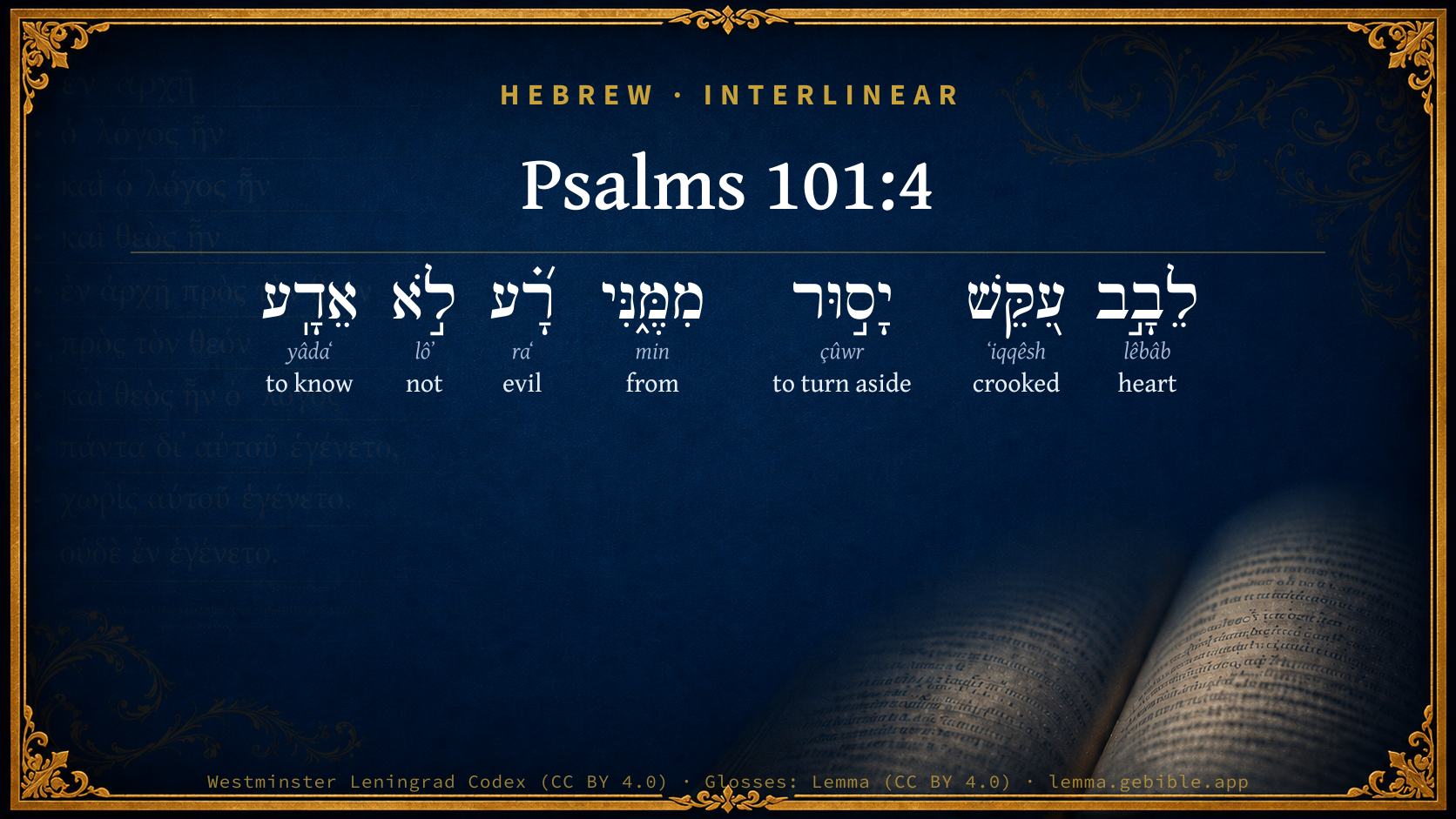
Hebrew (Westminster Leningrad Codex) Psalms 101:4 appears in the Hebrew Old Testament. The text above is from the Westminster Leningrad Codex. Each word links to its Strong’s number, a concise gloss, and parsing drawn from the Open Scriptures Hebrew Bible morphology. Click any word for its full Brown-Driver-Briggs (BDB) entry.
Download image
Cite this verse

Psalms 101:4 (World English Bible). Public Domain. Lemma interlinear Bible study tool, https://lemma.gebible.app/v/psalms/101/4.

Show BibTeX & RIS
BibTeX
RIS
English Translation
A perverse heart will be far from me. I will have nothing to do with evil.
World English Bible · Public Domain
Download a study sheet

One document with this verse’s original text, its word-by-word gloss line, the meaning frame, cross-references with their text, attributed commentary, and full source and license credits — printable, and it pastes into notes with its structure intact.

This verse Autodidact and up

Study sheet (.html) Plain text (.txt)

A passage Seminary Student

Up to 50 verses in one chapter. A passage sheet keeps up to 6 commentary sources and 12 cross-references per verse, in the order this page ranks them, and says so on the sheet whenever that leaves anything out. Ask for a single verse and you get the Autodidact verse sheet above.

Everything on this page stays free to read, with no account — the sheet is a download of what is already on screen, not access to it.

Want to remove ads? Support Godless Engineer
Compare translations 3

The same verse in 3 English versions, stacked beneath the original-language interlinear above. Click any original word for its lexicon entry.

Each is an independent rendering of the whole verse — the interlinear is not word-aligned to these translations.

Highlighted words mark where these versions differ — a whole-verse word diff, not a word-by-word alignment.

  • World English Bible Public Domain
    A perverse heart will be far from me. I will have nothing to do with evil.
  • King James Version Public Domain
    A froward heart shall depart from me: I will not know a wicked person.
  • unfoldingWord Literal Text CC BY-SA 4.0
    A perverse heart will turn away from me; I will not know evil.

unfoldingWord Literal Text — © unfoldingWord, licensed CC BY-SA 4.0. Word-aligned USFM3 via Door43 (git.door43.org/unfoldingWord/en_ult).

Versions to compare (up to 4)

3 of 4 selected

Show all 18 translations

Every available English version of this verse, each an independent rendering of the whole verse.

  • World English Bible Public Domain
    A perverse heart will be far from me. I will have nothing to do with evil.
  • Berean Standard Bible Public Domain
    A perverse heart shall depart from me; I will know nothing of evil.
  • Majority Standard Bible Public Domain
    A perverse heart shall depart from me; I will know nothing of evil.
  • King James Version Public Domain
    A froward heart shall depart from me: I will not know a wicked person.
  • American Standard Version (1901) Public Domain
    A perverse heart shall depart from me: I will know no evil thing.
  • Revised Version (1885) Public Domain
    A froward heart shall depart from me: I will know no evil thing.
  • Geneva Bible (1599) Public Domain
    A froward heart shall depart from me: I will knowe none euill.
  • Douay-Rheims (1899) Public Domain
    The perverse heart did not cleave to me: and the malignant, that turned aside from me, I would not know.
  • Young's Literal Translation Public Domain
    A perverse heart turneth aside from me, Wickedness I know not.
  • Literal Standard Version CC BY-SA 4.0
    A perverse heart turns aside from me, || I do not know wickedness.
  • Unlocked Literal Bible CC BY-SA 4.0
    Perverse people will leave me; I am not loyal to evil.
  • unfoldingWord Literal Text CC BY-SA 4.0
    A perverse heart will turn away from me; I will not know evil.
  • Darby Bible Public Domain
    A perverse heart shall depart from me; I will not know evil.
  • World Messianic Bible Public Domain
    A perverse heart will be far from me. I will have nothing to do with evil.
  • Webster's Bible Public Domain
    A froward heart shall depart from me: I will not know a wicked person.
  • Free Bible Version CC BY-SA 4.0
    I won't think bad thoughts—I won't even consider anything evil.
  • Bible in Basic English Public Domain
    The false heart I will send away from me: I will not have an evil-doer for a friend.
  • JPS Tanakh (1917) Public Domain
    A perverse heart shall depart from me; I will know no evil thing.

Literal Standard Version (2020), Covenant Press — licensed CC BY-SA 4.0. Text via the HelloAO Bible API (eBible.org). Unlocked Literal Bible (unfoldingWord) — licensed CC BY-SA 4.0. Text via the HelloAO Bible API (eBible.org). unfoldingWord Literal Text — © unfoldingWord, licensed CC BY-SA 4.0. Word-aligned USFM3 via Door43 (git.door43.org/unfoldingWord/en_ult). Free Bible Version, Dr. Jonathan Gallagher — licensed CC BY-SA 4.0. Text via the HelloAO Bible API (eBible.org).

Word by word

More ways to search: Search by grammar → Find every occurrence → Compare this word →

Practice this passage: Drill this verse → Learn its vocabulary →

About this verse

These counts appear in no published source. They are computed here, from the morphology-tagged text and Lemma’s own curated glosses. What Lemma adds →

7
words
7
distinct lemmas
Wisdom
section

Notable vocabulary

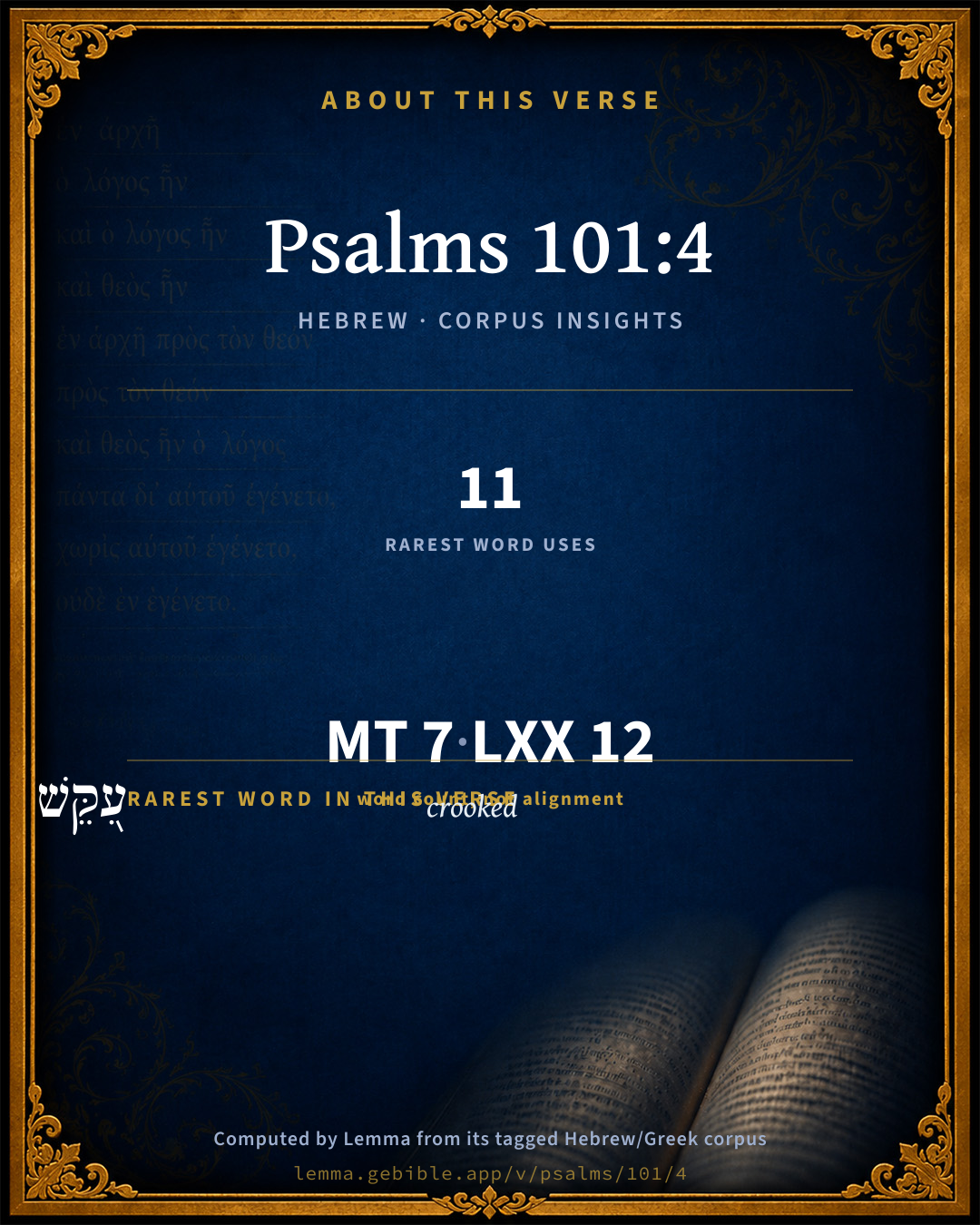
The rarest word here is עִ֭קֵּשׁ crooked H6141 — appearing just 11 times in the whole Hebrew Bible.

Shared distinctive vocabulary

עִ֭קֵּשׁ crooked H6141 occurs in 11 verses of the Hebrew Bible. Also found in:

Grammatical profile

  • 2 verbs
  • 1 noun
  • 2 adjectives
  • 1 preposition
  • 1 particle

Verb forms

  • יָס֣וּר Qal · Imperfect
  • אֵדָֽע Qal · Imperfect

Hebrew & Septuagint length

In English translation the verse runs 16 words from the Hebrew and 22 from the Septuagint (LXX English) — closely comparable.

A rough comparison of the two English renderings, which tokenize alike — not a word-level alignment.

Word counts can differ between the Hebrew and the Greek without any difference in meaning — e.g. the Hebrew direct-object marker אֵת has no separate Greek word, and Greek often adds the article ὁ.

In the original languages it is 7 Hebrew tokens and 12 Greek tokens — but the two are counted differently (Hebrew bundles its prefixes and suffixes into one token; the Greek is in lemma form), so that isn’t a like-for-like length.

Cross-references

12

Topical passages linked to Psalms 101:4 in the Treasury of Scripture Knowledge — connected by theme and wording, ordered by reader-vote popularity; previews shown in the World English Bible.

  • Proverbs 11:20 Those who are perverse in heart are an abomination to Yahweh, But those whose ways are blameless are his delight.
  • Psalms 119:115 Depart from me, you evildoers, That I may keep the commandments of my God.
  • Proverbs 8:13 The fear of Yahweh is to hate evil. I hate pride, arrogance, the evil way, and the perverse mouth.
  • Proverbs 9:6 Leave your simple ways, and live. Walk in the way of understanding."
  • Proverbs 22:24 Don't befriend a hot-tempered man, And don't associate with one who harbors anger:
  • Matthew 7:23 Then I will tell them, 'I never knew you. Depart from me, you who work iniquity.'
  • 2 Corinthians 6:14–16 Don't be unequally yoked with unbelievers, for what fellowship have righteousness and iniquity? Or what communion has light with darkness?
  • 2 Timothy 2:19 However God's firm foundation stands, having this seal, "The Lord knows those who are his," and, "Let every one who names the name of the Lord depart from unrighteousness."
  • Psalms 6:8 Depart from me, all you workers of iniquity, For Yahweh has heard the voice of my weeping.
  • Proverbs 2:12–15 To deliver you from the way of evil, From the men who speak perverse things;
  • Proverbs 3:32 For the perverse is an abomination to Yahweh, But his friendship is with the upright.
  • 2 Corinthians 11:33 Through a window I was let down in a basket by the wall, and escaped his hands.

Cross-references courtesy of OpenBible.info (CC BY 4.0).

Hebrew and Greek witnesses Masoretic Hebrew ↔ Greek Septuagint

The same verse in the two great witnesses to the Old Testament, shown verse-for-verse.

You’re reading Greek Psalm 100 (Hebrew Psalm 101). The Septuagint counts the superscription, so verse numbers can differ from the Hebrew — chapter-level alignment, not verse-by-verse. Numbering follows Rahlfs.

These are two independent witnesses, not word-aligned to each other, and the Septuagint is shown in lemma (dictionary) form.

Hebrew Psalms 101:4 Masoretic · Westminster Leningrad Codex

לֵבָ֣ב עִ֭קֵּשׁ יָס֣וּר מִמֶּ֑נִּי רָ֝֗ע לֹ֣א אֵדָֽע

A perverse heart will be far from me. I will have nothing to do with evil.

World English Bible · Public Domain

Greek LXX Greek Psalm 100:4 Septuagint · lemma form

οὐ κολλάω ἐγώ καρδία σκαμβή ἐκκλίνω ἀπό ἐγώ ὁ πονηρός οὐ γιγνώσκω

A perverse heart has not cleaved to me; I have not known an evil man, forasmuch as he turns away from me.

LXX2012 (modern English Septuagint) · Public Domain

Hebrew: Westminster Leningrad Codex (CC BY 4.0). Greek: Septuagint (public domain); English from LXX2012 (modern English Septuagint) (Public Domain). How the Septuagint differs from the Hebrew →

Commentary

Notes on Psalms 101:4 from classic Christian and Jewish commentators (each source and its license shown beneath its notes). The classic Christian expositions comment on the surrounding passage and are grouped to its opening verse, so a note may address several verses; the Jewish commentaries on the Tanakh (Rashi and others) are per-verse, so they appear only where the commentator wrote on this verse.

Lemma curates 59 commentaries, every one of them public domain or Creative Commons licensed, each selected and text-cleaned for this edition rather than reprinted as found. About our sources →

Trapp's Complete Commentary

John Trapp

Psa 101:4 A froward heart shall depart from me: I will not know a wicked [person].

Ver. 4. A froward heart shall depart from me] i.e. Say some, I will endeavour to put off the old man with the lusts thereof, Eph 4:22, the old crooked frame shall be dissolved, and a better erected. I will not know evil, that is, regard, or allow it, Psa 1:6. Others understand the text of rotten hearted and wicked counsellors, whom David would abhor and abandon.

John Trapp, A Commentary or Exposition upon All the Books of the Old and New Testament (1647–1656) — public domain. Text from a community e-Sword module.

J. A. Alexander on Psalms

Joseph Addison Alexander

4. (Psa 101:4) A crooked heart shall depart from me; evil I will not know. Crooked, froward, or perverse, as in Psa 18:26. Compare Pro 11:20; Pro 17:20. The whole phrase might be understood to mean a person having such a heart, and the whole clause that the Psalmist would have no intercourse with such. The parallel term evil would then mean a wicked person, as translated in the English Bible. On the ground, however, that the person of the sinner seems to be reserved for the latter part of the psalm, the best interpreters take evil in the abstract sense of moral evil, wickedness, as in Psa 34:17; Psa 52:3. The first clause will then naturally mean, my own heart shall not be perverse or froward.

Joseph Addison Alexander, The Psalms Translated and Explained (1850) — public domain. Text from a community e-Sword module.

Tyndale Open Study Notes

Tyndale Open Resources

101:4-5 The psalmist hates what the Lord hates (Prov 6:16-19; see Pss 5:5; 11:4-5). • Perverse ideas come from corrupt human hearts (cp. 18:26).

Tyndale Open Study Notes — © Tyndale Open Resources, licensed CC BY-SA 4.0. Text via the HelloAO Bible API.

Adam Clarke's Commentary

Verse 4. A froward heart] Rash and headstrong men shall not be employed by me.

I will not know a wicked person.] I will give no countenance to sinners of any kind; and whatever is evil shall be an object of my abhorrence.

Adam Clarke's Commentary on the Bible (1810–1826) — public domain. Text from a community e-Sword/MySword module.

John Calvin's Commentaries

4 The perverse heart shall depart from me Some by perverse heart understand perfidious men; but this I reject as a sense too forced, and it is moreover inconsistent with the context. As David has added in the second clause by way of exposition, I will not know evil, he doubtless in the first protests that he will be free from all perfidiousness and wickedness. The amount is, that he will do his endeavor to keep himself from all wrong-doing, and that he will not even know what it is to do wrong to his neighbors.

John Calvin's Commentaries (1540-1563) — public domain. Text from the Calvin Translation Society English edition (1840s-50s) via the Christian Classics Ethereal Library (ccel.org). Calvin's coverage is partial (roughly two-thirds of the Bible); uncommented books and verses are honest gaps, never fabricated. The 19th-century editor's footnotes and remarks are omitted so the notes are faithfully Calvin's own voice.

Ellicott's Commentary for English Readers

(4) Froward.—See Note, Psa_18:26.

A Bible Commentary for English Readers, edited by Charles John Ellicott (1878–1897) — public domain. Text from a community e-Sword module.

The Cambridge Bible for Schools and Colleges

gen. ed. J. J. S. Perowne

4. The Psalmist is still speaking of himself. All crookedness and perversity shall be banished from his heart, he will not consciously tolerate evil there. Render the second line, Evil I will not know. With 4 a and 2 b cp. Pro_11:20.

froward] Lit. crooked. Cp. Pro_11:20.

The Cambridge Bible for Schools and Colleges (gen. ed. J. J. S. Perowne; Cambridge University Press, 1878–1918) — public domain. Text from a community e-Sword module.

John Gill's Exposition

A froward heart shall depart from me,.... A man of a froward heart, that devises frowardness in his heart, and speaks it out with his mouth; that which is perverse, and contrary to the law of God and Gospel of Christ, to the light of nature and the word of God; contrary to the sentiments of all good men, and repugnant to truth and good manners: such sort of persons are disagreeable companions, and good men would not choose to have anything to do with them; they are hateful to Christ, and shall be bid to depart from him; see Pro 8:13.

I will not know a wicked person: so as to be familiar with him, or show him any respect; have any affection for him, or take any notice of him; such Christ will not know at the great day, Mat 7:23, or "I will not know wickedness" (l), or any wicked work and action, approve of it, love it, delight in it, and do it: the Targum interprets it of the evil concupiscence, corruption of nature, or indwelling sin, which is hated by the believer, Rom 7:15 and is utterly unknown to Christ; he was not conscious of it; he knew no sin, Co2 5:21 original or actual; he had no sin in him, nor was any done by him, or, it may be, mention is made of the morning, because that was the usual time of hearing and judging causes, Jer 21:12, or this may have respect to the spiritual reign of Christ, whose coming will be as the morning; when the Heathens shall perish out of his land, when sinners shall be consumed out of the earth, and the wicked shall be no more, and he will destroy them that destroy the earth, Psa 10:16. The Targum agrees with this,

"in the world to come, which is like to the light of the morning, I will destroy all the wicked of the earth:''

that I may cut off all wicked doers from the city of the Lord; from the city of Jerusalem, as the Targum and Kimchi interpret it; and it may be understood of the church of God, in the spiritual reign of Christ, into which shall enter no more the uncircumcised and the unclean; and all that offend and do iniquity shall be gathered out of it, Isa 52:1 or of the New Jerusalem church state, in the personal reign of Christ, into which no wicked doers will be admitted, but will remain for ever without, Rev 21:27.

(l) "malum hominem sive opus", Gejerus, Michaelis.

John Gill's Exposition of the Whole Bible (1746–1763) — public domain (CC PDM 1.0). Text via the HelloAO Bible API.

Albert Barnes' Notes on the Bible

A froward heart shall depart from me - The word here rendered froward means perverse, false, deceitful, depraved. See the notes at Psa 18:26. The “idea” here is that of one who is inclined to evil; who has some wrong passion or inclination to indulge; who has an obstinate and perverse will; who does not listen to reason or the voice of wise persuasion; who will do wrong, despite all the means which may be employed to induce him to do right. The language may either refer to the author of the psalm himself, as regulating his own conduct; or it may refer to those in his employ. In the former sense, it would mean that he would not himself be perverse and froward; in the latter sense, that he would not have such persons in his employ. The connection seems to require that we should understand it in the latter sense, as referring to the class of persons that the psalmist would have about him.

I will not know a wicked person - I will not countenance such a one; I will not recognize such a one among those who are admitted into my house, or own him as my friend; or, I will not have such in my employ. Probably the language embraces both these ideas - as it should in the case of all who are at the head of a family:

(a) I will not countenance or recognize as among my friends, who are to be admitted to my fireside and family, and who are to be familiar with me and my children, those who are profligate, wicked, and unprincipled, whatever may be their rank, their wealth, their accomplishments, their fascination of manner, or their power of conversation;

(b) I will have in my employ no one who is not honest, temperate, virtuous, pure. The welfare of a family depends more on the former of these things than the latter; no family can be well ordered where both are not found.

Albert Barnes' Notes on the Bible (1834–1885) — public domain. Text from a community e-Sword/MySword module.

Matthew Poole's English Annotations

A froward heart; a man of a corrupt mind and wicked life, such as other princes choose and prefer, as being suitable to themselves, and to their wicked designs.

Shall depart from me; shall be turned out of my court, lest they should tempt me, or infect the rest of my family, or be injurious or scandalous to my people. I will not know, i.e. not own nor countenance.

Matthew Poole's English Annotations on the Holy Bible (1683–1685) — public domain. Text from a community e-Sword/MySword module.

The Treasury of David

Charles H. Spurgeon

Ver. 4. A froward heart shall depart from me. He refers both to himself and to those round about him; he would neither be crooked in heart himself, nor employ persons of evil character in his house; if he found such in his court he would chase them away. He who begins with his own heart begins at the fountain head, and is not likely to tolerate evil compamons. We cannot turn out of our family all whose hearts are evil, but we can keep them out of our confidence, and let them see that we do not approve of their ways.

I will not know a wicked person. He shall not be my intimate, my bosom friend. I must know him as a man or I could not discern his character, but if I know him to be wicked, I will not know him any further, and with his evil I will have no communion. "To know" in Scripture means more than mere perception, it includes fellowship, and in that sense it is here used. Princes must disown those who disown righteousness; if they know the wicked they will soon be known as wicked themselves.

Ver. 4. A froward heart. The original sense of vqe is torsit, contorsit, to twist together, and denotes, when applied to men, persons of a perverse, subtle disposition, that can twist and twine themselves into all manner of shapes, and who have no truth and honour to be depended on. Samuel Chandler.

Ver. 4. A froward heart. By which I understand "from-wardness" giving way to sudden impulses of anger, or quick conception, and casting it forth in words or deeds of impetuous violence. Thomas Chalmers.

Ver. 4. The need of extreme care in the choice of our intimates.

Psalms 101:5*

Charles H. Spurgeon's The Treasury of David (1869–1885) — public domain. Psalms only. Text from a community e-Sword/MySword module.

Whedon's Commentary on the Bible

Daniel D. Whedon

4. A froward heart—A heart turned from the right way. Such is never to be trusted.

I will not know a wicked person—That is, not to approve. I will not tolerate a wicked person as an officer of government or a servant of my house. “Froward heart” and “wicked person” form the parallel here. So also “I will not know,” is explained by “shall depart from me,” in the first member.

Daniel D. Whedon (gen. ed.), Commentary on the Old and New Testaments (1874–1909) — public domain. Text from a community e-Sword module.

The Pulpit Commentary

A froward heart shall depart from me; i.e. I will put away from me all perversity of heart; I will root it out and rid myself of it. I will not know a wicked person. This is a possible meaning, but it is better to translate, with our Revisers, "I will know no evil thing. " The "principles of private conduct" may be summed up under the four heads of

(1) devotion;

(2) endeavour after perfectness;

(3) avoidance of evil;

(4) hatred of it.

The feeling of pious souls concerning self-will.

"A froward heart shall depart from me: I will not know a wicked person." The idea in the word "froward" is "twisted,", or "perverse." The idea in the word "wicked" is "wilful," self-willed," "lawlessness." "What David, therefore, disclaims is the reckless self-will, acknowledging no law of right, which is the temptation of despotic royalty, and was hereafter the secret of his own great sin.

I PIOUS SOULS SEE SELF-WILL AS THE ROOT OF SIN. Take man as the creature of God. Manifestly he is dependent on God. He has no independent rights, and no independent will. He has a free will within the necessary limits of the creature, but as that free will finds exercise, it can get no better standard than the sovereign and perfect will of the Creator. The supreme triumph of man"s free will is his full, loving, hearty acceptance of the Divine will. Adam sinned when he put his self-will in opposition to God"s will. Describe how you may the various forms that human iniquity can take, (Gal_5:19-21) the informing spirit of them all is self-pleasing, self-will. Therefore pious souls see clearly that their witness and work is not the mere cleansing of conduct, but the rooting out of the very fibres of self-will, which thread their souls as couch grass threads the fields, or cancers thread the body. Parents must deal with self-will in their children; kings must deal With self-will in their officials; Christians must deal with self-will in themselves and in the world.

II PIOUS SOULS SEE SELF-WILL AS THE ONE THING TO RESIST. Many may be occupied with special forms of temptation, and with what they discover to be their "easily besetting sins." So they are occupied with the expressions of things rather than with the causes. Illustrate from the various treatment of skin diseases. That treatment alone is hopeful which deals with the fountain of mischief. But the psalmist is dealing with self-will in others rather than in himself. There is a self-reliance which is good, if kept within due bounds. It is the spring of enterprise; it is the spirit of the man who conquers circumstance. But it may easily become masterfulness, tyranny, pursuit of ends irrespective of means, and then pious souls feel repugnance, and may rightly show repugnance. The self-willed man is not a God-fearing man. R.T.

"Privily slandereth his neigbbour.

Modern law cannot reach the slanderer unless his slander has produced pecuniary loss to him whom he has slandered. Eastern kings judged on principles of equity, and not according to written rules or established precedents, so they could punish all slanderers. To a king the term includes the jealous informer who tries to breed suspicion, and the sycophant who flatters the king, and speaks evil of others in order to obtain place and favour.

I THE SLANDERER IS A MISCHIEF MAKER. HIS interest is taken not by anything good, but by something evil. Every true and good man covers over, hides, smothers down, the evil, because it is like fire let it spread, and it will do a world of mischief. The slanderer fixes on the tiny spark of evil, fans it until it flares, and consumes reputations and ruins lives. Gossip is the slanderer"s weapon. Malice is his inspiration. Self-conceit is his guide. Often pure devilry makes a man start the evil suspicion which makes the mischief of broken hearts and untold misery. It is no excuse for the slanderer, when made to face the consequences of his slander, to say, "I did not mean it." As mischief makers, gossiping women are worse than men.

II THE SLANDERER IS A THIEF. He does not steal men"s goods; he steals what is of far more value to man than what he has he steals his reputation. Estimate the difficulty every man finds in building up a character. It may fall, like a house of cards, before the suspicion started by the slanderer; that suspicion may stick to a man for life, and he may find it impossible to recover his place. The robbery of the slanderer is oftentimes irremediable.

III THE SLANDERER IS A DETERIORATOR OF HIMSELF. The most serious injury a man can do to his own moral nature is to give expression to the suspicious, or malicious, temper. If a good man or woman ever find themselves betrayed into becoming the originators of a slander, they feel the bitterest regrets and most searching humiliations. The had man who finds he has slandered, and will be humbled by no regrets, belongs to the devil, and will have to find his home with him. R.T.

The Pulpit Commentary (1880–1919), ed. H.D.M. Spence-Jones & Joseph S. Exell — public domain. Text from a community e-Sword module.

John Wesley's Explanatory Notes

Depart - Shall be turned out of my court. Know - Not own nor countenance.

John Wesley, Explanatory Notes Upon the Whole Bible (1754–1765) — public domain. Text via the GEBible commentary corpus.

unfoldingWord translationNotes

Door43 World Missions Community

to evil

"to anything that is evil"

a proud demeanor and an arrogant attitude

These two phrases mean basically the same thing and emphasize how prideful such people are. (See: Doublet)

a proud demeanor

"a proud outward appearance."" This refers to a person being so proud that anyone who looks at him can see how proud he is.

I will look to the faithful of the land to sit at my side

This means that David would allow those people to be around him and live with him. AT: "I will allow the faithful of the land to live with me" (See: Idiom)

the faithful

This refers to the people who are faithful to God. AT: "the faithful people" (See: Nominal Adjectives)

walk in the way of integrity

Here David speaks about "living" as if it were "walking." AT: "live in a way that is honest and right" or "live lives full of integrity" (See: Metaphor)

translationWords

perverse

slander

neighbor

proud

arrogant

faithful

integrity

servant

unfoldingWord translationNotes — © Distant Shores Media and the Door43 World Missions Community, licensed CC BY-SA 4.0. Source: git.door43.org/Door43/en_tn.

Rashi

Rabbi Shlomo Yitzchaki (Rashi)

I know no evil I love no [evil] (Another explanation: [Shem Ephraim]) I recognize no evil thing.

Rashi on the Tanakh — English translations: “The Judaica Press complete Tanach with Rashi, translated by A. J. Rosenberg” (CC BY 4.0); “Pentateuch with Rashi's commentary by M. Rosenbaum and A.M. Silbermann, 1929-1934” (public domain); “The Metsudah Tanach series, Lakewood, N.J” (CC BY 4.0); and “The Book of Joshua, Metsudah Publications, 1997” (CC BY 4.0). Text via Sefaria.

Lesson kit

Teaching starters — assembled from the data on this page, not authored interpretation. Every prompt links to the verse data it draws on. Edit before teaching.

Psalms, in the Wisdom, opens this verse with 7 words (7 distinct Hebrew lemmas). Its most distinctive word is ʻiqqêsh (“crooked”). A historical commentator’s framing appears above. Read the whole chapter for the surrounding context.

Discussion questions

  1. How does “crooked” (ʻiqqêsh) shape what this verse is saying?
  2. Deuteronomy 32:5 shares the word «crooked» with this verse. How do the two illuminate each other?
  3. These translations render this verse differently. What is at stake in choosing one wording over another?
  4. The verb «יָס֣וּר» is Qal Imperfect. How does its form color the action?
  5. Reading how Trapp's Complete Commentary and J. A. Alexander on Psalms read this verse, where do the two commentators agree and where do they part?

Things to notice

Reading settings

Reading text

Shown beneath each verse's original-language words.

Old Testament
Old Testament edition

Read the OT as the Masoretic Hebrew (MT) or the Greek Septuagint (LXX).

English shown for the Greek Septuagint (in the Hebrew ↔ Greek comparison).

Comparing translations? Open the Compare panel on any verse page to stack up to four side by side.