

Psalms 37:27

Hebrew (Westminster Leningrad Codex) Psalms 37:27 appears in the Hebrew Old Testament. The text above is from the Westminster Leningrad Codex. Each word links to its Strong’s number, a concise gloss, and parsing drawn from the Open Scriptures Hebrew Bible morphology. Click any word for its full Brown-Driver-Briggs (BDB) entry.
Download image
Cite this verse

Psalms 37:27 (World English Bible). Public Domain. Lemma interlinear Bible study tool, https://lemma.gebible.app/v/psalms/37/27.

Show BibTeX & RIS
BibTeX
RIS
English Translation
Depart from evil, and do good; Live securely forever.
World English Bible · Public Domain
Download a study sheet

One document with this verse’s original text, its word-by-word gloss line, the meaning frame, cross-references with their text, attributed commentary, and full source and license credits — printable, and it pastes into notes with its structure intact.

This verse Autodidact and up

Study sheet (.html) Plain text (.txt)

A passage Seminary Student

Up to 50 verses in one chapter. A passage sheet keeps up to 6 commentary sources and 12 cross-references per verse, in the order this page ranks them, and says so on the sheet whenever that leaves anything out. Ask for a single verse and you get the Autodidact verse sheet above.

Everything on this page stays free to read, with no account — the sheet is a download of what is already on screen, not access to it.

Want to remove ads? Support Godless Engineer
Compare translations 3

The same verse in 3 English versions, stacked beneath the original-language interlinear above. Click any original word for its lexicon entry.

Each is an independent rendering of the whole verse — the interlinear is not word-aligned to these translations.

Highlighted words mark where these versions differ — a whole-verse word diff, not a word-by-word alignment.

  • World English Bible Public Domain
    Depart from evil, and do good; Live securely forever.
  • King James Version Public Domain
    Depart from evil, and do good; and dwell for evermore.
  • unfoldingWord Literal Text CC BY-SA 4.0
    Turn away from evil and do good, and dwell forever.

unfoldingWord Literal Text — © unfoldingWord, licensed CC BY-SA 4.0. Word-aligned USFM3 via Door43 (git.door43.org/unfoldingWord/en_ult).

Versions to compare (up to 4)

3 of 4 selected

Show all 18 translations

Every available English version of this verse, each an independent rendering of the whole verse.

  • World English Bible Public Domain
    Depart from evil, and do good; Live securely forever.
  • Berean Standard Bible Public Domain
    Turn away from evil and do good, so that you will abide forever.
  • Majority Standard Bible Public Domain
    Turn away from evil and do good, so that you will abide forever.
  • King James Version Public Domain
    Depart from evil, and do good; and dwell for evermore.
  • American Standard Version (1901) Public Domain
    Depart from evil, and do good; And dwell for evermore.
  • Revised Version (1885) Public Domain
    Depart from evil, and do good; dwell for evermore.
  • Geneva Bible (1599) Public Domain
    Flee from euill and doe good, and dwell for euer.
  • Douay-Rheims (1899) Public Domain
    Decline from evil and do good, and dwell for ever and ever.
  • Young's Literal Translation Public Domain
    Turn aside from evil, and do good, and dwell to the age.
  • Literal Standard Version CC BY-SA 4.0
    Turn aside from evil, and do good, and dwell for all time.
  • Unlocked Literal Bible CC BY-SA 4.0
    Turn away from evil and do what is right; then you will be safe forever.
  • unfoldingWord Literal Text CC BY-SA 4.0
    Turn away from evil and do good, and dwell forever.
  • Darby Bible Public Domain
    Depart from evil, and do good, and dwell for evermore;
  • World Messianic Bible Public Domain
    Depart from evil, and do good. Live securely forever.
  • Webster's Bible Public Domain
    Depart from evil, and do good; and dwell for evermore.
  • Free Bible Version CC BY-SA 4.0
    Reject evil, do what is good, and you will live forever in the land.
  • Bible in Basic English Public Domain
    Be turned from evil, and do good; and your place will be for ever.
  • JPS Tanakh (1917) Public Domain
    Depart from evil, and do good; and dwell for evermore.

Literal Standard Version (2020), Covenant Press — licensed CC BY-SA 4.0. Text via the HelloAO Bible API (eBible.org). Unlocked Literal Bible (unfoldingWord) — licensed CC BY-SA 4.0. Text via the HelloAO Bible API (eBible.org). unfoldingWord Literal Text — © unfoldingWord, licensed CC BY-SA 4.0. Word-aligned USFM3 via Door43 (git.door43.org/unfoldingWord/en_ult). Free Bible Version, Dr. Jonathan Gallagher — licensed CC BY-SA 4.0. Text via the HelloAO Bible API (eBible.org).

Word by word

More ways to search: Search by grammar → Find every occurrence → Compare this word →

Practice this passage: Drill this verse → Learn its vocabulary →

וּשְׁכֹ֥ן
shâkan
H7931
“and · dwell”
Conjunction + Verb, Qal, Imperative, 2nd Person, Masculine, Singular
Part of Speech
Conjunction + Verb
Stem
Qal
Form
Imperative
Person
2nd Person
Gender
Masculine
Number
Singular
Full BDB Definition

Origin: a primitive root [apparently akin (by transmission) to H7901 through the idea of lodging]

TWOT: 2387

to settle down, abide, dwell, tabernacle, reside - (Qal) - to settle down to abide - to abide, dwell, reside - (Piel) - to make settle down, establish - to make or cause to dwell - (Hiphil) - to lay, place, set, establish, settle, fix - to cause to dwell or abide
  1. ס֣וּר çûwr H5493 “turn aside” Verb, Qal, Imperative, 2nd Person, Masculine, Singular
  2. מֵ֭רָע raʻ H7451 “from · evil” Preposition + Adjective, Adjective, Masculine, Singular, Absolute
  3. וַעֲשֵׂה ʻâsâh H6213 “and · do” Conjunction + Verb, Qal, Imperative, 2nd Person, Masculine, Singular
  4. ט֗וֹב ṭôwb H2896 “good” Adjective, Adjective, Masculine, Singular, Absolute
  5. לְעוֹלָֽם ʻôwlâm H5769 “to/for · forever” Preposition + Noun, Common, Masculine, Singular, Absolute

About this verse

These counts appear in no published source. They are computed here, from the morphology-tagged text and Lemma’s own curated glosses. What Lemma adds →

6
words
6
distinct lemmas
Wisdom
section

Grammatical profile

  • 3 verbs
  • 1 noun
  • 2 adjectives

Verb forms

  • ס֣וּר Qal · Imperative
  • וַעֲשֵׂה Qal · Imperative
  • וּשְׁכֹ֥ן Qal · Imperative

Hebrew & Septuagint length

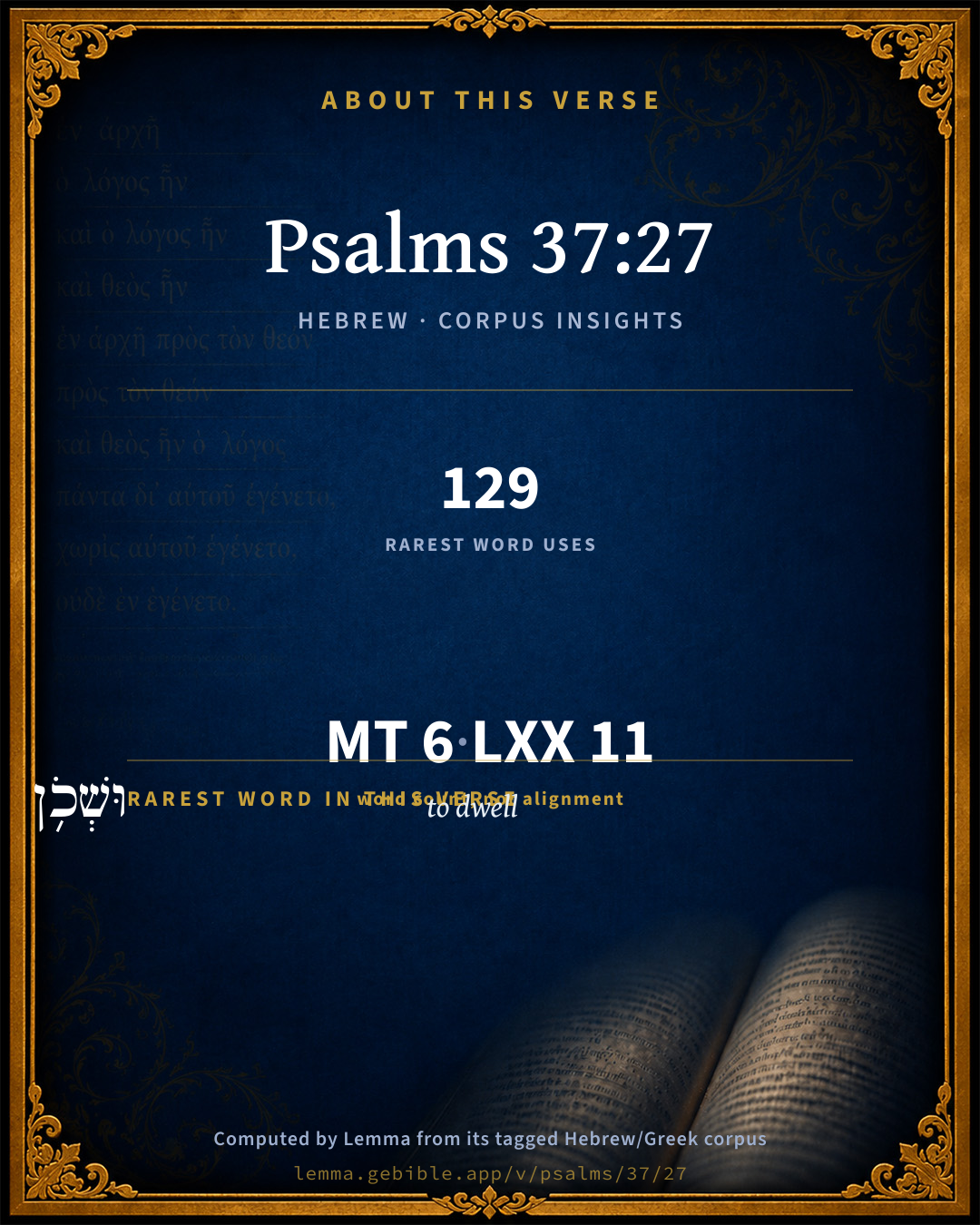
In English translation the verse runs 9 words from the Hebrew and 11 from the Septuagint (LXX English) — closely comparable.

A rough comparison of the two English renderings, which tokenize alike — not a word-level alignment.

Word counts can differ between the Hebrew and the Greek without any difference in meaning — e.g. the Hebrew direct-object marker אֵת has no separate Greek word, and Greek often adds the article ὁ.

In the original languages it is 6 Hebrew tokens and 11 Greek tokens — but the two are counted differently (Hebrew bundles its prefixes and suffixes into one token; the Greek is in lemma form), so that isn’t a like-for-like length.

Cross-references

14

Topical passages linked to Psalms 37:27 in the Treasury of Scripture Knowledge — connected by theme and wording, ordered by reader-vote popularity; previews shown in the World English Bible.

  • Psalms 34:14 Depart from evil, and do good. Seek peace, and pursue it.
  • Proverbs 16:6 By mercy and truth iniquity is atoned for. By the fear of Yahweh men depart from evil.
  • 1 Thessalonians 5:15 See that no one returns evil for evil to anyone, but always follow after that which is good, for one another, and for all.
  • 1 John 2:16–17 For all that is in the world, the lust of the flesh, the lust of the eyes, and the pride of life, isn't the Father's, but is the world's.
  • Hebrews 13:16 But don't forget to be doing good and sharing, for with such sacrifices God is well pleased.
  • 2 Timothy 2:19 However God's firm foundation stands, having this seal, "The Lord knows those who are his," and, "Let every one who names the name of the Lord depart from unrighteousness."
  • Titus 2:11–14 For the grace of God has appeared, bringing salvation to all men,
  • Hebrews 13:21 make you complete in every good work to do his will, working in you that which is well pleasing in his sight, through Jesus Christ, to whom be the glory forever and ever. Amen.
  • Job 28:28 To man he said, 'Behold, the fear of the Lord, that is wisdom. To depart from evil is understanding.'"
  • Isaiah 1:16–17 Wash yourselves, make yourself clean. Put away the evil of your doings from before my eyes; Cease to do evil.
  • Titus 3:8 This saying is faithful, and concerning these things I desire that you affirm confidently, so that those who have believed God may be careful to maintain good works. These things are good and profitable to men;
  • Psalms 102:28 The children of your servants will continue. Their seed will be established before you."
  • Proverbs 16:17 The highway of the upright is to depart from evil. He who keeps his way preserves his soul.
  • Titus 3:14 Let our people also learn to maintain good works for necessary uses, that they may not be unfruitful.

Cross-references courtesy of OpenBible.info (CC BY 4.0).

Hebrew and Greek witnesses Masoretic Hebrew ↔ Greek Septuagint

The same verse in the two great witnesses to the Old Testament, shown verse-for-verse.

You’re reading Greek Psalm 36 (Hebrew Psalm 37). The Septuagint counts the superscription, so verse numbers can differ from the Hebrew — chapter-level alignment, not verse-by-verse. Numbering follows Rahlfs.

These are two independent witnesses, not word-aligned to each other, and the Septuagint is shown in lemma (dictionary) form.

Hebrew Psalms 37:27 Masoretic · Westminster Leningrad Codex

ס֣וּר מֵ֭רָע וַעֲשֵׂה ט֗וֹב וּשְׁכֹ֥ן לְעוֹלָֽם

Depart from evil, and do good; Live securely forever.

World English Bible · Public Domain

Greek LXX Greek Psalm 36:27 Septuagint · lemma form

ἐκκλίνω ἀπό κακός καί ποιέω ἀγαθός καί κατασκηνόω εἰς αἰών αἰών

Turn aside from evil, and do good; and dwell for ever.

LXX2012 (modern English Septuagint) · Public Domain

On this verse, Whedon's Commentary on the Bible discusses the Septuagint’s reading. Read the note in Commentary ↓

Hebrew: Westminster Leningrad Codex (CC BY 4.0). Greek: Septuagint (public domain); English from LXX2012 (modern English Septuagint) (Public Domain). How the Septuagint differs from the Hebrew →

Commentary

Notes on Psalms 37:27 from classic Christian and Jewish commentators (each source and its license shown beneath its notes). The classic Christian expositions comment on the surrounding passage and are grouped to its opening verse, so a note may address several verses; the Jewish commentaries on the Tanakh (Rashi and others) are per-verse, so they appear only where the commentator wrote on this verse.

Lemma curates 59 commentaries, every one of them public domain or Creative Commons licensed, each selected and text-cleaned for this edition rather than reprinted as found. About our sources →

Trapp's Complete Commentary

John Trapp

Psa 37:27 Depart from evil, and do good; and dwell for evermore.

Ver. 27. Depart from evil, and do good] See Psa 34:14.

And dwell for evermore] Sine indigentia, saith Kimchi, without such indigency and poverty as may drive thee abroad, and make thee beg thy bread. Universal righteousness secureth a man from such straits.

John Trapp, A Commentary or Exposition upon All the Books of the Old and New Testament (1647–1656) — public domain. Text from a community e-Sword module.

The Biblical Illustrator

Joseph S. Exell

Psa_37:27

Depart from evil, and do good; and dwell for evermore.

Mans grand concern

I. Eschewing evil and doing good. Depart from evil and do good. Evil and good are correlative and coextensive terms. They are antagonistic principles, they are both in the world, and both incessantly working. Both are incarnate. Good in its perfect form is in Christ. Depart from evil. You are in it, as in a poisonous atmosphere, as in a foul disease, as in a miserable captivity; struggle to get out of it, leave the moral district, and strive after a more salubrious air. Do good. Good is a practical thing, not a thing for mere poetry or discussion, but a thing for practice. What is it to do good? Not the performance of any particular thing, for we have a thousand things to accomplish, but to do everything from a good motive--supreme love to God.

II. Speaking wisdom and judgment. The mouth of the righteous speaketh wisdom, and his tongue talketh of judgment. It is the characteristic of a righteous man that his speech is wise and just. He allows no corrupt communication to proceed out of his mouth. Mans speech has always a moral quality, it is always wise or foolish, just or unjust, good or bad.

III. Rectitude in heart and life. The law of his God is in his heart, none of his steps shall slide. It is one thing to have the law of his God in the book or the brain, and another thing to have it in the heart; to have it in the heart implies that it is cherished with love and obeyed with loyalty. It is in the heart as the moral monarch, holding empire over all the faculties of being and activities of life. Being in the heart, it directs the life. None of his steps (or goings ) shall slide. There will be an unswerving adherence to the path of right.

IV. Waiting on the lord and keeping his commandments. Wait on the Lord and keep His way.

1. Waiting on the Lord implies

(1) Realization of His presence;

(2) Expectation of His commands, and

(3) Readiness to obey.

V. The special favour of heaven.

1. The special guardianship of God. The Lord loveth judgment and forsaketh not His saints, they are preserved for ever.

2. Deliverance from the power of the wicked. The Lord will not leave him in his hand, nor condemn him when he is judged. The truth of this is realized in the experience of all good men after death.

3. Exaltation and long life. (Homilist.)

The Biblical Illustrator, edited by Joseph S. Exell (c. 1880s–1900s) — public domain. Text from a community e-Sword module.

Joseph Benson's Commentary

Psa 37:27-29. Depart from evil and do good — Having therefore these glorious promises and privileges, let no man do any evil or unjust thing, to enrich or secure himself, nor abstain from any pious or charitable action, for fear of empoverishing himself thereby: but let every man live in a conscientious discharge of all his duties to God and men, committing himself and all his affairs to God’s fatherly care and providence, and confidently expecting his blessing thereupon. And dwell for evermore —

That is, he shall dwell for evermore in heaven, and for a long time on earth. See on Psa 37:3. The Lord loveth judgment — That is, just judgment, or righteousness, as the word משׁפשׂ, mishpat, often signifies. That is, he loves it in himself: he loveth to execute it upon the wicked, and for the righteous: which he doth in the manner expressed in this Psalm. And he loves it in the righteous, whose justice, and piety, and charity he sees, approves, and will reward. And forsaketh not his saints — Hebrew, חסידיו, chasidaiv, his kind, merciful, and beneficent ones who exercise benignity and charity to others.

Joseph Benson's Commentary on the Old and New Testaments (1811–1818) — public domain. Text from a community e-Sword module.

Whedon's Commentary on the Bible

Daniel D. Whedon

27, 28. Dwell for evermore—In Psa_37:27-29 the reward of the righteous is three times set forth by two of the strongest words in the Hebrew language to express endless duration. Thus, “for evermore,” לעולם, (le’olam,) to eternity; Septuagint, εις αιωνα αιωνος, for ever and ever; Vulgate, in seculum seculi; Jerome, habita in sempiturnum. They [his saints] are preserved for ever—Hebrew, le’olam, to eternity; Septuagint, εις τον αιωνα, for ever; Vulgate, aeternum; Jerome, in aeturnum.

Daniel D. Whedon (gen. ed.), Commentary on the Old and New Testaments (1874–1909) — public domain. Text from a community e-Sword module.

Keil & Delitzsch

C. F. Keil & F. Delitzsch

Psa 37:27-28

The round of the exhortations and promises is here again reached as in Psa 37:3. The imperative שׁכן, which is there hortatory, is found here with the ו of sequence in the sense of a promise: and continue, doing such things, to dwell for ever = so shalt thou, etc. (שׁכן, pregnant as in Ps 102:29, Isa 57:15). Nevertheless the imperative retains its meaning even in such instances, inasmuch as the exhortation is given to share in the reward of duty at the same time with the discharge of it. On Psa 37:28 compare Psa 33:5.

Psa 37:28-29

The division of the verse is wrong; for the ס strophe, without any doubt, closes with חסדיו, and the ע eht dna strophe begins with לעולם, so that, according to the text which we possess, the ע of this word is the acrostic letter. The lxx, however, after εἰς τὸν αἰῶνα φυλαχθήσονται has another line, which suggests another commencement for the ע strophe, and runs in Cod. Vat., incorrectly, ἄμωμοι ἐκδικήσονται, in Cod. Alex., correctly, ἄνομοι δὲ ἐκδιωχθήσονται (Symmachus, ἄνομοι ἐξαρθήσονται). By ἄνομος the lxx translates עריץ in Isa 29:20; by ἄνομα, עולה in Job 27:4; and by ἐκδιώκειν, הצמית, the synonym of השׁמיד, in Psa 101:5; so that consequently this line, as even Venema and Schleusner have discerned, was עוּלים נשׁמדוּ. It will at once be seen that this is only another reading for לעולם נשׁמרו; and, since it stands side by side with the latter, that it is an ancient attempt to produce a correct beginning for the ע strophe, which has been transplanted from the lxx into the text. It is, however, questionable whether this reparation is really a restoration of the original words (Hupfeld, Hitzig); since עוּל (עויל) is not a word found in the Psalms (for which reason Bצttcher's conjecture of עשׁי עולה more readily commends itself, although it is critically less probable), and לעולם נשׁמרו forms a continuation that is more naturally brought about by the context and perfectly logical.

Keil & Delitzsch — Biblical Commentary on the Old Testament (1861–1891) — public domain (CC PDM 1.0). Text via the HelloAO Bible API. (Old Testament only.)

J. A. Alexander on Psalms

Joseph Addison Alexander

27. (Psa 37:27) Depart from evil, and do good, and dwell for evermore. This is the practical application of the foregoing lessons. Evil and good are correlative and coextensive terms. As evil includes all that is morally wrong, good includes all that is morally right, and to do good is to do well or act rightly. See above, on ver. 3.—Dwell, i. e. dwell securely, as in Psa 37:3, where as here the exhortation or command involves a promise. For ever, literally to eternity or perpetuity. As to the idea which these expressions would convey to Jewish and to Christian readers, see above, on Psa 37:18.

Joseph Addison Alexander, The Psalms Translated and Explained (1850) — public domain. Text from a community e-Sword module.

Tyndale Open Study Notes

Tyndale Open Resources

37:27-33 The godly are wise; they do good and reject evil. The Lord cares for them, protecting them and ensuring that they receive their rightful portion of the land as their inheritance. The wicked might try to ambush the godly, but they will not succeed.

Tyndale Open Study Notes — © Tyndale Open Resources, licensed CC BY-SA 4.0. Text via the HelloAO Bible API.

Jamieson, Fausset & Brown

Robert Jamieson, A. R. Fausset & David Brown

The exhortation is sustained by the assurance of God's essential rectitude in that providential government which provides perpetual blessings for the good, and perpetual misery for the wicked.

Jamieson, Fausset & Brown — Commentary Critical and Explanatory on the Whole Bible (1871) — public domain (CC PDM 1.0). Text via the HelloAO Bible API.

Adam Clarke's Commentary

Verse 27. Depart from evil, and do good] Seeing the above is so, depart from all evil-avoid all sin; and let not this be sufficient, do good. The grace of God ever gives this two-fold power to all who receive it; strength to overcome evil, and strength to do that which is right.

Dwell for evermore.] Be for ever an inhabitant of God's house. This may be also a promise of return to their own land, and of permanent residence there. See Ps 37:9; Ps 37:11, &c.

Adam Clarke's Commentary on the Bible (1810–1826) — public domain. Text from a community e-Sword/MySword module.

John Calvin's Commentaries

27 Depart from evil, and do good. In this verse David argues, that, in order to realize the blessedness of which he has spoken, we must abstain from all evil, perform the duties of humanity, and exert ourselves in doing good to our neighbors. This doctrine is at variance with the dictates of corrupt human nature; but it is, notwithstanding, certain that many of the troubles and distresses in which the whole human race are involved, proceed from no other cause than this, that every man respectively, in his own sphere, being given to injustice, fraud, extortion, and evil-dealing, contemptuously rejects the blessing of God. Thus, it is in consequence of the barriers which men throw in their own way, that they do not attain happiness in this world, and that every man in his own place does not possess the peace and quietness which belong to him. It is then with the highest propriety that David passes from the doctrine of the preceding context to this exhortation: for if the meek possess the earth, then every one, as he regards his own happiness and peace, ought also to endeavor to walk uprightly, and to apply himself to works of beneficence. It should also be observed, that he connects these two things, first, that the faithful should strictly do good; and, secondly, that they should restrain themselves from doing evil: and this he does not without good reason: for as we have seen in the thirty-fourth psalm, it often happens that the same person who not only acts kindly towards certain persons, but even with a bountiful hand deals out largely of his own, is yet all the while plundering others, and amassing by extortion the resources by means of which he displays his liberality. Whoever, therefore, is desirous to have his good offices approved by God, let him endeavor to relieve his brethren who have need of his help, but let him not injure one in order to help another, or afflict and grieve one in order to make another glad. Now David, under these two expressions, has briefly comprised the duties of the second table of the law: first, that the godly should keep their hands free from all mischief, and give no occasion of complaint to any man; and, secondly, that they should not live to themselves, and to the promotion merely of their own private interests, but should endeavor to promote the common good of all according to their opportunities, and as far as they are able. But we have already said, that the blessing which is promised to the righteous, that “they shall inherit the earth,” is not always realised in an equal degree as to all the people of God; and the reason we assigned for this is, that God cannot find among men an example of such great uprightness, but that even the most perfect procure to themselves much misery by their own fault: and therefore it need not surprise us though God withdraw, at least in some measure, his blessing even from his own. We know too to what excess the lusts of the flesh run riot, unless the Lord lay a restraint upon them. Besides, there is no one who is ready cheerfully to engage in meditation upon the divine life, who is not urged and encouraged to it by various motives. Hence it is that the possession of the earth, which David here assigns to the children of God, does not (as the lawyers would define the term) always consist in having the feet planted within it, and in being securely established in it; for there are many sources of disquietude and affliction here to trouble them. And yet it does not follow that it is a mere fiction or imaginary thing which he promises. For although daily experience shows us that the children of God do not as yet inherit the earth, yet, according to the measure of our faith, we feel how efficacious the blessing of God is, which, like a spring that cannot be drained, flows continually. They are indeed more than blind who do not perceive that the righteous have at present this reward, that God defends and upholds them by his power.

John Calvin's Commentaries (1540-1563) — public domain. Text from the Calvin Translation Society English edition (1840s-50s) via the Christian Classics Ethereal Library (ccel.org). Calvin's coverage is partial (roughly two-thirds of the Bible); uncommented books and verses are honest gaps, never fabricated. The 19th-century editor's footnotes and remarks are omitted so the notes are faithfully Calvin's own voice.

The Cambridge Bible for Schools and Colleges

gen. ed. J. J. S. Perowne

27. Once more the teacher addresses his disciple, as in Psa_37:3 ff. The first line is identical with Psa_34:14 a (see note): the second line is virtually a promise, and might be rendered so shall thou dwell &c. But as Delitzsch observes, the imperative retains its force in constructions of this type, as an exhortation to participate in the blessing by the fulfilment of the duty. Peaceable occupation of the land by successive generations is meant (cp. Psa_37:29). The individual lives on in his descendants.

28 a. Cp. Psa_33:5. For saints see note on Psa_4:3.

28 c, d, 29. Stanza of Ayin. The verses are wrongly divided. It is evident from the regular structure of the Psalm that the last two lines of Psa_37:28 together with Psa_37:29 should form a stanza commencing with the letter Ayin. If the Massoretic text is sound, the Ayin is represented by the second letter of the word l’ôlâm, ‘for ever’,—the prefixed preposition l being disregarded, as is the prefixed and in Psa_37:39. But a comparison of the LXX makes it all but certain that the first word of the verse has been lost, and a further corruption taken place in consequence[14]; and that the original reading was:

[14] The LXX reads thus: εἰς τὸν αἰῶνα φυλαχθήσονται· ἄνομοι δὲ ἐκδιωχθήσονται (א B ἄμωμοι ἐκδικηθήσονται), καὶ σπέρμα ἀσεβων ἐξολοθρευθήσεται, ‘They shall be preserved for ever; but the lawless shall be driven out (א B, the perfect shall be avenged), and the seed of the ungodly shall be destroyed.’ The reading of the Sinaitic and Vatican MSS. appears to be a correction or corruption, and must be abandoned in favour of that found in (apparently) all other MSS., and supported by the Vulg., iniusti punientur. We have then the words ἄνομοι δὲ ἐκδιωχθήσονται, but the lawless shall be driven out, in addition to a rendering of the Massoretic text. These words might represent an original עַוָּלִים נִשְׁמְדוּ If the original reading (written defectively) was עולם לעלם נשמדו the unrighteous are destroyed for ever, the process of corruption is easily intelligible. עולם was omitted, either accidentally, from its resemblance to לעלם, or because the transcriber did not recognise a somewhat rare word, and supposed it to be an erroneous repetition. When once it had disappeared, the change of נשמִדו (destroyed) into נשמִרו (preserved) followed as a matter of course, ‘his saints’ in the preceding line being the only possible subject. The word עַוָּלִים does not occur elsewhere in the Psalter, but is found four times in the Book of Job, with which this Psalm is so closely connected. Cp. too the substantive עַוְלָה in Psa_37:1. A case like this, in which the acrostic structure of the Psalm demands a correction for which the LXX supplies clear evidence, is a convincing argument for the temperate employment of the LXX for the correction of the Massoretic Text. This or some similar correction is adopted by most editors.

The unrighteous are destroyed for ever,

And the seed of the wicked is cut off.

With this reading a full stop must of course be placed after saints, and the couplet forms the antithesis to Psa_37:29. The perfect tenses, as in Psa_37:20 c, express the Psalmist’s conviction of the certainty of the event. Cp. Psa_37:38. The addition in the P.B.V., the unrighteous shall be punished, comes from the LXX through the Vulgate. See note below.

The Cambridge Bible for Schools and Colleges (gen. ed. J. J. S. Perowne; Cambridge University Press, 1878–1918) — public domain. Text from a community e-Sword module.

John Gill's Exposition

For the Lord loveth judgment,.... Righteousness, or righteous actions, when done according to his will, from love, in faith, and to his glory; see Psa 11:7; or to minister judgment to the people, and to render to every man according to his works;

and forsaketh not his saints; his Holy Ones, who are called with an holy calling, are created in righteousness and true holiness, and have principles of grace and holiness wrought in them; or whom he prosecutes with his favour and goodness, with his everlasting love and mercy, with spiritual blessings, with the blessings of justification, pardon, adoption, and a right to eternal life: these he never forsakes, not their persons, neither in life nor at death, nor at judgment; nor does he ever forsake the work of his own hands in them; but performs it until the day of Christ: nor will he ever so forsake them, as that they shall perish through the strength of sin, the temptations of Satan, or the snares of the world;

they are preserved for ever; from the dominion and damning power of sin, from being devoured by Satan, from a total and final falling away, and from being hurt of the second death: they are preserved in Christ, in whose hands they are; and by the power of God, safe to his kingdom and glory, into which they shall have an abundant entrance;

but the seed of the wicked shall be cut off; out of the earth, in the midst of their days, like withered branches; and be cast into everlasting burnings.

John Gill's Exposition of the Whole Bible (1746–1763) — public domain (CC PDM 1.0). Text via the HelloAO Bible API.

Albert Barnes' Notes on the Bible

Depart from evil, and do good - This is the sum of all that is said in the psalm; the great lesson inculcated and enforced by all these references to the effects of good and evil conduct. All these results - all that people experience themselves, and all the effects of their conduct on their posterity, enforce the great practical lesson that we should do good and avoid evil. These results of conduct are among the means which God employs to induce men to do right, and to abstain from what is wrong.

And dwell for evermore - That is, dwell in the land: meaning (in accordance with the general drift of the psalm) that righteousness will be connected with length of days and with prosperity; that its effects will be permanent on a family, descending from one generation to another. See the notes at Psa 37:3.

Albert Barnes' Notes on the Bible (1834–1885) — public domain. Text from a community e-Sword/MySword module.

Matthew Poole's English Annotations

Having therefore these glorious promises and privileges, let no man do any evil or unjust thing to enrich or secure himself, nor abstain from pious and charitable actions for fear of undoing himself by them; but let every man live in the conscionable discharge of all his duties to God and men, committing himself and all his affairs to God’s fatherly care and providence, and confidently expecting his blessing thereupon.

Dwell, i.e. thou shalt dwell, as before, Psa 37:3, to wit, in the land, as is expressed, Psa 37:3, and afterwards in heaven.

For evermore; either properly; or for a long time, of which that word is oft used.

Matthew Poole's English Annotations on the Holy Bible (1683–1685) — public domain. Text from a community e-Sword/MySword module.

The Treasury of David

Charles H. Spurgeon

Ver. 27-29. Here we have the seventh precept, which takes a negative and positive form, and is the quintessence of the entire Psalm

Ver. 27. Depart from evil, and do good. We must not envy the doers of evil, but depart altogether from their spirit and example. As Lot left Sodom without casting a look behind, so must we leave sin. No truce or parley is to be held with sin, we must turn away from it without hesitation, and set ourselves practically to work in the opposite direction. He who neglects to do good will soon fall into evil. And dwell for evermore. Obtain an abiding and quiet inheritance. Short lived are the gains and pleasures of evil, but eternal are the rewards of grace.

None.

Ver. 27. Negative, positive, remunerative.

Psalms 37:28*

Charles H. Spurgeon's The Treasury of David (1869–1885) — public domain. Psalms only. Text from a community e-Sword/MySword module.

The Pulpit Commentary

Depart from evil, and do good. The same injunction is given, in exactly the same words, in Psa_34:14. And dwell for evermore. This is to be understood as a promise, "If thou wilt depart from evil, and do good, then thou shalt dwell in the land for ever" (comp. ver. 3).

Vers. 27-40. Evil-doers.

Evil-doers are not truly objects of envy. The more closely we contemplate this, the more clearly do we see their baseness. But it is needful that we should be urged to this salutary duty. Again and again in this psalm is the exhortation addressed to us to consider and judge rightly, to cease from evil and learn to do well. And there are good and weighty reasons given why we should have no part with evil-doers.

I THEIR CHARACTER IS ODIOUS.

II THEIR PROSPERITY IS DELUSIVE. Image upon image is used to set forth the vanity and worthlessness of all prosperity not founded in righteousness. Reason, observation, and history are appealed to as teaching that sometimes quickly, at other times slowly, sometimes openly, at other times silently and secretly, but always certainly, the end cometh (ver. 38).

III THEIR DEVICES ARE DOOMED TO DEFEAT. We see, on the part of the wicked, malice suggesting, cunning contriving, and energy working out their evil devices, and, on the other hand, God watching and thwarting and overruling for good all their plans. So it was with Joseph"s brethren. (Act_7:9, Act_7:10) So it was with Daniel"s cruel foes. (Dan_6:24) So it was with the Jews, whose wicked hands had crucified the Son of God. (Act_2:23, Act_2:24) The day of retribution surely cometh. Not only defeat, but "shame and everlasting contempt," await the wicked. W.F.

Vers. 27-34. Goodness.

We have here

I THAT GOODNESS IS THE TRUE AIM OF LIFE. The first thing is to have the heart made good, and then all that flow from it, in word and deed, will be good also. "But such as are good men can give good things. (Milton)

II THAT GOODNESS IS THE REAL GLORY OF LIFE. (Vers. 30, 31) We cannot hut admire "wisdom" and "judgment;" but what gives these their sweetest savour and their highest worth is the spirit of goodness that dwells in them The glory of God is his goodness, and it is in the measure that we are like God in goodness that we are like him in glory. This glory is free to us in Christ Jesus.

III THAT GOODNESS IS THE MOST PERMANENT POSSESSION OF LIFE. Many things stand high for a time that will be brought low; many things are counted worthy amongst men that will yet be proved worthless. There may be wicked men who hold a prominent place in the world, and are for a while the envy of many, whose greatness is after all a delusion and a lie. In the end they will be cut down like a tree, whose glory is for ever abased. But it shall be otherwise with the righteous. Goodness cannot die. It is safe amidst all changes. It stands firm in the tumult and rage of the greatest storm. It emerges purer and brighter than ever from the fires of persecution and the fury of evil men (vers. 39, 40). Goodness lives as an influence in the world alter death, triumphs as the power of Cod in death, and will dwell in the light of God beyond death for ever and ever. W.F.

The Pulpit Commentary (1880–1919), ed. H.D.M. Spence-Jones & Joseph S. Exell — public domain. Text from a community e-Sword module.

John Wesley's Explanatory Notes

Dwell - Thou shalt dwell in the land, and afterwards in heaven.

John Wesley, Explanatory Notes Upon the Whole Bible (1754–1765) — public domain. Text via the GEBible commentary corpus.

Lesson kit

Teaching starters — assembled from the data on this page, not authored interpretation. Every prompt links to the verse data it draws on. Edit before teaching.

Psalms, in the Wisdom, opens this verse with 6 words (6 distinct Hebrew lemmas). Its most distinctive word is shâkan (“to dwell”). A historical commentator’s framing appears above. Read the whole chapter for the surrounding context.

Discussion questions

  1. What does “to dwell” (shâkan) contribute to the verse as a whole?
  2. How does Psalms 34:14, which shares this passage’s theme, read alongside this verse?
  3. The translations on this page render this verse differently — a whole-verse word diff, not a word-by-word alignment. What might account for the different wordings?
  4. «ס֣וּר» is a Qal Imperative verb. How does that grammatical form shape the action described?
  5. Compare how Trapp's Complete Commentary and The Biblical Illustrator read this verse. Where do they agree or differ?

Things to notice

Reading settings

Reading text

Shown beneath each verse's original-language words.

Old Testament
Old Testament edition

Read the OT as the Masoretic Hebrew (MT) or the Greek Septuagint (LXX).

English shown for the Greek Septuagint (in the Hebrew ↔ Greek comparison).

Comparing translations? Open the Compare panel on any verse page to stack up to four side by side.