
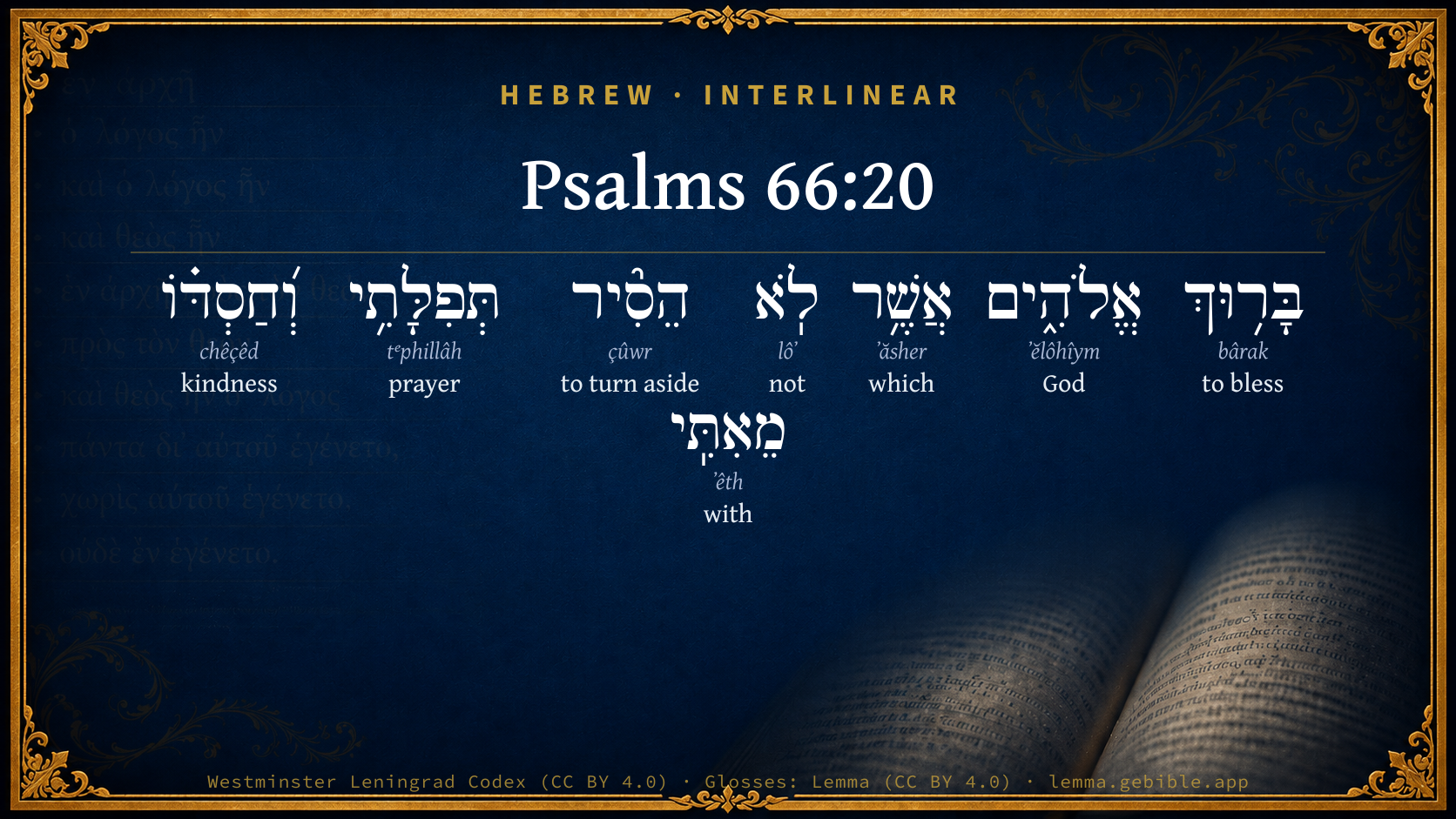
Psalms 66:20

Hebrew (Westminster Leningrad Codex) Psalms 66:20 appears in the Hebrew Old Testament. The text above is from the Westminster Leningrad Codex. Each word links to its Strong’s number, a concise gloss, and parsing drawn from the Open Scriptures Hebrew Bible morphology. Click any word for its full Brown-Driver-Briggs (BDB) entry.
Download image
Cite this verse

Psalms 66:20 (World English Bible). Public Domain. Lemma interlinear Bible study tool, https://lemma.gebible.app/v/psalms/66/20.

Show BibTeX & RIS
BibTeX
RIS
English Translation
Blessed be God, who has not turned away my prayer, Nor his loving kindness from me.
World English Bible · Public Domain
Download a study sheet

One document with this verse’s original text, its word-by-word gloss line, the meaning frame, cross-references with their text, attributed commentary, and full source and license credits — printable, and it pastes into notes with its structure intact.

This verse Autodidact and up

Study sheet (.html) Plain text (.txt)

A passage Seminary Student

Up to 50 verses in one chapter. A passage sheet keeps up to 6 commentary sources and 12 cross-references per verse, in the order this page ranks them, and says so on the sheet whenever that leaves anything out. Ask for a single verse and you get the Autodidact verse sheet above.

Everything on this page stays free to read, with no account — the sheet is a download of what is already on screen, not access to it.

Want to remove ads? Support Godless Engineer
Compare translations 3

The same verse in 3 English versions, stacked beneath the original-language interlinear above. Click any original word for its lexicon entry.

Each is an independent rendering of the whole verse — the interlinear is not word-aligned to these translations.

Highlighted words mark where these versions differ — a whole-verse word diff, not a word-by-word alignment.

  • World English Bible Public Domain
    Blessed be God, who has not turned away my prayer, Nor his loving kindness from me.
  • King James Version Public Domain
    Blessed be God, which hath not turned away my prayer, nor his mercy from me.
  • unfoldingWord Literal Text CC BY-SA 4.0
    Blessed God, who has not turned away my prayer or his covenant faithfulness from me.

unfoldingWord Literal Text — © unfoldingWord, licensed CC BY-SA 4.0. Word-aligned USFM3 via Door43 (git.door43.org/unfoldingWord/en_ult).

Versions to compare (up to 4)

3 of 4 selected

Show all 18 translations

Every available English version of this verse, each an independent rendering of the whole verse.

  • World English Bible Public Domain
    Blessed be God, who has not turned away my prayer, Nor his loving kindness from me.
  • Berean Standard Bible Public Domain
    Blessed be God, who has not rejected my prayer or withheld from me His loving devotion!
  • Majority Standard Bible Public Domain
    Blessed be God, who has not rejected my prayer or withheld from me His loving devotion!
  • King James Version Public Domain
    Blessed be God, which hath not turned away my prayer, nor his mercy from me.
  • American Standard Version (1901) Public Domain
    Blessed be God, Who hath not turned away my prayer, Nor his lovingkindness from me. Psalm 67 For the Chief Musician; on stringed instruments. A Psalm, a song.
  • Revised Version (1885) Public Domain
    Blessed be God, which hath not turned away my prayer, nor his mercy from me.
  • Geneva Bible (1599) Public Domain
    Praysed be God, which hath not put backe my prayer, nor his mercie from me.
  • Douay-Rheims (1899) Public Domain
    Blessed be God, who hath not turned away my prayer, nor his mercy from me.
  • Young's Literal Translation Public Domain
    Blessed `is' God, Who hath not turned aside my prayer, And His loving-kindness, from me!
  • Literal Standard Version CC BY-SA 4.0
    Blessed [is] God, || Who has not turned aside my prayer, || And His loving-kindness, from me!
  • Unlocked Literal Bible CC BY-SA 4.0
    Blessed be God, who has not turned away my prayer or his covenant faithfulness from me.
  • unfoldingWord Literal Text CC BY-SA 4.0
    Blessed God, who has not turned away my prayer or his covenant faithfulness from me.
  • Darby Bible Public Domain
    Blessed be God, who hath not turned away my prayer, nor his loving-kindness from me!
  • World Messianic Bible Public Domain
    Blessed be God, who has not turned away my prayer, nor his loving kindness from me.
  • Webster's Bible Public Domain
    Blessed be God, who hath not turned away my prayer, nor his mercy from me.
  • Free Bible Version CC BY-SA 4.0
    Praise God, who did not disregard my prayer or take his trustworthy love from me.
  • Bible in Basic English Public Domain
    Praise be to God who has not taken away his good faith and his mercy from me.
  • JPS Tanakh (1917) Public Domain
    Blessed be God, who hath not turned away my prayer, nor His mercy from me.

Literal Standard Version (2020), Covenant Press — licensed CC BY-SA 4.0. Text via the HelloAO Bible API (eBible.org). Unlocked Literal Bible (unfoldingWord) — licensed CC BY-SA 4.0. Text via the HelloAO Bible API (eBible.org). unfoldingWord Literal Text — © unfoldingWord, licensed CC BY-SA 4.0. Word-aligned USFM3 via Door43 (git.door43.org/unfoldingWord/en_ult). Free Bible Version, Dr. Jonathan Gallagher — licensed CC BY-SA 4.0. Text via the HelloAO Bible API (eBible.org).

Word by word

More ways to search: Search by grammar → Find every occurrence → Compare this word →

Practice this passage: Drill this verse → Learn its vocabulary →

About this verse

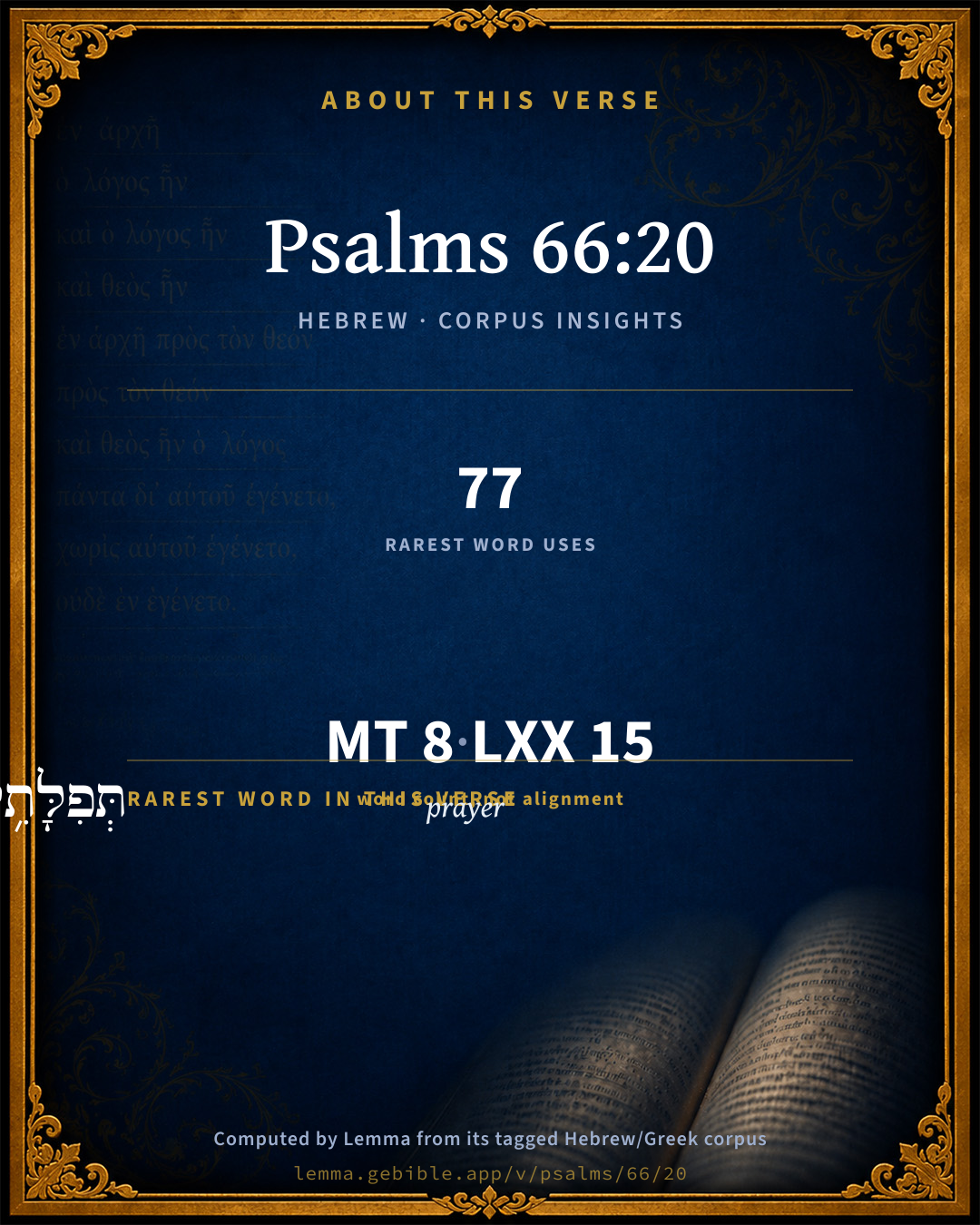
These counts appear in no published source. They are computed here, from the morphology-tagged text and Lemma’s own curated glosses. What Lemma adds →

8
words
8
distinct lemmas
Wisdom
section

Grammatical profile

  • 2 verbs
  • 3 nouns
  • 1 preposition
  • 2 particles

Verb forms

  • בָּר֥וּךְ Qal · Participle Passive
  • הֵסִ֘יר Hiphil · Perfect

Hebrew & Septuagint length

In English translation the verse runs 16 words from the Hebrew and 15 from the Septuagint (LXX English) — closely comparable.

A rough comparison of the two English renderings, which tokenize alike — not a word-level alignment.

Word counts can differ between the Hebrew and the Greek without any difference in meaning — e.g. the Hebrew direct-object marker אֵת has no separate Greek word, and Greek often adds the article ὁ.

In the original languages it is 8 Hebrew tokens and 15 Greek tokens — but the two are counted differently (Hebrew bundles its prefixes and suffixes into one token; the Greek is in lemma form), so that isn’t a like-for-like length.

Cross-references

5

Topical passages linked to Psalms 66:20 in the Treasury of Scripture Knowledge — connected by theme and wording, ordered by reader-vote popularity; previews shown in the World English Bible.

  • Psalms 86:12–13 I will praise you, Lord my God, with my whole heart. I will glorify your name forevermore.
  • Psalms 68:35 You are awesome, God, in your sanctuaries. The God of Israel gives strength and power to his people. Praise be to God!
  • Psalms 51:11 Don't throw me from your presence, And don't take your holy Spirit from me.
  • 2 Samuel 7:14–15 I will be his father, and he shall be my son: if he commit iniquity, I will chasten him with the rod of men, and with the stripes of the children of men;
  • Psalms 22:24 For he has not despised nor abhorred the affliction of the afflicted, Neither has he hidden his face from him; But when he cried to him, he heard.

Cross-references courtesy of OpenBible.info (CC BY 4.0).

Hebrew and Greek witnesses Masoretic Hebrew ↔ Greek Septuagint

The same verse in the two great witnesses to the Old Testament, shown verse-for-verse.

You’re reading Greek Psalm 65 (Hebrew Psalm 66). The Septuagint counts the superscription, so verse numbers can differ from the Hebrew — chapter-level alignment, not verse-by-verse. Numbering follows Rahlfs.

These are two independent witnesses, not word-aligned to each other, and the Septuagint is shown in lemma (dictionary) form.

Hebrew Psalms 66:20 Masoretic · Westminster Leningrad Codex

בָּר֥וּךְ אֱלֹהִ֑ים אֲשֶׁ֥ר לֹֽא הֵסִ֘יר תְּפִלָּתִ֥י וְ֝חַסְדּ֗וֹ מֵאִתִּֽי

Blessed be God, who has not turned away my prayer, Nor his loving kindness from me.

World English Bible · Public Domain

Greek LXX Greek Psalm 65:20 Septuagint · lemma form

εὐλογητός ὁ θεός ὅς οὐ ἀποἵστημι ὁ προσευχή ἐγώ καί ὁ ἔλεος αὐτός ἀπό ἐγώ

Blessed be God, who has not turned away my prayer, nor his mercy from me.

LXX2012 (modern English Septuagint) · Public Domain

Hebrew: Westminster Leningrad Codex (CC BY 4.0). Greek: Septuagint (public domain); English from LXX2012 (modern English Septuagint) (Public Domain). How the Septuagint differs from the Hebrew →

Commentary

Notes on Psalms 66:20 from classic Christian and Jewish commentators (each source and its license shown beneath its notes). The classic Christian expositions comment on the surrounding passage and are grouped to its opening verse, so a note may address several verses; the Jewish commentaries on the Tanakh (Rashi and others) are per-verse, so they appear only where the commentator wrote on this verse.

Lemma curates 59 commentaries, every one of them public domain or Creative Commons licensed, each selected and text-cleaned for this edition rather than reprinted as found. About our sources →

Adam Clarke's Commentary

Verse 20. Blessed be God] I therefore praise God, who has not turned aside my prayer, and who has not withheld his mercy from me. Thus he told them what God had done for his soul.

ANALYSIS OF THE SIXTY-SIXTH PSALM

There are five parts in this Psalm: -

I. An invitation.

1. To praise God, Ps 66:1-4.

2. To consider his works, Ps 66:5-7.

II. A repetition of the invitation, Ps 66:8, for the benefit and deliverance lately received, Ps 66:9-12.

III. A protestation and vow for himself, that he would serve the Lord, Ps 66:13-15.

IV. A declaration of God's goodness to him, which he invites all to come and hear, Ps 66:16-19.

V. A doxology, with which he concludes, Ps 66:20.

I. The invitation to praise God affectionately and heartily.

1. "Make a joyful song." 2. "Sing the honour of his name." 3. "Make his praise glorious." 4. "Say unto God," c. Where he prescribes the form in which God shall be praised.

He calls all men to consider his works, and the double effect: - 1. On God's enemies. 2. On his people.

1. On his enemies, a feigned obedience, Ps 66:3. See the note.

2. On his people, a willing service, Ps 66:4.

He calls on them again, Ps 66:5, to consider God's works, specially in delivering his people: 1. At the Red Sea. 2. In passing Jordan on foot, Ps 66:6.

He calls them to behold God's power and providence. 1. His power in ruling. 2. His providence in beholding, and, 3. His justice in punishing the rebellious, Ps 66:7.

II. He again invites them to praise God for some special mercy, without which they would have been destroyed, Ps 66:8. 1. He kept them alive. 2. Suffered not their feet to slip, Ps 66:9. 3. He tried, that he might purify, them.

He illustrates this trial by five similes taken, - 1. From silver. 2. From a net. 3. From a burden laid on the loins. 4. From bondage and slavery - men rode over us. 5. From fire and water useful servants, but cruel masters, Ps 66:10-12.

But the issue of all these trials was good: - they were brought through all, and profited by each.

III. For this he gives thanks, and purposes to pay his vows.

1. He would attend God's worship: "I will go into thy house," Ps 66:13.

2. He would there present his offerings, Ps 66:14.

3. These should be of the best kind, Ps 66:15.

IV. He declares God's goodness, and invites all that fear God to hear what he has got to say. Not of what he was to offer to God, but of what God had done for him.

1. He cried to God, and he heard him.

2. He took care to avoid iniquity, that his prayers might not be cast out: "For God heareth not sinners."

V. He closes the Psalm with a doxology, blessing God that, not through his merit, but his own mercy, he had heard and answered him. He attributes nothing to himself, but all mercy to his God, Ps 66:20.

Adam Clarke's Commentary on the Bible (1810–1826) — public domain. Text from a community e-Sword/MySword module.

Trapp's Complete Commentary

John Trapp

Psa 66:20 Blessed [be] God, which hath not turned away my prayer, nor his mercy from me.

Ver. 20. Blessed be God, &c.] This is the conclusion of David’s syllogism, in this and the two former verses; and herein his logic is better than Aristotle’s.

John Trapp, A Commentary or Exposition upon All the Books of the Old and New Testament (1647–1656) — public domain. Text from a community e-Sword module.

J. A. Alexander on Psalms

Joseph Addison Alexander

20. (Psa 66:20) Blessed (be) God who hath not put away my prayer (from him) and his mercy from me. Here as elsewhere, when applied to God, blessed can only mean praised or entitled to be praised. The double application of the verb in the last clause cannot well be imitated in translation. The same witness that he was not guilty of the duplicity in question. The words in Hebrew may be used to express the act of rejecting a petition, and that of withdrawing or withholding favour.

Joseph Addison Alexander, The Psalms Translated and Explained (1850) — public domain. Text from a community e-Sword module.

John Calvin's Commentaries

20 Blessed be God! who hath not turned away my prayer He concludes the psalm, as he began it, with thanksgiving, and gives the reason of his not having met with a repulse; or, to take the figurative expression which he employs, of God’s not having turned away his prayer. This was, that he had not withdrawn his mercy. For it is entirely of his free grace that he is propitious, and that our prayers are not wholly ineffectual.

John Calvin's Commentaries (1540-1563) — public domain. Text from the Calvin Translation Society English edition (1840s-50s) via the Christian Classics Ethereal Library (ccel.org). Calvin's coverage is partial (roughly two-thirds of the Bible); uncommented books and verses are honest gaps, never fabricated. The 19th-century editor's footnotes and remarks are omitted so the notes are faithfully Calvin's own voice.

Ellicott's Commentary for English Readers

(20) Who hath not turned . . .—i.e., he found himself able to pray, was not silenced. Notice the zeugma. God had not rejected his prayer nor withdrawn His grace.

A Bible Commentary for English Readers, edited by Charles John Ellicott (1878–1897) — public domain. Text from a community e-Sword module.

The Cambridge Bible for Schools and Colleges

gen. ed. J. J. S. Perowne

20. Blessed be God] Cp. Psa_28:6; Psa_31:21; Psa_68:19; Psa_68:35.

nor his mercy from me] From me must belong to this clause only. It is forced to explain ‘who has not removed my prayer and His loving-kindness from me’ to mean ‘who has not deprived me of the power to pray or of the blessing of an answer’; in spite of the beauty of St Augustine’s comment: “Cum videris non a te amotam deprecationem tuam, securus esto, quia non est a te amota misericordia eius.” Possibly a verb, such as Coverdale (P. B.V.) supplies for the sake of the rhythm, has been lost; so that the clause would read, nor withdrawn his lovingkindness from me.

The Cambridge Bible for Schools and Colleges (gen. ed. J. J. S. Perowne; Cambridge University Press, 1878–1918) — public domain. Text from a community e-Sword module.

John Gill's Exposition

Blessed be God, which hath not turned away my prayer,.... Has not been angry against it, shut it out, or covered himself with a cloud that it might not pass through, which sometimes saints have complained of, Psa 80:4; but graciously heard and received it;

nor his mercy from me; for that endures for ever, and is from everlasting to everlasting on them that fear the Lord, Psa 103:17; all which require thankfulness and praise, which is here given.

Next: Psalms Chapter 67

John Gill's Exposition of the Whole Bible (1746–1763) — public domain (CC PDM 1.0). Text via the HelloAO Bible API.

Albert Barnes' Notes on the Bible

Blessed be God, which hath not turned away my prayer - That is, It is fit that I should praise and adore God for the fact that he has graciously condescended to listen to the voice of my supplications.

Nor his mercy from me - There is no more proper ground of praise than the fact that God hears prayer - the prayer of poor, ignorant, sinful, dying men. When we consider how great is his condescension in doing this; when we think of his greatness and immensity; when we reflect that the whole universe is dependent on him, and that the farthest worlds need his care and attention; when we bear in mind that we are creatures of a day and “know nothing;” and especially when we remember how we have violated his laws, how sensual, corrupt, and vile our lives have been, how low and grovelling have been our aims and purposes, how we have provoked him by our unbelief, our ingratitude, and our hardness of heart - we can never express, in appropriate words, the extent of his goodness in hearing our prayers, nor can we find language which will properly give utterance to the praises due to his name for having condescended to listen to our cries for mercy.

Albert Barnes' Notes on the Bible (1834–1885) — public domain. Text from a community e-Sword/MySword module.

Matthew Poole's English Annotations

Turned away, or rejected, or removed, to wit, from his sight and audience, but hath received and granted it.

His mercy: though he had now asserted his own innocency and sincere piety, yet he imputeth not God’s hearing of his prayers to that, but solely unto God’s grace and mercy.

Matthew Poole's English Annotations on the Holy Bible (1683–1685) — public domain. Text from a community e-Sword/MySword module.

The Treasury of David

Charles H. Spurgeon

Ver. 20. Blessed be God. Be his name honoured and loved. Which hath not turned away my prayer, nor his mercy from me. He has neither withdrawn his love nor my liberty to pray. He has neither cast out my prayer nor me. His mercy and my cries still meet each other. The psalm ends on its key note. Praise all through is its spirit and design. Lord enable us to enter into it. Amen.

Ver. 20. The mercy of God.

I. In permitting prayer.

II. In inclining to prayer.

III. In hearing prayer.

Charles H. Spurgeon's The Treasury of David (1869–1885) — public domain. Psalms only. Text from a community e-Sword/MySword module.

Whedon's Commentary on the Bible

Daniel D. Whedon

20. Hath not turned away my prayer, nor his mercy—Prayer and mercy comprehend all. They belong together. Prayer represents our true attitude and implies our whole duty to God, and mercy comprehends the whole work of God for us.

Daniel D. Whedon (gen. ed.), Commentary on the Old and New Testaments (1874–1909) — public domain. Text from a community e-Sword module.

The Pulpit Commentary

Blessed be God, which hath not turned away my prayer, nor his mercy from me. The psalm of thanksgiving appropriately concludes with a special blessing of God by the psalmist, who felt that such especial mercy had been shown to himself (vers. 16-20).

The Pulpit Commentary (1880–1919), ed. H.D.M. Spence-Jones & Joseph S. Exell — public domain. Text from a community e-Sword module.

Rashi

Rabbi Shlomo Yitzchaki (Rashi)

Who did not remove my prayer from before Him, and He did not remove His kindness from me.

Rashi on the Tanakh — English translations: “The Judaica Press complete Tanach with Rashi, translated by A. J. Rosenberg” (CC BY 4.0); “Pentateuch with Rashi's commentary by M. Rosenbaum and A.M. Silbermann, 1929-1934” (public domain); “The Metsudah Tanach series, Lakewood, N.J” (CC BY 4.0); and “The Book of Joshua, Metsudah Publications, 1997” (CC BY 4.0). Text via Sefaria.

Lesson kit

Teaching starters — assembled from the data on this page, not authored interpretation. Every prompt links to the verse data it draws on. Edit before teaching.

Psalms, in the Wisdom, opens this verse with 8 words (8 distinct Hebrew lemmas). Its most distinctive word is tᵉphillâh (“prayer”). A historical commentator’s framing appears above. Read the whole chapter for the surrounding context.

Discussion questions

  1. What does “prayer” (tᵉphillâh) contribute to the verse as a whole?
  2. Psalms 86:12–13 shares this passage’s theme. How do the two illuminate each other?
  3. These translations render this verse differently; the difference is in the English rendering, not the original. What questions does that raise?
  4. The verb «בָּר֥וּךְ» is Qal Participle Passive. How does its form color the action?
  5. Reading how Adam Clarke's Commentary and Trapp's Complete Commentary read this verse, where do the two commentators agree and where do they part?

Things to notice

Reading settings

Reading text

Shown beneath each verse's original-language words.

Old Testament
Old Testament edition

Read the OT as the Masoretic Hebrew (MT) or the Greek Septuagint (LXX).

English shown for the Greek Septuagint (in the Hebrew ↔ Greek comparison).

Comparing translations? Open the Compare panel on any verse page to stack up to four side by side.