
1 Kings 20:39

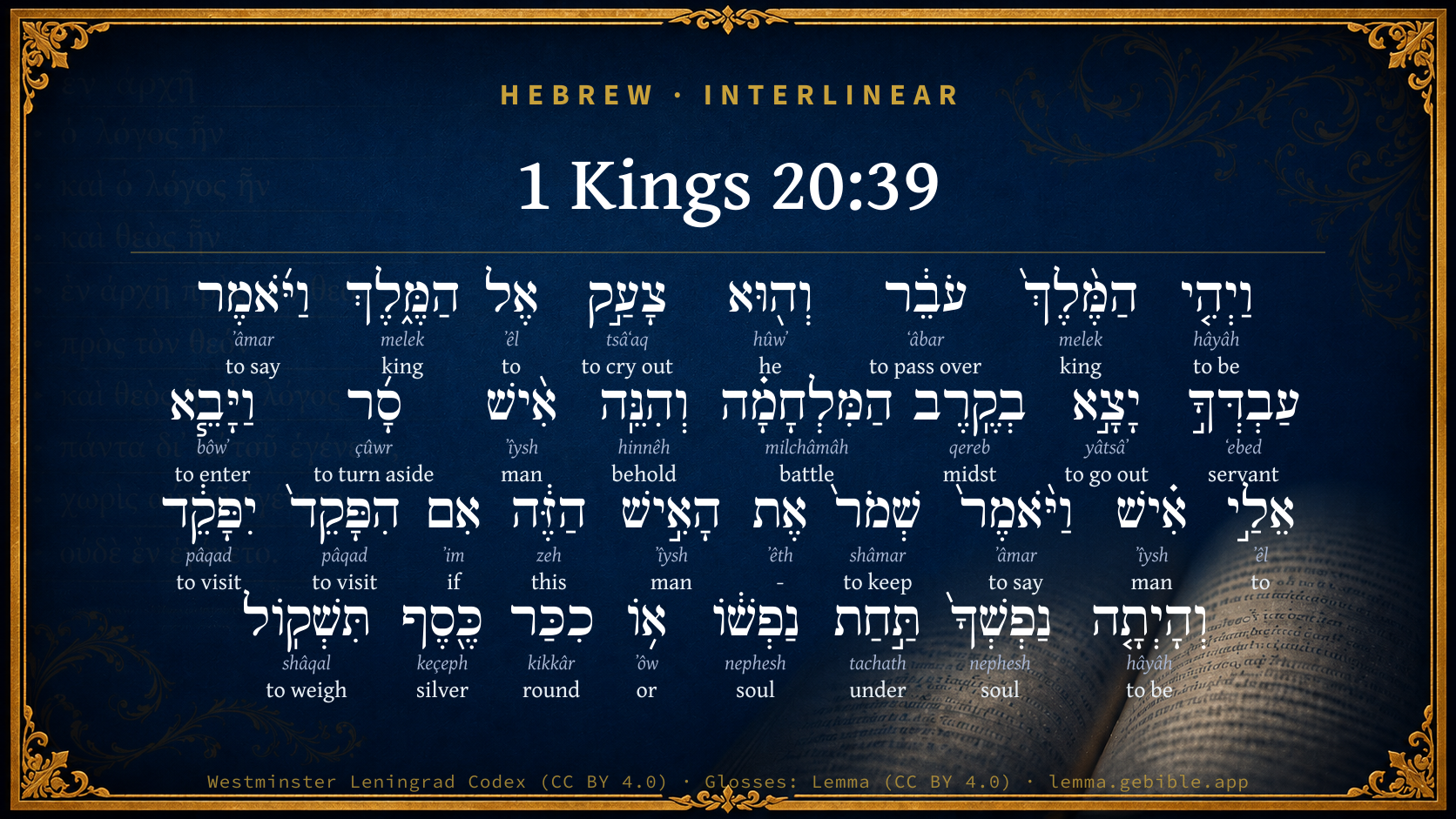
Hebrew (Westminster Leningrad Codex) 1 Kings 20:39 appears in the Hebrew Old Testament. The text above is from the Westminster Leningrad Codex. Each word links to its Strong’s number, a concise gloss, and parsing drawn from the Open Scriptures Hebrew Bible morphology. Click any word for its full Brown-Driver-Briggs (BDB) entry.
Download image
Cite this verse

1 Kings 20:39 (World English Bible). Public Domain. Lemma interlinear Bible study tool, https://lemma.gebible.app/v/1-kings/20/39.

Show BibTeX & RIS
BibTeX
RIS
English Translation
As the king passed by, he cried to the king; and he said, Your servant went out into the midst of the battle; and, behold, a man turned aside, and brought a man to me, and said, Keep this man: if by any means he be missing, then shall your life be for his life, or else you shall pay a talent of silver.
World English Bible · Public Domain
Download a study sheet

One document with this verse’s original text, its word-by-word gloss line, the meaning frame, cross-references with their text, attributed commentary, and full source and license credits — printable, and it pastes into notes with its structure intact.

This verse Autodidact and up

Study sheet (.html) Plain text (.txt)

A passage Seminary Student

Up to 50 verses in one chapter. A passage sheet keeps up to 6 commentary sources and 12 cross-references per verse, in the order this page ranks them, and says so on the sheet whenever that leaves anything out. Ask for a single verse and you get the Autodidact verse sheet above.

Everything on this page stays free to read, with no account — the sheet is a download of what is already on screen, not access to it.

Want to remove ads? Support Godless Engineer
Compare translations 3

The same verse in 3 English versions, stacked beneath the original-language interlinear above. Click any original word for its lexicon entry.

Each is an independent rendering of the whole verse — the interlinear is not word-aligned to these translations.

Highlighted words mark where these versions differ — a whole-verse word diff, not a word-by-word alignment.

  • World English Bible Public Domain
    As the king passed by, he cried to the king; and he said, Your servant went out into the midst of the battle; and, behold, a man turned aside, and brought a man to me, and said, Keep this man: if by any means he be missing, then shall your life be for his life, or else you shall pay a talent of silver.
  • King James Version Public Domain
    And as the king passed by, he cried unto the king: and he said, Thy servant went out into the midst of the battle; and, behold, a man turned aside, and brought a man unto me, and said, Keep this man: if by any means he be missing, then shall thy life be for his life, or else thou shalt pay a talent of silver.
  • unfoldingWord Literal Text CC BY-SA 4.0
    And it happened that the king was passing by, and he, he cried out to the king and said, “Your servant went out into the middle of the battle, and behold, a man turned and brought a man to me. And he said, ‘Guard this man. If missing, he is missing, then your life will be in place of his life, or you shall pay a kikkar of silver.’

unfoldingWord Literal Text — © unfoldingWord, licensed CC BY-SA 4.0. Word-aligned USFM3 via Door43 (git.door43.org/unfoldingWord/en_ult).

Versions to compare (up to 4)

3 of 4 selected

Show all 18 translations

Every available English version of this verse, each an independent rendering of the whole verse.

  • World English Bible Public Domain
    As the king passed by, he cried to the king; and he said, Your servant went out into the midst of the battle; and, behold, a man turned aside, and brought a man to me, and said, Keep this man: if by any means he be missing, then shall your life be for his life, or else you shall pay a talent of silver.
  • Berean Standard Bible Public Domain
    As the king passed by, he cried out to the king: “Your servant had marched out into the middle of the battle, when suddenly a man came over with a captive and told me, ‘Guard this man! If he goes missing for any reason, your life will be exchanged for his life, or you will weigh out a talent of silver.’
  • Majority Standard Bible Public Domain
    As the king passed by, he cried out to the king: “Your servant had marched out into the middle of the battle, when suddenly a man came over with a captive and told me, ‘Guard this man! If he goes missing for any reason, your life will be exchanged for his life, or you will weigh out a talent of silver.’
  • King James Version Public Domain
    And as the king passed by, he cried unto the king: and he said, Thy servant went out into the midst of the battle; and, behold, a man turned aside, and brought a man unto me, and said, Keep this man: if by any means he be missing, then shall thy life be for his life, or else thou shalt pay a talent of silver.
  • American Standard Version (1901) Public Domain
    And as the king passed by, he cried unto the king; and he said, Thy servant went out into the midst of the battle; and, behold, a man turned aside, and brought a man unto me, and said, Keep this man: if by any means he be missing, then shall thy life be for his life, or else thou shalt pay a talent of silver.
  • Revised Version (1885) Public Domain
    And as the king passed by, he cried unto the king: and he said, Thy servant went out into the midst of the battle; and, behold, a man turned aside, and brought a man unto me, and said, Keep this man: if by any means he be missing, then shall thy life be for his life, or else thou shalt pay a talent of silver.
  • Geneva Bible (1599) Public Domain
    And when the King came by, he cried vnto the King, and said, Thy seruant went into the middes of the battel: and beholde, there went away a man, whom another man brought vnto me, and sayd, Keepe this man: if he be lost, and want, thy life shall go for his life, or els thou shalt pay a talent of siluer.
  • Douay-Rheims (1899) Public Domain
    And as the king passed by, he cried to the king, and said: Thy servant went out to fight hand to hand: and when a certain man was run away, one brought him to me, and said: Keep this man: and if he shall slip away, thy life shall be for his life, or thou shalt pay a talent of silver.
  • Young's Literal Translation Public Domain
    And it cometh to pass -- the king is passing by -- that he hath cried unto the king, and saith, `Thy servant went out into the midst of the battle, and lo, a man hath turned aside and bringeth in unto me a man, and saith, Keep this man; if he be at all missing, then hath thy life been for his life, or a talent of silver thou dost weigh out;
  • Literal Standard Version CC BY-SA 4.0
    And it comes to pass—the king is passing by—that he has cried to the king and says, “Your servant went out into the midst of the battle, and behold, a man has turned aside and brings a man to me, and says, Keep this man; if he is at all missing, then your life has been for his life, or you weigh out a talent of silver;
  • Unlocked Literal Bible CC BY-SA 4.0
    As the king passed by, the prophet cried out to the king and said, “Your servant went out into the heat of the battle, and a soldier stopped and brought a man to me and said, 'Watch this man. If by any means he goes missing, your life will be given for his life, or you must pay a talent of silver.'
  • unfoldingWord Literal Text CC BY-SA 4.0
    And it happened that the king was passing by, and he, he cried out to the king and said, “Your servant went out into the middle of the battle, and behold, a man turned and brought a man to me. And he said, ‘Guard this man. If missing, he is missing, then your life will be in place of his life, or you shall pay a kikkar of silver.’
  • Darby Bible Public Domain
    And as the king passed by, he cried to the king and said, Thy servant went out into the midst of the battle; and behold, a man turned aside, and brought a man to me and said, Keep this man; if by any means he be missing, then shall thy life be for his life, or thou shalt pay a talent of silver.
  • World Messianic Bible Public Domain
    As the king passed by, he cried to the king, and he said, “Your servant went out into the middle of the battle; and behold, a man came over and brought a man to me, and said, ‘Guard this man! If by any means he is missing, then your life shall be for his life, or else you shall pay a talent of silver.’
  • Webster's Bible Public Domain
    And as the king passed by, he cried to the king: and he said, Thy servant went out into the midst of the battle; and behold, a man turned aside, and brought a man to me, and said, Keep this man: if by any means he shall be missing, then shall thy life be for his life, or else thou shalt pay a talent of silver.
  • Free Bible Version CC BY-SA 4.0
    As the king was passing by, he shouted out to the king: “Your servant had gone out fighting right in the middle of the battle, when all of a sudden a man came over with a prisoner and told me, ‘Guard this man! If for any reason he escapes, you will pay for his life with your life, or you will be fined a talent of silver.’
  • Bible in Basic English Public Domain
    And when the king went by, crying out to him he said, Your servant went out into the fight; and a man came out to me with another man and said, Keep this man: if by any chance he gets away, your life will be the price of his life, or you will have to give a talent of silver in payment.
  • JPS Tanakh (1917) Public Domain
    And as the king passed by, he cried unto the king; and he said: 'Thy servant went out into the midst of the battle; and, behold, a man turned aside, and brought a man unto me, and said: Keep this man; if by any means he be missing, then shall thy life be for his life, or else thou shalt pay a talent of silver.

Literal Standard Version (2020), Covenant Press — licensed CC BY-SA 4.0. Text via the HelloAO Bible API (eBible.org). Unlocked Literal Bible (unfoldingWord) — licensed CC BY-SA 4.0. Text via the HelloAO Bible API (eBible.org). unfoldingWord Literal Text — © unfoldingWord, licensed CC BY-SA 4.0. Word-aligned USFM3 via Door43 (git.door43.org/unfoldingWord/en_ult). Free Bible Version, Dr. Jonathan Gallagher — licensed CC BY-SA 4.0. Text via the HelloAO Bible API (eBible.org).

Word by word

More ways to search: Search by grammar → Find every occurrence → Compare this word →

Practice this passage: Drill this verse → Learn its vocabulary →

תִּשְׁקֽוֹל
shâqal
H8254
“to weigh”
Verb, Qal, Imperfect, 2nd Person, Masculine, Singular
Part of Speech
Verb
Stem
Qal
Form
Imperfect
Person
2nd Person
Gender
Masculine
Number
Singular
Full BDB Definition

Origin: a primitive root

TWOT: 2454

to weigh, weigh out, pay out - (Qal) - to weigh - to weigh out (a price) - of grief (figuratively) - (Niphal) - to be weighed - to be weighed out
  1. וַיְהִ֤י hâyâh H1961 “and · to be” Conjunction + Verb, Qal, Sequential Imperfect, 3rd Person, Masculine, Singular
  2. הַמֶּ֨לֶךְ֙ melek H4428 “the · king” Particle, Definite Article + Noun, Common, Masculine, Singular, Absolute
  3. עֹבֵ֔ר ʻâbar H5674 “passing over” Verb, Qal, Participle Active, Masculine, Singular, Absolute
  4. וְה֖וּא hûwʼ H1931 “and · he” Conjunction + Pronoun, Personal, 3rd Person, Masculine, Singular
  5. צָעַ֣ק tsâʻaq H6817 “to cry out” Verb, Qal, Perfect, 3rd Person, Masculine, Singular
  6. אֶל ʼêl H413 “to” Preposition
  7. הַמֶּ֑לֶךְ melek H4428 “the · king” Particle, Definite Article + Noun, Common, Masculine, Singular, Absolute
  8. וַיֹּ֜אמֶר ʼâmar H559 “and · to say” Conjunction + Verb, Qal, Sequential Imperfect, 3rd Person, Masculine, Singular
  9. עַבְדְּךָ֣ ʻebed H5650 “servant · your” Noun, Common, Masculine, Singular, Construct + Suffix, Personal, 2nd Person, Masculine, Singular
  10. יָצָ֣א yâtsâʼ H3318 “to go out” Verb, Qal, Perfect, 3rd Person, Masculine, Singular
  11. בְקֶֽרֶב qereb H7130 “in/at · midst of” Preposition + Noun, Common, Masculine, Singular, Construct
  12. הַמִּלְחָמָ֗ה milchâmâh H4421 “the · battle” Particle, Definite Article + Noun, Common, Feminine, Singular, Absolute
  13. וְהִנֵּֽה hinnêh H2009 “and · behold” Conjunction + Particle, Demonstrative
  14. אִ֨ישׁ ʼîysh H376 “man” Noun, Common, Masculine, Singular, Absolute
  15. סָ֜ר çûwr H5493 “to turn aside” Verb, Qal, Perfect, 3rd Person, Masculine, Singular
  16. וַיָּבֵ֧א bôwʼ H935 “and · to enter” Conjunction + Verb, Hiphil, Sequential Imperfect, 3rd Person, Masculine, Singular
  17. אֵלַ֣י ʼêl H413 “to · me” Preposition + Suffix, Personal, 1st Person, Common, Singular
  18. אִ֗ישׁ ʼîysh H376 “man” Noun, Common, Masculine, Singular, Absolute
  19. וַיֹּ֨אמֶר֙ ʼâmar H559 “and · to say” Conjunction + Verb, Qal, Sequential Imperfect, 3rd Person, Masculine, Singular
  20. שְׁמֹר֙ shâmar H8104 “keep” Verb, Qal, Imperative, 2nd Person, Masculine, Singular
  21. אֶת ʼêth H853 “-” Particle, Direct Object
  22. הָאִ֣ישׁ ʼîysh H376 “the · man” Particle, Definite Article + Noun, Common, Masculine, Singular, Absolute
  23. הַזֶּ֔ה zeh H2088 “the · this” Particle, Definite Article + Pronoun, Demonstrative, Masculine, Singular
  24. אִם ʼim H518 “if” Conjunction
  25. הִפָּקֵד֙ pâqad H6485 “to visit” Verb, Niphal, Infinitive Absolute
  26. יִפָּקֵ֔ד pâqad H6485 “to visit” Verb, Niphal, Imperfect, 3rd Person, Masculine, Singular
  27. וְהָיְתָ֤ה hâyâh H1961 “and · to be” Conjunction + Verb, Qal, Perfect, 3rd Person, Feminine, Singular
  28. נַפְשְׁךָ֙ nephesh H5315 “soul · your” Noun, Common, Both, Singular, Construct + Suffix, Personal, 2nd Person, Masculine, Singular
  29. תַּ֣חַת tachath H8478 “under” Preposition
  30. נַפְשׁ֔וֹ nephesh H5315 “soul · his” Noun, Common, Both, Singular, Construct + Suffix, Personal, 3rd Person, Masculine, Singular
  31. א֥וֹ ʼôw H176 “or” Conjunction
  32. כִכַּר kikkâr H3603 “round of” Noun, Common, Both, Singular, Construct
  33. כֶּ֖סֶף keçeph H3701 “silver” Noun, Common, Masculine, Singular, Absolute

About this verse

These counts appear in no published source. They are computed here, from the morphology-tagged text and Lemma’s own curated glosses. What Lemma adds →

34
words
26
distinct lemmas
Historical
section

Notable vocabulary

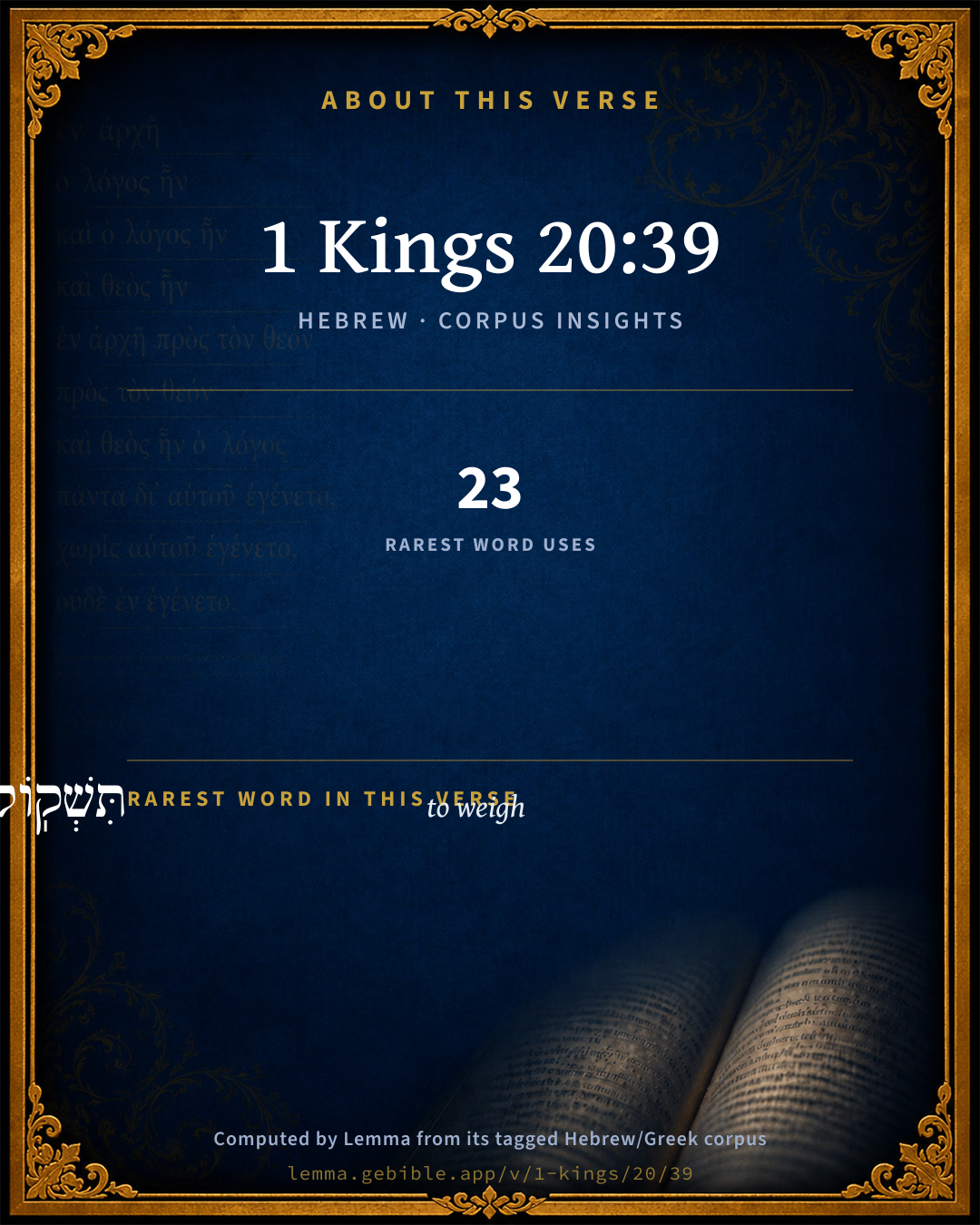
The rarest word here is תִּשְׁקֽוֹל to weigh H8254 — appearing just 23 times in the whole Hebrew Bible.

Shared distinctive vocabulary

תִּשְׁקֽוֹל to weigh H8254 occurs in 21 verses of the Hebrew Bible. Also found in:

Grammatical profile

  • 13 verbs
  • 12 nouns
  • 2 pronouns
  • 3 prepositions
  • 2 conjunctions
  • 2 particles

Verb forms

  • וַיְהִ֤י Qal · Sequential Imperfect
  • עֹבֵ֔ר Qal · Participle Active
  • צָעַ֣ק Qal · Perfect
  • וַיֹּ֜אמֶר Qal · Sequential Imperfect
  • יָצָ֣א Qal · Perfect
  • סָ֜ר Qal · Perfect
  • וַיָּבֵ֧א Hiphil · Sequential Imperfect
  • וַיֹּ֨אמֶר֙ Qal · Sequential Imperfect
  • שְׁמֹר֙ Qal · Imperative
  • הִפָּקֵד֙ Niphal · Infinitive Absolute
  • יִפָּקֵ֔ד Niphal · Imperfect
  • וְהָיְתָ֤ה Qal · Perfect
  • תִּשְׁקֽוֹל Qal · Imperfect

Repetition

Words recur within this verse — often emphatic in Hebrew:

  • אִ֨ישׁ man H376 ×3
  • וַיְהִ֤י to be H1961 ×2
  • הַמֶּ֨לֶךְ֙ king H4428 ×2
  • וַיֹּ֜אמֶר to say H559 ×2
  • הִפָּקֵד֙ to visit H6485 ×2
  • נַפְשְׁךָ֙ soul H5315 ×2
  • אֶל to H413 ×2

Cross-references

12

Topical passages linked to 1 Kings 20:39 in the Treasury of Scripture Knowledge — connected by theme and wording, ordered by reader-vote popularity; previews shown in the World English Bible.

  • 2 Kings 10:24 They went in to offer sacrifices and burnt offerings. Now Jehu had appointed him eighty men outside, and said, If any of the men whom I bring into your hands escape, [he who lets him go], his life shall be for the life of him.
  • Exodus 21:30 If a ransom is laid on him, then he shall give for the redemption of his life whatever is laid on him.
  • Judges 9:7–20 When they told it to Jotham, he went and stood on the top of Mount Gerizim, and lifted up his voice, and cried, and said to them, Listen to me, you men of Shechem, that God may listen to you.
  • 2 Samuel 12:1–7 Yahweh sent Nathan to David. He came to him, and said to him, "There were two men in one city; the one rich, and the other poor.
  • 2 Samuel 14:5–7 The king said to her, What ails you? She answered, Of a truth I am a widow, and my husband is dead.
  • 1 Kings 20:42 He said to him, Thus says Yahweh, Because you have let go out of your hand the man whom I had devoted to destruction, therefore your life shall go for his life, and your people for his people.
  • Job 36:18 Don't let riches entice you to wrath, Neither let the great size of a bribe turn you aside.
  • Proverbs 6:35 He won't regard any ransom, Neither will he rest content, though you give many gifts.
  • Proverbs 13:8 The ransom of a man's life is his riches, But the poor hear no threats.
  • Mark 12:1–12 He began to speak to them in parables. "A man planted a vineyard, put a hedge around it, dug a pit for the winepress, built a tower, rented it out to a farmer, and went into another country.
  • 1 Peter 1:18–19 knowing that you were redeemed, not with corruptible things, with silver or gold, from the useless way of life handed down from your fathers,
  • Psalms 49:7 None of them can by any means redeem his brother, Nor give God a ransom for him.

Cross-references courtesy of OpenBible.info (CC BY 4.0).

Hebrew and Greek witnesses Masoretic Hebrew ↔ Greek Septuagint

The same verse in the two great witnesses to the Old Testament, shown verse-for-verse.

These are two independent witnesses, not word-aligned to each other, and the Septuagint is shown in lemma (dictionary) form.

Hebrew 1 Kings 20:39 Masoretic · Westminster Leningrad Codex

וַיְהִ֤י הַמֶּ֨לֶךְ֙ עֹבֵ֔ר וְה֖וּא צָעַ֣ק אֶל הַמֶּ֑לֶךְ וַיֹּ֜אמֶר עַבְדְּךָ֣ יָצָ֣א בְקֶֽרֶב הַמִּלְחָמָ֗ה וְהִנֵּֽה אִ֨ישׁ סָ֜ר וַיָּבֵ֧א אֵלַ֣י אִ֗ישׁ וַיֹּ֨אמֶר֙ שְׁמֹר֙ אֶת הָאִ֣ישׁ הַזֶּ֔ה אִם הִפָּקֵד֙ יִפָּקֵ֔ד וְהָיְתָ֤ה נַפְשְׁךָ֙ תַּ֣חַת נַפְשׁ֔וֹ א֥וֹ כִכַּר כֶּ֖סֶף תִּשְׁקֽוֹל

As the king passed by, he cried to the king; and he said, Your servant went out into the midst of the battle; and, behold, a man turned aside, and brought a man to me, and said, Keep this man: if by any means he be missing, then shall your life be for his life, or else you shall pay a talent of silver.

World English Bible · Public Domain

Hebrew: Westminster Leningrad Codex (CC BY 4.0). Greek: Septuagint (public domain); English from a public-domain English Septuagint. How the Septuagint differs from the Hebrew →

Targum (Aramaic paraphrase)

1

The Targum is the ancient Jewish Aramaic paraphrase of the Hebrew Scriptures — an interpretive translation, not the Hebrew text itself. Onkelos (literal) and Pseudo-Jonathan (expansive) render the Torah, and Jonathan the Prophets. Coverage is partial: where no permissively-licensed English translation exists for a verse, only the Aramaic is shown. This is verse-level text, not a word-by-word alignment to the Hebrew.

  1. Targum Jonathan Prophets (Joshua–Malachi)
    וַהֲוָה מַלְכָּא עֲבַר וְהוּא צָוַח קֳדָם מַלְכָּא וַאֲמַר עַבְדָךְ נָפַק בְּגוֹ קְרָבָא וְהָא גַבְרָא זָר וְאַיְתֵי לִי גַבְרָא וַאֲמַר טַר יַת גַבְרָא הָדֵין אִם מִשְׁגָא יִשְׁגֵי וּתְהִי נַפְשָׁךְ חֲלַף נַפְשֵׁיהּ אוֹ כִכְּרָא דְכַסְפָּא תִּתְקוֹל:

    (no public-domain English translation for this verse)

    Targum Jonathan — Aramaic: “Mikraot Gedolot” (public domain). English: “Sefaria Community Translation” (CC0 1.0 (public-domain dedication)); “London "Chaldee Paraphrase," 1871” (public domain). Text via Sefaria.

Commentary

Notes on 1 Kings 20:39 from classic Christian and Jewish commentators (each source and its license shown beneath its notes). The classic Christian expositions comment on the surrounding passage and are grouped to its opening verse, so a note may address several verses; the Jewish commentaries on the Tanakh (Rashi and others) are per-verse, so they appear only where the commentator wrote on this verse.

Lemma curates 59 commentaries, every one of them public domain or Creative Commons licensed, each selected and text-cleaned for this edition rather than reprinted as found. About our sources →

Trapp's Complete Commentary

John Trapp

1Ki 20:39 And as the king passed by, he cried unto the king: and he said, Thy servant went out into the midst of the battle; and, behold, a man turned aside, and brought a man unto me, and said, Keep this man: if by any means he be missing, then shall thy life be for his life, or else thou shalt pay a talent of silver.

Ver. 39. Thy servant went ont.] Parabolically all, {as 1Sa 12:1-2, &c., See Trapp on "1Sa 12:1" &c} to bring Ahab to pass an impartial sentence against himself, in the person of another.

John Trapp, A Commentary or Exposition upon All the Books of the Old and New Testament (1647–1656) — public domain. Text from a community e-Sword module.

Joseph Benson's Commentary

1Ki 20:39. And he said, Thy servant, &c. — This relation is a parable; a usual way of instruction in the eastern parts, and most fit for this occasion, wherein an obscure prophet was to speak to a great king, impatient of a downright reproof, and exceeding partial in his own cause. A man turned aside and said, Keep, &c. — His commander said this unto him, as the manner of expression shows. The king of Israel said, So shall thy judgment be — Thou hast pronounced thy own sentence. According to your agreement; so shalt thou suffer. Thou shalt lose thy life, or pay the talent or silver. Ahab had forgot how he had dismissed a greater person willingly, or else he could scarcely have been so hard-hearted as to condemn one that had offended unwillingly. But the prophet soon brought it to his remembrance.

Joseph Benson's Commentary on the Old and New Testaments (1811–1818) — public domain. Text from a community e-Sword module.

Geneva Bible (1599)

Geneva Bible translators

By this parable he maketh Ahab condemn himself, who made a covenant with God’s enemy, and let him escape, whom God had appointed to be slain.

Geneva Bible (1599) marginal notes — public domain. Text via Bolls.life.

Jamieson, Fausset & Brown

Robert Jamieson, A. R. Fausset & David Brown

a talent of silver--£342.

Next: 1 Kings Chapter 21

Jamieson, Fausset & Brown — Commentary Critical and Explanatory on the Whole Bible (1871) — public domain (CC PDM 1.0). Text via the HelloAO Bible API.

Adam Clarke's Commentary

Verse 39. Keep this man] The drift of this is at once seen; but Ahab, not knowing it, was led to pass sentence on himself.

Adam Clarke's Commentary on the Bible (1810–1826) — public domain. Text from a community e-Sword/MySword module.

Ellicott's Commentary for English Readers

(39) Thy servant.—The parable is, of course, designed (like those of 2Sa_12:1-4; 2Sa_14:5-11) to make Ahab condemn himself. In Ahab, however, it excites not compunction, but characteristic sullenness of displeasure, like that of 1Ki_21:4.

A Bible Commentary for English Readers, edited by Charles John Ellicott (1878–1897) — public domain. Text from a community e-Sword module.

The Cambridge Bible for Schools and Colleges

gen. ed. J. J. S. Perowne

39. cried unto the king] The appeal for the king’s intervention is made with a view of getting free from the punishment which had been threatened to him.

a man turned aside] Evidently meant to indicate one of authority who had a right to command the services which he desires and to impose a penalty if they be not fulfilled. In the interpretation he represents Jehovah.

be missing] i.e. When I come to ask for the prisoner whom I trusted to your hands.

a talent of silver] The fine was large to mark the importance of the trust.

The Cambridge Bible for Schools and Colleges (gen. ed. J. J. S. Perowne; Cambridge University Press, 1878–1918) — public domain. Text from a community e-Sword module.

John Gill's Exposition

And as the king passed by, he cried unto the king,.... With a loud voice, signifying he had something to say unto him, at which he stopped:

and he said, thy servant went out into the midst of the battle; this was not real, but fictitious, an apologue, fable, or parable, by which he would represent to Ahab his own case, and bring him under conviction of his folly, just as Nathan dealt with David:

and, behold, a man turned aside; a superior officer in the army:

and brought a man unto me; he had made a prisoner of:

and said, keep this man; do not let him escape:

if by any means he be missing, then shall thy life be for his life, or else thou shalt pay a talent of silver; if he let him go willingly, or by any means he should get out of his hands, then he should either die for it, or be fined a talent of silver, which of our money is three hundred and seventy five pounds; and to this it seems he agreed.

John Gill's Exposition of the Whole Bible (1746–1763) — public domain (CC PDM 1.0). Text via the HelloAO Bible API.

Haydock's Catholic Bible Commentary

One. Thus God delivered the proud and blasphemous Benadad to Achab. (Haydock)

George Leo Haydock (1774–1849), Haydock's Catholic Family Bible and Commentary, 1859 edition — public domain. Excludes Psalms (Douay-Rheims chapter numbering differs from Protestant) and Deuterocanonical books (Catholic canon only).

Matthew Poole's English Annotations

Thy servant went out: this following relation is not an untruth, but a parable; a usual way of instruction in the eastern parts, and ancient times, and most fit for this occasion, wherein an obscure prophet was to speak to a great king; whose ears were tender, and impatient of a downright reproof, and exceeding partial in his own cause; who by this artifice is made to condemn himself before he was aware of it, and so forced to receive the prophet’s just sentence with more patience and moderation: compare 1Sa 12; 1Sa 14.

A man turned aside; my commander or superior, as the manner of his expression here following showeth.

Then shall thy life be for his life; thou shalt die in his stead; as below, 1Ki 20:42; compare Exo 21:23.

Matthew Poole's English Annotations on the Holy Bible (1683–1685) — public domain. Text from a community e-Sword/MySword module.

Whedon's Commentary on the Bible

Daniel D. Whedon

39. He cried unto the king — His measure to elicit from Ahab his own condemnation is like that of Nathan to make David pronounce judgment on himself. Compare 2Sa_12:1-12.

A talent of silver — About one thousand seven hundred dollars. A sum, says Keil, “not to be procured by a poor man, so that he must certainly have answered with his life, for the prisoner escaped.”

Daniel D. Whedon (gen. ed.), Commentary on the Old and New Testaments (1874–1909) — public domain. Text from a community e-Sword module.

The Pulpit Commentary

And as the king passed by, he cried unto the king in his capacity of supreme judge; (see on 1Ki_3:9) and he said, Thy servant went out into the midst of the battle i.e. , the recent battle; and, behold, a man turned aside rs cf. 1Ki_22:43; Exo_3:3 Exo_32:8. But Ewald, al. would read, rs prince or captain (properly rc), a change which certainly lends force to the apologue, and makes the analogy more complete. Only such an officer was entitled to give such an order. Moreover just as a common soldier ought to obey his captain, so should Ahab have obeyed God. But as our present text yields a good and sufficient meaning, we are hardly warranted in making any change, and brought a man unto me, and said, Keep this man: if by any means he be missing, then shall thy life be for his life, or else thou shalt pay Heb. weigh. There was then no coinage. Payments were made by means of bars of silver or gold a talent of silver. A considerable sum about "The prisoner is thus represented to be a very important personage" (Thenius). There is a hint at Ben-hadad. Ewald holds that the wounds represented the penalty inflicted instead of the talent which a common soldier naturally could not pay.

The Pulpit Commentary (1880–1919), ed. H.D.M. Spence-Jones & Joseph S. Exell — public domain. Text from a community e-Sword module.

John Wesley's Explanatory Notes

He said - This relation is a parable; an usual way of instruction in the eastern parts, and most fit for this occasion wherein an obscure prophet was to speak to a great king; impatient of a down-right reproof, and exceeding partial in his own cause. A man - My commander as the manner of expression sheweth.

John Wesley, Explanatory Notes Upon the Whole Bible (1754–1765) — public domain. Text via the GEBible commentary corpus.

Keil & Delitzsch

C. F. Keil & F. Delitzsch

When the king passed by, he cried out to him and related the following fictitious tale: He had gone to the war, and a man had come aside to him (סוּר as in Exo 3:3; Jdg 14:8, etc.), and had given a man (a prisoner) into his care with this command, that he was to watch him, and if he should be missing he was to answer for his life with his own life, or to pay a talent of silver (as a punishment). The rest may be easily imagined, namely the request to be saved from this punishment. Ahab answered (Kg1 20:40), משׁפּטך כּן, "thus thy sentence, thou hast decided," i.e., thou hast pronounced thine own sentence, and must endure the punishment stated.

Keil & Delitzsch — Biblical Commentary on the Old Testament (1861–1891) — public domain (CC PDM 1.0). Text via the HelloAO Bible API. (Old Testament only.)

unfoldingWord translationNotes

Door43 World Missions Community

Your servant went out

The prophet refers to himself in the third person as a sign of respect to the king.

into the heat of the battle

"Heat of the battle" here is an idiom to express the most intense and fierce fighting. AT: "to where the battle was most intense" (See: Idiom)

your life will be given for his life

"you will die in his place"

a talent of silver

A talent is a unit of weight equal to about 33 kilograms. AT: "33 kilograms of silver" (See: Biblical Weight)

going here and there

This is an idiom to represent being very busy and preoccupied. AT: "doing other things" or "doing this and that" (See: Idiom)

translationWords

cry

servant

adversary

life

silver

kingdom of Israel

punish

unfoldingWord translationNotes — © Distant Shores Media and the Door43 World Missions Community, licensed CC BY-SA 4.0. Source: git.door43.org/Door43/en_tn.

Rashi

Rabbi Shlomo Yitzchaki (Rashi)

And behold a man turned aside. From the road toward me.

And brought a man to me. A prisoner of war.

If he shall be missing. If he escapes, an expression [similar to], “and none of us is missing [נפקד],” an expression of lacking.

Rashi on the Tanakh — English translations: “The Judaica Press complete Tanach with Rashi, translated by A. J. Rosenberg” (CC BY 4.0); “Pentateuch with Rashi's commentary by M. Rosenbaum and A.M. Silbermann, 1929-1934” (public domain); “The Metsudah Tanach series, Lakewood, N.J” (CC BY 4.0); and “The Book of Joshua, Metsudah Publications, 1997” (CC BY 4.0). Text via Sefaria.

Lesson kit

Teaching starters — assembled from the data on this page, not authored interpretation. Every prompt links to the verse data it draws on. Edit before teaching.

1 Kings, in the Historical, opens this verse with 34 words (26 distinct Hebrew lemmas). Its most distinctive word is shâqal (“to weigh”). A historical commentator’s framing appears above. Read the whole chapter for the surrounding context.

Discussion questions

  1. How does “to weigh” (shâqal) shape what this verse is saying?
  2. How does Genesis 23:16, which shares the word «to weigh», read alongside this verse?
  3. What does the repetition of “man” (3× in this one verse) do in this verse?
  4. These translations render this verse differently. What is at stake in choosing one wording over another?
  5. «וַיְהִ֤י» is a Qal Sequential Imperfect verb. How does that grammatical form shape the action described?
  6. Compare how Trapp's Complete Commentary and Joseph Benson's Commentary read this verse. Where do they agree or differ?

Things to notice

Reading settings

Reading text

Shown beneath each verse's original-language words.

Old Testament
Old Testament edition

Read the OT as the Masoretic Hebrew (MT) or the Greek Septuagint (LXX).

English shown for the Greek Septuagint (in the Hebrew ↔ Greek comparison).

Comparing translations? Open the Compare panel on any verse page to stack up to four side by side.