2 Chronicles 20:33

Hebrew (Westminster Leningrad Codex) 2 Chronicles 20:33 appears in the Hebrew Old Testament. The text above is from the Westminster Leningrad Codex. Each word links to its Strong’s number, a concise gloss, and parsing drawn from the Open Scriptures Hebrew Bible morphology. Click any word for its full Brown-Driver-Briggs (BDB) entry.
Download image
Cite this verse

2 Chronicles 20:33 (World English Bible). Public Domain. Lemma interlinear Bible study tool, https://lemma.gebible.app/v/2-chronicles/20/33.

Show BibTeX & RIS
BibTeX
RIS
English Translation
However the high places were not taken away; neither as yet had the people set their hearts to the God of their fathers.
World English Bible · Public Domain
Download a study sheet

One document with this verse’s original text, its word-by-word gloss line, the meaning frame, cross-references with their text, attributed commentary, and full source and license credits — printable, and it pastes into notes with its structure intact.

This verse Autodidact and up

Study sheet (.html) Plain text (.txt)

A passage Seminary Student

Up to 50 verses in one chapter. A passage sheet keeps up to 6 commentary sources and 12 cross-references per verse, in the order this page ranks them, and says so on the sheet whenever that leaves anything out. Ask for a single verse and you get the Autodidact verse sheet above.

Everything on this page stays free to read, with no account — the sheet is a download of what is already on screen, not access to it.

Want to remove ads? Support Godless Engineer
Compare translations 3

The same verse in 3 English versions, stacked beneath the original-language interlinear above. Click any original word for its lexicon entry.

Each is an independent rendering of the whole verse — the interlinear is not word-aligned to these translations.

Highlighted words mark where these versions differ — a whole-verse word diff, not a word-by-word alignment.

  • World English Bible Public Domain
    However the high places were not taken away; neither as yet had the people set their hearts to the God of their fathers.
  • King James Version Public Domain
    Howbeit the high places were not taken away: for as yet the people had not prepared their hearts unto the God of their fathers.
  • unfoldingWord Literal Text CC BY-SA 4.0
    However, the high places did not turn aside. And still the people did not establish their heart to the God of their fathers.

unfoldingWord Literal Text — © unfoldingWord, licensed CC BY-SA 4.0. Word-aligned USFM3 via Door43 (git.door43.org/unfoldingWord/en_ult).

Versions to compare (up to 4)

3 of 4 selected

Show all 18 translations

Every available English version of this verse, each an independent rendering of the whole verse.

  • World English Bible Public Domain
    However the high places were not taken away; neither as yet had the people set their hearts to the God of their fathers.
  • Berean Standard Bible Public Domain
    The high places, however, were not removed; the people had not yet set their hearts on the God of their fathers.
  • Majority Standard Bible Public Domain
    The high places, however, were not removed; the people had not yet set their hearts on the God of their fathers.
  • King James Version Public Domain
    Howbeit the high places were not taken away: for as yet the people had not prepared their hearts unto the God of their fathers.
  • American Standard Version (1901) Public Domain
    Howbeit the high places were not taken away; neither as yet had the people set their hearts unto the God of their fathers.
  • Revised Version (1885) Public Domain
    Howbeit the high places were not taken away; neither as yet had the people set their hearts unto the God of their fathers.
  • Geneva Bible (1599) Public Domain
    Howbeit the hie places were not taken away: for the people had not yet prepared their hearts vnto the God of their fathers.
  • Douay-Rheims (1899) Public Domain
    But yet he took not away the high places, and the people had not yet turned their heart to the Lord the God of their fathers.
  • Young's Literal Translation Public Domain
    Only, the high places have not turned aside, and still the people have not prepared their heart for the God of their fathers.
  • Literal Standard Version CC BY-SA 4.0
    Only, the high places have not been removed, and still the people have not prepared their heart for the God of their fathers.
  • Unlocked Literal Bible CC BY-SA 4.0
    However, the high places were not taken away. The people still had not directed their hearts to the God of their ancestors.
  • unfoldingWord Literal Text CC BY-SA 4.0
    However, the high places did not turn aside. And still the people did not establish their heart to the God of their fathers.
  • Darby Bible Public Domain
    Only, the high places were not removed; and as yet the people had not directed their hearts to the God of their fathers.
  • World Messianic Bible Public Domain
    However the high places were not taken away, and the people had still not set their hearts on the God of their fathers.
  • Webster's Bible Public Domain
    But the high places were not taken away: for as yet the people had not prepared their hearts to the God of their fathers.
  • Free Bible Version CC BY-SA 4.0
    However, the high places were not removed, and the people were not committed to the God of their forefathers.
  • Bible in Basic English Public Domain
    The high places, however, were not taken away, and the hearts of the people were still not true to the God of their fathers.
  • JPS Tanakh (1917) Public Domain
    Howbeit the high places were not taken away; neither as yet had the people set their hearts unto the God of their fathers.

Literal Standard Version (2020), Covenant Press — licensed CC BY-SA 4.0. Text via the HelloAO Bible API (eBible.org). Unlocked Literal Bible (unfoldingWord) — licensed CC BY-SA 4.0. Text via the HelloAO Bible API (eBible.org). unfoldingWord Literal Text — © unfoldingWord, licensed CC BY-SA 4.0. Word-aligned USFM3 via Door43 (git.door43.org/unfoldingWord/en_ult). Free Bible Version, Dr. Jonathan Gallagher — licensed CC BY-SA 4.0. Text via the HelloAO Bible API (eBible.org).

Word by word

More ways to search: Search by grammar → Find every occurrence → Compare this word →

Practice this passage: Drill this verse → Learn its vocabulary →

הַבָּמ֖וֹת
bâmâh
H1116
“the · high places”
Particle, Definite Article + Noun, Common, Feminine, Plural, Absolute
Part of Speech
Particle + Noun
Type
Common
Gender
Feminine
Number
Plural
State
Absolute
Full BDB Definition

Origin: from an unused root (meaning to be high)

TWOT: 253

high place, ridge, height, bamah (technical name for cultic platform) - high place, mountain - high places, battlefields - high places (as places of worship) - funeral mound?
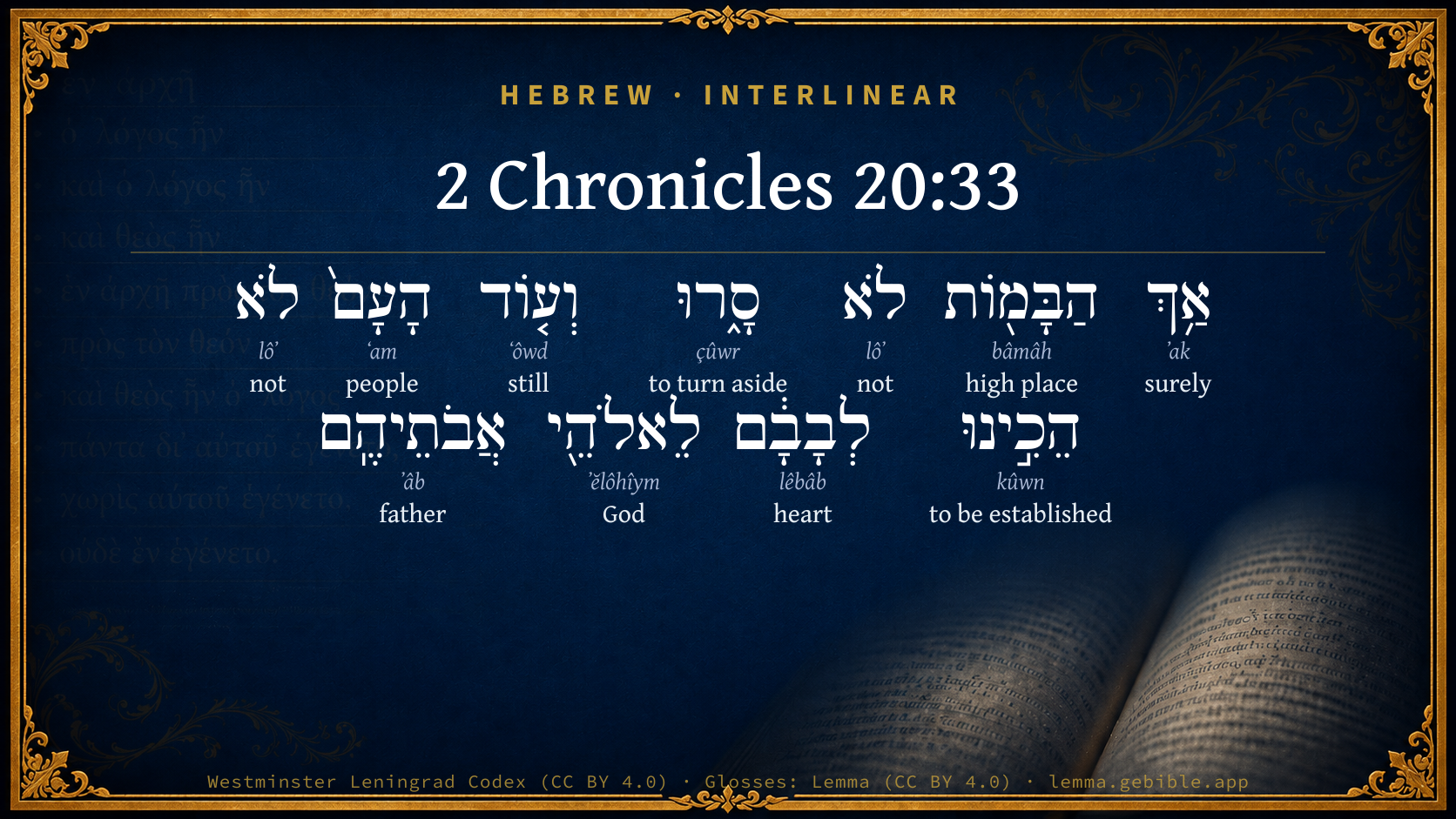
  1. אַ֥ךְ ʼak H389 “surely” Particle, Accusative
  2. לֹא lôʼ H3808 “not” Particle, Negative
  3. סָ֑רוּ çûwr H5493 “to turn aside” Verb, Qal, Perfect, 3rd Person, Common, Plural
  4. וְע֤וֹד ʻôwd H5750 “and · still” Conjunction + Adverb
  5. הָעָם֙ ʻam H5971 “the · people” Particle, Definite Article + Noun, Common, Masculine, Singular, Absolute
  6. לֹא lôʼ H3808 “not” Particle, Negative
  7. הֵכִ֣ינוּ kûwn H3559 “to be established” Verb, Hiphil, Perfect, 3rd Person, Common, Plural
  8. לְבָבָ֔ם lêbâb H3824 “heart · their” Noun, Common, Masculine, Singular, Construct + Suffix, Personal, 3rd Person, Masculine, Plural
  9. לֵאלֹהֵ֖י ʼĕlôhîym H430 “to/for · God(s) of” Preposition + Noun, Common, Masculine, Plural, Construct
  10. אֲבֹתֵיהֶֽם ʼâb H1 “fathers · their” Noun, Common, Masculine, Plural, Construct + Suffix, Personal, 3rd Person, Masculine, Plural

About this verse

These counts appear in no published source. They are computed here, from the morphology-tagged text and Lemma’s own curated glosses. What Lemma adds →

11
words
10
distinct lemmas
Historical
section

Grammatical profile

  • 2 verbs
  • 5 nouns
  • 1 adverb
  • 3 particles

Verb forms

  • סָ֑רוּ Qal · Perfect
  • הֵכִ֣ינוּ Hiphil · Perfect

Repetition

A word recurs within this verse — often emphatic in Hebrew:

Hebrew & Septuagint length

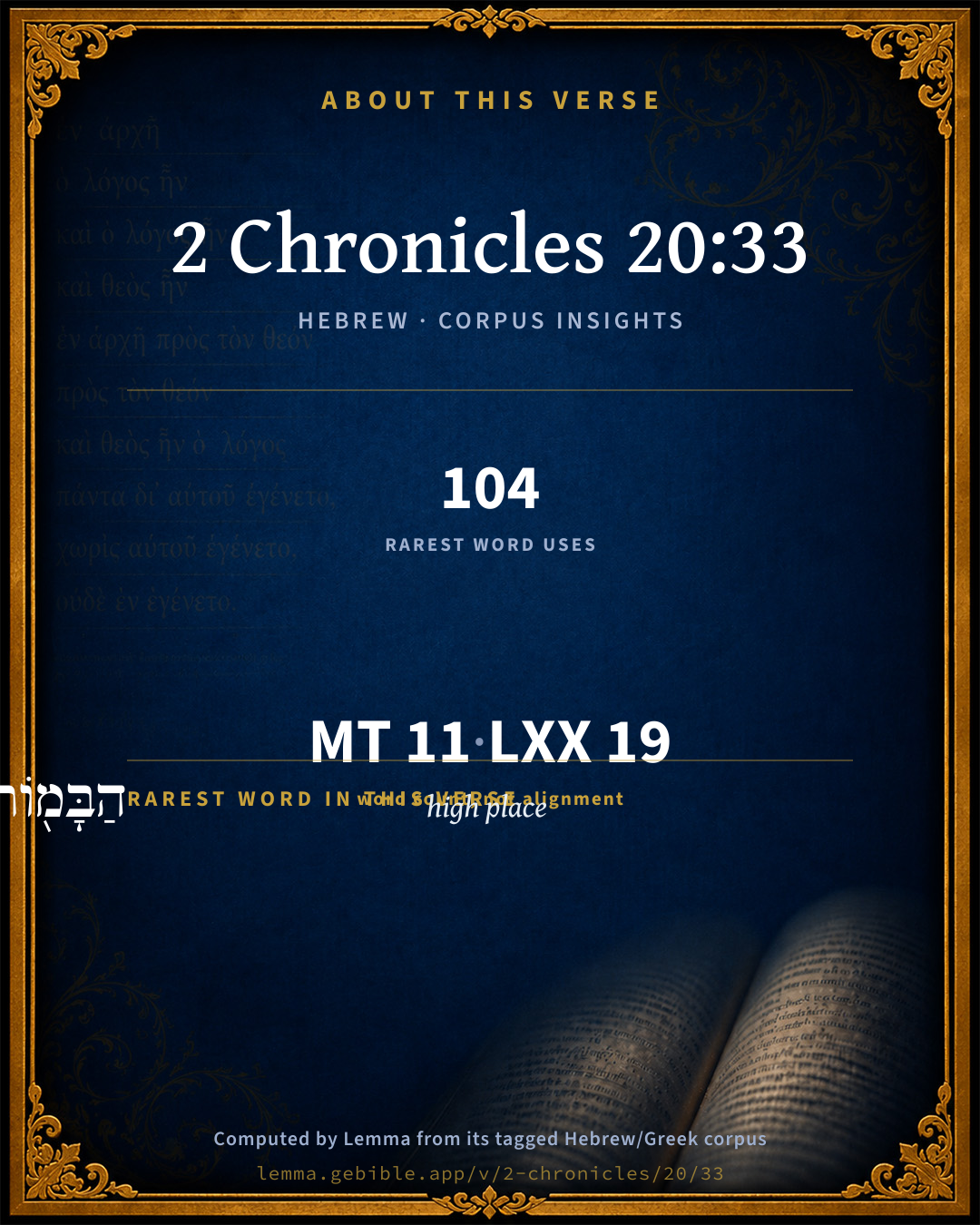
In English translation the verse runs 23 words from the Hebrew and 23 from the Septuagint (LXX English) — the same length.

A rough comparison of the two English renderings, which tokenize alike — not a word-level alignment.

Word counts can differ between the Hebrew and the Greek without any difference in meaning — e.g. the Hebrew direct-object marker אֵת has no separate Greek word, and Greek often adds the article ὁ.

In the original languages it is 11 Hebrew tokens and 19 Greek tokens — but the two are counted differently (Hebrew bundles its prefixes and suffixes into one token; the Greek is in lemma form), so that isn’t a like-for-like length.

Cross-references

7

Topical passages linked to 2 Chronicles 20:33 in the Treasury of Scripture Knowledge — connected by theme and wording, ordered by reader-vote popularity; previews shown in the World English Bible.

  • 2 Chronicles 17:6 His heart was lifted up in the ways of Yahweh: and furthermore he took away the high places and the Asherim out of Judah.
  • 2 Chronicles 19:3 Nevertheless there are good things found in you, in that you have put away the Asheroth out of the land, and have set your heart to seek God.
  • 2 Chronicles 12:14 He did that which was evil, because he didn't set his heart to seek Yahweh.
  • Deuteronomy 29:4 but Yahweh has not given you a heart to know, and eyes to see, and ears to hear, to this day.
  • 1 Samuel 7:3 Samuel spoke to all the house of Israel, saying, If you do return to Yahweh with all your heart, then put away the foreign gods and the Ashtaroth from among you, and direct your hearts to Yahweh, and serve him only; and he will deliver you out of the hand of the Philistines.
  • 2 Chronicles 14:3 for he took away the foreign altars, and the high places, and broke down the pillars, and hewed down the Asherim,
  • 2 Chronicles 30:19 who sets his heart to seek God, Yahweh, the God of his fathers, though not [cleansed] according to the purification of the sanctuary.

Cross-references courtesy of OpenBible.info (CC BY 4.0).

Hebrew and Greek witnesses Masoretic Hebrew ↔ Greek Septuagint

The same verse in the two great witnesses to the Old Testament, shown verse-for-verse.

These are two independent witnesses, not word-aligned to each other, and the Septuagint is shown in lemma (dictionary) form.

Hebrew 2 Chronicles 20:33 Masoretic · Westminster Leningrad Codex

אַ֥ךְ הַבָּמ֖וֹת לֹא סָ֑רוּ וְע֤וֹד הָעָם֙ לֹא הֵכִ֣ינוּ לְבָבָ֔ם לֵאלֹהֵ֖י אֲבֹתֵיהֶֽם

However the high places were not taken away; neither as yet had the people set their hearts to the God of their fathers.

World English Bible · Public Domain

Greek LXX 2 Chronicles 20:33 Septuagint · lemma form

ἀλλά ὁ ὑψηλός ἔτι ὑποἄρχω καί ἔτι ὁ λαός οὐ καταεὐθύνω ὁ καρδία πρός κύριος θεός ὁ πατήρ αὐτός

nevertheless the high places yet remained; and as yet the people did not direct their heart to the Lord God of their fathers.

LXX2012 (modern English Septuagint) · Public Domain

Hebrew: Westminster Leningrad Codex (CC BY 4.0). Greek: Septuagint (public domain); English from LXX2012 (modern English Septuagint) (Public Domain). How the Septuagint differs from the Hebrew →

Commentary

Notes on 2 Chronicles 20:33 from classic Christian and Jewish commentators (each source and its license shown beneath its notes). The classic Christian expositions comment on the surrounding passage and are grouped to its opening verse, so a note may address several verses; the Jewish commentaries on the Tanakh (Rashi and others) are per-verse, so they appear only where the commentator wrote on this verse.

Lemma curates 59 commentaries, every one of them public domain or Creative Commons licensed, each selected and text-cleaned for this edition rather than reprinted as found. About our sources →

Trapp's Complete Commentary

John Trapp

2Ch 20:33 Howbeit the high places were not taken away: for as yet the people had not prepared their hearts unto the God of their fathers.

Ver. 33. For as yet the people had not prepared their hearts.] They could not find in their hearts, though Jehoshaphat had been at much pains with them, {2Ch 19:4} to part with their accustomed sacrificing in those high places; nor could the king yet bring them to it. That tyrant of three letters, Mos , or custom, is very prevalent everywhere. The people called Hircani had an absurd custom of casting their dead to be devoured by dogs, which were kept for the purpose at the public charge, and called grave dogs. {a} And whenas king Nicanor would have broke them of that barbarous custom, he hardly escaped the loss of his kingdom and life together. {b}

{a} Cicero.

{b} Nicronym.

John Trapp, A Commentary or Exposition upon All the Books of the Old and New Testament (1647–1656) — public domain. Text from a community e-Sword module.

Joseph Benson's Commentary

2Ch 20:33. Howbeit, the high places were not taken away — Not universally; the fault was not in Jehoshaphat, but in the people, who, though they did worship the true God, yet would not be confined to the temple; but, for their own convenience, or from their affection to their ancient customs, chose to worship him in the high places.

Joseph Benson's Commentary on the Old and New Testaments (1811–1818) — public domain. Text from a community e-Sword module.

Geneva Bible (1599)

Geneva Bible translators

If the great care and diligence of this good king was not able utterly to abolish all superstition of this people, but that they would still retain theirs, how much less are they able to reform evil, which either have little zeal, or not such as he had: though here he was not to be excused?

Geneva Bible (1599) marginal notes — public domain. Text via Bolls.life.

Jamieson, Fausset & Brown

Robert Jamieson, A. R. Fausset & David Brown

the high places were not taken away--Those on which idolatry was practised were entirely destroyed (Ch2 17:6); but those where the people, notwithstanding the erection of the temple, continued to worship the true God, prudence required to be slowly and gradually abolished, in deference to popular prejudice.

Jamieson, Fausset & Brown — Commentary Critical and Explanatory on the Whole Bible (1871) — public domain (CC PDM 1.0). Text via the HelloAO Bible API.

Adam Clarke's Commentary

Verse 33. The high places were not taken away] The idolatry, as we have seen, was universally suppressed; but some of the places where that worship had been performed were not destroyed. Some of them still remained; and these, to such a fickle people, became the means of idolatry in reigns less propitious to truth and religion.

Adam Clarke's Commentary on the Bible (1810–1826) — public domain. Text from a community e-Sword/MySword module.

Ellicott's Commentary for English Readers

(33) For . . . hearts.—And the people had not yet directed their heart. This language is the chronicler’s own (see 2Ch_12:14; 2Ch_19:3), and is substituted for the statement, “The people were still wont to sacrifice and burn incense on the high places” (Kings). They had not yet accepted the principle of the one Temple.

(33) Howbeit the high places were not taken away.—This is no contradiction of 2Ch_17:6, “And further (or again), he took away the high places.” There the holy places of heathenism, here those of the illegal worship of Jehovah, appear to be meant.

A Bible Commentary for English Readers, edited by Charles John Ellicott (1878–1897) — public domain. Text from a community e-Sword module.

The Cambridge Bible for Schools and Colleges

gen. ed. J. J. S. Perowne

33. the high places] Cp. 2Ch_15:17, note.

for as yet the people had not prepared their hearts] R.V. neither as yet had the people set their hearts; cp. 2Ch_12:14. In Kings it is said particularly that the people sacrificed and burnt incense at the high places.

The Cambridge Bible for Schools and Colleges (gen. ed. J. J. S. Perowne; Cambridge University Press, 1878–1918) — public domain. Text from a community e-Sword module.

John Gill's Exposition

Now the rest of the acts of Jehoshaphat, first and last,.... Those that were done at the beginning, and those that were done at the latter end of his reign:

behold, they are written in the book of Jehu, the son of Hanani, who is mentioned in the book of the kings of Israel; see Kg1 16:1, the same that reproved Jehoshaphat, Ch2 19:2. He wrote a book of his own times, and which was so much esteemed, according to Kimchi, that it was written with, or put along with, the book of the kings of Israel, for so he interprets the phrase; but the Targum understands it of Jehu being the king's historiographer, who had the care and oversight of the diary, journal, or annals of the kings of Israel.

John Gill's Exposition of the Whole Bible (1746–1763) — public domain (CC PDM 1.0). Text via the HelloAO Bible API.

Albert Barnes' Notes on the Bible

The latter clause of this verse helps to reconcile the first clause with the statement that Jehoshaphat “took away the high places” (see 2Ch 15:17 note).

Albert Barnes' Notes on the Bible (1834–1885) — public domain. Text from a community e-Sword/MySword module.

Haydock's Catholic Bible Commentary

Places, erected in honour of God, but displeasing to him, C. xvii. 6. H. --- The good king perhaps attempted to take these also away, but was obliged to desist by the rebellious people. M. --- Hence we find that they are here blamed. H. --- They would not conform exactly to the law, (Lev. xvii. 3.; T.) and the king was not able to bring all to perfection. W. --- "It is better to pass over....vices, than to shew which we cannot subdue." Tacitus, An. iii.

George Leo Haydock (1774–1849), Haydock's Catholic Family Bible and Commentary, 1859 edition — public domain. Excludes Psalms (Douay-Rheims chapter numbering differs from Protestant) and Deuterocanonical books (Catholic canon only).

Matthew Poole's English Annotations

The high places where not taken away; not fully nor universally; of which See Poole "2Ch 17:6". The fault was not in Jehoshaphat, but in the people, who, though they did worship the true God, yet would not be confined to the temple, but for their own conveniency, or from their affection to their ancient custom, chose to worship him in the high places; which Jehoshaphat was forced to connive at, lest those people, being debarred from that dearly-beloved practice, should fall into a neglect of God and his worship.

Matthew Poole's English Annotations on the Holy Bible (1683–1685) — public domain. Text from a community e-Sword/MySword module.

The Pulpit Commentary

Howbeit the high places the people had not prepared. The statements so precisely made in this verse evidently serve the purpose of distinguishing between the wishes and orders of the king and the unequal conduct of his people.

The Pulpit Commentary (1880–1919), ed. H.D.M. Spence-Jones & Joseph S. Exell — public domain. Text from a community e-Sword module.

John Wesley's Explanatory Notes

Not taken - Not universally; the fault was not in Jehoshaphat, but in the people, who, though they did worship the true God, yet would not be confined to the temple, but for their own conveniency, or from their affection to their ancient custom chose to worship him in the high-places.

John Wesley, Explanatory Notes Upon the Whole Bible (1754–1765) — public domain. Text via the GEBible commentary corpus.

Scofield Reference Notes

C. I. Scofield

high places

(See Scofield "1Ki 3:2").

The Scofield Reference Bible (1917 edition), notes by C. I. Scofield — public domain. Text from a community e-Sword module.

Lesson kit

Teaching starters — assembled from the data on this page, not authored interpretation. Every prompt links to the verse data it draws on. Edit before teaching.

2 Chronicles, in the Historical, opens this verse with 11 words (10 distinct Hebrew lemmas). Its most distinctive word is bâmâh (“high place”). A historical commentator’s framing appears above. Read the whole chapter for the surrounding context.

Discussion questions

  1. What does “high place” (bâmâh) contribute to the verse as a whole?
  2. 2 Chronicles 17:6 shares this passage’s theme. How do the two illuminate each other?
  3. “not” occurs 2× in this one verse. What is the effect of the repetition?
  4. These translations render this verse differently. What is at stake in choosing one wording over another?
  5. The verb «סָ֑רוּ» is Qal Perfect. How does its form color the action?
  6. Reading how Trapp's Complete Commentary and Joseph Benson's Commentary read this verse, where do the two commentators agree and where do they part?

Things to notice

Reading settings

Reading text

Shown beneath each verse's original-language words.

Old Testament
Old Testament edition

Read the OT as the Masoretic Hebrew (MT) or the Greek Septuagint (LXX).

English shown for the Greek Septuagint (in the Hebrew ↔ Greek comparison).

Comparing translations? Open the Compare panel on any verse page to stack up to four side by side.