
Isaiah 14:25

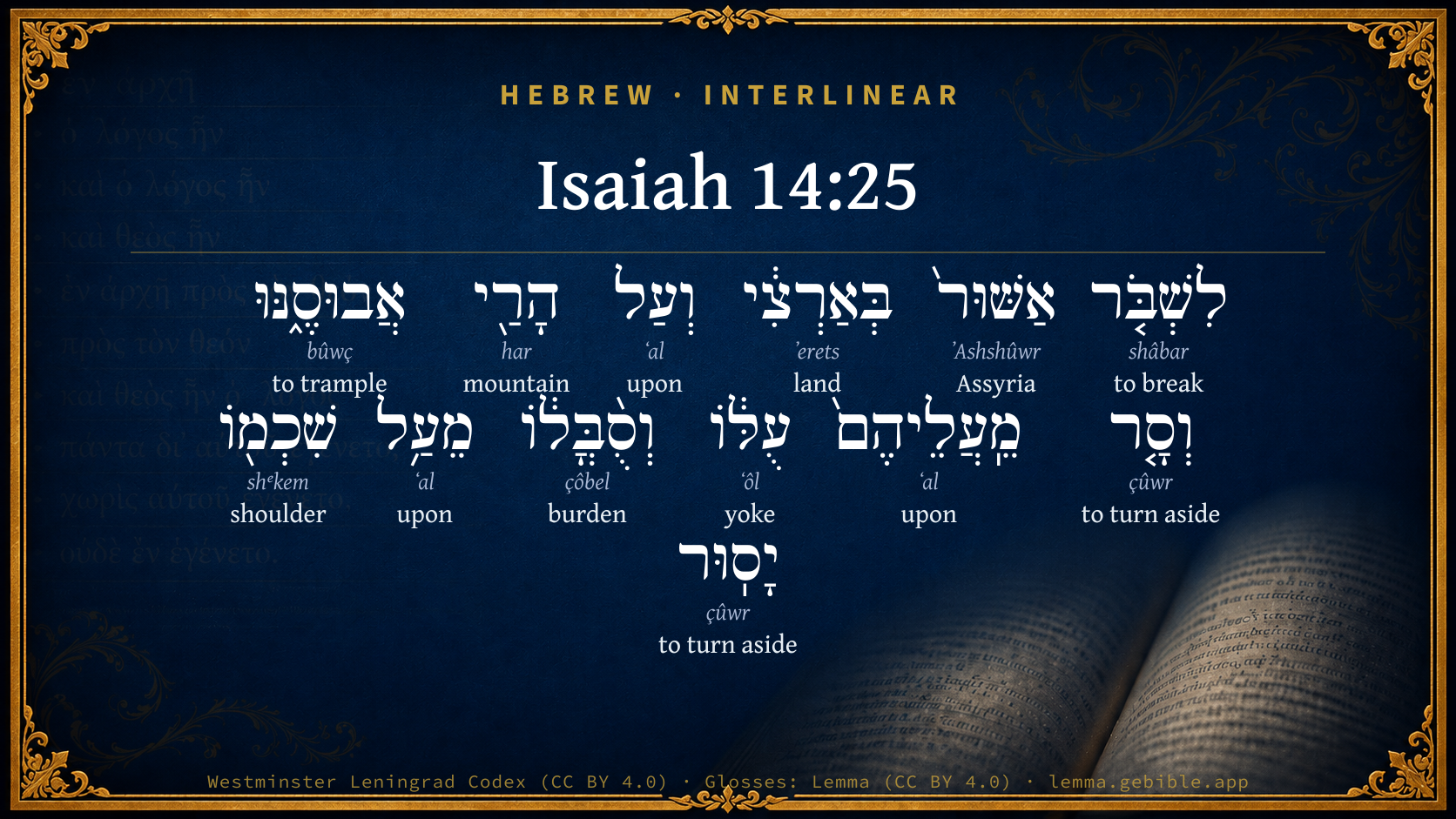
Hebrew (Westminster Leningrad Codex) Isaiah 14:25 appears in the Hebrew Old Testament. The text above is from the Westminster Leningrad Codex. Each word links to its Strong’s number, a concise gloss, and parsing drawn from the Open Scriptures Hebrew Bible morphology. Click any word for its full Brown-Driver-Briggs (BDB) entry.
Download image
Cite this verse

Isaiah 14:25 (World English Bible). Public Domain. Lemma interlinear Bible study tool, https://lemma.gebible.app/v/isaiah/14/25.

Show BibTeX & RIS
BibTeX
RIS
English Translation
that I will break the Assyrian in my land, and on my mountains tread him under foot: then shall his yoke depart from off them, and his burden depart from off their shoulder.
World English Bible · Public Domain
Download a study sheet

One document with this verse’s original text, its word-by-word gloss line, the meaning frame, cross-references with their text, attributed commentary, and full source and license credits — printable, and it pastes into notes with its structure intact.

This verse Autodidact and up

Study sheet (.html) Plain text (.txt)

A passage Seminary Student

Up to 50 verses in one chapter. A passage sheet keeps up to 6 commentary sources and 12 cross-references per verse, in the order this page ranks them, and says so on the sheet whenever that leaves anything out. Ask for a single verse and you get the Autodidact verse sheet above.

Everything on this page stays free to read, with no account — the sheet is a download of what is already on screen, not access to it.

Want to remove ads? Support Godless Engineer
Compare translations 3

The same verse in 3 English versions, stacked beneath the original-language interlinear above. Click any original word for its lexicon entry.

Each is an independent rendering of the whole verse — the interlinear is not word-aligned to these translations.

Highlighted words mark where these versions differ — a whole-verse word diff, not a word-by-word alignment.

  • World English Bible Public Domain
    that I will break the Assyrian in my land, and on my mountains tread him under foot: then shall his yoke depart from off them, and his burden depart from off their shoulder.
  • King James Version Public Domain
    That I will break the Assyrian in my land, and upon my mountains tread him under foot: then shall his yoke depart from off them, and his burden depart from off their shoulders.
  • unfoldingWord Literal Text CC BY-SA 4.0
    to break Assyria in my land, and I will trample him on my mountains. And his yoke will turn aside from upon them, and his burden will turn aside from upon their shoulder.”

unfoldingWord Literal Text — © unfoldingWord, licensed CC BY-SA 4.0. Word-aligned USFM3 via Door43 (git.door43.org/unfoldingWord/en_ult).

Versions to compare (up to 4)

3 of 4 selected

Show all 18 translations

Every available English version of this verse, each an independent rendering of the whole verse.

  • World English Bible Public Domain
    that I will break the Assyrian in my land, and on my mountains tread him under foot: then shall his yoke depart from off them, and his burden depart from off their shoulder.
  • Berean Standard Bible Public Domain
    I will break Assyria in My land; I will trample him on My mountain. His yoke will be taken off My people, and his burden removed from their shoulders.”
  • Majority Standard Bible Public Domain
    I will break Assyria in My land; I will trample him on My mountain. His yoke will be taken off My people, and his burden removed from their shoulders.”
  • King James Version Public Domain
    That I will break the Assyrian in my land, and upon my mountains tread him under foot: then shall his yoke depart from off them, and his burden depart from off their shoulders.
  • American Standard Version (1901) Public Domain
    that I will break the Assyrian in my land, and upon my mountains tread him under foot: then shall his yoke depart from off them, and his burden depart from off their shoulder.
  • Revised Version (1885) Public Domain
    that I will break the Assyrian in my land, and upon my mountains tread him under foot: then shall his yoke depart from off them, and his burden depart from off their shoulder.
  • Geneva Bible (1599) Public Domain
    That I will breake to pieces Asshur in my land, and vpon my mountaines will I treade him vnder foote: so that his yoke shall depart from them, and his burden shall be taken from off their shoulder.
  • Douay-Rheims (1899) Public Domain
    So shall it fall out: That I will destroy the Assyrian in my land, and upon my mountains tread him under foot: and his yoke shall be taken away from them, and his burden shall be taken off their shoulder.
  • Young's Literal Translation Public Domain
    To break Asshur in My land, And on My mountains I tread him down, And turned from off them hath his yoke, Yea, his burden from off their shoulder turneth aside.
  • Literal Standard Version CC BY-SA 4.0
    To break Asshur in My land, || And I tread him down on My mountain, || And his yoke has turned from off them, || Indeed, his burden turns aside from off their shoulder.
  • Unlocked Literal Bible CC BY-SA 4.0
    I will break the Assyrian in my land, and on my mountains trample him underfoot. Then his yoke will be lifted from off them and his burden from off their shoulder.” Then his yoke will be lifted from off them and his burden from off their shoulder.”
  • unfoldingWord Literal Text CC BY-SA 4.0
    to break Assyria in my land, and I will trample him on my mountains. And his yoke will turn aside from upon them, and his burden will turn aside from upon their shoulder.”
  • Darby Bible Public Domain
    to break the Assyrian in my land; and upon my mountains will I tread him under foot; and his yoke shall depart from off them, and his burden depart from off their shoulders.
  • World Messianic Bible Public Domain
    that I will break the Assyrian in my land, and tread him under foot on my mountains. Then his yoke will leave them, and his burden leave their shoulders.
  • Webster's Bible Public Domain
    That I will break the Assyrian in my land, and upon my mountains tread him under foot: then shall his yoke depart from off them, and his burden depart from off their shoulders.
  • Free Bible Version CC BY-SA 4.0
    I will smash the Assyrians when they are in my country Israel; I will trample them underfoot on my mountains. I will remove their yoke from my people, and take away the burdens they place on my people's shoulders.
  • Bible in Basic English Public Domain
    To let the Assyrian be broken in my land, and crushed under foot on my mountains: there will his yoke be taken away from them, and his rule over them come to an end.
  • JPS Tanakh (1917) Public Domain
    That I will break Asshur in My land, and upon My mountains tread him under foot; then shall his yoke depart from off them, and his burden depart from off their shoulder.

Literal Standard Version (2020), Covenant Press — licensed CC BY-SA 4.0. Text via the HelloAO Bible API (eBible.org). Unlocked Literal Bible (unfoldingWord) — licensed CC BY-SA 4.0. Text via the HelloAO Bible API (eBible.org). unfoldingWord Literal Text — © unfoldingWord, licensed CC BY-SA 4.0. Word-aligned USFM3 via Door43 (git.door43.org/unfoldingWord/en_ult). Free Bible Version, Dr. Jonathan Gallagher — licensed CC BY-SA 4.0. Text via the HelloAO Bible API (eBible.org).

Word by word

More ways to search: Search by grammar → Find every occurrence → Compare this word →

Practice this passage: Drill this verse → Learn its vocabulary →

וְסֻ֨בֳּל֔וֹ
çôbel
H5448
“and · burden · his”
Conjunction + Noun, Common, Masculine, Singular, Construct + Suffix, Personal, 3rd Person, Masculine, Singular
Part of Speech
Conjunction + Noun
Type
Common
Gender
Masculine
Number
Singular
State
Construct
Full BDB Definition

Origin: from H5445

TWOT: 1458a

burden, load
  1. לִשְׁבֹּ֤ר shâbar H7665 “to break” Preposition + Verb, Qal, Infinitive Construct
  2. אַשּׁוּר֙ ʼAshshûwr H804 “Assyria” Noun, Proper
  3. בְּאַרְצִ֔י ʼerets H776 “in/at · land · my” Preposition + Noun, Common, Both, Singular, Construct + Suffix, Personal, 1st Person, Common, Singular
  4. וְעַל ʻal H5921 “and · upon” Conjunction + Preposition
  5. הָרַ֖י har H2022 “mountains · my” Noun, Common, Masculine, Plural, Construct + Suffix, Personal, 1st Person, Common, Singular
  6. אֲבוּסֶ֑נּוּ bûwç H947 “to trample · him” Verb, Qal, Imperfect, 1st Person, Common, Singular + Suffix, Personal, 3rd Person, Masculine, Singular
  7. וְסָ֤ר çûwr H5493 “and · to turn aside” Conjunction + Verb, Qal, Sequential Perfect, 3rd Person, Masculine, Singular
  8. מֵֽעֲלֵיהֶם֙ ʻal H5921 “from · upon · them” Preposition + Preposition + Suffix, Personal, 3rd Person, Masculine, Plural
  9. עֻלּ֔וֹ ʻôl H5923 “yoke · his” Noun, Common, Masculine, Singular, Construct + Suffix, Personal, 3rd Person, Masculine, Singular
  10. מֵעַ֥ל ʻal H5921 “from · upon” Preposition + Preposition
  11. שִׁכְמ֖וֹ shᵉkem H7926 “shoulder · his” Noun, Common, Masculine, Singular, Construct + Suffix, Personal, 3rd Person, Masculine, Singular
  12. יָסֽוּר çûwr H5493 “to turn aside” Verb, Qal, Imperfect, 3rd Person, Masculine, Singular

About this verse

These counts appear in no published source. They are computed here, from the morphology-tagged text and Lemma’s own curated glosses. What Lemma adds →

13
words
10
distinct lemmas
Prophets
section

Notable vocabulary

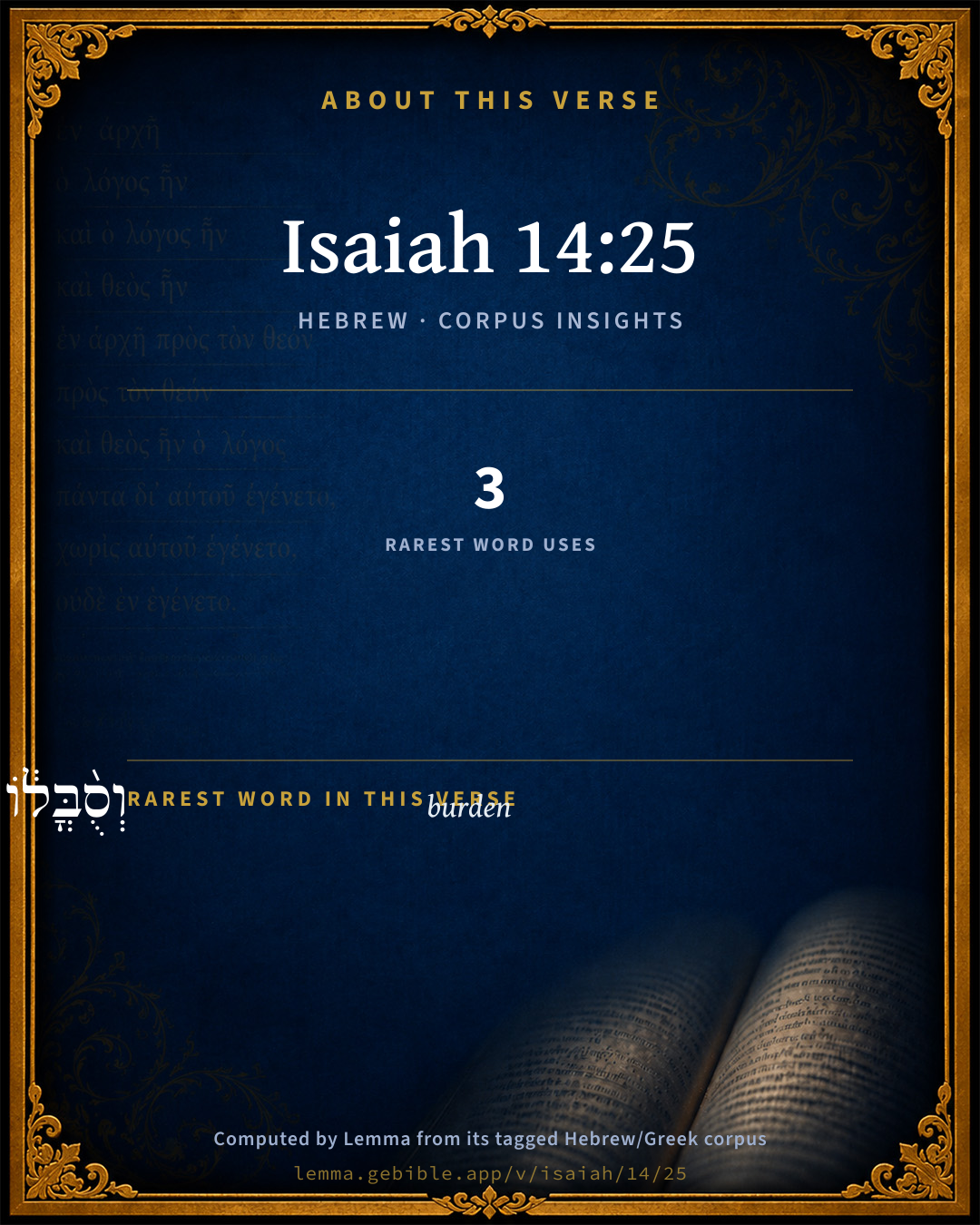
The rarest word here is וְסֻ֨בֳּל֔וֹ burden H5448 — appearing just 3 times in the whole Hebrew Bible.

Shared distinctive vocabulary

וְסֻ֨בֳּל֔וֹ burden H5448 occurs in 3 verses of the Hebrew Bible. Also found in:

Grammatical profile

  • 4 verbs
  • 6 nouns
  • 3 prepositions

Verb forms

  • לִשְׁבֹּ֤ר Qal · Infinitive Construct
  • אֲבוּסֶ֑נּוּ Qal · Imperfect
  • וְסָ֤ר Qal · Sequential Perfect
  • יָסֽוּר Qal · Imperfect

Repetition

Words recur within this verse — often emphatic in Hebrew:

  • וְעַל upon H5921 ×3
  • וְסָ֤ר to turn aside H5493 ×2

Hebrew & Septuagint length

In English translation the verse runs 33 words from the Hebrew and 37 from the Septuagint (LXX English) — closely comparable.

A rough comparison of the two English renderings, which tokenize alike — not a word-level alignment.

Word counts can differ between the Hebrew and the Greek without any difference in meaning — e.g. the Hebrew direct-object marker אֵת has no separate Greek word, and Greek often adds the article ὁ.

Cross-references

12

Topical passages linked to Isaiah 14:25 in the Treasury of Scripture Knowledge — connected by theme and wording, ordered by reader-vote popularity; previews shown in the World English Bible.

  • Isaiah 9:4 For the yoke of his burden, and the staff of his shoulder, the rod of his oppressor, you have broken as in the day of Midian.
  • Isaiah 37:36–38 The angel of Yahweh went forth, and struck in the camp of the Assyrians one hundred and eighty-five thousand; and when men arose early in the morning, behold, these were all dead bodies.
  • Nahum 1:13 Now will I break his yoke from off you, and will burst your bonds apart."
  • Isaiah 10:12 Therefore it shall happen that, when the Lord has performed his whole work on Mount Zion and on Jerusalem, I will punish the fruit of the stout heart of the king of Assyria, and the glory of his high looks.
  • Isaiah 10:16–19 Therefore will the Lord, Yahweh of Hosts, send among his fat ones leanness; and under his glory there shall be kindled a burning like the burning of fire.
  • Isaiah 10:32–34 This very day shall he halt at Nob: he shakes his hand at the mountain of the daughter of Zion, the hill of Jerusalem.
  • Isaiah 14:5 Yahweh has broken the staff of the wicked, the scepter of the rulers;
  • Isaiah 30:30–33 Yahweh will cause his glorious voice to be heard, and will show the lighting down of his arm, with the indignation of [his] anger, and the flame of a devouring fire, with a blast, and tempest, and hailstones.
  • Isaiah 10:24–27 Therefore thus says the Lord, Yahweh of Hosts, my people who dwell in Zion, don't be afraid of the Assyrian, though he strike you with the rod, and lift up his staff against you, after the manner of Egypt.
  • Isaiah 17:12–14 Ah, the uproar of many peoples, who roar like the roaring of the seas; and the rushing of nations, that rush like the rushing of mighty waters!
  • Isaiah 31:8–9 The Assyrian shall fall by the sword, not of man; and the sword, not of men, shall devour him; and he shall flee from the sword, and his young men shall become subject to forced labor.
  • Ezekiel 39:4 You shall fall on the mountains of Israel, you, and all your hordes, and the peoples who are with you: I will give you to the ravenous birds of every sort, and to the animals of the field to be devoured.

Cross-references courtesy of OpenBible.info (CC BY 4.0).

Hebrew and Greek witnesses Masoretic Hebrew ↔ Greek Septuagint

The same verse in the two great witnesses to the Old Testament, shown verse-for-verse.

These are two independent witnesses, not word-aligned to each other, and the Septuagint is shown in lemma (dictionary) form.

Hebrew Isaiah 14:25 Masoretic · Westminster Leningrad Codex

לִשְׁבֹּ֤ר אַשּׁוּר֙ בְּאַרְצִ֔י וְעַל הָרַ֖י אֲבוּסֶ֑נּוּ וְסָ֤ר מֵֽעֲלֵיהֶם֙ עֻלּ֔וֹ וְסֻ֨בֳּל֔וֹ מֵעַ֥ל שִׁכְמ֖וֹ יָסֽוּר

that I will break the Assyrian in my land, and on my mountains tread him under foot: then shall his yoke depart from off them, and his burden depart from off their shoulder.

World English Bible · Public Domain

Greek LXX Isaiah 14:25 Septuagint · lemma form

ὁ ἀποὀλλύω ὁ ἀσσύριος ἀπό ὁ γῆ ὁ ἐμός καί ἀπό ὁ ὄρος ἐγώ καί εἰμί εἰς καταπάτημα καί ἀποαἱρέω ἀπό αὐτός ὁ ζυγός αὐτός καί ὁ κῦδος αὐτός ἀπό ὁ ὦμος ἀποαἱρέω

even to destroy the Assyrians upon my land, and upon my mountains: and they shall be for trampling; and their yoke shall be taken away from them, and their glory shall be taken away from their shoulders.

LXX2012 (modern English Septuagint) · Public Domain

Hebrew: Westminster Leningrad Codex (CC BY 4.0). Greek: Septuagint (public domain); English from LXX2012 (modern English Septuagint) (Public Domain). How the Septuagint differs from the Hebrew →

Targum (Aramaic paraphrase)

1

The Targum is the ancient Jewish Aramaic paraphrase of the Hebrew Scriptures — an interpretive translation, not the Hebrew text itself. Onkelos (literal) and Pseudo-Jonathan (expansive) render the Torah, and Jonathan the Prophets. Coverage is partial: where no permissively-licensed English translation exists for a verse, only the Aramaic is shown. This is verse-level text, not a word-by-word alignment to the Hebrew.

  1. Targum Jonathan Prophets (Joshua–Malachi)
    לְמִתְבַּר אַתּוּרָאָה בְּאַרְעִי וְעַל טוּרֵי עַמִי אַדוֹשְׁשִׁינֵיהּ וְתֶעְדֵי מִנְהוֹן מַרְוָתֵיהּ וְנִירֵיהּ מֵעַל צַוְרֵיהוֹן יִתְפְּסַק:

    To break the Assyrian in my land, and upon the mountains of my people I will tread him under foot; then there shall depart from them his dominion, and his yoke off from their necks shall cease.

    Targum Jonathan — Aramaic: “Mikraot Gedolot” (public domain). English: “Sefaria Community Translation” (CC0 1.0 (public-domain dedication)); “London "Chaldee Paraphrase," 1871” (public domain). Text via Sefaria.

Commentary

Notes on Isaiah 14:25 from classic Christian and Jewish commentators (each source and its license shown beneath its notes). The classic Christian expositions comment on the surrounding passage and are grouped to its opening verse, so a note may address several verses; the Jewish commentaries on the Tanakh (Rashi and others) are per-verse, so they appear only where the commentator wrote on this verse.

Lemma curates 59 commentaries, every one of them public domain or Creative Commons licensed, each selected and text-cleaned for this edition rather than reprinted as found. About our sources →

Trapp's Complete Commentary

John Trapp

Isa 14:25 That I will break the Assyrian in my land, and upon my mountains tread him under foot: then shall his yoke depart from off them, and his burden depart from off their shoulders.

Ver. 25. That I will break the Assyrian in my Land.] Or, As in breaking the Assyrian in my land; for here, saith Junius, the overthrow of the Assyrian monarchy, which should shortly be, is given for a sign of the overthrow of the Babylonian.

John Trapp, A Commentary or Exposition upon All the Books of the Old and New Testament (1647–1656) — public domain. Text from a community e-Sword module.

Tyndale Open Study Notes

Tyndale Open Resources

14:25 This prophecy told what would happen when Sennacherib attacked Hezekiah some years later in 701 BC (see chs 36–37).

Tyndale Open Study Notes — © Tyndale Open Resources, licensed CC BY-SA 4.0. Text via the HelloAO Bible API.

Geneva Bible (1599)

Geneva Bible translators

From the Jews.

As I have begun to destroy the Assyrians in Sennacherib: so will I continue, and destroy them wholly, when I shall deliver you from Babylon.

Geneva Bible (1599) marginal notes — public domain. Text via Bolls.life.

Jamieson, Fausset & Brown

Robert Jamieson, A. R. Fausset & David Brown

That--My purpose, namely, "that."

break . . . yoke-- (Isa 10:27).

my mountains--Sennacherib's army was destroyed on the mountains near Jerusalem (Isa 10:33-34). God regarded Judah as peculiarly His.

Jamieson, Fausset & Brown — Commentary Critical and Explanatory on the Whole Bible (1871) — public domain (CC PDM 1.0). Text via the HelloAO Bible API.

Adam Clarke's Commentary

Verse 25. I will break the Assyrian - upon my mountains - "To crush the Assyrian - on my mountains"] The Assyrians and Babylonians are the same people, Herod. i. 199, 200. Babylon is reckoned the principal city in Assyria, ibid. 178. Strabo says the same thing, lib. xvi. sub init. The circumstance of this judgment being to be executed on God's mountains is of importance; it may mean the destruction of Sennacherib's army near Jerusalem, and have a still farther view: compare Eze 39:4; and see Lowth on this place of Isaiah.

Adam Clarke's Commentary on the Bible (1810–1826) — public domain. Text from a community e-Sword/MySword module.

Ellicott's Commentary for English Readers

(25) That I will break the Assyrian in my land . . .—The words found their fulfilment in the destruction of Sennacherib’s army. The “mountains” are the hills round Jerusalem on which the army of the Assyrians was encamped. They were sacred, as the phrase, “my mountains,” shows, to Jehovah (comp. Isa_49:11; Isa_65:9; Zec_14:5), and He, therefore, would put forth His power to rescue them from the proud invader.

A Bible Commentary for English Readers, edited by Charles John Ellicott (1878–1897) — public domain. Text from a community e-Sword module.

The Cambridge Bible for Schools and Colleges

gen. ed. J. J. S. Perowne

25. my mountains] i.e. the mountain land of Palestine.

then shall his yoke depart …] See ch. Isa_9:4, Isa_10:27.

The Cambridge Bible for Schools and Colleges (gen. ed. J. J. S. Perowne; Cambridge University Press, 1878–1918) — public domain. Text from a community e-Sword module.

John Gill's Exposition

That I will break the Assyrian in my land,.... This was his thought, counsel, purpose, and decree; which must be understood either of the king of Babylon, as before, called the Assyrian; as the king of Babylon seems to be called the king of Assyria in Ch2 33:11, but then his destruction was not in the land of Israel, or on the mountains of Judea, as is here predicted; or rather, therefore, this is a new prophecy, or a return to what is foretold in the tenth chapter Isa 10:1 concerning Sennacherib and his army, and the destruction of it; which, coming to pass long before the destruction of Babylon, is mentioned for the comfort of God's people, as a pledge and assurance of the latter: though some think that it was now past, and is observed to strengthen the faith of the Jews, with respect to the preceding prediction, and read the words thus, as "in breaking the Assyrian in my land"; and then the sense is, what I have thought, purposed, and sworn to, to come to pass, concerning the fall of Babylon, shall as surely be accomplished, and you may depend upon it, as I have broke the Assyrian army in my land before your eyes, of which ye yourselves are witnesses. Some think that Gog and Magog are intended by the Assyrian, of whom it is predicted that they should fall upon the mountains of Israel, as here, Eze 39:4 it may be, that as the king of Babylon was a type of the Romish antichrist in the preceding prophecy, the Assyrian here may represent the Turks, who now possess the land of Israel, and shall be destroyed:

and upon my mountains tread him under foot; the mountainous part of Judea, particularly the mountains which were round about Jerusalem, where the Assyrian army under Sennacherib was, when besieged by him, and where they fell and were trodden under foot; and now the Lord may be said to break the Assyrian troops, and trample upon them, because it was not only done according to his will, but without the use of men, by an angel that was sent immediately from heaven, and destroyed the whole host, Kg2 19:35,

there shall his yoke depart from off them, and his burden depart from off their shoulders: meaning, that hereby the siege of Jerusalem would be broken up, and the city rid of such a troublesome enemy; and the parts adjacent eased of the burden of having such a numerous army quartered upon them; and the whole land freed from the subjection of this monarch, and from paying tribute to him. The same is said in Isa 10:27. This, in the Talmud (m), is interpreted of Sennacherib.

(m) T. Bab. Sanhedrin, fol. 94. 2.

John Gill's Exposition of the Whole Bible (1746–1763) — public domain (CC PDM 1.0). Text via the HelloAO Bible API.

Albert Barnes' Notes on the Bible

That I will break - That I will break his power; that I will discomfit and destroy his army.

The Assyrian - Sennacherib (see Isa. 10.)

In my land - That is, in the land of Canaan. This is often called his land; and this expression shows that the passage does not and cannot refer to the king of Babylon, for he was destroyed in his own city Dan. 5)

And upon my mountains - That is, upon the mountains of Palestine. The army of Sennacherib was destroyed on the mountains that were near to Jerusalem (see the notes at Isa 10:33-34).

Then shall his yoke - The yoke of the Assyrian (see the note at Isa 10:27).

Albert Barnes' Notes on the Bible (1834–1885) — public domain. Text from a community e-Sword/MySword module.

Haydock's Catholic Bible Commentary

Assyrian. 4 Kings xix. (Worthington) --- Sennacherib, (St. Jerome) Cambyses, or Holofernes. The sight of their chastisement would ben an earnest of the fall of Babylon. (Calmet) --- The allies of Assyria, (Menochius) or the enemies of God’s people, will also be punished, chap. xv. (Haydock)

George Leo Haydock (1774–1849), Haydock's Catholic Family Bible and Commentary, 1859 edition — public domain. Excludes Psalms (Douay-Rheims chapter numbering differs from Protestant) and Deuterocanonical books (Catholic canon only).

Matthew Poole's English Annotations

The Assyrian; Sennacherib, and his Assyrian army. In my land; in Judea, which is my land in a peculiar manner, being chosen by me, and consecrated to my use and service, and inhabited by my people.

Upon my mountains; in my mountainous country, for such Judea was, Deu 8:9; Psa 133:3; Eze 6:2,3; 39:2,4,17, especially about Jerusalem, Psa 125:2, upon some of which probably his army was lodged.

Then shall his yoke depart from off them, and his burden depart from off their shoulders; which words are repeated from Isa 10:27, where they are explained.

Matthew Poole's English Annotations on the Holy Bible (1683–1685) — public domain. Text from a community e-Sword/MySword module.

The Pulpit Commentary

I will break the Assyrian in my land. This is referred by some critics to the miraculous destruction of Sennacherib"s army, and regarded as a proof that the scene, of that destruction was Judaea. But it is possible that a disaster to the forces of Sargon may be intended. (see the comment on Isa_10:28-32) His yoke shall depart from off them. (Jer_1:2-3) and a check received by either caused world-wide disturbance. No sooner did one subject nation recover her freedom, than an electric shock ran through all the rest plots were laid, confederacies formed, revolts planned, embassies sent hither and thither. The complete destruction of Assyria involved a complete change in the relations, not only of the principal powers Egypt, Assyria, Babylonia, Media, Elam, but even of the minor ones Philistia, Edom, Moab, Syria, Phoenicia, Ammon.

The Pulpit Commentary (1880–1919), ed. H.D.M. Spence-Jones & Joseph S. Exell — public domain. Text from a community e-Sword module.

John Wesley's Explanatory Notes

My land - In Judea, which is my land in a peculiar manner. Mountains - In my mountainous country, for such Judea was, especially about Jerusalem.

John Wesley, Explanatory Notes Upon the Whole Bible (1754–1765) — public domain. Text via the GEBible commentary corpus.

J. A. Alexander on Isaiah

Joseph Addison Alexander

He now declares what the purpose is, which is so certainly to be accomplished, namely, God’s determination to “break Assyria (or the Assyrian) in my land, and on my mountains I will trample him; and his yoke shall depart from off them, and his burden from of his back (or shoulder) shall depart.” My mountains some have understood to be Mount Zion, others more generally the mountains of Jerusalem; but it seems to be rather a description of the whole land of Israel, or at least of Judah, as a mountainous region. (See Eze 38:21; Eze 39:2; Eze 39:4).

Joseph Addison Alexander, The Prophecies of Isaiah (1846–1847; New York: Scribner, 1870–1878) — public domain. Text from a community e-Sword module.

Rashi

Rabbi Shlomo Yitzchaki (Rashi)

To break Assyria in My land And with this you shall know that what I planned about you will remain as well.

“To break...” is connected to “As I thought, so it was.”

will I trample him Heb. אֲבוּסֶנוּ, which I said to tread upon him and trample him.

Rashi on the Tanakh — English translations: “The Judaica Press complete Tanach with Rashi, translated by A. J. Rosenberg” (CC BY 4.0); “Pentateuch with Rashi's commentary by M. Rosenbaum and A.M. Silbermann, 1929-1934” (public domain); “The Metsudah Tanach series, Lakewood, N.J” (CC BY 4.0); and “The Book of Joshua, Metsudah Publications, 1997” (CC BY 4.0). Text via Sefaria.

Ibn Ezra

Rabbi Abraham ibn Ezra

As I have thought to break Assyria in my land, that is, in Jerusalem, where His residence is.

From them. From my land and from my mountains.

Ibn Ezra on the Tanakh — English translations: “Sefaria Community Translation” (CC0 1.0 (public-domain dedication)); “Yalkut, Sifsei Chachomim Chumash, Metsudah Publications, 2009” (CC BY 4.0); and “Commentary of Ibn Ezra on Isaiah - trans. by M. Friedlander, 1873” (public domain). Text via Sefaria.

Lesson kit

Teaching starters — assembled from the data on this page, not authored interpretation. Every prompt links to the verse data it draws on. Edit before teaching.

Isaiah, in the Prophets, opens this verse with 13 words (10 distinct Hebrew lemmas). Its most distinctive word is çôbel (“burden”). A historical commentator’s framing appears above. Read the whole chapter for the surrounding context.

Discussion questions

  1. How does “burden” (çôbel) shape what this verse is saying?
  2. How does Isaiah 9:4, which shares the word «burden», read alongside this verse?
  3. What does the repetition of “upon” (3× in this one verse) do in this verse?
  4. The translations on this page render this verse differently — a whole-verse word diff, not a word-by-word alignment. What might account for the different wordings?
  5. «לִשְׁבֹּ֤ר» is a Qal Infinitive Construct verb. How does that grammatical form shape the action described?
  6. Compare how Trapp's Complete Commentary and Tyndale Open Study Notes read this verse. Where do they agree or differ?

Things to notice

Reading settings

Reading text

Shown beneath each verse's original-language words.

Old Testament
Old Testament edition

Read the OT as the Masoretic Hebrew (MT) or the Greek Septuagint (LXX).

English shown for the Greek Septuagint (in the Hebrew ↔ Greek comparison).

Comparing translations? Open the Compare panel on any verse page to stack up to four side by side.