
Proverbs 13:14

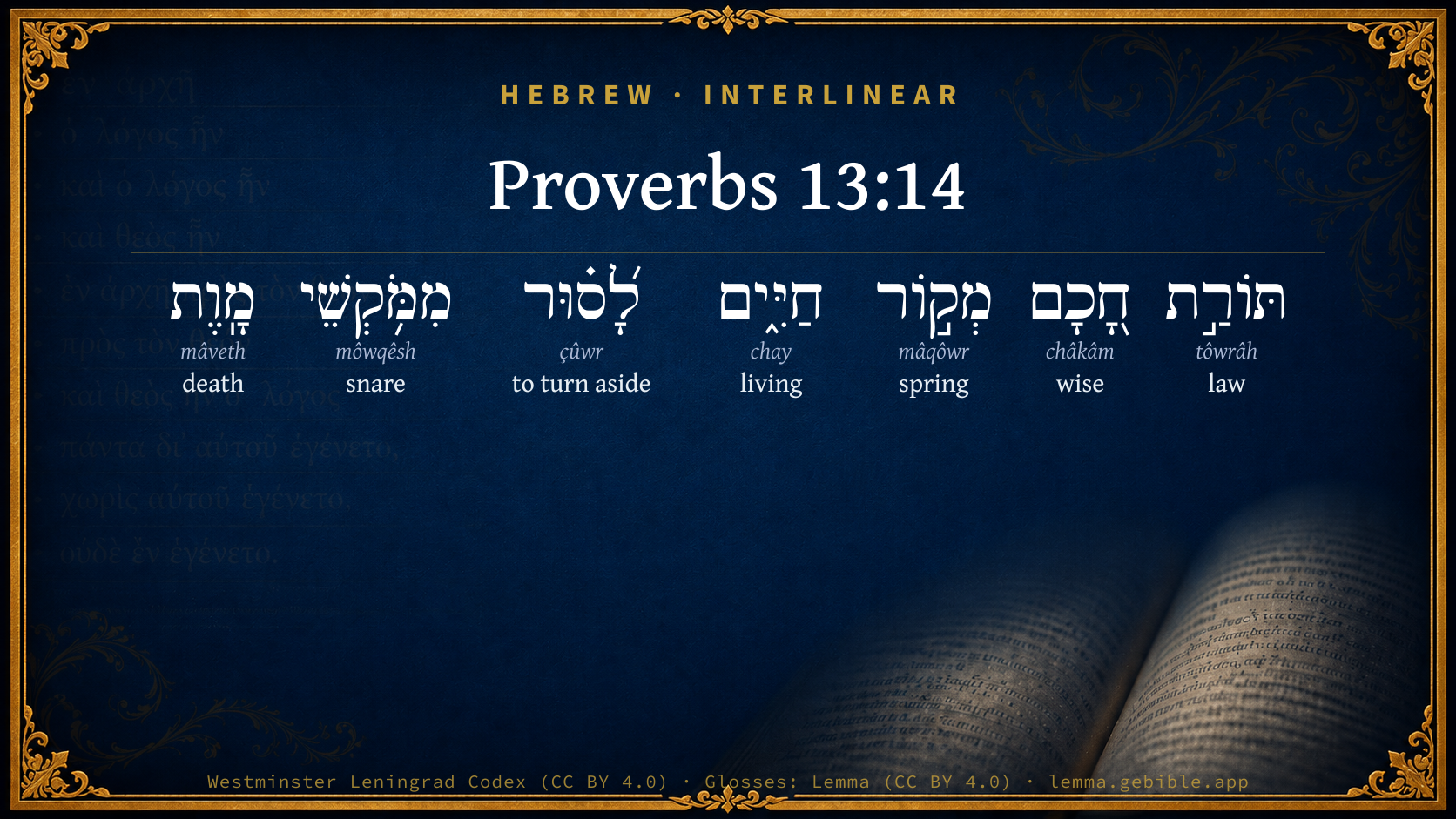
Hebrew (Westminster Leningrad Codex) Proverbs 13:14 appears in the Hebrew Old Testament. The text above is from the Westminster Leningrad Codex. Each word links to its Strong’s number, a concise gloss, and parsing drawn from the Open Scriptures Hebrew Bible morphology. Click any word for its full Brown-Driver-Briggs (BDB) entry.
Download image
Cite this verse

Proverbs 13:14 (World English Bible). Public Domain. Lemma interlinear Bible study tool, https://lemma.gebible.app/v/proverbs/13/14.

Show BibTeX & RIS
BibTeX
RIS
English Translation
The teaching of the wise is a spring of life, To turn from the snares of death.
World English Bible · Public Domain
Download a study sheet

One document with this verse’s original text, its word-by-word gloss line, the meaning frame, cross-references with their text, attributed commentary, and full source and license credits — printable, and it pastes into notes with its structure intact.

This verse Autodidact and up

Study sheet (.html) Plain text (.txt)

A passage Seminary Student

Up to 50 verses in one chapter. A passage sheet keeps up to 6 commentary sources and 12 cross-references per verse, in the order this page ranks them, and says so on the sheet whenever that leaves anything out. Ask for a single verse and you get the Autodidact verse sheet above.

Everything on this page stays free to read, with no account — the sheet is a download of what is already on screen, not access to it.

Want to remove ads? Support Godless Engineer
Compare translations 3

The same verse in 3 English versions, stacked beneath the original-language interlinear above. Click any original word for its lexicon entry.

Each is an independent rendering of the whole verse — the interlinear is not word-aligned to these translations.

Highlighted words mark where these versions differ — a whole-verse word diff, not a word-by-word alignment.

  • World English Bible Public Domain
    The teaching of the wise is a spring of life, To turn from the snares of death.
  • King James Version Public Domain
    The law of the wise is a fountain of life, to depart from the snares of death.
  • unfoldingWord Literal Text CC BY-SA 4.0
    The law of the wise a fountain of life, to turn away from the snares of death.

unfoldingWord Literal Text — © unfoldingWord, licensed CC BY-SA 4.0. Word-aligned USFM3 via Door43 (git.door43.org/unfoldingWord/en_ult).

Versions to compare (up to 4)

3 of 4 selected

Show all 18 translations

Every available English version of this verse, each an independent rendering of the whole verse.

  • World English Bible Public Domain
    The teaching of the wise is a spring of life, To turn from the snares of death.
  • Berean Standard Bible Public Domain
    The teaching of the wise is a fountain of life, turning one from the snares of death.
  • Majority Standard Bible Public Domain
    The teaching of the wise is a fountain of life, turning one from the snares of death.
  • King James Version Public Domain
    The law of the wise is a fountain of life, to depart from the snares of death.
  • American Standard Version (1901) Public Domain
    The law of the wise is a fountain of life, That one may depart from the snares of death.
  • Revised Version (1885) Public Domain
    The law of the wise is a fountain of life, to depart from the snares of death.
  • Geneva Bible (1599) Public Domain
    The instruction of a wise man is as the welspring of life, to turne away from the snares of death.
  • Douay-Rheims (1899) Public Domain
    The law of the wise is a fountain of life, that he may decline from the ruin of death.
  • Young's Literal Translation Public Domain
    The law of the wise `is' a fountain of life, To turn aside from snares of death.
  • Literal Standard Version CC BY-SA 4.0
    The law of the wise [is] a fountain of life, || To turn aside from snares of death.
  • Unlocked Literal Bible CC BY-SA 4.0
    The teaching of a wise person is a fountain of life, turning you away from the snares of death.
  • unfoldingWord Literal Text CC BY-SA 4.0
    The law of the wise a fountain of life, to turn away from the snares of death.
  • Darby Bible Public Domain
    The teaching of the wise [man] is a fountain of life, to turn away from the snares of death.
  • World Messianic Bible Public Domain
    The teaching of the wise is a spring of life, to turn from the snares of death.
  • Webster's Bible Public Domain
    The law of the wise is a fountain of life, to depart from the snares of death.
  • Free Bible Version CC BY-SA 4.0
    The teaching of the wise is like a fountain of life, so you can avoid the snares of death.
  • Bible in Basic English Public Domain
    The teaching of the wise is a fountain of life, turning men away from the nets of death.
  • JPS Tanakh (1917) Public Domain
    The teaching of the wise is a fountain of life, to depart from the snares of death.

Literal Standard Version (2020), Covenant Press — licensed CC BY-SA 4.0. Text via the HelloAO Bible API (eBible.org). Unlocked Literal Bible (unfoldingWord) — licensed CC BY-SA 4.0. Text via the HelloAO Bible API (eBible.org). unfoldingWord Literal Text — © unfoldingWord, licensed CC BY-SA 4.0. Word-aligned USFM3 via Door43 (git.door43.org/unfoldingWord/en_ult). Free Bible Version, Dr. Jonathan Gallagher — licensed CC BY-SA 4.0. Text via the HelloAO Bible API (eBible.org).

Word by word

More ways to search: Search by grammar → Find every occurrence → Compare this word →

Practice this passage: Drill this verse → Learn its vocabulary →

About this verse

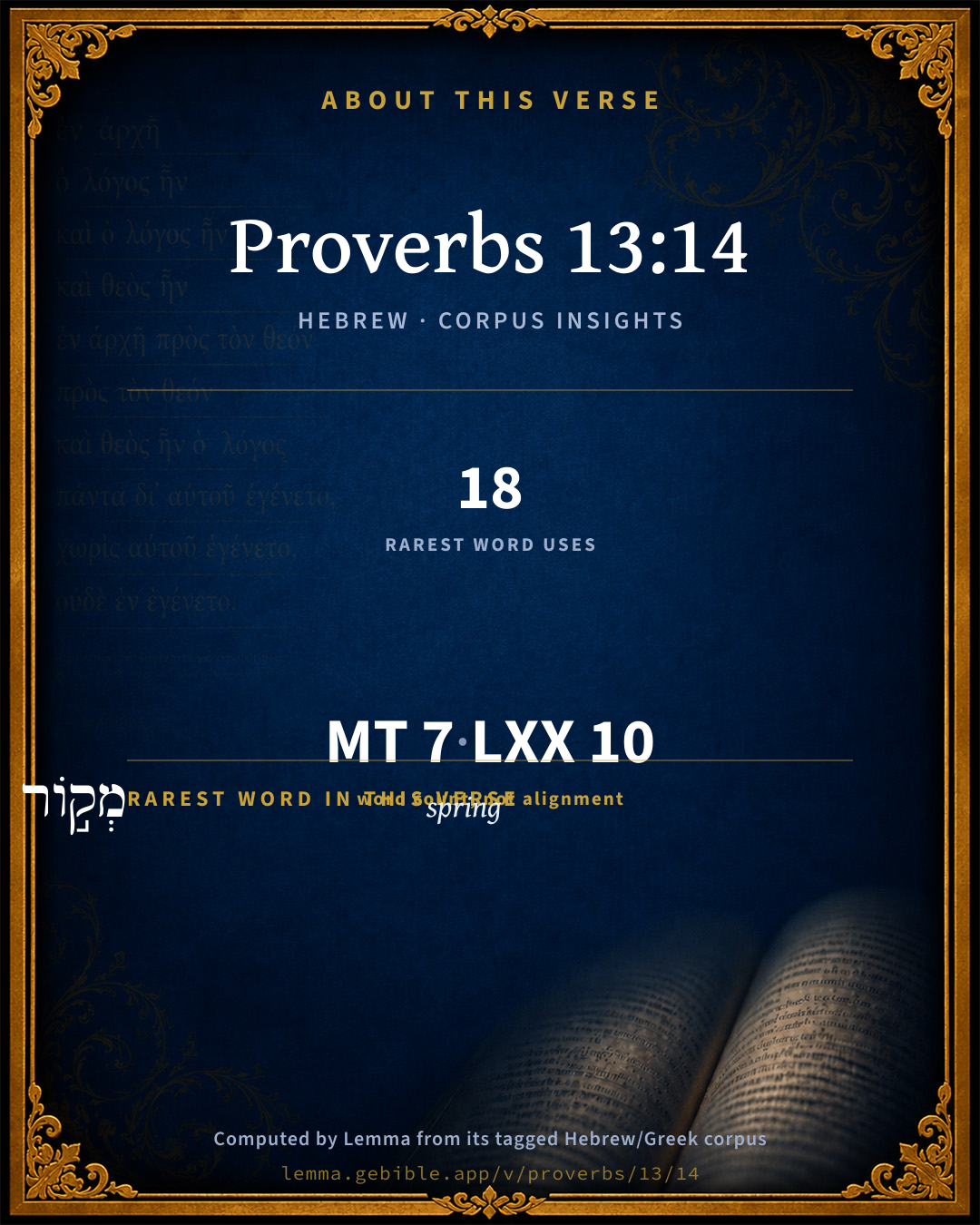
These counts appear in no published source. They are computed here, from the morphology-tagged text and Lemma’s own curated glosses. What Lemma adds →

7
words
7
distinct lemmas
Wisdom
section

Notable vocabulary

The rarest word here is מְק֣וֹר spring H4726 — appearing just 18 times in the whole Hebrew Bible.

Shared distinctive vocabulary

מְק֣וֹר spring H4726 occurs in 17 verses of the Hebrew Bible. Also found in:

Grammatical profile

  • 1 verb
  • 5 nouns
  • 1 adjective

Verb forms

  • לָ֝ס֗וּר Qal · Infinitive Construct

Hebrew & Septuagint length

In English translation the verse runs 17 words from the Hebrew and 20 from the Septuagint (LXX English) — closely comparable.

A rough comparison of the two English renderings, which tokenize alike — not a word-level alignment.

Word counts can differ between the Hebrew and the Greek without any difference in meaning — e.g. the Hebrew direct-object marker אֵת has no separate Greek word, and Greek often adds the article ὁ.

In the original languages it is 7 Hebrew tokens and 10 Greek tokens — but the two are counted differently (Hebrew bundles its prefixes and suffixes into one token; the Greek is in lemma form), so that isn’t a like-for-like length.

Cross-references

10

Topical passages linked to Proverbs 13:14 in the Treasury of Scripture Knowledge — connected by theme and wording, ordered by reader-vote popularity; previews shown in the World English Bible.

  • Proverbs 10:11 The mouth of the righteous is a spring of life, But violence covers the mouth of the wicked.
  • Proverbs 14:27 The fear of Yahweh is a fountain of life, Turning people from the snares of death.
  • Psalms 18:5 The cords of Sheol were round about me; The snares of death came on me.
  • 2 Samuel 22:6–7 The cords of Sheol were round about me; The snares of death came on me.
  • Psalms 116:3 The cords of death surrounded me, The pains of Sheol got a hold of me. I found trouble and sorrow.
  • Proverbs 16:6 By mercy and truth iniquity is atoned for. By the fear of Yahweh men depart from evil.
  • Proverbs 16:17 The highway of the upright is to depart from evil. He who keeps his way preserves his soul.
  • Proverbs 9:11 For by me your days will be multiplied. The years of your life will be increased.
  • Proverbs 15:24 The path of life leads upward for the wise, To keep him from going downward to Sheol.
  • Proverbs 16:22 Understanding is a fountain of life to one who has it, But the punishment of fools is their folly.

Cross-references courtesy of OpenBible.info (CC BY 4.0).

Hebrew and Greek witnesses Masoretic Hebrew ↔ Greek Septuagint

The same verse in the two great witnesses to the Old Testament, shown verse-for-verse.

These are two independent witnesses, not word-aligned to each other, and the Septuagint is shown in lemma (dictionary) form.

Hebrew Proverbs 13:14 Masoretic · Westminster Leningrad Codex

תּוֹרַ֣ת חָ֭כָם מְק֣וֹר חַיִּ֑ים לָ֝ס֗וּר מִמֹּ֥קְשֵׁי מָֽוֶת

The teaching of the wise is a spring of life, To turn from the snares of death.

World English Bible · Public Domain

Greek LXX Proverbs 13:14 Septuagint · lemma form

νόμος σοφός πηγή ζωή ὁ δέ ἄνους ὑπό παγίς θνήσκω

The law of the wise is fountain of life: but the man void of understanding shall die by a snare.

LXX2012 (modern English Septuagint) · Public Domain

On this verse, Haydock's Catholic Bible Commentary discusses the Septuagint’s reading. Read the note in Commentary ↓

Hebrew: Westminster Leningrad Codex (CC BY 4.0). Greek: Septuagint (public domain); English from LXX2012 (modern English Septuagint) (Public Domain). How the Septuagint differs from the Hebrew →

Commentary

Notes on Proverbs 13:14 from classic Christian and Jewish commentators (each source and its license shown beneath its notes). The classic Christian expositions comment on the surrounding passage and are grouped to its opening verse, so a note may address several verses; the Jewish commentaries on the Tanakh (Rashi and others) are per-verse, so they appear only where the commentator wrote on this verse.

Lemma curates 59 commentaries, every one of them public domain or Creative Commons licensed, each selected and text-cleaned for this edition rather than reprinted as found. About our sources →

Trapp's Complete Commentary

John Trapp

Pro 13:14 The law of the wise [is] a fountain of life, to depart from the snares of death.

Ver. 14. The law of the wise is as a well of life.] Or, The law to the wise is a fountain, &c., whence he may draw the best directions and helps to holiness and happiness. It confines him to live in that element where he would live - as if one were confined to paradise, where he would be - though there were no such law. The wicked, on the contrary, leaps over the pale after profit and pleasure, and falls upon the snares of death, as Shimei sought his servants and lost himself.

John Trapp, A Commentary or Exposition upon All the Books of the Old and New Testament (1647–1656) — public domain. Text from a community e-Sword module.

The Biblical Illustrator

Joseph S. Exell

Pro_13:14

The law of the wise is a fountain of life.

The law of the good

I. The good are ruled by law--The law of the wise. What is law? The clearest and most general idea I have of it is--rule of motion. In this sense all things are under law, for all things are in motion. The material universe is in motion, and there is the law that regulates it. The spiritual universe is in motion, and law presides over it. Of law, says Hooker, there can be no less acknowledged than that her seat is the bosom of God, her voice the harmony of the world. All things do her homage, the very least as feeling her care, and the greatest as not exempted from her power; both angels and men, and creatures of what condition soever, though each in different sort and manner, yet all with uniform consent, admiring her as the mother of their peace and joy. But what is the law of the good--that which rules them in all their activities? Supreme love to the supremely good.

II. The law that rules the good is beneficent. The law of the wise is a fountain of life to depart from the snares of death.

1. This law delivers from death. The word death here must not be regarded as the separation of body from soul, but as the separation of the soul from God. This is the awfullest death, and supreme love to God is a guarantee against this.

2. This law secures an abundance of life. The law of the wise is a fountain of life; a fountain gives the idea of activity, plenitude, perennialness. The law of the good is happiness. The happiness of the true soul is not something then and yonder, but it is something in the law that controls him. In the midst of his privations and dangers John Howard, Englands illustrious philanthropist, wrote from Riga these words--I hope I have sources of enjoyment that depend not on the particular spot I inhabit. A rightly cultivated mind, under the power of religion, and the exercise of beneficent dispositions, affords a ground of satisfaction little affected by heres and theres. (D. Thomas, D.D.)

The Biblical Illustrator, edited by Joseph S. Exell (c. 1880s–1900s) — public domain. Text from a community e-Sword module.

The Preacher's Complete Homiletical Commentary

Joseph S. Exell (gen. ed.)

CRITICAL NOTES.—

Pro_13:14. Law, rather “doctrine,” “instruction.”

MAIN HOMILETICS OF Pro_13:14

LIVING BY RULE

I. The wise man lives by rule or according to law. “The law of the wise.” Wherever there is any force or power there must be rule, or there will be destruction from the power and possibly destruction to the power. The power that sets in motion the locomotive must be governed by law, or it will destroy the driver and that to which it was intended to give motion. Under the guidance of law it will minister to man’s convenience, left to itself it will injure him and put an end to itself. Power is lodged within the hand of every human being which may be used to bless himself and others, but in order that it may do so it must act in accordance with some law, it must have some rule for its guidance. Nothing on the earth is so powerful for good or for evil as a human soul, because its power is exercised in the domain of spirit, but without rule it cannot exercise its power for the good of others, and will even destroy all its capabilities of working good to itself. Where men live without a rule of life there is power without law, and this must work evil and not good. It is the characteristic of a morally wise man that all his powers of mind and soul are under control, he has them well in hand.

II. Living by rule gives distinctness and definiteness to life, and thus augments its power. The chaff that is lifted from the sieve by the wind has no definite destination, it is entirely at the mercy of the breeze to carry it anywhere that it pleases. How different is the course of the eagle out in the storm wind! He moves by rule, either facing and cleaving the blast, or utilising its force to bring him to his destination. The vessel that has no hand to hold the rudder is bound for no special port. The sea will take her somewhere, either before or after she has gone to pieces; but it is very uncertain to which point of the compass she will be carried. How different is the steady ploughing of the waves by the ship whose head is under the rule of the helmsman. There is a definiteness in her path, which shows that she has one point to make, one port in view. Those who live without rule are “like the chaff which the wind driveth away.” The blasts of passion, the current of outside circumstances, carry them whithersoever they list. But the wise man lives under a law by which these winds are rendered powerless to drive him, and are made to carry him forward in the path which he is treading. The man without a rule is a vessel without a rudder, and is destined, finally, to be washed upon the shore of eternity a wreck. The very gait of the child of wisdom indicates that he is bound for a certain destination. By the way in which he guides his bark he shows that he has a port to make upon the sea of life. And this definiteness is always about him, whether he is in solitude or among the multitude. He lives by rule, in the private recesses of his soul (see on chap. Pro_12:5), and this enables him to rule his outward life. He finds that the rule which governs his private life is strong enough to keep him in public. The power of the multitude is not strong enough to overmaster the power that is resident in his single will, because that will is under a rule which gives it definiteness; and, therefore, increases its force of resistance. Elijah is a fine example of such a man. He was a man emphatically whose whole forceful nature was under Divine rule. Whether he was in the wilderness or upon Mount Carmel he was in subjection to the law of his God, and this made him a man whose life was possessed with one definite aim and purpose. Hence the mighty wave of opposition with which he was met had no more power to move him than the ocean has to move the solid rock. So with his great antitype, John the Baptist. He lived by rule as much when alone in the desert as he did when he was in the midst of the multitude; and, therefore, neither their applause or blame, nor Herod’s outburst of rage, had any power to change his pre-determined course. Hence the question of Him who declared the Baptiser to be the “greatest born of woman,” “What went ye out in the wilderness to see? A reed shaken with the wind,” implying that he was no reed bending to every blast, but a storm-resisting cedar, which amid the uproar of the storm holds its own, and comes out of it more firmly rooted and grounded by the power of the elements which it has resisted. This is the inevitable consequence of living by rule. The unruled though mighty locomotive wastes and loses its power in destroying, that which is under the guidance of law preserves and increases it. A lawless man possesses a terrible capacity for destruction; but his power diminishes, even while he exercises it, while he who is under Divine rule grows stronger and stronger. Sin weakens a man, goodness increases his power.

III. Snares are laid to turn men’s power into a wrong channel—to bring their lives under the dominion of lawlessness. There are “snares of death” set to entrap men’s feet. The aim of every tempter, whether human or Satanic, is to lead men to abuse that power which God has put into our hands in giving us a will. This being the supreme force in a human soul, it is the great aim of the devil that it should not be “subject to the law of God.” His aim in Eden was to loose the bonds which had hitherto held it firm to the Divine command. The end of the temptation was, and has always been, concealed under a specious pretence of freedom, hence it is a snare. It is a snare of death, because, as we have seen, power without rule destroys itself and others. As soon as Eve had fallen into the snare of the devil, she began to know what it was to be under the dominion of sin—she was conscious of having lost her hold upon herself, and of having set in motion within her spirit a mighty power of evil. The great aim of Satan in his temptation of Christ was to get His will to exercise its power, if only for a moment, in antagonism to the will of His Father. If the devil could have prevailed upon the Saviour to have but created a loaf of bread to satisfy His hunger, he would have succeeded in getting Him to use His divine power in a manner which would not have been in accordance with the purpose or plan of God. The same aim is seen in each temptation under different forms, to endeavour to lead the Son of God to free Himself by His Divine power from the law of His Father. But the snare was avoided in each instance by close adherence to the words of the law. “It is written” is a sure preservative from the snares of death.”

IV. The rule by which the morally wise are governed is—First, Abundant. It is a fountain. A fountain is supplied from a living spring—a never-failing source—and it therefore yields an unfailing supply of water for men of all classes and conditions whenever they need it. The Divine rule which governs the child of wisdom originated in God. The fountain of Divine truth came from this holy and Infinite spring. Therefore it is an all-sufficient guide or rule of life for men in all ages, and under all circumstances. Secondly—Lifegiving. It is a “fountain of life.” By being the conserver and strengthener of his spiritual power, as we saw under the first head, and by being the means of his escape from the great soul-ensnarer. Allowed to flow through the garden of the soul, and exert there its due influence, it produces fruit unto holiness, and the end everlasting life (Rom_6:22). The law of the Lord is perfect, converting the soul; the testimony of the Lord is sure, making wise the simple; the statutes of the Lord are right, rejoicing the heart; the commandment of the Lord is pure, enlightening the eyes.… Moreover, by them is thy servant warned, and in keeping of them there is great reward (Psa_19:7-11). This was the testimony of one who had drunk long and deeply of the waters of this life-giving fountain.

OUTLINES AND SUGGESTIVE COMMENTS

Of law there can be no less acknowledged than that her seat is in the bosom of God, her voice the harmony of the world. All things in heaven and earth do her homage; the very least, as feeling her care, and the greatest, as not exempt from her power, both angels and men, and creatures of what condition soever, though each in different sort and manner, yet all with uniform consent admiring her as the mother of peace and joy.—Hooker.

The holy instructions of a wise man are to be valued in this world. There is a living virtue in the word of truth, even when earthen pipes are the channel of its conveyance.—Lawson.

The figure leads to the idea of death as a fowler (Psa_91:3). If it is not here a mere formula for the dangers of death, then the proverb is designed to state that the life which springs from the doctrine of a wise man as from a fountain of health, for the disciple who will receive it, communicates to him knowledge and strength, to know where the snares of destruction lie, and to hasten with vigorous steps away when they threaten to entangle him.—Delitzsch.

If we take the law of the wise for the law of wise men as given by them, we may thus consider the words. He that goeth on according to the stream and course thereof, shall be sure at last to come to the fountain. The law of the wise is but a stream from the fountain of life, and he that keepeth to the stream shall be sure at last to meet with the fountain.—Jermin.

Sin is Satan’s snare to catch men to perdition. He that is in the power of it, and entangled therewith, is in great peril of perishing, being caught in a trap and held fast there, till either grace deliver him or death devour him. There is no safe treading but in the ways of God. Every step without it, through the length and breadth of the whole world, hath somewhat set in it to entangle us.—Dod.

Even in defect of literal prescript, the spirit of the law will supply practical rules for keeping the heart and life. Dr. Payson says, “By the help of three rules I soon settle all my doubts—viz., to do nothing of which the lawfulness is questionable; to do nothing which indisposes for prayer, or interrupts communion with God; to go into no company, business, or situation in which the presence and blessing of God cannot conscientiously be asked and expected.”—Bridges.

The “law of the wise” can be nothing but the Book of God.… It is essentially life-giving. Its design is not to publish and confirm the sentence of death, but to show how death may be escaped. The declaration of the sentence of death is only intended to show the necessity, and to impress the importance and value of the tidings of life. Life is the end of Divine revelation.—Wardlaw.

The Preacher's Complete Homiletical Commentary (gen. ed. Joseph S. Exell; Funk & Wagnalls, c. 1892) — public domain (pre-1929). A full-Bible homiletical/sermon-outline anthology covering 65 of 66 books (2 John is absent from the source module). Text from a community e-Sword module.

Matthew Henry's Commentary

By the law of the wise and righteous, here, we may understand either the principles and rules by which they govern themselves or (which comes all to one) the instructions which they give to others, which ought to be as a law to all about them; and if they be so, 1. They will be constant springs of comfort and satisfaction, as a fountain of life, sending forth streams of living water; the closer we keep to those rules the more effectually we secure our own peace. 2. They will be constant preservatives from the temptations of Satan. Those that follow the dictates of this law will keep at a distance from the snares of sin, and so escape the snares of death which those run into that forsake the law of the wise.

Matthew Henry's Commentary on the Whole Bible (1708–1710) — public domain (CC PDM 1.0). Text via the HelloAO Bible API.

Jamieson, Fausset & Brown

Robert Jamieson, A. R. Fausset & David Brown

(Compare Pro 10:11).

fountain--or, "source of life."

to depart--(compare Pro 1:2-4), or, "for departing," &c., and so gives life.

Jamieson, Fausset & Brown — Commentary Critical and Explanatory on the Whole Bible (1871) — public domain (CC PDM 1.0). Text via the HelloAO Bible API.

Adam Clarke's Commentary

Verse 14. The law of the wise is a fountain of life] Perhaps it would be better to translate, "The law is to the wise man a fountain of life." It is the same to him as the "vein of lives," מקור חיים mekor chaiyim, the great aorta which transmits the blood from the heart to every part of the body. There seems to be here an allusion to the garden of paradise, to the tree of lives, to the tempter, to the baleful issue of that temptation, and to the death entailed on man by his unwisely breaking the law of his God.

Adam Clarke's Commentary on the Bible (1810–1826) — public domain. Text from a community e-Sword/MySword module.

Ellicott's Commentary for English Readers

(14) The law of the wise.—Or, rather, his instruction. (Comp. Pro_10:11.)

Snares of death.—Set by the devil (2Ti_2:26).

A Bible Commentary for English Readers, edited by Charles John Ellicott (1878–1897) — public domain. Text from a community e-Sword module.

John Gill's Exposition

The law of the wise is a fountain of life,.... Or "doctrine" (n); the doctrine of those who are taught by the word, and are wise unto salvation; the words or doctrines of the wise, which are given forth by one Shepherd; the instructions of such who are like Scribes, well instructed themselves unto the kingdom of heaven: these are as a fountain of living water; which are the means of quickening dead sinners, and of reviving and refreshing the souls of weary saints; and bring life and immortality to light, and point and lead to eternal life: and so direct souls

to depart from the snares of death; the snares of sin, Satan, and the world, to shun and avoid them; with which men being entangled, are brought to destruction and death.

(n) "doctrina", Junius & Tremellius, Piscator, Cocceius, Schultens.

John Gill's Exposition of the Whole Bible (1746–1763) — public domain (CC PDM 1.0). Text via the HelloAO Bible API.

Haydock's Catholic Bible Commentary

That. Septuagint, "but the fool is slain in the snare." (Haydock)

George Leo Haydock (1774–1849), Haydock's Catholic Family Bible and Commentary, 1859 edition — public domain. Excludes Psalms (Douay-Rheims chapter numbering differs from Protestant) and Deuterocanonical books (Catholic canon only).

Matthew Poole's English Annotations

The law; the doctrine, instruction, or counsel; as the word law is frequently understood in Scripture.

Of the wise; of holy men, who are commonly called wise, as sinners are called fools, in this book.

Matthew Poole's English Annotations on the Holy Bible (1683–1685) — public domain. Text from a community e-Sword/MySword module.

Whedon's Commentary on the Bible

Daniel D. Whedon

14. The law — Instruction, precepts.

Is a fountain of life, to depart — That is, to cause or enable one to depart.

From the snares of death — “An established formula for the description of mortal perils.” — Zockler.

Daniel D. Whedon (gen. ed.), Commentary on the Old and New Testaments (1874–1909) — public domain. Text from a community e-Sword module.

The Pulpit Commentary

The law (instruction) of the wise is a fountain of life, (Pro_10:11) which has and imparts life. (Ecc 21:13; Psa_36:9) The rules and teaching of wise men are a source of life to those who follow them, so that they depart from the snares of death. (Pro_14:27) Obedience to good teaching saves from many dangers, material and spiritual, especially from the snare of the devil. (2Ti_2:26) With "snares of death" we may compare Psa_18:5 and Horace"s ("Carm.," 3:24. 8) "Non mortis laqueis expedies caput. Septuagint, "The fool shall perish by the snare."

The Pulpit Commentary (1880–1919), ed. H.D.M. Spence-Jones & Joseph S. Exell — public domain. Text from a community e-Sword module.

John Wesley's Explanatory Notes

The law - The instruction, or counsel; as the word law, is frequently understood in scripture.

John Wesley, Explanatory Notes Upon the Whole Bible (1754–1765) — public domain. Text via the GEBible commentary corpus.

Keil & Delitzsch

C. F. Keil & F. Delitzsch

14 The doctrine of the wise man is a fountain of life,

To escape the snares of death.

An integral distich, vid., p. 8 of the Introduction. Essentially like 14a, Pro 10:11 says, "a fountain of life is the mouth of the righteous." The figure of the fountain of life with the teleological 'לסור וגו (the ל of the end and consequence of the action) is repeated Pro 14:27. The common non-biblical figure of the laquei mortis leads also to the idea of death as יקוּשׁ a fowler, Psa 91:3. If it is not here a mere formula for the dangers of death (Hitzig), then the proverb is designed to state that the life which springs from the doctrine of the wise man as from a fountain of health, for the disciple who will receive it, communicates to him knowledge and strength, to know where the snares of destruction lie, and to hasten with vigorous steps away when they threaten to entangle him.

Keil & Delitzsch — Biblical Commentary on the Old Testament (1861–1891) — public domain (CC PDM 1.0). Text via the HelloAO Bible API. (Old Testament only.)

Bridges on Proverbs

Charles Bridges

Reverence to God’s commandment has just been enforced. The blessing of the law or instruction (Pro 3:1 ; Pro 4:2 ) of the wise is here shown. It is a fountain of life (Pro 10:11 ) to a teachable and thirsting heart. It is a grand conservative principle in a world full of snares, not of danger only, but of death. There is no safe treading, but in the ways of God. The word of God gives the necessary warning (Psa 17:4 ; Psa 119:9, Psa 119:11 .) The law of the wise — his instruction with all the authority of a law — applies it. This was David’s seasonable instruction to Solomon (Pro 4:4 ); Solomon’s to us. (Pro 5:1-13 ; Pro 7:24-27 .) Hear this warning law of the wise from an Apostle’s mouth. The love of money was fearfully destroying souls. — "Thou, O man of God, flee these things." (1Ti 6:9-11 .) This is the grand end of the Ministry of the Gospel; to "deliver them from the snares of the devil, who taketh men captive at his will." (2Ti 2:24-26 .) Let the young take heed to their feet, where every step is a snare of death. Let the instruction of thy God and his Ministers be the law of the wise to keep thy path in safety. Even in defect of literal prescript, the spirit of the law will supply practical rules for keeping the heart and life — e.g. to do nothing, of which the lawfulness is questionable — to consider everything as unlawful, which indisposes for prayer, and interrupts communion with God — never to go into any company, business, or situation, in which the presence and blessing of God cannot be conscientiously asked and expected.†1 Such rules are in the spirit of the law, and well worthy of adoption. "Ponder the path of thy feet, and let all thy ways be established." (Pro 4:26 .)

Footnotes:

†1 ’By the help of these three rules, I soon settle all my doubts, and find that many things I have hitherto indulged in, are, if not utterly unlawful, at least inexpedient, and I can renounce them without many sighs.’ — Life of Rev. Dr. Payson, chap. iii.

Charles Bridges, An Exposition of the Book of Proverbs (1846) — public domain. Text from a community e-Sword module.

Kretzmann's Popular Commentary

Paul E. Kretzmann

v. 14. The law of the wise is a fountain of life, his teaching being like a spring which yields new understanding and strength every day, to depart from the snares of death, for wisdom enables him to recognize and to avoid such snares.

Paul E. Kretzmann, Popular Commentary of the Bible (1921–1924) — public domain. Text from a community e-Sword module.

Rashi

Rabbi Shlomo Yitzchaki (Rashi)

The instruction of a wise man is a spring of life for he teaches him to turn away from the snares of death.

Rashi on the Tanakh — English translations: “The Judaica Press complete Tanach with Rashi, translated by A. J. Rosenberg” (CC BY 4.0); “Pentateuch with Rashi's commentary by M. Rosenbaum and A.M. Silbermann, 1929-1934” (public domain); “The Metsudah Tanach series, Lakewood, N.J” (CC BY 4.0); and “The Book of Joshua, Metsudah Publications, 1997” (CC BY 4.0). Text via Sefaria.

Lesson kit

Teaching starters — assembled from the data on this page, not authored interpretation. Every prompt links to the verse data it draws on. Edit before teaching.

Proverbs, in the Wisdom, opens this verse with 7 words (7 distinct Hebrew lemmas). Its most distinctive word is mâqôwr (“spring”). A historical commentator’s framing appears above. Read the whole chapter for the surrounding context.

Discussion questions

  1. How does “spring” (mâqôwr) shape what this verse is saying?
  2. Leviticus 12:7 shares the word «spring» with this verse. How do the two illuminate each other?
  3. These translations render this verse differently; the difference is in the English rendering, not the original. What questions does that raise?
  4. The verb «לָ֝ס֗וּר» is Qal Infinitive Construct. How does its form color the action?
  5. Reading how Trapp's Complete Commentary and The Biblical Illustrator read this verse, where do the two commentators agree and where do they part?

Things to notice

Reading settings

Reading text

Shown beneath each verse's original-language words.

Old Testament
Old Testament edition

Read the OT as the Masoretic Hebrew (MT) or the Greek Septuagint (LXX).

English shown for the Greek Septuagint (in the Hebrew ↔ Greek comparison).

Comparing translations? Open the Compare panel on any verse page to stack up to four side by side.